Associated with the Utilization of Antenatal
Care in Bangladesh
学位名
修士(公衆衛生学)
学位授与機関
聖路加国際大学
学位授与年度
2020
学位授与番号
32633公修専第078
URL
http://hdl.handle.net/10285/00016440
Progress in Reducing Inequity and Factors Associated with the Utilization of Antenatal Care in Bangladesh
Maki Tomizawa,
Table of Contents
Acknowledgement ... 3
Abstract ... 4
Introduction ... 5
Literature review ... 6
Factors associated with ANC utilization ... 6
Inequity in ANC utilization in Bangladesh ... 7
Methods ... 7
Data source and sample ... 7
Outcome variables ... 8
Predictor variables ... 9
Ethical Consideration ... 9
Statistical Analysis ... 9
Results ... 11
Key characteristics of women ... 11
Progress in reducing inequity in the utilization of ANC ... 11
Bivariate analyses of ANC visits ... 12
Factors associated with first ANC at less than 4 months gestation: Multivariable logistic regression . 13 Factors associated with 4+ANC: Mixed-effects multiple logistic regression analysis ... 13
Factors associated with 8+ANC: Mixed-effects logistic regression ... 14
Discussion ... 15
Socioeconomic inequity in ANC utilization ... 15
Factors associated with ANC utilization ... 17
Limitations ... 21
Conclusion ... 22
References ... 23
Appendices ... 28
TABLE 1 SOCIODEMOGRAPHIC CHARACTERISTICS OF WOMEN ... 28
TABLE 2 BIVARIATE RELATIONSHIPS WITH ANC UTILIZATION ... 29
TABLE 3MULTIVARIABLE LOGISTIC REGRESSION OF FIRST ANC AT LESS THAN 4 MONTHS GESTATION ... 30
TABLE 4 MIXED-EFFECTS LOGISTIC REGRESSION OF 4+ANC ... 31
TABLE 5 SUB-GROUP ANALYSIS OF 4+ANC MODEL STRATIFIED BY ADMINISTRATIVE DIVISIONS ... 32
FIGURE 1 CONCENTRATION CURVES OF 4+ANC ... 34
FIGURE 2 DIFFERENCES OF CONCENTRATION INDICES AMONG 7 ADMINISTRATIVE DIVISIONS ... 34
Acknowledgement
I am very happy to submit this master’s capstone report. The last two years had been very busy with all the classes, reports and family matters but also very fruitful. It would not have been possible to finish this report without the help of many people around me. I would like to gratefully acknowledge those people who contributed to the capstone and supported my MPH study.
First and foremost, I would like to express my deepest gratitude to my capstone supervisor, Prof. Huy Van Nguyen for providing me with valuable guidance. His patience, motivation, and enthusiasm have fully inspired and motivated me. He has patiently couched me through the whole process of research, especially the data analysis. It was a great privilege and honor to conduct my research under his guidance. My sincere thanks go to Prof. Erika Ota, Prof. Mahbubur Rahman and Junior Associate Prof. Katharina da Silva Lopes for their insightful comments on my capstone project based on their background and expertise. I also would like to thank my mentor, Prof. Stuart Gilmour for his guidance during my school years.
I take this opportunity to thank St. Luke’s International University for the St. Luke’s GSPH
Educational scholarship. This financial support gave me the opportunity to deeply explore the field of public health over the two years.
I also thank all my classmates who encouraged and supported me for the last two years. I could not have come this far without their support, even though we could not meet in person in the final year due to COVID-19.
Finally, I am extremely grateful to my husband and my son for their love, understanding, and continuous support, without which the completion of this study could not have been achieved.
Abstract
Background: Bangladesh has acknowledged the noteworthy progress in maternal health it achieved
over the last decades. However, the trajectory of maternal mortality rate (MMR) indicates that it has yet to achieve its 2030 Sustainable Development Goal (SDG) target. While antenatal care (ANC) during
pregnancy is important to reduce the risk of maternal mortality, previous studies have found that ANC utilization in Bangladesh is very low and that inequity based on socioeconomic status persists. Objectives: This study assessed the latest status of progress in reducing inequity, and identified factors associated with first ANC utilization at less than 4 months gestation, 4+ANC and 8+ANC. Methods: We used the data of the Bangladesh Multiple Indicator Cluster Survey (MICS) of 2012-2013 and 2019. The concentration curve (CC) and concentration index (CCI) were used to assess the inequity. To analyze the factors associated with ANC utilization, standard multivariable logistic regression and mixed-effects multivariable regression were performed. Results: There was improvement in the inequity of 4+ANC against socioeconomic group over the two survey years. However, a considerable level of pro-rich inequity still existed. No improvement was observed in 8+ANC. Unchanged national policy was considered the main potential reason behind this. Wealth index and women’s education, area of living, and administrative division were the main predictors of all outcomes. Conclusions: Bangladesh still has a long way to go to meet the current WHO
recommendation. This study highlighted the importance of first addressing 4+ANC through expanded and tailored programs for all socioeconomically vulnerable populations. By reviewing the health services and strengthening the health system in Bangladesh, the goal of 8+ANC for all women can be achieved.
Progress in Reducing Inequity and Factors Associated With the Utilization of Antenatal Care in Bangladesh
Introduction
According to the World Health Organization (WHO), 295,000 women died globally as a result of pregnancy and childbirth in 2017 (World Health Organization, 2019). Many of these deaths occurred in low-resource settings and were mainly preventable. The three delays model specified that there are three factors that affect maternal mortality: 1) delay in the decision to seek care, 2) delay in arrival at the health facility, and 3) delay in the provision of adequate care (Thaddeus & Maine, 1994). However, the obstetric outcome is usually satisfactory if adequate and prompt treatment is provided.
Reducing the maternal mortality ratio (MMR) has been ranked as one of the most important long-term global goals as stated in the Millennium Development Goal (MDG) 5 and Sustainable Development Goal (SDG) 3. Antenatal care (ANC) is known as an effective tool for the prevention of maternal death. It is associated with the three delays model 1) and 2) above, and contributes to a reduction in MMR, not only by detecting risks but also by referring women to health facilities for delivery. In 2002, the WHO
recommended Focused Antenatal Care (FANC), which promoted women to receive at least four ANC visits (World Health Organization, 2002). The new guideline published in 2016 recommended the optimal
frequency of ANC visits of more than 8 to assure a positive pregnancy experience (World Health Organization, 2016).
In Bangladesh, reducing MMR has been one of the top priorities of the government as a health policy (Jahan, 2007). As a result, MMR dropped significantly from 574 per 100,000 live births in 1990 to 173 live births in 2017 (World Health Organization, 2019). The current national health plan, i.e., the 7th Five-year plan 2016-2020 (7FYP), also emphasizes the importance of ensuring adolescent and reproductive healthcare and improving the quality and accessibility of maternity services (Ministry of Health and Family Welfare, Government of People's Republic Bangladesh, 2018).
Despite the great progress achieved in maternal health in Bangladesh, the United Nations Children’s Fund (UNICEF) reported that Bangladesh had one of the lowest ANC utilization levels in the world (UNICEF, 2020). In addition, Bangladesh has experienced persistent maternal health inequity for decades (Khan et al., 2011). The low utilization of ANC implies that preventable complications may not be promptly detected and properly treated. In fact, the projection of the SDGs tracker, which is reported by the
Government of Bangladesh, estimates that it is not likely to achieve SDG 3 by 2030 (Bangladesh Bureau of Statistics).
Several ANC studies have been published in Bangladesh in the past. However, to the best of our knowledge, no studies assessed the latest status of inequity using data since the new ANC recommendation has been published. The recent progress in the reduction of inequity in ANC utilization and its associated factors have not been clarified. Analyzing maternal health including the latest data to assess the progress of promoting ANC utilization will undoubtedly contribute to future and effective interventions for MMR improvement. Therefore, the aim of this study is to assess the ANC utilization distribution against socioeconomic status, and to identify factors associated with ANC utilization.
Literature review
Factors associated with ANC utilization
The ANC utilization in Bangladesh is low compared with neighboring countries (UNICEF, 2020). Islam and Masud (2018) analyzed the Demographic Health Survey (DHS) 2014 and found that on average women had fewer than three ANC visits throughout a pregnancy and that approximately 21% of women never received ANC. Several studies analyzed the factors associated with ANC utilization. Socioeconomic status, education level of the woman, and area of living were commonly presented as associated factors (Ali et al., 2018; Bhowmik et al., 2019; Islam & Masud, 2018).
Inequity in ANC utilization in Bangladesh
Arcaya et al. (2012) defined that health inequities are unfair systematic healthcare differences that can be avoided by reasonable means. They differentiated it from the term “inequalities” and stated that
“inequities” require a moral judgment.
Inequity in ANC utilization has been assessed by some studies in Bangladesh. Rahman et al. (2018) analyzed the trend and projections of indicators of universal health coverage. They found that coverage of 4 ANC visits was not projected to achieve the SDGs target. Pulok et al. (2016) identified progress to close the equity gap in maternal healthcare utilization, including ANC, from 2004 to 2011. They pointed out
persistent pro-rich inequity, especially in rural areas. One study analyzed regional variations using DHS 2014. The strongest pro-rich inequities were found in Chittagong and Sylhet (Pulok et al., 2018).
All studies were conducted before the new recommendations were published. No studies analyzed the changes in inequity and factors associated with ANC utilization after publication of the new
recommendations. To our best knowledge, the most recent ANC status has not been studied yet. As ANC is a useful tool to reduce maternal mortality and morbidity, an understanding of the latest status of inequity in and factors associated with ANC utilization will contribute to future policy development.
Methods
Data source and sample
For this study, data from the Bangladesh Multiple Indicator Cluster Survey (MICS) by the Bangladesh Bureau of Statistics supported by UNICEF were used. The survey provides internationally comparable data that support the development of evidence-based policies and programs, and monitors progress toward national and global goals. Four rounds of Bangladesh MICS have been conducted. As we aimed to see progress against inequity, we wished to include more than one round. However, due to
inconsistencies and unavailability of variables of interest, we ultimately included rounds 5 (2012-2013) and 6 (2019). The sample of MICS is designed to provide estimates of a large number of indicators on the situation of children and women at the national level. A two-stage stratified cluster sampling approach was used for selection of the sample. The urban and rural areas within each district were identified as the main
sampling strata and the sample of households was selected systematically with probability proportional to size. As the sample was not self-weighting, sample weights were used to report survey results. More details are found in the MICS final reports (Bangladesh Bureau of Statistics & United Nations Children's Fund, 2015; Bangladesh Bureau of Statistics & United Nations Children's Fund, 2019).
Identified samples were 59,599 households in MICS5 and 64,400 households in MICS6. The
interviewed households included 59,599 women aged 15-49 in MICS5 and 68,711 in MICS6. In the original protocol of the study, only women who agreed to participate in the survey were included in the dataset for analysis. The response rates of these women were 86.9% and 93.7%, respectively. In our study, to address our research objectives, we restricted data to women of reproductive age (15-49) who had given birth within 2 years, resulting in the inclusion of 17,151 in the analysis.
Outcome variables
This study assesses inequity in ANC utilization and determines predictors of ANC utilization in Bangladesh. These have the following three binary outcomes: i) first antenatal care visit at less than 4 months gestation, ii) four or more antenatal care visits with any skilled provider (4+ANC), and iii) eight or more antenatal care visits with any skilled provider (8+ANC). The cut-off point of ANC visits was set based on the WHO ANC guidelines (World Health Organization, 2002; World Health Organization, 2016).
Outcomes of 4+ANC and 8+ANC were used to assess if the previous (FANC) and current ANC recommendations, respectively, were fulfilled.
For the categorization of skilled or non-skilled providers, MICS reports and interview questionnaires were followed. In MICS5, medical doctors, nurses/midwives and auxiliary midwives were categorized as skilled providers. In MICS6, medical doctors, nurses/midwives, paramedics/medical assistants/sub-assistant community medical officers, family welfare visitors, and community skilled birth attendants were
categorized as skilled providers. Since some women visited more than one provider, ii) and iii) were defined as at least one ANC visit to any skilled provider.
Predictor variables
As the main predictor variables of interest, wealth index (i.e. poorest, second, middle, fourth, and richest) and woman’s education (i.e. no education, primary, secondary, and higher than secondary), area of living, and administrative division, were selected based on literature reviews of similar previous studies (Ali et al., 2018; Bhowmik et al., 2019; Islam & Masud, 2018; Jiwani et al., 2020; Pulok et al., 2016; Saad-Haddad et al., 2016). In the MICS surveys, to construct the wealth index, principal components analysis was performed using information on the ownership of consumer goods, dwelling characteristics, water
sanitation, and other characteristics that were related to the household’s wealth, to generate weights for each item used. The survey household population was ranked according to the wealth score and then divided into five equal quintiles from poorest on the first and richest on the fifth. Details of the methodology behind calculation of the wealth index are discussed by Filmer & Pritchett (2001).
Other covariates were age category, marital status, mother tongue of the household head, parity and pregnancy wantedness. We used Variance Inflation Factor (VIF) to check the multicollinearity of variables; the mean VIF=1.96 in multiple regression models suggested that there was not an issue of collinearity.
For the inequity analysis, the wealth score, which was the base of the calculation of the wealth index, was used instead of the wealth index.
Ethical Considerations
Despite the use of secondary data, we followed the principal rules of ethics in human health research such as analysis of data in an aggregate manner, meticulous analysis and reporting of the true results. The research protocol was approved by the Institutional Review Board of St. Luke’s International University (No. 20-R062, June 17, 2020).
Statistical Analysis
The analysis was conducted with the following components: building dataset, descriptive analysis, and fixed-effects and mixed-effects logistic regression. We combined MICS5 and MICS6 datasets and
conducted statistical analyses. The MICS survey used a multistage stratified cluster sampling technique. To accommodate it, we used the Stata svy command.
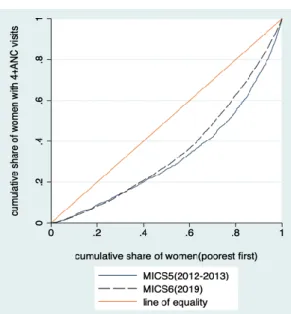
The Concentration index (CCI) and the Concentration curve (CC) were used to present the degree of wealth related to inequity in ANC utilization. The CC plots the cumulative proportion of the variable of interest against the cumulative proportion of individuals ranked from poorest to richest (O'Donnell Owen et al., 2008). If there is perfect equality, the CC will be on the 45° line, running from the bottom left to the top right. In contrast, if the health variable is higher among poorer people, the line lies above the line of
equality. The further the line is above the line of equality, the more concentrated the health outcome is among the poor, and vice-versa. However, the CC does not provide the magnitude of the inequity.
Therefore, we used CCI, which is directly related to CC and quantifies the degree of inequity of the health variable. The indexes range from -1 to 1. If the distribution is pro-rich or pro-poor, the index shows positive or negative values, respectively.
We calculated the proportion of ANC utilization by each of the predictor variables to see the bivariate relationship for each survey year. As the predictors and covariates are all categorical variables, the chi-square test was performed. Information on first ANC visit at less than 4 months gestation was only available in MICS6. Therefore, we used the fixed-effects logistic regression (standard multivariable logistic
regression) to examine factors associated with first ANC visit at less than 4 months gestation. Finally, we used the mixed-effects logistic regression models to examine factors associated with 4+ANC and 8+ANC.
For each logistic regression, in addition to the p-value, confounders and interactions were identified by checking whether or not the coefficient differed more than 10% or not. Weighted adjusted odds ratio
(wAOR) and weighted 95% confidence intervals (weighted 95% CI) were presented as results. All statistical analyses were performed using STATA® version 16 and a p-value < 0.05 was used to indicate statistical significance.
Results
Key characteristics of women
In total, 7,866 women responded to the survey interview in 2012-2013 and 9,285 women in 2019. Table 1 presents the socio-demographic characteristics of the women. The weighted mean age of the women in MICS5 and MICS6 was similar (25.85±5.85 years in MICS5 and 25.98±5.86 years in MICS6). The respective weighted mean age of the husband was 33.36±7.70 years and 33.52 ±7.31 years. The proportion of women with at least one ANC was 67.17% in MICS5, which increased to 82.81% in MICS6. The
weighted mean number of ANC visits with skilled providers in MICS5 was 1.84±2.45times and 2.67 ±2.40 times in MICS6. The majority of women lived in a rural area, both in MICS5 (78.85%) and MICS6
(78.08%). Most of the women had completed their secondary school level education, namely, 49.27% in MICS5 which increased to 60.14% in MICS6.
Progress in reducing inequity in ANC utilization
Figure 1 presents the CC for 4+ANC with skilled providers stratified by the survey year. The CCs of both survey rounds lie below the line of equality, suggesting a disproportionate 4+ANC that benefits the richer group more. The poorest 40% of the women accounted for approximately 20% of at least 4 visits with skilled providers both in MICS5 and MICS6. On the other hand, the poorest 80% of women accounted for approximately 50% of 4+ANC in MICS5 and 60% of 4+ANC in MICS6. The CCI is 0.41 in MICS5 and 0.32 in MICS6, respectively. Both CCIs are statistically significant and positive, but decreased over the course of time, suggesting that the existing inequity is pro-rich, although the level of inequity decreased between the two survey years. The difference between these CCIs (p-value<0.001) is statistically significant.
We further conducted a sub-group analysis (see Figure 2), which shows improvement of the inequity in ANC utilization and the improvement differed in different administrative divisions. In Barisal and Dhaka, inequity improved to a greater extent than in other places. In contrast, in Sylhet the same level of inequity remained as the worst case of all.
Figure 3 presents the CCs for 8+ANC stratified by the survey year. The CCs of both years lie below the line of equality, suggesting the existence of pro-rich inequity. Although the CCs seem different, the CCI of 0.49 in MICS5 and 0.50 in MICS6, and the insignificant p-value in the dominance test suggested that the level of inequity was not different.
Bivariate analyses of ANC visits
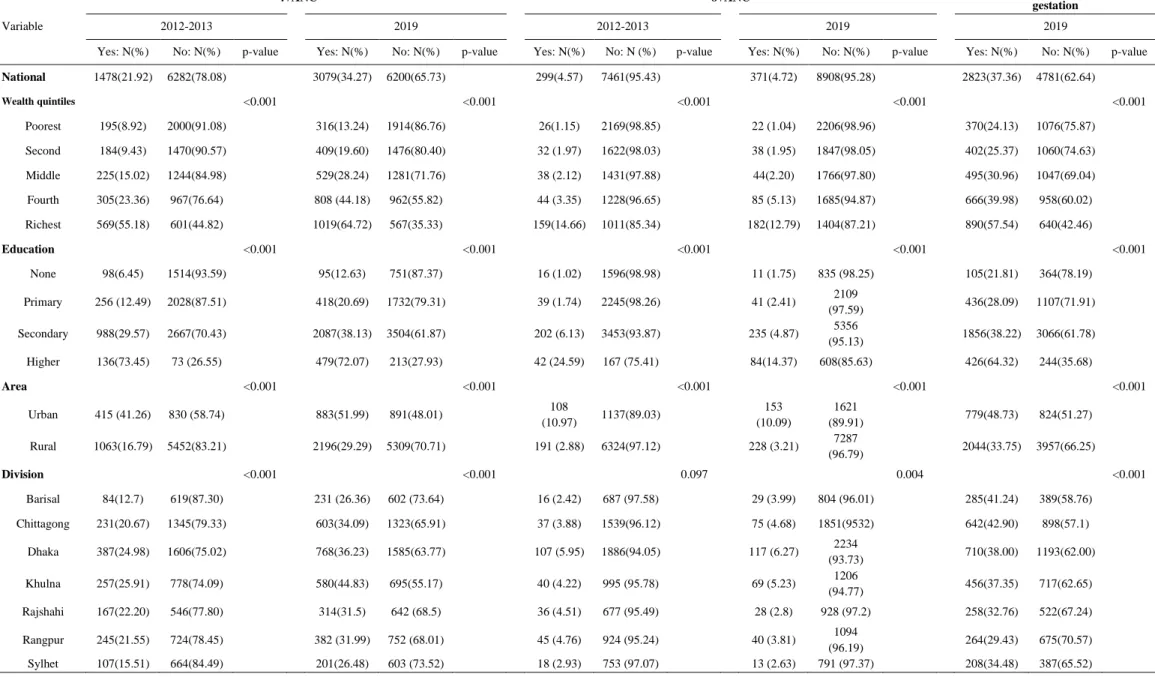
Table 2 shows the bivariate associations between ANC visits with skilled providers and predictors and covariates. The wealth index, the woman’s education, area of living, and administrative division had a significant association with 4+ANC both in the MICS5 and MICS6 survey rounds. The poorest strata of women were less likely to achieve 4+ANC, while approximately 9% of them in MICS5 and 13% in MICS6 actually achieved it. The proportion of women with 4+ANC increased with increasing socioeconomic rank. The education of women showed a positive association with the frequency of ANCs. Women living in rural areas had a lower frequency of ANC visits than women living in urban areas. Among the seven
administrative divisions, more women living in Khulna and Dhaka achieved 4+ANC than their counterparts. Administrative divisions Barisal and Sylhet had the lowest proportion of women with 4+ANC. Overall, the proportion of women achieving 4+ANC increased over the years.
The current WHO recommendation is more than 8 ANC visits; however, the proportion of women with 8+ANC by a skilled provider was very low. The associations between predictors and covariates for 8+ANC showed an almost equivalent trend as for 4+ANC.
The data of ANC visits at less than 4 months gestation was only available in MICS6. Nationally, 37.36% of women had a first ANC by a skilled provider within 4 months of pregnancy. While 24.13% of women initiated the first ANC at this optimal timing in the poorest group, 57.54% of women in the richest group did. The proportion of women who received the first ANC at less than 4 months gestation increased with increasing socioeconomic level. As the level of school education became higher, the proportion of women receiving their first ANC at less than 4 months gestation also increased. At 48.73%, a higher
the seven administrative divisions, Barisal and Chittagong had a higher proportion of women who initiated ANC at less than 4 months gestation of 41.24% and 42.90%, respectively. On the other hand, Rangpur had the lowest proportion of 29.43%.
Factors associated with first ANC utilization at less than 4 months gestation: Multivariable logistic regression
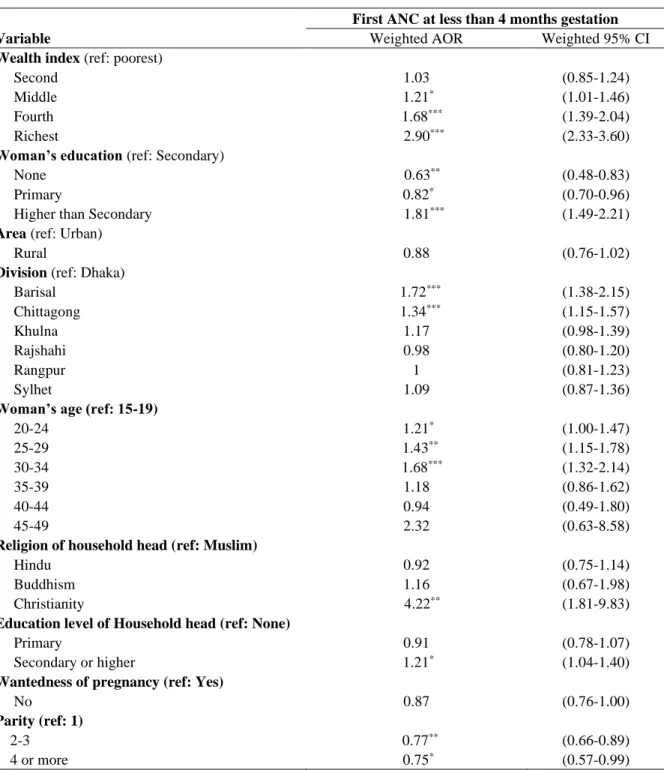
Table 3 shows the results of the fixed-effects multivariable logistic regression analysis that examined the factors associated with first ANC utilization at less than 4 months gestation. Wealth index, woman's education, and administrative division all had a significant association with first ANC at less than 4 months gestation. The list of confounders included the woman’s age, the religion of the household head, education level of the household head, wantedness of the pregnancy and parity. Compared with the poorest quintile, the women in the middle, fourth and richest quintiles had 21% (wAOR: 1.21, 95% CI: 1.01-1.46), 68% (wAOR: 1.68, 95% CI: 1.39-2.04) and 190% higher odds (wAOR: 2.90, 95% CI: 2.33-3.60), respectively, of first ANC at less than 4 months gestation after adjusting for covariates. The higher the order of the wealth quintile, the greater the likelihood of a first ANC visit at the optimal timing. A similar trend was also observed for the education level of the women. Compared with the women who completed secondary education, the women who had not completed school education had 37% lower odds (wAOR:0.63, 95% CI: 0.48-0.83), while those who completed primary education had 18% lower odds (wAOR:0.82, 95% CI: 0.70-0.96) of initiating ANC at less than 4 months gestation. Among the seven administrative divisions, women in Barisal and Chittagong had 72% (wAOR: 1.72, 95% CI: 1.38-2.15) and 34% higher odds (wAOR: 1.34, 95% CI: 1.15-1.57), respectively, of first ANC at less than 4 months gestation.
Factors associated with 4+ANC: Mixed-effects multiple logistic regression
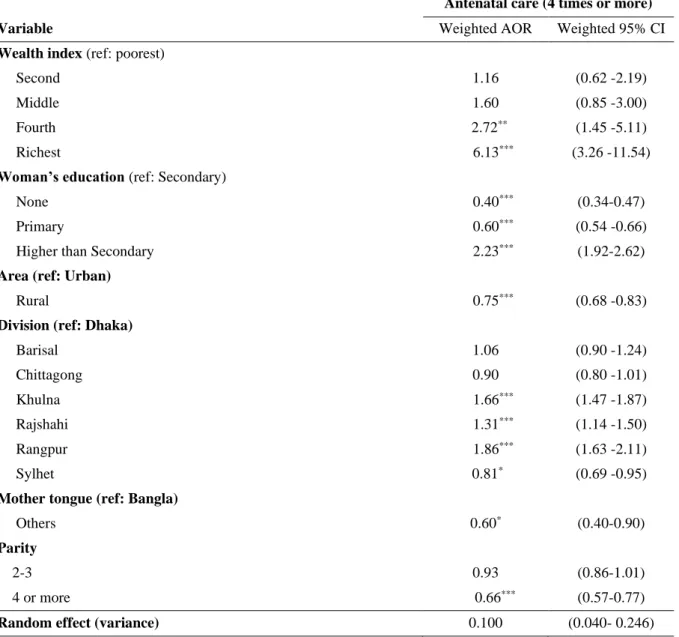
Table 4 shows the results of the mixed-effects logistic regression analysis that examined factors associated with 4+ANC by a skilled provider. The results indicated that wealth index, woman’s education, area of living, and administrative division were strongly associated with 4+ANC. The higher the quintile of
the women, the more likely optimal ANC frequency was. While holding other covariates constant for women from the same round of MICS (2012-2013 or 2019) and the same socioeconomic status (random effect variance: 0.100, 95% CI: 0.040-0.246), the odds of 4+ANC for women in the fourth and fifth (richest) quintiles were 172% (wAOR: 2.72, 95% CI: 1.45-5.11) and 513% (wAOR: 6.13, 95% CI: 3.26-11.54) higher compared to women in the first (poorest) quintile. A similar trend was observed with regard to the woman’s education. The higher the level of the woman’s education, the higher the odds of 4+ANC. Compared with women who completed secondary school education, those who completed higher than secondary education had 123% higher odds (wAOR: 2.23, 95% CI: 1.92-2.62) of 4+ANC. On the other hand, women who had not completed any school education had 60% lower odds (wAOR: 0.40, 95% CI: 0.34-0.47) of 4+ANC. Living in a rural area was also associated with 25% lower likelihood (wAOR:0.75, 95% CI: 0.68-0.83) of 4+ANC.
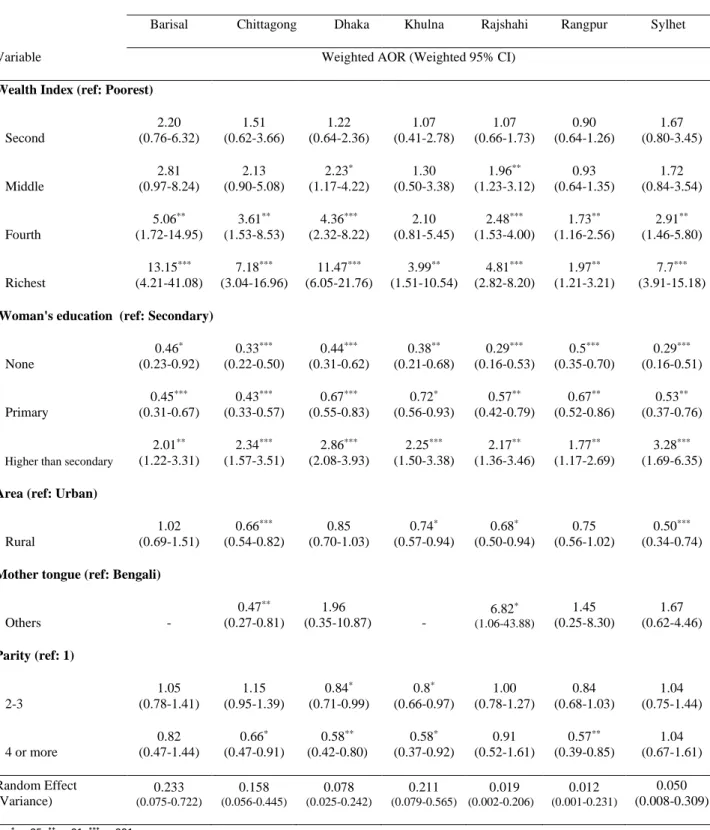
We further assessed the interaction between wealth index and administrative division of this model using sub-group analysis (Table 5). In all administrative divisions, the odds of 4+ANC increased by the level of wealth index and woman’s education. The weighted AOR showed a notably significant difference against wealth index. The richest women in Barisal have 13.15 times (95% CI: 1.21-3.21) higher odds of 4+ANC than the poorest group. Rural/urban difference can be observed in this sub-group analysis, showing that women in Sylhet living in a rural area are 50% less likely (wAOR:0.50, 95% CI: 0.34-0.74) and women in Chittagong living in a rural area are 34% less likely (wAOR:0.66, 95% CI: 0.54-0.82) to achieve 4+ANC.
Factors associated with 8+ANC: Mixed-effects multiple logistic regression
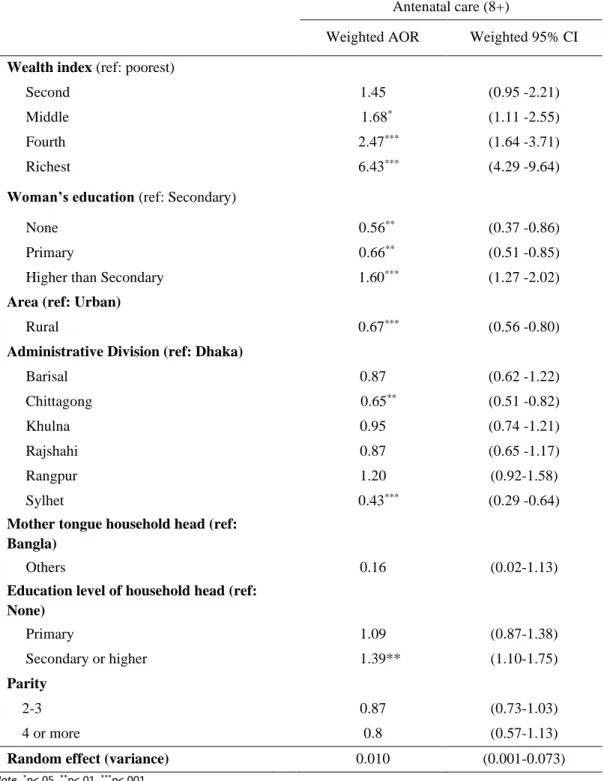
Table 6 presents the factors associated with 8+ANC based on the mixed-effects logistic regression analysis. Like the model based on 4+ANC (Table4), wealth index, woman’s education, area of living, and administrative division were significantly associated with 8+ANC while holding other confounders constant. The mother tongue of the household head, education level of the household head, and parity were identified as confounders as these affected change in predictor’s coefficients more than 10%. The association between wealth index and 8+ANC showed a similar trend as the 4+ANC model. The women in the fourth and fifth (richest) quintiles had 2.47 (95% CI: 1.64-3.71) and 6.43 times (95% CI: 4.29-9.64) higher odds of
achieving 8+ANC, respectively, compared with women in the first (poorest) quintile while holding other covariates constant for women from the same round of MICS (2012-2013 or 2019) and the same
socioeconomic status (random effect variance: 0.010, 95% CI: 0.001-0.073). Women living in a rural area had 33% lower odds of 8+ANC (wAOR: 0.67, 95% CI: 0.56-0.80). Those living in Chittagong and Sylhet had lower odds of 8+ANC [Chittagong (wAOR: 0.65, 95% CI:0.51-0.82) and Sylhet (wAOR: 0.43, 95% CI: 0.29-0.64)]. Among the covariates, the odds of 8+ANC by women whose household’s head had completed secondary or higher education were increased by 39% (wAOR:1.39, 95% CI: 1.10-1.75) compared with a non-educated household head.
Discussion
ANC is an indirect contributor to reducing maternal mortality by identifying risks, providing education for well-being, and linking women to delivery with professional attendance. Bangladesh has dramatically reduced maternal mortality over the decades; however, it is not likely to achieve the SDGs target by 2030. This study was conducted to assess the progress in reducing the inequity in ANC utilization, and examine the factors associated with ANC use for further improvement. Our findings suggested that there is improvement in 4+ANC inequity. Wealth index, woman’s education, area of living and administrative division were the main predictors of 4+ANC and 8+ANC.
Socioeconomic inequity in ANC utilization
Inequity in the use of health care is a key constraint of maternal health outcomes. Several studies previously explored the status of inequity in ANC use in Bangladesh (Iqbal et al., 2015; Pulok et al., 2016; Pulok et al., 2018; Rahman et al., 2018). Our study demonstrated improvement of 4+ANC inequity in
MICS6 compared to MICS5. Yet, considerable pro-rich inequity still existed in MICS6. The poor population is less likely to receive optimal frequency of ANC. Rahman et al. (2018) assessed the inequities in essential health service coverage in Bangladesh and reported that 4+ANC was one of the least equitable indicators.
They considered lack of awareness, unavailability of specific services, and high out-of-pocket payment as the main barriers to proper maternal health.
The difference in the improvement of CCI among administrative divisions implies that every
administrative division may have a specific remedy that would work well. Sylhet is one of the administrative divisions that have disadvantaged geographical areas to which the lower healthcare utilization and adverse health outcomes are attributed. The effective intervention here may be different from that in other
administrative divisions. Byrne et al. (2014) identified strategies to reduce barriers to reproductive health in hard-to-reach areas from eleven countries. Maximizing the use of community health workers, improving the facilities to provide quality performance, utilizing community input for appropriate health services across generations and cultures, as well as knowledge- and awareness-raising interventions are identified as effective measures. Like Sylhet, in administrative divisions that include disadvantaged areas, maximal use of community capacity should be taken into consideration.
In comparison, inequity with regard to 8+ANC showed a pro-rich phenomenon but the CCIs showed that the inequity level of the two survey years were not significantly different. The reason could be that the government policies and programs had not yet adopted the new WHO recommendation (8+ANC) in Bangladesh. The proportion of women who achieved 8+ANC did not improve over the two survey cycles: 4.57% in MICS5 and 4.72% in MICS6. As a result, the 8+ANC situation has not changed from 2012-2013 to 2019. The research by Islam and Masud (2018) assessed the extent of compliance with the WHO
recommendation using the 2014 DHS data. They concluded that Bangladesh was very far from achieving universal coverage of the newly recommended ANC. Our data also implies that there is still a long way to go to achieve 8+ANC in Bangladesh. Jiwani et al. (2020) stated in their systematic review that achieving the 8+ANC target would be too challenging to establish policies and programs that address service demands and reinforce the health systems if the 4+ANC level is lower than 75%. Therefore countries might be hesitant to adopt a new recommendation. No studies have yet reported the effective implementation of 8+ANC in lower- and middle- income countries (LMICs). If Bangladesh introduces the new recommendation, health service availability, such as health facilities and health professionals that accommodate such increase in the
number of women in each division, and a health system that reduces the financial burden on women are expected to be specifically reinforced.
Factors associated with ANC utilization
Our study showed that wealth index and woman’s education were significantly associated with all three outcomes of ANC utilization (first ANC at less than 4 months gestation, 4+ANC and 8+ANC).
Early initiation of ANC is very important to receive the recommended ANC schedule. Findings by Jiwani et al. (2020) showed a strong and independent effect of ANC initiation on the number of ANC contacts. In our study, 37% of women had the first ANC at less than 4 months gestation, and 80% of these women ended up with 8+ANC. This result implied that optimal timing of ANC initiation may be a driving force behind 8+ANC. However, it was not possible to examine this association in the mixed-effect model due to the lack of information on the relevant variable in MICS5. Due to the survey design of Bangladesh MICS, it was also not clear whether the 8+ANC followed the schedule recommended by WHO. Concerning the factors associated with first ANC at less than 4 months gestation, wealth index and woman’s education were the two important factors associated with optimal timing of ANC initiation. Saad-Haddad Ghada et al. (2016) also observed that women from poorer households are less likely to start seeking ANC among those who sought it and that women’s choice of healthcare services is related to the out-of-pocket payment. This study also reported that women’s education enabled them to be autonomous and knowledgeable about healthcare.
We observed another interesting finding that had not been reported in any published studies. Our result showed that the first ANC utilization differed by different administrative division. Women residing in Barisal and Chittagong administrative divisions had significantly higher odds of initiating ANC at the optimal timing compared with Dhaka. We are unable to explain this trend using the findings of this study. Further studies are needed to examine the reasons for this trend.
A significant association was found between wealth index and 4+ANC. This is consistent with the results of previous similar studies (Ali et al., 2018; Bhowmik et al., 2019; Pulok et al., 2016). Together,
these studies implied that poorer women are less likely to achieve 4+ANC. The sub-group analysis
stratified by administrative divisions showed that the biggest gap of ANC use among wealth quintiles was observed in Barisal and Dhaka. This implies the programs targeting poor populations should be particularly strengthened in those administrative divisions. In Bangladesh, several programs are being conducted by the government along with many non-government organizations (NGOs), such as Urban Primary Health Care Project (UPHCP), Demand Side Financing of Maternal Health Voucher Scheme project (DSF-MHVS) and Maternity Allowance (MA), that target poor women of reproductive age. These programs are reportedly contributing to enhance maternal health care utilization among the poor (Albis et al., 2019; Jetha, 2014; Mahmood et al., 2019). It was also noted that these pro-poor and women-focused programs have contributed to health gains (Alayne et al., 2013). The WHO stated in the Bangladesh Health System Review that 64% of the national health account came from out-of-pocket payments (Masud et al., 2015). Concerning maternal health, in the rural areas of Bangladesh, individual out-of-pocket payment for antenatal care of US$3.6 in the public sector and US$ 12.40 in the private sector has been reported (Rahman et al., 2012). This payment burden discourages poorer women from attending regular recommended ANC unless they experience any physical problems. The DSF-MHVS was designed to provide maternal health service vouchers for poor women who fulfilled its criteria. Several studies showed that this measure has improved maternal health access (Das, 2015; Khan & Khan, 2016; Mahmood et al., 2019). Yet, it is estimated to cover only
approximately 3% of all pregnancies (Khan & Khan, 2016). In terms of ANC coverage by the DSF-MHVS, three ANC visits are covered by this scheme. It clearly does not cover all the recommended ANC visits of poor populations in need. It was also reported that DSF-MHVS should show considerable overlap with MA in terms of covered beneficiaries as well as mistargeted beneficiaries (Khan & Khan, 2016). Although Bangladesh’s success with health outcomes may be attributed to a pluralistic health system with many stakeholders including government and NGOs (Chowdhury et al., 2013), this complicated health system may have caused some service coverage gaps and overlaps. To further increase ANC utilization, this financial burden on the poor population should be minimized by reforming the current programs and expanding the areas of implementation.
The education level of women is an important determinant of maternal and child health (Cleland et al., 1989) as it has an effect on self decision-making and healthcare-seeking behavior. Although Bangladesh has
been on track removing gender disparity in educational access, our results showed that half of the women in MICS5 and nearly 40% of women in MICS6 were still either uneducated, or had completed only primary level education. The current study also showed that women without any school education had 60% lower odds of achieving 4+ANC, whereas women with primary level education had 40% lower odds compared with women who had completed secondary level education. These findings suggested that higher ANC utilization might be achieved if secondary level education can be provided to all. Bangladesh has
implemented several programs, (e.g. Food for Education Program and Female Stipend Program) to increase female school enrollment. As a result, female school enrollment has increased over the last decades. A further increase in the number of women who complete secondary level education is expected in the future. However, geographical inequities regarding female education continue to exist with an extremely low rate of access in remote areas and a higher dropout rate in urban slums (Alayne et al., 2013). In Bangladesh,
religious groups take a pivotal role in the education system (Roy et al., 2020). Thus, in addition to the programs implemented by the government, it will be helpful to reinforce collaboration with religious leaders to ensure education in disadvantaged areas.
The current results also suggested regional variations. The odds of achieving 4+ANC among women by administrative division was reduced by 19% in Sylhet and 10% in Chittagong compared with Dhaka as the reference group. On the other hand, Khulna, Rajshahi and Rangpur divisions have higher odds of achieving 4+ANC, that is, 66%, 31% and 86% increase, respectively, compared with Dhaka. Sylhet division, as previously mentioned, is one of the administrative divisions that has low maternal healthcare utilization associated with adverse maternal health outcomes. Due to its geographical situation characterized by submerged land that is under water for 6 months of the year, health remains practically inaccessible in this region. The study of Haque et al. (2016) reported that the women in this area only seek ANC when they face a particular problem in their pregnancy. Low education level, lack of awareness and poor
socioeconomic condition are determining factors of healthcare-seeking behavior in this area. Chittagong administrative division also had lower odds of achieving 4+ANC although it was not of statistical
significance. While Chittagong is a major city in southeastern Bangladesh, it has adverse hilly areas where a number of tribes live. Sarker et al. (2016) identified in their qualitative study that traditional views, religious fallacy, geographical access and transportation to health facilities were the main factors involved in the use
of Traditional Birth Attendants (TBA). This may indicate a preference for not using health facilities
resulting in non-professional ANC utilization. However, in our study, ethnicity was not a significant factor, and geographical access and transportation rather served as potential keys in these administrative divisions.
Living in a rural area is negatively associated with ANC utilization. Other previous studies also reported that women in rural areas were less likely to receive maternal health services (Ali et al., 2018; Islam & Masud, 2018; Mehata et al., 2017; Noh et al., 2019). Compared with women living in urban areas, women living in rural areas have less access due to limited number and quality of healthcare services and available professionals, as well as lack of transportation. The socioeconomic status of an individual also tends to be lower in rural areas (Ali et al., 2018; Islam & Masud, 2018). In rural areas of several
administrative divisions it is even less likely to achieve an optimal number of ANC visits. The region-stratified sub-group analysis presents the rural area of Sylhet as the least likely to achieve 4+ANC. Our results of a mixed-effect model in addition to the concentration indices suggest that the rural area of Sylhet should be the key prioritized area for further intervention.
Among all confounders, parity has a significantly negative association with ANC utilization. The more children a woman has, the less likely she is to seek ANC. This has been explained by the financial burden, the experience of the ANC service, and the perception of pregnancy (Islam & Masud, 2018; Jiwani et al., 2020). The current DSF criteria exclude more than three pregnancies, and a second pregnancy without family planning. Since it is known that the risk of maternal death is the highest with parity of 4 or higher in Bangladesh (National Institute of Population Research and Training, (NIPORT) et al., 2019), it is also important to ensure safe motherhood of a pregnant multipara while reinforcing family planning for households with multiple children.
We observed almost similar correlates for 8+ANC and 4+ANC. It implies that the direction of the programs may be similar to improve 8+ANC statistics. However, it is not so easy for the country to just set the higher goal according to the WHO recommendation. Jiwani et al. (2020) pointed out that countries with 75% or lower achievement of 4+ANC would find achievement of 8+ANC so overwhelming that they would rather not address the issue at all. Our study also shows very low achievement of 4+ANC in Bangladesh.
Given the limited resources of the country, 4+ANC should be the priority goal to be addressed before jumping to achieve the 8+ANC goal.
Promoting 8+ANC is a recent concept considered to improve maternal health as mentioned above. However, it is not easy to achieve in the short term. If 8+ANC would simply be adopted in Bangladesh, the intervention target would range from the poorest to the richest members of the population based on the very low rate of 8+ANC among the entire population. It might end up resulting in deterioration of the inequity in ANC utilization. Countries that have a very low rate of ANC utilization like Bangladesh need to formulate a policy by prioritizing the target. There have been no studies, to our best knowledge, that assessed these three components (first ANC at less than 4 months gestation, 4+ANC, and 8+ANC) and ranked effectiveness on the outcome of ANC utilization. Given that the timeliness of the first ANC visit opens the door for frequent ANC use, the combination of promoting first ANC at less than 4 months gestation and 4+ANC would be the best strategy for a country with slow progress of ANC utilization.
This study analyzed the latest available dataset and compared the ANC utilization situation over the period of the two surveys. Our findings showed improvement in 4+ANC and reduction of inequity in utilization among socioeconomic groups over the period of the two surveys. However, a considerable level of inequity still exists in 4+ANC. Wealth index and women’s education, area of living, and administrative division were the strong predictors of 4+ANC. In terms of 8+ANC, the government of Bangladesh has not introduced this concept yet. Therefore, the proportion of women with 8+ANC was very small, and the level of inequity did not show any improvement between the two surveys. The SDGs slogan is “No one is left behind,” but there is still a long way to go, not only for 8+ANC but to first achieve 4+ANC for all pregnant women in all regions of Bangladesh. Some policies and programs have been implemented to improve inequity and access to maternal health services; however, more programs tailored specifically to the vulnerable population should be developed.
Limitations
This study is based on a large-scale population survey that can serve as a national representative. Therefore, these findings are generalizable to the national level. To the best of our knowledge, this is the
first study that analyzed the most recent available dataset. The results of this study imply the potential for further improvement in maternal healthcare in Bangladesh.
Nevertheless, this study also has some limitations. Based on the nature of the questionnaire-based cross-sectional study, recall bias and reporting bias may affect the result. However, recall bias may be minimized because the survey only concerned the most recent delivery within the previous 2 years. The reporting bias may be minimized by advance training of interviewers. It is also important to assure the quality of ANC, but since it could not be measured under this survey design, the focus was limited to the ANC frequency. It may also not be possible to confirm the temporal order of the relationship between predictors and outcomes, given the nature of a cross-sectional study. By nature, the secondary data analysis design also precluded the availability of some variables such as the status of the slum population, the woman’s work status, and her autonomy in the household. Since this survey did not specify the attendant at each ANC visit, ANC performed by skilled professionals may be overestimated.
Conclusion
Improving the utilization of ANC and addressing its inequity is crucial to further reduce maternal mortality in the future. Our findings showed that Bangladesh still has a long way to go to achieve the current WHO recommendation. This study also highlights the importance of addressing 4+ANC first through
expanded and tailored programs for all socioeconomically vulnerable populations, while intervention in the rural area of Sylhet should be prioritized. To tackle the goal of 8+ANC in the future, enormous improvement in health service coverage and the health service system is necessary. By reviewing the health services and strengthening the health system in Bangladesh, it will be possible to achieve the goal of 8+ANC in the future.
References
Alayne, M. A., Atonu, R., Shamim, A., Shaila, M., Ahmed, A., Sabina F, R., & Timothy G, E. (2013). Explaining equity gains in child survival in Bangladesh: Scale, speed, and selectivity in health and
development. www.Thelancet.Com, 382(1681), 2027-2037.
Albis, M. L. F., Bhadra, S. K., & Chin, B. (2019). Impact evaluation of contracting primary health care services in urban Bangladesh. BMC Health Services Research, 19(1), 854. 10.1186/s12913-019-4406-5
Anwar, I., Nababan, H. Y., Mostari, S., Rahman, A., & Khan, J. A. M. (2015). Trends and inequities in use of maternal health care services in Bangladesh, 1991-2011. PloS One, 10(3), e0120309.
doi:10.1371/journal.pone.0120309
Arcaya, M. C., Arcaya, A. L., & Subramanian, S. V. (2015). Inequalities in health: definitions, concepts, and theories. Global health action, 8, 27106. https://doi.org/10.3402/gha.v8.27106
Bangladesh Bureau of Statistics. SDG Tracker Bangladesh's Development
Mirror . https://www.sdg.gov.bd/#1. https://www.sdg.gov.bd/page/indicator-wise/1/28/2/0#1
Bangladesh Bureau of Statistics, & United Nations Children's Fund. (2015). Progotir Pathey Final Report. Dhaka: www.unicef.org.bd.
Bangladesh Bureau of Statistics, & United Nations Children's Fund. (2019). Progotir Pathey Bangladesh Survey Finding Report. Dhaka: http://catalog.crl.edu/record=b2025807
Chowdhury R., M. A., Bhuiya, A., Chowdhury, M. E., Rasheed, S., Hussain, Z., & Chen, L. C. (2013). The
Bangladesh paradox: exceptional health achievement despite economic poverty
Cleland, J., & Van Ginneken, J. (1989). Maternal schooling and childhood mortality. Journal of Biosocial Science, 21 (S10), 13-34. Doi
El-Saharty, S., Sparkes, S. P., Barroy, H., Karar, Z. A., & Syed Masud, A. (2015). The Path to Universal Health
Filmer, D., & Pritchett, L. (2001). Estimating Wealth Effects without Expenditure Data-or Tears: An
Application to Educational Enrollments in States of India. Demography,38(1), 115-132. Retrieved January 14, 2021, from http://www.jstor.org/stable/3088292
Finlayson, K., & Downe, S. (2013). Why Do Women Not Use Antenatal Services in Low- and Middle-Income Countries? A Meta-Synthesis of Qualitative Studies. PLoS Medicine, 10(1), e1001373.
10.1371/journal.pmed.1001373
Government of the People's Republic of Bangladesh. (2019). Progotir Pathey Bangladesh. Dhaka: Bangladesh Bureau of Statistics, Ministry of Planning, Govt. of the People's Republic of Bangladesh with assistance from
UNICEF. http://catalog.crl.edu/record=b2025807
Haque, M. A., Dash, S. K., & Chowdhury, M. A. B. (2016). Maternal health care seeking behavior: The case of haor (wetland) in Bangladesh. BMC Public Health, 16(1), 592. doi:10.1186/s12889-016-3296-2
Islam, M. M., & Masud, M. S. (2018). Determinants of frequency and contents of antenatal care visits in Bangladesh: Assessing the extent of compliance with the WHO recommendations. PloS One, 13(9), e0204752.
doi:10.1371/journal.pone.0204752
Iqbal, A., Herfina Y, N., Shabnam, M., Aminur, R., & Jahangir, A. M. K. (2015). Trends and inequities in use of maternal health care services in Bangladesh, 1991-2011. PloS One, 10(3), e0120309.
doi:10.1371/journal.pone.0120309
Jahan R. (2007). Securing maternal health through comprehensive reproductive health services: lessons from
Bangladesh. American Journal of Public Health, 97(7), 1186–1190. https://doi.org/10.2105/AJPH.2005.081737
Jetha, Q. (2014). Cash Transfers to Promote Safe Motherhood: Evidence from Bangladesh’s Maternity Allowance
Program
Jiwani, S. S., Amouzou-Aguirre, A., Carvajal, L., Chou, D., Keita, Y., Moran, A. C., . . . Boerma, T. (2020). Timing and number of antenatal care contacts in low- and middle-income countries: Analysis in the countdown to 2030 priority countries. Journal of Global Health, 10(1) doi:10.7189/jogh.10.010502
Khan M., M., & Khan, M. A. R. (2016). Report on the Diagnostic Study of Demand Side Financing-Maternal Health
Khan, M. M. H., Krämer, A., Khandoker, A., Prüfer-Krämer, L., & Islam, A. (2011). Trends in
sociodemographic and health-related indicators in Bangladesh, 1993–2007: will inequities persist?
Mahmood, S. S., Amos, M., Hoque, S., Mia, M. N., Chowdhury, A. H., Hanifi, S. M. A., Iqbal, M., Stones, W., Pallikadavath, S., & Bhuiya, A. (2019). Does healthcare voucher provision improve utilisation in the continuum of maternal care for poor pregnant women? Experience from Bangladesh. Global Health Action, 12(1),
1701324. 10.1080/16549716.2019.1701324
Michael Marmot, Jessica Allen, Ruth Bell, Ellen Bloomer, & Peter Goldblatt. (2012). WHO European review of social determinants of health and the health divide. The Lancet (British Edition), 380(9846), 1011.
10.1016/S0140-6736(12)61228-8;10.1016/S0140-6736(12)61520-7;10.1016/S0140-6736(12)61521-9;10.1016/S0140-6736(12)61481-0
Mehata, S., Paudel, Y. R., Dariang, M., Aryal, K. K., Lal, B. K., Khanal, M. N., & Thomas, D. (2017). Trends and Inequalities in Use of Maternal Health Care Services in Nepal: Strategy in the Search for
Improvements. BioMed Research International, 2017, 5079234-11. 10.1155/2017/5079234
National Institute of Population Research and Training, (NIPORT), International Center for Diarrhea Disease Research, Bangladesh (icddr,b), & MEASURE evaluation. (2019). Bangladesh Maternal Mortality and Health Care Survey 2016: Final Report. Dhaka, Bangladesh Chapel Hill, NC, USA
Government of People's Republic Bangladesh Ministry of Health and Family Welfare.Health Bulletin 2018.
Noh, J., Kim, Y., Lee, L. J., Akram, N., Shahid, F., Kwon, Y. D., & Stekelenburg, J. (2019). Factors associated with the use of antenatal care in Sindh province, Pakistan: A population-based study. PloS One, 14(4), e0213987. 10.1371/journal.pone.0213987
O'Donnell Owen, Doorslaer V, E., Wagstaff, A., & Lindelow, M. (2008). Analyzing Health Equity Using Household Survey Data: a guide to techniques and their implementation. World Bank.
Paudel, Y. R., Jha, T., & Mehata, S. (2017). Timing of first antenatal care (ANC) and inequalities in early initiation of ANC in Nepal.Frontiers in Public Health, 5, 242. doi:10.3389/fpubh.2017.00242
Pulok, M. H., Sabah, M. N., Uddin, J., & Enemark, U. (2016). Progress in the utilization of antenatal and delivery care services in Bangladesh: where does the equity gap lie? BMC Pregnancy and Childbirth, 16(1), 200. 10.1186/s12884-016-0970-4
Pulok, M. H., Uddin, J., Enemark, U., & Hossin, M. Z. (2018). Socioeconomic inequality in maternal healthcare: An analysis of regional variation in Bangladesh. Health & Place, 52, 205-214.
doi:10.1016/j.healthplace.2018.06.004
Rahman, M., Rob, U., Noor, F. R., & Bellows, B. (2012). Out-of-pocket expenses for maternity care in rural
Bangladesh: a public-private comparison. International Quarterly of Community Health Education, 33(2), 143– 157. https://doi.org/10.2190/IQ.33.2.d
Rahman, M. M., Rahman, M. M., Tareque, M. I., Ferdos, J., & Jesmin, S. S. (2016). Maternal pregnancy intention and professional antenatal care utilization in Bangladesh: A nationwide population-based survey. Plos One, 11(6) doi:10.1371/journal.pone.0157760
Rahman, M. S., Rahman, M. M., Gilmour, S., Swe, K. T., Abe, S. K., & Shibuya, K. (2018). Trends in, and projections of, indicators of universal health coverage in Bangladesh, 1995–2030: a Bayesian analysis of population-based household data. The Lancet Global Health, 6(1), e84-e94. 10.1016/S2214-109X(17)30413-8
Roy, S., Rob, A. B. A. & Huq, S. (2020). Faith and Education In Bangladesh: A Review of the Contemporary
Landscape and Challenges. https://search.datacite.org/works/10.13140/rg.2.2.34208.20485
Saad-Haddad, G., DeJong, J., Terreri, N., Restrepo–Méndez, M. C., Perin, J., Vaz, L., Newby, H., Amouzou, A., JD Barros, A., & Bryce, J. (2016). Patterns and determinants of antenatal care utilization: analysis of national survey data in seven countdown countries. Journal of Global Health, 6(1)10.7189/jogh.06.010404
Sahito, A., & Fatmi, Z. (2018). Inequities in Antenatal Care, and Individual and Environmental Determinants of Utilization at National and Sub-national Level in Pakistan: A Multilevel Analysis. International Journal of
Health Policy and Management, 7(8), 699-710. 10.15171/ijhpm.2017.148
Sarker, B. K., Rahman, M., Rahman, T., Hossain, J., Reichenbach, L., & Mitra, D. K. (2016). Reasons for Preference of Home Delivery with Traditional Birth Attendants (TBAs) in Rural Bangladesh: A Qualitative
Syed Masud, A., Bushra. B, A., Iqbal, A., Begum, T., Tuque, R., Khan. A.M., J., Nababan, H., & Osman A, F. (2015). Bangladesh health system review. Manila
SDG Tracker Bangladesh’s Government Mirror. : Retrieved December 26, 2020, from
https://www.sdg.gov.bd/page/indicator-wise/1/28/2/0#1
Thaddeus, S., & Maine, D. (1994). Too far to walk: maternal mortality in context. Social Science & Medicine
(1982), 38(8), 1091–1110. https://doi.org/10.1016/0277-9536(94)90226-7
United Nations International Children's Emergency Fund. Antenatal Care . https://data.unicef.org/topic/maternal-health/antenatal-care/
Watterson, J. L., Walsh, J., & Madeka, I. (2015). Using mHealth to improve usage of antenatal care, postnatal care, and immunization: A systematic review of the literature. BioMed Research International, 2015, 1-9.
doi:10.1155/2015/153402
World Health Organization. (2002). WHO Antenatal Care Randomized Trial: Manual for the implementation of the New Model
World Health Organization. (2016). WHO recommendations on antenatal care for a positive pregnancy experience. ().
WHO, UNFPA, UNICEF, World Bank Group, & The United Nations Population Division. (2019). Trends in
Maternal Mortality 2000-2017 Washington, DC: Retrieved from
Appendices
Table 1 Socio-demographic characteristics of women
Variable MICS5 (2012-2013) MICS6 (2019)
Weighted Mean (Weighted SD) Weighted Mean (Weighted SD)
Age of woman (years) 25.85(5.85) 25.98 (5.86)
Age of husband (years) 33.36(7.70) 33.52 (7.31)
Number of children ever born 2.29(1.44) 2.15 (1.20)
Times received ANC at the latest pregnancy 1.84(2.45) 2.67 (2.40)
n (%) n (%) Received ANC Yes 5070 (67.17) 7607 (82.81) No 2730 (32.83) 1677 (17.19) Place of residence Urban 1280 (21.15) 1774 (21.92) Rural 6586 (78.85) 7511 (78.08) Completed education None 1628 (18.36) 846 (9.17) Primary 2317 (28.77) 2151 (23.24) Secondary 3707 (49.27) 5596 (60.14) Higher 214 (3.60) 692 (7.45)
Table 2 Bivariate relationships with ANC utilization
4+ANC 8+ANC First visit at less than 4 months
gestation
Variable 2012-2013 2019 2012-2013 2019 2019
Yes: N(%) No: N(%) p-value Yes: N(%) No: N(%) p-value Yes: N(%) No: N (%) p-value Yes: N(%) No: N(%) p-value Yes: N(%) No: N(%) p-value
National 1478(21.92) 6282(78.08) 3079(34.27) 6200(65.73) 299(4.57) 7461(95.43) 371(4.72) 8908(95.28) 2823(37.36) 4781(62.64) Wealth quintiles <0.001 <0.001 <0.001 <0.001 <0.001 Poorest 195(8.92) 2000(91.08) 316(13.24) 1914(86.76) 26(1.15) 2169(98.85) 22 (1.04) 2206(98.96) 370(24.13) 1076(75.87) Second 184(9.43) 1470(90.57) 409(19.60) 1476(80.40) 32 (1.97) 1622(98.03) 38 (1.95) 1847(98.05) 402(25.37) 1060(74.63) Middle 225(15.02) 1244(84.98) 529(28.24) 1281(71.76) 38 (2.12) 1431(97.88) 44(2.20) 1766(97.80) 495(30.96) 1047(69.04) Fourth 305(23.36) 967(76.64) 808 (44.18) 962(55.82) 44 (3.35) 1228(96.65) 85 (5.13) 1685(94.87) 666(39.98) 958(60.02) Richest 569(55.18) 601(44.82) 1019(64.72) 567(35.33) 159(14.66) 1011(85.34) 182(12.79) 1404(87.21) 890(57.54) 640(42.46) Education <0.001 <0.001 <0.001 <0.001 <0.001 None 98(6.45) 1514(93.59) 95(12.63) 751(87.37) 16 (1.02) 1596(98.98) 11 (1.75) 835 (98.25) 105(21.81) 364(78.19) Primary 256 (12.49) 2028(87.51) 418(20.69) 1732(79.31) 39 (1.74) 2245(98.26) 41 (2.41) 2109 (97.59) 436(28.09) 1107(71.91) Secondary 988(29.57) 2667(70.43) 2087(38.13) 3504(61.87) 202 (6.13) 3453(93.87) 235 (4.87) 5356 (95.13) 1856(38.22) 3066(61.78) Higher 136(73.45) 73 (26.55) 479(72.07) 213(27.93) 42 (24.59) 167 (75.41) 84(14.37) 608(85.63) 426(64.32) 244(35.68) Area <0.001 <0.001 <0.001 <0.001 <0.001 Urban 415 (41.26) 830 (58.74) 883(51.99) 891(48.01) 108 (10.97) 1137(89.03) 153 (10.09) 1621 (89.91) 779(48.73) 824(51.27) Rural 1063(16.79) 5452(83.21) 2196(29.29) 5309(70.71) 191 (2.88) 6324(97.12) 228 (3.21) 7287 (96.79) 2044(33.75) 3957(66.25) Division <0.001 <0.001 0.097 0.004 <0.001 Barisal 84(12.7) 619(87.30) 231 (26.36) 602 (73.64) 16 (2.42) 687 (97.58) 29 (3.99) 804 (96.01) 285(41.24) 389(58.76) Chittagong 231(20.67) 1345(79.33) 603(34.09) 1323(65.91) 37 (3.88) 1539(96.12) 75 (4.68) 1851(9532) 642(42.90) 898(57.1) Dhaka 387(24.98) 1606(75.02) 768(36.23) 1585(63.77) 107 (5.95) 1886(94.05) 117 (6.27) 2234 (93.73) 710(38.00) 1193(62.00) Khulna 257(25.91) 778(74.09) 580(44.83) 695(55.17) 40 (4.22) 995 (95.78) 69 (5.23) 1206 (94.77) 456(37.35) 717(62.65) Rajshahi 167(22.20) 546(77.80) 314(31.5) 642 (68.5) 36 (4.51) 677 (95.49) 28 (2.8) 928 (97.2) 258(32.76) 522(67.24) Rangpur 245(21.55) 724(78.45) 382 (31.99) 752 (68.01) 45 (4.76) 924 (95.24) 40 (3.81) 1094 (96.19) 264(29.43) 675(70.57) Sylhet 107(15.51) 664(84.49) 201(26.48) 603 (73.52) 18 (2.93) 753 (97.07) 13 (2.63) 791 (97.37) 208(34.48) 387(65.52)
Table 3 Multivariable Logistic Regression of First ANC at Less Than 4 Months Gestation
First ANC at less than 4 months gestation
Variable Weighted AOR Weighted 95% CI
Wealth index (ref: poorest)
Second 1.03 (0.85-1.24)
Middle 1.21* (1.01-1.46)
Fourth 1.68*** (1.39-2.04)
Richest 2.90*** (2.33-3.60)
Woman’s education (ref: Secondary)
None 0.63** (0.48-0.83)
Primary 0.82* (0.70-0.96)
Higher than Secondary 1.81*** (1.49-2.21)
Area (ref: Urban)
Rural 0.88 (0.76-1.02)
Division (ref: Dhaka)
Barisal 1.72*** (1.38-2.15) Chittagong 1.34*** (1.15-1.57) Khulna 1.17 (0.98-1.39) Rajshahi 0.98 (0.80-1.20) Rangpur 1 (0.81-1.23) Sylhet 1.09 (0.87-1.36)
Woman’s age (ref: 15-19)
20-24 1.21* (1.00-1.47) 25-29 1.43** (1.15-1.78) 30-34 1.68*** (1.32-2.14) 35-39 1.18 (0.86-1.62) 40-44 0.94 (0.49-1.80) 45-49 2.32 (0.63-8.58)
Religion of household head (ref: Muslim)
Hindu 0.92 (0.75-1.14)
Buddhism 1.16 (0.67-1.98)
Christianity 4.22** (1.81-9.83)
Education level of Household head (ref: None)
Primary 0.91 (0.78-1.07)
Secondary or higher 1.21* (1.04-1.40)
Wantedness of pregnancy (ref: Yes)
No 0.87 (0.76-1.00)
Parity (ref: 1)
2-3 0.77** (0.66-0.89)
4 or more 0.75* (0.57-0.99)
Table 4 Mixed-effects Logistic Regression of 4+ANC use
Antenatal care (4 times or more)
Variable Weighted AOR Weighted 95% CI
Wealth index (ref: poorest)
Second 1.16 (0.62 -2.19)
Middle 1.60 (0.85 -3.00)
Fourth 2.72** (1.45 -5.11)
Richest 6.13*** (3.26 -11.54)
Woman’s education (ref: Secondary)
None 0.40*** (0.34-0.47)
Primary 0.60*** (0.54 -0.66)
Higher than Secondary 2.23*** (1.92-2.62)
Area (ref: Urban)
Rural 0.75*** (0.68 -0.83)
Division (ref: Dhaka)
Barisal 1.06 (0.90 -1.24) Chittagong 0.90 (0.80 -1.01) Khulna 1.66*** (1.47 -1.87) Rajshahi 1.31*** (1.14 -1.50) Rangpur 1.86*** (1.63 -2.11) Sylhet 0.81* (0.69 -0.95)
Mother tongue (ref: Bangla)
Others 0.60* (0.40-0.90)
Parity
2-3 0.93 (0.86-1.01)
4 or more 0.66*** (0.57-0.77)
Random effect (variance) 0.100 (0.040- 0.246)
Table 5 Sub-group analysis of 4+ANC model stratified by administrative division
Antenatal care (4+)
Barisal Chittagong Dhaka Khulna Rajshahi Rangpur Sylhet
Variable Weighted AOR (Weighted 95% CI)
Wealth Index (ref: Poorest)
Second 2.20 (0.76-6.32) 1.51 (0.62-3.66) 1.22 (0.64-2.36) 1.07 (0.41-2.78) 1.07 (0.66-1.73) 0.90 (0.64-1.26) 1.67 (0.80-3.45) Middle 2.81 (0.97-8.24) 2.13 (0.90-5.08) 2.23* (1.17-4.22) 1.30 (0.50-3.38) 1.96** (1.23-3.12) 0.93 (0.64-1.35) 1.72 (0.84-3.54) Fourth 5.06** (1.72-14.95) 3.61** (1.53-8.53) 4.36*** (2.32-8.22) 2.10 (0.81-5.45) 2.48*** (1.53-4.00) 1.73** (1.16-2.56) 2.91** (1.46-5.80) Richest 13.15*** (4.21-41.08) 7.18*** (3.04-16.96) 11.47*** (6.05-21.76) 3.99** (1.51-10.54) 4.81*** (2.82-8.20) 1.97** (1.21-3.21) 7.7*** (3.91-15.18) Woman's education (ref: Secondary)
None 0.46* (0.23-0.92) 0.33*** (0.22-0.50) 0.44*** (0.31-0.62) 0.38** (0.21-0.68) 0.29*** (0.16-0.53) 0.5*** (0.35-0.70) 0.29*** (0.16-0.51) Primary 0.45*** (0.31-0.67) 0.43*** (0.33-0.57) 0.67*** (0.55-0.83) 0.72* (0.56-0.93) 0.57** (0.42-0.79) 0.67** (0.52-0.86) 0.53** (0.37-0.76) Higher than secondary
2.01** (1.22-3.31) 2.34*** (1.57-3.51) 2.86*** (2.08-3.93) 2.25*** (1.50-3.38) 2.17** (1.36-3.46) 1.77** (1.17-2.69) 3.28*** (1.69-6.35)
Area (ref: Urban)
Rural 1.02 (0.69-1.51) 0.66*** (0.54-0.82) 0.85 (0.70-1.03) 0.74* (0.57-0.94) 0.68* (0.50-0.94) 0.75 (0.56-1.02) 0.50*** (0.34-0.74)
Mother tongue (ref: Bengali)
Others - 0.47** (0.27-0.81) 1.96 (0.35-10.87) - 6.82* (1.06-43.88) 1.45 (0.25-8.30) 1.67 (0.62-4.46) Parity (ref: 1) 2-3 1.05 (0.78-1.41) 1.15 (0.95-1.39) 0.84* (0.71-0.99) 0.8* (0.66-0.97) 1.00 (0.78-1.27) 0.84 (0.68-1.03) 1.04 (0.75-1.44) 4 or more 0.82 (0.47-1.44) 0.66* (0.47-0.91) 0.58** (0.42-0.80) 0.58* (0.37-0.92) 0.91 (0.52-1.61) 0.57** (0.39-0.85) 1.04 (0.67-1.61) Random Effect (Variance) 0.233 (0.075-0.722) 0.158 (0.056-0.445) 0.078 (0.025-0.242) 0.211 (0.079-0.565) 0.019 (0.002-0.206) 0.012 (0.001-0.231) 0.050 (0.008-0.309) Note. *p<.05. **p<.01. ***p<.001.
Table 6 Mixed-effects Logistic Regression of 8+ANC
Antenatal care (8+)
Weighted AOR Weighted 95% CI
Wealth index (ref: poorest)
Second 1.45 (0.95 -2.21)
Middle 1.68* (1.11 -2.55)
Fourth 2.47*** (1.64 -3.71)
Richest 6.43*** (4.29 -9.64)
Woman’s education (ref: Secondary)
None 0.56** (0.37 -0.86)
Primary 0.66** (0.51 -0.85)
Higher than Secondary 1.60*** (1.27 -2.02)
Area (ref: Urban)
Rural 0.67*** (0.56 -0.80)
Administrative Division (ref: Dhaka)
Barisal 0.87 (0.62 -1.22) Chittagong 0.65** (0.51 -0.82) Khulna 0.95 (0.74 -1.21) Rajshahi 0.87 (0.65 -1.17) Rangpur 1.20 (0.92-1.58) Sylhet 0.43*** (0.29 -0.64)
Mother tongue household head (ref:
Bangla)
Others 0.16 (0.02-1.13)
Education level of household head (ref:
None) Primary 1.09 (0.87-1.38) Secondary or higher 1.39** (1.10-1.75) Parity 2-3 0.87 (0.73-1.03) 4 or more 0.8 (0.57-1.13)
Random effect (variance) 0.010 (0.001-0.073)
Figure 1 Concentration curves of 4+ANC
Figure 2 Differences of Concentration Indices among 7 administrative divisions
Figure 3 Concentration Curves of 8+ANC
0 0.1 0.2 0.3 0.4 0.5 0.6 0.7 0.8
Barisal Chittagong Dhaka Khulna Rajshahi Rangpur Sylhet
Panel 1: MICS5 0 0.1 0.2 0.3 0.4 0.5 0.6 0.7 0.8
Barisal Chittagong Dhaka Khulna Rajshahi Rangpur Sylhet