
Title
Regional Promoter Upbringing, Educational Program −Using
the JICA-Net Development, Implementation and a
Evaluation−
Author(s)
YOSHIKAWA, Hiroya
Citation
沖縄大学法経学部紀要 = Okinawa University JOURNAL
OF LAW & ECONOMICS(8): 1-25
Issue Date
2007-03-31
URL
http://hdl.handle.net/20.500.12001/6023
[Articles]
Regional Promoter Upbringing, Educational Program
Using the JICANet Development, Implementation and a Evaluation
-Hiroya YOSHIKAWA< Contents >
Regional Promotion Theory and Practice (HI)
Taking Experience of Regional Promotion in Okinawa to Southeast Asia —
I . Program Outline of this course II . Preliminary Survey of Needs III . Preparation Meeting in Okinawa JV . Recruitment of participants
V . Development of Teaching Materials VI. Implementation of the Course
EEH9
4Okinawa Neo-industrial Theory — Jointly with Asian Countries —
(Case Studies and Lessons) Content ID: FY2OOZQTZ7
Hiroya Yoslukawa Produced by JICA Iff" March, 2003 c
.
]
| OKINAWA |H_3Ha — nisn
{Compact Disc for preliminary study)Photo 1
In order to maximize the Effectiveness of training, the use of the remote technical assistance system will be based on
sufficient Compact
Disk-based educational materials.
<At JICA-Net Okinawa Studio) <From JICA-Net Okinawa Studio)
I . Program Outline of this course (Training Course Title)
Methods for Regional Promotion as Seen in Okinawa and Regional Development in Southeast Asia - Case Study: Utilizing Characters Common throughout the Neighboring Countries in Asia —
Regional Promotion Theory and Practice (IK)
1. Course Purpose and Principles
This course introduces attempts and lessons learned at regional promotion in Okinawa, to link them to an examination of regional promotion methods for Southeast Asia. The following points are the basic guidelines for the course.
• Focus on the geographical, natural and cultural characteristics that Okinawa and Southeast Asian countries have in common.
• Use case studies to apply Okinawa's lessons to Southeast Asian countries.
■ Investigate the potential for business partnerships, between Okinawa and Southeast Asian Countries at the company level, with expectations for regional companies in Southeast Asia to gain some business successes. It is thought that these successful
experiences would build those companies' self confidence for subsequent projects,
and the companies would stand as role models for other companies and regions. • Training will target multiple countries via remote technical assistance, so that
trainees can communicate bi-directionally in real time, (not only with the Lecturer(s) but also) among participating countries.
• In order to maximize the effectiveness of training, the use of the remote technical assistance system will be combined with local workshops moderated by the
Lecturer(s), an assistance system based on sufficient CD-based educational
materials, and the opening and management of a dedicated homepage for the course. 2. Target Participants
Participants from the Philippines, Indonesia and Thailand will be invited. Each
country's participants will consist of the following three(3) groups;
® Group A : Moderator candidates (central government officials from relevant departments /divisions, leaders of NPOs and NGOs and graduate students).
® Group B: Main actors in regional economies (local government officials, business
persons and entrepreneurs in local areas).
(DGroup C: University students. 3. Staff Composition
© Director and Chief lecturer: Prof. Hiroya YOSHIKAWA
Professor at the Department of Law and Economics, University of Okinawa, Japan.
Director of the Japan Venture Business Society
Prof. Yoshikawa has over 35 years experience in research in economics, commercial science, and regional development. He has been advocating "Action Research," synergy between research and practice, and struggling to improve the entrepreneurship movement in Okinawa. In addition, to advocate the advance of unique, original goods and services of Okinawa into mainland's markets, Prof. Yoshikawa studies the theory of venture business,
aclvocates reform of Okinawa's venture, and supports and coordinates actual venture
companies not only in Okinawa but also between the mainland and Okinawa.
(D Assistant lecturer: Prof. Shinji FUKUI
Assistant Professor at the Department Social System and Policy (Business
Administration), University of the Ryukyus, Japan.
Prof. Fukui specializes in management accounting, venture accounting and Okinawa small
and medium business theory. While working in Okinawa for seven years, he studied
Okinawa and Southeast Asia, taking local industries, analysis of local companies and
community promotion as his themes in studies, research and publications with the prefectural office, other public agencies and local consultants. He is developing theories for local and global industries and companies (including state theory and regional theory) in the 21st century. He has also established and managed local NPOs, such as for a group for
the handicapped and a community promotion group.
(3) Managers A and B:
A.Motokuni Ishiguro (Production of educational materials) B.Kayoko Nakanishi (Course implementation)
B.Madoka Yamaryo (Course implementation)
® Local Facilitators and Assistant Lecturers :
Each of the Participating countries will provide one local facilitator and one assistant lecturer.
Facilitators will manage local enrolment and the progress of training and carry on various coordination duties through communication with PADECO and local JICA offices. Assustant lecturers will communicate in English with the lecturers and be on hand in the local classrooms to offer supplementary explanation on the lectures and lead workshops.
The staff scheduled to fill the facilitator and assistant lecturer positions in each country are as listed below.
• Thailand
Ms. Nuengnam Navaboonniyom (To-U-Power Limited Partnership: Consult) • Indonesia
Dr. Deddy Herdiansjah (The Indonesian Institute for Management Development) • Philippines
Regional Promotion Theory and Practice (III)
Photo 2
On 27th and 28th December 2003, the staff composition net in Okinawa to discuss about the couese implementation. Staff Composition at Okinawa University Conference room.
(From left)
Mrs. Yamaryo (The director of curriculum development)
Mr. Hanchai Sawangned (The second assistant of Thailand) Ms. Navaboonniyom (Thailand)
Mr. Gilbert (Philippines)
Pro. Yoshikawa (Okinawa Univ.) Pro. Fukui (Ryukyu Univ.) Dr. Herdiansjah (Indonesia)
4. Curriculum Structure
This course will follow the scenario below. First, it will introduce and explain efforts and successes in community promotion in Okinawa, and at the same time, present the basic theories necessary for devising community promotion strategies.
Thereafter, 3 days-session including lectures and workshops (Module 3-5) will be held
by the Lecturer(s) at each country successively. During this session, guidance on the preparation of regional promotion strategy will be provided according to each country's
needs, while all countries can share this in real time through the network in order to learn and apply it to their own country or region. During the workshops, Group B will be divided
to work in teams (each team consists of participants from the same region), Group A will
participate as Moderators and Group C will be able to take part as observers.
Groups A and C will complete an attainment test at the end of the 3-days session in their own country. Each team from Group B will make a presentation on the last day to gauge the results of the training.
-(1) Module 1 (Lecture) "The Experience of Okinawa andBasic Theories of Regional Promotion":
Introduction will be provided on the status of Okinawa, its regional characteristics and the lessons learned from its regional promotion. At the same time, explanations will be given on the concepts of the management strategy and regional industry domains, which are necessary to understand regional promotion, will be given.
(2) Module 2 (Self-study) "Exploration of Candidate Cases in the Promotion of Local Economies":
Based on the preceding lectures, participants will be asked to understand problems and limitations affecting the progress of local regional promotion and to identify a number of candidate cases.
(3) Module 3 (Lecture/Workshop) "Country-by-Country: How to Approach Regional Promotion":
With application to the characteristics and circumstances in each country, successful cases of Okinawa will be introduced and the potential for cooperation between Okinawa and Southeast Asia will be subjected to theoretical examination. On this basis, participants will focus on a specific case or theme according to their own country/region.
{A) Module 4 (Lecture/Workshop) "Countryby-Country: Advanced Theories, Methods andStrateg ies for Regional Promotion Strategy":
As in the preceding module, the characteristics and circumstances in each country will be considered, where a lecture is given on corporate management methods and concepts, followed by a workshop on proposals of specific business models and other methods. Instruction in presentation methods will also be provided. Groups A and C will take attainment tests.
(5) Module 5 (Self-study) "Work Out a Regional Promotion Strategy":
Following the instructions given during the workshops, participants will practice
to structure regional promotion business models, to establish regional (niche) brands
and other methods.
(6) Module 6 (Presentation and Discussions) "Presentation of a Regional Promotion Strategy":
Each team of Group B will make a presentation on its own region's promotion
5. Course Schedule Table 1 Course Implementation Schedule (Transmission, Workshops, and Self-studies) I CT3 Host-Site Module 1 Feb. 10 (Tue) Module 2 Feb. 11 ~ 12 Japan -15 (Tue) Module 3 16 (Mon) Module 4 17 (Tue) Module 5 18 (Wed) Module 3 19(Thu) Module 4 Module 5 20 (Fri) Thailand Indonesia 21 (Sat) 22 (Sun) Module 3 23 (Mon) Module 4 24 (Tue) Module 5 25 (Wed) Module 6 Mar. 2 (Tue) Philippines Japan Philippines (-In) L: Lecture W: Workshop 11:30-17:00 L Self-study Indonesia(-2h) L: Lecture W: Workshop 10:30-16:00 L Self-study Thailand(-2h) L: Lecture W: Workshop 10:30-16:00 L Self-study Japan (Okinawa, Tokyo) Lecture only 12:30-18:00 -JICA-Net Reservations(Japan Time) For Transmission(all countries) /For no transmission(host-site only) 10:00-19:30 -(Lecturers: Japan -» Thailand) 14:00-16:00 L 11:00-12:30 L 13:00-15:00 L 10:00-11:30 L (Lecturers: Japan -» Thailand) 14:00-16:00 L 9:30-11:00 L 13:00-15:00 L 8:30-10:00 L 13:00-15:00 L 15:30-17:10 W 10:00-11:30 L 12:30-14:10 W 9:00-15:00 Self-study 13:00-15:00 L 8:30-10:00 L 15:00-17:00 L 12:00-13:30 L 15:00-17:00 L 10:30-12:00 L 14:00-17:30/ 17:30-19:30 11:00-14:00/ 14:00-16:30 / 11:00-17:00 14:00-17:30/ 17:30-19:30 9:30-12:30 / 12:30-20:30 (Lecturers: Indonesia —► Philippines) 10:00-12:00 L 13:00-14:40 W 10:30-12:00 L 13:00-14:40 W 9:00-15:00 Self-study 11:30-16:00 L 9:00-11:00 L 9:30-11:00 L 9:00-11:00 L 9:30-11:00 L (Lecturers: Philippines -* Japan) 10:30-15:00 L 10:30-15:00 L 11:00-13:00 L 11:30-13:00 L 12:30-17:00 L 10:00-13:30/ 13:30-16:00 10:30-13:30/ 13:30-16:00 / 10:00-16:00 10:00-19:00 to ft OQ Z 3 o o' -3 n> o hd
fMffi^ffifi^sKHS
II . Preliminary Survey of Needs
The preliminary survey was carried out over 12 days between 16th and 27th April 2003 by a team of four persons comprising the director and chief lecturer (Yoshikawa), the assistant lecturer (Fukui), the chief of teaching material development (Ishiguro) and the chief of curriculum development (Yamaryo). The team toured Thailand (Bangkok), Indonesia (Jakarta) and the Philippines (Manila), conducting interview surveys at JICA offices, central ministries and agencies, regional authorities, chambers of commerce and industry and local entrepreneurs (see Figure 1). The curriculum was revised on the basis of the survey results, in coordination with the JICA-Net office.
Besides gathering information on local situations and concerns, the implementation of a survey of local needs received advice on the methods used for running the course. Information gathered on local situations and concerns covered issues such as industry in each country, the progress of decentralization, unemployment, nationwide efforts for regional promotion, and the problems facing local companies (particularly small and medium businesses). We referred to this information in reconsidering the curriculum, to see how the experiences of Okinawa could be applied to the challenges faced by each country. We also received advice on course implementation, including the languages to be used, the times and duration of implementation and the enrollment of participants. Local people (staff of the agencies running the training and consultants) assisted in the selection of interview subjects, enabling efficient and appropriate visits and interviews.
Unfortunately, poor explanation to JICA offices in each county in advance meant that the details of this course had to be explained to the office staff from the beginning. Also, we had not gathered enough local information before beginning the survey, thus the curriculum had to be substantially revised on the basis of the survey results. The revision was a time-consuming process. The survey of local needs gave a grasp of local situations and concerns, and obtained advice on course implementation methods, thus it was enormously useful in the curriculum revision process. Local people (staff of the agencies running the training and consultants) assisted in the selection of interview subjects, enabling efficient and appropriate visits and interviews. However, investigating local information before preparing the curriculum and providing the JICA offices with thorough explanations in advance would have made the
survey more efficient and reduced the workload which followed the survey.
Photo 3 JICA -Net Remote office in each countries
Regional Promotion Theory and Practice (HI)
Figure 1 Places Visited during the Preliminary Survey
Country Location Visited
Indonesia Head of Office of Industry and Trade, Bekasi Area( Drs. H. Dadang Mulyadi, MM) <H,2>
Tangerang Chamber of Commerce and Industry(Mr. H. Udin Syahbudin) (I-3>
PT. Fumakilla Indoneshia (manufacturer and distributor of mosquito repellents and other chemicalsXMr. Toendan, Sutikno, Rudy Munthe) <I-4> PT. Pan-Sadoshima Components (Electronic components factory in Bekasi) Mr. Dien Hussein Keshar G. <I-5,6>
Philippines ■ LGU Guarantee Corporation (Ms. Lydia N. Orial) <P-1,2>
• Local Government Academy (Mr.Marivel C. Ssacendoncillo,ceso M) <P-3,4> • Quezon City Chamber of Commerce and Industry(Mr. Nathan C. Zulueta) <P-5> • ENW Manufacturing Tech. Inc. (Manufacturer of metal (steel) products and
components) (Mr. Jose Ignacio)
• League of Cities of the Philippines(Mr. Gil Fernando C. Cruz)
Thailand ■ Foreign Agricultural Relation Division, Ministry of Agricultural and Cooperatives(Mr. Boonnorm Oonkasem) <T-1,2>
• Department of Policy and Planning, Bangkok Metropolitan Administration
(Mr. Prasit Pongpaesat) <T-3>
• Department of Community Development, Ministry of Interior(Mr. Mr.
Jarupong Phondej) <T-4>
• The Thai Chamber of Commerce (Mr. Apiruh Wanasathop) <T-5>
• National Science and Technology Development Agency, Ministry of Science
Technology and Environment (Dr. Chadamas Thuvasethakul)
• National Institute of Health, Department of Medical Sciences, Ministry of
Public Health <T-6>
• Pathom Asoke Community, Nakhon Pathom Province, Herbal Medicine
Research Center (Ms. FagFaNueng Asoketrakul) <T-7,8> ■ Decentralization to Local Government Organization Committee
■ The Prime Minister Office, Secretariat of National Committee Board on "One Tambol, One Product" Project <T-9>
<T-7> <T-8>
mrih M-W, 1'nf'yrti/ htzi \\ the project,..
'One Tombon-One Product'
<T-9>
Regional Promotion Theory and Practice (IE)
HI Preparation Meeting in Okinawa
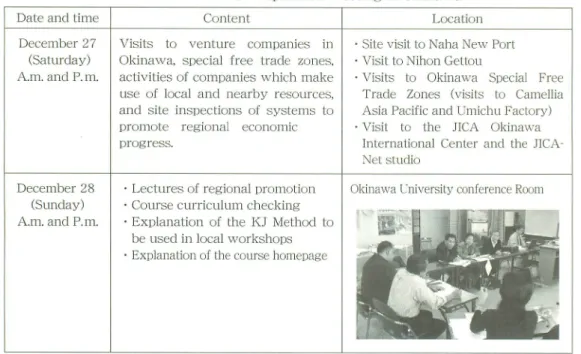
On 27th and 28th December 2003, the director and chief lecturer (Yoshikawa), the
assistant lecturer (Fukui), local assistant lecturers (one each from Indonesia, Thailand and
the Philippines), the chief of teaching material development (Ishiguro) and the chief of curriculum development (Yamaryo) met in Okinawa to make study visits to venture
companies in Okinawa, special free trade zones and other sites, as well as to discuss about
the course implementation (See Photo 2, Table 2).
As the preparation meeting was concentrated in a short period, the course objectives,
course content, and lecturers' views were thoroughly reviewed and shared. This was very
important, because the course was run in three countries.
Visiting Okinawa enabled the local assistant lecturers to experience the similarities and differences between Okinawa and their own countries, and gave them an opportunity to study the activities of companies in Okinawa that are using the resources of their own and nearby areas.
Table 2 Schedule of Preparation Meeting in Okinawa
Date and time December 27 (Saturday) A.m. and P. rn. December 28 (Sunday) A.m. and P.m. Content
Visits to venture companies in Okinawa, special free trade zones, activities of companies which make use of local and nearby resources, and site inspections of systems to promote regional economic
progress.
• Lectures of regional promotion • Course curriculum checking • Explanation of the KJ Method to
be used in local workshops • Explanation of the course homepage
Location • Site visit to Naha New Port • Visit to Nihon Gettou
• Visits to Okinawa Special Free Trade Zones (visits to Camellia
Asia Pacific and Umichu Factory)
• Visit to the JICA Okinawa International Center and the JICA-Net studio
Okinawa University conference Room
tB - -B
tj jHlMMallirf^fcJ
" i" • -«B ■"
i
Carrying out this kind of preparatory meeting via JICA-Net is another option. However, as the course was run in three countries, the actual meeting between all the parties involved was highly effective in ensuring full sharing of information and building close relationships. In order to hold such a concentrated meeting, it was important for the participants to have some common knowledge before the meeting, thus all had to read the relevant documentation in advance.
m8
-IV. Recruitment of participants
Participants for this course were enrolled in January 2004 after candidates were selected between mid-November and the end of December 2003. The lecturers, local assistant lecturers, local facilitators, and training implementation managers cooperated in
the selection process. In particular, JICA local offices cooperated in the selection of regional participants.
Table 3 Participant Recruitment Schedule
Selection of candidate participants Enrollment of participants 2003 November December 2004 January February Indonesia Thailand Philippines
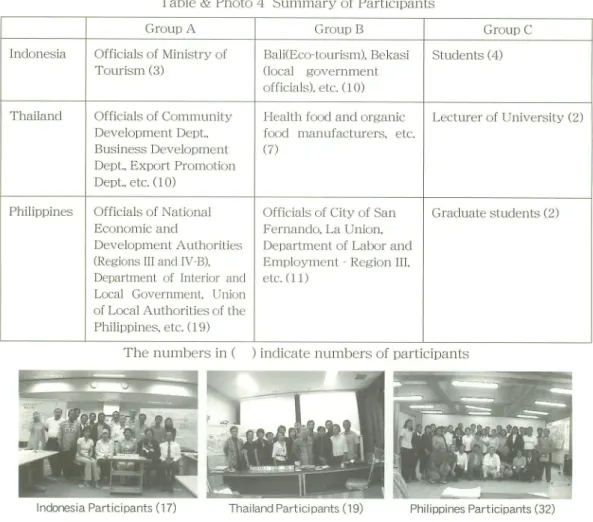
Table & Photo
Group A Officials of Ministry of Tourism (3) Officials of Community Development Dept., Business Development Dept, Export Promotion
Dept., etc. (10)
Officials of National Economic and
Development Authorities (Regions III and IV-B), Department of Interior and Local Government, Union of Local Authorities of the Philippines, etc. (19) 4 Summary of Participants Group B Bali(Eco-tourism), Bekasi (local government officials), etc. (10)
Health food and organic food manufacturers, etc. (7)
Officials of City of San
Fernando, La Union, Department of Labor and Employment - Region III, etc. (11)
Group C
Students (4)
Lecturer of University (2)
Graduate students (2)
The numbers in ( ) indicate numbers of participants
Indonesia Participants (17) Thailand Participants (19) Philippines Participants (32)
Regional Promotion Theory and Practice (m)
government staff, NPO and NGO leaders, postgraduates etc.), who are seen as leadership candidates for regional promotion, Group B (regional authority staff, regional companies and entrepreneurs), who are the supporters of regional economies, and Group C (university students). Therefore they had to be gathered from a variety of agencies and groups. Time
was taken to select the participants carefully, with the cooperation of local JICA offices, so
all three groups were assembled in each country.
However, coordination with local JICA offices on the participant recruitment process and the handling of participant expenses took large amounts of time. Preliminary coordination was inadequate on issues such as how much advice local offices should provide on candidate participants, whether to pay the daily allowances, transport expenses, and accommodation costs.
Allowing sufficient time for the selection of candidate participants in the enrollment process made it possible to gather groups of participants in line with the course objectives. Nevertheless, preliminary coordination with local JICA offices must begin at an earlier stage on matters such as the participant
JICA recruitment process, their costs and
other matters requiring coordination
with local offices, and on matters where
JICA-Net Training Course
Methods for Regional Promotion
as Seen in QMnawQ_m^BegiomWeyeipp'>^;u in Southeast Asia -Utilizing Common Characteristics among Neighboring Countries
JICA (Jiipnn International Cooperation Agency) i
Regional PromolioiT course using iheJlCA-Nct, n clisiiicc learning facility oFJICA.conducting the '■Methods for
Participating Countries:
The course is delivered through liie JICA-net sites in Bangkok (Thailand), Jakarta (Indonesia), and Manila (Philippine) 1'rom Okinawa (Japan).
uaty 2004 to March 2004 JTCA-Nct Office (Satellite Center) 4F National linginecring Center Building University of the Philippincs-DilimiiiJ.Quei
ilh JICA regional o
the regulations and customary practices of those offices are applicable.
Figure 2
Recruniment of particpants in Philippines case: Participants for this course were enrolled in January 2004 to March 2004.
Allowing sufficient time for the selection of candidate participants in the enrollment process made it possible to gather groups of participants in line with the course objectives.
-V . Development of Teaching Materials
The following materials were developed for this course.
1) CD for preliminary study
Course summary, schedule, video introducing cases of companies in Okinawa, glossary, reference documents.
2) Teaching materials for preliminary study (trilingual materials in English, Indonesian and Thai).
Comprising documents of 16 types, lettered A~P. Documents correspond to the lecture content for each module.
3) Teaching materials for lectures (PowerPoint)
These materials are used for each remote lecture.
4) Teaching Materials for follow-up study (assignments for modules 2 and 5)
Topics are proposed for private study after the completion of each distance lecture.
5) Various manuals and glossaries
Manuals etc. for the KJ method and other techniques used in local workshops.
6) Dedicated homepage
Photo 5 List of developed teaching materials
JICA-Net
Okinawa i leo-indusfrral In - \ry
-Jointl/ ./irii Asrafl Countria;-(Qa
The following is a summary of the evaluation and lessons gained from the development of this content.
1. Compact Disc (CD) for preliminary study
CDs for preliminary study were distributed to all participants in the three countries at the start of the lecture. The CD contains a course summary, commentary on the schedule and the teaching staff, summaries of the live lectures, and recorded images of trends in company startups that
contributed to regional vitalization in Okinawa. It also contains papers by the teaching staff
(specific examples and data documentation that students should know as basic or supplementary
knowledge) and glossaries as extra material, supporting students in their comprehensive self study. The aim of this material is to raise the readiness and motivation of participants.
Regional Promotion Theory and Practice (M)
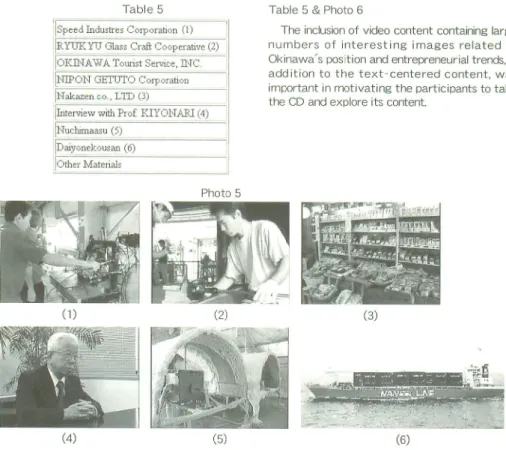
Table 5
Speed Industres Corporation (1)
|RYHKT(JGlass Craft Cooperative (2)
|NIPON GETTJTO Corporation Nakazen co., LTD (3)
Interview with Prof KIYONARI (4)
|Nuchirnaasu (5) paiyonekousan (6)
Other Materials
Table 5 & Photo 6
The inclusion of video content containing large
numbers of interesting images related to
Okinawa's position and entrepreneurial trends, in
addition to the text-centered content, was important in motivating the participants to take
the CD and explore its content.
Photo 5
The inclusion of Video content conctaining large number of interesting images related to Okinawa's position.
As an overall evaluation, the CD was successful in delivering a certain amount of lecture-related information to the participants before the live lectures and after the completion of module 1. This had a major effect at the start of the course, enabling participants to smoothly gain an understanding of lecture content. In particular, the inclusion of video content containing large numbers of interesting images related to
Okinawa's position and entrepreneurial trends, in addition to the text-centered content, was
important in motivating the participants to take the CD and explore its content.
Most participants who viewed the CD did so after the completion of module 1, and we
assume that relatively few viewed the CD before the start of module 1. This pattern indicates the difficulty of making participants put the CD into an audio player and listen to its content before the course starts, while they have very little information about the lectures.
Lessons for the future include hard copy introducing the content of the CD in a more convenient form (one which takes no time to access), taking time during the live lectures for module 1 to announce the content of the preliminary CD, and guiding all participants to
complete listening to the CD by the start of module 2, at the least.
-Figure 3 Teaching materials for preliminary study (trilingual materials in English Indonesian and Thai) A. B. C. D. Self-introduction and greeting to all participants Why regional development now? My experience (the lecturer speaks from experience of regional promotion projects) From the perspective of decentralization E. F. G. Ret The emergence of trade-type venture businesses How to promote regional industries Nihon Gettou (example of a successful venture in Okinawa) ;ional venture business theory H. I. J. K. Music industry in Okinawa Why Okinawa was chosen as the case study subject Industrial and corporate domains in Okinawa The KJ Method L. M. N. 0. Resource mapping Starting points for promotion From regions within a to regions within a positioning Tourism as a regional
regional country regional industry
CD PJ O IT era i English What is Regional Promotion? Using Japan's Experience out not only in small vifticcs in noun lowis. fishing ullage: in costi] area, Mas media also tcport these prpjccj ko popular? in area, but also large fum villages in plains, big cities, snail / ic^ioniJ prcjedA aic in lull bfoom. Wby ;.B**tnnli£ofrt£i>>nilprrimortonI>o»m In the lira pUcc, Takcshita csbinefs policy nan*:.l ■■Rcsi.wal Creation Program O Himildl Million Yen" [llayoi important rote in I9KS jn<I in I9&°. The polk? w*S sai.l "Sibsidi For self participation of people in the region''. This policy was eyruM.lin.iiy. The xnfc&liflty gave pwpk opinirtiiniiy (nihinkan.l act for Ihcti (*n tcgiPii IOO,000,r) >"cn w^tnot Ng moTMy for najcr ci(ic* tn:( it v--*s lii£ amninit d' tri-r^-* ]Vi .-.nt'il ".T?J.i^C'. ^Tiil^' n ««p«ri K«i<a*l (nwwHe nwam ftr Hiifkiict Millio fiHiirc vision of IbcirplKC Of course, nwny cities and (owtik UzA cin^iCi! rc^iTm^ laiittciK.i txx fta potoj AmH be WgUy vAcd fet B» bbw« t activities n> plso«; in nil over Japan. The policy, ■Hcfiional Cwatiw Veil", m*(o (he Iwim of lEgioral prnrrWinn. Thai Indonesian 100 fiiumuj Ouvun i r1ufiiiRJilaann-«3i-|jf]&niRLnriauMLiifiiiluiJau Apa yung Dimaksuiikiin dengnn Prumusi Oaci^ — Mcmpcrgiiiiakaii Pcngalaninn Jt-pang— Scfcarann di Jcjving, di mins-m di tL-icrah pcgiuimicri:! il.n: l^:.:.i ii:ov,ii: j':ir.i,;i alau di pillan-pulai I'crtami-taifta, sciirra 2 laliun, y.-utu padi ruaaw .Soa:i, Sctatu.=. Jills \'cii il' ina ada $ciakan mcnyioinoiikan bcihj^-ii ilicrah. \Vilau[>ur Ji ^fcsa fcccil ^,;.: .1: *.Licr^fi '.i:ulr. J.-it:t;. >ii ?:«.:r.L Iv.^r jijij kcliI, Ji koti pcrikjnjn Ji tci]iis:ih Cicrak^in icrscblil i.iiik.in iii ;^y;i!;i icnyal di Jcpanp Media 198V, kebsjakan u lmn (fafesl f Juta \cn)"" telah mczminkjn pcran;i:i lvs.il I;titi t"■:.1 r, \;~:v.--.'-'. !"^::i.:';:. S.,Vi/.iLh .:i'':.: I'ti^'h (Bdahri Pikiraii ScwjW .tin fe&feuaun Scndiri" mi pcniih dcafan klrasc1> luai UsM. iiftl im hcraili j>lliak olimnni! din poiidii.itik Klah itihtfnkan kcsctiif sWn mituk ii*rniakai siili indcpciufcn iiin scsdVany.i sctidifi, cii sanying. junilsh ysng. h.mj'ak sun sciiiki! fscrafin jnia y jumiah kccilhftgi kiiUIwjar, dainuTnlsJi bcssrhnai ■,1c...i kccil'i. XicnmngjTiicrefcftpcihilicrciisfcu yatij; i{ik«nal daavia nus.ufcfaii lii dut-rjh. djn akbitiiya h;il im OKDlferOSgptotacn daccali. Tvnlu Eiiji!, seWiini ilu. tittik scdihil *L*;iali idjti btiu-^ihj mebkubn piontosi. Namun BJStHD ini buk-li JicvTiIuasi dm diiiihi ltngj;i kawnj pcnvtibar.Ln ki.'iiBsrp promos! ilacw!) wcira "Furusalu Swei, Serai us Jula Yen" iiii k-Ijh urembcrikaii xbajii kcanopaeui utiluh nitngc Rei-akjn pnmiysi Jacrjli letUi kinjul. c Q. s
Regional Promotion Theory and Practice (IH)
Sixteen types of explanatory documents (Word files) were prepared in English, Indonesian and Thai as teaching materials for private study of the basic knowledge needed for an understanding of the content of each lecture. The teaching materials included the following elements:
These teaching materials were distributed with a table indicating which elements of which module class they corresponded to. This correlation enabled these teaching materials to function effectively as tools for participants to recheck lecture content before and after
the lectures. In particular, the translation of all these extensive teaching materials into three
languages provided precious supplemental material for participants who are not adept at
listening to classes in English.
Lessons for the future include a need to search for presentation methods that would be easier for participants to understand, such as inclusion of charts and photographs in the
teaching materials for preliminary study. 3. Teaching materials for lectures
PowerPoint presentations were used in conjunction with lecture content during the live lectures. These materials were built with a tempo that included scenes reporting on companies in Okinawa and videos introducing unique Okinawan products, which contribute to regional vitalization, while the
lecturer presents the actual items. The aim was to present a blend of content, which would hold participants' concentration
and interest through the lectures. Out of consideration for the
inconsistency of participants' levels of knowledge, experience
and English-language ability, the key points of the lecture content were summarized as a supplement to the live lecture, and some detailed content was included.
We also tried to combine that content with varied images,
such as the lecturer bringing relevant products into the live the lecture content)
•:'-lecture studio to show to participants in the course of the lectures. These measures have succeeded in attracting the attention of participants throughout the series of lectures.
In the Feedback reports from the three countries, it is also commented that the letter font of the PowerPoint slide was too small and that some charts looked blurred. However, modules 3 and 4 were composed differently
(Power Point in Okinawan products into
the live lecture from my reseach room) from other remote programs, being transmitted from
II
I
-three countries, thus there were problems such as interruptions in the video feeds, which
included the PowerPoint presentations, and loss of sound. In particular, the Thai studio, which lacks an adequate audio system, was unable to transmit video directly, thus video images seen locally had instead to be broadcast indirectly to each country. This introduces signal noise and participant voices into the transmission, making viewing very difficult.
•(Power Point in conjunction with the lecture content)
Lessons for the future include use of studios with adequate equipment, if the PowerPoint materials are to include video, and limiting the broadcast destinations to one point at a time, because broadcasting to multiple Countries increases the risk of degraded images).
4. Teaching Materials for follow-up study Word files were used to suggest
points to consider for self-study
assignments in modules 2 and 5.
In this course, lecturers left Japan to have on-site lectures in three countries, and workshop sessions were held after each live lecture, thus the lecturers and facilitators/ teaching assistants can provide instruction following the points
presented in the relevant teaching
materials, thereby giving the partici
pants a semi-Compulsory experience of
workshop participation.
Therefore, we believe these teaching materials were part of an enormously effective follow-up study process.
Assignments for Each Country Module 2 and 5 (Self-study in each individual country) [Modulc2]
Group A (If possible, Group C as well)
Individually, use the KJ method to come to a conclusion on the following
topic. (People who cannot do this should use this time for preparations so that they can accomplish the task)
Form an image or picture of being a regional promoter and come up with future potentialities, issues that need to be tackled, and problems using the KJ method (Those who can't finish should write out 5-6 KJ cards).
Group B Indonesia
As we will use the KJ method to come to a conclusion as a group, use this time to make preparations. As a group, come up with how Bali can solve its tourism problems (measures to deal with decreasing tourist numbers
following the recent terrorist bombing is a very big issue, but also consider issues outside of this as well), break away from being dependent on outside forces (large travel agencies, etc.), and come up
with methods for creating local or regional industries and the problems
there within. (Even if this cannot be completed, write out responses on KJ
cards) Thailand
Come up with issues and problems for methods to expand ways for
cash-based in come in individual communes (For example, the Asoke Society's
capsule). (Even if you can't complete this, write out your responses on KJ
cards) Philippines
The Group A and B will be split into two separate groups (the KJ method
will be used)
1. (Common/mutual) issues for Group A
2. Explore possibilities for cooperative businesses between Okinawa and the three countries.
[Module 5]
Group A: Using KJ cards that have been prepared (written down) come to a consensus and also help Group B
Come to a conclusion using the KJ cards that Indonesia and Thailand B
Group have prepared (written down).
Group B*: will make concrete business proposals, collect and prepare the appropriate materials for this.
Indonesia: Prepare materials for ecotourism resources and ecotourism courses on Bali Thailand: We would like to do a case study to set up
test-marketing shops, including inspection tours in each of the communes. Please prepare materials for this,
^possibly, also Philippine's Group A, as well
Regional Promotion Theory and Practice (HI)
5. Manuals
Manuals were prepared on the content, procedures and other aspects of the KJ Method and resource mapping, for use in workshop sessions conducted by lecturers after their on-site lectures. The manuals were used by the lecturers in the preliminary meetings which
took place in Okinawa at the end of December, to provide assistant lecturers (from the
three countries) with explanations in preparation for use in local workshops.
The use of these manuals meant that, in addition to providing teaching materials in line with lecture content, the course could provide tools for studying the key points of regional vitalization methods. In the same way as 4 above, the manuals are regarded as having yielded great results.
Stage 1. Making Labels (Visualizing your idea) (Stage 1 "CD~U»
^i.itc Nc hip sheet of |>»pei
theme lor allow 1
■ ■
■ All mefnben ihoHld tuvm Dtbcr
■ It is fpoi Idea «■ make a quiet r.l
menders' points
Figure 4
Variouse manuals and glossaries, Manuals etc. for the KJ method and other techniques used in local workshops.
Stage 4.Completion of on illustration
(<D©)
r»i)ge the medium group I iow ihc that login] fchiinns ut |Ik h*^\c- M\ iir.inv v lU ymi cnn fintl ippn-pn
n show ih« logic Headtml ihcli-pt Stmud CaatiRDn trying till you lin.l ilic
best pl.ice IV»rc:ich boy.
Use iiDRs 10 ihov ibc logic unong nicJiuiii n'vl1JP' invluilin^
iv^i -.in ill t-t^ii^*.
n^^
fap-a
Sli.t. Itic l.ll^l.-. .m llwr!ti.-. win
ibddcd.
(Don't sbek tliu nwdiuiii Wbflh
tilt nMmbm shiinhl Ei(hfr pnTloekl!
6. Dedicated homepage
A dedicated homepage for this course was set up to enable exchanges of information and views between participants and their lecturers and assistant lecturers, and between individual participants, both during the training period and afterwards.
At each live lecture, the host tells the participants the address of the homepage and the information it contains, to encourage them to use it to the full.
-(8 if
Photo 7 The opening and management of a dedicated homepage for the course.
February 19. 20 Bangkok vrorkshop ■ The first sessbn of Methods for Regional Prom 16 in Indonesia „■;.,
3 held on February
The homepage is still
maintained, even now that all
modules have been completed,
and the participants use it as a
forum for discussion with
Okinawan entrepreneurs.
Thus the establishment of this homepage can be seen as highly significant for the regional promotion, which is the aim of the course.
Among the participants
from Southeast Asia, some cannot access the Internet or lack computer skills. Therefore, one lesson for the future is that we should look for some other way for participants to access the lecturers at times other than the live lectures.
VI. Implementation of the Course
The twelve modules (comprising eight live lecture modules, three workshop modules and one self study module) were carried out between 10th February and 2nd March 2004.
The implementation schedule is as shown in Appendix 1.
Modules 1, 2 and 6 were implemented simultaneously in the three countries, while
modules 3, 4 and 5 were run as boarding courses over two nights and three days (1 set), in Indonesia, Thailand then the Philippines (three sets in all). The course schedule
concentrated twelve modules into a short period of around one month, and was composed to enable participants to maintain their concentration for the duration.
The following is a summary of the evaluation and lessons gained from the implementation of the course.
1, Live lectures
(1) Contents of the lectures
Modules 1 and 6 were live lectures, as were modules 3 and 4, which ran in three countries simultaneously. Each of the live lectures progressed in clear order through the main message
and case studies of Okinawa. The lecturers' speeches were limited to around 40 minutes, to maintain participants' concentration and promote understanding. Image-based supplementary
teaching materials were used to the full, and time was allotted for participants to pose questions in Q&A sessions. This approach appears to have produced a system that
Regional Promotion Theory and Practice (IK)
On the other hand, for the modules broadcast from the three Southeast Asian countries
(modules 3 and 4 in each country), interpreting for the Q&A sessions between lecturers and
participants was handled by Pacleco staff in Tokyo ITC. The interpreting method used is
that the staff in Tokyo are in contact with the lecturers by IP telephone in addition to the
broadcast, interpreting each question over the telephone, and finally interpreting the
answers for communication to the participants. Unfortunately, this method left participants
waiting for the responses to each question.
As a lesson for the future, lecturers should be selected who are able to handle Q&A sessions in English, or expert English-Japanese interpreters should be posted on site to provide interpreting service.
(2) Audio system of the live lectures
Broadcasts which linked four countries experienced occasional interruptions and indistinct sound, systemic problems which continued to the final module. In particular, the lack
of a satellite center in Thailand meant that it took time to adjust the sound and video, forcing
a 30 minute interruption of module 3 transmission from Thailand. As a lesson for the future, video transmission must be improved by measures such as allowing more time for setting up.
Photo 8 The JICA-Net Remote Techical Assistant System
Contents of the lectures Workshops (without net
broadcast)
Audio system of the live lectures
Indonesia
Thailand
Philippines
2. Workshops (without net broadcast)
In addition to remote live lectures, workshops based on the KJ Method followed on
from the lectures. The workshops examined the real challenges faced by each region and
considered grand designs and business models for each region.
-The lecturers who were on site in the three countries were able to lead the workshops as well, so participants were able to receive direct instruction from the lecturers in the KJ Method and other methods, which increased their interest in regional promotion.
The workshops saw lively discussion between the participants, which is not normally seen in distance lectures. The debate between participants from different walks of life, such as civil servants, entrepreneurs and university students, generated ideas that will contribute to regional promotion. Bringing the participants, facilitators and assistance
lecturers together in the same forum builds participants' familiarity with and trust in the
lecturers and, as a result, earned this course high evaluations from the participants.
In contrast to the one-way flow of information from the lecturer in classes, the workshops provide participants with opportunities to use their own heads and hands to tackle challenges. This approach makes them a highly effective learning tool, and it would be worth considering ways to run workshops on a distance learning basis.
3. Presentation (module 6: Live)
In the last live lecture (module 6), the participants made presentation of what they had learned in the live lectures and the results of their deliberations in the workshops. In that way, each individual participant was given an opportunity to present his or her inquiries live to each country. They were clearly enjoying the course as they took the microphone to give lively presentations of their ideas.
Photo 9 Presentation of a Regional Promotion Strategy
i
(Philippines)
(Indonesia) (Thailand)
This revealed the importance, in an extensive program such as this one, which spreads
over 12 modules, of enabling the participants themselves the create their own broadcast scenes of some kind.
Conversely, the following problems require consideration:
• The style of presentation in which the KJ Method results are displayed on simili paper and viewed through the camera was unclear due to blurring of the characters and chart lines. • It was not possible for the lecturers to give adequate time as well as comments and
evaluation on the presentations from each country, partly clue to time constraints.
• It was not possible to fully elicit comments from the company participants in Okinawa
in the short time available.
Regional Promotion Theory and Practice (M)
presentations (making figures appear larger, etc.), and allocate more time for exchanges
between lecturers and students in classes after the presentations.
The attainment test for this course was used for the lecturers to provide their evaluations of the presentations. The evaluation results were fed back to the students, a
process which is expected to contribute to the development of future "regional promoters". Photo 10 The style of presentation are displayed on simili paper and viewed through the camera.
The following are examples of evaluation results returned by lecturers.
Table 6 Presentation evaluation results
[Indonesia] KJ Method presentation Grade
Theme Evaluation
B+
Development of eco-tourism
This group summarized strategies of the development of eco-tourism. It raised a wide range of issues, from the support of the government, law and regulations, marketing, the useful investment on the eco-tourism, to the importance of hospitality. The idea of the three pillars, attraction, accessibility and amenity, was interesting. More detailed investment strategy, law enforcement strategy, or
marketing strategy should have been commented. Grade
Theme Evaluation
A-Eco-tourism in Indonesia and ASEAN
All the students worked hard to produce a comprehensive and balanced presentation. Nevertheless, I would have liked to see some bold and unique content from such a
young group. As a rule, the kind of culture and events proposed can, of course, serve as resources for eco-tourism, and they are important.
But, perhaps you should consider eco-tourism that focuses on culture in everyday life. In that way it would be possible to focus efforts on improving that everyday living culture and building social capital, reconciling enhanced living standards
with eco-tourism (the economics of the tourism industry).
The implementation strategy should contain more originality. How about a single
unique proposal from such a youthful group? [Thailand] KJ Method presentation
Grade
A-Theme How to develop agricultural products for national and global markets Key Points The conclusion is as follows:
Producers must aim at producing goods with best quality, uniqueness, brand names
-m s -st
and reduced cost of production; market channels must be increased with financial
and investment supports from the government. The conclusion is drawn from these three areas:
Product development / Marketing survey consumer behavior, create brand name and increased market channels / The government supports in financial and
investment
Evaluation This presentation was a well-balanced overall summary, which is worthy for
evaluation in this regard. However, as this was a Group B presentation, it must look a little more into personal themes.
Grade Theme Key Points
Evaluation
A-How to develop agricultural products for national and global markets
The conclusion is as follows:
Producer must aim at producing goods with best quality, uniqueness coupling with
the market promotion through government and private sector supports.
The conclusion is drawn from these three cireas:
Production development / Market promotion / Outside supports
Considering the fact that this was summarized by Group A, this presentation lacks specificity compared to 7, but perhaps I am asking for too much.
Grade Theme Key Points
Evaluation
A+++
The Enlargement of Thai Herbal Products to nationwide & international market? The conclusion, as below, is that this is a compact and skilful presentation, but it lacks
impact. In particular, I would like to see the characteristics of a Group B presentation.
Conclusions (KJ mapping) shows that the producing of developing chemical free products of good standard must be consisted of old wisdom, research works, and appropriate technology, the result of which lead to quality control and guarantee both
in and outside Thailand.
Only through so doing, the product make would be developed to nationwide and global. This is built on the following three key elements.
Promotion of Herbal Products
1. Productivity Process (Production, P&D, Packaging) 2. QC
3. Marketing
One of these three elements is unique, being specific to a Buddhist group, as follows:
Production
• • • • Because raw material is 100% chemical free produced by Buddhist group,
who emphasis starting on human spiritual through raw material, therefore it effects to the limitation of qualified raw material and labor.
This promotion characteristic is to be reflected in the marketing plan as follows.
Marketing Plan
• • • • Arrange visiting tour on manufacture
• • • • Participate in exhibition on Health Products, join health activities
Self study into specific plan proposals and projects for realizing them yielded results
which were also presented.
One plan included opening the commune once in two weeks for tour buses from Bangkok. A herb restaurant could-be opened, and the general public could tour the
commune, whichwould promote sales of health foods, while aiding outside
understanding of the ideas of the commune. These proposals included very detailed content, such as diagrams planning specific facilities and suggested tours. It is regrettable that the detailed content cannot be reproduced here.
Regional Promotion Theory and Practice (IE)
into the night, and extended their debate to consider the ideal character of the commune, which was outstanding.
Guest Comments Nakazen Corporation (the largest manufacturer of health foods in
Okinawa)-Comments from Mr. Mitsuru Horita, head of the Planning and PR Office.
"We are primarily a health food company, and we went on to create a herb restaurant and tourism facilities, which we use in PR. You all start with spirit, and create health foods on that basis.
That is an excellent approach. Please ask us if there is anything, even technical
matters, which we can help you with" [The Philippines] KJ Method presentation
Grade Theme Key Points Evaluation
B+
Regional Promotion in the Philippines (A)
The presentation identified general challenges in regional promotion, and emphasized the importance of exploiting regional resources and obtaining finance from the state. This presentation was commendable as a skilful summary with a broad perspective.
However, more commentaries on specific challenges, based on participants'
experiences are desired. Grade
Theme Key Points
Evaluation
B++
Regional Promotion in the Philippines (B)
This is similar to 1 above, but with the following additional issues:
Problems due to political interference, and technological aspects ranging from production technology to information technology.
Compared to 1, this presentation took a wider perspective and raised new issues. However, in common with 1, it lacked specifics.
Grade A
Theme Domestic Sales Promotions and Export Trials for Agricultural Produce
Key Points The presentation began with an overview of Bataan, followed by explanation focused on agricultural produce (fruit, vinegar).
At present, mango pickles, guava jelly, fruit vinegar and other foods are produced for sale and local consumption.
The presentation proposed marketing and quality improvement efforts to begin direct sales (door to door) as the first step, followed by Internet sales, diversified marketing, advertising anci distribution channels.
It also proposed the use of local ports for exporting.
Evaluation This kind of study is necessary as the first stage, to summarize the tasks and problems. This was a skilful summary.
Its proposals for future sales promotion activities were also commendable. It also requires consideration of the objective, whether it is centered on profit or sale volume (employment), and what markets efforts should focus on.
However, In future it will be necessary to consider product characteristics (quality improvement, tailoring to individual applications, etc.), product development to expand sales channels, and the relationship between product position and characteristics and sales channels.
There was no specific consideration of exports, thus the proposal and advice below were provided as an example.
If exports are planned, there will be differences in diet and tastes between countries, so the question of what market in which country must be considered.
For example, in Japan, JETRO will send an expert taster to producers who request one. The lecturer advised planning based on this kind of support.
-24-m 8 it Grade Theme Key Points Evaluation A
Regional Promotion in the Philippines (D)
This group summarized general content on regional promotion, and went on to discuss the specific fields in which the participants were involved (for example, furniture production, biotechnology).
It raised a wide range of issues, from local products to improvements in marketing to quality control, in order to expand domestic and overseas sales channels, draw in foreign investment and found public and private partnerships.
The range of issues raised was wide, so comments were focused on the two points
of orders of priority for investments and the problems of public and private
partners.
The balance of two perspectives, the broad summary of challenges and the tasks for specific regions was impressive.
Grade A+
Theme Improving city Economy by harnessing Agricultural-Industrial by product
Key Points First there was a summary of the region, followed by "Strengths and opportunities", "Issues and concerns", "Strategies", namely marketing improvements, and measures
such as agricultural trade fairs, improvement and expansion of agricultural data, government support for related policies, with proposals for specific projects under
"Projects identified" .It also raised a wide range of issues, from local products to
improvements in marketing to Quality control, in order to expand domestic and overseas sales channels, draw in foreign investment and found public and private partnerships.
The range of issues raised was wide, so comments were focused on the two points of orders of priority for investments and the problems of public and private partners. It presented the following proposals and documents on joint projects with Okinawa. The proposal concerns the seed industry, which is one industry in the region concerned. The industry discards fruits after their seeds have been extracted, but the proposal suggests using that fruit in some way.
Data was presented on the usable volumes of watermelon and bitter gourd (Galaxy Jadestar).
Guest Comments Special guest, Mr. Mitsuo Taira (papain enzyme extraction factory) gave his
comments and discussed the potential for a cooperative project. "The technology for
making bitter gourd into juice as a medicine (health food) has been established in
Okinawa, so wouldn't it be possible to build a factory on site to produce the raw
materials? I (Taira) have developed technology to extract enzymes from papaya, so the same kind of activity would be possible where papaya fruit is being discarded. I
would like to visit the site and investigate."
Photo 11 Proposals and documents on Joints with Okinawa

![Table 6 Presentation evaluation results [Indonesia] KJ Method presentation](https://thumb-ap.123doks.com/thumbv2/123deta/6929573.1185403/23.753.123.610.265.430/table-presentation-evaluation-results-indonesia-kj-method-presentation.webp)
