
JAIST Repository: 新規官能化ポリへドラルオリゴメリックシルセスキオキサンの合成法の開発
5
0
0
全文
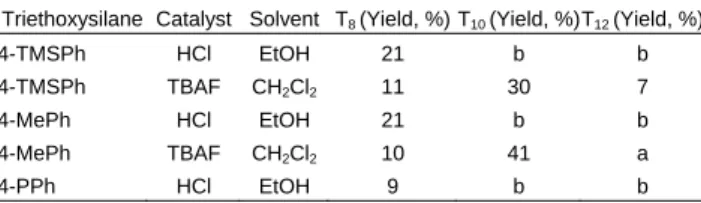
(2) 1. Development of Synthetic Methods for New Functional Polyhedral Oligomeric Silsesquioxane Derivatives Kawakami laboratory 0540017 Akio Miyazato [Introduction] Polyhedral oligomeric silsesquioxanes (POSS) have nanometer-size cubic structure with wide surface area and controlled porosity, and can be functionalized with a wide variety of organic groups in the design of nanocomposite materials and hybrid polymer systems. Hydrolysis of trichloro- or trialkoxysilane gives polysilsesquioxane with formal structure [RSiO1.5]n, but the actual product is often a mixture of insoluble gel, crystalline compounds, or oil. The product distribution depends on reaction conditions, such as solvent, concentration, catalyst, temperature, and organic group. Well-established methods of the synthesis of these compounds were introduced by Feher’s group, 1, 2 Lichtenhan’s group 3, 4 and Laine’s group. 5, 6 Until now, researches on octasilsesquioxane were mostly focused and limited to the systems with hydrido- (H8-T8), cycloalkyl- (Cy8-T8) and alkyl- (R8-T8). Although the molecular weights of these compounds fall in only 420-2000 Da. region, they still showed high thermal stability. They have been used in numerous areas, such as composite material with typical plastics to enhance the thermal property. 7, 8 However, the yield of the synthesis was considerably low, and long reaction time was required. This bottleneck has made the research and development of octasilsesquioxane as the new material difficult. On the other hand, increasing need has been noticed for the introduction of functional groups to POSS, such as cage to be used as the building blocks to construct variety of nano-hybrid materials with precise structure. 9-22 Phenyl derivatives, to which functional groups can be introduced by variety reactions, are the most convenient for the purpose. However, it is normally very difficult to directly synthesize functionalized phenyl-substituted cages, and thus functionalization of phenyl group attached to the cage silicon atom has been long desired. Amino group is one of the versatile functional groups to construct new structure by condensation or addition reactions, and introduction of nitro group is the key to introduce amino group to the aromatic group. Laine and Olson reported the nitration of octa(phenyl)octasilsesquioxane by fuming nitric acid and further reduction and application of the product. 23 However, the multi-, but incomplete functionalization of phenyl ring often made it unclear to correlate the property of the system with the structure. In this paper, firstly, synthesis and separation of novel 4-trimethylsilyl-phenyl-POSS cages were described. Nextly, regioselective nitration of octa(4-tolyl)octasilsesquioxane and octa, deca, dodeca(4-trimethylsilyl- phenyl)-T8, -T10, and -T12. Finally, we have developed new cage-type silsesquioxane and their derivatives.. [Results and discussion]. A 4-Tolyl(4-MPh)-T8, 4-isopropylphenyl(4-PPh)-T8 and 4-trimethylsilylphenyl(4-TMSPh)-T8 were obtained in moderate yield by direct acidic hydrolysis of (4-MPh)triethoxysilane, (4-PPh)triethoxysilane, and (4-TMSPh)triethoxysilane in the presence of hydrochloric acid (HCl). Simple washing with ethanol gave 4-MPh-T8 and 4-PPh-T8. Passage through short silica gel column with hexane as an eluent gave pure 4-TMSPh-T8. Hydrolysis of 4-substituted-phenyltriethoxysilane in the presence of tetrabutylammmonium fluoride gave a mixture of T8, T10, and T12 cages having T10 as the major fraction. 4-MPh-T10 was obtained from the mixture by recrystallization using acetonitrile-THF (1 : 1). Treatment of the mixture of 4-TMSPh cages firstly with hexane removed 4-TMSPh-T8 (11%) as a crystalline material. Following crystallization using ethanol-hexane (1 : 4) gave 4-TMSPh-T12 as crystal in 7% yield. Final crystallization using acetonitrile-THF (1 : 3) Scheme 1. Synthesis of 4-TMSPh-T8, -T10 and -T12. R R O Si O O Si O Si R O O O R O Si O Si O Si O Si O R R R R. Me3Si. Si. HCl. Si(OEt)3. TBAF. R=. SiMe3. 4-TMSPh-T8. R Si R R R O Si O O Si O Si R R O Si O O O Si O Si Si O R O + O O + O O R O R O Si Si O O Si Si O Si O Si O R O Si O R R R O Si O Si O R R R. R. R. R. R. Si. O. R. Si. Si. R. Si. O O O Si. R. Si. R. O. 4-TMSPh-T10. O. Si. O Si. R. O. Si. O R. O. Si. O. O. O. R. O. Si. O. Si. R. 4-TMSPh-T8. O. O. Si. O. R. 4-TMSPh-T12. R.
(3) 2. gave 4-TMSPh-T10 as crystal in 30% yield. Each fraction was purified by further recrystallization. The reaction scheme is shown for 4-TMSPh POSS cages in Scheme 1, and the results of the synthesis of 4-substituted-phenyl-cages are shown in Table 1. Table 1. Synthesis of 4-substituted-phenyl-POSS cages Triethoxysilane Catalyst Solvent T8 (Yield, %) T10 (Yield, %)T12 (Yield, %) 4-TMSPh. HCl. EtOH. 21. b. b. 4-TMSPh. TBAF. CH2Cl2. 11. 30. 7. 4-MePh. HCl. EtOH. 21. b. b. 4-MePh. TBAF. CH2Cl2. 10. 41. a. HCl. EtOH. 9. b. b. 4-PPh. a: Not isolated, b: Not detected by NMR.. Formation of T10 and T12 cages should be the result of the decomposition of the T8 cage and re-assembling to thermodynamically tabler cages, which are commonly observed under various reaction conditions. Nitration of 4-TMSPh-POSS cages was examined. For comparison, nitration of (4-toly)- and (4-isopropylphenyl)-T8 were also carried out. Nitration of 4-tolyl-T8 by fuming nitric acid (added at -30oC), or by copper (II) nitrate trihydrate (copper (II) nitrate/octasilsesquioxane = 1.2 / 0.125 mol/mol) at room temperature gave clean 3-nitration. When starting material’s peak in 1H-NMR has disappeared, three aromatic protons at δ = 8.32, 7.88 and 7.45 and one CH3Ph at 2.64 ppm have appeared, which strongly indicated the formation of 4-methyl-3-nitrophenyl group. There were no symmetrical doublet pair of protons assignable to 3- and 2-protons of 4-nitrophenyl derivatives, which might be produced by ipso substitution. Accurate position of nitration was confirmed by the help of NOE of the product in NMR. Irradiation on methyl protons, only one peak at δ = 7.88 ppm assigned to 2-proton appeared as a positive signal. R= Other correlation was also consistent with the 3-nitration. Thus, the NOE analysis of product confirmed the 4-TMSPh-T 4-TMSPh-T 4-TMSPh-T 3-nitration of 4-tolyl-T8. The 29Si NMR showed only HNO one peak at δ = -79.2 ppm assignable to T3 structure. MALDI-TOF MS showed interesting phenomenon. The highest mass of 1528 Da could be octa(4-methyl3-nitrophenyl)octasilsesquioxane with one 3-nitro group on each phenyl group of the T8 cage [(CH3NO2PhSiO1.5)8-Na+], and the MS spectrum showed arrays of peak differing 15 in molar mass. Considering the result of NMR, these peaks seemed 4-NPh-T 33 % 4-NPh-T , 94 % 4-NPh-T , 80 % to appear under ionization condition of the compound Scheme 2. Synthesis of 4-nitrophenyl-T8, T10, and T12 by eliminating methyl group, and not by ipso substitution. Although some decomposed products were formed when fuming nitric acid was added to 4-TMSPh-T8 at room temperature, almost pure completely nitrated products were obtained from 4-TMSPh-T8, -T10, and T12, if the addition of the acid was carried out at -30 oC followed by the reaction at room temperature in 10h as shown in Scheme 2. The 1H, 13C, 29Si-NMR and IR data also support the formation of 4-nitrated product. The IR spectra showed two strong peaks at 1345, 1515 (4-NPh-T8), 1349, 1520 (4-NPh-T10) and 1348, 1518 cm-1 (4-NPh-T12) assignable to symmetric and antisymmetric stretching of N=O band. 29Si-NMR showed the disappearrance of the singlet of trimethylsilyl group of 4-TMSPh-T8, T10 and T12 at δ = -3.83, -3.98 and -4.06, -4.13 ppm, and the appearance of about 1-2 ppm shifted cage peaks of 4-NPh-T8, T10, and T12 at δ = -79.2 (NPh-T8), -80.9 (NPh-T10), and δ = -80.3, -82.2 ppm, respectively. This is the first report on the effective formation of 4-nitrophenyl cage POSS derivatives. These pure nitro compounds, 4-NPh-T8, 4- NPh-T10, and 4-NPh-T12 will find applications in designing new nano-hybrid material with precise structure. Nextly, we have development of new cage-type phenylsilsesquioxane derivatives. Hydrolysis of phenyltrichlorosilane in the acidic condition gave a new cage type phenylsilsesquioxanes. The purification of condensation products was also tried with precipitation and preparative SEC. Obtained R R R Si O Si R R R O R O Si O Si O R O O Si Si O R R Si Si R Si O O Si OR O Si O Si O Si O Si O O + R O + O O O O O O O Si O R O R O O Si O Si Si Si O O Si Si O Si O Si Si O Si R R O R O O Si O R R R O Si O Si O R R O R Si O Si O R R R R R. R. 8. 10. SiMe3. 12. 3. NO2. NO2. O2 N. Si. O. Si. O Si O O Si O Si O O O Si O Si O O Si O. Si. NO2. O2N. NO2. NO2. NO2. O. Si. O. +. NO2. NO2. O2 N. NO2. O. Si. O. O Si. O. O2N Si. NO2. O. O O O Si. NO2. NO2. O. Si. +. O2N. NO2. NO2. NO2. Si. Si O Si O O O O Si O O Si. O O Si. NO2. NO2. O2N. Si. O. Si O O Si Si. O O Si NO2. O. 10. Si. NO2. NO2. 12. NO2. Si O O. O O Si NO2. NO2. 8. Si O O. NO2. O.
(4) 3. phenylsilsesquioxane shows relatively narrow moleculer distribution and their molecular weight for main peaks are 1212 from MALDI-TOF MS measurement. On the other hand, hydrolysis of phenyltriethoxysilane in the presence of tetrabutylammonium fluoride (TBAF) gave a DDT8OH and T9(OH)3. The Obtained product shows relatively narrow moleculer distribution and their molecular weight for main peaks are 1352, 1212 and 1092 from MALDI-TOF MS measurement. Ph Ph Si. O O. HO. O. HO Si Ph. Si. O O Ph. Si. Si. Ph. Ph O O. Si. Si. OH O. O. Si O. Ph. Ph. DDT8OH MADI-TOF MS: [M+Na]+ 1092 (found) 1092 (Calc). Si Ph. Si O O. Ph O. Si O. Ph Si OH. O Ph. O. Ph. OH. O Si. Ph. Si. OHO. OO Si O Ph. Ph Si. O. Ph Si. OH. T9(OH)3 MADI-TOF MS: [M+Na]+ 1212 (found) 1212 (Calc). Figure 1. Structure of phenylsilsesquioxane in the presence of tetrabutylammonium fluoride.. [References] 1. 2. 3. 4. 5. 6. 7. 8. 9. 10. 11. 12. 13. 14. 15. 16.. 17. 18. 19. 20.. 21. 22.. F. J. Feher, D. A. Newman, J. F. Walzer. J. Am. Chem. Soc. 1989, 111, 1741. M. E. Wright, D. A. Schorzman, F. J. Feher, R-Z. Jin. Chem. Mater. 2003, 15, 264. T. S. Haddad, J. D. Lichtenhan. J. Inorg. Organomet. Polym. 1995, 5, 237. T. S. Haddad, J. D. Lichtenhan. Macromolecules 1996, 29, 7302. A. Sellinger, R. M. Laine. Macromolecules 1996, 29, 2327. A. Sellinger, R. M. Laine. Chem. Mater. 1996, 8, 1592. R. M. Laine, C. Zhang, A. Sellinger, L. Viculis. Appl. Organometal. Chem. 1998, 12, 715. R. O. R. Costa, W. L. Vasconcelos, R. Tamaki, R. M. Laine. Macromolecules 2001, 34, 5398. J. D. Lichtenhan, Y. A. Otonari, M. J. Carr. Macromolecules 1995, 28, 8345. A. Tsuchida, C. Bolln, F. G. Sernetz, H. Frey, R. Mülhaupt. Macromolecules 1997, 30, 2818. R. H. Baney, M. Itoh, A. Sakakibara, T. Suzuki. Chem. Rev. 1995, 95, 1409. G. Li, L. Wang, H. Ni, C. U. Pittman Jr. J. Inorg. Organomet. Polym. 2002, 11, 123. V. Chandrasekhar, R. Boomishankar, S. Nagendran. Chem. Rev. 2004, 104, 5847. K. Pielichowski, J. Njuguna, B. Janowski, J. Piechowski. Adv. Polym. Sci. 2006, 201, 225. a) J. F. Brown Jr, L. H. Vogt Jr, A. Katchman, J. W. Eustance, K. M. Kiser, K. W. Krantz. J. Am. Chem. Soc. 1960, 82, 6194. b) J. F. Brown, L. H. Vogt, P. I. Prescott. J. Am. Chem. Soc. 1964, 86, 1120. c) J. F. Brown, Jr, J. Am. Chem. Soc. 1965, 87, 4317. a) F. J. Feher. J. Am. Chem. Soc. 1986, 108, 3850. b) F. J. Feher, D. A. Newman, J. F. Walzer. J. Am. Chem. Soc. 1989, 111, 1741. c) F. J. Feher, T. A. Budzichowki, K. J. Weller. J. Am. Chem. Soc. 1989, 111, 7288. d) F. J. Feher, D. A. Newman. J. Am. Chem. Soc. 1990, 112, 1931. e) F. J. Feher, J. J. Schwab, D. Soulivong, J. W. Ziller. Main Group Chemistry 1997, 2, 123. f) F. J. Feher, T. A. Budzichowski, R. L. Blanski, K. J. Weller, J. W. Ziller. Organometallics 1991, 10, 2526. g) F. J. Feher, D. Soulivong, G. T. Lewis, J. Am. Chem. Soc. 1997, 119, 11323. h) F. J. Feher, R. Terroba, J. W. Ziller. Chem. Commun. 1999, 2153. i) F. J. Feher, R. Terroba, J. W. Ziller. Chem. Commun. 1999, 2309. a) E. G. Shockey, A. G. Bolf, P. F. Jones, J. J. Schwab, K. P. Chaffee, T. Haddad, J. D. Lichtenhan. Appl. Organomet. Chem. 1999, 13, 311. a) A. R. Bassindale, Z. Liu, I. A. Mackinnon, P. G. Taylor, Y. Yang, M. E. Light, P. N. Horton, M. B. Hursthouse. Dalton Trans. 2003, 2945. b) A. R. Bassindale, H. Chen, Z. Liu, I. A. MacKinnon, D. J. Parker, P. G. Taylor, Y. Yang, M. E. Light, P. N. Horton, M. B. Hursthouse. J. Organomet. Chem. 2004, 689, 3287. a) M. Unno, K. Takada, H. Matsumoto. Chem. Lett. 1998, 489. b) Y. Kawakami, K. Yamaguchi, T. Yokozawa, T. Serizawa, M. Hasegawa, Y. Kabe. Chem. Lett. 2007, 36, 792. a) D. W. Lee, Y. Kawakami. Polymer Journal 2007, 39, 230. b) Y. Kawakami. Reactive & Functional Polymers 2007, 67, 1137. c) C. Pakjamsai, Y. Kawakami. Polymer Journal 2004, 36, 455. d) C. Pakjamsai, N. Kobayashi, M. Koyano, S. Sasaki, Y. Kawakami. J. Polym. Sci; Part A: Polym. Chem. 2004, 42, 4587. e) C. Pakjamsai, Y. Kawakami. Designed Monomers and Polymers 2005, 8, 423. a) I. Imae, Y. kawakami. J. Mater. Chem. 2005, 15(43), 4581. b) M. Y. Lo, C. Zhen, M. Lauters, G. E. Jabbour, A. Sellinger, J. Am. Chem. Soc. 2007, 129, 5808. c) R. M. Laine, M. Roll, M. Asuncion, S. Sulaiman, V. Popova, D. Bartz, D. J. Krug, P. H. Mutin. J. Sol. Gel. Sci. Tech. 2008, 46, 335. a) C. Zhang, F. Babonneau, C. Bonhomme, R. M. Laine, C. L. Soles, H. A. Hristov, A. F. Yee. J. Am. Chem. Soc. 1998, 120, 8380. b) T. S. Haddad, B. D. Viers, S. H. Phillips. J. Inorg. Organomet. Polym. 2001, 11, 155. c) G. Pan, J, E. Mark, D. W. Schaefer. J. Polym. Sci; Part B: Polym. Phys. 2003, 41, 3314..
(5) 4 23. a) K. Olsson, C. Grönwall. Arkiv Kemi. 1961, 17, 529. b) R. Tamaki, Y. Tanaka, M. Z. Asuncion, J Choi, R. M. Laine. J. Am. Chem. Soc. 2001, 123, 12416.. [Contents of doctoral dissertation] Chapter 1: Introduction. 2-26. Chapter 2: Synthesis of Incompletely Condensed-Phenyl Silsesquioxanes. 27-38. Chapter 3: Synthesis and Separation of 4-Substituted-Phenyl Silsesquioxane Cages. 39-64. Chapter 4: Nitration of 4-Substituted-Phenyl Silsesquioxane Cages. 65-87. Chapter 5: Summary. 88-89. Publication. 90. Contribution to Conferences and Meetings. 90. Acknowledgement Abstract of Subsidiary Research. 91-92 93. [Publications] 1. Y. Kawakami, D. W. Lee, C. Pakjamsai, M. Seino, A. Takano, A. Miyazato, I. Imae, “Formation and Functionalization of Aryl-substituted Silsesquioxanes" , ACS Symp. Ser. 2006, 889, 460. 2. A. Miyazato, C. Pakjamsai, and Y. Kawakami, “Octa, deca, and dodeca(4-nitrophenyl) cage silsesquioxanes via 4-trimethylsilylphenyl derivatives”, accepted to Dalton Trans (2010). 3. Y. Kawakami, Y. Kakihana, A. Miyazato, S. Tateyama. A. M. Hoque, “Polyhedral Oligomeric Silsesquioxanes with Controlled Structure: Formation and Application in New Si-based Polymer Systems”, submitted to Adv. Polym. Sci (2010)..
(6)
図

関連したドキュメント
The aqueous layer was extracted with ethyl acetate, and the combined organic layers were washed with brine, dried over anhydrous MgSO 4 , and concentrat- ed in vacuo.. The solution
Two kinds of SF wetlands purify water better than FWS wetland, however there is not obvious difference between two kinds of SF wetlands with gravel and artificial fillings.. Two
M…剛曰劉Ⅱ 、=3 2)TBAF 1)Bu3SnH ,鍼:苧 ace トトト 123 mm、 一一一一一一 111 ?99 bdf ●●●●。● nnn コ聿罰
Thecriminalcaseswithstimulantssucllasmethamphetamine,designersdrugsand
LABORATORIES OF VISITING PROFESSORS: Solid State Chemistry / Fundamental Material Properties / Synthetic Organic Chemistry / International Research Center for Elements Science
Key Word: Reconfigurable Processor, Single Plane Multiple Function, Single Function Multiple Plane, Reconfigurable Part, Dynamic Loading, Fibonacci numbers..
Maskit shows that this data may be used to identify a finite sided polyhedral fundamental set for the action of the (Teichm¨ uller) modular group on the space of all marked
Yuki Kanakubo, University of Tsukuba (Partially joint work with Toshiki Nakashima) The inequalities defining polyhedral realizations and monomial realizations of crystal bases
