151
Perceptions and Experiences of the Healing Effects of Fundamental Faith
Practices in Kakure Kirishitan Society
Roger Vanzila MUNSI
Keywords:
Kakure Kirishitan survivors, Perceptions, Healing experiences, Health outcomes, Fundamental faith practices, Orasho, Ohatsuhoage, Nagasaki Christians
1.Introduction
As I investigated the present-day remnants of Kakure Kirishitan communities in Nagasaki settings, my understanding of what are actually the least distinctive aspects of their lived- religious experiences and articulated beliefs has greatly improved, allowing me to better understand how and why the prsisting communal participation in Kakure Kirishitan religion and private spiritual devotion have had beneficial effects on their physical, spiritual, and emotional health. So far, however, there has been relatively little discussion about these facets of the subject. It is therefore of signal importance that research be conducted to examine the nature, extent, and contours of this seldom explored religious phenomenon against the backdrop of the Kakure Kirishitan survivors’ psycho-religious life and imagination. Here I would like instead to provide a close-up review of some salient perceptions and experiences surrounding the significant positive healing effects of fundamental faith practices within individual Kakure Kirishitan households, and discover their specific meanings (including personal, collective, religious, moral, and cognitive significance of affliction and recovery) and implications for these seemingly integrated religious minorities.
The synthesis includes mainly ethnographic information gleaned from three religiously active Kakure Kirishitan communities found in Shimo-Kurosaki, Shitsu, and Wakamatsu districts, on various dates between 2004 and 2018. Specifically, I triangulated three methods—open-ended, in-depth semi-structured interviews; long-term direct observations documented in field notes; and review of published and other documents—to improve the validity of the findings and explore diverse perspectives. Adopting an ethnographic lens (Tedlock 1992: xiii; Kielmann 2012: 236), I tried to understand various aspects of their religion and historical [hidden] memories from the member’s point of view, not merely analyzing them from a third-person perspective. In
152
particular, I pose three important questions: (1) how do the performance of religious ritual, the engagement in religious practice, and the shape of religious belief, contribute to, or hinder, health and well-being in Kakure Kirishitan society? (2) How does Kakure Kirishitan religion—faith-based community address questions of disease and healing? (3) How does religious engagement with health (broadly defined) negotiate indigenous and Western epistemologies in this specific setting? It was also important to understand whether the healing stories were based on isolated instances or from a number of spiritual encounters/experiences, and how recent the perceptions and observations had been formed. Following Hovi’s (2013: 187) analytical tool, I further took into consideration what is included in the idea of health in this specific context, what is counted as healing and how it is strived for; and finally what are seen as healing effects and where are the (possible) limits of healing in question.
By eliciting patterns of ritual healing and symbolic actions reflecting Kakure Ki rishitan survivors’ spirituality (personal relationship to the transcendent) and relig ious belief systems (as hopefully unveiled by ethnography), I hoped to have constr ued some experiences and potential healing effects of their fundamental faith prac tices set in motion. With the help of narrative analysis, I focused more specificall y on meanings given to illness and healing in the interview material (Riessmann 2008 reviewed by Hovi 2013: 188). At the most basic level, I have identified and interpreted Kakure Kirishitan prayers (Orasho) and the age-old ritual event of O hatsuhoage as constituting two fundamental faith practices that are deeply embed ded and inscribed with a set of healing meanings. The overall discussion therefor e provides an understanding of synthesis and interpretation which articulates pra yers and healing within the continuous spiritual path of Kakure Kirishitan surviv ors. More specifically, it is dealt with by framing these vital themes of the study within the practitioners’ pursuit of well-being as a sacred journey in the least res tricted environment.
2.Background: Kakure Kirishitan Survivors in Nagasaki Settings
The History of the Roman Catholic Church in Japan, particularly in the Nagasaki area, spans nearly 500 years, originating in the mission of the Jesuit Priest, Francis Xavier, and his companions (1549-51). Despite his amazing success, Xavier’s missionary work did not last as expected. In 1587 a religious culture and tradition surrounding the persecution of the Japanese Catholic Church and Christian holocaust thus developed under Tokugawa Hideyoshi (1536-1598) and temporarily ceased in 1598. The reasons for this are varied. The most likely explanation is that their persecution, including that of 26 martyrs of Nagasaki that occurred in 1597, had more to do with the conversion of warlords and vassals who ended up on the losing side than with anything doctrinal.
153
The new ruler, Tokugawa Ieyasu (1543-1616), was reportedly quite tolerant of Christianity for a while but scattered local persecutions did take place. There were 132 recorded Christian martyrdoms between 1600 and 1612 and thousands more of the Japanese Christians were stripped of their property and banished. From 1614 persecution increased. Ieyasu became determined to stop all Catholic Christian missionary activity in Japan and then to eradicate the faith from among his subjects. After his death, a much more brutal persecution was carried out. All kinds of horrible torture methods were created, such as sawing bodies with bamboo, stabbing with a spear, placing people in boiling hot springs, burying people alive and worst of all “ana-tsurushi”, which was hanging the victim bound upside down in a pit with the head in excrement until they suffocated. And further, related to this whole system of surveillance was the famous Fumi-e (“stepping on pictures”), which were first used in Nagasaki in 1628. Suspects were asked to step on a holy picture or small bronze metal picture of Jesus as proof that they were not Christians. This “Christian Century” then came to a halt in 1639 when the shogun closed Japan’s borders from foreign contact in order to solidify control over the nation.
Many early Japanese Christians (Catholics) courageously chose not to step on the
fumie and died as a result of their strong faith. There were reportedly over 2000 executions by 1650, and several systematic persecutions of individual Kirishitan communities as late as 1873. Others, however, in an effort to escape—as far possible— the persecution and preserve their Christian/Catholic faith, remarkably demonstrated their propensity to organize themselves into distinctive underground Christian communities. By so doing, these Kirishitan faith practitioners, for the most part, poorly catechized and ill prepared believers, transformed the implications of the hitherto external and internal policies to their own advantage (Ohashi 1996: 59-60) and over time gradually established their own Japanese version of Catholicism. Hence, they remembered the story of Christ through religious ritual practices, prayers, and beliefs in secret without Catholic priests and without any sacrament other than baptism, marriage and funerals, while at the same time pretending to follow the hitherto state-imposed Buddhism. Left without priests, they therefore developed their own rituals, liturgies, symbols, and a few texts, adapting them from remnants of 16th century Portuguese Catholicism and often camouflaging them in forms borrowed from the surrounding Buddhism and Shinto. (For a concise overview of this history, see Endo 1982; Morioka 1975; Higashibaba 2001; Lee 2010; Dunoyer 2011).
The most notable production during this period was a sacred book (Bible-like narrative) called “Tenchi hajimari no koto” (The beginning of Heaven and Earth), which comprises familiar Bible stories, apocryphal Christian material, Japanese religion, and folklore, as well as stories of Japanese martyrs (see Figure 1-1). The historical background is that this book was probably committed to paper in about 1823 (Tagita
154
1978:36), and as such it is particularly associated with the Kakure Kirishitan communities in Sotome (present-day Kurosaki) and Gotō archipelago (For further details, see Turnbull 1996; 1998; Miyazaki 1996; Whelan 1996; Mase-Hasegawa 2015). Moreover, the early Japanese Crypto-Christians produced an annual calendar of worship called “Basuchan reki or Basuchan no koyomi” (the calendar of Bastian), “which tradition says was revealed in a vision to Bastian (a Japanese Catechist), who was martyred in 1659 (See Figure 1-2). Other major productions by the early Japanese Crypto-Christians included a set of payers called Orasho—after the Latin Oratio (see Figure 1-3) and the Age-old Ritual practice of Ohatsuhoage briefly discussed below.
Figure 1-1 Tenchi Hajimari no Koto Bible-like Narrative (Murakami Community in Shimo-Kurosaki) Photo by the Author, 19-07-2004
Figure 1-2 Calendar of Bastian-sama (Murakami Community)Photo by the Author, 19-07-2004
Figure 1-3 Orasho (Kakure Kiri shitan Prayers)
(Murakami Community) Photo by the Author, 31-10-2014
155
After the ban of Christianity of 1614 was lifted in 1873, a sizeable number of believers (Senpuku Kirishitan)—especially from Gotō archipelago and Urakami (Nagasaki)— eventually returned to the Catholic Church. In Part 17 of a series entitled “Great Moments in Catholic History”, published in 1983 in the journal The Catholic Register, Fr. Jacques Monet aptly calls it “one of the most extraordinary acts of preserving faith in the long history of the Church.”, while Pope Pius went to far as to describe it as a ‘miracle.’ Although the hidden Christian communities have been tolerated by the Japanese State for almost 150 years now, remnants of the communities have continued their separate and partly private lives as independent, Christian communities. Indeed, they have long kept to the religious activities and culture left behind by their deceased predecessors or righteous ancestors in faith with whom they share ethnicity, historical and Christian/Catholic roots—while allowing permutations of form and content. It can be suggested that the ‘hiddenness’ has become part of their continued Christian life and worship. The present study therefore focuses on these Kakure Kirishitan survivors— generally labeled as descendants of the early Japanese Christian converts and the underground Christians/Catholics (Senpuku Kirishitan), who survived the severe persecution by the Japanese authorities, especially between 1614 and 1873.
The number of religiously committed Kakure Kirishitan individuals in Nagasaki settings was relatively stable in the years after the first systematic study of them reported by Tagita (1978), but subsequently there has been a dramatic decrease. According to our tally, there were only 3,000 Kakure Kirishitan survivors as of 1 July
156
2004, and 1,500 to 2,000 practitioners as of November 2014, living exclusively in six remote localities: Sotome (present-day Kurosaki), Shitsu, Kashiyama, Wakamatsu (Shin-Kamigotō), Ikitsuki, and Hirado (see Figure 2). Today these faith-based communities constitute a tiny, marginalized minority of the local populace, and their survival is in question. The unprecedented demographic shrinkage is the result of various historical events, together with sociological, structural, and economic threats which are, except tangentially, not reflected here. A major factor contributing to the membership crisis, however, is the rarity of new adherents to a community that is already in decline due to the aging of the members (Munsi 2014b: 41).
Three factors seem to be particularly significant in reviewing the present-day Kakure Kirishitan survivors. First, it should be kept in mind that each community of Kakure Kirishitan practitioners has a distinct history and character (Filus 2003). Yet, it lives according to its own established regulations under the leadership of recognized religious authorities or community formal leaders (Chōkata 帳 方), who also represents the community to the rest of society, and who also are seen as relating the community to the Trinity (God, Jesus Christ and Holy Spirit), the Blessed Virgin Mary (whom they referred to as Maria Kannon), the “divine” ancestors and in some instances, to the protective “deities”. This form of religious organization, which, in some respects, reflects the traditional Japanese value pattern (Bellah 1970: 116-117), helped preserve and nourish cultural idioms that, theological considerations apart, distinguished these seemingly integrated minority religious communities. It is difficult for researchers to even make fairly accurate generalizations, given their limited personal experiences with any particular community, and any such generalizations must be scientifically treated with suspicion. Second, the cultural heritage of Kakure Kirishitan communities is traceable in their traditional customs, faith and organization. They continue to display a close association with the earlier Japanese Christians and martyrs (their righteous ancestors in faith), even though allowing permutations of form and content. This is so because the members of Kakure Kirishitan communities have long created their religious identity in remote areas, remaining steadfast to the beliefs and traditional ideals set forth by the older generations.
Finally, a third important consideration is that the present-day Kakure Kirishitan communities in Nagasaki settings reveal a kind of community participation which is both a process toward an end and an outcome in itself. In the present-day Kurosaki, Shitsu and Wakamatsu districts, for instance, the remnants of Kakure Kirishitan Communities underwent radical transformations concomitant with changes in the structure of their society as whole. Thus, the visible presence of the tiny, minority of marginalized Kakure Kirishitan communities in this context should be seen as a result of their dynamic creativity and their adaptability to challenges of survival, rather than to conclude that they are conservative and are simply holding on to old ways. On current
157
evidence, moreover, the specific characteristics of the San Jiwan Karematsu Shrine Festival (Shimo-Kurosaki) were regarded as the most visible nexus between religious expression and social context (Munsi 2008: 226-227, 241; see also Munsi 2013: 101-108). San Jiwan was reportedly a Portuguese missionary who took particular care of the Kakure Kirishitan survivors in the present-day Kurosaki district (formerly Sotome) during the period of persecution. Despite some fine legendary tales that serve to define the saint’s identity and his marvelous deeds in the region, including his supernatural qualities according to some believers, little is known about him. But, this fact, according to Kakure Kirishitan informants, does not seem to really matter, for their longstanding religious sentiment towards San Jiwan depends on oral report of his deeds, transmitted over generations. (For further details on the cult of San Jiwan, see Munsi 2015: 269-270). But an additional emphasis is necessary. A difference should be made between the decline of Kakure Kirishitan communities and the continuity of their faith. It is not to be expected that the faith of Kakure Kirishitan communities we know today will disappear in the immediate or near future. On the contrary it will be interesting to observe for a couple of decades the continuation of the faith of Kakure Kirishitan communities ‘focused on individuals’ rather than ‘focused on community.’ In general, therefore, it seems that the survival of contemporary Kakure Kirishitan communities remains a question, not because it is intrinsically and inevitably doomed, but because much of their religious vitality and affirmation will depend on the individual and the collective past experiences, their perceptions and interest in finding alternative ways of survival, and how these all combine to create their anticipation of future events (Munsi 2012; 2014. For an encompassing, detailed, and intricately woven ethnography of these seemingly integrated religious minorities in Nagasaki settings, see Tagita 1978; Masaki 1973; Kataoka 1997; Furuno 1969; Miyazaki 1996, 2001, 2014, Harrington 1993, 1998; Turnbull 1998; Filus 2003, 2009; Lee 2010; Munsi 2012a, 2012b, 2015, 2018 among others)). With this background, it remains now to review more closely the main themes of this article, before delving into our subject matter.
3.Reviewing Religion, Prayer, Spiritual Healing, and Kakure Kirishitan Patterns in Context
Here I would like to provide an outline review of the vital concepts and themes characterizing this case study. This is particularly articulated against the backdrop of the intersection between lived religion, spirituality, and well-being.
3-1. Religion
It is evident from the scope of this study that “the pathway toward healing leads most often through the realm of spirituality and religion” (Sorajjakool 2006: xii). In this
158
respect, the term ‘religion’ is used here to simply denote “a covenant of faith community with teachings and narratives that enhance the search for the sacred and encourage morality” (Dollahite 1998: 5). Consistent with this startling definition, I concur with the framework developed by Dollahite and Mars (2009: 375) suggesting that “religion consists of at least three dimensions of experience: (a) spiritual beliefs (beliefs, framings, meanings, and perspectives that are faith-based); (b) religious practices (expressions of faith such as prayer, scripture study, rituals, traditions, or abstinences that are religiously grounded); and (c) faith communities (support, involvement, and relationships rooted in one’s congregation or less formal religious community).” These same themes can be inferred from the current study.
3-2. Kakure Kirishitan Religion
Even if Kakure Kirishitan religion has some traits in common with the above-mentioned definition and dimensions of religion, it should nevertheless be fully understood within its specific cultural and socio-historical context. On account of its essence, worldview (metaphysical conceptions) and framework, as well as in relation to the evolution of Japanese society, Kakure Kirishitan religion as we know it today should be appropriately labeled not simplistically and cartoonishly as Kakure Kirishitentism
(Furuno 1969) or “folk religion” (Miyazaki 1996, 2001, 2014, 2018), but rather as “Japanized Catholicism” (Filus 2009) translating a kind of Indigenous Catholicism in a relative sense.
One might, however, suppose that the overall religious phenomenon of this minority religion is profoundly marked by the creative adaptation of the Kakure Kirishitan individuals and communities. What indeed surfaces in this specific setting is an interaction between physical characteristics of the faith-based community and the patterned action of its individual members. As will be discussed further on, this community dynamic is significant, partly because frequent rituals and religious imagination in the individual Kakure Kirishitan families and communities have not only shaped a sense of belonging but also strengthened the identity formats and adaptation processes for generations. This seemingly clear fact should be acknowledged and given due attention by researchers. One more important point should be kept in mind. It was not until Tagita’s (1978) seminal work that Kakure Kirishitan religion really became prominent in the public consciousness and highly regarded as being lived as communion and commitment.
However, on the basis of my long-term experience with Kakure Kirishitan practitioners, I would like to acknowledge and highlight the fact that the inter-related important aspects of this striking “Japanese Catholicism’ (in all its variegated, multifaceted, intertwined dimensions of the many forms of local Japanese cultural and Christian spiritualties) are not things to be taken lightly. Rather they can be, to use
159
Bloch’s formulation (1989: 167), “identified and further explored (with appropriate interpretations), of course after a certain amount of in-depth analysis and by bringing in a certain amount of contextual ethnography”. Such inquiry could, in turn provide some very fundamental insights into this restricted field of Kakure Kirishitan studies. Whatever needs saying about this, it seems more likely that within Kakure Kirishitan religion is a vision of the human-being that is quite grounded in a strong consideration of the virtue of community belonging, religious beliefs, unpublished spiritual writings, relics of veneration, specific prayers and ritual practices bequeathed to them by their deceased predecessors.
An interesting detail here is that the present-day “individual Kakure Kirishitan families have an ever-present fear that they would betray their righteous ancestors in faith by giving up the Kakure Kirishitan faith, especially when they are still active physically. It transpires from narratives and interviews that those who promptly obeyed this principle of preserving the Kakure Kirishitan faith would make things easier for themselves both in this and the next world. One thing is therefore clear from this:
Kakure Kirishitan communities have re-emerged in urban settings as corporate religious minorities who struggle to achieve transition while retaining the persistence of the past, sustaining a kind of dialogue between the past and the present. Because of their religion particularly defines who they are, to change religions, for most remnants of Kakure Kirishitan survivors, means to give up their identity and the support and security that are embodied in it. Unlike their deceased predecessors, they are confronted with a diverse set of contextual, socio-cultural, and ethical issues and settings (Munsi 2014b: 40).
We may be able to say that, when actually confronting a health crisis, these seemingly integrated religious minorities often rely upon their religion—which dictates their fundamental faith practices—to eventually seek for the divine intervention. Next I will briefly discuss the particularly intriguing question of precisely how it is that prayer and health are intersected and symbolically represented within the scope of the ritual constituencies’ religiosity (subset of spirituality).
3-3. Prayer and Healing Prayer
In the narrative perspective, prayer can be broadly defined as a dialogue with the sacred or divine or transcendent. As the foremost practice of cultural and religious beliefs and practices, it “manifests among religious believers regardless of faith tradition” (Castelli 1994). But, at the macro-level, it is also viewed as a kind of dialogue between history and modernity, and between the individual and the community. In his book The Fulfillment of All Desire, which draws upon the teaching of seven spiritual doctors of the
160
Roman Catholic Church, Dr. Ralph Martin describes it in a way that is succinct and yet comprehensive and inclusive of diverse expression: “prayer is at root, simply paying attention to God” (2006: 121). In the context of emerging interest in the healing power of prayer, the Baylor Religion survey has greatly improved our understanding of the peculiar fact:
Among the most pressing reasons for prayer—for prayerfulness in general and the act of focused praying, in particular—are challenges to health or well-being, such as due to acute or chronic illness or to an injury […] For active believers and people of faith, prayer, including for healing, is more than a situationally motivated response to one’s own suffering; it is an ongoing expression of piety and of taking up the yoke to be of service to others by acting as a liaison or advocate between suffering individuals and God (Levin 2016: 1136-1137).
On the basis of this preamble, the common understanding of healing prayer would then refer to a conversation with God, requesting a cure for a physical aliment, arising from “faith healing” practices in various Christian denominations. The point for now is only that healing in those contexts is rooted in a deeply personal relationship with a loving God (Luhrmann 2013). Evidently, the psychiatrist and anthropologist Laurence Kirmayer (2004: 34) has the merit to emphasize that healing rituals and other symbolic actions can thus have effects on physiology, experience, interpersonal, interaction and social positioning. Of all ways that healing is conceptualized and understood, that faith healing is perceived and expressed, “at the heart of any healing practice, however, are metaphorical transformations of the quality of experience (from illness to wellness) and the identity of the person (from afflicted to healed)”. The broad discussion on the relationship between prayer in its different forms and health outcomes has been carefully reviewed recently (Baesler &Ladd 2009).
3-4. Kakure Kirishitan Prayers (Orasho)
Considering especially the actual psycho-religious and socio-cultural contexts of Kakure Kirishitan practitioners studied, it is evident to me that they have long collectively shared witness stories that fit squarely into the above interpretations of prayer and healing. In particular, however, their set of prayers is most well-known as
Orasho, a term that derives from the Latin word Oratio (prayer). As such, it should be more accurately regarded as a set of distorted Catholic prayers. Since its earliest formulations in the period of Christian persecution in Japan (1614-1873), the Orasho
has increasingly come to occupy a central place in the ritual life and imagination of Kakure Kirishitan survivors. Even more importantly, its recital constitutes an expression of their spirituality (part of the structure of being). Nevertheless, Orasho still
161
remains “unintelligible” in content. This is so because it consists of “an amalgam of printed 16th century Portuguese, Latin and Japanese texts and a number of undecipherable words, of which formal leaders of Kakure Kirishitan communities hitherto had no knowledge. In fairness, however, I learned that they include the Our Father (Lord’s Prayer), Hail Mary, Creed, Salve Regina, and other standards” which the members of Kakure Kirishitan communities hold and remember collectively (Munsi 2008: 230, 238).
In regard to ethnographic claims involving beliefs and practices within Kakure Kirishitan communities, Orasho is perhaps—alongside their Bible–like “The beginning of Heaven and earth [Tenchi hajimari no koto]”—the most discussed specific prayer pattern of this kind (Tagita 1978; Kataoka 1997; Minagawa 1981, 2004; Miyazaki 1996, 2001, 2015, 2018; Turnbull 1998; Nakazono 2018). It was clear then, and is even clear now that, for the most part, Kakure Kirishitan practitioners do not understand the contours and implications of what they recite during their prayer meeting; neither do they seem very interested in the specific psycho-religious and theological meaning of their specific prayers (Orasho), behavior, or various symbols they intelligibly use in a concrete spatio-temporary location. In the light of Durkheim’s (2001) principle, it must also be mentioned that some texts of the Orasho also inform us that, at times, Kakure Kirishitan survivors are more interested in being involved with forms of the sacred which are “consistent with their ongoing beliefs and values”, and hence strive to preserve a great common heritage bequeathed to them by their distinguished forebears in faith. In this specific setting, it is interesting to note that the many various implications of such connection to the past in these religious practitioners’ sociological experience and existing strivings for physical and spiritual well-being have been highlighted in my previous reports.
Characterized by the use of a fixed and elaborated liturgy (the foremost religious event being the age-old ritual practice of Ohatsuhoage (briefly discussed below), recited at prescribed times and accompanied by certain forms of ritual, Orasho has, moreover, become part of the psycho-religious and ethical formation of Kakure Kirishitan faith-based communities. Beginning perhaps with earlier Kakure Kirishitan communities, it is posited that both the singing and reciting Orasho in this quasi-religious setting inherently involves the ritual constituents into feelings of connection to each other, to their respective communities and tradition, and more importantly, to the Trinity, the Blessed Virgin Mary, and their deceased predecessors or righteous ancestors in faith, whom they will eventually become. The whole picture thus renders a framing in which
Orasho effectively creates comfort, support, strength, agency and thanksgiving, and hence catalyzes emotional shifts and spiritual transcendence. On the very basic level, what is pointed up cogently is that Kakure Kirishitan survivors of my sample have traditionally subscribed to the belief that Orasho, like any structured prayer, often gives
162
them what cannot be imagined. Put differently, it gives them all that is beyond the border of the mind’s eye. The same can be said of the Ohatsuhoage ritual event as explained in the following.
3-5. The Age-Old Ritual Practice of Ohatsuhoage
3-5-1.Institution and Aims
In their religious development during the period of Christian persecution in Japan, Kakure Kirishitan survivors consistently generated the so-called Ohatsuhoage, aritual practice or an institutional cult established as the unique and unprecedented consequence of their religious actions. These patterns specifically involved a synopsis and syncretism of Christian, Buddhist, Shinto, and local patterns through which the ritual constituencies ostensibly experienced vertical relationships with the Trinity, the Virgin Mary, and their deceased predecessors or righteous ancestors in faith, including San Jiwan—their local Patron Saint enshrined at the Karematsu Shrine in Shimo-Kurosaki (Nagasaki).
The age-old ritual practice of Ohatsuhoage (precious offerings) represents, for many reasons, by far the most important time-persisting event observed within Kakure Kirishitan society. From the outset it is clear in this specific context that the chief purpose or meaning of its performance is twofold: first, it is basically celebrated (with a restricted but elaborated repertory and unpublished spiritual writings) as a symbolic equivalent or ritual substitute of the Eucharist during which they reach the highest form of approach to God, experiencing his presence and power. The second, and seldom explored, aim of this ritually-prepared communal meal is to stimulate the imagination of individual participants, while at the same time conjuring up their cherished memories and beliefs. In such a way, they become integrally involved in a communion and/or communication with their righteous ancestors in faith, much like the way Christians believe in the presence of Christ in the sacred meal of communion. Such an event’s symbolic significance also reflects the common belief in various rites of conspicuous consumption which usually involve food and drink, highly regarded as objects with special material and symbolic value and “solemnly consumed in forms of feasts [and] banquets” (Falassi 1987).
3-5-2. Sequence of sub-categories
What also emerged from the analysis of the age-old ritual practice of Ohatsuhoage— which I was fortunate to have been able to observe closely—is especially its functioning as a sequence of sub-category. Just as Catholics have the opportunity to intimately experience the Eucharistic celebration, so too during the course of the Ohatsuhoage
religious ceremony Kakure Kirishitan believers are in a sense “renewed”, and leave their set “tatami spiritual/prayer room” once again pure. This is evident for instance in the
163
recital of the distorted version of the Nicene Creed that very effectively reaffirms the values of the Roman Catholic Church in which Kakure Kirishitan survivors claim their roots. In one way at least, the ritual celebrant and co-participants, we can posit, also display some signs of deference as they repeatedly bow during the most significant part of the Ohatsuhoage ritual practice: the preparation of the communal meal. In other respects, the ritual celebrant shows deference to the Trinity, the Blessed Virgin Mary, and righteous ancestors in faith through his gestures, enhancing clues about their important associated spiritual beliefs and sacred space-time. Yet it is necessary to emphasize that the repetition of the same prayers (Orasho) and pious actions among Kakure Kirishitan practitioners both defines and determines their respective communities and, more importantly, preserve the Ohatsuhoage ritual practice in quasi-urban contexts. That is perhaps the very reason why a great number of Kakure Kirishitan informants indicated that non-participation in the Ohatsuhoage ritual practice prescribed by their communities would mean not only taking the risk of losing membership in them, something that would not do justice to the righteous ancestors in faith, but also being unable to learn the persistent religious behavior and patterns particular to its performance.
3-5-3. Climax and Communal context
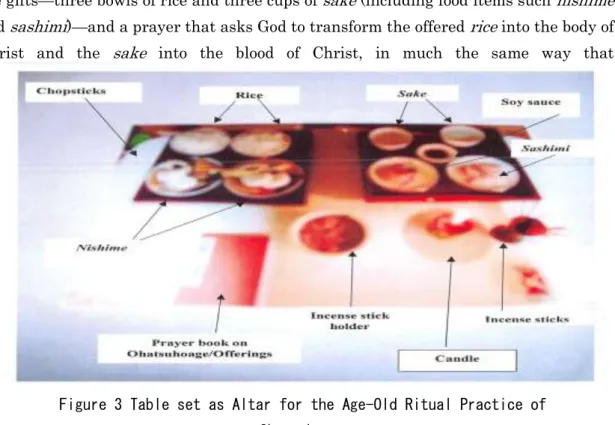
The climax of the Ohatsuhoage ritual activity integrally involves the consecration of the gifts—three bowls of rice and three cups of sake (including food items such nishime
and sashimi)—and a prayer that asks God to transform the offered rice into the body of Christ and the sake into the blood of Christ, in much the same way that
Figure 3 Table set as Altar for the Age-Old Ritual Practice of Ohatsuhoage
(Murakami Community) Photo by the Author, 31-10-2014
164
transubstantiation is effected in the Eucharist (see Figures 3).
As important, if not more so, is the Kakure Kirishitan believers’ substantial spiritual conviction that these two elements (rice and sake)—products of the land of the practitioners’ own righteous ancestors—correspond closely to the notion of bread and wine—without which this religious ceremony would lose its original, meaningful context and sense. This acute awareness of substituting patterns, which characterized the
Ohatsuhoage ritual event from its inception, is in line with Bloch’s (2005: 21-22) startling assumption that:
The ritual process is always focused on special type of substitution, where one thing ‘becomes’ another, in the same way as wine ‘becomes’ the blood of Christ during the Mass (Levi-Strauss 1962: ch.8). These transformations are not arbitrary. When one thing is changed into another, it is clear that some sort of empirical connection between the two still exists. It is commonality that is to be the channel for the achievement of ritual […] Ritual transformations depend therefore on connection that links different states and on difference sufficiently obvious to make the transformation worthwhile and arresting. Transforming wine into blood is typical of ritual; transformations of wine into whisky would not do. I view such transformative potential as the central fact of ritual symbolism.
The consecration of these food items is followed by an effective symbolic communal meal, whereby the ritual celebrant (who is the community formal leader commonly known as Chōkata 帳方) drinks first the consecrated sake (representing the blood of Christ) in distinct movements and passes it on to the co-participants. What happens is that he does the same for the consecrated rice (representing the body of Christ)—using chopsticks, which curiously comes in the end to vividly delineate both a reverse pattern of the communion service observed in the Eucharist and a cultural pattern of a traditional Japanese meal (whereby rice is commonly served at the end). This emphasis on ritually-prepared communal meal or sacrament (similar to the Christian Eucharist) thus culminates in a focus on collective spiritual gestures. Looked at more simply, the consecrated sake is first consumed, and then the consecrated rice is placed in the palm of the cupped left hand very similar to the way the Communion host is received in the hand in the present-day Catholic churches. The consecrated rice is then eaten directly from the palm without using the fingers.
It is important to consider that the Ohatsuhoage ritual activity is virtually always at the center of the distinctively religious activities of the Kakure Kirishitan communities studied. Moreover, it seems to be a characteristic of this ritual event that it symbolizes the mystical and social unit of its participants. Evolving from more psycho-religious
165
meanings and determinants, it has therefore become a specific religious setting whereby all community members are united by a great common heritage, religious and historical bonds, and cherished memories, narratives, and emotions, while at the same time sharing both repeated co-presence in the sacred space and a worldview, which in turn bring them imaginatively into interaction them with their righteous ancestors in faith. One can only speculate at this point, yet it is worth noting that when the Ohatsuhoage
ritual event is intelligibly performed at Christmas and Easter vigils, it almost becomes an ecstatic celebration of the highest sort, binding Kakure Kirishitan survivors together in a surprisingly real ‘holy communion,’ much in the same way as happens at the Catholic Mass. Seen from a historical perspective, consumption thus becomes, for Kakure Kirishitan practitioners, a single creative directional process which is sustained by the psycho-religious/spiritual aspirations and desires of their individual faith-based communities.
3-5-4.Symbolism and Implications
Often overlooked, the symbolism of religious forms (including the representation of the sacred) and member bonds have proved to be very important dimensions in the lived religious experiences and continuing struggles of Kakure Kirishitan survivors. This is unsurprising perhaps, as it tells us that the distinctively religious activities afford Kakure Kirishitan believers the opportunity to practice their persuasive religious patterns and all that entails (Munsi 2015: 273; 2016: 10). I argue that it is precisely in terms of all these persisting activity patterns of the Ohatsuhoage ritual practice and its attendant beliefs that Kakure Kirishitan survivors typically bring to the foreground their minority religion (labeled as “Japanized Catholicism”). The point can thus be made that the situated specific and interactive dimensions of this religious setting ultimately involve them in a collective sense of identity and heritage, sense of belonging (which together with the sharing of values, symbols, practices, obligations, emotions and memories created in this setting work to produce sense of “spiritual kinship”), religious/spiritual aspirations, and minimal survival in urban settings. By ‘heritage’, I refer more specifically to the embodied meaning of a congregation or community’s “sacred deposit from the past” (Son 2014: 108), while the term ‘identity’ merely denotes its “sentient” boundaries. Most essentially, the latter includes not only “history, myths, values, mores, beliefs, emotions, and traditions, manners of informal conversation”, but also “explicit sentiences as seen in its creed, constitution, by-laws, and mission statement and its particular history; implicit sentiences that “give more influential messages such as worship style, dress codes, friendliness or judgmental attitude” (Son 2014: 104-105). From the perspective of the event-centered ethnography, I would strongly suggest that the construction and interplay of the salient elements (material symbols of religious life and their emotional significance) of the Ohatsuhoage ritual activity largely translates
166
into actual practice what it is perhaps more appropriate to speak of as the significance positive intersection of identities and various forms of ritual resources. It also bears observing that the way these fundamental faith practices are perceived in this specific context is not only reflected in the Kakure Kirishitan survivors’ identity but also in their subsequent feelings toward specific locations within their specific prayers, ritual practices, and festivals. My sense from the field is that these time-persisting religious activities are significant in that community solidarity forged in the powerful and emotional moments sequentially allowed Kakure Kirishitan believers to learn the patterns of Orasho and of the Ohatsuhōage ritual practice, which often create the state from which potentially healing can emerge. With some exceptions, there has been very little theorizing about the specific links between these two fundamental faith practices of the Kakure Kirishitan survivors and the various measures of their well-being such as physical, mental, and emotional health. A detailed description and interpretation of the subject can be found in Munsi’s forthcoming (2019).
Turning to the results of structure and healing effects in this specific socio-religious setting, we should note, finally, that these further dimensions to Kakure Kirishitan practitioners’ faith practices highlight their shared conception according to which the
Orasho and the Ohatsuhōage ritual event embody and entrench power relations, being potentially functional for their well-being. This stems from the intriguing field-based realization that these fundamental faith practices, when used for health-directed prayer and modes of spiritual intervention can often heal them from the root, from the soul to the subtle body, to the physical body. In a similar sense, these two distinctively religious activities are therefore, following Koen’s formulation (2011), “used as potent practices of healing where beliefs in the supernatural or spiritual dimension frame the contexts where healing occurs”. During my ethnographic fieldwork I indeed came across many examples illustrating this statement. Tellingly, what I recorded includes diverse stories, many of which a modern scholar would probably be more comfortable in classifying as ‘folk literature” rather than as biography or hagiography. This synthetic review, in turn, leads us to the appreciation of the interactions between faith and healing among the Kakure Kirishitan survivors.
4.The Relationship between the Kakure Kirishitan Society and Healing
It is increasingly recognized that religious healing comes in many forms, from miraculous supernatural intervention, to the manipulation of metaphysical energies, to the proper ordering of healthy human relationships and societies. This can also be shown in many examples within Kakure Kirishitan society. From in-depth interviews, it transpired that the Kakure Kirishitan faith-based communities allow individual members to explore the meaning of their spirituality, minority religion, and personal
167
beliefs and to define and determine as clearly as possible, potential facets of their religiosity. Within that context, the connection of the Kakure Kirishitan practitioners to their respective faith-based communities has been identified and proven to be a protective factor in the individual healing experience. At the heart is the focus on spirituality. And it is arguable that prayers and rituals of Kakure Kirishitan believers constitute a highly significant part of the mechanisms through which their community interconnectedness operates in the different healing cases outlined and discussed below.
Remnants of Kakure Kirishitan communities are still scattered over Nagasaki settings, representing a significant religious phenomenon. Today, perhaps more than before, their minority religion has been on the whole highly regarded as a benign force of motivation to action and virtue, while their fundamental faith practices have been instrumental in enabling community connectedness to buffer effects of illness and the implication for divine intervention. Eventually, healing outcomes occur here both within the performative organization of the fundamental faith practices—liminal period, and in the contexts of meaning and action which extend around them—post liminal period. One might argue, in turn, that Kakure Kirishitan practitioners really discover, in this liminal context, their minority religion and tradition which, embedded in the socio-historical and religious/spiritual processes and contexts, significantly define and determine them.
We have known for some time that many Kakure Kirishitan informants significantly express a deep-felt sense of community belonging and a strong belief in the potential effect of their fundamental faith practices for health benefits. There is substantial evidence that a strong sense of community (sense of belonging, influence, integration and emotional connection) among individual members of Kakure Kirishitan faith-based community readily influences options for collaboration of their respective communities with other communities representing different religions. How then does it account for individual religious practitioners?
The truth (as many social scientists following Durkheim have indeed pointed out) is that religion is fundamentally a matter of community identity and belonging. Most believers do not convert to a faith; they are born into it. And neither is it that common outside Europe (and more recently America) for them to overtly reject their faith, even if their practice of it becomes more casual (Walters 2018: 3).
It is perhaps not surprising that Orasho (specific Catholic prayers) and the age-old ritual practice of Ohatsuhoage (a ritual substitute for the Eucharist) are considered among the Kakure Kirishitan survivors as powerful, determinative and credible, since they provide them with an important source of social coherence and psycho-religious/spiritual support. This, in turn, will reiterate the point that the power of these fundamental faith practices is evident in this dynamic interplay between the religiously
168
committed Kakure Kirishitan community and members. If individual members feel that they have contributed to the achievement of the overall spiritual goal, then the whole community benefits and healing is fostered accordingly. If the community is either thriving or in decline, or even disbanded, then it will be able to influence its individual members both physically and spiritually. This is a cycle that, at least in my opinion, will continue as long as these seemingly integrated religious minorities stay intact and are successful in fulfilling their needs.
There is accruing evidence that a Kakure Kirishitan faith-based community that influences its individual members and has influential members and prominent figures may have a strong position in Kakure Kirishitan society, and may be able to combine religious forces with another community (preferably, another faith-based community because, like I said earlier, of their common goals). In this way, the re-incorporation of the Ōura community into Fukaura Community (Wakamatsu) in December 2011 is a case to the point. The Fukaura community can be, in this particular case, identified as “surviving’, simply because members have maintained their original corporate ownership and structure. While the Ōura community first experienced survival “in name,” because members have retained their “brand” after the death of their leader, prior to the death of its leader, Ōura Moriye (101 years old) on 4 February 2013, and secondly, it finds itself now in the state of “disappearing’, because its members’ religious activities have been absorbed into those of the Fukaura community (Munsi 2014:48). In addition to this is the tranquil and high centered Kirishitan shrine festivals held annually in Shimo-Kurosaki and Wakamatsu (Munsi 2011, 2014: 51-53, 2015: 270-273, 2018). As such, these religious events provide particularly fruitful examples of how such interfaith gatherings can give resources to and enhance the religiosity of the faith-based communities.
More significantly, the above-mentioned patterns purport to say how the present-day remnants of Kakure Kirishitan communities have especially empowered themselves personally, collectively, and spiritually by incorporating their specific religious experience. The psycho dynamics of these events reveal striking patterns determining religious traditions in urban settings, allowing us to study them as “religious emotional regimes characterized by balanced dialectical connections between self, society and symbols (Riis/Woodhead 2012: 121). In any case, suffice it to emphasize here that collaboration between these two faith-based communities, or among more than two religious communities, may be difficult at the beginning (e.g. the crisis of the Karematsu Shrine festival accurately described by Munsi 2018) because members may be wary of the others’ differences (or what appear to be differences). Opportunity for trust building must continuously take place so that the two or more communities begin to see each other as one.
169
and experiences of the healing effects of the fundamental faith practices make Kakure Kirishitan believers implicitly encourage Kakure Kirishitan believers in their own spiritual identity. It is precisely in this way that they tend to reconcile their sense of the sacred and express the Kakure Kirishitan faith, both in private and public sphere. We may also note that such experience often makes them come away with a heightened awareness of the spiritual dimension in lived-religious experiences and an awareness of the mysterious divine in their least restricted environment. Allowing Kakure Kirishitan practitioners not only to tell their story but also to explore it in a way that encompasses fundamental faith practices can be healing psychologically, emotionally, and spiritually. Asking questions about their relationship with the Divine and how this relationship helps to heal or hurt therefore enables us to further inquire about their core religious beliefs and faith systems. Each of the healing experiences and stories of Kakure Kirishitan patients both emphasizes the potential power of their contemplative practices and prayers and fits squarely into physical and spiritual healing results, something that surpasses our understanding of the material and physical nature of our world. It is moreover not the case that healing is the sole feature or function of their minority religion but restoration of wellness and wholeness is a central component of their lived--religious experiences and minimal survival in Nagasaki settings.
Here more than one point of view has been apparent: the Orasho and the Ohatsuhōage
ritual event are defined and understood not just by their functionality, or even their healing properties—but they are fundamental faith practices with social and spiritual meaning, as they express the community’s highest aspirations. They reinforce in each of the Kakure Kirishitan practitioners the awareness that they are part of the faith-based community, which in turn makes them continue to learn about the connections between spirituality and healing, faith and spirit manifested in their present localities. It is part of my basic argument that Kakure Kirishitan practitioners in my sample group, believe in a God of supernatural miracles. This seems to be evident across their minority faith-based communities, though any attempt to understand such lived-religious beliefs and experiences as they relate to supernatural physical healing is often subject of much debate theologically and scientifically. For these seemingly integrated religious minorities, however, such a debate appears to be a minor, almost peripheral concern. I would agree nonetheless that if we look more closely at Kakure Kirishitan practitioners in my sample, we will find that they seem, much more like the Merina of Madagascar studied by Bloch (1989: 122-123): “little interested in what their beliefs consist of, they are horrified at the suggestion that those beliefs, whatever they might be, would not be totally shared by everybody”.
Between 2008 and 2018, I conducted a survey to examine closely the healing experiences of 30 Kakure Kirishitan practitioners from three religiously active communities in Shimo-Kurosaki, Shitsu and Wakamatsu. I focused mainly on these
170
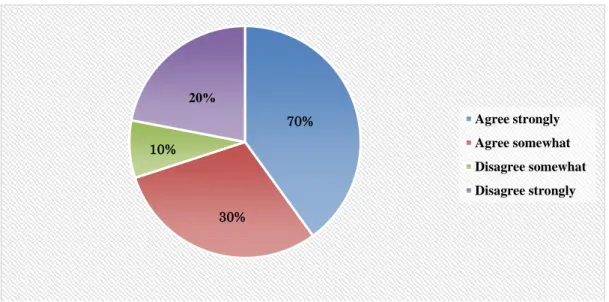
particular faith-based communities because I initially during my pilot study looked at what they were about (their joint enterprise as understood and continually renegotiated by their members), and how they did function (the relationships of mutual engagement that bind members together into a socio-religious entity), and what capability they have produced (the shared repertoire of communal resources—routines, sensibilities, artifacts, scripts, vocabulary, symbols, styles—that members have developed over time. The first part of the data was collected with attention paid to the degree of healing results through the divine intervention experienced by Kakure Kirishitan patients themselves and witnessed by their community members. It transpired that the majority (70%) of Kakure Kirishitan practitioners indicated their belief in supernatural healing through their fundamental faith practices. This majority was made up equally of those who either strongly (40%) or somewhat (30%) agree that it is possible to be physically healed supernaturally by God through the intercession of the righteous ancestors in faith. The remaining one-third (30%)—most of them young practitioners who either received Infant baptism or adhered to Kakure Kirishitan communities through marriage—were skeptical, amounting to those who either strongly (20%) or somewhat (10%) disagree (see Figure 4).
On the surface, it transpired that Kakure Kirishitan practitioners from Shitsu district experienced less supernatural healings than those from Shimo-Kurosaki and Wakamatsu who recorded many supernatural healing experiences within their communities and surroundings. In this we see clearly the particularity of the Kakure Kirishitan worldview in which the visible world of human experience and the invisible world of the spirits and God exist along a continuum and form an organic reality. Equally these quantitative findings delineate how Kakure Kirishitan practitioners live
70% 30% 10% 20% Agree strongly Agree somewhat Disagree somewhat Disagree strongly
Figure 4 Proportion of Belief in Supernatural Healing among the Kakure Kirishitan Survivors
171
significant religious experiences and share naturally the deep convictions that induce them: Heaven often answers them in a most unexpected way. Thus, ironically, it may be argued that these convictions are so taken for granted that they are seldom articulated. Yet, they infuse every aspect of the Kakure Kirishitan practitioners’ fundamental religious forms or ritual processes by which ideology is created both individually and historically. Quite simply, it seems that their individual and collective piety, religious aspirations and expectations somehow rely traditionally on the judgments rendered about the divine grace and miracles in the Roman Catholic Church’s teaching, preaching and theology.
Another part of the data collection was designed to determine the prevalence of the use of healing prayer in response to a medical issue. In findings from this interview survey of Kakure Kirishitan practitioners in Shimo-Kurosaki and Shitsu which asked respondents to select from a lengthy list of ‘‘therapies and treatments’’ that they had used in the past year, 40 % reported using ‘‘spiritual healing’’ by others’’ and 60 % reported using ‘‘prayer’’. Both categories, however, confessed to having often combined their belief in supernatural healing with ordinary medical treatment. There was no mention of any kind of physical exercise as a suitable therapy. Our follow-up 2014 survey, however, found that the past-year prevalence of ‘‘spiritual healing by others’’ was now 35 % and ‘‘self-prayer’’ was now 65 %, perhaps due to the aforementioned decline in membership. In the 2018 interview survey it transpired that 70 % of Kakure Kirishitan practitioners of my sample clearly indicated a lifetime prevalence of healing prayer for either their own sake or for individual members’ health benefits, while 30% emphasized the importance of having a healing ritual or “sacrament” performed for one’s health. One important predicator to consider in these data is that most respondents were over 40 years old and aging persons predominated. The practitioners’ belief in the healing power of their fundamental faith practices brings substance to their prayers and ritual practices, which in turn reaffirm the community’s social, psycho-religious and spiritual cohesion. And whenever healing occurs within individual Kakure Kirishitan households it takes the form of enhancing consciousness, as the two fundamental faith practices —Orasho and Ohatsuhoage ritual practice—bring their participants into contact with the supranational beings (Trinity, Blessed Virgin, and righteous ancestors in faith).
A final part of the data collection focused on the degree of health security that Kakure Kirishitan practitioners felt themselves to have. Individual members who remained active within their respective faith-based communities were differentiate d between those who described their presence and participation in prayers and rit uals as “very secure” or “secure” , and those who regarded it as “insecure or very insecure”. Those who were not religiously active within communities were divide d between those who said they were seeking an alternative religious denominatio
172
n, such as conversion to either to Buddhism or Catholicism, and those who were not. Thus, there were four categories: (1) secure-participation; (2) insecure-parti cipation; (3) non-participation; and (4) permanently removed from the community’s commitment. I tried to determine whether change in illness between the intende d sampling and follow-up differed between respondents in the four categories of r eligious participation after 17 March 2015, when the local Catholic Church celebr ated the 150th anniversary of the return of many underground Christians (Senpuk
u Kirishitan) on the 17 March 1865, following the confession of Bernadette Sugim oto and his companions in the presence of the Paris Mission Priest, Fr. Bernard-Thaddée Petitjean (1829– 1884) in Ōura Catholic Church (Nagasaki). In so doing, I purposely used secure-participation as a referential group. The proportions in e ach of the four religious participation categories were as shown in the following f igure 5:
These quantitative findings provide us with important insights into the relationship between health status and religious practices, but they tell us little about the actual experiences of those involved. More specifically, they do not explicitly help us to fully understand how Kakure Kirishitan practitioners manage and negotiate their fundamental faith practices and health benefits within their specific environments. With this said, while much can be gleaned from our survey results, we are dealing only with more subjective feelings and emotions of the Kakure Kirishitan believers involved. In addition, it should be admitted that our data collection methods here initially provided respondents with a limited number of response options. Still, much study is needed in this area to determine how they perceive, interpret and explain what is really happening around them. For this, qualitative methods (in-depth semi-structured interviews, narrative interviews, direct observations) somehow provided us with a deeper and richer source of data. Clearly I cannot examine all such empirical data gleaned from different Kakure Kirishitan communities. In what follows, however, I propose in the limits of space, to offer a general understanding of them by outlining only four single case studies, which are of central importance in this article. They signify four different striking
Religious participation Number %
Secure-participation 60 75
Insecure-participation 10 12.5
Non-participation 8 10
Permanent exit from Kakure Kirishitan community 2 2.5
Total 80 100
Figure 5 Proportion of the relationship between Religious Participation and Health Security
173
narratives gleaned from four different settings (hospital, home, and the temple) that offer us useful insight into the claims made above.
5.Divine Intervention as a Potent Mechanism for Healing
My focus here is particularly on the use of health-directed prayer and other modes of spiritual intervention for purposes of healing, for oneself and for others. I will then examine its social, psycho-religious and spiritual implications for Kakure Kirishitan practitioners.
Case Study 1 Healing of Fukaura Fukuemon (Wakamatsu)
I what follows, I shall recount the story of Kakure Kirishitan survivors in Shinkamigoto, more precisely in Wakamatsushima (present-day Wakamatsu-chō), using a somewhat unconventional scheme, in which faith and health are intertwined. The area had its share of Christian martyrs, such as Callisto (Kuemon), who was arrested and beheaded in 1624; an account is given in The History of Christianity in Goto by Urakawa Kazusaburō. Christians suffered martyrdom in Tabuto, a place-name that has not survived. According to my informant, an old man, Tabuto was located behind the present-day City Hall of Wakamatsu. A monument to these martyrs was erected in 2001 at the Doinoura Catholic Church. The traces of the persecuted remain all over the islands.
Kakure Kirishitan survivors migrated to the region seeking to preserve their faith even at the cost of abandoning their homelands. But the new locations were not really safe either, and the inhabitants despised them. Consequently they had a difficult struggle to find land between the mountains. When freedom of religion was given throughout the country in 1873, a great number of the descendants of the migrated Kakure Kirishitan practitioners in this area chose, surprisingly, to become Buddhists, while a small number converted to Shintoism. Converts to Catholicism were few, perhaps for financial reasons. In the Catholic Church it was required that they contribute money, whereas in the Shinto shrines one only needed to pay for amulets, and in Buddhism there was no charge at all, except on the occasion of burial.
The following is excerpted from interviews I conducted on 6 November 2008 with Fukaura Fukuemon, the eighth Taishō (大将, formal leader) of the Kakure Kirishitan community in Wakamatsu:
Around 1628 my ancestors, a couple names Kajirō and Ume, left Omura village for Tsukiji to escape the persecution of Christians ordered by the local authorities. After much hardship on the sea they finally arrived in Tsukiji (present-day Wakamatsu-chō). The present-day Kakure Kirishitan families or practitioners in Wakamatsu are all descendants of those early migrants.
174
God defends and protects me, and I am really grateful to him. I think that my life has been safe because I always pray to Deus (God) and Maria (Blessed Virgin Mary). This conviction was strengthened during World War II and again by recent events. On 4 October 1946, when I was 27 years old, I was demobilized from the south. Before I left the Malayan Peninsula, we were heavily bombarded by the USA army. During the bombardment I was hiding in a small hole in the form of a cone. When I realized that the attack was over, I came out, but the American offensive suddenly restarted. In that confusion, a bullet penetrated my iron-mask struck me just left of my eyes. I was really scared. Then when we were pulling out, my uncle, Fukaura Fukumitsu, was shot in his left arm and thigh. He had to be carried by four soldiers. As the attack became violent, some wanted to leave him and flee but one soldier said, ‘We must not abandon him; keep on holding him.’ This soldier’s reaction saved my uncle.
Regarding the recent events, I was hospitalized on 21 December 2007, with swellings about the size of a coin in my chest. They released me from the hospital after reducing the dose of medication, and now there is nothing at all. That also, I believe, was a grace from Deus and Maria. I requested to sleep out in order to conduct the Prayer of Christmas, but the hospital only left me out during the day, not at night. During my hospitalization, I thought of death, and said to myself: ‘As I approach death, I will become a Catholic. I want to go in the other world and enjoy eternal life with Jesus Christ. Because Jesus is the child of Maria, is he not?’
Then, on 22 December 2007, I presided over the ceremony of the delivery of an heirloom of mine, a secret statue, said to be of Jesus, which I had kept for decades at home. It is now in the keeping of Sakai Yoshihiro, Taishō (formal leader) of the Fukaura community. Fr Teruaki Asada, originally from Kurosaki Catholic Church (Archdiocese of Nagasaki), paid me a visit at the hospital, and suggested that I receive baptism next year. So now I am memorizing the Our Father [The Lord’s Prayer]. Both Fr Teruaki and my eldest daughter have been teaching me the basic principles of Catholicism.
Items such as the Takarazōsho, two books of Orasho left by his righteous ancestors, and the Shishikioboegaki constitute the treasure of Fukaura Fukuemon. The turning point of their spiritual life nonetheless came on 18 June 2009 when Fukaura Fukuemon and his wife Fukaura Tsuyako were baptized by Fr Teruaki Asada, taking the Christian names Johannes and Maria. The whole conversion process took them many months. The
striking account that Fukaura gave me was theologically oriented towards what it means
to be a good Christian, and the grace that God reserves for those who accept Him in their
life (Munsi 2011: 176-177). This brings us to the second, and perhaps most interesting
175
Case Study 2 Healing of Sakai Yoshihiro (Wakamatsu)
The striking story of Sakai Yoshihiro, whom I met on 14 May 2008 and later subsequently interviewed, has not yet received a great deal of attention in the ethnographic research literature. It is noteworthy that after a decade I felt the need to revisit it in this section. Much more can be said of its fundamental contours, but for the purpose of the holistic understanding of the concept of “healing” entailed in the present analysis two features in particular stand out. First, based on existing reviews and assessments, it not unlikely that his healing could eventually be seen as the experienced improvement in relation to the past. A second consideration for Sakai’s case is that his complete healing is very much associated with acceptance of a more Kakure Kirishitan religious (Christian) orientation in his life experience, with significant facets, religious patterns, circumstances and conditions needing further research.
A fisherman by profession, Sakai Yoshihiro is a convert from Pure Buddhism to Kakure Kirishitan faith, something unusual in Kakure Kirishitan society. It is recorded that he was baptized as Domegos [Domingos] by Taishō (大将, community formal leader) Fukaura Fukumitsu in December 1976. He is married to Sakai Suzuko, daughter of Fukaura Fukumitsu, the seventh Taishō (formal leader) of the Kakure Kirishitan community in Wakamatsu. On June 8, 1998, Fukaura Fukumitsu died at the age of 86. He was immediately succeeded by Fukaura Fukuemon (see case study 1) who worked hard for the survival of the community, which had a high level of cohesion. On September 20, 2007, when Fukaura Fukuemon turned 87 and decided to retire from the office of Taishō (formal leader), the members realized that there was nobody available to take over the leadership of the faith-based community. The Kakure Kirishitan rules require that only a baptized man can become Taisho, so Sakai Suzuko was not qualified to take over the leadership of the community. As weeks passed, worry grew that the selection process would take too long and that events or ceremonies would have to be postponed. One day an idea surfaced. They asked Sakai Yoshihiro to take over the office of Taishō (大将, community formal leader). He was reluctant at first, as he had been diagnosed with liver and stomach cancer and the latest medical checkup showed that his case was worsening. His doctor had told him he might survive for about six months, and since then he had been preparing for death. Coupled with this concern was his acute awareness of the fact that, coming from a Buddhist family background, his knowledge of Kakure Kirishitan faith was limited.
However, Kakure Kirishitan survivors repeatedly insisted that they really felt he was the one most suited to be Taishō, even if only for six months. Sakai Yoshihiro started to be aware that something might lie behind such an appeal. Meanwhile he could see— through the spiritual life of his wife Suzuko and other community members—that