
流体シミュレーションによる炎の形状制御
3
0
0
全文
(2) Vol.2014-CG-155 No.8 2014/6/28. 情報処理学会研究報告 IPSJ SIG Technical Report. 図 2:シミュレーション空間 れた位置の密度を引き寄せるために目標密度 ρ~ * で割るこ. 図 1:提案手法の概要. とで規格化を行う. りつける.また,シミュレーション空間の下端中央に炎を 発生させる領域(ソース)を配置する.毎ステップの処理は 以下のようになる.配置したソースに鉛直上向きの速度と 温度を与えることで炎の発生を疑似的に表現する.その後, シミュレーション空間内の速度場および温度場を文献[7] の方法を応用して計算することで炎をシミュレーションす る. 2.2.. 2.3.. 制御力の調節. 炎は目標形状に沿って発展するため,目標密度から離れ た位置では driving force の効果はほぼない.加えて,炎に は強い浮力があるため,熱源の温度などの影響により,炎 が目標形状を越えてしまうことがある.これを防ぐため, シミュレーション空間全体で一定であった driving force の 係数 νf の代わりに,各格子点でその大きさを変化させた係 数 νf (x)を用いる.これは図 4 に示す累積分布を計算するこ. 流体の運動制御. 炎の運動制御を行う driving force は,図 3 に示すように,. とにより得られ,以下の式で与えられる.. 指定した目標密度に炎を一致させるような流れを生み出す 外力である.この項は流体運動の速度場を表現する N-S 方. ν (f n ) (x) = k f ρcu( n ) (x)ν (f n−1) (x) ,. (2). 程式に外力項として付加され,目標密度分布を用いて各タ イムステップにおいて発展していく密度分布を元に計算さ れる.以下にその構成過程を示す.driving force は以下の式. ここで kf はユーザにより指定される制御係数,ρcu(x)は差分 累積分布である.これは以下の式であらわされる.. で表される.. ∇ρ~* ~ F ( ρ , ρ ) = ν f ρ ~* , ρ *. (1). ρ は各タイムステップでの密度,ρ*はユーザが設定する目 標密度を表す.νfは driving force の大きさを調節するため の係数である. ρ~ および ρ~ * は,それぞれ,ρ および ρ*に対 して,ガウス関数との畳み込みを行ったものである.目標 密度の勾配∇ρ*は目標密度の値が大きい方向を常に指す. そのため,F は目標密度方向への流れを生み出すことにな る.ここで,F = 0 となる場所ができてしまうことを避ける ために,∇ρ* ではなく∇ ρ~ * を用いる.次に, driving force が適用される位置を密度 ρ が存在する範囲の周辺のみに限 定するため,F を ρ~ に比例させる.また,目標密度から離. ⓒ 2014 Information Processing Society of Japan. ρ cu( n ) (x) = {ρ bi (x) − ρ * (x)} + kc ρ cu( n −1) (x) , . ρ bi (x) = . 1 (T (x) ≥ Tth ) 0 (T (x) < Tth ). (3) (4). ,. ここで,kc は累積係数,ρbi(x)は温度を閾値として設定し, 温度を二値化することで得られる炎の二値分布である.こ こで,Tth は実験的に決定した温度の閾値である.ρbi(x) ρ*(x)が負の場合は0を設定し,累積係数は0から1までの 値を設定する.driving force の係数は累積分布に比例し,kc の値を大きくすると,差分累積が大きい場所の driving force がより強くなる.これにより,炎が目標形状を越えて移動 してしまうことを防ぐ.. 2.
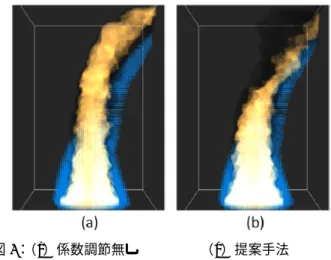
(3) Vol.2014-CG-155 No.8 2014/6/28. 情報処理学会研究報告 IPSJ SIG Technical Report. 図 3:driving force による外力 図 4:差分累積分布の生成過程. 3. 実験結果 提案手法により制御された炎のシミュレーション結果を 図 5 に示す.目標形状は Y 字形状を設定し,シミュレーシ ョン空間の格子数は 64×64×96 である.実装環境は CPU:. Intel Core i7 3.50GHz,GPU:NVIDIA GeForce GTX 780,メ モリ:8.00GB,グラフィックス API:OpenGL である.累 積係数 kc は 0.95,閾値温度 Tth は実験的に決定した 0.4 に設 定している. 提案手法により driving force の係数が自動的に調節され. 図 5:Y 字形状に制御された炎のシミュレーション結果. た例を図 6 に示す. (a)が提案手法を用いない場合で, ( b) が提案手法である.目標形状は青色の点で示している.図 に示すように, (b)の炎の形状の方が(a)の炎の形状より も目標形状により近いことが確認できる.. 4. まとめ 本論文では,流体解析に基づいた炎の動きの制御手法を 提案した.提案手法では,炎の形状と目標形状との差分の 累積分布を計算することにより,driving force の係数を局所 的に調節した.これにより,炎がユーザの指定した形状に 沿うアニメーションの生成が可能となった. 本手法では driving force のみを用いて炎のシミュレーシ ョンを制御した.今後の課題として,より複雑な形状への. 図 6:(a)係数調節無し. (b)提案手法. 制御のために浮力を自動調節することなどが挙げられる.. Alfred R. Fuller, Hari Krishnan, Karim Mahrous, Bernd Hamann, and Kenneth I. Joy. Real-time procedural volumetric fire. In Proceedings of the 2007 Symposium on Interactive 3D Graphics and Games, I3D '07, pp. 175-180. 6) R. Fattal and D. Lischinski, Target-driven smoke animation, In Proceeding of ACM SIGGRAPH 2004, pp. 441-448. 7) D. Q. Nguyen, R. Fedkiw, H. W. Jensen 2002, Physically Based Modeling and Animation of Fire, In Proceeding of ACM SIGGRAPH 2002, pp. 721-728.. 5). 参考文献 Jeong-MoHong and Chang-Hun Kim. Controlling fluid animation with geometric potential. In Computer Animation and Virtual Worlds (CASA 2004), Vol. 24, pp. 140-164, 2005. 2) Anitoine McNamara, Adrien Treuille, Zoran Popovic’, and Jos Stam. Fluid control using the adjoint method. In ACM Transactions on Graphics, pp. 449-456, 2004. 3) Lin Shi and Yizhou Yu. Taming liquids for rapidly changing targets. In ACM SIGGRAPH/Eurographics Symposium on Computer Animation, pp. 229-236, 2005. 4) Arnauld Lamorlette and Nick Foster. Structural modeling of flames for a production environment. In Procedings of the 29th Annual Conference on Computer Graphics and Interactive Techniques, SIGGRAPH '02, pp. 729-735. 1). ⓒ 2014 Information Processing Society of Japan. 3.
(4)
図
関連したドキュメント
One dimensional classification problem is used for simulation to show the validity of adding one randomly selected data to a pair of the boundary data.. The location of the boundary
The test cases are used to test whether an implementation satisfies the specification and the property verified by the proof score1. Since a proof score involves impor- tant
By means of a simulation study the estimation method is compared by using a local polynomial kernel regression with the use of radial kernel functions in relation with the average
mathematical modelling, viscous flow, Czochralski method, single crystal growth, weak solution, operator equation, existence theorem, weighted So- bolev spaces, Rothe method..
Finally, we infer through a second simulation study that when the multidimensional data is fitted with a unidimensional model, the unidimensional latent ability is precisely
This paper presents a new wavelet interpolation Galerkin method for the numerical simulation of MEMS devices under the effect of squeeze film damping.. Both trial and weight
Next, using the mass ratio m b /m t 100 as in Figure 5, but with e 0.67, and e w 1, we increase the acceleration parameter to a sufficiently large value Γ 10 to fluidize the
A variety of powerful methods, such as the inverse scattering method [1, 13], bilinear transforma- tion [7], tanh-sech method [10, 11], extended tanh method [5, 10], homogeneous
