著者
Okabe Masayoshi
権利
Copyrights 日本貿易振興機構(ジェトロ)アジア
経済研究所 / Institute of Developing
Economies, Japan External Trade Organization
(IDE-JETRO) http://www.ide.go.jp
journal or
publication title
IDE Discussion Paper
volume
425
year
2013-08-01
to stimulate discussions and critical comments
Keywords:
Secondary education; Education reform; Human development;
Poverty; The Philippines
JEL classification: O15, I21, I28, I31
* Research Promotion Department, IDE. Email: [email protected]
IDE DISCUSSION PAPER No. 425
Where Does Philippine Education Go?
The “K to 12” Program and Reform of
Philippine Basic Education
Masayoshi OKABE*
August 2013
Abstract
In 2012 the Philippines launched its “K to 12” Program, a comprehensive reform of its basic education. Through this reform, the Philippines is catching up with global standards in secondary education and is attaching a high value to kindergarten. The structure, curricula, and philosophy of the education system are undergoing reform and improvement. The key points of the new policy are “preparation” for higher education, “eligibility” for entering domestic and overseas higher educational institutions, and immediate “employability” on graduating, all leading toward a “holistically developed Filipino”. This policy appears admirable and timely, but it faces some pedagogical and socioeconomic problems. The author wants to point out in particular that the policy needs to address gender problems and should be combined with demand-side approaches in order to promote poverty alleviation and human development in the Philippines.
The Institute of Developing Economies (IDE) is a semigovernmental,
nonpartisan, nonprofit research institute, founded in 1958. The Institute
merged with the Japan External Trade Organization (JETRO) on July 1, 1998.
The Institute conducts basic and comprehensive studies on economic and
related affairs in all developing countries and regions, including Asia, the
Middle East, Africa, Latin America, Oceania, and Eastern Europe.
The views expressed in this publication are those of the author(s). Publication does not imply endorsement by the Institute of Developing Economies of any of the views expressed within.
INSTITUTE OF DEVELOPING ECONOMIES (IDE), JETRO 3-2-2, WAKABA,MIHAMA-KU,CHIBA-SHI
CHIBA 261-8545, JAPAN
©2013 by Institute of Developing Economies, JETRO
No part of this publication may be reproduced without the prior permission of the IDE-JETRO.
1
W
HERE
D
OES
P
HILIPPINE
E
DUCATION
G
O
?
T
HE“K
TO12”
P
ROGRAM ANDR
EFORM OFP
HILIPPINEB
ASICE
DUCATIONM
ASAYOSHIOKABE
*August 2013
Abstract
In 2012 the Philippines launched its “K to 12” Program, a comprehensive reform of its basic education. Through this reform, the Philippines is catching up with global standards in secondary education and is attaching a high value to kindergarten. The structure, curricula, and philosophy of the education system are undergoing reform and improvement. The key points of the new policy are “preparation” for higher education, “eligibility” for entering domestic and overseas higher educational institutions, and immediate “employability” on graduating, all leading toward a “holistically developed Filipino”. This policy appears admirable and timely, but it faces some pedagogical and socioeconomic problems. The author wants to point out in particular that the policy needs to address gender problems and should be combined with demand-side approaches in order to promote poverty alleviation and human development in the Philippines.
Keywords: Secondary education; education reform; human development; poverty; The Philippines JEL classification: O15, I21, I28, I31
I. INTRODUCTION
The Philippines has long been famous for its high level of education (Nakanishi 1990). After Spain colonized the islands, more than a few institutions of higher education were established1 (Tandora
This paper is relevant in part to my presentation at IDE’s APL seminar dated November 26, 2012. I am grateful for the then moderator Yuya Kudo, Microeconomic Research Studies Group, Development Studies Center, IDE-JETRO, and all the participants who gave me useful comments. And I am grateful to Yurika Suzuki, Southeast Asian Studies Group I, Area Studies Center, IDE-JETRO. Her 2011 paper and my later talks with her stimulated my thinking on this topic. Also I would like to express gratitude to Professor Mikiko Nishimura, International Christian University, who commented in the Practicum on Human Security at University of Tokyo on the topic of this paper. However, all errors and mistakes are mine, and I still need to make an empirical study. Needless to say, all views and ideas expressed herein are my own and do not reflect those of my affiliations.
2
2003). During the 20th century under US rule, the Philippines absorbed the American system of formal education (Tandora 2003). Thereafter enrolment in higher education was relatively high compared with other Southeast Asian countries. This trend seems to be continuing even in the 21st century.
On the other hand, basic education in the Philippines has been a problem. As will be shown in the next section, access to primary schools through the Education for All (EFA) policy has experienced a setback. At the same time access to and the level of enrolment in secondary education has remained almost the same. Other problems include the dropout rate and congested curricula as a result of the number of courses that schools must cram into their curricula in order to fulfill the mandated educational requirements. But along with the need to increase access to basic education, the Philippines also has to improve qualitatively or pedagogically what students learn.
In 2012 the Philippine government declared the start of a fundamental overhaul of the country’s educational system under a policy called the “K to 12” Program. It is “the most comprehensive basic education reform initiative ever done in the country since the establishment of the public education system more than a century ago”2 (SEAMEO INNOTECH 2012: Message from the Department of Education). What content does this reform contain? Why is this reform the most comprehensive? What are the expectations for Philippine education? Since this reform program has just begun, it is not yet possible to answer these questions comprehensively. This paper will not seek to evaluate the reforms. Rather its purpose is to marshal the contents of the reform program and examine them from a development perspective in order to interpret the thoughts and ideals underlying the program.
This paper is organized as follows. Section II examines the situation for access to basic education in the Philippines prior to the start of the “K to 12” Program. Without knowing that situation, we
1
Most of those institutes were for the purpose of training clergy.
2 Aside from this new program, possibly the biggest change in education was the reform of the Philippine
3
cannot examine the new policy. Section III briefly explains the “K to 12” Program, describing its key features and comparing it with the existing state of education. In section IV I seek to interpret the reform program from the perspectives of comparative education, pedagogy, and socio-economics. Here I focus especially on the globalization of education, on language as teaching medium, and on the effect of human development. Section V, the final section, discusses education and human development in the Philippines.
II. ACCESS TO BASIC EDUCATION
The Philippine has acknowledged the international framework for educational development set forth under the concept of Education for All (EFA) and the Millennium Development Goals (MDGs). Since the 1990s the global community has concentrated on issues related to poverty alleviation and human development. This effort has shifted the role of education toward human development. Moreover, in 1994 the related concept of human security was introduced internationally in the Human Development
Report 1994 of the United Nations Development Program (UNDP). This report emphasized the value
of education for promoting freedom from fear and want. In short, education is a key element to empowerment.
The Philippine government has sought to disseminate education to the Filipino people. The reform of the Constitution of the Philippines in 1987 mandated basic education. Primary education in public schools was made free and compulsory, and secondary education in public schools also became free (although not mandatory). Whether one were rich or poor, it was expected that this constitutional reform would give the Filipino people easier access to basic education.
4
A. Enrolment Ratio
Figure 1 shows the nationwide net enrolment ratio (NER) in primary education in the Philippines over the past two decades. It stood at about 98% in 1990 indicating that by then universal primary education by and large had been accomplished. Figure 2 provides the nationwide NER for secondary education. In 1990 the percentage was in the mid 40s; in 2009 it had moved up to the mid 50s, indicating that over the 20 years there was only a slight increase in secondary education enrolment3.
The figures also show that in primary education the NER has been decreasing over the past two decades while in secondary education it has increased slightly. The aim of the EFA and MDGs is the universalization of access to education for all children by the year of 2015, but in the Philippines the trend of access to primary education has been away from this aim; however, access to secondary education has improved. A possible reason for the opposing trends is that students in some social strata have gained better access to secondary educations while most other students have failed to progress in their education. In order to investigate this possibility, further empirical study will be needed. Meanwhile in the Philippines as the year 2015 approaches, the trend in access to primary education is moving away from the EFA goal.4
3
Twenty percent of high school students go to private schools (see Figure 2). The “K to 12” Program covers only public schools. Thus, the students who go to private schools are, in principal, outside of the “K to 12” Program’s new philosophy, ideals, and curricula.
4
Moreover, Balisacan has pointed out that the cohort survival rates in the Philippines for public primary and secondary education, which shows the educational progress of students, barely rose over the 20 years of the 1980s and 1990s (Balisacan 2003: 289). Thus not only access but also educational progress in the Philippines seems to have faltered.
5
Figure 1: Net Enrollment Ratio (NER), Primary Education, 1990-2009
Source: World Development Indicator (various years)
Figure 2: Net Enrollment Ratio (NER), Secondary Education, 1990-2009
Source: World Development Indicator (various years)
B. Literacy Rate
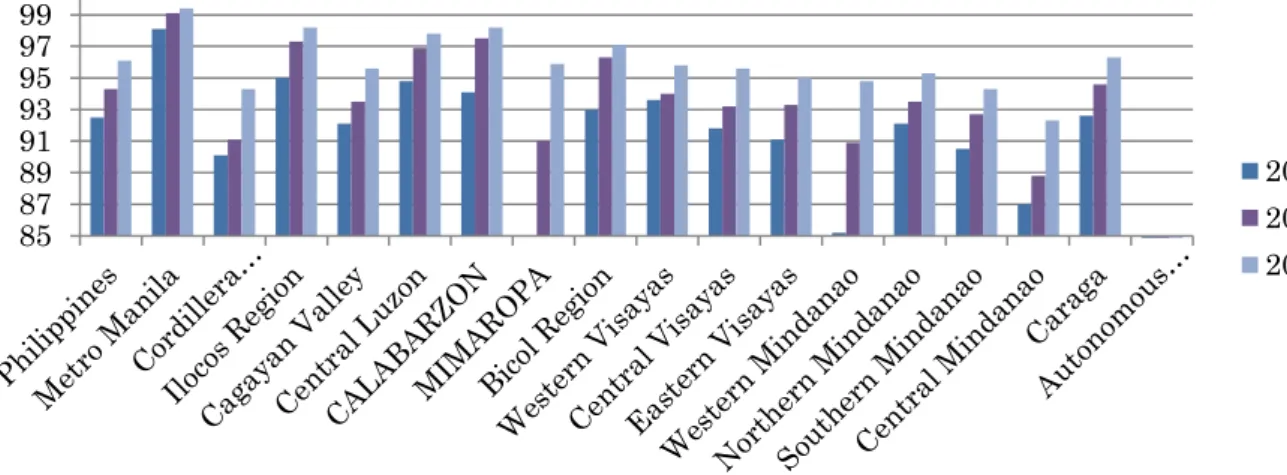
From Figure 3 we can see that the literacy rate in youth for the Philippines is well over 90%, meaning that the country is a literate society. The figure also indicates a gender difference with the literacy rate for females being higher than for males.
Figure 4 shows the geographical variation in literacy rates. The National Capital Region (NCR)
80 85 90 95 100 1990 1991 1998 1999 2001 2002 2003 2004 2005 2006 2007 2008 2009 Male+Female Female Male 0 10 20 30 40 50 60 70 80 1998 1999 2001 2002 2003 2004 2005 2006 2007 2008 2009 Male+Female Female Male
6
has the highest rate while the peripheral areas, such as the regions of Mindanao Island, have relatively low rates. Although the literacy rate has been improving overall, there still remain urban-rural and central-peripheral disparities.
Figure 3: Literacy Rate 1990-2008
Source: World Development Indicator (various years)
Figure 4: Basic Literacy of the Population Ten Years Old and Over,2000, 2003 and 2008 (%)
Source: NSCB (http://www.nscb.gov.ph/secstat/d_educ.asp)
C. Comparison of Education by Income Stratum, Region (Rural-Urban), and Gender
Table 1 shows the rate of education in 2010 by region, income stratum, and gender for the
91 92 93 94 95 96 97 98 99 1990 2000 2003 2008 85 87 89 91 93 95 97 99 2000 2003 2008
■ 15-24 aged population (male)
7
population five years old and over by highest grade completed. The top half of the table presents the rates for the Philippines nationwide while the bottom half has those for the NCR.
Table 1: Percentage of the Population Five Years Old and Over as Measured by Highest Grade Completed (based on Region, Income Stratum, and Gender in 2010)
Region and
Highest Grade Completed
Income Stratum (percent distribution)
Both Income Strata Lowest 30% Highest 70%
Both Male Female Both Male Female Both Male Female
Philippines
Total 100 100 100 100 100 100 100 100 100 No grade completed 4.9 5.2 4.7 8.9 9.3 8.4 2.7 2.9 2.6 Pre-school 3.2 3.3 3.1 4.0 4.1 3.9 2.7 2.9 2.6 Elementary not completed 23.3 25.2 21.4 34.5 37.2 31.7 16.9 18.1 15.8 Elementary completed 12.7 12.9 12.5 16.2 16.4 15.9 10.8 10.9 10.7 High school not completed 15.0 15.0 15.0 16.9 15.9 17.9 13.9 14.5 13.4 High school completed 18.6 18.1 19.2 14.0 12.5 15.6 21.3 21.4 21.2 Post-Secondary 2.6 2.7 2.5 1.0 0.9 1.1 3.5 3.7 3.3 College not completed 9.7 9.5 9.8 3.4 2.7 4.1 13.2 13.5 13.0 College graduate or higher 9.9 8.1 11.7 1.1 0.9 1.4 14.8 12.2 17.4
National Capital Region (NCR)
Total 100 100 100 100 100 100 100 100 100 No grade completed 2.2 2.4 1.9 6.1 8.4 3.9 2.0 2.1 1.8 Pre-school 3.4 3.8 3.0 5.3 5.3 5.3 3.3 3.7 2.9 Elementary not completed 14.5 15.2 13.8 24.6 23.8 25.4 13.9 14.7 13.2 Elementary completed 7.4 7.4 7.4 10.6 9.9 11.3 7.2 7.2 7.2 High school not completed 12.6 12.7 12.6 18.9 20.9 17.1 12.3 12.2 12.3 High school completed 23.4 23.9 23.0 25.1 23.3 26.8 23.4 23.9 22.8 Post-Secondary 2.4 2.5 2.3 2.4 3.5 1.4 2.4 2.4 2.3 College not completed 16.0 16.9 15.1 5.3 3.3 7.2 16.6 17.6 15.6 College graduate or higher 18.1 15.3 20.8 1.7 1.8 1.6 19.0 16.1 21.8
Source: National Statistics Office (2011) Annual Poverty Indicators Survey 2010.
For reasons of space, I have omitted the detailed information for regions other than the NCR. But the difference between the Philippines (nationwide) and the National Capital Region (urban capital)
8
represents the gap existing between the urban capital and rest of the regions, the latter being composed mostly of rural areas. The nationwide statistics indicate that one-fourth of the population over five years old has not completed elementary school, and after the post-secondary level the rates drop suddenly.
Looking at the effect of income on the rate of education, a higher percentage of the low income stratum fills the range up to the high school incompleted level, but from the high school completed level, the rate is higher for the high income stratum. The total rate for the low income stratum that completed high school or higher education is 19.5%; for the high income stratum it is 52.8%. Therefore, what we see in the low income stratum is a majority of people who have only completed primary education, who have had some but not completed secondary education, or who dropped out of school. In contrast to this, in the high income stratum we find people who have had easier access to higher education, or who have completed high school and gone on to higher education.
Looking next at the gap between central and regional areas, Table 1 shows that the rates of education nationwide (Philippines) for the levels from no grade completed to high school incompleted are higher than for the NCR, but the rates reverse from the level of high school completed and above. In other words, there are more high school graduates and more students who can access higher education in the urban center, the same phenomenon as we saw between the high and low income strata. Thus educationally, the separation between the high social stratum (those with high income and living in the urban center) and the low stratum (those with low income and living in peripheral areas) is greatest at the rate of completing secondary education. Students who live in lower income families or in peripheral areas are less apt to finish high school.
Regarding the gender difference in education, although the difference is not great, females tend to be more educated than males. This tendency is more clearly seen in the low income stratum where more females complete high school. The difference is even greater at the college graduate or higher
9
level (except for the low income stratum of the NCR). These findings indicate that at the lower levels of education, there are no particular advantages or disadvantages between male and female students, but at the upper levels a clear difference emerges with females getting more higher education than males.
Table 2: Gender Parity Index in Primary, Secondary, and Tertiary Education, 2001-09
Level 2001 2002 2003 2004 2005 2006 2007 2008 2009
Primary 0.9 0.9 0.9 0.9 0.9 0.9 1.0 1.0 1.0
Secondary 1.1 1.1 1.1 1.1 1.1 1.1 1.1 1.1 1.1
Tertiary 1.2 1.2 1.2 1.2 1.3 n.a. 1.2 1.2 1.2
Source: NSCB (2010).
Table 2 presents this difference in simpler terms. It shows the Gender Parity Index (GPI). The GPI measures the proportion of female students, given the proportion of male students as 1.0. If the GPI is less than 1.0, the proportion of male students is larger than for females; if the GPI is more than 1.0, the proportion of female students is larger. Table 2 reconfirms the gender differential in education that is shown in Table 1. At the primary school level, the GPI was 0.9 but over the years has moved up to 1.0. Meanwhile in both secondary and tertiary education, the GPI has remained larger than 1.0, showing that fewer boys than girls access higher education. Considering this gender gap in Philippine higher education, it will be necessary to comprehensively approach gender equality in schooling, especially paying attention to boys in their early adolescence.
III. EXPLANATION AND KEY FEATURES OF THE “K TO 12” PROGRAM
In this section we will take a close look at the “K to 12” Program and its key features to see how well it conforms to SEAMEO INNOTECH (2012).
10
A. Lengthened Secondary Education and Mandated Kindergarten
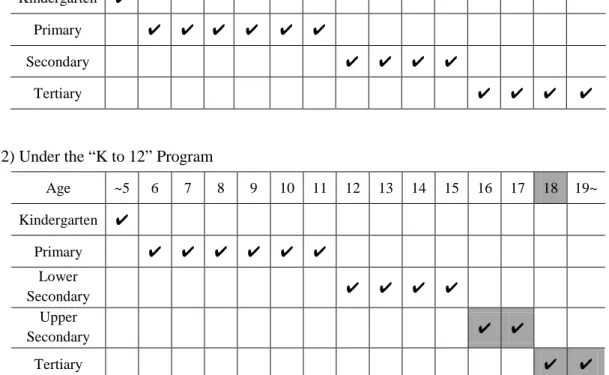
Under the “K to 12” Program, the length of basic education has been expanded. Two more years have been added to the existing four years of secondary education, which will extend basic education to 12 years, and one year of kindergarten has been mandated as part of basic education (Table 3). The extension of secondary education means that students aged 16 and 17, will now be in senior high school, and entry into tertiary education will be at age 18 (as highlighted in Table 3).
Table 3: The Philippine School System Prior to and Under the “K to 12” Program
(1) Prior to the “K to 12” Program
Age ~5 6 7 8 9 10 11 12 13 14 15 16 17 18 19~ Kindergarten ✔
Primary ✔ ✔ ✔ ✔ ✔ ✔
Secondary ✔ ✔ ✔ ✔
Tertiary ✔ ✔ ✔ ✔
(2) Under the “K to 12” Program
Age ~5 6 7 8 9 10 11 12 13 14 15 16 17 18 19~ Kindergarten ✔ Primary ✔ ✔ ✔ ✔ ✔ ✔ Lower Secondary ✔ ✔ ✔ ✔ Upper Secondary ✔ ✔ Tertiary ✔ ✔
Source: The K to 12 Basic Education Program, The Government of the Republic of the Philippines (http://www.gov.ph/k-12/)
The extension of secondary education through age 17 will bring the Philippines into conformity with the other countries of Southeast Asia. Its long-standing system with high school ending at age 15 has been a cause for many problems both pedagogical and socio-economic, e.g., the congested
11
curricula because of schools having had to cram many courses into their curricula in order to fulfill mandated educational requirements, the non-eligibility of graduates to immediately enter overseas tertiary educational institutes because of the younger age of Filipino high school graduates, and the ineligibility of graduates to take up employment immediately because of being under the legally employable age. Reform of the education system under the “K to 12” Program is expected to reduce these problems.
B. Features of the Curriculum
Lengthening secondary schooling by two years will help decongest the curriculum. Content that had to be taught within 4 years will now be taught over 6 years. The “K to 12” Program also makes possible the seamless continuity of education from kindergarten through elementary school to high school. Graduates will gain a high school diploma, and they can also acquire a Certificate of Competencies or a National Certification showing that they have acquired a mid-level of skill in their specialization when going on for higher education or getting a job.
The learning goal in the new “K to 12” curriculum is the acquisition of 21st century skills, notably (1) leaning and innovation skills, (2) IT and media skills, (3) effective communication skills, and (4) life and career skills (SEAMEO INNOTECH 2012). The aim is to bring about “holistically developed Filipinos with 21st century skills” who are ready for employment, have entrepreneurship, and who possess mid-level skills and higher education upon graduation from high school. Prior to the “K to 12” Program, two curricula were in effect: the Basic Education Curriculum (BEC) 2002 and the Secondary Education Curriculum (SEC) 2010. These two curricula aimed at promoting functional literacy and lifelong learning. With the new “K to 12” Program introduced in 2012, the aim is to promote holistic skill development leading to employment and higher education. The keywords of the “K to 12” Program can be summed up as “preparation” for higher education, “eligibility” for entrance
12
to overseas tertiary educational institutes, and lawful “employability.”
C. The Transition from the BEC/SEC to the “K to 12” Curriculum
The newly mandated kindergarten began in the School Year (SY) 2011-2012, and the new Grade 1 of elementary school and new Grade 7 (the first year) of junior high school started in SY 2012-13. In SY 2013-2014 Grade 2 and 8 are to start, and thereafter year by year Grade 3 and 9, Grade 4 and 10, Grade 5 and 11, and Grade 6 and 12 are planned to start. Thus the first cohort to complete elementary school and the first to complete secondary school under the new “K to 12” Program will graduate in the year 2018. Therefore, it will not be until 2018 that we can consider evaluating the “K to 12” reform.
D. Reforms at Each School Level
(1) Kindergarten
Republic Act No. 10157 (Act Institutionalizing Kindergarten Education into the Basic Education System and Appropriating Funds Therefor”) was enacted on January 20, 2012. This act declares,
“In consonance with the Millennium Development Goals on achieving Education for All
(EFA) by the year 2015, it is hereby declared the policy of the State to provide equal
opportunities for all children to avail of accessible mandatory and compulsory
kindergarten education …to sufficiently prepare them for formal elementary schooling.” 5
With enactment of the Act, kindergarten education is now free and mandatory. Kindergarten, i.e., Early Childhood Education (ECE), is the first level of the basic educational system. During early childhood, the brain grows up to 60-70 percent of adult size, so this period is crucial for a person’s
5
http://ledac.neda.gov.ph/Resources/RA%2010157%20Kindergarten%20Education%20Act.pdf (accessed July 28, 2013)
13
future physiological development and growth. For this reason and for children to be better prepared for elementary education, kindergarten is seen as highly important.
(2) Elementary Education
Unlike secondary education, elementary education has not been lengthened under the “K to 12” Program. However, the medium of instruction has changed significantly. It is now “Mother Tongue-Based Multilingual Education” for grades 1-3. The previous curriculum had provided for bilingual education, but “bilingual” referred to English and Tagalog. This did not always work well in the Philippine context. The country is multilingual/multiethnic. Tagalog, with 21.5 million speakers, is spoken over much of the main island of Luzon. However, Tagalog is not the only language spoken in the Philippines. There are more than 170 languages, the major ones being Cebuano (18.5 million speakers), Ilolo (Ilocano, 7.7 million speakers), Hiligaynon (6.9 million speakers), and Bikol (4.5 million speakers) (Ricardo 2008). Thus, non-Tagalog speaking children had difficulty or were burdened with additional costs when taking classes taught in English and Tagalog (Ricardo 2008). Besides their local language, they had to learn Tagalog and English as second and third languages in order to attend school.
Table 4: The Twelve Major Languages Serving as Teaching Language (Gr 1-3)
Tagalog* Cebuano Meranao Kapampangan Hiligaynon Chabacano Pangasinense Waray
Iloko Bahasa-sug Bikol Maguindanaoan Note: *Tagalog is an official national language besides English.
Source: SEAMEO INNOTECH (2012) p. 22.
The “K to 12” Program expands the number of local languages used as the medium of instruction in grades 1-3. Along with Tagalog and English, eleven other languages will be used (Table 4). This is
14
expected to better enable younger children to follow the classroom instruction. From grades 4 to 6, the language will shift to Tagalog.
(3) Secondary Education
The big change in the Philippine educational system under the “K to 12” Program is in secondary education. As discussed in section II, access to elementary school has largely been accomplished,6 but access to secondary education has not greatly improved. In the context of educational development studies, secondary education has tended to be less valued compared to elementary and tertiary education (Lewin and Caillods 2001).7 Elementary education has been emphasized because of the desire for universal education and the alleviation of poverty while the focus on tertiary education has been to promote industrial development and knowledge economies. Secondary education has been in between and its role less clear.
Under the “K to 12” Program, the value and role of secondary education has been revisit and
reevaluation and is going through significant changes and reform. These changes and reform are in structure, curriculum, and assessment (Table 5). The most visible change is the lengthening to six years and the division into junior and senior high school. Regarding curriculum and assessment changes, the new curriculum focuses on a “spiral approach” that highlights the building of knowledge on previously learned knowledge. Under the new curriculum, assessment will be based on an examination at the end of Grade 10 and Grade 12. This will replace the national assessment test that was taken by secondary students at the end of the second year.
The keyword “decongest” is embodied in the allotment of time in the new curriculum for
6
However, access to elementary education has recently experienced a setback in its progress toward the 2015 EFA goals (see section II and Caoli-Rodriguez 2009).
7
Lewin and Caillods (2001) comment that “Secondary education has been quietly neglected, squeezed as it is between primary education, the object of so much attention, and higher education, which has never really lost its supporters”.
15
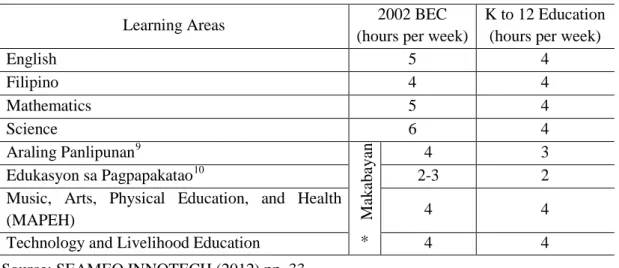
secondary education. Table 6 provides a comparison of subjects and the time allotted to each per week before and after implementation of the “K to 12” Program. Under the new program, time allotted to the core subjects of English, Filipino, and Math as well as to some courses that used to fall under the category of “Makabayan”8 has decreased. Overall this decreased allotment of time per week has decongested the curriculum. This has been made possible by the addition of two more years to secondary education. Moreover, although the allotment of time per week is being decreased, with the lengthening of high school years, the sum total of time allotted to courses will actually increase. Thus the amount that students learn overall will increase while each week the amount of time students spend taking core courses and some other classes will decrease. This is a key feature of the new “decongested” curriculum.
Table 5: Main Changes in Secondary Education: Structure, Curriculum, and Assessment
Type Content of Change
(1) Structure
Lengthening the years of education
Adding two years to make it a total six 6 years Divided into junior and senior high school
(2) Curriculum
Understanding by Design (UbD), identifying desired results, determining acceptable evidence, and planning instruction will be replaced by the spiral approach wherein learning is a process of building upon previously learned knowledge
(3) Assessment The National Achievement Test (NAT) taken by second year students will be replaced by an examination at the end of Grade 10 and Grade 12.
Source: SEAMEO INNOTECH (2012) pp. 26-27.
Under the “K to 12” curriculum, the expectation is that students will be able to study more slowly and sufficiently each week, and take their time to review what they learn in school. Under the old congested curriculum, students had less time to review and absorb what they learned, leading to what
8
Makabayan means Patriotism. Makabayan education in high school has been a characteristic of Philippine secondary education and is meant to promote social cohesion and uniformity among Filipinos.
16
could be called learning “indigestion”. With the new “decongested” curriculum, there is much expectation that for students learning will be more sufficient and efficient.
Table 6: Curriculum Learning Areas and Time Allotment
Learning Areas 2002 BEC (hours per week)
K to 12 Education (hours per week)
English 5 4 Filipino 4 4 Mathematics 5 4 Science 6 4 Araling Panlipunan9 Mak ab ay an * 4 3 Edukasyon sa Pagpapakatao10 2-3 2 Music, Arts, Physical Education, and Health
(MAPEH) 4 4
Technology and Livelihood Education 4 4
Source: SEAMEO INNOTECH (2012) pp. 33.
IV. EXAMINATION OF THE “K TO 12” PROGRAM
The previous two sections essentially set forth the facts and features of the “K to 12” Program. This section will examine that program from three perspectives. One is that of comparative education, which has especially sought to describe the globalization and localization of education. The second is that of pedagogy which looks at curricula and methods of teaching, i.e., the content of what is taught and learnt. The “K to 12” Program not only increases the years of schooling, it also transforms the curricula and teaching methods. Simultaneously, this pedagogical transformation has been influenced by the globalization of education. The third perspective is that of socio-economics which studies the impact of education on social and economic development, and the social and economic pathways for disseminating education.
9
This subject corresponds to Social Studies.
10
Edukasyon sa Pegpapakatao means “Value Education”. Pegpapakatao itself stands for “personality”. This course “focuses on honing an individual’s capacity to make moral and ethical decisions and actions.”(SEAMEO INNOTEC 2012: 40)
17
A. The Comparative Education Perspective
When a country launches a new educational policy, it is important to examine how the policy is interpolated with the existing thought on education. The “K to 12” Program puts a high value on the “holistically developed Filipino” through a combination of education input and curriculum reform. Although on the surface this reform appears to be seeking the Philippines’ inherent values, the outcomes it is seeking imply that the “K to 12” program ultimately is connected to the globalization of education.
In this regard, Joel Spring has introduced the useful concepts of a “world culture theory” and “educational borrowing” in explaining the globalization of education. He writes: “The basic ideas of world culture theorists” are “that the spread of mass schooling and a uniform curriculum accompanied the spread of the Western concept of the nation state and that national policy leaders select from a global flow of best educational practices” (Spring 2009: 118). World culture theory holds that there is a common world culture in various social dimensions – political, economic, social, cultural, and even educational. Therefore, a world education culture exists. Each country has its own educational system and institution, but each of these national systems and institutions will, in the long run, as though drawn toward a common ideal form, converge to be transformed into very similar ones. Spring summarizes the key points of the world culture theory as follows (Spring 2009: 17):
1. Development of a uniform global education culture sharing similar goals,
educational practices, and organizations
2. Similarity of national school systems [as] a result of adoption of Western model of
the nation-state which requires mass education
3. Most national schools systems share a common educational ladder and
18
4. Global uniformity of schooling provides entrance into the global economy.
As set forth in these four points of the theory, educational reform in the Philippines is integrating that country’s educational system into the common global one. As a result, the progression of education in the Philippines from kindergarten to tertiary education is corresponding more closely to the common one existing in most countries. Filipino students after graduation are expected to behave as good laborers in the Philippine and in overseas markets. Enhanced technical and vocational education is preparation for that purpose. In a globalized society, Philippines education has no choice but to transform itself into a global-friendly system.
Spring’s other useful concept is educational borrowing. As pointed out above, the Philippine educational system is moving toward conforming with the common world norm as predicted by the world culture theory, and part of this is due to educational borrowing. An increasing number of countries are promoting early childhood education which includes kindergarten, and this early education is a key to improving primary education. With the “K to 12” Program, the Philippines has now borrowed this model from the international practice by integrating kindergarten into its educational system. Another example is the extending of secondary education to six years. This has been the norm for countries in and outside of Southeast Asia, and the shortness of secondary education in the Philippines has been regarded as an Achilles tendon for the whole of Philippine education. With the “K to 12” Program, the Philippines has now adopted the six-year model.
Through a self-conscious effort to conform to common international educational practices and through borrowing better educational models from other countries, the Philippines is undertaking a fundamental reform of its education. The system that emerges will be very different from the one that had previously existed.
19
B. The Pedagogical Perspective
Although converging toward common world educational norms and borrowing models from other countries, the Philippine educational system has its unique aspects. One concerns the ethnic and lingual diversity of the country. Prior to the “K to 12” Program, the education system largely overlooked this diversity. Under the new curriculum, along with studying Tagalog, children in grades 1 to 3 will be able to take lessons in their mother tongue. How well this change copes with the country’s multi-lingual challenge will be a major issue in a future evaluation of the “K to 12” Program.
Regarding the curriculum, the existing BEC and SEC are being replaced with the K to 12 Curriculum 2012. This new curriculum focuses on the “holistic development” of the leaner. It emphasizes the “outcome-based approach” to better prepare students for higher education and to provide them with middle-level skills useful for employment and developing entrepreneurship. The curriculum is anchored in the principles of inclusiveness, leaner’s growth and development, teaching and learning, and assessment is critically important.
The pedagogical features of the new curriculum are (1) preparation for further study or work, and (2) efficiency in the conduct of lessons and courses and in measuring the outcomes of education. Expressions about preparation for higher education or employment are ubiquitous in the declaration and documents of the new curriculum. And multilingual education plus more frequent testing to assess the outcomes of schooling will lead to more efficient student learning.
However, “holistic development” or “the holistic development of Filipinos for the 21st century” is an abstract concept. The model of the ideal learner in the new curricula is relevant for the betterment of the human resource and manpower needed for Philippine social and economic development. The formation of the human resources and preparation for a greater variety of opportunities in learning and employment is becoming the central role of education. These elements are measurable in that they are
20
quantitative. The progress of student learning and the state of employment are facts that can be examined and interpreted statistically. However, “holistic development” has to range beyond statistical and quantifiable dimensions. The non-measurable aspects of learning and the student’s non-cognitive skills must also be developed. The “K to 12” Program mentions the non-cognitive dimension that is attached to the skills and ability of a student, but the actual way that education tries to develop these is unclear. Despite being difficult to measure, holistic aspects like mutually understanding social and cultural differences, the ability to express oneself, or a willingness to cope with risk are important to Filipino society and have to be fostered through education.
C. The Socio-economic Perspective
Education has long been an engine driving social and economic development. Studies on the economics of education have shown that education is a prepotent explanatory variable of GDP and individual income (Becker 1964, Mincer 1974 among others). Additional education brings added economic growth and other beneficial outcomes, such as declining birth rate and improved health. The “K to 12” Program to improve education was launched with these benefits to the economy and society in mind. SEAMEO INNOTECH 2012 refers to studies on the economics of education,11 such as Psacharopoulos and Patrinos (2004), Hanushek (2005), and Hanushek et al. (2008), which explain the impact of human capital investment (including education) on economic development.12
At the individual level, education has a positive effect on income and the probability of obtaining a job. This is particularly important for poor people. They have few resources, and for these people, education offers practically the only opportunity for moving up the socioeconomic ladder. Area
11
In referring to Psacharopoulos and Patrinos (2004), SEAMEO INNOTECH 2012 argues that the additional years of education will bring significant economic benefit to the national economy.
12
These studies emphasize that not only the amount of input into education but also the quality of education are important for development. For instance, teacher training is necessary for quality development.
21
studies and recent microeconomic studies dealing with the Philippines show that education is positively correlated with urban and rural income (Nakanishi 1991, Maluccio 1998, Estudillo et al. 2008, Estudillo et al. 2009).13
Beyond economic growth and increased income, education has other positive effects. It contributes to social cohesion and mutual understanding among others, and at the individual level it plays a role in the formation of personality.
Thus, enhancing basic education contributes not only to economic growth and poverty alleviation but also to social unity and personality formation. The Philippines has long suffered from endemic social and economic problems such as unemployment, poverty, and ethnic conflict. The “K to 12” Program and reform of the country’s education can be seen as one step toward overcoming these long-standing problems.
V. DISCUSSION
A. Highlighting the Role of Secondary Education
The Philippines has begun a fundamental overhaul of its educational system. Through introduction of the “K to 12” Program, the country is seeking to highlight basic education and overcome deficiencies in the system, such as low student learning performance, congested curricula, and the shortness of secondary education, shortcomings that Filipino scholars have long pointed out.14 Of particular note in the new program is the attention given to secondary education, the importance of which has long been ignored. (Lewin and Caillods 2001).
Secondary education is the bridge between primary and tertiary education. Its importance is the
13
Nakanishi (1991) conducted a multiple regression with OLS using data he gathered from a squatter area in Metro Manila and found a positive correlation between education and income. The other studies used more econometrically sophisticated methods that factored for endogenous bias. These showed that there are high returns on education in the rural Philippines.
14
22
role it plays in fostering higher learning. It prepares high school students for study in institutions of higher learning whose graduates play a central role in a modern industrialized society. But the role of secondary education goes beyond education. It is a period important in the formation of personality. Students in secondary school are in their adolescence and susceptible to influences from the external environment and other people. Knowledge, experiences, and memories that students acquire in this period influence their personality. Thus enhancing and improving this stage of education and life is of particular importance, not only for economic development but also for fostering a population of socially and mentally healthy people.
B. Is the Philippines Going toward a Credentialed or a Diploma-diseased Society?
In analyzing what has been expressed by the government and in SEAMEO INNOTECH (2012), I find that the Philippines appears to be heading toward the globalization of its education and seemingly becoming a more credentialed society. National certificates earned through the acquisition of secondary education will play a significant role in highlighting the abilities and skills that high school graduates have gained, and educational credentials that are necessary for employment (Spring 2009: 13). And better preparation for better educational opportunities and employment is a key role of “K to 12” education.
Filipinos have been enthusiastic seekers after higher diplomas, and this may now be accelerating. With the new “K to 12” Program, the government is emphasizing the level of education that leads to higher education. This means that a growing number of students will seek to enter colleges and universities which will increase competition for places in these institutions. However, as Dore (1976) pointed out by his term “diploma disease”, education works not only as an engine of development; it can also be a cause of social malaise. Overheated competition for diplomas can become a cause for stress and anxiety among youths and their parents as they compete for a limited number of places in
23
higher educational institutions. At the same time this heated competition can deter lower income families from pursuing more education because of the cost and effort required when the family is more in need of making a living. The outcome is that low income children get less education, which impedes their upward economic and social mobility, and they end up remaining in the low income stratum. Thus the “K to 12” Program’s emphasis on secondary education will have to hold to its ideal of fostering holistically developed students and not become simply a process that graduates a growing number of candidates for higher education.
C. Pedagogical Issues, Teachers, and Teacher Training
One of the main goals of the “K to 12” Program is to contribute to a “holistically developed Filipino” (SEAMEO INNOTECH 2012). The mean of “holistically” is obscure, and developing such a Filipino requires better quality education. Here pedagogical improvement matters.
Under the “K to 12” Program, curricula are in the process of being improved, but another basic problem of pedagogy is teaching-related matters. For better pedagogy in schools, teachers play the crucially important role,15 and to fulfill their role, teachers need adequate teaching facilities, materials and equipment. Thus classrooms and the other physical resources of school teaching also matter.
The government already has begun or has planned to supply the needed resources, aiming at fulfilling the need by the end of 2013.16 Judging from the amount supplied between 2010 and 2012, it appears that a considerably high number of classrooms, desks, and textbooks have already been delivered. However, given the size of the shortages, which have traditionally plagued Philippine education, it will be very difficult to satisfy the huge need by the end of 2013.
Along with sufficient resources, the success of the new education program will depend on the training and upgrading of teacher skills. According to SEAMEO INNOTECH (2012), there should be
15
To improve students’ performances, teachers’ quality is crucial (Hanushek 2005: pp. 14-15)
16
24
no additional load on teachers since the curricula are being decongested. Moreover, the Magna Karta for Public School Teachers provides that teachers should not teach more than six hours a day. If these conditions are fulfilled, the additional time available is expected to be allocated to teacher development. Here the Philippines could cooperate with foreign countries that have developed successful programs for teacher-training.
D. Demand-side Approach
The “K to 12” Program is interpreted as a supply-side policy in that it is meant to improve the supply of education. The Department of Education (DepED) has declared public schooling free from kindergarten through high school. Certainly, free schooling is necessary. But the indirect costs should not be forgotten. For children living in remote areas there is cost of transportation, or perhaps cost of moving in with a relative or friend who lives in a central area where there are more schools. The cost of clothes is also important; Filipino students wear school uniforms from elementary school. There is cost of textbooks and stationery. And very importantly for poor households where children are expected to earn money and contribute to the household livelihood at as early an age as possible, there is foregone income from children who are students. Therefore, free education is in fact not free, especially for poor households.
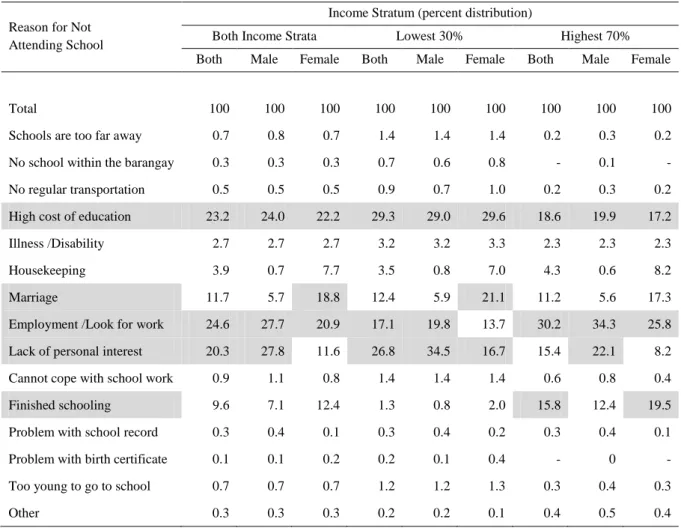
Even with free education, poverty still matters. Table 7 shows the results of the Annual Poverty
Indicators Survey on the reasons that persons aged 6-24 did not attend school in SY2010-11. The
reason most often given regardless of income stratum or gender was the high cost of education. The fact that cost was one of the top three reasons for not attending school even for those in the high income stratum indicates how much more difficult it is financially for the poor to pay for attending school.
25
obstacle to the universalization of basic education in the Philippines. Over the last decade boys have tended to access education less than girls, and this tendency becomes more noticeable as they progress up the levels of education. For girls the main gender obstacle to attending school is marriage. Marriage often leads quickly to pregnancy which frequently causes girls to stop attending school. The “K to 12” Program will need to further address gender-related issues.
E. Expectations of Education
In this final section, I would like to look at what is expected to education. This will vary among individuals and households. Among the poor, the tendency is to value the earning of money on a short-term basis at as early an age as possible; therefore the tendency is to prefer less schooling as long as people accomplish the level of education that they initially demand. Although myopic, for the poor it is more often a choice between the certain fruit in the near-term from labor and job and the future uncertain fruit from education. In effect, they lack an expectation of benefiting from education.
Table 7 provided another indication of this lack of expectation. Among the top reasons for not attending school in SY 2010-11 was “lack of personal interest”.17 While students in the low income stratum tended more often to give this reason, it was especially true for boys regardless of income stratum. The greater lack of personal interest among low income students and among boys in general could indicate that the existing education has been too uniform, not varied and flexible enough to meet the needs and interests of these students (and in the case of low income students, of their families as well). Along with the country’s ethnic and linguistic diversity, the educational system will need to know how to address the population’s social- and local-context needs, and for this task a combination of effort by educationists and socio-cultural studies will be required.
17
Although it may be difficult to distinguish “the lack of personal interest” from “finished schooling,” the former implies that the student has lost his/her interest in pursuing schooling, while the latter sounds more like the student accomplished his/her planned amount of education.
26
Table 7: Percent of Population 6 to 24 Years Old Not Attending School in SY 2010-11 and the Reason for Not Attending School
Reason for Not Attending School
Income Stratum (percent distribution)
Both Income Strata Lowest 30% Highest 70% Both Male Female Both Male Female Both Male Female
ののの ののの ののの ののの ののの ののの ののの ののの ののの
Total 100 100 100 100 100 100 100 100 100
Schools are too far away 0.7 0.8 0.7 1.4 1.4 1.4 0.2 0.3 0.2
No school within the barangay 0.3 0.3 0.3 0.7 0.6 0.8 - 0.1 -
No regular transportation 0.5 0.5 0.5 0.9 0.7 1.0 0.2 0.3 0.2
High cost of education 23.2 24.0 22.2 29.3 29.0 29.6 18.6 19.9 17.2
Illness /Disability 2.7 2.7 2.7 3.2 3.2 3.3 2.3 2.3 2.3
Housekeeping 3.9 0.7 7.7 3.5 0.8 7.0 4.3 0.6 8.2
Marriage 11.7 5.7 18.8 12.4 5.9 21.1 11.2 5.6 17.3
Employment /Look for work 24.6 27.7 20.9 17.1 19.8 13.7 30.2 34.3 25.8
Lack of personal interest 20.3 27.8 11.6 26.8 34.5 16.7 15.4 22.1 8.2
Cannot cope with school work 0.9 1.1 0.8 1.4 1.4 1.4 0.6 0.8 0.4
Finished schooling 9.6 7.1 12.4 1.3 0.8 2.0 15.8 12.4 19.5
Problem with school record 0.3 0.4 0.1 0.3 0.4 0.2 0.3 0.4 0.1
Problem with birth certificate 0.1 0.1 0.2 0.2 0.1 0.4 - 0 -
Too young to go to school 0.7 0.7 0.7 1.2 1.2 1.3 0.3 0.4 0.3
Other 0.3 0.3 0.3 0.2 0.2 0.1 0.4 0.5 0.4
Note: Shaded portions indicate the top three reasons for non-attendance, based on income stratum and gender.
Source: National Statistics Office (2011) Annual Poverty Indicators Survey 2010.
F. Brain-drain Issues
Another issue for the Philippines is the importance of Overseas Filipino Workers (OFWs) to the national economy. One study has suggested that remittances from OFWs accounts for 10 percent of the country’s GDP (Le Borgne 2009). Many among these OFWs are people with post-secondary education, as is the case for many developing countries experiencing a migration of their educated
27
population (Spring 2009: 178). At present this “brain-drain” cannot be held down as the Philippine government encourages emigration for job opportunities abroad (mostly to the USA, UK, Middle Eastern countries, and Singapore). The government is doing this because of the importance of OFW remittances for the economy. But this policy is an issue of serious concern when considering education. The “K to 12” Program aims at enhancing secondary education, but enhancement alone could very well further the brain drain (or worse still, lead to further “brain waste” [Spring 2009: 188-190]). Thus along with improving education, the government needs to encourage industrial development and the growth of domestic industries that can provide employment for higher educated school graduates.
G. Some Concluding Remarks
The Philippine government’s project to overhaul the country’s public school educational system and its new “K to 12” Program are still at the introductory stage. It is too early to draw any conclusions on the many issues discussed in this paper. But the reform is an ambitious project, and this researcher along with many others interested in education and the economy will be observing to see how well the reform progresses and meets its objectives by 2018.
28
R
EFERENCES
Balisacan, Arsenio M. 2003. The Philippine Economy: Development, Policies, and Challenges. Quezon City: Ateneo de Manila University Press.
Becker, Gary. S. 1964. Human Capital: A Theoretical and Empirical Analysis, with Special
Reference to Education. Chicago: University of Chicago Press, 3rd edition (1993).
Caoli-Rodriguez, Rhona B. 2009. “Hard-pressed to achieve the EFA goals by 2015 in the Philippines.”
Prospects 38, no. 3: 393–99.
Dore, Ronaldo. 1976. The Diploma Disease: Education, Qualification and Development. London: G. Allen and Unwin.
Estudillo, Jonna. P.; Yasuyuki Sawada; and Keijiro Otsuka. 2008. “Poverty and Income Dynamics in Philippine Village 1985-2004.” Review of Development Economics 12, no. 4. 877–90.
---. 2009. “Income Dynamics, Schooling Investment, and Poverty Reduction in Philippine Villages, 1985-2004.” In Rural Poverty and Income Dynamics in Asia and Africa, edited by Otsuka Keijiro, Jonna P. Estudillo, and Sawada Yasuyuki. New York, Routledge. 22–46. Hanushek, Eric A. 2005. “Economic Outcomes and School Quality.” Education Policy Series 4. Paris:
International Institute for Educational Planning and International Academy of Education. Hanushek, Eric A.; Dean T. Jamison; Eliot A. Jamison; and Ludger Woessmann. 2008.
“Education and Economic Growth: It’s Not Just Going to School, but Learning Something while There That Matters.” Education Next, Spring, 62–70.
Le Borgne, Eric. 2009. Remittances and the Philippines' Economy: The Elephant in the Room. http:// blogs.worldbank.org/eastasiapacific/remittances-and-the-philippines-economy-the-elephant- in-the-room (accessed July 28, 2013).
Lewin, K. and F. Caillods. 2001. Financing Secondary Education in Developing Countries: Strategies
29
Maluccio, John. 1998. “Endogeneity of Schooling in the Wage Function: Evidence from the Rural Philippines.” Discussion Paper no. 54, Washington, DC: International Food Policy Research Institute.
Mincer, Jacob. 1974. Schooling, Experience, and Earnings. New York: National Bureau of Economic Research.
Nakanishi, Toru. 1990. “The Market in the Urban Informal Sector: A Case Study in Metro Manila, the Philippines.” Developing Economies 28, no. 3: 271–301.
Nakanishi, Toru. 1991. Suramu no Keizaigaku : Firipin ni okeru Toshi Infōmaru Bumon (Economics
of the Slum: the Urban Informal Sector in the Philippines) . Tokyo: University of Tokyo
Press.
National Statistical Coordination Board (NSCB). 2010. 2011 Philippine Statistical Year Book. Makati: National Statistical Coordination Board.
National Statistics Office (NSO). 2011. 2010 Annual Poverty Indicators Survey (Final Report). National Statistics Office, Republic of the Philippines.
Psacharopoulos, George, and Patrinos, Harry A. 2004. “Returns to Investment in Education: a Further Update.” Education Economics 12, no. 2, 111–34.
Ricardo, D. Ma. Nolasco. 2008. “The Prospects of Multilingual Education and Literacy in the Philippines.” In The Paradox of Philippine Education and Education Reform: Social Science
Perspective, edited by Allan B.I. Bernado. Quezon City: Philippine Social Science
30
Southeast Asian Ministers of Education Organization, Regional Center for Educational Innovation and Technology (SEAMEO INNOTECH). 2012. K to 12 Toolkit: Reference Guide for
Teacher Educators, School Administrators and Teachers. Quezon City: SEAMEO
INNOTEC.
Spring, Joel. 2009. Globalization of Education: An Introduction. New York: Routledge.
Suzuki, Yurika. 2011. “Kiso Kyouiko wo 6-4 Sei kara K-6-4-2 Sei e” (“Changing Philippine Basic Education from 6-4 System to K-6-4-2 System”) http://www.ide.go.jp/Japanese/Publish/ Download/Overseas_report/1106_suzuki.html (accessed November 20, 2012 and July 25, 2013).
Tanodra, Elena Q. 2003. Philippine Educational System. Quezon City: Verh Educational Enterprise. World Bank. Various Years. World Development Indicator. http://data.worldbank.org/
424 Bo MENG, Zhi WANG And Robert KOOPMAN
How Are Global Value Chains Fragmented and Extended in China’s
Domestic Production Networks? 2013 423 Shinichi SHIGETOMI Development and Institutionalization of Communitarian Thought in
Thailand 2013
422 Takahiro FUKUNISHI Political Crisis and Suspension of Duty-free Access in Madagascar:
Assessment of Impacts on the Garment Industry 2013 421 Toshihiro KUDO, Satoru
KUMAGAI and Hikari ISHIDO Agriculture Plus Plus: Growth Strategy for Myanmar Agriculture 2013 420 Mai FUJITA The Japanese and Chinese Models of Industrial Organisation:
Fighting for Supremacy in the Vietnamese Motorcycle Industry 2013 419 Mai FUJITA Exploring the Sources of China’s Challenge to Japan: Models of
Industrial Organisation in the Motorcycle Industry 2013 418 Romio MORI, Kaoru NABESHIMA
and Nanae YAMADA
Food Safety Control System of Chinese Eel Exports and its
Challenges 2013
417 Takashi NOMURA, Saori OKADA,
Takeshi YOSHIZAKI Features of IP Rights Enforcement in Korea and China 2013 416 Yasushi UEKI Supply Chain Collaboration and Responsiveness: A Comparison
between Thai Automotive and Electronics Industries 2013 415 Yasushi UEKI Formation of Supply Chain Collaboration and Firm Performance in
the Thai Automotive and Electronics Industries 2013 414 Futaba ISHIZUKA International Labor Migration in Vietnam and the Impact of Receiving
Countries' Policies 2013 413 Chie KASHIWABARA The Central Bank and Bank Credits in the Philippines: A Survey on
Effectiveness of Monetary Policy and Its Measures 2013 412 Takahiro FUKUNISHI and
Tatsufumi YAMAGATA
Slow and Steady Wins the Race: How the Garment Industry Leads
Industrialization in Low-income Countries 2013 411 Tsuruyo FUNATSU Changing Local Elite Selection in Thailand: Emergence of New Local
Government Presidents after Direct Elections and Their Capabilities 2013 410 Hikari ISHIDO Harmonization of Trade in Services by APEC members 2013
409 Koichi KAWAMURA Presidentialism and Political Parties in Indonesia: Why Are All
Parties Not Presidentialized? 2013 408 Emi KOJIN The Development of Private Farms in Vietnam 2013
407 Tadayoshi TERAO Political Economy of Low Sulfurization and Air Pollution Control
Policy in Japan: SOx Emission Reduction by Fuel Conversion 2013 406 Miki HAMADA Impact of Foreign Capital Entry in the Indonesian Banking Sector 2013
405 Maki AOKI-OKABE Research Review: Searching for a New Framework for Thailand’s
Foreign Policy in the Post-Cold War Era 2013 404 Yuka KODAMA Relationship between Young Women and Parents in Rural Ethiopia 2013
403 Yoshihiro HASHIGUCHI and Kiyoyasu TANAKA
Agglomeration and firm-level productivity:
A Bayesian Spatial approach 2013 402 Hitoshi OTA India’s Senior Citizens’ Policy and an Examination of the Life of
400 Takayuki HIGASHIKATA
Japan’s Regional Income Disparity from 1955 to 1998 2013 399 Ikuo KUROIWA, Kenmei
TSUBOTA
Economic Integration, Location of Industries, and Frontier Regions:
Evidence from Cambodia 2013 398 Toshitaka GOKAN The Location of Manufacturing Firms and Imperfect Information in
Transport Market 2013
397 Junko MIZUNO An Export Strategy and Technology Networks in the Republic of
Korea 2013
396 Ke Ding, Toshitaka Gokan, Xiwei
Zhu Search, Matching and Self-Organization of a Marketplace 2013 395 Aya SUZUKI and VU Hoang Nam Status and Constraints of Costly Port Rejection: A case from the
Vietnamese Frozen Seafood Export Industry 2013 394 Natsuko OKA A Note on Ethnic Return Migration Policy in Kazakhstan: Changing
Priorities and a Growing Dilemma 2013 393 Norihiko YAMADA Re-thinking of “Chintanakan Mai” (New Thinking): New Perspective
for Understanding Lao PDR 2013 392 Yasushi HAZAMA Economic Voting under a Predominant Party System 2013
391 Yasushi HAZAMA Health Reform and Service Satisfaction in the Poor: Turkey 2013
390 Nanae YAMADA and Shuyan SUI Response of Local Producers to Agro-food Port Rejection: The Case
of Chinese Vegetable Exports 2013 389 Housam DARWISHEH From Authoritarianism to Upheaval: the Political Economy of the
Syrian Uprising and Regime Persistence 2013 388 Koji KUBO Sources of Fluctuations in Parallel Exchange Rates and Policy Reform
in Myanmar 2013
387 Masahiro KODAMA Growth-Cycle Nexus 2013
386 Yutaka ARIMOTO, Seiro ITO, Yuya KUDO, Kazunari TSUKADA
Stigma, Social Relationship and HIV Testing in the Workplace:
Evidence from South Africa 2013 385 Koichiro KIMURA Outward FDI from Developing Countries: A Case of Chinese Firms in
South Africa 2013
384 Chizuko SATO Black Economic Empowerment in the South African Agricultural
Sector: A Case Study of the Wine Industry 2013 383 Nudjarin RAMUNGUL, Etsuyo
MICHIDA, Kaoru NABESHIMA
Impact of Product-related Environmental Regulations/Voluntary
Requirements on Thai Firms 2013 382 Kazushi TAKAHASHI Pro-poor Growth or Poverty Trap? : Estimating the Intergenerational
Income Mobility in Rural Philippines 2013 381 Miwa TSUDA Kenya after the 2007 “Post-Election Violence”: Constitutional Reform
and the National Accord and Reconciliation Act 2013
380 Kazuhiko OYAMADA
Parameterization of Applied General Equilibrium Models with Flexible Trade Specifications Based on the Armington, Krugman, and Melitz Models
2013
377
Fauzi Abdul Hamid Fall of LDP in Japan 2012 376 Koji KUBO Myanmar’s Two Decades of Partial Transition to a Market Economy:
A Negative Legacy for the New Government 2012 375 Bo MENG, Yaxiong ZHANG,
Satoshi INOMATA
Compilation, Application and Challenge of IDE-JETRO’s
International Input-Output Tables 2012 374 Momoe MAKINO What Motivates Female Operators to Enter the Garment Industry in
Pakistan in the Post-MFA Period? 2012 373 Kenta GOTO Is the Vietnamese Garment Industry at a Turning Point?: Upgrading
from the Export to the Domestic Market 2012 372 Kazunobu HAYAKAWA Impact of Diagonal Cumulation Rule on FTA Utilization: Evidence
from Bilateral and Multilateral FTAs between Japan and Thailand 2012 371 Toshihiro KUDO and Satoru
KUMAGAI
Two-Polar Growth Strategy in Myanmar: Seeking "High" and
"Balanced" Development 2012 370 Takeshi Inoue and Shigeyuki Hamori Market Efficiency of Commodity Futures in India 2012
369
Satoru KUMAGAI, Kazunobu HAYAKAWA, Ikumo ISONO, Souknilanh KEOLA and Kenmei TSUBOTA
Geographical Simulation Analysis for Logistics Enhancement in Asia 2012
368 Yuya KUDO Marriage as Women's Old Age Insurance: Evidence from Migration
and Land Inheritance Practices in Rural Tanzania 2012 367 Bo MENG, Jinjun XUE, Kuishuang
FENG, Dabao GUAN
China’s Inter-regional Spillover of Carbon Emissions and Domestic
Supply Chains 2012
366 Kazunobu HAYAKAWA Impacts of FTA Utilization on Firm Performance 2012 365 Kuo-I CHANG and Kazunobu
HAYAKAWA
Selection and Utilization of the Early Harvest List: Evidence from the Free Trade Agreement between China and Taiwan 2012 364 Kazunobu HAYAKAWA Does the Use of Multiple FTAs Force Firms to Raise Local Input
Share?: Evidence of the Spaghetti Bowl Phenomenon 2012 363 Kazunobu HAYAKAWA Firms' Use of FTA Schemes in Exporting and Importing: IsThere a
Two-way Relationship? 2012 362 Bo MENG, Yong FANG, Norihiko
YAMANO
Measuring Global Value Chains and Regional Economic Integration: An International Input–Output Approach 2012 361 Tadashi ITO New Aspects of Intra-industry Trade in EU Countries 2012 360 Ho Yeon Kim Shrinking Population and the Urban Hierarchy 2012 359 Bo MENG, Yaxiong ZHANG,
Jiemin GUO, Yong FANG
China’s Regional Economies and Value Chains: An Interregional
Input-Output Analysis 2012 358 Koji KUBO Real Exchange Rate Appreciation, Resource Boom, and Policy
Reform in Myanmar 2012
357 Maki AOKI-OKABE
Increasing Popular Participation in the Treaty-making Process : The Legislative Process of Section 190 of the 2007 Constitution of Thailand
2012 356 Tadashi ITO Revisiting the Determinants of Unit Values 2012
355
Susumu (Shin) ABE, Ryo TAKAHASHI, Akiko HARUNA, Eiji YAMAJI, and Toshiyuki WAKATSUKI
Farming Strategy of African Smallholder Fermers in Transition from
Traditional to Alternative Agriculture 2012
354 Kiyoyasu TANAKA and Yoshihiro HASHIGUCHI
Spatial Spillovers from FDI Agglomeration: Evidence from the
Yangtze River Delta in China 2012 353 Takeshi INOUE Central Bank Intervention and Exchange Rate Behaviour: Empirical
Evidence for India 2012
352 Rajnish KUMAR, Arup MITRA
and Mayumi MURAYAMA Toiling Children: The Gender Dimension 2012 351 Chizuko SATO Casting a Voice for Rural Struggles during Apartheid: The Case of
AFRA 2012