universities : A government-funded university
childcare support project
journal or
publication title
Bulletin of Kobe Tokiwa University
number
13
page range
68-82
year
2020-03-31
原著
Abstract
Until 20 05, it was a common idea that education and research are universities’ only mission in Japan. However, in 2005, the Central Council of Education stated that the ‘university has education and research as its original mission. At the same time, the role expected of the university is also changing, and now the importance of the contribution to society/community of the university is being emphasized’. Therefore, with this reference to the indispensability of
Society and community engagement in Japanese universities:
A government-funded university childcare support project
わが国の大学におけるソーシャル/コミュニティ・エンゲージメント
高松 邦彦
1)2)3)國崎 大恩
1)濵田 道夫
3)4)伴仲 謙欣
2)3)5)三浦 真希子
6)澤村 暢
6)内橋 一惠
7)大城 亜水
1)戸谷 富江
7)紀ノ岡 浩美
8)尾﨑 優子
8)川井 綾
1)山下 敦子
1)藤原 桜
8)京極 重智
1)島内 敦子
8)庄司 靖枝
8)中村 美紀
5)坂井 利衣
8)光安 早織
8)脇本 聡美
1)野田 育宏
2)3)7)牛頭 哲宏
1)光成 研一郎
1)大森 雅人
1)中田 康夫
2)3)8)Kunihiko TAKAMATSU
1)2)3), Taion KUNISAKI
1), Michio HAMADA
3)4),
Kenya BANNAKA
2)3)5), Makiko MIURA
6), Toru SAWAMURA
6),
Kazue UCHIHASHI
7), Tsugumi OSHIRO
1), Tomie TOTANI
7),
Hiromi KINOOKA
8), Yuko OZAKI
8), Aya KAWAI
1), Atsuko YAMASHITA
1)3),
Sakura FUJIWARA
8), Shigetomo KYOGOKU
1), Atsuko SHIMANOUCHI
8),
Yasue SHOJI
8), Miki NAKAMURA
5), Toshie SAKAI
8), Saori MITSUYASU
8),
Satomi WAKIMOTO
1), Ikuhiro NODA
2)3)5), Tetsuhiro GOZU
1),
Kenichiro MITSUNARI
1), Masato OMORI
1), and Yasuo NAKATA
2)3)8)1)Department of Child Education, Faculty of Education 2)Center for the Promotion of Excellence in Research and Development of Higher Education 3)Organization for the Advancement of Higher Education 4)President 5)Department of Oral Health, Kobe Tokiwa Junior College
Introduction
The population of Japan has been declining since it showed a peak in 2008 (Figure 1). In 2016, the total fertility rate was 1.44, and the population aging rate was 27.3% 1). In 2014, the Japan Policy Council forecasted that 896 municipalities out of about 1,800 may disappear because of an approximately 50%
要旨
2005 年に公表された「我が国の高等教育の将来像(答申)」(中央教育審議会)において、「社会貢献の役割 を、言わば大学の『第三の使命』としてとらえていくべき時代となっている」と示された。それ以来、わが国 における大学の社会貢献は質・量ともに増加した。一方、国外ではソーシャル/コミュニティ・エンゲージメ ント(以下、SCE)という言葉が散見されるようになっている。本学は医療検査、看護、こども教育、口腔保 健の 4 学科を有しており、開学以来、地域とのつながりを重視し、本学が位置する自治体とも地域連携協定を 結んでおり、2017 年には文部科学省の私立大学研究ブランディング事業に採択された。本事業における活動 をもとにして、わが国の大学における SCE について検討した結果、SCE は地域住民・自治体・大学が「双方 の成長に貢献しあう関係」であり、そのためにはコミュニティ・ベースド・リサーチを推進していくことが 1 つの要であることが示唆された。 キーワード:ソーシャル/コミュニティ・エンゲージメント、社会貢献、コミュニティ・ベースド・リサー チ、文部科学省私立大学研究ブランディング事業the university’s contribution to society and community, its involvement in such has increased in both quality and quantity during the past 15 years in Japan. On the other hand, the term social and community engagement (SCE) is used rather than contribution to society/community abroad. Kobe Tokiwa University’s four departments—medical technology, nursing, child education, and oral health—are able to alleviate many of the problems that accompany related issues. From 2017 through 2021, this university will be implementing childcare support with the collaboration of citizens, the municipal government, and the university and supported by the Ministry of Education, Culture, Sports, Science and Technology’s Private University Research Branding Project. As a result of considering SCE in universities in Japan based on the activities in this project, SCE is a relationship where local residents, local governments, and universities contribute to the growth of both. It was suggested that promotion of community-based research is one of the key points for SCE.
Key words: society and community engagement, contribution to society/community, community-based research, Ministry of Education, Culture, Sports, Science and Technology’s Private University Research Branding Project
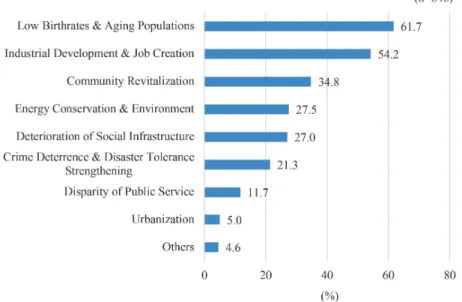
decrease in the female population of 20–39 years by 2040 2). Because of this, municipal governments are experiencing problems from the perspective of community development. When the Ministry of Internal Affairs and Communications 3) investigated these problems in 2012, many of them were related to low birth rates, aging populations, lack of industrial development, and less job creation 4). Community revitalization, deterioration of social infrastructure, energy and environmental conservation, crime prevention, and disaster preparedness also were pointed out as issues to be resolved. Among them, the declining birth rates and aging populations are the biggest problems, and together they constitute 61.7% of total problems reported by municipal governments (Figure 2). These critical social problems must be solved immediately to sustain
Figure 1 Population trends in Japan
Sources: Population Estimates by the former Statistics Bureau, “Population Census of Japan”, “Population Estimates”, by Statistics Bureau, Population Projections for Japan: 2017-2065 Posting from National Institute of Population and Social Security Research (http://www.ipss. go.jp/pr-ad/e/eng/03.html)
the country’s development. Furthermore, 63.3% of the municipal governments listed multiple problems, suggesting that, when considering community development, many of them faced varied combinations of problems. The widening gap between urban and rural areas, the relocation of people, jobs, and industries to Tokyo, and the weakening of small communities are notable concerns.
In terms of the responses regarding these governments’ interest in strengthening their defined selling points and attractiveness, many of them chose the items ‘ease of living’, ‘richness of regional resources’, and ‘ease of childcare’ (Figure 3). The results suggest that the municipal governments’ highest priority concerning community development was to create attractive communities where people want to live. This is because if enough people leave a municipality because it is not an attractive place to live, that municipality can disappear, merging with another. Additionally, when many people leave a community, the older residents are usually left alone and have no support system or ties to other residents. Although there is an increasing sense of urgency that residents’ ties must be rebuilt, that concern has not necessarily been connected to awareness of residents’ independence and motivation to participate in community activities.
Regarding the university’s link to social problems, the public mission of universities has expanded in the 21st century. In Japan, until 2005, it was thought that education and research constitute universities’ only mission. However, in 2005, the Central Council of Education (CCE) stated that the ‘university has education and research as its original mission. At the same time, the role expected of the university is also changing, and now the importance of the contribution to society/community of the university is being emphasized’. With this statement, Japanese universities began to focus on their contributions to society and community, and over the past 15 years, this contribution has increased in both quality and quantity. However, it can be said that the position of the society/community contribution as part of the university’s activities is not fixed. To continuously and stably promote the university’s society/community contribution, it is necessary to include it in the mission of the university.
Access to childcare is related to declining birth rates and economic slowdown: when parents cannot
Figure 3 Municipal governments’ interest in strengthening their defined selling points and attractiveness
find anyone to take care of their children, often the woman will stay home to take care of them, which is a loss to the economy 5). Additionally, young couples may choose to have fewer or no children, resulting in lower birth rates and less people to sustain the economy. In Japan, these factors are rapidly changing, such as the declining birth rate, the increasing number of nuclear families, and the changes happening in small communities, for example the disappearance of small neighborhood shops and their resulting relationships for community members 6). Therefore, problems have arisen, such as decreasing parental functions taken on by neighbors and parents’ increasing loneliness and anxiety. It is important to promote the establishment of a childcare support system/platform to encourage interaction among parents of young children in the community to increase community member bonds and therefore create more desirable, friendly communities. It also is important to improve childcare support functions of the community, like creating municipality-provided day care, to ease parents’ childcare concerns and to promote children’s healthy growth and development 7). Thus, as part of Kobe Tokiwa University’s desire to include society/community contribution as part of its mission, it was decided to focus on solving or reducing related problems associated to childcare by promoting collaboration among citizens, the government at the city and ward levels, and the university.
The four departments of Kobe Tokiwa University̶medical technology, nursing, child education, and oral health̶have the ability to help solve problems that accompany these societal issues. From 2017 through 2021, the university will be implementing childcare support through a collaboration of citizens, the municipal government, and the university, supported by the Ministry of Education, Culture, Sports, Science and Technology’s Private University Research Branding Project (MEXT-PURBP)8). The project theme is ‘Work to Satisfy the Citizens, Government, and University by Developing a Childcare Platform in the University’s Community’.
Society and community contribution in Japan as well as in other parts of the world is a topic that has been attracting attention recently. In fact, the theme of this year’s 15th International Conference on Higher Education Reform is society/community engagement 9). Yet, knowledge concerning society/ community engagement on the part of universities is not sufficient. For this reason, how social contribution by universities is understood varies according to country and university. The purpose of this article is to introduce and discuss society/community engagement in Japanese universities through Kobe Tokiwa university’s childcare support project, particularly focusing on the specific efforts that utilize the strengths of each of the four departments, as a way to fill this gap.
A childcare support project to serve the university community
1.The MEXT-PURBP
Under the leadership of the president of the university, the MEXT-PURBP is a project to promote the strengthening of private universities, especially their image and branding. The objective is to help private universities increase their presence throughout the country and also their self-financing, which would allow the government to cut back its funding to about 600 private universities. In MEXT-PURBP, there are two project types: type A refers to ‘social expansion’, which will be focused on in this paper, and type B to
‘world expansion’. Type A includes research contributing to regional economic and social development, employment, cultural development, and the development and deepening of knowledge in specific fields: utilization of local resources, promotion of industry, discovery of tourism resources, and development of culture in specific areas or fields. Authorities at Kobe Tokiwa University selected to compete as type A in 2017. The project theme at the time of selection was childcare support for the community where Kobe Tokiwa University is located.
The university’s activities under MEXT-PURBP are based on the future vision of the university; the project is an effort to formulate a branding strategy and prepare a university project implementation system and support system.
2. History of the university
The school corporation (a school corporation is a body authorized by the Ministry of Education or local government to operate area private schools) Tamada Gakuen was founded in Nagata Ward of Kobe City, Hyogo Prefecture, Japan, and it opened a private women’s school in 1908. In 1967, it established College A, which had two departments: the Department of Medical Technology and the Department of Child Education. In 2001, the Department of Nursing was opened. In 2008, the Tamada Gakuen school corporation celebrated its 100th anniversary, and Kobe Tokiwa University was opened to replace College A, with a Faculty of Health Sciences consisting of the Department of Medical Technology and the Department of Nursing was established. In 2018, the school corporation celebrated its 110th anniversary. We show the history of Tamada Gakuen in Figure 4.
3. History of society/community engagement in the university
The university was established based on the idea that the ‘university would give back to society and the community through education and research to contribute to their development 8). In 2001, the school corporation opened a center of community (COC). The COC is a bridge that connects university staff and students to the surrounding communities and serves as a general contact point for regional exchange, collaboration, and contributions.
On January 17, 1995, the area where the university is located was hit by the Great Hanshin-Awaji Earthquake. The intensity reached 7 on the JMA Shindo scale and 6.9 on the moment magnitude scale. Up to 6,402 people lost their lives 10). One student in Tamada Gakuen died. Around the university, many houses were destroyed or caught on fire, so the university became a temporary shelter for the victims. At that time, the university received a lot of support from people all over the country and world, and thanks to that generosity, it was able to survive. The president of the school corporation never forgot the gratitude he felt at that time, and wanted to return the favor in some way. In 2009, the school corporation opened a volunteer center. University students and faculty participate in volunteer activities that serve communities during usual times and disaster volunteer activities after events such as earthquakes and floods. In fact, after the 2011 Tōhoku earthquake and tsunami (the Great East Japan Earthquake), volunteers from Kobe Tokiwa University cooked 300–350 meals a day for three days in the Iwate Prefecture11).
University students and faculty have participated in disaster volunteer activities almost every year since then. Thus, at the university, volunteer activities are becoming common.
4. Childcare support project in the university community under MEXT-PURBP
Currently, the university is conducting two activities as part of a broader childcare support project in the university community under MEXT-PURBP: a program providing practical support for children and their parents and a community-based research program.
1)Practical support
The childcare practical support project started in May 2017. Prior to this project, in 2008, the university signed an agreement with Nagata Ward in Kobe City (Figure 4). Based on this agreement, the university was consulted about providing childcare support for the community by the Nagata Ward municipal government, after which it opened a childcare support center using an elementary school, Terakoya, that had been closed. Both the Kobe Tokiwa Universitynd the municipal government collaborated to establish and manage this center for parents raising children and elementary school students (Figure 5).
As a first activity, ‘KIT’ was created as the childcare center mentioned above. KIT stands for ‘kids’, ‘inspire’, and ‘Tokiwa.’ KIT has three roles related to the following concepts: Terakoya, en, and kotie. Terakoya originally operated as an elementary school during the Edo period in Japan. En is a Japanese word that means ‘relationship’. Kotie is a combination of two words: koti in Finnish, which means ‘home’, and ie in Japanese, which also means ‘home’, and refers to the idea that the community is the university’s home. In Terakoya’s after-school program, Faculty of Education students help elementary school children
with their homework, exam preparation and review. This personalized attention is beneficial for elementary school children, allowing them to learn at their own pace and ask questions. Elementary school children learn to make studying a habit, and patience is encouraged for both the university students and the elementary school children. A full-time support staff is on hand at Terakoya, allowing small children and parents to freely play and interact with each other and other parents and children.
2)Research
Currently, Kobe Tokiwa University professors are conducting three types of research constituting ten projects. These three types of research are research with the community, research in the community, and research on the community. These are referred to collectively as the ‘WIN’ research program, which focuses on community-based research for community development and university revitalization. Table 1 lists the research topics currently being conducted as part of MEXT-PURBP.
Discussion
Community engagement in higher education has shifted beyond the traditional roles of instruction and research. The Carnegie Foundation 12) defines community engagement as ‘collaboration between institutions of higher education and their larger communities for the mutually beneficial exchange of knowledge and resources in a context of partnership and reciprocity’. Communities can be local, regional, statewide, national, or international. The Carnegie Foundation 12) emphasizes that such partnerships not only address societal concerns and contribute to the public good but also can enhance teaching, learning, and research, preparing students to be engaged citizens.
After analyzing this university’s particular experience, we have concluded there are two types of university society/community engagement: 1) problems faced by municipal governments are solved through collaboration among citizens, the municipal government, and the university, and 2) universities can play a supporting role in municipalities’ policymaking and implementation through WIN. These are discussed in the next sections.
1. Community problems solved through collaboration among citizens, the municipal government, and the university
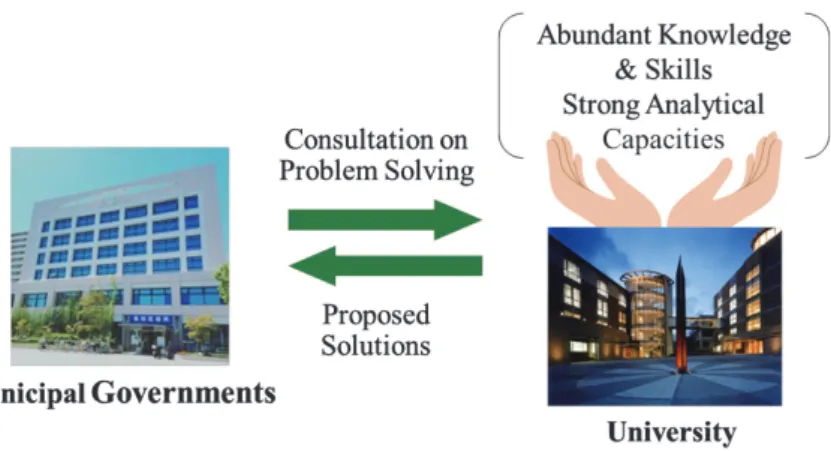
It is impossible for community problems to be solved solely by municipal governments because such problems are becoming more diversified and complicated. In general, universities have abundant knowledge, skills, and strong analytical capacities. If a municipality were energized by taking advantage of university resources, the university would also benefit by an increase in its presence and significance for the community (Figure 6). It is also necessary for residents to tackle problem-solving with an awareness of who their allies are in the community. If residents do not participate in improving the problem, community stability will not last long. In a three-way interaction and interrelationship, represented in Figure 7, all residents, communities, municipal governments, and universities can benefit.
This approach brings another benefit to universities from an educational perspective. It provides service-learning opportunities, which is one pedagogical approach to incorporating community engagement into the curriculum. One commonly accepted definition from Bringle and Hatcher 13) characterizes service-learning as ‘a credit-bearing educational experience in which students participate in an organized service activity that meets identified community needs and reflect on the service activity’. Research suggests that such experiences have positive implications for student retention and success as well as students’ understanding of course content and sense of civic responsibility 13).
2. Creating new policy, culture, and values through WIN
Recently, many municipal governments have relied on consulting firms to resolve complex and diverse social problems and/or to promote community development for the following reason 14). The current social environment of Japan’s communities is characterized by critical issues. In particular, declining populations caused by decreasing birth rate, aging populations, serious economic problems of national and local governments, the widening gap between urban and rural areas, centralization in Tokyo, and the weakening of small communities are notable concerns. Although there is an increasing sense of urgency that residents’ ties must be rebuilt, that concern has not necessarily been connected to an awareness of residents’ independence and motivation to participate in community activities.
However, the results have been disappointing, despite the significant cost invested in them 14). Three main reasons might explain the lack of success: (1) the difference between what the community needs to
Figure 6 Universities’ possible support roles in municipalities’ policymaking and implementation as society/community engagement
revitalize and what can be done by the consulting firm, (2) problems created by turning over all the planning and projects to the consulting firms, and (3) consulting firms that are unable to take responsibility for the results. If the municipality can effectively utilize universities instead of the consulting firms, it can reduce the wasteful use of taxes while the university can increase its presence and revitalize itself, which will help it survive. To that end, it is necessary to shift the university’s research focus from traditional, top-down research to community research.
Community-based research (CBR) is a collaboration between community groups and researchers for the purpose of creating new knowledge or understanding about a practical community issue to bring about change 14). The issue to be investigated is generated by the community, and community members participate in all aspects of the research process. CBR therefore is collaborative, participatory, empowering, systematic, and transformative 15). CBR must have a high degree of relevance to the community; it should place the research objective and endeavors in the context of daily work activities to solve problems and help make those activities more effective and ultimately more satisfying. The research should result in decision-making by the community (i.e., individuals, community agencies, health units, program managers, etc.) or provide information that is in some way directly useful to the community in which it is initiated. The term ‘CBR’ is increasingly being used across a variety of settings. The Centre for Community-Based Research 16) has developed the following working definition for CBR. It constitutes research that strives to be:
(1) Community-driven: begins with a research topic of practical relevance to the community and promotes community self-determination.
(2) Participatory: community members and researchers equitably share control of the research agenda through active and reciprocal involvement in the research design, implementation, and dissemination. (3) Action-oriented: the process and results are useful to community members in making positive social
change and to promote social equity.
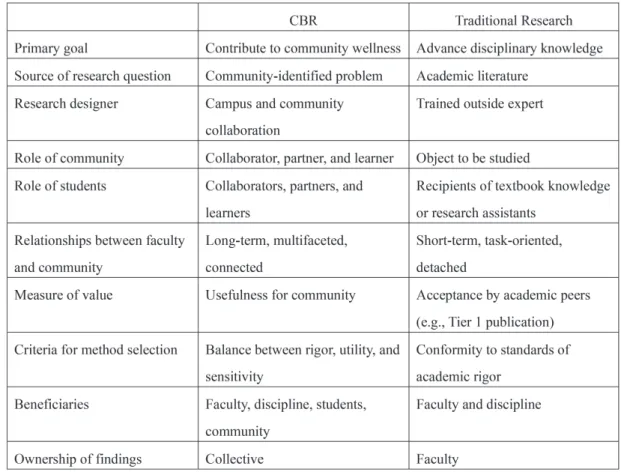
The difference between CBR and traditional research as determined by Strand, Marullo, Cutforth, Stoecker, & Donohue 17) is presented in Table 2.
CBR is similar to ‘action research’ (AR), which has attracted attention in recent years. AR is either research initiated to solve an immediate problem or a reflective process of progressive problem-solving led by individuals working with others in teams or as part of a ‘community of practice’ to improve the way they address issues and solve problems 18). The difference between AR and traditional research as determined by McMillan and Wergin 19) is presented in Table 3. The common aspect in both CBR and AR is the collaboration of residents, municipal governments, and universities to solve society/community problems.
Judging from the above, we think that society/community engagement in universities needs to move from collaboration to co-creation. In this case, co-creation means not only solving community problems but also creating new municipal policies, culture, and values based on evidence found through WIN, including CBR and/or AR projects carried out by universities to promote social evolution and change 20).
Table 2. The difference between community-based research (CBR) and traditional research
Conclusion
This article introduced a university childcare support project that collaborates with community residents and the municipal government, particularly focusing on the specific efforts that utilize the strengths of each of the four university departments as a type of society/community engagement in Japan.
If a municipality and a community benefited from using the university’s resources, the university also might be revitalized because its presence to the community would increase. Unlike top-ranked research universities, small universities can only survive in Japan if education and society/community engagement are linked. This connection will be more and more important in a future that values a university with a public mission focusing on ‘society/community engagement: collaboration between higher education institutions and their communities’, as stated by the conference chair of the 15th Higher Education Forum held at Johns Hopkins University in 2018. Based on our experience, for society or the community to value a university’s existence, that university needs to recognize the community and municipal government not only as a research location or subject but also as partners.
Part of this research was orally presented at the 15th International Workshop on Higher Education Reform (HER).
This work was supported by the MEXT Private University Research Branding Project (PURBP).
KunihikoTakamatsu and Yasuo Nakata write this article mainly. Taion Kunisaki mainly writes this application of this project. Michiyo Hamada is a president of KobeTokiwa University and chief of this project. Kenichiro Mitsunari and MasatoOmori are the chief of teams for this project. Ikuhiro Noda and Kenya Bannakasupported as administrative staff for this project. Other members contribute toeach research team of this project.
References
1) Ministry of Health, Labor and Welfare. 2016 jinko doutai toukei (kakutei su) no gaikyo [Vital statistics in 2016 in Japan]. 2017.
http://www.mhlw.go.jp/toukei/saikin/hw/jinkou/kakutei16/index.html, (accessed 2019-09-01).
2) Policy Research Institute for Land, Infrastructure, Transport and Tourism. Chiiki shometsu jidai wo misueta kongo no kokudo kotsu senryaku no arikata ni tsuite [On the way of future land transportation strategy in anticipation of the era of community annihilation]. 2014.
http://www.mlit.go.jp/pri/kouenkai/syousai/pdf/b-141105_2.pdf, (accessed 2019-09-01).
3) Ministry of Internal Affairs and Communications. Chiiki ryoku sozo ni kansuru yushikisha kaigi saishu torimatome [Report of the expert committee on creation of regional strength]. n.d.
4) Ministry of Internal Affairs and Communications. Machi zukuri no kanten kara jichitai ga kakaeru kadai [Issues of municipalities from the viewpoint of town development]. 2012.
http://www.soumu.go.jp/johotsusintokei/whitepaper/ja/h24/html/nc115110.html, (accessed 2019-09-01). 5) Cabinet Office, Government of Japan. Seifu no shoshika taisaku ni tsuite [Government’s declining
birthrate measures]. 2005.
http://www8.cao.go.jp/shoushi/shoushika/etc/block/block1/siryou2.html, (accessed 2019-09-01).
6) Japan Center for Cities. Jinko gensho shakai ni okeru tasedai koryu kyousei no machidukuri [Town development for multi-generation exchange and coexistence in population declining society]. 2016, http:// www.toshi.or.jp/app-def/wp/wp-content/uploads/2016/08/report161.pdf, (accessed 2019-09-01).
7) Ministry of Health, Labor and Welfare. Kongo no kosodate shien no tameno kihonteki hoko ni tsuite [On the basic direction of policies for future childrearing support]. 1994.
http://www.mhlw.go.jp/bunya/kodomo/angelplan.html, (accessed 2019-09-01).
8) Ministry of Education, Culture, Sports, Science and Technology. Shiritsu daigaku kenkyu burandeingu jigyo ni tsuite (annual year 2017) [Private University Research Branding Project in annual year 2017].
2017.
http://www.mext.go.jp/component/a_menu/education/detail/__icsFiles/afieldfile/2017/04/05/1384025_ 001.pdf, (accessed 2019-09-01).
9) International Conference on Higher Education Reform. Reinventing the Public Mission of Higher Education: Policies and Practice. 2018.
http://edpolicy.education.jhu.edu/2018her_jhu/call-for-papers/, (accessed 2019-09-01).
10) Hyogo Prefecture. Hanshin-Awaji Daishinsai no shisya ni kakaru chosa ni tuite. [About the survey on the deceased of the Great Hanshin-Awaji Earthquake], 2005.
https://web.pref.hyogo.lg.jp/kk42/pa20_000000016.html, (accessed 2019-09-01).
11) Nakata, Yasuo; Saruwatari, Yasuhiro. Higashi-Nihon daishinsai hisaisha ni taisuru saigai shien boranteia katsudo: Hanshin-Awaji dai shinsai de jindai na higai wo koumutta kobeshi nagataku ni ichisuru daigaku to shite [Disaster volunteer activity for victims suffered from East Japan Great Earthquake]. Campus Health. 2012, vol. 49, no. 2, p. 118–125.
12) Carnegie Foundation for the Advancement of Teaching. Classification description. 2005. http://classifications.carnegiefoundation.org/, (accessed 2019-09-01).
13) Bringle, Robert G.; Hatcher, Julie A. Implementing service learning in higher education. The Journal of Higher Education. 1996, vol. 67, no.2, p. 221–239.
14) Toyo Keizai Inc. Chiho wo horobosu ‘nabakari konsarutanto’ [‘Consulting firms in name’ to destroy region]. 2015.
http://toyokeizai.net/articles/-/62102, (accessed 2019-09-01).
15) Hills, Marcia; Mullett, Jennifer. Community-based research: Collaborative action for health and social change. Paper presented at the Qualitative Evidence-based Practice Conference, Coventry University,
2000-05.
16) Centre for Community Based Research. Community based research. n.d.
http://www.communitybasedresearch.ca/Page/View/CBR_definition, (accessed 2019-09-01).
17) Strand, Kerry J.; Marullo, Sam; Cutforth, Nicholas; Stoecker, Randy; Donohue, Patrick. Community-based research and higher education: principles and practices. San Francisco, CA, USA: Jossey-Bass, 2003. 18) Stringer, Ernest T. Action research (4th ed.). Thousand Oaks, CA, USA: Sage Publications, Inc, 2013. 19) McMillan, James H.; Wergin, Jon F. Understanding and evaluating educational research. Columbus, OH,
USA: Prentice Hall, 1998.
20) Park, Peter. Participatory Research, Democracy, and Community. Practicing Anthropology. 1997, vol. 19, no. 3, p. 8–13.