
トップページ - 横浜国立大学学術情報リポジトリ
12
0
0
全文
(2) し. 二 Global society, therefore, attempts to promote democracy in non-democratic. democracy works in reality. Thus, normative theory corresponds to democratic. countries by providing support for democratization through electoral monitoring,. theory within the broader field of political theory, whereas explanatory theory is. military intervention, and other means. In settings where democracy is recognized. equivalent to the concept of democracy in empirical studies. Although normative. as a system worth instituting, empirical studies have investigated the effect of. and explanatory theories developed independently, Shapiro notes their close. democracy on political outcomes and have evaluated the degree of democracy in. relationship, saying “speculation about what ought to be [i.e., normative theory] is. target countries (Munck, 2009; Sirowy & Inkeles, 1990). Such studies have the need. likely to be more useful when informed by relevant knowledge of what is and what is. of measures or indexes of democracy.. feasible,” and that “explanatory theory too easily becomes banal and method driven. However, despite the existence of several democracy indexes, scholars,. when isolated from the pressing normative concerns that have fueled worldwide. especially the “end users” of these indexes, have not paid much attention to the. interest in democracy in recent decades” (p. 235). Political theory can lead us to. implicit definition of democracy used in the indexes; that is, what the producers of. revisit conceptions of democracy taken for granted in empirical studies. Therefore,. data define as democracy.1 Such users choose a particular index from the universe. researchers who undertake empirical studies should consider several views on a. of democracy data sets, based on data availability and practicability of analysis;. conception of democracy within political theory to measure democracy. As a matter. considerations include data coverage (how long a period of time, or how many. of course, there have been several attempts to capture various types of democratic. countries, does a certain index include?) and data popularity (how popular is a. theory.2 However, these attempts have failed to reflect the essential attribute of. given index?). Researchers have also often assumed in their analyses that democracy. democracy, as discussed later in this study.. indexes are interchangeable, due to the high correlations between the indexes.. However, diverse indexes have their own definitions and attributes of democracy. surrounding democracy within political theory and surveying the definitions of. (i.e., conceptualization), and they quantify the degree of democracy or categorize. democracy in democracy indexes, it aims to better understand the present position of. each country into the appropriate political regime by operationalizing components. the conception of democracy in both political theory and empirical studies. Second,. deduced from the attributes of democracy (i.e., measurement) (Munck & Verkuilen,. this study clarifies the conceptual problem, which is termed here as the conceptual. 2002, pp. 7-22). We must choose our democracy indexes carefully before employing. vacuum indicating that conceptual attributes have been ignored in previous efforts. them in analyses, since using different indexes can produce inconsistent results. to measure democracy. To this end, this article discusses the differences between. (Casper & Tufis, 2003).. democracy in political theory and in democracy indexes. Consideration of this. In fact, there exist numerous methodological essays on the measures of. This study has two aims. First, by reviewing the current controversy. ー. 1 1. ―壬}. vacuum will suggest potential attributes of democracy that must be measured in. democracy, and some studies have recognized that theoretically conceptualizing. future studies.. democracy is the most important task preceding any attempt to measure it (e.g., Bollen, 1990, pp. 9-14). Although several studies on democracy measurement review. 2. Two Models of Democracy in Political Theory. democratic theory developed within political theory (e.g., Arat, 1991; Hadenius,. 1992; Przeworski, Alvarez, Cheibub, & Limongi, 2000), they do not necessarily. difficult to answer because democracy is an “essentially contested concept,” meaning. What is democracy? What should democracy be like? These questions are. devote much space to examining or reflecting on current discussions of democracy.. that it is ambiguous in nature; conflicting definitions exist (Gallie, 1956, esp. pp.. However, a conception of democracy in empirical studies is required to mirror. 168-9). Furthermore, democracy itself has developed historically and theoretically,. political theory. According to Shapiro (2002), democratic theory can be divided. so democracy cannot be a univocal term. To explain this development, Macpherson. into two types: “normative theory” and “explanatory theory.” The former contains. (1977) introduces the notion of “models of democracy” and proposes four models:. discussions of what form democracy should have, while the latter explicates how. “protective,” “developmental,” “equilibrium,” and “participatory” democracy.3 Due. 24. 研究論文. Conceptual Vacuum in Measuring Democracy: The Political Process beyond Aggregation. ----E~. 25. F.
(3) し. 二 to the lack of a single model of democracy, this study simply compares the political. Young, 2000). Therefore, the aggregative model equates the decision-making process. processes assumed to be existence in the two conflicting models of democracy. with the aggregation of fixed preferences through election, while the deliberative. currently predominant in political theory: the “aggregative” and “deliberative”. model equates the process with the communication of fluid preferences.. models (e.g., Young, 2000, pp. 18-26).4. Where are decisions made? As is evident, elections, or the ballot boxes, are. These two models differ mostly in terms of the assumption regarding the. the primary place for the aggregative model. In this model, although an election is. decision-making process, property of preferences that citizens possess, and places of. a conduit between politics and citizens, citizens often have no role in the political. decision-making.. process other than their participation in the elections to select the politicians and. For the decision-making process, the aggregative model equates decision-. parties; the classical advocates of the aggregative model, Schumpeter and Downs,. making with vote counting through electoral competition, while the deliberative. limit the citizens’ role in representative democracy to “produc[ing]” (Schumpeter,. model places greater value not on elections but on political processes both pre- and. 2010 [1942], p. 241) or “select[ing]” (Downs, 1957, p. 24) a government by majority. post-elections. This contrast between the two models is apparent in the assumptions. rule. Furthermore, in Schumpeter’s argument, the main function of the parliament. of identifying the properties of citizen’s preferences. In the aggregative model,. is to maintain or oust the current government by counting politicians’ votes for or. individuals cast a ballot to pursue their self-interest based on the choice of their. against the government’s policies (p. 248). Dahl (1971) assumes that democracy,. preferences which are “fixed” in the political process (Downs, 1957; Dryzek, 2000,. or in his term “polyarchy,” is attained by guaranteeing two dimensions—“public. p. 9; Young, 2000, p. 20); thus, vote counting is equated with the aggregation of. contestation” and “inclusiveness”—to construct a government responsive to citizens’. the preferences that the citizens hold. Therefore, the aggregation of fixed preferences. preferences. For citizens to realize that a government possesses a higher level of these. demonstrates what policy or party is the most popular (for details, see Young, 2000,. two dimensions, Dahl also asserts that free and fair elections with political freedom. p. 19).. and suffrage are necessary conditions (pp. 1-4). In sum, the aggregative model. In contrast, the deliberative model of democracy assumes that individuals can. focuses on election as the place of the decision-making process; thus, this model is. transmute their own preferences through their own will by communicating with. mainly concerned with whether the formation of a government can be realized by the. each other pre- and post-elections. In general, to make a decision, participants in. aggregation of fixed preferences through political competition in elections.. the decision-making process utilize two additional means besides voting, namely,. “arguing” and “bargaining.” Arguing is a communicative act meant to persuade. political institutions such as the legislature and judiciary, and the other is the “public. other participants through “appeal[s] to impartial values,” whereas bargaining is a. sphere,” which is a non-institutionalized “network for communicating information. communicative act involving coercion such as threats (Elster, 1998, pp. 5-8). In the. and points of view” in civil society (Habermas, 1996, p. 360). Deliberation by. deliberative model, individuals can change or tend to change their preferences in. assembly or jury members in political institutions makes decisions reflecting public. response to others’ persuasion or out of consideration for their society, such as common. opinion molded by citizens in the public sphere (Habermas, 1996, pp. 299-300).. benefits, by communicating with each other with a will of their own (Dryzek, 2000,. In addition to public opinion, Dryzek (2000, pp. 50-55) emphasizes the role of. p. 167; Habermas, 1996, pp. 336-337; Shapiro, 2002, p. 238; Young, 2000, pp.. rhetoric, which can convey preferences from civil society to the political arena and. 24-25). Hence, the former communicative act, arguing, is a primary method in the. change policies by emotionally influencing the dominant ideology. In sum, the. deliberative political process, while the latter, bargaining, is not an appropriate one.. deliberative model does not confine the role of citizens to the casting of ballots. This. In addition to arguing, some researchers stress other non-coercive communicative. model identifies the core of democracy to exist before and after the formation of a. approaches, one of which is “rhetoric,” meaning that a communication act can make. government rather than just the moment of the formation of a government.. ー. 1 1. ―壬}. Where is deliberation held? Habermas (1996) identifies two places: one is within. an emotional appeal to other participants to shift their attitudes (Dryzek, 2000; 26. 研究論文. Conceptual Vacuum in Measuring Democracy: The Political Process beyond Aggregation. ----E~. 27. F.
(4) し. 二 3. Conceptualizations of Democracy in Empirical Studies. the conceptual agreements and disagreements of the existing indexes as well as. Distinct from democratic theory, which explores the best form of democracy,. conceptual attributes other than the aggregative model, the remainder of this section. empirical studies endeavor to develop a number of democratic indicators that evaluate. initially discusses the conceptions of democracy in the existing indexes, and then. existing democracies. Their study is intended to compare the level of democracy. classifies the indexes into four groups, according to the measured components.5 As. and to examine the relationship between democracy and social/economic/political. a result, we will understand the preponderance of the aggregative model in existing. outcomes. Therefore, these democracy indexes are “self-congratulatory,” because. efforts to measure democracy, even though some of the efforts have attributes that. countries with the highest level of democracy are regarded as impeccable and to be. cannot be grasped by this model.. emulated (Beetham, 1994a, p. 4). This section compares these indexes by referring. to and improving the framework developed by Munck and Verkuilen (2002).. defines democracy by comparing political power between elites and non-elites:. The most commonly used democracy indexes share several common traits.. democracy is “the extent to which the political power of the elite is minimized and that. Almost all democracy indexes are influenced by Dahl’s (1971) conception of. of the nonelite is maximized” (italics in original, p. 372). This is a “nonprocedural”. democracy, which aims to assess the current degree of democracy in a country. definition (Mainwaring, Brinks, & Pérez-Liñán, 2001, p. 38). However, as discussed. (Beetham, 1994a, p. 1; Munck, 2009, p. 17). In other words, in many empirical. earlier, most researchers have constructed their own indexes based on the procedural. studies, democracy is composed of, or refers to, at least two dimensions. These two. definition of democracy, which revolves around the political process for indirectly. dimensions are competition and participation, which Dahl called “contestation” and. controlling or constructing a government that reflects citizens’ preferences.. “inclusiveness.”. Researchers do this by referring to, criticizing, or improving upon Schumpeter’s. Each researcher conceptualizes democracy in his or her own way. Bollen (1980). Munck and Verkuilen argue that most indexes employ “minimalist” and. and Dahl’s conceptions of democracy.6 Przeworski et al. (2000) place a democratic. “procedural” definitions of democracy. The minimalist definition stipulates that a. value on political competition among diverse interests, which originates from. researcher’s own definition should include only the minimum necessary attributes. Schumpeter’s thinking about competition and exclusively focuses on “contestation,”. of democracy to avoid “maximalist definitions” containing “extraneous attributes. which is one of Dahl’s dimensions. Therefore, Przeworski et al.’s conception of. that correspond to other concepts” (Munck, 2009, pp. 16-17; see also Munck &. democracy is “a regime in which those who govern are selected through contested. Verkuilen, 2002, p. 9). The outcomes of policies implemented by the government,. elections” (p. 15). However, their narrow view fails to account for other essential. such as how income is distributed, should therefore not be included in the concept of. aspects of democracy. Mainwaring, Brinks, and Pérez-Liñán (2001) call such a. democracy (Bollen, 1990, p. 12). The procedural definition means that democracy is. restricted view on democracy “a subminimal definition,” pointing out that this. a political process for regulating or constructing a government (e.g., Arat, 1991, pp.. view counts regimes without civil liberties and with a strong military that controls. 19-22; Huntington, 1991, pp. 6-7). This process is identical to that in the aggregative. decision-making as democracies (pp. 41-45). In other words, some works assume. model. In other words, existing democracy indexes employing procedural definitions. that democracy is not conceptualized only by holding elections. For instance, in his. have been developed based on the aggregative model.. conception of democracy, Hadenius (1992, pp. 27-28) points out the significance of. Nonetheless, a detailed examination enables us to view the differences between. “mutual adjustment” in the decision-making process, such as compromise, to justify. democracy indexes due to the various derivative forms of the procedural definition. the representative form of democracy. For definitions of democracy, the aggregative. and diverse components of democracy in the indexes. Surprisingly, some of the. procedure is not necessarily preponderant.. conceptions of democracy and their components in the indexes attempt to capture. democratic attributes beyond the aggregative-procedural perspective. Therefore,. of their conceptions illustrate various ways of measuring democracy. To evaluate the. this detailed examination will also help us understand such attributes. To clarify. current measurements and to measure democracy properly, Munck and Verkuilen. 28. 研究論文. Furthermore, both researchers’ conceptions of democracy and the components. Conceptual Vacuum in Measuring Democracy: The Political Process beyond Aggregation. ----E~. ー. 1 1. ―壬}. 29. F.
(5) し. 口山. 二 argue that the “identification of attributes” is an essential task (Munck, 2009, p.. Table 1. Summary of the Existing Data Sets. 16; Munck & Verkuilen, 2002, p. 7). They initially employ Dahl’s two dimensions:. No .Da t aS e t. “contestation” and “participation.” The attributes of the former are electoral. Com1 J 0 1 1 e n t sf r i r. D m > e U S K > l S t. Mcas u r i n, t ( e f f e c t i v e )e x e c u t i v e s e l e c 1 i o 1. pa,t~ipat畑. competition among parties, as well as political liberties, such as freedom of the press. On the other hand, the components of the latter attributes include voting rights and fair elections. Munck and Verkuilen then add two more attributes to capture. IA r n t( I 切り 血油 s i v en e s so f血. the characteristics of democracy: “offices” and the “agenda-setting power of elected officials.” The third attribute, offices, means that public offices in government and. c i v i l i 1 如r t cs. in legislatures have to be elected. The last attribute, agenda-setting power, is vital for. 1 x i 1 ) U ] a rs o v e r e 屯 ; n t y. democracy, because a regime in which unelected power has real “power” to make a decision cannot be democratic (Munck, 2009, pp. 17-23; Munck & Verkuilen, 2002,. 2Bo l k : n( 1 9 8 0 ) p o l i t にa l 恥 , t i e s. pp. 9-13). Several measures label this attribute as “effectiveness” (e.g., Bollen, 1980).. p 1 uce s s. c ( l l T i j : > e t i t i v e ! l e s s. Based on Munck and Verkuilen’s attributes, this study evaluates and classifies. A u t l m r 'ヽJ d じn t i f i c a t i < mo f A t t r i b u t e s. R e f e r e n c eC o n c e p t. C ' 1 mt c s t a t i l m( [ l c c t n r al DOI ヽ n s( 1 9 5 7 )a n dDa h r s Compet i t ゆo ) ( 19 5 6)co , , c e p 1 S 1El f r c L i v e 心 s s l e g i s l a 伍 es e ¥ e c f o n Cou t e s r n t i o n( E l e c t o r nl Comoe L i L k l n ) l e ! l . i s h t i v eele ct i v e n e ! ; ! ;E f l e c t i v e n es s t h ecom J ) e t i t i v e n e s so f Con t e s t a f o n( 卜 : l e c t o r al Cm n p e t i t 紅n ) themn 血 t oo IP•心 c d , . c むi p a t i o n Pa , p 紅必i p a t i o n ( R; 炉1 1 0> O l e ) I nanvl e双i n i a cv C , m t e s t o f o o ( : 卜ec t o r nl o m o e , ; 1 i o n ) I o a r t vcom 心 t < t J V e n e s s C g o v e r n m e n tc 心 r c i v c n s sC ' o n t c s i t l l k ) n( P o l i t i c a l a n d C i s l iLve c < 記s ) 和i r n eヽ so fe~ctions C o n t e s t a f o n( E l e c t o r al Ori~im1I defm i t i ( m Co 叫 元t i l i o n ) CXCCLtlivc ~ckction l e g i s l a 伍 es e l e c t 紅n C o o t e s t a t i o n( E l e c t o r nl C, , m p c l i l i o n ) +E f f e c t i v e n e s s I p r e s sf r eedom Coo t e s t n t i o n( P o l i t i c n l n o d 如c < l o morg r o u p C i v i l L i x : r l i c s ) o p p o s t t K J n l e:nvcminc nし ~anctii)n. pub l i cc o n t e s 1 a r i o n. the previous indexes by employing the following conceptual attributes: Contestation,. Coppe d g e& 3R e 1 1 i c k e. Participation, and Effectiveness .7 The first attribute consists of Electoral Competition. ( 1 9 9 0 ). t i 1 c 虹s i v e n es sふ. and Political and Civil Liberties. Electoral Competition corresponds to free and fair. p o l i t k a l 屯h t s. elections under a multiparty system. Munck and Verkuilen (2002, p. 11) regard the fairness of elections as one component of Participation because voting rights should not be disrupted by either the government or the opposition. However, the. 4n ℃e d r n n Hm, s e. fairness of elections can also be assumed as a rule for the creation of free competition without the major irregularities that often distort electoral results. Thus, several researchers place the principle of fair elections within the dimension of competition. c i v i li l b e r t i e s. t ヤ e ea 心.f ai rel e c r i o n s C 0 1 ) t e s t a t i o nl P o l i t i c a la r i d Da h l s( 1 971 )p o l y ar c h y i , i l L i o e , t 5 ' s ) f r c c d ( m 1()八 l r l ? < ' ¥ n 四t i o t ,C 伍! e d omo fe x D r e ! > ! > i o n a , r a i l a b i l i t y ・ o fa l t ema l r . ' eCon t e s t a t i o n( E l e c t o r al s o u r ce so fi nfom m t i o n C o n , p c t恥 n ) t h ee x t e n to fs t l f f r a g e - Pa , む仰a t i o n 玉 I nL O, o L , ( R帥 tt oV o t e ) lE l e c t o r a l Pr o c e s s Con t e s t . : i t i o n( E l e c t o r al P r i m a r yp t 1 『p o s ei st o1 1 : i e a s u r e 2Po l i t i c al Pl u r nl i s ma n t iCo a ' l " ' t i f o n ) m> td c m、 1 e r n c yhu t恥 叫om +Comestaoon( Po l i t i c a la n dBute l e c t o r a lde moc r a c yi s P o t t に屈 t i J n 3Fun c t i n 1 i n gor C i v i l U, e r t i e s )1 s n n i l a rL O汝 h t m唸 1 e r i a n C i o v e r n m e n t Pa r r にi p a t i o n( R i g h tt o c o m p e 1 i t i v edemocracy VO [ e )+E t ' t ' e c t i v e u e s s+ ( V r e e l a n d , 2 0 0 3 , p4) Po l t i 心 I Vi o : > l c n c c 1Fr e e d o mo「 C 0 1 1 1 e s l a l i o n( P o l i t i c a la 図 Ex p r e s s i o na n dHe l i e f Ci v l iI む t 1 i e s )+Ru l eo f 2A s s o c i at i o 1 1 a l a 叫 L awIPo l i t たa lV i o l e n c e < , c i a V じo n o m記 F r e edom Orga ni z a t . l i m a lR i g h t s S 3R u l eo fLaw 4. Pc r 8 o n a l Au t o n omy a n dh t d i v i < . i u al R勅 t s. ー. 1 1. ―壬}. (Coppedge & Reinicke, 1990, p. 53; Mainwaring et al., 2001, pp. 39, 45-46; see also Munck & Verkuilen, 2002, p. 11, footnote 5), and therefore this study also includes it in Electoral Competition. Political and Civil Liberties, such as freedom of. decide who holds public offices in the government and the legislature. Thus, it is. organization and freedom of expression are intrinsically necessary for dissidents or. inconceivable that coders attempt to identify elections for non-public offices. For. citizens to oppose the government; hence this study assumes this as a component of. instance, although Munck and Verkuilen (2002, p. 12) argue that Vanhanen (2000). Contestation. The second attribute of democracy, Participation, has two components. lacks any account of the important attribute of offices, he actually creates his indexes. related to electoral participation: Right to Vote and Breadth of Participation. The third. “on the basis of parliamentary or presidential elections, or both” (Vanhanen, 2000,. attribute, Effectiveness, is the same as Munck and Verkuilen’s attribute of agenda-. p. 254).. setting power. Finally, the attribute of offices is omitted in this article. As described. before, this attribute captures “the extent to which offices are filled by means of. sets.8 This summary demonstrates that all measures base their conceptual attributes. elections instead of some other procedure” (Munck 2009, p. 20). When judging. on the procedural characteristics of democracy related to the electoral process. whether a given election is democratic or not, coders inevitably target elections that. (see Online Appendix). Even the latest measures developed in the 2010s focus on. 30. 研究論文. Table 1 shows a summary of the measurement components of existing data. Conceptual Vacuum in Measuring Democracy: The Political Process beyond Aggregation. ----E~. 31. F.
(6) し. 口山. 二 o ; , , . , , , , 螂. No D r r t . ' lS e l. Co 1 npo 心n u ヽf o r U『 i ng ー:— Mcaゞ. '. ( a )c o n v i e l i lmIe l T e c i l i v e n e s ヽ GasK ) C ' ( ) w s k i ( b )i 1 " 1 C l u s r v en e s s ( 1 ' 1 9 6 ) ( c )r x 1 l i t i c aI r i g h t sa n dc i v l il i h c r t 心 5 I. \ \ r i g h tofr x 1 l i t i c a l opposfo a. 恥r ' s[ J c n i l 「 i c aL i l . mof Aul R d e r e 1 1 C eC o n c e p t Attribute~. Co n t e s i . a t i o n( E l e c t o r a l Cn mpct < < > n }+ E l 1 ' e c l i v e n e s s Pa 1 1 にやl i o n 以h tt o, o t e ) l (R Co n t e ヽ じt t l i m( l ' o l i t K : aI a n d むs ) C i v i lL加『t. D i a皿 m < l ,L加 ,a n < ll i p s e 1 ' s ( 1 9 8 9 ,pp . x v i x v i i )c t m c c p l w h i c hi sb as e d0 1 1D a l u ' s ( 1 9 71 )J X > i y , c c h y. E k c t . , . , s. Pr opo r t i o nofe k : c l o r n t e sPartic~tion (応g i ll O V o t i . : ) C( m l e s t aゆ n( E l e c t o r a l Co r n p cl h, n ) M e a n i n g 訂1 e l e c t幻n sO区 " C o n t e s t a t i o n( R l e c t C H 1 1 I C o r r e c t C叩 訳Ihm) E l l c c t ; w ドr n じ c t i v c o r n Ora 直mt i o n a lf r ℃e d 0 1 n sC 0 1 1 t e s t a t i o n( Po 駈c al a i . 迅 P o U t i : a lLhe r t たs f r c 叫( l f l loro p i n i l m C i v i ll i b c r l i . : s ) Po l t i i c a l v i o l e r l C ea n d l 」 n i v c r s a ls u f f r n g じ. P r o p o 『 I ヽ 劾no !e l e c l e d. " " ". E l e c 1 i c 心 f o rf . e g i s J . . 1両 ea n d E x . e c u l i l i e I s1 h e1 1 a心 h i s el 1 1 C l t 1 s 柘' e ? 7Mai n wa r i n g e tn l( 2 ( ) ( ) 1 ) Ar cCi v i l Li h t : r l i c sR c s p c c l c d ?. Dot h eEl e c t e dR u l e r sE n j o yRe a l Go v c mingCa p a c i t y ? Cヽ n n i x : t l i i v c n cヽ S. P o l i t yJ V 8( M 2 ( , x l 0 ) l 6 l ) c tal. Cヽ " ' ゞ , , , ; , , ヽ Port~屈 t i , m Ri g h tt oVo ↑ e. ,. M皿 c k C k : anC : l c < : l i o : n ; ( 2 0 ¥ l ' ) ) UNDP( 2 ! ( ) 比 Fr e eE l e c l i o t 1 s pp . 2 0 7 2 1 3 ) E l e c 1 edPu b l i cOf f i c e s. D i t 1 1 . e n s i o n s t Co m p e t i t i v e n e s sofEx e c u t i v e Re c r u i t n 1 e n t Op e n n e s so fExe c u r i v eRe c1 , 1 i t n " 1 e n t. S ol n yI V e c u f a ・ eC o u s r r a i n r s 1 0( M a t o h a l& Ex J a巽 打s , 2 0 0 9 ) Reg u l a t i o no fP a r t i c i p a t i o n. にa lo f i n f 1 l f l l 1 a t i n nc r i t l 2 o v e r r u n e n ta t x l .l e a d e r s p h ) ' S i c aI i n l i t n 迅a t i , : ma~ s u p p r e s si n gi x i l i t i c a l o p p o s , t i o n. R心: h( 2 0 0 2 ). I f a < l e n i u s 6( 1 9 9 2 ). Nn .Da t aS e t. Co mp e t i t i v e n e s so fPa r t i c i p a t i o n Com p e国i o n I IPr 心W Ol ゞk ie t " '( 2 ( ) ( ) ( ) ). 沿2 ,Cbap l e r2 ) I Ia d e n i u s( 1 : l l c n i c st h ec o n c e p to f おm x : r a c yr e s t r i ct i n gc i t 加n ・ s po i l t i c al p r i 1 t i c i p a t i o L 11 0t h e l : a d c rs c k : c t i o : m. Comperit~n 2Vanh i r n cn ) I (200<). 1 3V ( 2 r 0 c 0 吐 3 ) 叫. P a r l i c i p a t i o n Co mp e t i t 紅l (¥ mt c s t ≪ t < m. 1 4Bo . i ' Ceta l ( 2 01 3 ). """ s s , o n f r e ea n df a i re l e c ti o i 1 s Co n t e s t a t i o n( R l e c 1 o r a l Cmue p l fon). M a i n w a r i n ge t: i l( 2 0 01 ) c r i t i c i . L e st h es u b t n i 血l l 8 1 じ(加c p to fd c tn o :江 t c ya~ Hi g h 1t ov o r e+No t l ' a r t i cゃ . 1 1 i o n(l~ighr r o pnJfXi~cd h yS c h u mpct c r t r i 邸 r i n gs o c叫 p r t ) l C S l . < ;v し ) l C) 」 a r i dPr 7 e wo r s k i ( 2 0 1 0 )l l 9 4 2 e t a l ( 2 0 0 0 ) T h e y c r e a l e -L 1 1 e C o n t eヽ じl l i l m( l ' o l i t r . : 1I a n < l o r i g i n a lc ( m c c p t .e x 匹n d i ng C i v i lI i b e r t i e s ) D a h ! sn . v od h 1 : 1 e 1 1 S i o n sb y E f f e c t i v e n e s s a d d i n gc i v i ll i b c r l i c sa n d e f f e c t i v eg o v e r n m e n t .. 1 5S a k . ' l . l . ( a 2 01 血 屯 5 )C l. \. ra r t i ci p a t i o n. \ -. \. い, npo n e n t sfm ャ Me a s ur i n g. \. \ \ \. A u t h o r ' sl d e n t i f r a t i o no f R e f e r e n c eCl mcq i t A l t r o o t e s Co n t c s t a t i o n( Il c c u . i r a l Co m区 t i t i o n ). Pr i r n : : i r yp u r p : , s ci st()n I C a s u r c n o td e n ' l O C r a cyb u t" a u t h o r i t y ・ p : i t t c m翌 ( Ma 吋1 all& J a認 e r s ,2 0 0 ) ,p .1 ). Et l e e c j ¥ . ・ e 1 l e s s Co n t e s t a t i o n( E l e c t o r a l Com 区t i t i o n ). ~ e x e c u t i v es e l e c t i o n l e c i s b t i v es e l e c t 虹I p a r t y(PA R百 l I NCUMH ) a l t e r n a t i o n. \. \ \ c x c cu t i ¥ ' cs c l c c t K > n l e g i sl a t i v cs c k : : c t i c m r i g h tt ov o t e. Co n t e s t a t i o n( El e c t o r a l Co m 1 x o t fo, ). S c h m n p e o e r s( 2 0 1 0[ 1 9 4 2 ] ) い )r n p c l 心 na ndDa h ' ! ヽ( 1 9 7 1) c o n c e s t at oo. Co n t e s r a c i o n(E~ctornl Com 区t i 凶n ). Da h ! s( 1 971 )po 憐r c hy. 唸 ' ' ' ". Part~ ( Br e a d 山o lp a c i < i ' o a 匹) Con t e s r a t i o n( El e c t o r a l Cum1~ttt,m) Co n t e s t a t i o n( L l c c いr a l Co n , p e , i t i o n ) ra i , i ci p a t i o n( Ri g h tt o V叩 ). l e g i s l a t i v es e l e c t i o n c . x c c u t i v cs e l e ct i o n. S c h u n , , e i e c( 2 01 0L 1 9 4 2 」 )a nd Pr z c w t l f S k i c ta . l( 2 0 C l 0 ) Da h l( 19 7 1 )a ndPr z c w o r s k i e ta l .( 2 ( ) ) ( ) ). S chwn p e , e , ・ ( 2 Q I虹 l 児2 」 ). Co n t e s r a t i o n( E l e c t o r a l Co m図 ; u o n ) n c on 匹 l r t < > n ( , 皿 e r t a m t y ) ma l es u f f r ar e Pa r t i c 和t i c : m( Ri g h tt o fo na l ,s u f f r n g e V o t e ). ー. 1 1. ―壬}. ' " " ' " " 印. Note. For a more detailed summary, see the Online Appendix on the author’s webpage. * Inclusiveness is not included in their data set. †Each author’s label of Dimensions/Components has been referred to or renamed for this article.. Compc l l i i v i . : n i . : s so r C o n t e ヽ t : l l K l n( L l l c c h1 r , ; 1 . I l ) ah r s( 1 9 7 1 )r x 1 l y a r c hya n d e x e c u t i v er e cn i i r n 記n t C o m p e t < < > n ) Po l < y p c o j e c t (XRCOMP) Ope 皿e s sofe x e c u t i v e r c c r u i t 1 n c n l( XROPEN') 応gu~1ticlf'1 o f l p . , r t i c ; , . c i o n(PARREG) Compc L i l i v c n c s ヽo r J > O r t i c i p a f o , ( PARCOMP) C1m ゞ t r n i n r .l l f lc x c c u t i v cl ザf c c t r . c n c s s XCONsn 恥 叫t ho f p . ) l i t i c : a l に" ' " " " p a , [ ( R , e a d ! hofpa , t i d p . , i幻o , ) IIX!rt<;,."~" P a r t i c . , m l i m( Hi g h tm S c l m m p c t c c( 2 1 1 1 0J 1 9 4 2 l ) . V o t e ) Ro 血 1e ta l( 1 9 7 0 ) :D a h l ( 1989) ,s" , , , ; ( 1 9 8 7 ) , ' lr 7 ewor s k i e ta . l( 2 0 ! . I O } ; Con t e s l a t i o n( E l e c t o r a l びD o n n e l l( 2 0 01 ) Com 訟1 < 畑). to the electoral process and political liberties (p. 372).10 Hadenius (1992) does not operationalize his conception either, because his conceptual attributes do not reflect negotiations among representatives in the political process.. To discuss the conceptual coverage of the existing indexes, I classify them into. four groups, as shown in Figure 1, where Electoral Competition and Participation. \. are combined into a new attribute: Election. Group 1 includes indexes that focus on. \. only the electoral process; therefore, this group can be labeled “electoral democracy”. \. (Freedom House, 2010). Group 2 shifts our attention to the effective power exercised. -. by an elected government without intervention by non-elected authorities such as. elections, much like the previous ones (Boix, Miller, & Rosato, 2013; Skaaning,. the military. Group 3, on the other hand, values not only elections but also political. Gerring, & Bartusevičius, 2015).9 Bollen’s (1980) process of operationalization. and civil liberties. Indexes of this group include content that citizens living in. contains a significant gap between his non-procedural conception of democracy. democracies must enjoy several kinds of freedom to express their opposition and. and the attributes of his conception. He recognizes that direct measurement of. convey their own preferences for their own government. Lastly, Group 4 covers all. the political power of the elite, compared with that of the non-elite, is difficult to. three attributes.. achieve; thus, he utilizes the procedural conception in order to indirectly measure. the non-procedural conception. Therefore, he introduces two dimensions related. of whether the components of Election capture the attribute of Participation. The. 32. 研究論文. Table 2 shows the group distribution by distinguishing each group in terms. Conceptual Vacuum in Measuring Democracy: The Political Process beyond Aggregation. ----E~. 33. F.
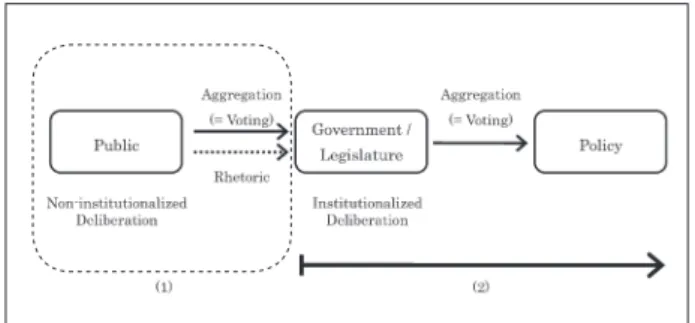
(7) し. 二. Table 2. Group Distribution. 、. Pol i ti calaadCi , i lL i b c c t i c. ( , r oup. E l f . 心 ! is c nc s,. El心1;m, •. N. Name~o 「 Indexes. + Vanhanen(2000),Mu n c k( 2 009 ) ,珈 i xe ¥a l( 201 3 ) ,Sk a a ni ngeta l( 201 5). 4. -. I. I GmupI. 5 P r : , ew o r c : kie 1 al( 2 0 0 0) '. + Moone ta l .( 2 0 0 6 ). 汀u up2 C. I. 2. 2 -. Gr n up3. ) Pol i t yJ V( M a r < ; hal& Jagger~, 2009. l. C : 刈1 p e dge& Re i ni c k e( 1 9叩 ). ゜. +. Gm" p4. 3. I. -. l. / ¥ r . t t( 1 991 ) .Had c ni u s( 1992 ) , Fr e e domHous e( 2 01 0 ) .G a s i orowski( 1 99 6 )凡 +. Figure 1. Grouping of Existing Indexes. -. Note.* Election is a dimension that includes only electoral competition or both electoral competition and participation. Group 1: Democracy means electoral democracy. Group 2: Democracy means the political process for constructing effective government through elections. Group 3: Democracy means electoral democracy with political and civil liberties. Group 4: Democracy means the political process in which citizens enjoy political and civil liberties as well as holding elections for constructing an effective government.. 5. n ge tal( 2 ( 1 0 1 ) Mai nwa『i. 4. 6. Bol l en( 1 98 0). l Sum. 1 4. Note. + The components for Election includes not only Electoral Competition but also Participation. - The components for Election are composed of only Electoral Competition. a Vreeland (2003) creates a continuous index of democracy by calculating the probability of the democratic government formation from Przeworski et al. (2000). b Reich (2002) expands Gariorowski’s data by employing a coding framework.. positive sign stands for the group that includes both Electoral Competition and. attribute capturing whether an election is a substantive way to control a government.. Participation, while the negative sign represents the group focusing only on Electoral. Thus, although there are conceptual differences among extant indexes, previous. Competition. For instance, the index created by Przeworski et al. (2000), exactly. efforts to measure democracy have equated it with the establishment of a government. reflecting the subminimal definition of democracy, is allocated to the negative. through elections and have not focused on the political processes existing before and. category of Group 1. Table 2 suggests that the existing indexes are bimodally. after a government comes into being. Despite there being multiple ways to define and. distributed. Group 1 includes five indexes focusing on the electoral process, while. measure democracy from the procedural view of democracy, we have used only one. Group 4 has the largest number of indexes, some of which exhibit the problem of. model of democracy to measure it—i.e., the aggregative model, or a model related to. the maximalist definition, because they partly rely on social and economic freedom. the aggregative model.. ー. 1 1. ―壬}. as well as political violence (Arat, 1991; Hadenius, 1992; Freedom House, 2010; for the problem of the maximal definition, see Munck & Verkuilen, 2002, pp. 9-11).. 4. Conceptual Vacuum in Measuring Democracy. In other words, the existing indexes have attempted to concentrate on the electoral. process or to cover wider aspects of democracy, including election, freedom, and. democracy indexes in terms of government formation as the result of a competition. effectiveness.. among people’s preferences through elections. However, political theory, especially. As we can see, when perusing the Tables and Figure, the prevailing aspect of. the deliberative model, suggests that the value of democracy lies not only in its. democracy in empirical studies is the preference aggregation through elections.. aggregation of preferences but also in the policy-making process that occurs through. Some indexes take into account democratic values and conditions achieved not. interaction between actors with diverse interests in the political arena as well as. only by holding competitive elections, such as political freedoms and the real. in civil society. Dryzek (2009) argues that in comparative studies, definitions of. power of elected government, but these values and conditions are also interpreted. democracy based on competitive elections and civil liberties “miss a key aspect—. as requirements for making elections sound. Political freedom is a component of. deliberation” (p. 1380).. competition, while government effectiveness is not. In other words, effectiveness is. not directly based on the aggregative model. However, this can be regarded as an. both the aggregative and the deliberative models; and it also points out a conceptual. 34. 研究論文. This study has demonstrated that the aggregative view is dominant in existing. Figure 2 shows the simplified flow of the decision-making process based on. Conceptual Vacuum in Measuring Democracy: The Political Process beyond Aggregation. ----E~. 35. F.
(8) し. 二. +. 1 1. ―壬}. argues (see [1] in Figure 2). Additionally, negotiation and deliberation within and ,-・ - - . .. - - - - - - - - - - - - - - -- - - ,ヽ. : , : ,. '. 、 Agg ・e ,g a t i o n‘ :. between political institutions have a direct impact upon policies, while deliberation. 9. 口ロニニ二. ' , .on i nat it u t ionalmd. ' ヽ ― , '. Uc l i b c c a t i o n. Agg ・e , g o t io n. in civil society can have only indirect effects upon policies. Therefore, the former procedures are more crucial than the latter. However, as already discussed, Hadenius (1992) does not measure the political process after elections, despite pointing out. ' ; T na t i t u t ;. : .__) ― - . ( 1 ). D c l i b c r n t i o n. its importance for democracy. In sum, the political process after the formation of a government—which current research has tended to ignore—is surrounded by a fatal. ( 2 ). conceptual vacuum (see [2] in Figure 2).. Figure 2. Decision-making Process based on the Two Democratic Models. If efforts exclusively focus on elections to measure democracy, they are at risk of. recognizing non-democratic methods as legitimate approaches. Thus, steamrolling in problem. Previous indexes have a “conceptual vacuum”; this is, in part, the problem. the name of majority rule is included as a democratic method. However, this can lead. of minimalist definitions, and it means that existing efforts at measurement have. to such clichéd dangers as: the “tyranny of the majority” or “the greatest happiness of. failed to capture or measure the essential aspects or attributes of a given concept.11. the greatest number,” which constitute the utilitarianism opposed to Rawls’ (1971). If we are satisfied with indexes contaminated by this vacuum, we will continue to. justice.12 Barker (1942, p. 35) raises the question “why … should the will of a part,. overlook these aspects, and in doing so, expand the gap between the conceptions. however numerous, be identified with the will of the whole?” He also maintains that. of democracy suggested in political theory and those in empirical studies. While. democracy must have “a government depending on mutual interchange of ideas, on. existing studies have mainly measured the electoral process, the deliberative model. mutual criticism of the ideas interchanged, and on the common and agreed choice of. shifts our viewpoint to democratic decision-making in the political process before. the idea which emerges triumphant from the ordeal of interchange and criticism” (p.. and after the electoral process. The process before and after elections amounts to a. 36).13. conceptual vacuum for current indexes, as it is unaccounted for in the indexes (see. Figure 2).. a level of democracy among mature democracies. For instance, Beetham (1994b,. If we hold that democracy is a continuous concept (Elkins, 2000), we can discern. This study, however, does not emphasize only deliberation itself, for the following. pp. 34-35) argues that the democratic level of mature democracies is the goal to be. two reasons. First, in real politics, decisions are made not only through deliberation. attained by non-democracies in the existing indexes. Hence, he raises the question. but also by negotiation or compromise, as can be seen in the work of one deliberative. of how democratic countries become more democratic, and recognizes the necessity. theorist. Dryzek (2000), one of the most influential deliberative theorists, implicitly. of “a self-critical tool for the assessment or ‘audit’ of the quality of democracy” in a. seems to admit the unavoidability of negotiation based on threats and self-interest,. mature democratic country (pp. 25-27; quote from p. 25). Moreover, Foweraker and. as he illustrates the negotiations for conflict resolution in Northern Ireland in his. Krznaric (2000, p. 759) argue that the “performance” of democracy differs among. explanation of deliberation in real politics (p. 41). Simply put, existing research. democratic governments, even if they fulfill the minimum conditions of democracy,. has focused on voting, which is one of Elster’s (1998) three political methods;. such as holding competitive elections. Therefore, we cannot be satisfied with the. therefore, future research should quantify Elster’s remaining methods: arguing. existing democracy indexes referring to only electoral components of democracy,. (i.e., deliberation) and bargaining. Second, the current approach may measure the. if we assume that democracy has yet to be achieved in mature democracies and. latent setting that fosters civil society. Some indexes have gauged various freedoms as. that communication through the policy-making process after elections is the core. being at the basis of elections. Yet freedoms may also be considered to be the “basic. component of democracy.. rights” necessary for the public sphere/civil society, as Habermas (1996, p. 368). 36. 研究論文. As a matter of course, there exist several approaches to measure the political Conceptual Vacuum in Measuring Democracy: The Political Process beyond Aggregation. ----E~. +. 37. F.
(9) し. 二 process from the perspectives of comparative democracy and deliberation in the. parliament by performing a content analysis of speeches to evaluate the degree of. institutionalized political arena. In the final part of this article, I will describe four. deliberative politics.. attempts. The first two are attempts not to measure the level of democracy across. all countries, including dictatorships, but to measure the quality of democracy or. political process after aggregation. His index is based on the concept of “discussion”. classify the type of democracy within developed democracies. The latter two are. by Fearon (1998) which is a broader concept than deliberation since it captures. attempts to measure the degree of democracy similar to the existing measures of. communication without any distinction between arguing and bargaining. To. democracy discussed earlier.. measure this concept, he uses the duration of budgetary debates in the legislature for. First, Lijphart (1999) proposes continuous variables reflecting different rules. Third, Kamahara (2012) proposes a new index of democracy, mainly measuring. 26 countries.. for decision-making in a “majoritarian democracy” and “consensus democracy.” The. Although existing studies have made these attempts to go beyond the limitations. former type of democracy employs institutions that favor majority groups, such as a. of the conceptions of democracy that contaminate conventional indexes, such as the. plurality voting system, a single-party cabinet, and a unitary system. The latter type. conceptual vacuum, as discussed in Sections 3 and 4, these efforts solely focusing on. attempts to attain consensus between majority and minority groups by introducing. political processes in government do not cover the number of countries necessary for. institutions, such as a proportional representation system, a coalition cabinet, and. large-N studies (for Lijphart, 1999, only 36 countries; for Steiner et al., 2004, many. a federal system. Lijphart focuses on the political process after the formation of a. speeches in only four countries; for Kamahara, 2012, only 26 countries).. democratic government to compare the performances between the two types of. democracies. To build consensus, political elites must negotiate with each other.. “electoral,” “liberal,” “participatory,” “deliberative,” and “egalitarian.” There. Hence, consensus democracy is also called “negotiation democracy” (Kaiser, 1997,. are included seven components for the principle of deliberation: (1) “reasoned. p. 434).. justification,” (2) “common good,” (3) “respect counterarguments,” (4) “range of. On the other hand, the V-Dem Project measures five principles of democracy:. Lijphart’s consensus democracy is conceptualized in terms of institutionalism;. consultation,” (5) “engaged society,” (6) “particularistic or public goods,” (7) “means-. therefore, he measures it by employing institutional variables and does not assess. tested v. universalistic policy” (Coppedge et al. 2016).15 Thus, this explicitly measures. actual negotiation, that is, the behavior of political elites within institutions (Kaiser,. deliberation for 173 countries. Although this is quite the most comprehensive and. 1997, pp. 432-433; Steiner, Bächtiger, Spörndli, & Steenbergen, 2004, Chapter 1).. largest-N database project in the world, this does not explicitly quantify the degree. This criticism also fits Lijphart’s (1977) early concept of “consociational democracy”. of democracy of the political process after elections including both deliberation and. (Steiner et al., 2004).14 To fill the gap between institutional conceptualization and. discussion.16 Therefore, unfortunately, even this project does not perfectly overcome. behavioral interpretation, Steiner et al. move away from constitutional institutions. the conceptual vacuum in measuring democracy.. and are more concerned with the “spirit of accommodation” in consociational. theory, which is the principle that addresses politicians’ interactions making. In the whole political process, there are two important procedures: (1) elections to. political decisions and resolving political disputes in segmented societies (Lijphart,. make a government and (2) discussion, or negotiation as well as deliberation in. 1968, pp. 103-104; 1977; Steiner et al., 2004, pp. 8-11). In politics that have a spirit. government and civil society. Data producers have created democracy indexes in. of accommodation, politicians may communicate with each other by using both. terms of only parts of these procedures: election and potential deliberative settings. bargaining and arguing (Steiner et al., 2004, p. 15). As a result, Steiner et al. relate. in civil society. The deliberative model, however, leads us to find the importance of. consociational democracy to deliberation, saying that the former is “just one of. the political process in the elected government within the conception of democracy.. many applications of the deliberative model” (Steiner et al., 2004, p. 16). In this. By measuring democracy based on this conception, we obtain a democracy index. context, they create a new index for measuring the quality of politicians’ debates in. without this type of conceptual problem.. 38. 研究論文. This section has discussed the fatal conceptual problem in measuring democracy.. Conceptual Vacuum in Measuring Democracy: The Political Process beyond Aggregation. ----E~. ー. 1 1. ―壬}. 39. F.
(10) し. 二 5. Conclusion. References. This study has reviewed the current situation of democracy in political theory. Arat, Z. F. (1991) Democracy and human rights in developing countries. Boulder, CO: Lynne Rienner Publishers.. as well as empirical studies, and shown the conceptual problem in the existing. Barker, E. (1942) Reflections on government. London: Oxford University Press.. measurements. By comparing two conflicting models of democracy and surveying. Beetham, D. (1994a) Introduction. In: D. Beetham (ed.) Defining and measuring democracy. London: Sage Publications, pp. 1-5.. the conceptions of democracy in the existing measures, this study has revealed that the extant efforts to measure democracy have conceptualized it in terms of the. Beetham, D. (1994b) Key principles and indices for a democratic audit. In: D. Beetham (ed.) Defining and measuring democracy. London: Sage Publications, pp. 25-43.. electoral process leading to the formation of a government. This has, in turn, led to. Bishop, S., and Hoeffler, A. (2016) Free and fair elections: A new database. Journal of Peace Research 53(4): 608-616.. a conceptual vacuum, as these efforts have ignored communicative actions in civil society and in the political system. In particular, if we restrict our viewpoint to. Boix, C., Miller, M., and Rosato, S. (2013) A complete data set of political regimes, 1800–2007. Comparative Political Studies 46(12): 1523-1554.. institutionalized decision-making, the procedural conception of democracy has to. Bollen, K. A. (1980) Issues in the comparative measurement of political democracy. American Sociological Review 45(3): 370-390.. embrace not only government formation but also policy formation.. Measuring democracy and its methodology are pivotal research areas. For our. Bollen, K. A. (1990) Political democracy: Conceptual and measurement traps. Studies in Comparative International Development 25(1): 7-24.. purposes, we can consider empirical studies using the democracy index as “applied. Casper, G., and Tufis, C. (2003) Correlation versus interchangeability: The limited robustness of empirical findings on democracy using highly correlated data sets. Political Analysis 11(2): 196203.. research” and measuring democracy as “fundamental research.” The neglect of fundamental research will halt the development of applied research. Therefore, we must evaluate existing efforts to measure democracy and improve the methodology. Coppedge, M., and Reinicke, W. (1990) Measuring polyarchy. Studies in Comparative International Development 25(1): 51-72.. of that measurement. In addition, we must never stop developing and refining. a bridge between political theory and empirical studies. This work will enable us to. Coppedge, M., Gerring, J., Lindberg, S. I., Skaaning, S., Teorell, J., with Altman, D., Bernhard, M., Fish, M. S., Glynn, A., Hicken, A., Knutsen, C. H., McMann, K., Paxton, P., Pemstein, D., Staton, J., Zimmerman, B., Andersson, F., Mechkova, V., and Miri, F. (2016) V-Dem codebook v6. Varieties of Democracy (V-Dem) Project, https://v-dem.net/en/reference/version6-mar-2016/, accessed April 15, 2016.. examine whatever conception of democracy we attempt to measure without leading. Corbet , H. (1973) GATT in a conceptual vacuum. Intereconomics 8 (9): 280-3.. to a conceptual vacuum, and allow us to find other types of conceptual vacuum. To. Dahl, R. A. (1956) A preface to democratic theory. Chicago: University of Chicago Press.. achieve this objective, it is necessary to begin measuring political processes after the. Dahl, R. A. (1971) Polyarchy: participation and opposition. New Haven, CT: Yale University Press.. the conception of democracy itself, because conceptualizing democracy is the foundation of fundamental research. To this end, we are building and strengthening. ー. 1 1. ―壬}. Dahl, R. A. (1989) Democracy and its critics. New Haven, CT: Yale University Press.. formation of government.. Diamond, L. J., Linz, J. J., and Lipset, S. M. (eds.) (1989) Democracy in developing countries (Vol. 4). Boulder, CO: Lynne Rienner. Downs, A. (1957) An economic theory of democracy. New York: Harper. Dryzek, J. S. (2000) Deliberative democracy and beyond: Liberals, critics, contestations. Oxford: Oxford University Press. Dryzek, J. S. (2009) Democratization as deliberative capacity building. Comparative Political Studies 42(11): 1379-1402. Elkins, Z. (2000) Gradations of democracy? Empirical tests of alternative conceptualizations. American Journal of Political Science 44(2): 293-300. Elster, J. (1998): Introduction. In: J. Elster (ed.) Deliberative democracy. Cambridge: Cambridge University Press, pp. 1-18. Fearon, J. D. (1998) Deliberation as Discussion. In: J. Elster (ed.) Deliberative democracy. Cambridge: Cambridge University Press, pp. 44-68.. 40. 研究論文. Conceptual Vacuum in Measuring Democracy: The Political Process beyond Aggregation. ----E~. 41. F.
(11) し. 二. MD: Johns Hopkins University Press.. Foweraker, J., and Krznaric, R. (2000) Measuring liberal democratic performance: An empirical and conceptual critique. Political Studies 48(4): 759-787.. Munck, G. L., and Verkuilen, J. (2002) Conceptualizing and measuring democracy. Comparative Political Studies 35(1): 5-34.. Freedom House. (2002) Freedom in the World, 2002 edition, http://www.freedomhouse.org/ template.cfm?page=351andana_page=166andyear=2002, accessed June 29, 2011.. O’Donnell, G. (2001) Democracy, law, and comparative politics. Studies in Comparative International Development 36(1): 7-36.. Freedom House. (2010) Freedom in the World, 2010 edition, http://www.freedomhouse.org/template. cfm?page=351andana_page=362andyear=2010, accessed June 29, 2011.. Przeworski, A., Alvarez, M. E., Cheibub, J. A., and Limongi, F. (2000) Democracy and development: Political institutions and well-being in the world, 1950-1990. Cambridge: Cambridge University Press.. Gabardi, W. (2001) Contemporary models of democracy. Polity 33(4): 547-568. Gallie, W. B. (1956) Essentially contested concepts. Proceedings of the Aristotelian Society 56: 167198.. Rawls, J. (1971) A theory of justice. Cambridge, MA: Harvard University Press.. Gasiorowski, M. J. (1996) An overview of the political regime change dataset. Comparative Political Studies 29(4): 469-483.. Reich, G. (2002) Categorizing political regimes: New data for old problems. Democratization 9(4): 1-24.. Habermas, J. (1996) Between facts and norms: Contributions to a discourse theory of law and democracy (W. Rehg, Trans.). Cambridge, MA: MIT Press.. Rokkan, S. with Angus, C., Torsvik, P., and Valen, H. (1970) Citizens, elections, parties: Approaches to the comparative study of the processes of development. New York: David Mckay Company.. Hadenius, A. (1992) Democracy and development. Cambridge: Cambridge University Press.. Sartori, G. (1987) The theory of democracy revisited. Chatham, NJ: Chatham House Publishers.. Held, D. (1987) Models of democracy. Stanford: Stanford University Press.. Schumpeter, J. A. (2010) [1942] Capitalism, socialism and democracy. London: Routledge.. Huntington, S. P. (1991) The third wave: Democratization in the late twentieth century. Norman: University of Oklahoma Press.. Shapiro, I. (2002) The state of democratic theory. In I. Katznelson and H. Milner (eds.) Political science: The state of the discipline. New York: W. W. Norton and Co., pp. 235-265.. Kaiser, A. (1997) Types of democracy. Journal of Theoretical Politics 9(4): 419-444.. Sirowy, L., and Inkeles, A. (1990) The effects of democracy on economic growth and inequality: A review. Studies in Comparative International Development 25(1): 126-157.. Kamahara. Y. (2011) Measuring democracy for empirical studies: A review [Minshushugi sihyo no genjo to kadai]. Journal of Law and Political Studies [Hogaku seijigaku ronkyu] (90): 103-136.. Skaaning, S.E., Gerring, J., and Bartusevičius, H. (2015) A lexical index of electoral democracy. Comparative Political Studies 48(12): 1491-1525.. Kamahara, Y. (2012) Bringing “discussion” into the discussion: Innovation in the calibration of democracy. Prepared for the 70th Annual Conference of the Midwest Political Science Association, Chicago, IL, April 13, 2012.. Steiner, J., Bächtiger, A., Spörndli, M., and Steenbergen, M. R. (2004) Deliberative politics in action: Analysing parliamentary discourse. Cambridge: Cambridge University Press.. Kamahara, Y. (2013) Democracy, deliberation, and public choice [Minshushugi, jukugi, kokyo sentaku]. Public Choice Studies [Kokyo sentaku] (59): 66-85.. Takada, H. (2001) Index of democracy in cross-national analyses [Oudan-teki kokka bunseki ni okeru minshu-shugi no sihyo to sono mondai-ten]. Jinbun Gakuho 17: 77-98.. Keenes, E. (1993) History and international relations: Long cycles of world politics. Canadian Journal of Political Science/Revue canadienne de science politique 26 (1): 145-54.. UNDP (United Nations Development Programme). (2004) Democracy in Latin America: Toward a citizen's democracy. New York and Buenos Aires: UNDP and Aguilar, Altea, Taurus, Alfaguara.. Lijphart, A. (1968) The politics of accommodation: Pluralism and democracy in the Netherlands. Berkeley: University of California Press.. Vanhanen, T. (2000) A new dataset for measuring democracy, 1810-1998. Journal of Peace Research 37(2): 251-265.. Lijphart, A. (1977) Democracy in plural societies: A comparative exploration. New Haven, CT: Yale University Press.. Vreeland, J. R. (2003) A continuous Schumpeterian conception of democracy. Paper presented at the the 2003 Annual Meeting of the American Political Science Association; August 28-31, Philadelphia.. Lijphart, A. (1999) Patterns of democracy: Government forms and performance in thirty-six countries. New Haven, CT: Yale University Press.. ー. 1 1. ―壬}. Vreeland, J. R. (2008) The effect of political regime on civil war: Unpacking anocracy. Journal of Conflict Resolution 52(3): 401-425.. Macpherson, C. B. (1977) The life and times of liberal democracy. Oxford: Oxford University Press.. Yomiuri Shimbun (2010) Postal bill rammed through in six hours. Opposition party: “The legislature was disregarded” [Yūsei hōan, “rokujikan” de kyōkō saiketsu, yatō, “kokkai keishi da”]. May 29, p. 4.. Mainwaring, S., Brinks, D., and Pérez-Liñán, A. (2001) Classifying political regimes in Latin America, 1945-1999. Studies in Comparative International Development 36(1): 37-65. Marshall, M. G., and Jaggers, K. (2009) Polity IV Project: Political regime characteristics and transitions, 1800-2007, Dataset Users’ Manual. College Park, MD: Center for International Development and Conflict Management, University of Maryland. http://www.cidcm.umd.edu/ polity, accessed June 2, 2010.. Young, I. M. (2000) Inclusion and democracy. Oxford: Oxford University Press.. Moon, B., Birdsall, J., Ciesluk, S., Garlett, L., Hermias, J., Mendenhall, E., Schmid, P., and Wong, W. (2006) Voting counts: Participation in the measurement of democracy. Studies in Comparative International Development 41(2): 3-32. Munck, G. L. (2009) Measuring democracy: A bridge between scholarship and politics. Baltimore,. 42. 研究論文. Conceptual Vacuum in Measuring Democracy: The Political Process beyond Aggregation. ----E~. 43. F.
(12) し. 二. “When important policy changes are being considered, how wide and how independent are public deliberations?”; (6) particularistic or public goods: “Considering the profile of social and infrastructural spending in the national budget, how “particularistic” or “public goods” are most expenditures?”; and (7) means-tested v. universalistic policy: “How many welfare programs are means-tested and how many benefit all (or virtually all) members of the polity?” (Coppedge et al., 2016, pp. 192–197). Thus, the V-Dem project measures only deliberation in the decisionmaking process, which is the narrower definition of the political process after elections.. Notes. Acknowledgments: I would like to thank Brad Horton, Garren Mulloy, and the two anonymous reviewers for their insightful comments. This research was funded by the Grantin-Aid for JSPS Fellows (No. 21-56591).. This article is based on Chapters 1, 3, and 4 in my Ph.D dissertation entitled Political. 16. Moreover, Dryzek’s (2009) framework for evaluating “deliberative capacity” is also useful for measuring the degree of deliberative democracy in civil society as well as a political system. For details, see Dryzek (2009).. Regime and Its Outcomes in the World: From the Perspectives of Concept and Measurement for Democracy [Kokusai shakai ni okeru seiji taisei to sono seiji teki kiketsu ni kansuru jissho bunseki] (Keio University). The Online Appendix is available at https://sites.google.com/ site/yutakamaharapolisci/.. (Assistant Professor, Institute of Urban Innovation, Yokohama National University). 1. For the initial study, see Vreeland (2008). 2. For instance, see the V-Dem Project (see Section 4). 3. For the succeeding studies that employ and modify Macpherson’s “models of democracy,” see Held (1987) and Gabardi (2001). 4. The discussion in this section mainly relies on Kamahara (2013).. ー. 1 1. ―壬}. 5. This study selects the existing indexes discussed in this article by referring to Munck and Verkuilen (2002) and adding a few data sets for the purpose of this research. 6. See also Table 1 in this section. 7. See also Kamahara (2011). 8. For the more detailed summary, see the Online Appendix on the author’s webpage. 9. Bishop and Hoeffler (2016) created a new index that is specific to operationalizing free and fair elections. Thus, their primary purpose is not even to measure electoral democracy but only to measure the “freeness” and “fairness” of elections (Bishop & Hoeffler, 2016, p. 608). 10. Takada (2001, p. 80) also points out Bollen’s operationalization. 11. The phrase, “conceptual vacuum,” has been used in several studies (e.g., Corbet, 1973; Keenes 1993, p. 148). However, the definition of conceptual vacuum in this study might have not been utilized ever before in previous studies. 12. In recent Japanese politics, the ruling parties railroaded the postal bill in 2010 (see Yomiuri Shimbun 2010). 13. Interestingly, Barker (1942) understood the importance of deliberative aspect as the core of democracy around the same time as Schumpeter (2010 [1942]) presented his aggregative conception of democracy before deliberative democracy explicitly theorized. 14. Yet, Kaiser (1997, pp. 426-430) argues that consociational democracy is defined on the basis of behaviorism, that is, political elites’ behavior. 15. Questions for the seven components of deliberation are as follows: (1) reasoned justification: “When important policy changes are being considered, i.e. before a decision has been made, to what extent do political elites give public and reasoned justifications for their positions?”; (2) common good: “When important policy changes are being considered, to what extent do political elites justify their positions in terms of the common good?”; (3) respect counterarguments: “When important policy changes are being considered, to what extent do political elites acknowledge and respect counterarguments?”; (4) range of consultation: “When important policy changes are being considered, how wide is the range of consultation at elite levels?”; (5) engaged society:. 44. 研究論文. Conceptual Vacuum in Measuring Democracy: The Political Process beyond Aggregation. ----E~. 45. F.
(13)
図


関連したドキュメント
Related to this, we examine the modular theory for positive projections from a von Neumann algebra onto a Jordan image of another von Neumann alge- bra, and use such projections
Definition An embeddable tiled surface is a tiled surface which is actually achieved as the graph of singular leaves of some embedded orientable surface with closed braid
Considering this lack of invariance of existing models and to non-conformity with thermo- dynamical principles, we propose in the next section a new way of deriving models which, on
We study the classical invariant theory of the B´ ezoutiant R(A, B) of a pair of binary forms A, B.. We also describe a ‘generic reduc- tion formula’ which recovers B from R(A, B)
While conducting an experiment regarding fetal move- ments as a result of Pulsed Wave Doppler (PWD) ultrasound, [8] we encountered the severe artifacts in the acquired image2.
Giuseppe Rosolini, Universit` a di Genova: [email protected] Alex Simpson, University of Edinburgh: [email protected] James Stasheff, University of North
The first display in Lemma 2.6 is a standard subsolution estimate while the second display is a standard weak Harnack estimate for positive weak solutions to nonlinear
静岡大学 静岡キャンパス 静岡大学 浜松キャンパス 静岡県立大学 静岡県立大学短期大学部 東海大学 清水キャンパス
