Synthesis and biological evaluation of
thielocin B1 analogues as protein-protein
interaction inhibitors of PAC3 homodimer
著者
Ohsawa Kousuke, Yoshida Masahito, Izumikawa
Miho, Takagi Motoki, ShinYa Kazuo, Goshima
Naoki, Hirokawa Takatsugu, Natsume Tohru, Doi
Takayuki
journal or
publication title
Bioorganic & medicinal chemistry
volume
26
number
23-24
page range
6023-6034
year
2018-11-07
URL
http://hdl.handle.net/10097/00129721
doi: 10.1016/j.bmc.2018.11.0011
Synthesis and biological evaluation of thielocin B1 analogues as protein–protein
interaction inhibitors of PAC3 homodimer
Kosuke Ohsawaa, Masahito Yoshidaa, 1, Miho Izumikawab, Motoki Takagib, 2, Kazuo Shin-yac, Naoki Goshimac,
Takatsugu Hirokawac, Tohru Natsumec, and Takayuki Doia, *
aGraduate School of Pharmaceutical Sciences, Tohoku University, 6-3 Aza-aoba, Aramaki, Aoba-ku, Sendai
980-8578, Japan
bJapan Biological Informatics Consortium (JBIC), 2-4-32 Aomi, Koto-ku, Tokyo 135-0064, Japan
c National Institute of Advanced Industrial Science and Technology (AIST), 2-4-7 Aomi, Koto-ku, Tokyo
135-0064, Japan
*Corresponding author
E-mail address: [email protected] Phone number: +81-22-795-6865
Fax number +81-22-795-6864
1Present address: Department of Chemistry, Faculty of Pure and Applied Sciences, University of Tsukuba, 1-1-1
Tennodai, Tsukuba, Ibaraki 305-8571, Japan
2Present address: Translational Research Center, Fukushima Medical University 11-23 Sakaemachi, Fukushima
2 Abstract
The synthesis and biological evaluation of thielocin B1 analogues have been demonstrated. Fourteen analogues modified in the central core and terminal carboxylic acid moiety were concisely synthesized by simple esterification or etherification reaction. The evaluation of synthetic analogues as inhibitors of proteasome assembling chaperone (PAC) complexes (the PAC3 homodimer and PAC1/PAC2) revealed that the natural product-like bending structure and terminal carboxylic acid groups were crucial for its biological activity. Moreover, SAR and in silico docking studies indicated that all methyl groups on the diphenyl ether moiety of thielocin B1 contribute to the potent and selective inhibition of the PAC3 homodimer via hydrophobic interactions.
Keywords
protein-protein interaction inhibitors, protein assembling chaperon 3 (PAC3), natural product analogues, multi-substituted benzene
1. Introduction
The interfacial spaces in protein−protein interactions (PPIs) are expected to be novel and potent therapeutic targets because PPIs are involved in many vital biological processes, such as cell growth, DNA replication, and transcriptional activation.1 Although recent research has revealed that small molecule compounds could inhibit
PPIs by interacting with high-affinity regions (“hot spots”)2–4 on the surface of PPIs, a few PPI interface
inhibitors have been reported.5 A structure-based drug design would certainly be effective for predicting the
interaction models between small molecules and hot spots, such as shallow grooves or indentations; however, hot spots are not always located in the grooves. This makes applying conventional lock-and-key-based drug
3
design methodology to various PPIs difficult.
In 2009, Hashimoto et al. conducted high-throughput screening to identify PPI inhibitors for cancer cells.6
After the exhaustive screening of over 250,000 diverse samples with a natural products library, thielocin B1 (1) (Figure 1), which was isolated from the fermentation broth of Thielavia terricola RF-143,7 was found to be a
potent inhibitor of the proteasome assembling chaperone (PAC) 3 homodimer.8, 9 The IC
50 value of 1 was 0.020
µM for the PAC3 homodimer, whereas 1 did not inhibit PAC1/PAC2 heterodimer10 (IC
50 > 250 µM). Therefore,
1 has a potential to be a superior proteasome inhibitor targeting the PPI interface.
We recently reported the first total synthesis of 1 and its spin-labeled analogue to characterize the interaction mechanism of 1 as a PPI inhibitor of the PAC3 homodimer.11 The NMR experiments of 15N-labeled PAC3 using
the synthetic compounds showed inhibition on the PPI interface of the PAC3 homodimer but not on monomeric PAC3. On the basis of the NMR titration studies and in silico docking simulation, we concluded that 1 approached the PPI interface of the PAC3 homodimer in areas that did not contain a cavity. Thereafter, 1 destabilizes the structure of the PAC3 homodimer by insertion into the homodimer interface via the terminal carboxylic acid group of 1, thereby inducing the dissociation of PAC3 to the monomeric form. This rare inhibition mechanism, i.e., a small molecule targeting the PPI interface of multimeric proteins, is remarkable.12, 13 Our interest then shifted to the relationship between the central benzene ring of 1 and the PPI inhibitory
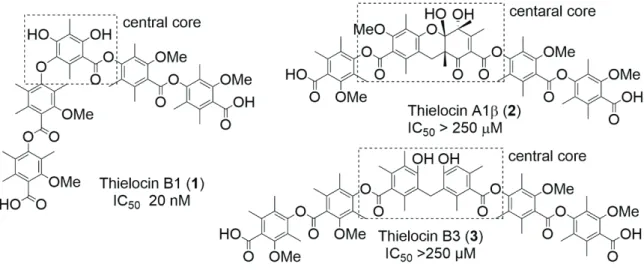
activity. Since other natural thielocins, such as thielocin A1β (2) and B3 (3) (Figure 1), did not inhibit the PAC3 homodimer even at higher concentrations (IC50 > 250 µM) despite the structural resemblance to 1, the central
core moiety seems to be closely involved in the biological activity. The central core of 1 is a fully substituted benzene ring and a component of the electron-rich 2,2’,6,6’-tetrasubstituted diphenyl ether moiety, whereas it is not clear what structural feathers are important for the PPI inhibition. Therefore, the elucidation of structure activity relationships focused on the central benzene ring of 1 would be a worthwhile endeavor. In the current
4
study, we report the synthesis of thielocin B1 analogues bearing an alternative core structure and the evaluation of their inhibitory activity against the PAC3 homodimer.
Figure 1. Structures and PPI inhibitory activity of natural thielocins for the PAC3 homodimer.
2. Results and Discussion
To investigate the important features in 1 as a potent and selective PPI inhibitor of the PAC3 homodimer, we designed various analogues of 1, and its retrosynthetic analysis is shown in Figure 2. Based on the results of the PPI inhibitor screening with natural thielocins, we initially changed the central benzene ring of 1 to other carbon tethers with similar length while keeping side substructures. Thus, symmetric meta-disubstituted aromatic rings as C-5 cores and 1,4-disubstituted aliphatic carbon chains as C-4 cores were selected (Figure 2, a). Symmetric diether and diester analogues 4–7 will be readily prepared from the corresponding dibromide or dicarboxylic acids by etherification or esterification with 2 equivalents of the phenol 8, respectively (Figure 2, b). The other analogues 9 were designed to elucidate the substituent effects on the fully substituted diphenyl ether moiety of 1. The stepwise esterification of the diphenyl ether 10 containing the synthetic equivalent of two carboxylic acid groups with two different phenols 8 and 11 will afford unsymmetrical analogues 9 (Figure 2, c). To validate the importance of the free carboxylic acid groups in 1, we decided to evaluate the inhibitory activity of the
5
di-methoxymethyl (MOM) esters of these analogues as well.
Figure 2. (a) Designed analogues based on the structure of thielocin B1 (1). (b) Retrosynthetic analysis of
symmetric diether and diester analogues 4–7. (c) Retrosynthetic analysis of unsymmetrical analogues 9.
6
etherification of the dibromides 1214 with the phenol 8a14 using K
2CO3 produced desired diethers 13 in moderate
yields. All MOM groups in 13 were removed immediately with 20% TFA/DCM to provide the analogues 4 in 67%–79% yields.
Scheme 1. Synthesis of dibenzylic ether analogues 4.
The synthesis of the diester analogues 5 followed the procedure in Scheme 2. The esterification of the dicarboxylic acids 1414 with the phenol 8b11 at sterically hindered position proceeded smoothly using the same
method for the preparation of 1. Treatment with excess trifluoroacetic anhydride11, 15–18 under heating conditions
produced desired diesters 15 in good yields. Next, transformation of 15 to 5 was performed, as summarized in Table 1. Removal of all benzyl groups in 15a through hydrogenolysis afforded the analogue 5a in 60% yield (entry 1). By contrast, the benzyl groups in 15b were readily removed using iodotrimethylsilane, which was generated in situ, to produce the analogue 5b in 94% yield (entry 2). Removal of the benzyl groups in 15b and subsequent formation of di-MOM esters provided the analogue 5c in 96% yield over two steps (entry 3).
7
Scheme 2. Synthesis of diester analogues 5.
Analogues 6 and 7, which bear aliphatic carbon chains as a central core, were synthesized as follows. The etherification of trans-1,4-dibromo-2-butene (16) with the phenol 8a proceeded under the same conditions in the preparation of 13 to provide the diether 17 in 95% yield. The oxidation of the alkene moiety in 17 then carried out in the presence of a catalytic amount of OsO4. Although the reaction did not complete despite further
addition of OsO4, desired diol 18 was obtained in 68% after separation from 17 by silica gel column
chromatography. Finally, the MOM groups in 17 and 18 were removed with 20% TFA/DCM to furnish the analogues 6a and 6b in 66% and 14% yields, respectively. Moreover, carbonate formation for 18 using triphosgene followed by removal of the MOM groups under acidic conditions furnished the analogue 6c in 24% yield over two steps. The yields of 6b and 6c were quite lower than those of the other dicarboxylic acid analogues due to the poor solubility in the eluents used during preparative TLC purification (Scheme 3). The esterification of succinic acid (19) with the phenol 8a also proceeded successfully using EDCI·HCl/DMAP to provide the diester 20. Subsequent removal of all MOM groups in 20 with 20% TFA/DCM afforded the
8
analogue 7 in 67% yield (Scheme 4).
Scheme 3. Synthesis of diether analogues 6.
9
The synthesis of unsymmetrical analogues 9, having the same linkage system with 1, is shown in Scheme 5. The carboxylic acids 10 were prepared by a conventional Ullmann reaction14 and esterified with the phenol 1111
using EDCI·HCl/DMAP to give the esters 21 in moderate to high yields. After removal of the allyl group in 21a and 21b in the presence of a catalytic amount of Pd(PPh3)4 (Table 2, entries 1 and 2) or oxidation of the formyl
group in 21c with NaClO2 in tBuOH-H2O19-21 (Table 2, entry 3), further esterification of the resulting carboxylic
acids 22 with the phenol 8b was performed, as summarized in Table 3. The carboxylic acid 22a was smoothly esterified with the phenol 10b with EDCI·HCl/DMAP to provide the ester 23a in 57% yield (entry 1). In contrast, the esterification of sterically hindered 2-substituted benzoic acids 22b and 22c with the 8b proceeded using triphosgene via the in situ formation of the acid chlorides to furnish the corresponding the esters 23b and 23c, respectively (entries 2 and 3). Finally, removal of all benzyl groups in 23 by hydrogenolysis afforded the analogues 9 in 59%–83% yields.
10
Scheme 5. Synthesis of unsymmetrical analogues 9.
With the synthetic thielocin analogues in hand, the PPI inhibitory activity for the PAC3 homodimer and PAC1/PAC2 were evaluated using an in vitro protein-fragment complementation assay with monomeric Kusabira-Green (mKG) fluorescent protein in vitro. 6, 22, 23, 24 Split inactive mKG fragments are fused to target
proteins, which emit fluorescence when 2 target proteins interact to allow the reformation of the active mKG. Hence, a fluorescent signal by the active mKG depends on the fused target PPI. Decrease of a fluorescent
11
intensity by synthetic analogues were converted to the percentage of inhibition, as summarized in Figure 3. In short, symmetric diether and diester analogues 4a-b, 5a-b, 6a-c and 7 actually inhibited the PAC3 homodimer at higher concentration than 1, whereas these analogues worked as poor inhibitors for PAC1/PAC2. Compared to
4a-b and 5b, corresponding di-MOM esters 13a-b and 5c did not inhibit both the PAC3 homodimer and
PAC1/PAC2 at even 10 µM. These results strongly support the proposed inhibition mechanism: one terminal carboxylic acid group in 1 is critical for disrupting the PAC3 homodimer. Among them, it should be noted that the diester 5a, which has a quite similar structure to that of 1 (one ester linkage in 5a vs. one ether linkage in 1), expressed poor and nonselective inhibitory activity for both protein complexes. Besides, the free hydroxyl groups on the central core in 1 do not seem to be important for its bioactivity because the PPI inhibitory activity of the dimethoxy 5b were similar to those of the dihydroxy 5a. Interestingly, skeletally mimicking-analogues
9a–c inhibited both the PAC3 homodimer and PAC1/PAC2 at 10 µM, and the PPI inhibitory activity were
actually higher than the other analogues. These facts suggest that tightly bending structure in the central core of 1 is important for the potent PPI inhibitory activity and that the hydrophobic interactions with all the methyl groups on the 2,2’,6,6’-tetrasubstituted diphenyl ether moiety in 1 facilitate the selective inhibition of the PAC3 homodimer. We also validated a substructure of 1 as a PPI inhibitor, and the carboxylic acid 8c (P = H) was found to be unworking. Therefore, the entire structure in 1 is indispensable for its unique PPI inhibitory activity.
12
Figure 3. PPI inhibitory activity of synthetic analogues for the PAC3 homodimer (left) and PAC1/PAC2 (right).
Inhibition rates of a DMSO solution of compounds for both protein complexes are shown as bars in green (10 µM), orange (1 µM) and blue (0.1 µM).
We next carried out an in silico docking study for the natural 1 and the analogue 5a at the interface of PAC3 (PDB code: 2Z5E)9 using the Molecular Operating Environment program25 to validate the importance of the
13
hydrophobicity on the diphenyl ether moiety. Because the analogue 5a possesses an ester linkage instead of an ether linkage in the natural 1, the mode of interaction to PAC3 would be different among thielocin B1 (1) and its analogue 5a. As expected, the docking study suggested that the unique bent structure induced by diphenyl ether linkage of 1 fit nicely to the hill-like β-sheet structure of PAC3, and the methyl groups on the aryl groups assisted the interaction of 1 to PAC3 by hydrophobic interaction (Figure 4, left). On the other hand, a carbonyl group of the ester linkage in 5a significantly provoked structural change, which would reduce an intensity of hydrophobic interaction due to detachment of several methyl groups from the surface of PAC3 (Figure 4, right). The above observations concluded that sophisticated structure of 1 is crucial to exhibit potent and selective inhibition of PAC3 homodimer.
Figure 4. In silico docking study at the interface of PAC3 for thielocin B1 (left) and diester analogue 5a (right).
14
shown as CPK model (carbons in blue). The five methyl groups in 1 involved in hydrophobic interactions are shown in both figures (CPK model, carbons in green). The corresponding methyl groups in 5a (see red dashed circle) are apart from those in 1.
3. Conclusion
In conclusion, we have demonstrated the synthesis of thielocin B1 (1) analogues containing various central cores and evaluated their PPI inhibitory activity for the PAC3 homodimer and PAC1/PAC2. Symmetric diether and diester analogues 4–7 were obtained in a short sequence of steps by etherification or esterification of the corresponding dibromides or dicarboxylic acids with two equivalents of the phenol 8, respectively. The skeletally mimicking-analogues 9 were furnished by the stepwise esterification of the diphenyl ether 21 containing the synthetic equivalents of carboxylic acids with the phenols 11 and 8b. The evaluation of these synthetic analogues as PPI inhibitors of the PAC3 homodimer and PAC1/PAC2 with monomeric Kusabira-Green fluorescent protein in vitro revealed that the meta-substituted benzene bearing ether and ester linkages is an essential core structure for potent PPI inhibition. In addition, the terminal carboxylic acid groups were found to be critical for biological activity, whereas the hydroxyl groups on the central core were not. Moreover, the demethylated analogues 9 exhibited nonselective inhibition for both the PAC3 homodimer and PAC1/PAC2. In silico docking study for the natural 1 at the interface of PAC3 suggested that all the methyl groups including 2,2’,6,6’-tetrasubstituted diphenyl ether moiety in 1 contribute to the strong interaction at the interface of PAC3 via hydrophobic interactions at huge area. Therefore, almost the entire structure of 1, containing the synthetically difficult multi-substituted diphenyl ether moiety, is indispensable for potent PPI inhibitory activity. It is worthwhile that structurally complicated natural product such as 1 covered the chemical space unsupported by simplified synthetic compounds.
15 4. Experimental section
4.1. General Techniques
All commercially available chemicals and solvents were used as received. Dry THF and DCM (Kanto Chemical Co.) were obtained by passing commercially available pre-dried, oxygen-free formulations. Microwave irradiation was performed with Biotage InitiatorTM. All reactions in solution phase were monitored
by thin-layer chromatography carried out on 0.25 mm E. Merck silica gel plates (60F-254) with UV light and visualized with p-anisaldehyde H2SO4–ethanol solution or phosphomolybdic acid ethanol solution. Flash column
chromatography was carried out with silica gel 60N (Kanto Chemical Co. 40–100 µm). 1H NMR spectra and 13C
NMR spectra were recorded on JEOL JNM-AL400 spectrometer. Chemical shifts (δ) are reported in units parts per million (ppm) relative to the signal for internal tetramethylsilane (0.00 ppm for 1H) for solutions in
chloroform-d. NMR spectral data are reported as follows: chloroform (7.26 ppm for 1H), chloroform-d (77.0
ppm for 13C), methanol (3.30 ppm for 1H) or methanol-d
4 (49.0 ppm for 13C) when internal standard is not
indicated. Multiplicities are reported by using following abbreviations: s (singlet), d (doublet), t (triplet), m (multiplet), dd (double doublet), dt (double triplet), dq (double quartet), ddd (double double doublet), ddt (double double triplet) and J (coupling constants in Hertz). Mass spectra and high-resolution mass spectra were measured with JEOL JMS-DX303 (for EI) or Thermo Scientific ExactiveTM Plus Orbitrap Mass Spectrometer (for ESI)
instruments. IR spectra were recorded with Shimadzu FT-IR, and the data are given in cm-1. Only the strongest
and/or structurally important absorptions are reported. Melting points were measured with Round Science Inc. RFS-10 and are uncorrected.
16
To a solution of the dibromides 1214 and the phenol 8a14 in dry DMF (2.0 mL) was added K
2CO3 at room
temperature under an argon atmosphere. After being stirred at 30 °C, the reaction mixture was diluted with EtOAc and quenched with 1 M aqueous HCl. The organic layer was separated, and the aqueous layer was extracted with EtOAc twice. The combined organic layers were washed with saturated aqueous NaHCO3 and
brine, dried over MgSO4 and filtered. The filtrate was concentrated in vacuo, and the resulting residue was
purified by flash column chromatography on silica gel to afford the diethers 13. 4.2.1. The diether 13a.
Conditions: the dibromide 12a (15.0 mg, 43.8 µmol, 1 equiv), the phenol 8a (44.9 mg, 101 µmol, 2.3 equiv), K2CO3 (36.3 mg, 263 µmol, 6.0 equiv), 15 h; Purification: flash column chromatography on silica gel (eluted
with toluene/EtOAc = 10:1); Yield: 62% (29.2 mg, 27.2 µmol) as a white solid; mp 76–77 °C; 1H NMR (400
MHz, CDCl3) δ 7.79 (2H, d, J = 7.8 Hz), 7.54 (1H, t, J = 7.8 Hz), 5.49 (4H, s), 4.93 (4H, s), 3.84 (6H, s), 3.82
(6H, s), 3.58 (6H, s), 2.40 (6H, s), 2.30 (6H, s), 2.29 (3H, s), 2.27 (6H, s), 2.26 (6H, s), 2.25 (6H, s); 13C NMR
(100 MHz, CDCl3) δ 168.1, 166.5, 157.6, 154.7, 153.6, 149.6, 137.2, 133.6, 132.5, 128.1, 127.8, 127.2, 126.7,
125.8, 124.7, 122.6, 122.2, 121.6, 91.1, 73.6, 62.1, 61.9, 57.9, 17.2, 16.7, 13.0, 12.8, 10.2, 9.9; IR (neat) 2998, 2941, 1735, 1576, 1460, 1322, 1280, 1150, 1100 cm−1; HRMS[ESI] calcd for C
56H65BrO16Na [M+Na]+
1095.3348, found 1095.3324. 4.2.2. The diether 13b.
Conditions: the dibromide 12b (15.0 mg, 56.6 µmol, 1.0 equiv), the phenol 8a (58.1 mg, 130 µmol, 2.3 equiv), K2CO3 (46.9 mg, 340 µmol, 6.0 equiv), 14 h; Purification: flash column chromatography on silica gel (eluted
with hexane/EtOAc = 3:1); Yield: 48% (27.1 mg, 27.2 µmol) as a white solid; mp 71–72 °C; 1H NMR (400 MHz,
CDCl3) δ 7.92 (1H, t, J = 7.6 Hz), 7.70 (2H, d, J = 7.6 Hz), 5.49 (4H, s), 4.95 (4H, s), 3.83 (6H, s), 3.82 (6H, s),
3.58 (6H, s), 2.39 (6H, s), 2.31 (6H, s), 2.28 (3H, s), 2.27 (12H, s), 2.25 (6H, s); 13C NMR (100 MHz, CDCl 3) δ
17
168.0, 166.6, 157.6, 156.8, 154.7, 153.6, 149.6, 137.7, 133.6, 132.5, 127.2, 126.6, 125.8, 124.6, 122.4, 122.2, 120.3, 91.1, 74.7, 62.1, 62.0, 57.9, 17.2, 16.7, 13.0, 12.7, 10.2, 9.9; IR (neat) 2941, 1739, 1577, 1459, 1322, 1280, 1149, 1101 cm−1; HRMS[ESI] calcd for C
55H65NO16Na [M+Na]+ 1018.4196, found 1018.4174.
4.3. General procedure for the synthesis of the carboxylic acids 4.
To a solution of the MOM esters 13 in dry DCM (1.6 mL) was added TFA (0.4 mL) at room temperature under an argon atmosphere. After being stirred at the same temperature, the reaction mixture was concentrated in vacuo, and the resulting residue was purified by preparative TLC to afford the carboxylic acids 4.
4.3.1. The carboxylic acid 4a.
Conditions: the MOM ester 13a (25.0 mg, 23.3 µmol, 1 equiv), 30 min; Purification: preparative TLC (eluted with CHCl3/MeOH = 3:1); Yield: 67% (15.3 mg, 15.5 µmol) as a white solid; mp >300 °C; 1H NMR (400 MHz,
CD3OD) δ 7.72 (2H, d, J = 7.6 Hz), 7.53 (1H, t, J = 7.6 Hz), 5.01 (4H, s), 3.83 (6H, s), 3.79 (6H, s), 2.35 (6H, s),
2.29 (6H, s), 2.26 (6H, s), 2.24 (6H, s), 2.21 (6H, s), 2.20 (6H, s); 13C NMR (100 MHz, CD
3OD) δ 176.6, 168.2,
158.9, 156.0, 153.3, 148.6, 138.7, 136.2, 134.7, 131.7, 130.4, 128.9, 127.9, 126.3, 126.0, 124.2, 123.8, 122.4, 75.1, 62.4, 62.0, 17.5, 17.1, 13.4, 13.0, 10.6, 10.3; IR (neat) 3393, 3242, 2945, 1739, 1688, 1574, 1170 cm−1;
HRMS[ESI] calcd for C52H57BrO14Na [M+Na]+ 1007.2824, found 1007.2813.
4.3.1. The carboxylic acid 4b.
Conditions: the MOM ester 13b (24.0 mg, 24.1 µmol, 1 equiv), 50 min; Purification: preparative TLC (eluted
with CHCl3/MeOH = 9:1); Yield: 79% (17.3 mg, 19.1 µmol) as a white solid; mp >300 °C; 1H NMR (400 MHz,
CD3OD) δ 8.00 (1H, t, J = 7.6 Hz), 7.71 (2H, d, J = 7.6 Hz), 4.97 (4H, s), 3.83 (6H, s), 3.79 (6H, s), 2.34 (6H, s),
2.29 (6H, s), 2.27 (6H, s), 2.24 (6H, s), 2.21 (6H, s), 2.19 (6H, s); 13C NMR (100 MHz, CD
3OD) δ 176.6, 168.2,
18
62.0, 17.5, 17.1, 13.4, 12.9, 10.6, 10.2; IR (neat) 3403, 2940, 1735, 1576, 1165, 1092 cm−1; HRMS[ESI] calcd
for C51H57NO14Na [M+Na]+ 930.3671, found 930.3656.
4.4. General procedure for the synthesis of the diesters 15.
To a solution of the carboxylic acids 1414 and the phenol 8b11 in dry toluene (2.0 mL) was added (CF 3CO)2O
at room temperature under an argon atmosphere. After being stirred at 80 °C, the reaction mixture was cooled to room temperature and quenched with saturated aqueous NaHCO3. The organic layer was separated, and the
aqueous layer was extracted with EtOAc twice. The combined organic layers were washed with brine, dried over MgSO4 and filtered. The filtrate was concentrated in vacuo, and the resulting residue was purified by flash
column chromatography on silica gel (eluted with hexane/EtOAc = 4:1) to afford the diesters 15. 4.4.1. The diester 15a.
Conditions: the carboxylic acid 14a (30.0 mg, 73.9 µmol, 1 equiv), the phenol 8b (87.3 mg, 177 µmol, 2.4 equiv), (CF3CO)2O (309 µL, 2.22 mmol, 30 equiv), 10 h; Yield: 99% (99.5 mg, 73.4 µmol) as a white solid; mp
103–104 °C; 1H NMR (400 MHz, CDCl 3) δ 7.34–7.48 (10H, m), 5.40 (4H, s), 5.07 (4H, s), 3.79 (6H, s), 3.71 (6H, s), 2.73 (3H, s), 2.39 (3H, s), 2.36 (6H, s), 2.25 (6H, s), 2.21 (6H, s), 2.18 (6H, s), 2.17 (6H, s), 2.12 (6H, s); 13C NMR (100 MHz, CDCl 3) δ 168.3, 166.2, 165.4, 157.6, 154.3, 153.6, 149.9, 149.4, 136.3, 135.6, 133.5, 133.1, 132.7, 128.6, 128.52, 128.48, 128.3, 127.9, 127.4, 126.6, 126.1, 125.8, 125.7, 124.6, 122.5, 122.2, 76.7, 67.1, 62.1, 62.0, 18.3, 17.3, 16.8, 13.5, 13.0, 10.7, 10.5, 10.2; IR (neat) 2940, 1743, 1733, 1574, 1277, 1188, 1149, 1176, 753 cm−1; HRESIMS calcd for C
82H82O18Na [M+Na]+ 1377.5393, found 1377.5377.
4.4.2. The diester 15b.
Conditions: the carboxylic acid 12b (20.0 mg, 78.7 µmol, 1 equiv), the phenol 10b (89.1 mg, 181 µmol, 2.3 equiv), (CF3CO)2O (307 µL, 2.20 mmol, 28 equiv); Yield: 68% (64.6 mg, 53.7 µmol) as a white solid; mp 111–
19 112 °C; 1H NMR (400 MHz, CDCl 3) δ 7.46–7.48 (4H, s), 7.34–7.40 (6H, m), 5.40 (4H, s), 3.91 (6H, s), 3.85 (6H, s), 3.71 (6H, s), 2.62 (3H, s), 2.42 (6H, s), 2.37 (3H, s), 2.33 (6H, s), 2.29 (6H, s), 2.26 (6H, s), 2.22 (6H, s), 2.18 (6H, s); 13C NMR (100 MHz, CDCl 3) δ 168.3, 166.1, 165.3, 158.9, 154.4, 153.7, 149.9, 149.5, 135.7, 133.6, 133.3, 132.7, 128.6, 128.5, 128.3, 127.4, 126.7, 126.1, 125.7, 125.1, 123.7, 122.4, 122.2, 67.1, 62.2, 62.02, 62.00, 17.7, 17.3, 16.7, 13.2, 13.0, 10.5, 10.2, 9.9; IR (neat) 2942, 1744, 1575, 1277, 1148, 1076 cm−1; HRESIMS calcd
for C70H74O18Na [M+Na]+ 1225.4767, found 1225.4748.
4.5. Preparation of the carboxylic acid 5a.
To a solution of the benzyl ester 15a (33.0 mg, 24.3 µmol, 1 equiv) in EtOH (1.0 mL) and EtOAc (1.0 mL) was added 10% Pd/C (30.0 mg, 91 wt%) at room temperature under an argon atmosphere, and the flask was purged with hydrogen 3 times. After being stirred at the same temperature for 30 min, the reaction mixture was filtered through a pad of Celite®. The filtrate was concentrated in vacuo, and the resulting residue was purified
by preparative TLC (eluted with CHCl3/MeOH = 3:1) to afford the carboxylic acid 5a (14.5 mg, 14.6 µmol,
60%) as a white solid. mp >300 °C; 1H NMR (400 MHz, CD 3OD) δ 3.81 (6H, s), 3.80 (6H, s), 2.90 (3H, s), 2.39 (6H, s), 2.28 (12H, s), 2.23 (6H, s), 2.21 (6H, s), 2.19 (6H, s), 2.18 (3H, s); 13C NMR (100 MHz, CD 3OD) δ 169.8, 167.7, 163.2, 155.7, 153.8, 151.1, 149.4, 140.6, 134.5, 132.4, 128.1, 127.3, 126.4, 123.5, 122.8, 111.5, 111.4, 62.8, 62.3, 21.9, 17.6, 17.0, 13.5, 13.4, 10.8, 10.6, 8.5; IR (neat) 3402, 2939, 1748, 1662, 1577, 1458, 1308, 1155, 1075 cm−1; HRESIMS calcd for C
54H58O18Na [M+Na]+ 1017.3515, found 1017.3511.
4.6. Preparation of the carboxylic acid 5b.
To a solution of I2 (15.8 mg, 62.3 µmol, 5.0 equiv) in dry DCM (1.0 mL) was added (Me3Si)2 (12.5 µL, 62.3
20
reaction mixture was cooled to room temperature. To the resulting brown mixture was added the benzyl ester
15b (15.0 mg, 12.5 µmol, 1 equiv) in dry DCM (1.0 mL) dropwise at −78 °C under an argon atmosphere. After
being stirred at −40 °C for 30 min, the reaction mixture was quenched with 1 M aqueous HCl at −40 °C and stirred at room temperature for 15 min. The mixture was concentrated in vacuo, and the resulting residue was purified by preparative TLC (eluted with CHCl3/MeOH = 3:1) to afford the carboxylic acid 5b (12.0 mg, 11.7
µmol, 94%) as a white solid. mp >300 °C; 1H NMR (400 MHz, CD
3OD) δ 3.92 (6H, s), 3.84 (6H, s), 3.83 (6H,
s), 2.60 (3H, s), 2.42 (6H, s), 2.39 (3H, s), 2.32 (6H, s), 2.30 (12H, s), 2.23 (6H, s), 2.22 (6H, s); 13C NMR (100
MHz, CD3OD) δ 176.7, 167.8, 166.6, 160.4, 155.7, 153.3, 151.2, 148.5, 136.4, 134.6, 134.2, 131.7, 128.3, 127.4,
126.3, 126.0, 125.3, 123.7, 122.4, 62.8, 62.0, 18.1, 17.6, 17.2, 13.5, 13.4, 10.9, 10.6, 10.2; IR (neat) 3372, 2941, 1745, 1577, 1459, 1158, 1074 cm−1; HRESIMS calcd for C
56H62O18Na [M+Na]+ 1045.3828, found 1045.3817.
4.7. Preparation of the di-MOM ester 5c.
To a solution of I2 (31.6 mg, 125 µmol, 5.0 equiv) in dry DCM (1.0 mL) was added (Me3Si)2 (25.2 µL, 125
µmol, 5.0 equiv) at room temperature under an argon atmosphere. After being stirred at 40 °C for 30 min, the reaction mixture was cooled to room temperature. To the resulting brown mixture was added the benzyl ester
12b (15.0 mg, 12.5 µmol, 1 equiv) in dry DCM (1.0 mL) dropwise at −78 °C under an argon atmosphere. After
being stirred at −40 °C for 15 min, the reaction mixture was quenched with 1 M aqueous HCl at −40 °C and stirred at room temperature for 15 min. The mixture was concentrated in vacuo, and the resulting mixture was used for next reaction without further purification.
To the solution of the crude carboxylic acid in DMF (1.0 mL) were added DIEA (17.1 µL, 125 µmol, 10 equiv) and MOMCl (9.5 µL, 125 µmol, 10 equiv) at room temperature under an argon atmosphere. After being stirred at the same temperature for 2.5 h, the reaction mixture was diluted with EtOAc and quenched with 1 M
21
aqueous HCl. The organic layer was separated, and the aqueous layer was extracted with EtOAc twice. The combined organic layers were washed with brine, dried over MgSO4 and filtered. The filtrate was concentrated
in vacuo, and the resulting residue was purified by flash column chromatography on silica gel (eluted with CHCl3/MeOH = 29:1) to afford the di-MOM ester 5c (13.3 mg, 12.0 µmol, 96% in 2 steps) as a white solid. mp
222–223 °C; 1H NMR (400 MHz, CDCl
3) δ 5.50 (4H, s), 3.92 (6H, s), 3.87 (6H, s), 3.82 (6H, s), 3.58 (6H, s),
2.63 (3H, s), 2.43 (6H, s), 2.38 (3H, s), 2.34 (6H, s), 2.30 (6H, s), 2.29 (6H, s), 2.27 (6H, s), 2.25 (6H, s); 13C
NMR (100 MHz, CDCl3) δ 168.1, 166.1, 165.3, 158.9, 154.4, 153.6, 150.0, 149.5, 133.6, 133.3, 132.6, 127.3,
126.7, 126.1, 125.8, 125.1, 123.7, 122.4, 122.2, 91.1, 62.2, 62.1, 62.0, 57.9, 17.7, 17.4, 16.7, 13.2, 13.0, 10.5, 10.3, 9.9; IR (neat) 2942, 1745, 1575, 1277, 1202, 1146, 1076 cm−1; HRESIMS calcd for C
60H70O20Na [M+Na]+
1133.4353, found 1133.4344.
4.8. Preparation of the diether 17.
To a solution of trans-1,4-dibromo-2-butene (16) (20.0 mg, 93.5 µmol, 1 equiv) and the phenol 8a (96.0 mg, 215 µmol, 2.3 equiv) in dry DMF (2.0 mL) was added K2CO3 (77.5 mg, 561 µmol, 6.0 equiv) at room
temperature under an argon atmosphere. After being stirred at 30 °C for 16 h, the reaction mixture was diluted with EtOAc and quenched with 1 M aqueous HCl. The organic layer was separated, and the aqueous layer was extracted with EtOAc twice. The combined organic layers were washed with saturated aqueous NaHCO3 and
brine, dried over MgSO4 and filtered. The filtrate was concentrated in vacuo, and the resulting residue was
purified by flash column chromatography on silica gel (eluted with toluene/EtOAc = 9:1) to afford the diether 15 (83.7 mg, 88.6 µmol, 95%) as a white solid. mp 188–189 °C; 1H NMR (400 MHz, CDCl
3) δ 6.20 (2H, s), 5.49
(4H, s), 4.38 (4H, s), 3.82 (6H, s), 3.81 (6H, s), 3.58 (6H, s), 2.37 (6H, s), 2.30 (6H, s), 2.28 (6H, s), 2.26 (6H, s), 2.25 (6H, s), 2.24 (6H, s); 13C NMR (100 MHz, CDCl
22
128.6, 127.2, 126.6, 125.8, 124.4, 122.4, 122.2, 91.1, 72.3, 62.1, 61.9, 57.9, 17.2, 16.7, 13.0, 12.8, 10.2, 10.0; IR (neat) 2941, 1738, 1576, 1460, 1322, 1280, 1149, 1100, 1022, 757 cm−1; HRESIMS calcd for C
52H64O16Na
[M+Na]+ 967.4087, found 967.4065.
4.9. Preparation of the carboxylic acid 6a.
To a solution of the MOM ester 17 (23.0 mg, 24.3 µmol) in dry DCM (1.6 mL) was added TFA (0.4 mL) at room temperature under an argon atmosphere. After being stirred at the same temperature for 30 min, the reaction mixture was concentrated in vacuo, and the resulting residue was purified by preparative TLC (eluted with CHCl3/MeOH = 9:1) to afford the carboxylic acid 6a (13.8 mg, 16.1 µmol, 66%) as a white solid. mp
>300 °C; 1H NMR (400 MHz, CD
3OD) δ 6.20 (4H, s), 4.40 (4H, s), 3.83 (6H, s), 3.78 (6H, s), 2.33 (6H, s),
2.282 (6H, s), 2.275 (6H, s), 2.24 (6H, s), 2.20 (6H, s), 2.19 (6H, s); 13C NMR (100 MHz, CD
3OD) δ 168.3,
159.0, 156.0, 153.3, 148.6, 136.4, 134.5, 131.6, 129.9, 127.8, 126.0, 123.6, 122.3, 75.5, 62.4, 62.0, 17.8, 17.1, 13.4, 13.0, 10.6, 10.3; IR (neat) 3421, 2941, 1738, 1569, 1456, 1164, 1092 cm−1; HRESIMS calcd for
C48H569NO14Na [M+Na]+ 879.3562, found 879.3549.
4.10. Preparation of the diol 18.
To a solution the olefin 17 (40.0 mg, 42.3 µmol, 1 equiv) in dry THF (1.0 mL) and water (1.0 mL) were added NMO (16.1 mg, 137 µmol, 3.2 equiv) and OsO4 (0.05 M in THF, 9.2 µL, 458 nmol, 0.02 equiv) at 0 °C, and the
mixture was stirred at room temperature for 24 h. To the reaction mixture were added NMO (16.1 mg, 137 µmol, 3.2 equiv) and OsO4 (0.05 M in THF, 9.2 µL, 458 nmol, 0.02 equiv) at 0 °C. After being stirred at room
temperature for 24 h, the reaction mixture was diluted with EtOAc and quenched with saturated aqueous Na2S2O3. The organic layer was separated, and the aqueous layer was extracted with EtOAc twice. The
23
combined organic layers were washed with brine, dried over MgSO4 and filtered. The filtrate was concentrated
in vacuo, and the resulting residue was purified by flash column chromatography on silica gel (eluted with hexane/EtOAc = 1:2) to afford the diol 18 (28.0 mg, 28.6 µmol, 68%) as a white solid. mp 183–184 °C; 1H
NMR (400 MHz, CDCl3) δ 5.49 (4H, s), 4.38 (2H, t, J = 4.9 Hz), 3.99 (4H, d, J = 4.9 Hz), 3.82 (6H, s), 3.81 (6H,
s), 3.58 (6H, s), 2.37 (6H, s), 2.32 (6H, s), 2.27 (6H, s), 2.26 (12H, s), 2.24 (6H, s); 13C NMR (100 MHz, CDCl 3)
δ 168.1, 166.5, 157.0, 154.7, 153.6, 149.6, 133.7, 132.5, 127.2, 126.4, 125.8, 124.8, 122.23, 122.21, 91.1, 73.8, 70.2, 62.1, 62.0, 57.9, 17.2, 16.7, 13.0, 12.6, 10.2, 9.8; IR (neat) 3487, 2941, 1739, 1623, 1575, 1459, 1151, 755 cm−1; HRESIMS calcd for C
52H66O18Na [M+Na]+ 1001.4141, found 1001.4130.
4.11. Preparation of the carboxylic acid 6b.
To a solution of the MOM ester 18 (25.0 mg, 25.5 µmol, 1 equiv) in dry DCM (1.6 mL) was added TFA (0.4 mL) at room temperature under an argon atmosphere. After being stirred at the same temperature for 30 min, the reaction mixture was concentrated in vacuo, and the resulting residue was purified by preparative TLC (eluted with CHCl3/MeOH = 9:1) to afford the carboxylic acid 6b (3.1 mg, 3.48 µmol, 14%) as a white solid. mp
>300 °C; 1H NMR (400 MHz, CDCl
3/CD3OD = 9:1) δ 4.20 (2H, t, J = 4.6 Hz), 3.86–3.94 (4H, m), 3.743 (6H, s),
3.741 (6H, s), 2.29 (6H, s), 2.25 (6H, s), 2.21 (6H, s), 2.20 (6H, s), 2.18 (6H, s), 2.15 (6H, s); 13C NMR (100
MHz, CDCl3/CD3OD = 9:1) δ 166.9, 157.2, 154.6, 152.8, 148.8, 133.5, 132.1, 126.4, 125.6, 124.4, 122.2, 121.8,
73.6, 70.0, 61.9, 61.8 17.0, 16.6, 12.8, 12.5, 10.0, 9.6; IR (neat) 3283, 2924, 1731, 1693, 1625, 1570, 1460, 1278, 1160, 1093 cm−1; HRESIMS calcd for C
48H58O16Na [M+Na]+ 913.3617, found 963.3607.
4.12. Preparation of the carboxylic acid 6c.
24
313 µmol, 18 equiv) and triphosgene (7.7 mg, 26.1 µmol, 1.5 equiv) at 0 °C under an argon atmosphere. After being stirred at room temperature for 1 h, the reaction mixture was diluted EtOAc and quenched with 1 M aqueous HCl. The organic layer was separated, and the aqueous layer was extracted with EtOAc twice. The combined organic layers were washed with saturated aqueous NaHCO3 and brine, dried over MgSO4 and filtered.
The filtrate was concentrated in vacuo, and the resulting residue was used for next reaction without further purification.
To a solution of the crude MOM ester in dry DCM (1.6 mL) was added TFA (0.4 mL) at room temperature under an argon atmosphere. After being stirred at the same temperature for 30 min, the reaction mixture was concentrated in vacuo, and the resulting residue was purified by preparative TLC (eluted with CHCl3/MeOH =
9:1) to afford the carboxylic acid 6c (3.8 mg, 4.14 µmol, 24% over 2 steps) as a white solid. mp >300 °C; 1H
NMR (400 MHz, CDCl3/CD3OD = 5:1) δ 5.08 (2H, s), 4.02 (4H, s), 3.701 (6H, s), 3.698 (6H, s), 2.25 (6H, s),
2.19 (6H, s), 2.16 (6H, s), 2.14 (6H, s), 2.13 (6H, s), 2.10 (6H, s); 13C NMR (100 MHz, CDCl
3/CD3OD = 5:1) δ
171.4, 166.6, 156.0, 154.5, 154.3, 152.4, 148.6, 133.7, 131.9, 128.9, 126.1, 125.4, 125.0, 122.0, 121.7, 76.4, 70.4, 61.8, 61.7, 16.9, 16.4, 12.7, 12.3, 9.9, 9.5; IR (neat) 3387, 2942, 1779, 1738, 1699, 1575, 1457, 1165, 1094 cm−1;
HRESIMS calcd for C4H56O17Na [M+Na]+ 939.3410, found 939.3398.
4. 13. Preparation of the ester 20.
To a solution of succinic acid (19)14 (60.0 mg, 50.8 µmol, 1 equiv) and the phenol 8a (52.2 mg, 117 µmol, 2.3
equiv) in dry DCM (2.0 mL) were added DIEA (55.8 µL, 406 µmol, 8.0 equiv), EDCI·HCl (30.0 mg, 152 µmol, 3.0 equiv) and DMAP (0.6 mg, 5.08 µmol, 0.10 equiv) at 0 °C under an argon atmosphere. After being stirred at 30 °C for 21 h, the reaction mixture was diluted EtOAc and quenched with 1 M aqueous HCl. The organic layer was separated, and the aqueous layer was extracted with EtOAc twice. The combined organic layers were
25
washed with saturated aqueous NaHCO3 and brine, dried over MgSO4 and filtered. The filtrate was concentrated
in vacuo, and the resulting residue was purified by flash column chromatography on silica gel (eluted with hexane/EtOAc = 2:1) to afford the ester 20 (32.9 mg, 33.7 µmol, 72%) as a white solid. mp 76–77 °C; 1H NMR
(400 MHz, CDCl3) δ 5.49 (4H, s), 3.809 (6H, s), 3.807 (6H, s), 3.58 (6H, s), 3.13 (4H, s), 2.38 (6H, s), 2.26 (12H,
s), 2.23 (6H, s), 2.14 (6H, s), 2.09 (6H, s); 13C NMR (100 MHz, CDCl
3) δ 169.9, 168.0, 166.1, 154.3, 153.6,
149.8, 149.5, 133.4, 132.5, 127.2, 126.4, 125.8, 122.2, 122.0, 91.1, 62.14, 62.07, 57.9, 28.4, 17.2, 16.7, 13.0, 12.8, 10.2, 10.0; IR (neat) 2942, 1752, 1735, 1459, 1278, 1148, 1129, 756 cm−1; HRESIMS calcd for
C52H62O18Na [M+Na]+ 997.3828, found 997.3804.
4.14. Preparation of the carboxylic acid 7.
To a solution of the MOM ester 20 (25.0 mg, 25.6 µmol, 1 equiv) in dry DCM (1.6 mL) was added TFA (0.4 mL) at room temperature under an argon atmosphere. After being stirred at the same temperature for 40 min, the reaction mixture was concentrated in vacuo, and the resulting residue was purified by preparative TLC (eluted with CHCl3/MeOH = 9:1) to afford the carboxylic acid 7 (15.1 mg, 17.0 µmol, 67%) as a white solid. mp
>300 °C; 1H NMR (400 MHz, CD
3OD) δ 3.83 (6H, s), 3.78 (6H, s), 3.15 (4H, s), 2.36 (6H, s), 2.28 (6H, s), 2.21
(6H, s), 2.20 (6H, s), 2.12 (6H, s), 2.10 (6H, s); 13C NMR (100 MHz, CD
3OD) δ 172.0, 167.8, 155.6, 153.4,
151.2, 148.7, 134.3, 131.9, 127.9, 127.2, 126.1, 123.4, 122.4, 62.7, 62.1, 29.4, 17.4, 17.1, 13.4, 13.0, 10.6, 10.2; IR (neat) 3386, 2925, 1751, 1574, 1459, 1276, 1160, 1131, 1094 cm−1; HRESIMS calcd for C
48H54NO16Na
[M+Na]+ 909.3304, found 909.3288.
4.15. General procedure for the synthesis of the ester 21.
26
EDCI·HCl and DMAP at 0 °C under an argon atmosphere. After being stirred at room temperature, the reaction mixture was diluted EtOAc and quenched with 1 M aqueous HCl. The organic layer was separated, and the aqueous layer was extracted with EtOAc twice. The combined organic layers were washed with saturated aqueous NaHCO3 and brine, dried over MgSO4 and filtered. The filtrate was concentrated in vacuo, and the
resulting residue was purified by flash column chromatography on silica gel to afford the esters 21. 4.15.1. The ester 21a.
Conditions: the carboxylic acid 10a (100 mg, 335 µmol, 1 equiv), the phenol 11 (121 mg, 402 µmol, 1.2 equiv), DIEA (184 µL, 1.34 mmol, 4.0 equiv), EDCI·HCl (98.9 mg, 503 µmol, 1.5 equiv), DMAP (4.1 mg, 33.5 µmol, 0.10 equiv), 3.5 h; Purification: flash column chromatography on silica gel (eluted with hexane/EtOAc = 9:1); Yield: 58% (113 mg, 195 µmol) as a colorless oil; 1H NMR (400 MHz, CDCl
3) δ 8.21 (2H, d, J = 9.0 Hz), 7.92 (1H, dt, J = 7.9, 1.6 Hz), 7.79 (1H, t, J = 1.6 Hz), 7.50 (1H, t, J = 7.9 Hz), 7.46–7.48 (2H, m), 7.30–7.41 (4H, m), 7.08 (2H, d, J = 9.0 Hz), 6.03 (1H, ddt, J = 17.3, 10.6, 5.7 Hz), 5.41 (1H, dq, J = 17.3, 1.3 Hz), 5.40, (2H, s), 5.30 (1H, dq, J = 10.6, 1.3 Hz), 4.83 (1H, dt, J = 5.7, 1.3 Hz), 3.68 (3H, s), 2.16 (3H, s), 2.09 (3H, s), 2.05 (3H, s); 13C NMR (100 MHz, CDCl 3) δ 168.3, 165.3, 163.5, 162.0, 155.6, 153.6, 149.5, 135.6, 132.6, 132.5, 132.4, 131.9, 130.2, 128.6, 128.5, 128.3, 127.2, 125.8, 125.5, 124.7, 123.6, 121.9, 121.1, 118.5, 117.7, 67.1, 65.9, 62.0, 16.6, 12.7, 9.8; IR (neat) 2941, 1735, 1730, 1583, 1503, 1281, 1267, 1161, 1096 cm−1; HRESIMS calcd for
C35H32O8Na [M+Na]+ 603.1989, found 603.1978.
4.15.2. The ester 21b.
Conditions: the carboxylic acid 10b (100 mg, 320 µmol, 1 equiv), the phenol 11 (115 mg, 384 µmol, 1.2 equiv),
DIEA (176 µL, 1.28 mmol, 4.0 equiv), EDCI·HCl (94.5 mg, 480 µmol, 1.5 equiv), DMAP (3.9 mg, 32.0 µmol, 0.10 equiv), 8.5 h; Purification: flash column chromatography on silica gel (eluted with hexane/EtOAc = 9:1); Yield: 94% (179 mg, 301 µmol) as a yellowish oil; 1H NMR (400 MHz, CDCl
27 (1H, dd, J = 8.0, 1.2 Hz), 7.45–7.48 (2H, m), 7.33–7.40 (3H, m), 7.31 (1H, t, J = 8.0 Hz), 7.20 (1H, dd, J = 8.0, 1.2 Hz), 6.95 (2H, d, J = 9.0 Hz), 6.06 (1H, ddt, J = 17.5, 10.5, 5.9 Hz), 5.44 (1H, dq, J = 17.5, 1.4 Hz), 5.39 (2H, s), 5.32 (1H, dq, J = 10.5, 1.4 Hz), 4.84 (1H, dt, J = 5.9, 1.4 Hz), 3.68 (3H, s), 2.45 (3H, s), 2.16 (3H, s), 2.08 (3H, s), 2.04 (3H, s); 13C NMR (100 MHz, CDCl 3) δ 168.7, 167.1, 163.8, 162.9, 153.9, 153.8, 149.8, 135.9, 133.0, 132.9, 132.8, 132.3, 128.89, 128.85, 128.6, 127.8, 127.5, 127.2, 125.8, 125.2, 123.1, 122.2, 119.0, 116.5, 67.4, 66.1, 62.3, 17.0, 13.7, 13.0, 10.1; IR (neat) 2940, 1733, 1605, 1503, 1456, 1281, 1247, 1161, 1097, 755 cm−1; HRESIMS calcd for C
36H34O8Na [M+Na]+ 617.2146, found 617.2133.
4.15.3. The ester 21c.
Conditions: the carboxylic acid 10c (40.0 mg, 148 µmol, 1 equiv), the phenol 11 (53.3 mg, 178 µmol, 1.2
equiv), DIEA (81.2 µL, 592 µmol, 4.0 equiv), EDCI·HCl (43.7 mg, 222 µmol, 1.5 equiv), DMAP (13.8 mg, 14.8 µmol, 0.10 equiv), 21 h; Purification: flash column chromatography on silica gel (eluted with toluene/EtOAc = 12:1); Yield: 41% (33.7 mg, 61.0 µmol) as a colorless oil; 1H NMR (400 MHz, CDCl
3) δ 10.3 (1H, s), 8.15 (1H, d, J = 1.5 Hz), 7.97 (1H, dd, J = 8.7, 1.5 Hz), 7.71 (1H, d, J = 7.6 Hz), 7.46-7.47 (2H, m), 7.33-7.41 (4H, m), 7.18 (1H, d, J = 7.6 Hz) , 6.62 (1H, d, J = 8.7 Hz), 5.39 (2H, s), 3.68 (3H, s), 2.56 (3H, s), 2.45 (3H, s), 2.16 (3H, s), 2.08 (3H, s), 2.04 (3H, s); 13C NMR (100 MHz, CDCl 3) δ 192.0, 168.3, 163.7, 160.2, 154.3, 153.6, 149.6, 136.2, 135.6, 133.6, 132.53, 132.45, 129.8, 128.6, 128.5, 128.4, 128.30, 128.26, 127.3, 127.1, 125.5, 125.4, 123.1, 121.9, 115.0, 67.1, 12.0, 16.6, 16.2, 12.7, 11.2, 9.8; IR (neat) 2941, 1733, 1701, 1607, 1577, 1462, 1249, 1170, 1100, 755 cm−1; HRESIMS calcd for C
34H32O7Na [M+Na]+ 575.2040, found 574.2033.
4.16. General Procedure for the synthesis of the carboxylic acids 22a and 22b.
To a solution of the allyl esters 21 in dry THF (2.0 mL) were added morpholine and Pd(PPh3)4 at room
28
reaction mixture were added further morpholine and Pd(PPh3)4 at room temperature. After being stirred at the
same temperature for 2.5 h, the reaction mixture was diluted with EtOAc. The organic layer was washed with saturated 1 M aqueous HCl and brine, dried over MgSO4 and filtered. The filtrate was concentrated in vacuo, and
the resulting residue was purified by flash column chromatography on silica gel (eluted with hexane/EtOAc = 4:1) to afford the carboxylic acids 22.
4.16.1. The carboxylic acid 22a.
Conditions: the allyl ester 21a (100 mg, 172 µmol, 1 equiv), morpholine (60.0 µL, 688 µmol, 4.0 equiv), Pd(PPh3)4 (39.8 mg, 34.4 mmol, 0.20 equiv), 2 h then morpholine (60.0 µL, 688 µmol, 4.0 equiv), Pd(PPh3)4
(19.9 mg, 17.2 µmol, 0.10 equiv), 2.5 h; Yield: 84% (78.1 mg, 144 µmol) as a white solid; mp 74–75 °C; 1H
NMR (400 MHz, CDCl3) δ 8.23 (2H, d, J = 9.0 Hz), 7.96 (1H, dt, J = 8.0, 1.5 Hz), 7.82 (1H, t, J = 1.5 Hz), 7.53 (1H, t, J = 8.0 Hz), 7.46–7.48 (2H, m), 7.32–7.40 (4H, m), 7.09 (2H, d, J = 9.0 Hz), 5.40 (2H, s), 3.68 (3H, s), 2.16 (3H, s), 2.09 (3H, s), 2.05 (3H, s); 13C NMR (100 MHz, CDCl 3) δ 170.7, 168.4, 163.5, 161.8, 155.8, 153.6, 149.5, 135.6, 132.6, 131.4, 130.3, 128.6, 128.5, 128.3, 127.2, 126.3, 125.5, 123.7, 121.9, 121.4, 117.9, 67.1, 62.0, 16.6, 12.7, 9.8; IR (neat) 3068, 2930, 1738, 1733, 1583, 1504, 1451, 1281, 1245, 1162, 1097, 756 cm−1;
HRESIMS calcd for C32H28O8Na [M+Na]+ 563.1676, found 563.1673.
4.16.2. The carboxylic acid 22b.
Conditions: the allyl ester 21b (175 mg, 394 µmol, 1 equiv), morpholine (76.9 µL, 882 µmol, 4.0 equiv), Pd(PPh3)4 (68.0 mg, 58.9 µmol, 0.20 equiv), 1.5 h then morpholine (76.9 µL, 882 µmol, 4.0 equiv), Pd(PPh3)4
(34.0 mg, 29.5 µmol, 0.10 equiv), 1.5 h; Yield: 89% (145 mg, 261 µmol) as a yellowish solid; mp 87–88 °C; 1H
NMR (400 MHz, CD3OD) δ 8.18 (2H, d, J = 9.2 Hz), 7.79 (1H, d, J = 7.6 Hz), 7.46-7.48 (2H, m), 7.32-7.39 (4H,
m), 7.22 (1H, d, J = 7.6 Hz), 6.98 (2H, d, J = 9.2 Hz), 5.37 (2H, s), 3.62 (3H, s), 2.14 (3H, s), 2.11 (3H, s), 2.03 (3H, s), 2.01 (3H, s); 13C NMR (100 MHz, CD
29
134.9. 133.7. 133.3. 129.8. 129.6. 129.4. 128.64. 128.55. 128.1 126.8. 125.8. 123.8. 123.1. 117.4. 68.2. 62.5. 16.7. 13.6. 12.8. 10.0; IR (neat) 3066, 3018, 2940, 1733, 1696, 1605, 1457, 1247, 1161, 754 cm−1; HRESIMS
calcd for C33H30O8Na [M+Na]+ 577.1833, found 577.1823.
4.17. Preparation of the carboxylic acid 22c.
To a solution of the aldehyde 21c (33.0 mg, 62.7 µmol, 1 equiv) in tBuOH (0.5 mL) and water (0.5 mL) were added 2-methyl-2-butene (0.5 mL), NaH2PO4 (19.6 mg, 163 µmol, 2.6 equiv) and NaClO2 (14.7 mg, 163 µmol,
2.6 equiv) at 0 °C. After being stirred at room temperature for 12 h, the organic layer was separated and the aqueous layer was extracted with EtOAc twice. The combined organic layers were washed with brine, dried over MgSO4 and filtered. The filtrate was concentrated in vacuo, and the resulting residue was purified by flash
column chromatography on silica gel (eluted with hexane/EtOAc = 2:1) to afford the carboxylic acid 22c (35.0 mg, 61.6 µmol, 98%) as a white solid. mp 72–73 °C; 1H NMR (400 MHz, CDCl
3) δ 8.15 (1H, d, J = 2.1 Hz), 7.97 (1H, dd, J = 8.7, 2.1 Hz), 7.92 (1H, dd, J = 8.1, 1.1 Hz), 7.46–7.48 (2H, m), 7.33–7.40 (4H, m), 7.17 (1H, dd, J = 8.1, 1.1 Hz) , 6.61 (1H, d, J = 8.7 Hz), 5.40 (2H, s), 3.68 (3H, s), 2.53 (3H, s), 2.46 (3H, s), 2.16 (3H, s), 2.08 (3H, s), 2.04 (3H, s); 13C NMR (100 MHz, CDCl 3) δ 172.3, 168.4, 163.8, 160.5, 154.2, 153.6, 149.6, 135.6, 133.6, 133.12, 132.6, 131.1, 129.9, 128.6, 128.5, 128.3, 128.2, 127.8, 127.1, 126.8, 125.5, 124.8, 122.9, 121.9, 114.9, 67.1, 62.0, 16.6, 16.2, 13.4, 12.7, 9.8; IR (neat) 2941, 1738, 1733, 1695, 1607, 1578, 1456, 1251, 1170, 1121, 1099, 757 cm−1; HRESIMS calcd for C
34H32O8Na [M+Na]+ 591.1989, found 591.1982.
4.18. Preparation of the ester 23a.
To a solution of the carboxylic acid 22a (61.0 mg, 113 µmol, 1.2 equiv) and the phenol 8b (46.3 mg, 94.0 µmol, 1 equiv) in dry DCM (2.0 mL) were added DIEA (51.6 µL, 376 µmol, 4.0 equiv), EDCI·HCl (40.0 mg,
30
203 µmol, 1.8 equiv) and DMAP (1.2 mg, 9.40 µmol, 0.10 equiv) at 0 °C under an argon atmosphere. After being stirred at 30 °C for 40 h, the reaction mixture was diluted EtOAc and quenched with 1 M aqueous HCl. The organic layer was separated, and the aqueous layer was extracted with EtOAc twice. The combined organic layers were washed with saturated aqueous NaHCO3 and brine, dried over MgSO4 and filtered. The filtrate was
concentrated in vacuo, and the resulting residue was purified by flash column chromatography on silica gel (eluted with hexane/EtOAc = 9:1) to afford the ester 23a (54.1 mg, 53.3 µmol, 57%) as a white solid. mp 92– 93 °C; 1H NMR (400 MHz, CDCl 3) δ 8.25 (2H, d, J = 9.0 Hz), 8.11 (1H, dt, J = 7.8, 1.4 Hz), 7.97 (1H, dd, J = 2.4, 1.4 Hz), 7.60 (1H, t, J = 7.8 Hz), 7.32–7.48 (11H, m), 7.15 (2H, d, J = 9.0 Hz), 5.40 (4H, s), 3.82 (3H, s), 3.71 (3H, s), 3.68 (3H, s), 2.40 (3H, s), 2.26 (3H, s), 2.22 (3H, s), 2.18 (3H, s), 2.17 (3H, s), 2.16 (3H, s), 2.12 (3H, s), 2.09 (3H, s), 2.05 (3H, s); 13C NMR (100 MHz, CDCl 3) δ 168.32, 168.28, 166.1, 163.4, 163.3, 161.7, 156.0, 154.4, 153.6, 149.9, 149.5, 149.4, 135.63, 135.62, 133.5, 132.7, 132.6, 131.0, 130.6, 128.58, 128.55, 128.54, 128.32, 128.31, 127.4, 127.2, 126.5, 126.3, 125.8, 125.7, 125.44, 125.40, 123.9, 122.2, 122.1, 121.9, 121.4, 117.9, 67.08, 67.06, 62.2, 62.02, 62.00, 17.2, 16.7, 16.6, 12.97, 12.95, 12.7. 10.2. 10.1. 9.8; IR (neat) 2931, 1734, 1597, 1583, 1457, 1280, 1151, 1096 cm−1; HRESIMS calcd for C
61H58O14Na [M+Na]+ 1037.3719,
found 1037.3695.
4. 19. General procedure for the synthesis of the esters 23b and 23c.
To a solution of the carboxylic acids 22 in dry DCM (1.5 mL) were added Et3N and triphosgene at 0 °C under
an argon atmosphere, and the mixture was stirred at the same temperature for 1 h. To the mixture were added phenol 8b in dry DCM (1.5 mL) and DMAP at 0 °C. After being stirred at room temperature, the reaction mixture was diluted EtOAc and quenched with 1 M aqueous HCl. The organic layer was separated, and the aqueous layer was extracted with EtOAc twice. The combined organic layers were washed with saturated
31
aqueous NaHCO3 and brine, dried over MgSO4 and filtered. The filtrate was concentrated in vacuo, and the
resulting residue was purified by flash column chromatography on silica gel (eluted with hexane/EtOAc = 9:1) to afford the esters 23.
4.19.1. The ester 23b.
Conditions: the carboxylic acid 22b (23.0 mg, 41.5 µmol, 1 equiv), Et3N (17.0 µL, 125 µmol, 3.0 equiv),
triphosgene (5.5 mg, 18.7 µmol, 0.45 equiv), the phenol 8b (24.5 mg, 49.8 µmol, 1.2 equiv), DMAP (0.5 mg, 4.15 µmol, 0.10 equiv), 10 h; Yield: 79% (33.8 mg, 32.8 µmol) as a white solid; mp 92–93 °C; 1H NMR (400
MHz, CDCl3) δ 8.22 (2H, d, J = 8.8 Hz), 8.16 (1H, d, J = 7.6 Hz), 7.31–7.48 (12H, m), 7.01 (2H, d, J = 8.8 Hz), 5.40 (4H, s), 3.84 (3H, s), 3.71 (3H, s), 3.68 (3H, s), 2.57 (3H, s), 2.41 (3H, s), 2.26 (3H, s), 2.23 (3H, s), 2.22 (3H, s), 2.184 (3H, s), 2.176 (3H, s), 2.16 (3H, s), 2.09 (3H, s), 2.05 (3H, s); 13C NMR (100 MHz, CDCl 3) δ 168.34, 168.29, 166.1, 164.3, 163.5, 162.4, 154.4, 154.0, 153.64, 153.61, 150.0, 149.5, 149.4, 135.64, 135.62, 134.1, 133.5, 132.7, 132.58, 132.56, 130.8, 128.58, 128.55, 128.52, 128.3, 127.9, 127.4, 127.2, 127.1, 126.5, 125.8, 125.74, 125.68, 125.5, 123.0, 122.2, 122.1, 121.9, 116.4, 67.07, 67.06, 62.2, 62.02, 62.00, 17.3, 16.7, 16.6, 13.4, 13.1, 13.0, 12.7, 10.2, 9.8; IR (neat) 3018, 2942, 1739, 1733, 1605, 1453, 1280, 1248, 1161, 1096, 755 cm−1; HRESIMS calcd for C
62H60O14Na [M+Na]+ 1051.3875, found 1051.3858.
4.19.2. The ester 23c.
Conditions: the carboxylic acid 22c (21.0 mg, 36.9 µmol, 1.1 equiv), Et3N (13.7 µL, 101 µmol, 3.0 equiv),
triphosgene (4.5 mg, 15.1 µmol, 0.45 equiv), the phenol 8b (16.5 mg, 33.6 µmol, 1 equiv), DMAP (0.4 mg, 3.69 µmol, 0.10 equiv), 12 h; Yield: 69% (24.3 mg, 23.3 µmol) as a white solid; mp 94–95 °C; 1H NMR (400 MHz,
CDCl3) δ 8.52 (1H, d, J = 1.9 Hz), 8.11 (1H, dd, J = 8.0, 1.0 Hz), 8.00 (1H, dd, J = 8.7, 1.9 Hz), 7.46–7.48 (4H,
m), 7.32–7.41 (7H, m), 7.21 (1H, dd, J = 8.0, 1.0 Hz) , 6.69 (1H, d, J = 8.7 Hz), 5.40 (4H, s), 3.84 (3H, s), 3.71 (3H, s), 3.68 (3H, s), 2.57 (3H, s), 2,47 (3H, s), 2.41 (3H, s), 2.26 (3H, s), 2.224 (3H, s), 2.220 (3H, s), 2.18 (3H,
32 s), 2.17 (3H, s), 2.16 (3H, s), 2.09 (3H, s), 2.05 (3H, s); 13C NMR (100 MHz, CDCl 3) δ 168.4, 168.3, 166.1, 164.4, 163.7, 160.3, 154.5, 154.4, 153.7, 153.6, 150.0, 149.6, 149.5, 135.7, 133.6, 133.5, 133.4, 132.7, 132.6, 130.7, 129.9, 128.58, 128.55, 128.53, 128.3, 127.4, 127.24, 127.15, 127.0, 126.5, 125.8, 125.7, 125.5, 124.6, 124.6, 123.1, 122.2, 122.1, 121.9, 115.1, 67.06, 67.05, 62.2, 62.01, 61.99, 17.2, 16.7, 16.6, 16.2, 13.3, 13.1, 13.0, 12.7, 10.22, 10.20, 9.8; IR (neat) 3016, 2941, 1733, 1607, 1577, 1457, 1279, 1250, 1170, 755 cm−1; HRESIMS
calcd for C63H62O14Na [M+Na]+ 1065.4032, found 1065.4009.
4. 20. General procedure for the synthesis of the carboxylic acids 9.
To a solution of the benzyl esters 23 in EtOH (1.5 mL) and EtOAc (1.5 mL) was added 10% Pd/C at room temperature, and the flask was purged with hydrogen 3 times. After being stirred at the same temperature for 30 min, the reaction mixture was filtered through a pad of Celite®. The filtrate was concentrated in vacuo, and the
resulting residue was purified by preparative TLC (eluted with CHCl3/MeOH = 3:1) to afford the carboxylic
acids 9.
4.20.1. The carboxylic acid 9a.
Conditions: the benzyl ester 23a (20.0 mg, 19.7 µmol, 1 equiv), 10% Pd/C (10.0 mg, 50 wt%); Yield: 59% (9.7 mg, 11.6 µmol) as a white solid; mp >300 °C; 1H NMR (400 MHz, CD
3OD) δ 8.25 (2H, d, J = 8.8 Hz), 8.13 (1H, dt, J = 8.1, 1.2 Hz), 7.94 (1H, dd, J = 2.3, 1.2 Hz), 7.69 (1H, t, J = 8.1 Hz), 7.51 (1H, ddd, J = 8.1, 2.3, 1.2 Hz), 7.21 (2H, d, J = 8.8 Hz), 3.84 (3H, s), 3.82 (3H, s), 3.81 (3H, s), 2.39 (3H, s), 2.29 (3H, s), 2.27 (3H, s), 2.22 (3H, s), 2.21 (3H, s), 2.15 (3H, s), 2.12 (3H, s), 2.04 (3H, s), 2.03 (3H, s); 13C NMR (100 MHz, CD 3OD) δ 176.6, 167.8, 165.2, 164.8, 163.2, 157.7, 155.6, 153.29, 153.26, 151.2, 148.6, 148.5, 134.5, 133.6, 132.20, 132.16, 131.7, 131.6, 128.1, 127.3, 127.2, 126.8, 126.0, 125.8, 125.5, 123.4, 122.4, 122.2, 122.1, 119.3, 62.8, 62.1, 62.0, 17.4, 17.1, 17.0, 13.4, 13.0, 12.9, 10.6, 10.2, 10.0; IR (neat) 3397, 2930, 1738, 1581, 1264, 1157,
33
1094 cm−1; HRESIMS calcd for C
47H46O14Na [M+Na]+ 857.2780, found 857.2761.
4.20.2. The carboxylic acid 9b.
Conditions: the benzyl ester 23b (25.0 mg, 24.3 µmol, 1 equiv), 10% Pd/C (10.0 mg, 40 wt%); Yield: 72% (14.9 mg, 17.6 µmol) as a white solid; mp >300 °C; 1H NMR (400 MHz, CD
3OD) δ 8.22 (2H, d, J = 9.0 Hz), 8.19 (1H, d, J = 8.2 Hz), 7.51 (1H, t, J = 8.2 Hz), 7.40 (1H, d, J = 8.2 Hz), 7.06 (2H, d, J = 9.0 Hz), 3.83 (3H, s), 3.82 (3H, s), 3.81 (3H, s), 2.52 (3H, s), 2.41 (3H, s), 2.29 (3H, s), 2.27 (3H, s), 2.23 (3H, s), 2.22 (3H, s), 2.21 (3H, s), 2.17 (3H, s), 2.04 (3H, s), 2.03 (3H, s); 13C NMR (100 MHz, CD 3OD) δ 176.6, 167.8, 165.8, 165.3, 163.9, 155.7, 155.4, 153.32, 153.28, 151.3, 148.64, 148.58, 136.2, 136.1, 134.8, 134.5, 133.6, 132.0, 131.8, 131.6, 129.1, 128.7, 128.1, 127.2, 127.1, 126.0, 125.8, 124.7, 123.4, 122.4, 122.1, 117.6, 62.8, 62.1, 17.5, 17.1, 17.0, 13.6, 13.4, 13.1, 12.9, 10.6, 10.4, 10.0; IR (neat) 3434, 2929, 1738, 1575, 1252, 1163, 1094 cm−1;
HRESIMS calcd for C48H48O14Na [M+Na]+ 871.2936, found 871.2924.
4.20.3. The carboxylic acid 9c.
Conditions: the benzyl ester 23c (20.0 mg, 19.2 µmol, 1 equiv), 10% Pd/C (10.0 mg, 50 wt%); Yield: 83% (13.7 mg, 15.9 µmol) as a white solid; mp >300 °C; 1H NMR (400 MHz, CD
3OD) δ 8.14–8.16 (2H, m), 8.01 (1H, dd, J = 8.4, 1.6 Hz), 7.48 (1H, t, J = 7.9 Hz), 7.29 (1H, dd, J = 7.9, 0.8 Hz) , 6.73 (1H, d, J = 8.4 Hz), 3.84 (3H, s), 3.83 (3H, s), 3.82 (3H, s), 2.55 (3H, s), 2.47 (3H, s), 2.41 (3H, s), 2.30 (3H, s), 2.27 (3H, s), 2.23 (3H, s), 2.22 (3H, s), 2.21 (3H, s), 2.18 (3H, s), 2.04 (3H, s), 2.02 (3H, s); 13C NMR (100 MHz, CD 3OD) δ 176.7, 167.8, 165.9, 165.5, 161.6, 156.0, 155.7, 153.3, 153.2, 151.3, 148.6, 148.5, 136.5, 136.3, 134.5, 134.4, 134.1, 132.0, 131.7, 131.5, 131.0, 129.7, 128.6, 128.5, 128.1, 127.2, 126.0, 125.8, 124.8, 123.4, 122.4, 122.1, 116.4, 62.8, 62.1, 17.5, 17.2, 17.0, 16.3, 13.5, 13.4, 13.1, 12.9, 10.6, 10.4, 10.0; IR (neat) 3417, 2942, 1738, 1572, 1457, 1256, 1169, 1093 cm−1; HRESIMS calcd for C
34
4.21. Preparation of 4-((4-Hydroxy-2-methoxy-3,5,6-trimethylbenzoyl)oxy)-2-methoxy-3,5,6-trimethylbenzoic acid (8c).
To a solution of the benzyl ester 8b (40.0 mg, 81.2 µmol) in EtOAc (2.0 mL) was added 10% Pd/C (10.0 mg, 25 wt%) at room temperature, and the flask was purged with hydrogen 3 times. After being stirred at the same temperature for 1 h, the reaction mixture was filtered through a pad of Celite®. The filtrate was concentrated in
vacuo, and the resulting residue was purified by flash column chromatography on silica gel (eluted with hexane/EtOAc = 1:4) to afford the carboxylic acid 8c (22.0 mg, 54.7 µmol, 67%) as a white solid. mp 215– 216 °C; 1H NMR (400 MHz, CD
3OD) δ 3.79 (3H, s), 3.75 (3H, s), 2.31 (3H, s), 2.25 (3H, s), 2.21 (3H, s), 2.20
(3H, s), 2.18 (3H, s), 2.17 (3H, s); 13C NMR (100 MHz, CD
3OD) δ 172.3, 168.8, 157.1, 156.0, 154.4, 150.7,
140.1, 133.0, 129.7, 127.0, 123.3, 121.3, 120.9, 116.9, 62.50, 62.45, 17.5, 16.9, 13.3, 12.3, 10.5, 9.8; IR (neat) 3472, 2943, 1723, 1578, 1464, 1287, 1161 cm−1; HRESIMS calcd for C
22H27O7 [M+H]+ 403.1751, found
403.1754.
Acknowledgements
This study was supported by a grant from the New Energy and Industrial Technology Development Organization (NEDO) of Japan (No. P06008).
Declarations of interest: none
Supplementary material
35 References and notes
1. Braun P, Gingras, AC. Proteomics. 2012;12:1478–1498. 2. Clackson T, Wells JA. Science. 1995;267:383–386.
3. Clackson T, Ultsch MH, Wells JA, de Vos AM. J. Mol. Biol. 1998; 277:1111–1128. 4. Keskin O, Ma B, Nussinov R. J. Mol. Biol. 2005;345:1281–1294.
5. Guo W, Wisniewski JA, Ji H. Bioorg. Med. Chem. Lett. 2014;24:2546–2554.
6. Hashimoto J, Watanabe T, Seki T, Karasawa S, Izumikawa M, Seki T, Iemura S, Natsume T, Nomura N, Goshima N, Miyawaki A, Takagi M, Shin-ya K. J. Biomol. Screen. 2009;14:970–979.
7. Matsumoto K, Tanaka K, Matsutani S, Sakazaki R, Hinoo H, Uotani N, Tanimoto T, Kawamura Y, Nakamoto S, Yoshida T. J. Antibiot. 1995;48:106–112.
8. Hirano Y, Hayashi H, Iemura S, Hendil KB, Niwa S, Kishimoto T, Kasahara M, Natsume T, Tanaka K, Murata S. Mol. Cell. 2006;24:977–984.
9. Yashiroda H, Mizushima T, Okamoto K, Kameyama T, Hayashi H, Kishimoto T, Niwa S, Kasahara M, Kurimoto E, Sakata E, Takagi K, Suzuki A, Hirano Y, Murata S, Kato K, Yamane T, Tanaka K. Nat. Struct. Mol. Biol. 2008;15:228–236.
10. Hirano Y, Hendil KB, Yashiroda H, Iemura S, Nagane R, Hioki Y, Natsume T, Tanaka K, Murata S. Nature. 2005;437:1381–1385.
11. Doi T, Yoshida M, Ohsawa K, Shin-ya K, Takagi M, Uekusa Y, Yamaguchi T, Kato K, Hirokawa T, Natsume T. Chem. Sci. 2014;5:1860–1868.
12. He MM, Smith AS, Oslob JD, Flanagan WM, Braisted AC, Whitty A, Canicilla MT, Wang J, Lugovskoy AA, Yoburn JC, Fung AD, Farrington G, Eldredge JK, Day ES, Cruz LA, Cachero TG, Miller SK, Friedman JE, Choong IC, Cunningham BC. Science. 2005;310:1022–1025.
36
13. Wendt MD, Sun C, Kunzer A, Sauer D, Sarris K, Hoff E, Yu L, Nettesheim DG, Chen J, Jin S, Comess KM, Fan Y, Anderson SN, Isaac B, Olejniczak ET, Hajduk PJ, Rosenberg SH, Elmore SW. Bioorg. Med. Chem. Lett. 2007;17:3122–3129.
14. Synthetic protocols of 8a, 10, 12 and 14 are described in the supplementary material. 15. Parish RC, Stock LM. J. Org. Chem. 1965;30:3927–3929.
16. Genisson Y, Tyler PC, Young RN. J. Am. Chem. Soc. 1994;116:759–760.
17. Genisson Y, Tyler PC, Ball RG, Young RN. J. Am. Chem. Soc. 2001;123:11381–11387. 18. Genisson Y, Young RN. Tetrahedron Lett. 1994;35:7747–7750.
19. Lindgren BO, Nilsson T. Acta Chem. Scand. 1973; 27:888–890. 20. Kraus GA, Taschner MJ. J. Org. Chem. 1980;45:1174–1175.
21. Bal BS, Childers Jr, WE, Pinnick HW. Tetrahedron. 1981;37:2091–2096.
22. Ueyama T, Kusakabe T, Karasawa S, Kawasaki T, Shimizu A, Son J, Leto TL, Miyawaki A, Saito N. J. Immunol. 2008;181:629–640.
23. Miyawaki A, Karasawa S. Nat. Chem. Biol. 2007;3:598–601.
24. The details of the PPI assay using mKG fluorescent protein are described in the supplementary material. 25. The docking study of thielocin B1 (1) and the analogue 5a with PAC3 was performed as previously reported,