Some
Integral Equations Related
to
A Branching Model
Isamu
D\^OKU
Department
of
Mathematics, Facultyof
Education,Saitama University, Saitama 338-8570 JAPAN
分枝モデルに関連する積分方程式
道工 勇
埼玉大学教育学部数学教室・数理科学コース
Thepresent studyhasbeen carried outbasedupon the motivationtoclarify themathematical mechanism
usually hidden in the background ofbiological systems, mainly by making use of mathematical models
includingstochastic models. In particular, weareinterested inbranchingmodels, andwe areveryeager
tocharacterizetheirfundamentalproperties byformulatinganaspectofrandom branching in the viewpoint
of functionalequations. As anexcitingcasestudy, whenacertainclass ofintegral equations is given, then we are goingto introduce inthis article a method to construct its solutionin a probabilistic mannerby
using branching models. Toput things ina distinct way, this implies that the above-mentionedintegral
equationsthemselvesarenothing buta characterization of the mathematicalmodelthatisconstructedby
a branchingprocess arisinginthe description of biologicalsystems. Paying attention to the
tree
structurethat aproper branching process determines, wewouldintroduce aspace ofmarkedtrees and construct a
“tree-based functional”’ in terms of non-commutativestar-product. It is proven that ifacertain tree-based
ordinary multiplicationfunctionalsatisfies the integrability condition, then thereexistsaproper weighted
tree-basedstar-productfunctionalsuch that the function determinedby expectationof the functionalgives
aunique solutionto the originaldeterministicintegral equations.
本研究は確率モデルなどを含むいわゆる数理モデルを主な道具として用いることにより、生命系の背後に隠された 数理メカニズムの解明を主な動機として始められた.とくに分枝モデルにおいて,ランダムに枝分かれしていく様 相を方程式的に定式化して,その性質を特徴付けることを目指す.スタディ ケースとして,あるクラスに属する確 定的な積分方程式が与えられたとき,その解を分枝モデルを用いて確率論的に構成する手法について紹介する.こ
のことは視点を変えてみると,生命系の記述に現れる分枝過程を用いた数理モデルの数学的特徴付けとして,上述の
積分方程式が出現するという構図になっている.適当な分枝過程の定める樹形構造に着目して,マーク付き樹木の
空間を導入し,非可換なスター積に基づいた「樹状汎関数」を構成する.ある樹状通常積汎関数が可積分性の条件を みたせば,適当な重み付き樹状スター積汎関数が存在して,その期待値にょって定められる関数は元の積分方程式の 一意解であることが示される. 1 IntroductionLet$D_{0}$ $:=\mathbb{R}^{3}\backslash \{O\}$ and$\mathbb{R}+:=[0, \infty$). For every
$\alpha,$$\beta\in \mathbb{C}^{3}$,
we
use
thesymbol $\alpha\cdot\beta$for innerproduct,and
we
put $e_{x}$ $:=x/|x|$ forevery
$x\in D_{0}$. Inthis articlewe
consider thedeterministic
nonlinear integralequation of the type
$e^{\lambda t|x|^{2}}u(t, x)=u_{0}(x)+ \frac{\lambda}{2}\int_{0}^{t}dse^{\lambdas|x|^{2}}\int p(s, x, y;u)n(x, y)dy$
$+ \frac{\lambda}{2}\int_{0}^{t}e^{\lambda s|x|^{2}}f(s, x)ds$, for $\forall(t, x)\in \mathbb{R}+\cross D_{0}$,
(1)
where$u$is
an
unknownfunction: $\mathbb{R}+\cross D_{0}arrow \mathbb{C}^{3},$ $\lambda>0$, and$u_{0}$: $D_{0}arrow \mathbb{C}^{3}$ is theinitialdata. Moreover,$f$ : $\mathbb{R}_{+}\cross D_{0}arrow \mathbb{C}^{3}$ isagiven functionsatisfying$f(t, x)/|x|^{2}=:\tilde{f}\in L^{1}(\mathbb{R}_{+})$
for each$x\in D_{0}$. The term
$p$ in (1) isgiven by
$p(t, x, y;u)=u(t, y)\cdot e_{x}\{u(t, x-y)-e_{x}(u(t, x-y)\cdot e_{x}$ (2)
consider
a
Markov kernel $K$ : $D_{0}arrow D_{0}\cross D_{0}$, namely, forevery
$z\in D_{0},$ $K_{z}(dx, dy)$ lies in the space$\mathcal{P}(D_{0}\cross D_{0})$ofallprobability
measures on
$D_{0}\cross D_{0}$.
Whenthekernel$k$is given by$k(x, y)=i|x|^{-2}n(x, y)$,thenwe define$K_{z}$
as a
Markovkernelsatisfying thatfor anypositivemeasurable function$h=h(x, y)$on
$D_{0}\cross D_{0},$
$\iint h(x, y)K_{z}(dx, dy)=\int h(x, z-x)k(x, z)dx$
.
(3)Moreover,
we
assume
that forevery measurable functions $f,$$g>0$on
$\mathbb{R}^{+},$$\int h(|z|)\nu(dz)\int g(|x|)K_{z}(dx, dy)=\int g(|z|)\nu(dz)\int h(|y|)K_{z}(dx, dy)$ (4)
holds, where the
measure
$v$ is givenby $\nu(dz)=|z|^{-3}dz.$ 2 Main resultsIn this section
we
shall state the main results on the existence and uniqueness of solutions to the nonlinear integral equation (1). That is to say,we
derivea
probabilistic representation of the solutionsto (1) byemployingthe star-product functional.
As
a
matter offact, the solution$u(t, x)$ is nothingbuta
probabilisticsolution. Let$M_{\star} \langle(\omega)=\prod\star[x_{n^{-}}]^{-}-m_{2}^{1}.m_{3}[u_{0}, f](\omega)$, (5)
be
a
random quantity in termsoftree-based star-product functional withweight functions $(u_{0}, f)$.
Ontheother hand, $M_{*}^{\langle U,F\rangle}(\omega)$ denotes
the associated $*$-product functional with weight $(U, F)$. In fact, in
a
similarmanner
as
(5)we can
construct $a(U, F)$-weightedtree-based $*$-product functional $M_{*}^{\langle U,F\rangle}(\omega)$.This quantity is indexed by the nodes $(x_{m})$ of
a
binary tree. We suppose that $U$ (resp. $F$) isa
non-negative measurable function
on
$D_{0}$ $($resp. $\mathbb{R}+\cross D_{0})$ respectively, and also that $F(\cdot, x)\in L^{1}(\mathbb{R}_{+})$ foreach$x$
.
Indeed, ordinary multiplication$*is$takeninconstruction of$the*$-product functional, instead ofthe star-product $\star$ in (5).
THEOREM 1. Suppose that $|u_{0}(x)|\leq U(x)$
for
$\forall x$and $|\tilde{f}(t, x)|\leq F(t, x)$
for
$\forall t,$$x$, and also thatfor
some
$T>0$ ($T>>1$ sufficiently large),$E_{T,x}[M_{*}^{\langle U,F\rangle}(\omega)]<\infty$,
ae.
$-x$ (6)
Then there exists $a(u_{0}, f)$-weightedtree-based star$\star$-product
functional
$M_{\star}^{\langle u_{0},f\rangle}(\omega)$, indexed bya
setof
node labels accordingly to the tree
structure which a
binary critical branching process $Z^{K_{x}}(t)$determines.
Furthermore, the
function
$u(t, x)=E_{t,x}[M_{\star}^{\langle u_{0},f\rangle}(\omega)]$ (7)
gives
a
unique solution to the integral equation (1). Here $E_{t,x}$ denotes the expectation with respect to aprobability
measure
$P_{t,x}$as
the time-reversed lawof
$Z^{K_{x}}(t)$.
3 Construction ofbranching model and tree-likestructure
Inthissectionwe consider a continuous time binarycritical branching process$Z^{K_{x}}(t)$
on
$D_{0}$, whosebranchingrateis given by
a
parameter $\lambda|x|^{2}$,whosebranchingmechanism isbinarywith equi-probability(see Figure 1), andwhose descendant branching particle behavior (or distribution) is determined by the kernel $K_{x}$
.
Next,taking noticeofthetreestructureby theprocess$Z^{K_{x}}(t)$,we
denote thespaceofmarkedtrees
Parentparticle Death
$O$ $–\geq$ $\cross$
with$probab4i\eta$ $1/2$
OR
図 1Binary Branching
by $\Omega$.
Furthermore, the time-reversed law of $Z^{K_{x}}(t)$ on $\Omega$ is written
as $P_{t,x}$
.
Here$t$ denotes the birthtime of
common
ancestor, and the particle $x_{m}$ dies when $\eta_{m}=0$, while it generates two descendants$x_{m1},$ $x_{m2}$ when$\eta_{m}=1$
.
Onthe otherhand,$\mathcal{V}=\bigcup_{\ell\geq 0}\{1, 2\}^{\ell}$
isa set of all labels, namely, finite sequences of symbols with length$\ell$. For$\omega\in\Omega$we denoteby$\mathcal{N}(\omega)$ the
totalityofnodes being branching points of tree, and let$N_{+}(\omega)$betheset of all nodes$m$being
a
memberof$\mathcal{V}\backslash \mathcal{N}(\omega)$, whose directpredecessor lies in$\mathcal{N}(\omega)$ and which satisfies the condition$t_{m}(\omega)>0$, and let
$N_{-}(\omega)$ be the
same
setas
described above, but satisfying$t_{m}(\omega)\leq 0$.
Finallywe
put$N(\omega)=N_{+}(\omega)\cup N_{-}(\omega)$
.
(9)4 Star $\star$-product functional and $*$-product functional
Let
us
now introducea
tree-based star-product functional. First of all, we denote by the symbol$Proj^{z}$ aprojectionofthe objectiveelementonto itsorthogonal partof the $z$component in$\mathbb{C}^{3}$
,andwe
define a $\star$-product of$\beta,$
$\gamma$for $z\in D_{0}$ as
$\beta\star_{[z]}\gamma=-i(\beta\cdot e_{z})Proj^{z}(\gamma)$. (10) We shall define $\Theta^{m}(\omega)$ for each $\omega\in\Omega$ realized as follows. When $m\in N_{+}(\omega)$, then $\Theta^{m}(\omega)=$
$\tilde{f}(t_{m}(\omega), x_{m}(\omega))$, while $\Theta^{m}(\omega)=u_{0}(x_{m}(\omega))$ if
$m\in N_{-}(\omega)$. Then wedefine
$\Xi_{m_{2}.m_{3}}^{m_{1}}(\omega)\equiv_{-m_{2},m_{3}}--7\gamma\iota_{1}\fbox{Error::0x0000}[u_{0}, f]( \omega):=\Theta^{m_{2}}( \omega)\star_{rx_{m_{1}}]}\Theta^{m_{3}}( \omega))$ (11)
where
as
for the product order in the star-product $\star$, whenwe
write $m\prec m’$ lexicographically withrespect to the natural order $\prec$, the term $\Theta^{m}$ labelled by
$m$ necessarily occupies the
left-hand
side andthe other $\Theta^{m’}$
labelled by$m’$ occupies the right-hand side. Andbesides,
we
write$–\emptyset(\omega)\equiv_{-,\emptyset[u_{0}}-, f](\omega):=\Theta^{m}(\omega)$, (12)
when$m\in \mathcal{V}$ is
a
label ofsingle terminal point.Under these circumstances,
we
consider a random quantity which obtained by executing the star-product $\star$ inductively at each node in$\mathcal{N}(\omega)$, andwe
call it atree-based $\star$-product functional, and weexpress it symbolically
as
$M_{\star}^{\langle u0,f\rangle}( \omega)=\prod\star_{[x_{m^{-}}]}\Xi_{m_{2}^{1}.m_{3}}^{m}[u_{0}, f](\omega)$, (13)
where$m_{1}\in \mathcal{N}(\omega)$and$m_{2},$$m_{3}\in N(\omega)$,and by the symbol$\prod\star$ (as
a
product relativetothe star-product)we mean
that the star-products $\star$’s should be succeedingly executed ina
lexicographicalmanner
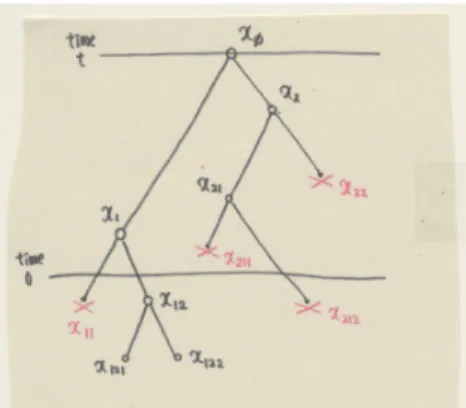
with図2Exampleofa Realized Tree$\omega_{1}$
図3Classificationof Nodesfor$\omega_{1}$
EXAMPLE 2. Suppose that
a
treestructure$\omega_{1}(\in\Omega)$ hasbeen realized here (see Figure 2). Clearlywehave$\mathcal{N}(\omega_{1})=\{\phi$, 1, 2,21$\},$ $N_{+}(\omega_{1})=\{22$,211$\}$, and $N_{-}(\omega_{1})=\{11$,12,212$\}$
.
However, for this$\omega_{1}\in\Omega,$unfortunately labels
{121},
{122}
are not included in any$\mathcal{N}(\omega_{1})$, $N_{+}(\omega_{1})$, nor $N_{-}(\omega_{1})$.
As a matter offact,
we can
construct$-11,12-1$
by
a
star-product $u_{0}(x_{11}(\omega_{1}))\star_{[X_{1}]}u_{0}(x_{12}(\omega_{1}))$ in accordance with the rule, because both $m_{1}=11$ and $m_{2}=12lie$ in $N_{-}(\omega)$. As to the node $x_{21}$, it goes similarly. Hence $–211,212(\omega_{1})$ is given by$\tilde{f}(t_{211}(\omega_{1}), x_{211}(\omega_{1}))\star_{[x_{21}]}u_{0}(x_{212}(\omega_{1}))$, see Figure3. Consequently, we obtain finally an explicit
repre-sentation of the star-product functional
$M_{\star}^{\langle u0,f\rangle}(\omega_{1})=([x_{1}]$
$\{([x_{21}]$
.
(14)口
5 A sketch of the proofofexistence result
In this sectionwe shall first construct $a(U, F)$-weighted tree-based $*$-product functional $M_{*}^{\langle U,F\rangle}(\omega)$,
which is indexed by the nodes $(x_{m})$ of
a
binarytree. Moreover, in construction of the functional, theproduct is taken
as
ordinary multiplication $*$ instead of the star-product $\star$.
We need the followingLEMMA 3. For$0\leq t\leq T$ and$x\in D_{0}$, the
function
$V(t, x)=E_{t,x}[M_{*}^{\langle U,F\rangle}(\omega)]$satisfies
$e^{\lambda t|x|^{2}}V(t, x)=U(x)+ \int_{0}^{t}ds\frac{\lambda|x|^{2}}{2}e^{\lambda s|x|^{2}}\{F(s, x)$
$+ \int V(s, y)V(s, z)K_{x}(dy, dz)\}$
.
(15)Proof of
lemma 3. By makinguse
of the conditional expectationwe can
get $V(t, x)=E_{t,x}[M_{*}^{\langle U,F\rangle}(\omega)]$$=E_{t,x}[M_{*}^{\langle U,F\rangle}(\omega), t_{\phi}\leq 0]+E_{t,x}[M_{*}^{\langle U,F\rangle}(\omega), t_{\phi}>0]$
$=E_{t,x}[M_{*}^{\langle U,F\rangle}(\omega))t_{\phi}\leq 0]+E_{t,x}[M_{*}^{\langle U,F\rangle}(\omega), t_{\phi}>0, \eta_{\phi}=0]$
$+E_{t,x}[M_{*}^{\langle U,F\rangle}(\omega), t_{\phi}>0, \eta_{\phi}=1]$
.
(16) As to the first term in (16), the $*$-product functional is allowed to havea
simple representation:$E_{t,x}[M_{*}^{\langle U,F\rangle}, t_{\phi}\leq 0]=E_{t,x}[M_{*}^{\langle U,F\rangle}\cdot 1_{\{t_{\phi}\leq 0\}}]=U(x)\cdot P_{t,x}(t_{\phi}\leq 0)$
$=U(x) \int_{t}^{\infty}f_{T}(s)ds=U(x)l^{\infty}\lambda|x|^{2}e^{-\lambda s|x|^{2}}ds$
$=U(x)\cdot\exp\{-\lambda t|x|^{2}\}$
.
(17)As to the third term, the Markov property guarantees that the lower tree structure below the first
generation branching node point (or location) $x_{1}$ is independent of that below the location $x_{2}$ with
realized $\omega\in\Omega$, hence
$a*$-product functional branched after time $s$ is also probabilistically independent
oftheother$*$-productfunctionalbranched after time$s$. Therefore,
an
easycomputation provides with$E_{t,x}[M_{*}^{\langle U,F\rangle}, t_{\phi}>0, \eta_{\phi}=1]=\frac{1}{2}\int_{0}^{t}ds\lambda|x|^{2}e^{-\lambda|x|^{2}(t-s)}\cross\int\int E_{s,x_{1}}[M_{*}]\cdot E_{s,x_{2}}[M_{*}]K_{x}(dx_{1}, dx_{2})$.
Notethat
as
for the second term, itgoes almostsimilarly. Finally, summing up we obtain$V(t, x)=E_{t,x}[M_{*}^{\langle U,F\rangle}(\omega)]$
$=U(x)r^{-\lambda t|x|^{2}}+ \int_{0}^{t}\frac{\lambda|x|^{2}}{2}e^{-\lambda|x|^{2}(t-s)}F(s, x)ds$
$+ \int_{0}^{t}\frac{\lambda|x|^{2}}{2}e^{-\lambda|x|^{2}(t-s)}\int\int V(s, y)V(s, z)K_{x}(dy, dz)ds$
.
(18)This completes the proof. $\square$
Next notice that
$E_{t,x}[M_{*}^{\langle U,F\rangle}(\omega)]<\infty$
(19)
holds for $\forall t\in[0, T]$ and $x\in E_{c}$, where a measurable set $E_{C}$ denotes the totality of all the elements $x$
in $D_{0}$ such that $E_{T,x}[M_{*}^{\langle U,F\rangle}]<\infty$ holdsfor
a.e.-x.
Another important aspect for the proofconsists in
establishment of the $M_{*}$-controlinequality.
LEMMA 4. ($M_{*}$-control inequality) The following inequality
$|M_{\star}^{\langle u_{0},f\rangle}(\omega)|\leq M_{*}^{\langle U,F\rangle}(\omega)$
(20)
In fact, the $M_{*}$-control inequality yields immediately
from
a
simple inequality$|w\star_{[x]}v|\leq|w|\cdot|v|$ for every $w,$$v\in \mathbb{C}^{3}$ and every $x\in D_{0}.$
Ifwedefine
$u(t, x):=\{\begin{array}{l}E_{t,x}[M_{\star}^{\langle u_{0},f\rangle}(\omega)], on E_{c},0, otherwise,\end{array}$
then$u(t, x)$ iswell-defined
on
the whole space $D_{0}$under the assumptionsof the main
theorem (Theorem1). Moreover, it follows from the$M_{*}$-control inequality (20) that
$|u(t, x)|\leq V(t, x)$
on
$[0, T]\cross D_{0}$.
(21)On
thisaccount, it is easy tosee
from (15) that$\int_{0}^{T}ds\int|u(s, y)|\cdot|u(s, z)|K_{x}(dy, dz)<\infty$ for $x\in E_{c}$
.
(22)Hence, taking (22) into consideration wedefine the space $\mathcal{D}$ofsolutions to (1)
as
$\mathcal{D}$
$:=\{\varphi$:$\mathbb{R}_{+}\cross D_{0}arrow \mathbb{C}^{3};\varphi$ is continuous in $t$ and measurable such that
$\int_{0}^{\infty}ds\int e^{\lambda|x|^{2}s}|\varphi(s, y)|\cdot|\varphi(s, z)|K_{x}(dy, dz)<\infty$ holds
a.e.
$-x$}.
(23) Byemploying theMarkovpropertywithrespecttotime$t_{\phi}$ andbya
similartechniqueas
in the proof ofLemma3,
we
may proceed inrewritingand calculatingtheexpectation: for$\forall t>0$ and$x\in E_{c}$$u(t, x)=E_{t,x}[M_{\star}^{\langle u_{0},f\rangle}(\omega)]$
$=e^{-\lambda t|x|^{2}}u_{0}(x)+ \int_{0}^{t}ds\lambda|x|^{2}e^{-\lambda(t-s)|x|^{2}}\cross$
$\cross\frac{1}{2}\{\tilde{f}(s, x)+\iint E_{8x_{1}}[M_{\star}]\star_{[x]}E_{s,x_{2}}[M_{\star}]K_{x}(dx_{1}, dx_{2})\}$. (24)
Furthermore,
we
mayapplythe integral equality (3) in the assumptionon
the Markov kernelfor (24) to obtain$E_{t,x}[M_{\star}^{\langle u0,f\rangle}( \omega)]=e^{-\lambda t|x|^{2}}\{u_{0}(x)+\frac{\lambda}{2}\int_{0}^{t}e^{\lambda s|x|^{2}}f(s, x)ds$
$+ \frac{\lambda}{2}\int_{0}^{t}ds\int e^{\lambda s|x|^{2}}p(s, x, y;u)n(x, y)dy\}$
.
(25)Finally weattain that $u(t, x)=E_{t,x}[M_{\star}^{\langle u0,f\rangle}(\omega)]$ satisfies the integral equation (1), and this $u(t, x)$ is
a
solution lying in thespace$\mathcal{D}$.
This completes the proofof the existence.Acknowledgements. This work is supported in part by JapanMEXT Grant-in AidsSR(C)No.24540114
and also by theISM Cooperative Research Program
No.201-ISM-CRP-5011.
References
[1] Aldous, D. : The continuum random tree I.
&
III. Ann. Probab.19
(1991), 1-28; ibid. 21 (1993), 248-289.[2] Aldous, D. : ne-based models for random distributionof
mass.
J. Stat. Phys.73
(1993),625-641.
Inst. HenriPoicar\’e 34 (1998), 637-686.
[4] D\^oku, I. : An application of randommodel to mathematical medicine.
ISM
Cop. Res. Rept. 262(2011),
108-118.
[5] D\^oku,I. : On mathematical modelling for immune responseto the
cancer
cells. J. SUFE Math. Nat.Sci.
60
(2011), no.1,137-148.
[6]
D\^oku,
I. :On a
randommodel for immune response: toward a modelling of antitumor immuneresponses.
RIMS
K\^oky\^uroku (Kyoto Univ 1751 (2011),18-24.
[7] D\^oku,I. : A remark
on
tumor-induced angiogenesis from theviewpoint of mathematical cellbiology:mathematical medical approachvia stochastic modelling. J.
SUFE
Math. Nat. Sci. 60 (2011), no.2,205-217.
[8] D\^oku, I. : On extinction property of superprocesses.
ISM
Cop. Res. Rept.275
(2012),34-42.
[9] D\^oku, I. : Arandom model for tumor immunobiomechanism: theoreticalimplicationfor host-defense
mechanism.
RIMS
K\^oky\^uroku (KyotoUniv1796
(2012),93-101.
[10] D\^oku, I. : Finite time extinctionofhistorical superprocess related to stable
measure.
RIMSK\^oky\^uroku(Kyoto Univ 1855 (2013), 1-9.
[11] D\^oku, I. : Limit Theorems
for
Superprocesses. LAP, Schalt. Lange, Berlin,2014.
[12]
D\^oku,
I. :On
a
probabilistic solution fora
class of integralequations.ISM
Cop.Res.
Rept. Vol.328,(2014),
56-61.
[13] D\^oku, I. : Probabilisticconstructionof solutions to
some
integral equations. RIMSK\^oky\^uroku(Kyoto Univ Vol.1903, (2014),
23-29.
[14] D\^oku,I. : Star-productfunctional and unbiased estimator of solutions to nonlinearintegral equations.
Far EastJ. Math. Sci. 89 (2014), 69-128.
[15] D\^oku, I. : Vessel mathematical model fortumour angiogenesis and its fluctuation characterization
equation. RIMS K\^oky\^uroku (Kyoto Univ Vol.1917 (2014), 29-36.
[16] D\^oku, I. and Misawa, M. : Meanprinciple and fluctuationofSDE model fortumourangiogenesis.
J. SUFE Math. Nat. Sci. 62 (2013), no.2, 1-26.
[17] D\^oku, I. andMisawa, M. : The limit function andcharacterization equation for fluctuationin the
tumourangiogenic SDE model.
J.
SUFE Math. Nat. Sci. 63 (2014), no.1,115-131.
[18] Drmota, M. : Random $7rees$
.
Springer, Wien,2009.
[19] Evans, S.N. : Probability andReal Trees. Lecture Notesin Math. vol.1920,
Springer, Berlin,
2008.
[20] Harris, T.E. : The Theory