Unstable
periodic
orbits embedded
in
a
continuous time
dynamical
system-time
averaged
properties-連続カオス力学系の不安定周期軌道解析 -軌道平均値について
-Yoshitaka SAIKI1 (斉木 吉隆)
Michio YAMADA (山田 道夫)
京都大学数理解析研究所 RIMS, Kyoto University
ABSTRACT
It is recently found in
some
dynamical systems in fluiddynam-ics that only a few unstable periodic orbits (UPOs) with low
pe-riods can give good approximations to mean properties of
turbu-lent (chaotic) solutions. By employing the Kuramoto-Sivashinsky
equation we compared time averaged properties of a set of UPOs
embedded
ina
chaoticattractor
and those ofa
set of segments ofchaotic orbits, and reported that the distribution of a time average
of a dynamical variable along UPOs with lower and higher periods
are similar to each other and the variance of the distribution is
small, in contrast with that along chaotic segments. The result is
similar to those for low dimensional ordinary differential equations
(Lorenz system, R\"ossler system and Economic system) reported in
Saiki and Yamada, 2009, Physical Review $E$, 79(1) R015201.
1 Introduction
Chaos in dynamical systems has been discussed in relation to UPOs
(un-stable periodic orbits) embedded in a chaotic attractor, as a chaotic orbit is
considered to be approximatable by an ensemble of UPOs which are densely
distributed in the chaotic attractor [3]. Recently, in some turbulence
sys-tems in fluid dynamics, it has been shown that even only a few UPOs with
relatively low periods
can
capture mean properties of chaotic motions [6].For the turbulent
Couette
flow of rather low Reynolds number in the fullNavier-Stokes
system, Kawahara andKida obtained a remarkable
agree-ment of
an
averaged velocity profile alonga
single UPO with that alonga
chaotic orbit in phase space of
a
turbulent Couette flow. Latervan
Veenet al. [16] performed a numerical study of an isotropic Navier-Stokes
tur-bulence with high symmetry, and found that among several UPOs there
is an UPO with relatively low period where the energy dissipation rate
appears to
converge
to anonzero
valueas
assumed in the Kolmogorovsim-ilarity theory in the limit of large Reynolds number. This suggests that
the UPO corresponds to the isotropic turbulence of fluid motion, although
the Reynolds number is not large enough to discuss
the
detailed propertiesof the fully developed turbulence because of computational difficulties. As
for the universal statistical properties of fluid turbulence at high Reynolds
numbers, employing the GOY shell model, Kato and Yamada [7] found a
single
UPO
which gives a fairly good approximation to the scalingexpo-nents of structure functions of velocity, which suggests that the
intermit-tency in the model turbulence can be interpreted as a property of a single
UPO, rather than
a
statistical contribution of complex orbits.In the above studies, it seems that only
a
fewUPOs
with relatively lowperiods
are
enough to capturesome mean
properties ofa
chaotic solution.However, on the other hand, the chaotic attractor includes an infinite
num-ber of UPOs, and it appears that an UPO with longer period gives a better
approximation to the statistical properties of chaotic solutions,
as a
set oflong UPOs and a set of chaotic orbits are intuitively taken to have
sim-ilar statistical properties. So we may have a question why in the above
systems even a small number of UPOs with rather low periods can give a
remarkably good approximation to the chaotic mean values. Some
stud-ies have been concerned with this problem [8, 5, 13, 14]. Kawasaki and
Sasa studied a simple model of chaotic dynamical systems with a large
degree of freedom, and found that there is
an
ensemble ofUPOs
with thebe calculated using one UPO sampled from the ensemble. Hunt and Ott
studied an optimal periodic orbit which yields the optimal (extreme) value
of a time average of a given smooth performance function of dynamical
variables. They obtained an implication that the optimal periodic orbit is
typically
a
periodic orbit of low period, although they do not consider therelation of averaged statistical properties along UPOs and chaotic orbits.
On the other hand, Yang et al. reported that the optimal UPO can be a
periodic orbit of high period when the system is near crisis. In a study
on
UPOs of low dimensional map systems by Saiki and Yamada [13], it isreported that UPOs with low periods are not effective to approximate the
time averaged properties of chaotic orbits.
Recently Saiki and Yamada [14] employed chaotic systems described by
low dimensional ODEs and investigate the relation between the average
of a dynamical quantity along an UPO and that along a chaotic orbit,
especially with an attention focused on the dependence of the variance of
averaged values on the periods of the UPOs. At a first glance, it may
ap-pear that if we take all the UPOs with the period around $T$, for example,
and take the averages of a dynamical quantity along these UPOs, the
vari-ance of the averages would decrease
as
$T$ increases, because an extremelylong orbit would
cover
most part of the chaotic attractor, capturingpos-sible dynamical states on the attractor. The aim was to see whether this
intuitive discussion holds for chaotic systems simple enough to obtain a
large number of UPOs by available numerical computation with double
accuracy. For this purpose we take three chaotic systems; Lorenz system,
R\"ossler model and a business cycle model. A set of UPOs in each model
were obtained numerically, and found that for every chaotic system the
distributions of a time average of a dynamical variable along UPOs with
lower and higher periods are similar to each other and the variance of the
distribution is small, in contrast with that along chaotic segments. Here,
partial differential equation system and examine time averaged properties
along UPOs and segments of chaotic orbits with the corresponding lengths.
2 Time averaged properties
UPOs
in the Kuramoto-Sivashinsky equationare
already studied insome
ways [2, 17, 4, 9, 10, 11]. Christensen et al. reported that cycle
expan-sion theory works in the system with
a
periodic boundary condition insome set of parameter values. Zoldi and Greenside investigated UPOs
of the Kuramoto-Sivashinsky equation with
a
rigid boundary condition,which generates spatio temporal chaotic behaviors. In this paper, we study
Kuramoto-Sivashinsky equation with a periodic boundary condition with
the
same
settingas
thatstudied
in the previous studies [2, 11]. That is,the original system
$u_{t}=(u^{2})_{x}-u_{xx}-\nu u_{xxxx}$ (1)
is written in the Fourier space as
$\dot{b}_{k}=$ $(k^{2}$ 一 $\nu k^{4})b_{k}+ik\sum_{m=-\infty}^{\infty}b_{m}b_{k-m}$ (2)
by
$u(x, t)= \sum_{k=-\infty}^{\infty}b_{k}(t)e^{ikx}$, (3)
where the coefficients $b_{k}$ are in general complex variables. However, we
simplify the system by assuming that $b_{k}$ are pure imaginary, $b_{k}=ia_{k}$,
where $a_{k}$ are real and obtain evolution equations [2]
$\dot{a}_{k}=(k^{2}-\nu k^{4})a_{k}-k^{\text{コ}}\sum_{m=-\infty}^{\infty}a_{m}a_{k-m}$. (4)
We reduce this system to 16 dimensional ODEs and fix $\nu$
as 0.02991.
Thesystem generates two chaotic attractors which are symmetric to each other.
Here we focus our attention to the distribution of time averaged values of
order to detect UPOs we employ in this paper the Newton-Raphson-Mees
method in which the period of the UPO is regarded as a variable to be
found in the numerical calculation [12]. We found more than 650 UPOs
of the periods from 0.87072 through 12.30608, corresponding respectively
from 1 through 14 Poincar\’e map periods (PERIODs). Detected UPOs
are
classified into three types. UPOs which are embedded in a chaotic attractor
are classified into the first type. In Fig.1 two examples of the $(a_{1}, a_{2})$
projections of UPOs $((b)T=0.870729, (c)T=6.172071)$ are described in
contrast with that of a chaotic attractor (a). The second type is a UPO
which is outside a chaoticattractor but mediates an attractor merging crisis
at the different parameter value. The stable manifold of the UPO forms
the basin boundary of two chaotic attractors before the merging crisis and
the orbit becomes embedded in a big attractor after the merging crisis [10].
Other existing UPOs which are outside a chaotic attractor are classified
into the third type. Here in this paper we focus our attention to UPOs of
the first type which are embedded in a chaotic attractor.
It should be remarked that the Poincar\’e map is defined by the Poincar\’e
section $a_{1}=0$ with $da_{1}/dt>0$. In our numerical calculation, we identified
most UPOs with PERIOD less or equal to 12.
One of the most important indices representing the complexity of a
dy-namical system is the topological entropy [1], which is estimated by the
ex-ponential growth rate of the number of periodic orbits; $h_{top}= \lim\sup_{Narrow\infty}$
$\log(\#\{PERIOD-N UPOs\})/N$, and the topological entropy $h_{top}$ of the
Poincar\’e map in this case is estimated to be log(1.6) from Fig. 2. We
should remark a clear linear dependence of $\log\{\UPO\}$ on $N$ which
sug-gests that the number of UPOs with PERIOD $N$ detected in our
computa-tion is sufficient to study statistical properties of UPOs. We now calculate
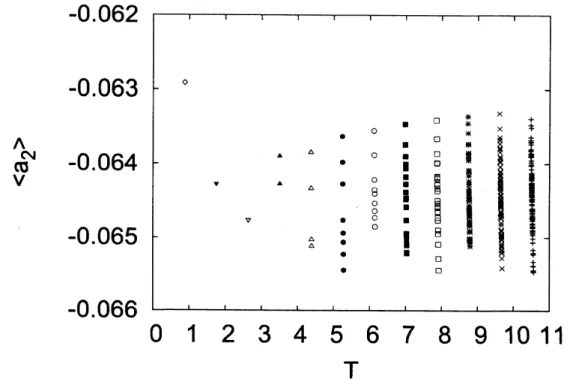
the time average of $a_{2}( \langle a_{2}\rangle\equiv\int_{t=0}^{T}a_{2}/Tdt)$ along each
UPO
with periodT. $\langle a_{2}\rangle s$ along UPOs take similar but different values around the average
$2\cdot 1.5\cdot 1\cdot 0.500.511.52$
$a_{1}$
2 $\cdot 1.5\cdot 1\cdot 0.500.5\{1.52$
$a_{\{}$
$2151050a_{\{}0.51t.52$
Fig. 1: Projections of a chaotic attractor (a) and UPOs $((b)T=0.870729$,
$(c)T=6.172071)$ onto $a_{1}-a_{2}$ plane
$\supset LO^{)}tJ$
\={o}
$\overline{z\circ\circ\in\supset}$
$N$
Fig. 2: Number of detected UPOs with PERIOD $N$ of the
Kuramoto-Sivashinsky system which are embedded in a chaotic attractor in
$\hat{v\tilde{\varpi}}$
$T$
Fig. 3: Time averages $\langle a_{2}\rangle s(\langle a_{2}\rangle\equiv\int_{t=0}^{T}a_{2}/Tdt)$ along UPOs with period
$T$.
$\check{r\varpi}q)$
$<a_{2^{>}}$
Fig. 4: Density distribution of time averages $\langle a_{2}\rangle s(\langle a_{2}\rangle\equiv\int_{t=0}^{T}a_{2}/Tdt)$
$\circ\vdash\omega$
$N$
Fig. 5: Standard deviation ofdensity distribution of $\langle a_{2}\rangle s$ along UPOs with
PERIOD $N(+)$ and that along $10^{5}$ chaotic segments with the corresponding
time lengths $T(=0.8774\cdot N)(\cross)$ and $0.02N^{-1.05}(1ine)$.
0.8 UPO(10) – 0.7 Chaos(10)
$-$
0.6 0.5 $\frac{Q)}{\not\subset\varpi}$ 0.4 0.3 叩 $:\backslash ..$ : 0.2 01 .$\ovalbox{\tt\small REJECT}^{\int j}\acute{i}\text{化^{}/}$
,
$O-0.08$
$-O.07$ $-0^{\backslash }.06$ $-0.05$
$<a_{2^{>}}$
Fig. 6: Density distribution of $\langle a_{2}\rangle s$ along UPOs with PERIOD 10
$(\langle a_{2}\rangle=-0.06442)$ (average period$=8.7625$) in comparison with that along
$10^{5}$ chaotic segments with the corresponding time-length $T(=0.8774\cdot 10)$
density distribution of $\langle a_{2}\rangle s$ along UPOs for $N(=7,8, \cdots, 12)$. We
can see
that the distribution stays similar shape though $N$ varies, indicating that
even longer UPO is not necessarily suitable for evaluation of $a_{2}$ averaged
along
a
long chaotic orbit. This may be contrary toour
expectation thatan UPO with longer period would give better approximations to statistical
properties of chaotic orbits. Actually in Fig. 5 the standard deviations of
the density distribution of $\langle a_{2}\rangle s$ along UPOs with PERIOD $N$
are
seen tobe nearly constant as $N$ increases. The figure also shows that the
stan-dard deviations of $\langle z\rangle s$ along segments of chaotic orbits with time length
$T=N\cdot 0.8774$, where 0.8774 stands for the corresponding recurrent time to
the Poincar\’e section. We
can see
thatas
$N$ increases, the latter standarddeviation decreases nearly as $N^{-1.05}$. The difference between the density
distribution of time averages along UPOs is clearly observed in Fig. 6 in
the case of the distribution of $\langle z\rangle s$ along a set of UPOs of PERIOD 10 and
chaotic segments with the corresponding lengths.
-0.075 $-0.07$ -0.065 $-0.06$ -0.055 -0.075 $-0.07$ $-0.065$ $-0.06$ -0.055
く$a_{2^{>}}$ $<a_{2^{>}}$
Fig. 7: Relations between time averaged values of $a_{2}(\langle a_{2}\rangle)$and $a_{6}(\langle a_{6}\rangle)$
along chaotic segments $($length $T=8\cdot 0.8774)$ (left), UPOs$(+$$)$ and chaotic
In Fig.7 we investigate relations between time averaged values of $a_{2}(\langle a_{2}\rangle)$
and $a_{6}(\langle a_{6}\rangle)$ along chaotic segments $($length $T=8\cdot 0.8774)$ (left), and those
along UPOs$(+$$)$ and chaotic mean value $(\square )$(right). Surprisingly there
are
linear correlations between two time averaged values along UPOs, whereas
time averaged values along chaotic segments (length $T=8$
.
0.8774)are
spreading on $(\langle a_{2}\rangle, \langle a_{6}\rangle)$ plane. It
can
also be confirmed that chaoticmean
value is on the constraint formed by a set of time averaged values along
UPOs.
3 Summary
We have discussed time
averages
of dynamical variables alongUPOs
inthe Kuramoto-Sivashinsky equation. We have calculated
more
than650
UPOs, and found that time averaged properties along a set of UPOs and
a set of chaotic orbits with finite lengths
are
totally different from eachother. From our numerical result a longer UPO is not necessarily
advanta-geous than shorter UPO to estimate mean properties of the chaotic state
in the model. The result is similar to those obtained for the
case
of ODEs(the Lorenz system, the R\"ossler system and
a
6-dimensional business cyclemodel). It is implied that we
can
employ a shortUPO
for the estimationof the mean properties of the chaotic state without significant reduction
of plausibility. In
some
fluid dynamical systems, it has been found thatonly a few UPO with low periods give fairly good approximations to some
statistical properties. Our result about the Kuramoto-Sivashinsky
equa-tion suggests that the estimation by using a short UPO is as reliable (or
unreliable) as that by using a long UPO. It would be interesting to study
chaotic macro-economic models from the point ofview of unstable periodic
Acknowledgment
This work is partially supported by the Grant-in-Aids (No. 194048) and
an incentive system for young researchers of the Academic Center for
Com-puting and Media Studies, Kyoto University. References
[1] R. Bowen, Topological entropy and AxiomA, Global Analysis (Berkeley,
CA, 1968) Proc. Sympos. Pure Math.,14 AMS, Providence, RI (1970)
23-41.
[2] F. Christiansen, P. Cvitanovi\v{c} and V. Putkaradze, Spatiotemporal
chaos in terms of unstable recurrent patterns, Nonlinearity, 10 (1997)
55-70.
[3] C. Grebogi, E. Ott, J. A. Yorke, Unstable periodic orbits and the
dimen-sions ofmultifractalchaotic attractors Physical Review $A,$ $37,1711-1724$
(1988).
[4] Y. Lan and P. Cvitanovi\v{c}, Characterization of the Lorenz attractor by
unstable periodic orbits, Physical Review $E,$ $69$ (2004) 016217: Y. Lan
and P. Cvitanovi\v{c},
Characterization
of the Lorenz attractor by unstableperiodic orbits, Physical Review $E,$ $78$ (2008) 026208.
[5] B. Hunt and E. Ott, Optimal Periodic Orbits of Chaotic Systems,
Phys-ical Review Letters, 76 (13) (1996) 2254: B. Hunt and E. Ott, Optimal
Periodic Orbitsof Chaotic Systems occur at low period, Physical Review
$E,$ $54$ (1996) 328: T.-H. Yang, B. Hunt and E. Ott, Optimal periodic
orbits for continuous time systems, Physical Review $E62$ (2000)
1950-1959.
[6] G. Kawahara and S. Kida, Periodic motion embedded in plane Couette
turbulence: regeneration cycle and burst, Joumal
of
Fluid Mechanics,[7] S. Kato and M. Yamada, Unstable periodic solutions embedded in
a
shell model turbulence, Physical Review $E,$ $68$ (2003)
25302-25305.
[8] M. Kawasaki and
S.
Sasa,Statistics
of unstable periodic orbits of achaotic dynamical system with a large number of degrees of freedom
Physical Review $E,$ $72$ (2005)
37202.
[9] E. L. Rempel, A. C.-L. Chian, E. E. N. Macau and R. R. Rosa,
Anal-ysis of chaotic saddles in high-dimensional dynamical systems: The
Kuramoto-Sivashinsky equation, Chaos, 14, 545-556 (2004).
[10] E. L. Rempel,
A.
C.-L.
Chian,A.
J. Preto andS.
Stephany,Intermit-tency chaos driven by nonlinear Alfv\’en waves, Nonlinear Processes in
Geophysics, 11,
691-700
(2004).[11] E. L. Rempel and A. C.-L. Chian, Intermittency induced by
attractor-merging crisis in the Kuramoto-Shivashinsky equation, Physical Review
$E,$ $71$, 016203 (2005).
[12] Y. Saiki, Numerical detection of unstable periodic orbits in
continuous-time dynamical systems with chaotic behaviors, Nonlinear Processes in
Geophysics, 13, (2007), 615-620.
[13] Y. Saiki and M. Yamada, Time averaged properties along unstable
pe-riodic orbits and chaotic orbits in two map systems, Nonlinear Processes
in Geophysics, 15, (2008), 675-680.
[14] Y. Saiki and M. Yamada, Time averaged properties along unstable
periodic orbits and chaotic orbits in two map systems, Physical Review
$E,$ $79$, (2009), 015201: 1-4.
[15] Y. Saiki and K. Ishiyama,.Recognition of transition patterns in a
busi-ness cycle model by unstable periodic orbits, to appear in Intemational
[16] L.
van
Veen,S.
Kida andG.
Kawahara, Periodic motion representingisotropic turbulence, Fluid Dynamics Research, 38(1) (2006)
19-46.
[17] S. M. Zoldi and H. S. Greenside, Spatially localized unstable periodic
orbits of a high-dimensional chaotic system, Physical Review $E,$ $57$