FIXED POINT
THEOREM,
PERIODICITY THEOREM AND
BINOMINAL AND TRINOMINAL SEQUENCES FOR
ITERATION DYNAMICAL SYSTEMS OF DISCRETE
LAPLACIANS ON
THE PLANE
LATTICE
(
))
離散ラプラス作用素の反復力学系における
不動点定理
,
周期性定理と二項・三項係数
C.Hadlich*, K.Guerlebeck* and O. Suzuki**
*InstituteofMathematicsandPhysics, Weimar University, CoudrayStreet13, Weimar, Germany
”Department ofComputerSciences andSystem Analysis, Nihon $Univeisit_{X}$. Sakurajosui, Setagaya ku, Tokyo, Japan.
[email protected] niAon.ac.jp
Key words: dynamicalsystem, discrete Laplacians,
fixed
pointtheorem,periodicity theorem We treatmathematical problems for iteration dynamical systems ofdiscrete Laplacianson theplanelattice. Atfirstwe prove a fixedpointtheorem for evenneighborhoods and
a periodicity theorem for odd neighborhoods of the dynamical systems, respectively. Then we
are
concemed with binominal and trinomial sequences associated the dynamical systemsandcommentsome
observations.1. ITERATION DYNAMICAL SYSTEM OF DISCRETE
LAPLACIAN
We choose the plane lattice which is generated by two families of lines which
are
orthogonalto each other. We identifya
cell of the lattice withone
point of thecell, e.g., the midpoint. We calla
set of cells whichare
attached with the reference cella
neighborhood. We call neighborhoodeven
(or odd) if the number of the cells iseven
(respectivelyodd).We give several examples. Some ofthem
are
well known([1]):Moore Neumann Diag Hexagonal Sierpinski
$b$下um $rightarrow$歌$\sim$W
Figure 1. Examplesofneighborhoods
We take the space $F$ of {0,1} valued functions on the plane lattice. Choosing
a
neighborhood $U_{p}$ ,
we
define the Laplacian operationas
follows:
$\Delta_{U_{p}}f(p)=\sum_{q\in U_{p}}(f(q)-f(p))$
Foraninitial function$f_{o^{\in}F}$
,
we consider the dynamicalsystem
$\{f_{n}\},f_{n}=\Delta_{U}f_{n-1}(n=1,2, \ldots)$
.
We call the dynamical systemof
a
givenneighborhood, theneighborhood dynamical system. Forexample, whenwe
choose the Mooreneighborhoodwe
call itMoore dynamical system. Forother neighborhoods,we
call them following the neighborhoodsin
an
analogousmanner.
2. COMPUTER SIMULATION
Choosing
sources
and neighborhoods,we can
realizea
wide class ofphenomena by theseiteration
dynamical systems. We calla
point $Q$a source
ofthe dynamical system$\{f_{n}\}$ if
$f_{n}(Q)=1$ for any step $n$
.
Incase
ofsources we
apply the discrete Laplacianonly at all points except the
sources.
We givenow some
examples of computer simulations ([1], [2]).(1) Ice crystals.
We
can
generate ice crystals under suitable conditions. Wecan
realize them byuse
of the dynamical system of the hexagonal neighborhood. The realizationscan
be obtainedsystematically and
we
may expect to describe its mathematical theory in terms of thedynamical system.
(2)The evolution ofextinct animals ([3]).
We present
a
computer simulation ofone
of extinct animals which is calledechinoderms. The left side is thereal data which is givenby Sepkoski ([6])and theright
side is
a
computer simulation which is given bya
dynamical system of Moore neighborhood witha
singlesource.
We have done the time evolutions of extinct animalsFigure 3. Evolutionof
an
extinct animal(3) Design patterns ([4]).
We
can
produce many kinds of design pattems including carpets and embroidery. Wegive
some
examplesof simulations.Figure4.Generationofdesignpattems
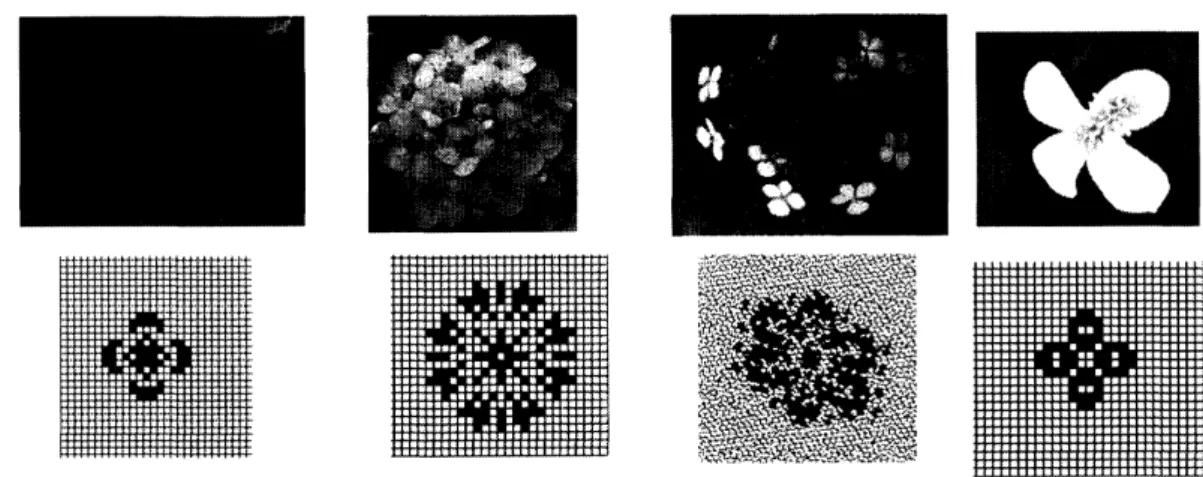
(4) Flower patterns.
Next
we
proceed to the realizations problems of designpattems of flowers. Wesee
thatwe
have possibilities of realizations of flowers byuse
ofour
dynamical systems. This will be performed and published ina
near
hture.(5) Design patterns of butterfly wings.
We
can
also try to realize design pattems of butterfly wings. We notice thatwe can
realizeso
called “snake eyepattern” and “long tail patterns” andwe
can
compare thebody construction scheme at the DNA level. We give several computer simulations. These results will be presented inthe annual meeting
on
BiologicalMathematics and itsapplicationinKyoto2010.
Figure 6. Generationofbutteffiy design pattems
3.
MATHEMATICAL
PROBLEMS ON DISCRETE LAPLACIANS
Herewe recall
some
basic notations onthe dynamical systemsand stateproblemson
mathematical structures ([1], [3], [4])$)$.
At firstwe
notice thatwe
consider dynamicalsystems under the periodic condition. Namely, choosing
an
integer $M$, which is calledthe size,
we
consider the followingperiodic functions:$F(M)=\{f\in F|f(x+mM,y+nM)=f(x,y), (n,m\in Z)\}$
Choosing
a
neighborhood,we
can
definea
discrete Laplacian andwe
can
consider its iteration dynamical system under the periodic condition. Hencewe
can
understand thatwe
consider the dynamicalsystemon
the toms with the size $M\cross M$.
The toms isdenoted by $T(M)$
.
Weprepare several basicnotations:(1)Adynamical system iscalled tohave afixed point, if ョ$k\in N$s.t. $f_{n}=f_{k}(\forall n\geq k)$
(2)Adynamicalsystem is calledperiodic if ョ$n,$ョ$l$
such that $f_{n}=f_{n+kl}\forall k\in N$
If$n=0$, it is calledperiodic simply and if $n\neq 0$
, itis called asymptoticallyperiodic,
respectively.
$f_{n}Q_{j})=1$ $\forall n\in N.j=1,2,$
$\ldots,$
$k$ .
CONJECTURE([1], [3], [4])
We
can
proposeconjectures forsome cases:
(1) In the
case
$M=2^{p}$anda
single source,we
have the following results:$(\alpha)$ If
a
neighborhood is even,we see
that the dynamical systemhasa
fixed point andits
fixed pointcan
be attained after $2^{p}$ (or2
p-l) steps for Moore, Hexagonal,andNeumann(resp. Sierpinski)neighborhoods.
$(\beta)$ If the neighborhood is odd,
we see
that the dynamical system is periodic, itsperiod depends
on
neighborhoods.(2) In the
case
where $M$ is odd, the dynamical system is periodic in thecase
ofa
single
source
with Neumam neighborhood. We give the table of periods for small values of$M$(seeTable 1).$\frac{M35791113151719212325272931}{Period15613306229305111262046204510211638461}$
$\underline{Recurrencepointlllllllllllllll}$
Table 1. Periodsforsmalloddsize4. FIXED POINT THEOREMS FOR EVEN NEIGHBORHOODS
Theoreml
Let $M=2^{p}$ and let the neighborhood be of Sierpinski type (resp. Neumann type).
Then, in case ofa one point source, the dynamical system reaches at afixed point after
$2^{p}$(resp. 2$p-1$ ) steps.
Proof of the assertion for Sierpinski neighborhood.
We give
a
proofof Theorem I inthecase
$p=2$.
We putthesource
atthecomer
which isdenoted by yellow color. Making iterations,
we
have the assertion. By this shortobservation,
we
knowthatour
assertionmay hold forany$p$.$*$
Figure 7.Proof forSierpinski dynamical system$(p=4)$
We introduce
a
coordinate systemsuchthattheorigin(0,0) islocatedatthe
upper
rightcomer
ofthe rectangleas
shown inFigure 8.We put $N_{n}=\{(i,j):i+j=n, i,j\geq 0\},$ $M_{n}=$
$\bigcup_{k=0}^{n}N_{k}$
.
Wecan
prove the followingpropositionwhichproves
theassertionofTheorem Iin the
case
ofgeneral $2^{p}$.
PROPOSITION For the dynamical system $\{f_{n}\}$
with the
source
at the origin,we
have:
(1) $f_{n}(i,j)=f_{n}(i, i)$
on
$N_{n}$,(2) $f_{n}(n, 0)=f_{n}(0,n)=1$ $(0\leq n\leq M-1)$
(3) $f_{n}(i,j)=f_{n}(i-1,j)+f_{n}(i,j-1)$
on
$N_{n}$ (mod 2)(4) The image ofthe Laplacianis
invariant on
$M_{n}:f_{n+1|M_{n}}=f_{n}$ .Remark 1.
By this proposition
we see
the following facts:(i) We seethat the Pascal triangle$mod 2$appears intheuppertrianglepart.
(ii) At step $2^{p}$, everyelement in the diagonal is 1.
(iii) Thenthe lowertriangleisfilled by$0$ (see Figure7).
Proof of
theassertion for Neumann
neighborhood.At first
we
givea
proofofTheorem I in thecase
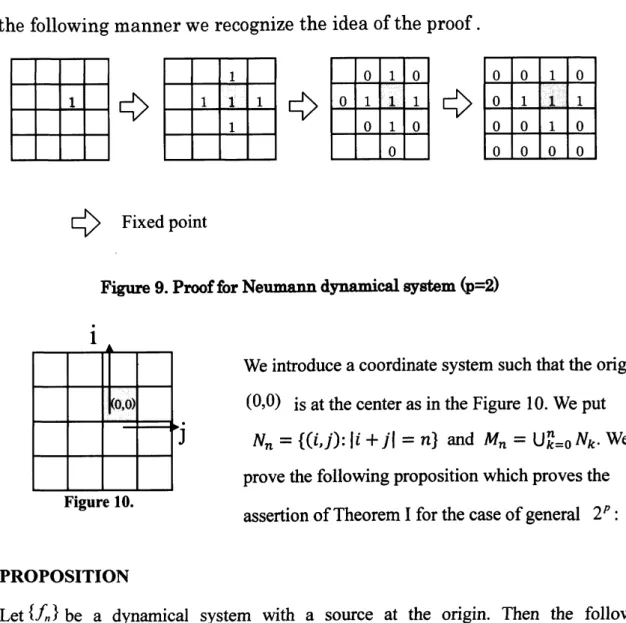
$p=2$ (see Figures 9,10). We put thesource
at the position which is denoted by yellow color. Iterating inthe following
manner we
recognize the idea of the proof.
$*$ $*$ $*$
$*$ Fixedpoint
Figure9.Prooffor Neumanndynamical system$(p=2)$
We introduce
a
coordinate systemsuchthat the origin(0,0) isat the center
as
inthe Figure 10. We put$N_{n}=\{(i,j):|t+j|=n\}$ and $M_{n}= \bigcup_{k=0}^{n}N_{k}$
.
Wecan
prove
the followingpropositionwhichproves theFigure 10.
assertion
ofTheoremI for thecase
of general $2^{p}$:
PROPOSITION
Let$\{f_{n}\}$
be a dynamical system with
a source
at the origin. Then the following properties hold foran
integer $n$of the form $n=2^{q}(0\leq q\leq p-1)$
:
(1)The Laplacian $\Delta$ mapsthe support of $M_{n}$ to thatof $M_{n+1}$.(2) The Laplacianpreservesthefimction $f_{n}$
on
$M_{n}$ ,i.e., $f_{m}i|_{M}=f_{n}$(3) $f_{n}(i,j)=1:i+j=\pm n$ and $f_{n}(i_{J})=O$ the outside of$M_{n}$,
(4) $f_{n+1}(\pm(n+1,0)=1,f_{n+1}(0, \pm(n+1))=1$
on
$N_{n+1}$.
Remark2.
The condition (2) in the proposition is called monotonic increasing condition. We
can
Remark3.
In [5], the concept of the linearization of the discrete Laplacian and the
iteration
dynamical system is considered. The comparison theoremson
the fixed point and periodicity between these operators and the original discrete Laplacianare
given andinteresting similarities canbeobserved.
Remark4.
In[8],the conceptof characteristic polynomialswhich
are
introduced by Wolframinthecase
ofl-dimensional latticecan
be transported to the plane latticeand it isproved thatthe periodofNeumannneighborhood is identical with that ofMooreneighborhood.
5. PERIODICITY THEOREMFORODD NEIGHBORHOODS
We
can
provethe following theorem: THEOREM IIIn the
case
$M=2^{p}$, witha
neighborhood of Peano typeor
Roof type anda one
pointsource, the dynamical system isperiodic and its period is $2^{p}$(resp. 2$p-1$).
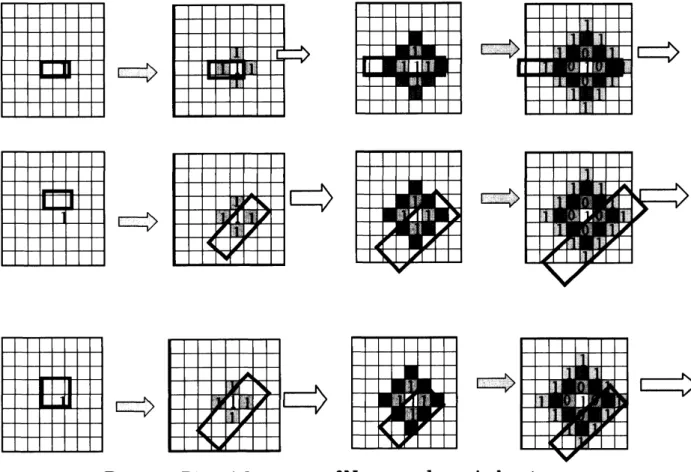
Proof. We give the prooffor the Peano neighborhood. The proofs for the other
cases
are
similar. We givean
idea of the proof in thecase
$p=2$ (see Figure 11). Putting thesource
at thecomer
which is denoted by yellow color, and making iterations,we
have the assertion..
$*$
$\theta$ $*$
$*$ $\Leftrightarrow$
Figure 11. ProofforPeano neighborhood$(p=2)$
We choose a local coordinate system
as
in thecase
ofSierpinski neighborhood. Thenwe can
provetheassertion ofTheorem II bythe following proposition:PROPOSITION
We consider the
square
domain with the origin at the right uppercomer
of the size$2^{q}(=m)$ and call it $T(m)$
.
We considera
dynamical system $\{f_{n}\}$ witha
source
attheorigin. Then
we
can
prove the following assertions foran
integer $m=2^{q},$ $(0\leq q\leq$$p-1$
:
(1)TheLaplacian $\Delta$maps the supportof $M_{m}$ tothat of $M_{m+1}$
(2) $f_{m}(m=2^{k})$
is
harmonicon
$T(m)$,i.e., $\Delta f_{m-1}|_{T(m)}=0$Remark 5. The condition (2) in the proposition is called hamonic monotonic
increasing condition. We
can prove
thesame
assertionunderthis condition.6. BINOMIAL ANDTRINOMIAL SEQUENCES OFITERATION DYNAMICAL
SYSTEMS OF DISCRETE LAPLACIANS
For
an
iteration dynamical systemwe
have configurations whichconstitute
distributions of $0$ and 1. We will obtain binomial and trinomialsequences
for thedynamical systems. In fact,
we
have the usual $mod 2$ binomial sequence ffom theSierpinski dynamical system. We listup
some
interestingsequenceswithout proofs. Theexact mathematical treatments will be given
in
anotherpaper.
At firstwe
introduce the following three “triangles” of integers and associated $mod 2$ reductions whichare
calledtheir “sequences”:
(1) Wolfram triangle andWolframsequence.
Wolfram triangle 100 110 1110 12110 $\supset$ 123110 1434110 14845110 1981356110 Wolfram sequence 10 110 1110 10110 101110 1010110 10001110 110110110
(2) Pascal triangle and binomialsequence.
Pascal triangle $1^{}2^{}$ 1 1 3 3 1 14641 151010 5 1 Binominal sequence 1 1 1 1 $0$ 1 1 1 1 1 1 $0$ $0$ $0$ 1 1100 01
(3) Trinomial triangle and trinomialsequence. $\ovalbox{\tt\small REJECT}-$ Trinomial sequence 1 111 12321 1367631 1 41016104 1 151530363015 1 Moore trinomial $S$伽$q$火伽寡 ce 1 1 1 1 1010 1 1101011 100010001 11001110011 1001101011001
(1) Wolfram
#-90
dynamical system.We begin with the configurations obtained for the case of l-dimensional dynamics. We notice that the dynamical system is identical with the Wolfram
#90
dynamical system.Then we have the configuration which is given in the Figure 12 (left side). Hence
we
havethe Wolfram
sequence.
$\frac{\mathscr{K}}{\ovalbox{\tt\small REJECT}}0000000t$
$\frac{01^{000001\not\in}\lrcorner 1}{}\frac{\ovalbox{\tt\small REJECT}}{\ovalbox{\tt\small REJECT}^{000001t1}-D}$
$D$
$TL$
Figure 12. Binomial sequence ofWolframdynamicalsystem
(2) The Sierpinski dynamical system.
Next
we
will be concemed withbinomial sequences ofthe Sierpinski dynamical system. By this scheme wesee
that wecan
obtain the binominal sequence in the diagonaldirection.
$B–$ $\infty$
$\mathfrak{Q}$ $\infty$
(3) Neumann dynamical system.
We will deal
now
with binomialsequences
of the Neumann dynamical system. Then,we
can
observe Wolframsequences
in the horizontal and vertical directions (Figure 14,upper sequence). In
an
analogousmanner
we
can
expect to obtain the binominal sequence in the diagonaldirection(Figure 14, lowersequence):Figure 14Binomial sequence of Neumann$dyna\dot{m}\infty 1$system
(4) The binomial
sequence
of Diagonal Neumann dynamical system.The next example is concemed with binomial sequences of the diagonal Neumann dynamical system.
–
In the vertical and the horizontal directions,
we
obtain the usual binomial sequences. Inthe diagonal direction, Wolfram sequence
appears
Figure 15. Binomial sequenceofdiagonaldynamical system
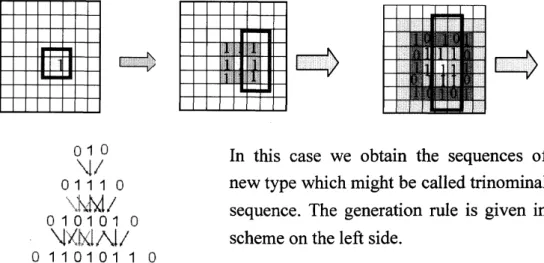
(5)$The$Mooredynamical system.
The last exampleleadsto the binomial sequences of the dynamical system ofthe Moore neighborhood.
$\oplus$
$01\zeta\}\backslash |f$ In this
case
we obtain the sequences of0111 0
new
type whichmight be called trinominal$\searrow_{;}\mathscr{A}1$
sequence. The generation rule is given in
0101010
$\zeta)11^{\dot{\gamma}_{\backslash _{q}}’}0101\backslash \triangleleft\backslash \ovalbox{\tt\small REJECT}|A|\sqrt 10$ scheme
on
the left side.Figure 16. Tkinomial sequence ofMooredynamical system
Remark 6.
The trinomial sequence appears in the time evolution of the dynamical system of Wolffam
#150
dynamical system. This is communicated by Dr. Kawaharaguchi(Hokkaido University) privately. We will hunt the sequences in the table of Wolffam
dynamical systems and make thecollections inmoredetails.
7. SEQUENCE ANALYSIS ON ITERATION DYNAMICAL SYSTEMS OF
DISCRETELAPLACIANS
Inthis section
we
suggesta
new
method forthe analysis of dynamical systems byuse
of binomial andtrinomial sequences. We introduceaconcept of“sequence analysis”of thedynamical systems choosing
sequences
appearing in the dynamical systems. Herewe
propose severalproblems conceming sequenceanalysis. Comparison problem.
We consider thecomparisonoftwo dynamical systems. One ofthe interestingquestions
is
for instance, whether the dynamical systemsare
equivalent. For example,we
can
askthe following: Choosing
some
sequences of the both systems andcomparing
them,can
we
derive the equivalence of the systems? Herewe compare
the Wolfram dynamicalsystemwith the Neumann system. We noticethe followingtheorem duetoX. Li([8]):
Theorem (Comparison Theorem [8]).
The
access
speeds to the fixed points of Neumann dynamical system is identical with thatofWolffamdynamical system.This theorem
can
be treated byuse
of the comparison of both associated binomialsequences.
Ina
similar mamer,we may
expect toprove a
similar theorem betweenNeumann dynamical system and diagonal Neumann dynamical system. Wemay expect
toprove thefollowing
assertion:
ASSERTION.The fixed pointtheorem holds for the Neumam neighborhood, ifand only it holds for the diagonalNeumannneighborhood.
Strategy to the proof of the assertion:.
The resultmayfollow ffom the fact that the
access
speeds tothe fixedpoints of the bothLaplacians of diagonal Neumann neighborhoods and Neumalm neighborhood
are
identical after rotationbythe angle $\pi/4$
.
Generation problem.
We have obtained only three kinds of sequences, the Pascal sequence, the Wolffam
sequence and the trinomial sequence. Can
we
find other sequences formore
complicated neighborhoods, for example Hexagonal neighborhoods? In generalwe
mayproposethe following problem: PROBLEM.
Can
we
characterize the dynamical system in terms ofthesequences
associated to the dynamical systems?REFERENCES
[1] Y. Aiba, K. Maegaito, and O.Suzuki. Iteration dynamical systems of discrete Laplacian on
the plane lattice (I)(Basic properties andcomputersimulations). In K. G\"urlebeck and C. K\"onke
(Eds.), Proceedings of IKM 2006, 17th Intemational Conference on the Applications of
Computer Science and Mathematics in Architecture and Civil Engineering, 12-14 July 2006, Bauhaus-University Weimar(ProceedingsCD-ROM(ISSN 1611-4085)).
[2] M.Aiba,K. Maegaito, O. Suzuki. Evolution model described by iterationdynamical
system ofdiscrete Laplacian
on
the plane lattice, Reporton
Mathematical Sciences of Kyoto University, vol. 1499, (2006), 179-184[3] O. Suzuki, K. Kosaka. Iteration dynamical system of discrete Laplacian and the
evolution of extinct animals, Proc. ISAAC Cong. (Catania), World Scientific, 2005,
967-976
[4] Y. Makino, C. Hadlich, K. Guerlebeck, A. Kimura, and O. Suzuki. Iteration dynamical systemsofdiscrete Laplacians
on
the plane lattice (Itsmathematical structure and computer simulations of designs): Report on Mathematical Sciences of KyotoUniversity, vol.1552,(2007),107-116
[5] C. Hadlich. Eine Anwendung finiter Differenzenoperatoren auf die Theorie
dynamischerSysteme, Diplomarbeit,Bauhaus-UniversitatWeimar2007
[6] J.J. Sepkoski Jr.: A factor analytic description ofPhanerozic marine fossil record,
Paleobiology 7, 36-53 (1981)
[7] O. Suzuki: Recent developments
on
the iteration dynamical systems of discreteLaplacians, 18th Intemational Conference
on
the Application of ComputerScienceandMathematics in Architecmre and Civil Engineering, K. G\"urlebeckand C. K\"onke (eds.),
Weimar, Germany, 07-09July 2009, (ProceedingsCD-ROM (ISSN 1611-4085)).
[8] X.Li: Erzeugung zweidimensionaler Zellul\"arer Automaten durch diskrete