JAIST Repository
https://dspace.jaist.ac.jp/
Title
Synthesis of well-defined hyperbranched polymers bio-based on multifunctional phenolic acids and their structure-thermal property relationships Author(s) Wang, Siqian; Tateyama, Seiji; Kaneko, Daisaku;
Ohki, Shin-ya; Kaneko, Tatsuo
Citation Polymer Degradation and Stability, 96(12): 2048-2054
Issue Date 2011
Type Journal Article
Text version author
URL http://hdl.handle.net/10119/10739
Rights
NOTICE: This is the author's version of a work accepted for publication by Elsevier. Siqian Wang, Seiji Tateyama, Daisaku Kaneko, Shin-ya Ohki, Tatsuo Kaneko, Polymer Degradation and Stability, 96(12), 2011, 2048-2054,
http://dx.doi.org/10.1016/j.polymdegradstab.2011. 10.003
Synthesis of well-defined hyperbranched polymers bio-based on
multifunctional phenolic acids and their structure-thermal property
relationships
Siqian Wang, Seiji Tateyama, Daisaku Kaneko, Shin-ya Ohki, Tatsuo Kaneko*
School of Materials Science, Japan Advanced Institute of Science and Technology, 1-1Asahidai, Nomi, Ishikawa 923-1292, Japan
Additional Supporting Information may be found in the online version of this article. Correspondence to: T. Kaneko (E-mail: [email protected])
Abstract
A number of multifunctional ABx-type monomers exist in plant metabolites, and studies on the formation of hyperbranching polymers from ABx-type monomers are very significant in the development of bio-related polymeric materials. We established a method for the preparation of well-defined structures in bio-based, hyperbranched (HB) polyarylates by the copolycondensation of caffeic acid (DHCA) as an AB2-monomer and p-coumaric acid (4HCA) as an AB-monomer, using the
highly efficient catalyst Na2HPO4 to regulate the polymerization speed. 1H NMR
analysis revealed the time course of the formation of the hyperbranching structures. which strongly affected the glass transition and degradation temperatures, as well as the molecular weight and composition.
Keywords
Hyperbranched polymers, Bio-based polymers, Biomimetics, Polyarylates, NMR analyses.
1. Introduction
The importance of dendrimers and hyperbranched (HB) polymers has continuously drawn the attention of researchers during the last two decades due to their globular shape resulting from the branched backbone topology and their unique properties [1-6]. Although HB polymers have incomplete branched structures, they can be synthesized cost-efficiently and possess desirable properties similar to dendrimers. These attractive features have led to the development of novel synthetic routes for these polymers in this field [7, 8]. Most HB polymers are prepared by the polycondensation of ABx-type monomers, such as AB2[9, 10], AB3[11–13], AB4 [14, 15] and AB6[15] monomers, where the ABx units play a role in the branching points.
However, most of these ABx-monomers are prepared via several steps, which preclude the rapid production of HB polymers on a large scale for industrial applications. Although many research groupshave devoted themselves to developing facile, versatile, and cost-effective routes to synthesize HB polymers [16-26], only limited families of HB polymers have been prepared through the aforementioned methods.
On the other hand, there exist many ABx-type multifunctional biochemicals such as glutamic acid, lysine, uronic acids, etc. We have focused on caffeic acid (3,4-dihydroxycinnamic acid; DHCA), which is an AB2-type biomonomer with a
polymerizable dihydroxyl-acid group. DHCA exists in most plants, belongs to the family of aromatic phytochemicals containing a p-coumaryl group, and is reported to
be biodegraded by microbial action [27]. From DHCA and p-coumaric acid (4-hydroxycinnamic acid; 4HCA), we have prepared high-performance functional bio-based polymers exhibiting good degradability and excellent thermomechanical performance [28-31]. However the effects of the branching structure on the thermal properties of these polymers have not been clarified yet, since the polymers showed too poor solubility to analyze their structure by spectroscopy.
Here, we developed a facile polymerization method using an appropriate catalyst that easily controls the reaction speed to prepare bio-based polyarylates, poly(DHCA-co-4HCA)s, with a well-defined structure. We then investigated their hyperbranching process and structure-thermal properties relationships in detail.
2. Experimental Section
The copolycondensation of 4HCA and DHCA was performed by in-bulk polymerization at an elevated temperature under a light-shield. The branching structures were analyzed by gel permeation chromatography (GPC) and 1H nuclear magnetic resonance (1H NMR), and the thermal properties were analyzed by differential scanning calorimetry (DSC) and thermogravimetry (TGA). The details are shown in Supporting Information I.
3. Results and discussion
3.1 Synthesis
Aromatic HB polyesters, poly(4HCA-co-DHCA)s, were prepared based on the acidolysis polymerization of DHCA as the AB2 monomer and 4HCA as the AB
monomer using various alkaline catalysts (Scheme 1). First, we used a conventional catalyst such as CH3COONa for the preparation of the poly(4HCA-co-DHCA)s,
which showed multimodal GPC peaks indicative of a heterogeneous structure, presumably due to difficulty in controlling the side reactions. Next, we tried to find suitable catalysts for the production of copolyesters with well-defined structures, such as Na2HPO4, NaH2PO4, KH2PO4 and (CH3COO)2Zn. NaH2PO4, KH2PO4, and
(CH3COO)2Zn only yielded oligomers with molecular weights of Mw=9.9 x 10³, Mw
=8.2 x 10³, and Mw=3.5 x 10³, respectively, after 4 hours of polymerization at 200 oC.
However, Na2HPO4 efficiently catalyzed those reactions generating polymers with a Mw of 6.1 x 10⁴ and monomodal GPC peaks with a very narrow molecular weight
distribution, which increased gradually with reaction time. As a result, it was concluded that Na2HPO4 was the most efficient catalyst for the polymerization of
DHCA and 4HCA of the catalysts examined here. The good catalytic performance of Na2HPO4 can be attributed to its suitable alkalinity [32]. Using Na2HPO4 as a catalyst,
a series of copolymers with in-feed compositions of DHCA (CDHCA) of 75, 67, 60, 50,
40, and 25 were prepared (Table 1). The Mn values were in a narrow range of
a result, the molecular weight distribution (Mw/Mn) for CDHCA of 25 and 75 mol%
were more than 5, and were higher than the other copolymers with medium CDHCA
compositions of 67, 60, 50, and 40. Although a large number of DHCA units can raise the amount of AB2 branching points to increase the Mw/Mn value, a large number of
4HCA units can form very rigid continuous segments of 4HCA to make the GPC peak broad.
3.2 Hyperbranching-process
In order to investigate the process of HB structure formation in the copolymer poly(4HCA-co-DHCA), GPC was used to monitor the polymerization process, permitting the evolution of molecular weight and branch architecture to be conveniently characterized that provide information with respect to the mechanistic hypothesis [33]. Fig. 1 shows changes in the GPC chromatogram as a function of the polymerization time. Two minor peaks appeared together with a main peak (Mw
=10300 and Mw/Mn =1.2) in the chromatogram of oligomeric samples prepared for 2
hrs. After 4 hours, these two minor peaks disappeared, and only a monomodal peak with a symmetrical distribution (Mw =61000 and Mw/Mn=2.8) was detected. The
monomodal peak became broader and shifted to a shorter retention time, meaning an increase in the molecular weight. After 8 hrs of polymerization, a very high molecular weight peak (more than 10 x 106; marked by the star) appeared, and increased its size with an increase in polymerization time from 8 to 16 hrs. In addition, the Mw/Mn
increased slightly, which could be attributed to an increase in the branching degree (BD). Based on this consideration, the appearance of multimodal GPC peaks suggests
the presence of different components with different branching forms in the HB polymers [34].
The structures of these HB copolyesters were characterized by 1H NMR (Fig. 2a). In particular, the COSY spectra showed sufficient resolution to assign these protons
(Fig. S1; see for further discussion in Supplementary Information II). Detailed
analyses using NMR spectroscopy were made to elucidate the precise structure and to quantify the BD of these copolymers. Since the number of acetyl groups equals the DHCA unit number plus one, it should be regarded as almost the same value as the number of DHCA units at a high polymerization degree. Therefore, it was hypothesized that the DHCA molar fraction, fDHCA, to all units in
poly(DHCA-co-4HCA) was almost the same as the content of acetyl groups estimated from the integral ratio of the proton signals from the acetyl groups to those of the aromatic rings. Fig. 3 is a representative plot of the fDHCA change as a function of the
polymerization time in poly(DHCA-co-4HCA)s with an in-feed CDHCA of 60 mol%. It
can be seen that fDHCA was not constant during the polymerization; the fDHCA
decreased from 0.96 to 0.55 mol/mol, and the fDHCA at 6 hrs of polymerization was
almost the same as the CDHCA. During the early stages of polymerization, the fDHCA
was much higher than the CDHCA, supporting the higher reactivity of DHCA with two
hydroxyls than 4HCA with only one hydroxyl groups. However, after 6 hours, the fDHCA was lower than 0.6 mol/mol. The resulting fDHCA was lower than the fDHCA in the
feed CDHCA, which may be attributed to DHCA inactivation by oxidation over the long
copolymers with different CDHCA values (Figs. S3c and S4c).
The BD is one of the most important molecular parameters of HB polymers, because the BD characterizes the difference in the molecular structure from the linear analogs. NMR is a powerful tool for determining the BD value [35] for the purpose of studying the dynamic changes over the course of the HB polymerization. In order to investigate the process of HB polymer chain formation, we focused on a variety of acetyl groups in DHCA. If only one acetyl group of the diacetylated DHCA reacted, then a branching point would be not formed, and the residual acetyl groups became side chain acetyls. In this case, there are two side chain acetyls (m- and p-), as shown in Illustrations SDHCA of Fig. 2b. Furthermore, one can confirm two acetyl end groups
in DHCA (Illustration EDHCA in Fig. 2b) and one end group in 4HCA (Illustration
E4HCA in Fig. 2b). In total, five acetyl signals should be detected in the 1H NMR of the
copolymers. Fig. 2b shows a close-up view of the 1H NMR spectrum over the chemical shift range of 2.35-2.55 ppm, focusing on the acetyl groups of poly(DHCA-co-4HCA) with a CDHCA of 60 %, where one peak with various shoulders
appeared. One can clearly separate the peak into five components, which were assigned to the above-mentioned five acetyl groups of poly(DHCA-co-4HCA). The end acetyl of 4HCA could be easily recognized by referring to the assignment of the DHCA homopolymers (only 4 acetyls; Fig. S2a). The DHCA related-acetyls could be assigned using the proton signals of the acetylated monomer as shown in Fig. 2b. In addition, the 1H 1H-NOESY spectrum of the polyDHCA homopolymer focusing on the correlation between the acetyl groups and the aromatic and double bonds
increased the reliability of this assignment; two signals marked by SDHCA were
multiply-correlated with those of the aromatic and double bonds, and were assigned to the side acetyl groups, whereas two signals marked by EDHCA showed little correlation
and thus were assigned to end acetyl groups (Fig. S2b). The signal marked by E4HCA
was detected in the 1HNMR spectra of the copolymers, poly(DHCA-co-4HCA)s, and then this signal should be assigned to the end acetyl groups of 4HCA. Based on the assignment, the integral ratios of the end acetyls to the total acetyls, E/(S+E), were calculated, where S refers to the integral signal intensity of the side acetyls and E refers to the integral signal intensity of the end acetyls. Fig. 4a is a representative plot of E/(S+E) in a copolymer with a CDHCA of 60 mol%. During the initial 10 hrs of
polymerization, the E/(S+E) decreased with reaction time from 0.40 at 2 hours to 0.13 at 10 hours, and the ratio decreased most dramatically during the initial 4 hours. The end chain ratio decrease implies a decrease in the BD. On the other hand, with a further increase in the reaction time from 10 to 14 hrs, the E/(S+E) increased slightly and then almost kept constant. Actually, the E/(S+E) value was governed only by the DHCA units, because the BD was defined here as the branching unit molar ratios to all monomer units, and was simply calculated using equation [36],
BD = E / (S+E)·fDHCA
Fig. 4b shows the effect of the reaction time on the BD of poly(DHCA-co-4HCA)
with a CDHCA of 60 mol%. The BD decreased with the reaction time from 2 to 10 hrs,
high at 0.39 because the DHCA, which has a higher reactivity than 4HCA, was consumed preferentially at the beginning of polymerization to create small hyperbranching oligomers (from A to B in Fig. 5). However, the BD declined drastically from 0.39 at 2 hrs to 0.15 at 4 hrs. Further branching of the small oligomers may have been difficult due to steric hindrance, and thus main chain propagation was favored, causing the rapid BD decline. The degree of decline decreased as the reaction time increased from 4 to 10 hrs, and then became almost constant at 0.07-0.09 up to 14 hrs, because further polymerization elongated the main chain while the branching reactions occurred occasionally due to reduced steric hindrance (from B to D in Fig. 5). After 14 hrs, the BD increased again to make the chain ends highly dense, presumably due to the HB reaction caused by a monomer or polymer chain reaction with the residual acetyl groups to create large polymers with Mw values more than 107 (from D to E in Fig. 5).
It should be noted that the branching degree of the copolymer was not high, even at the last stage of polymerization, which may be attributed to the following reasons. One of two hydroxyls of DHCA reacted with carboxylic acid as efficiently as the hydroxyl of 4HCA, to create the polycoumarate backbone. However the reactivity of another hydroxyl of DHCA might be remarkably reduced by steric hindrance of the already-formed backbone.
3.3. Thermal properties
copolymers showed fairly heat-processable (Fig. 5(b)). Thermal behavior such as the glass transition and thermal degradation are key factors for the utilization of these polymers in industrial applications.
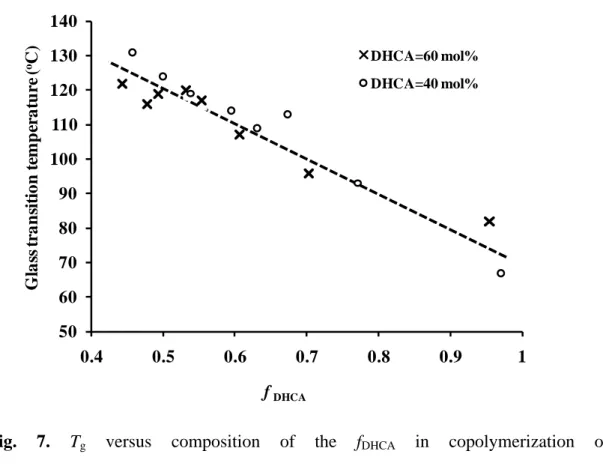
Theoretically, the glass transition temperature should decrease upon increasing the free volume fraction in polymeric materials [37]. The free volume is larger in a polymer with a higher chain-end composition to the entire chain. Therefore, the Tg
value is strongly dependent on the molecular weight and the flexibility of the polymer chains. The relationship between the Tg vs reaction time and the Tg vs fDHCA in
poly(DHCA-co-4HCA)s with CDHCA values of 40 and 60 mol% are summarized in
Fig. 6 and Fig. 7, respectively. Fig. 6 shows that the Tg increased with a decrease in
the reaction time to 8 h, became almost constant from 8 h to 12 h, but then unexpectedly increased again at over 12 h. As seen from Fig. 1. the Mw increased with
increasing reaction time, although the GPC peaks were multimodal and contributed strongly to the increased Tg. When the Mw values were very high at polymerization
times over 8 h, the effects of further Mw increases on the decrease in the chain end
composition were trivial, and thus the Tg became almost constant. However, the
further Tg increase with the reaction times over 12 h could not be explained simply by
an increase of Mw. The value of the fDHCA decreased throughout the entire
polymerization reaction as shown in Fig. 3, which contributed to the increase in the Tg
in both copolymer systems with in feed CDHCA of 40 mol% and 60 mol% (Fig. 7),
because of the reduced flexibility in the copolymer with an increased 4HCA composition. Therefore, it was difficult to postulate that the fDHCA had any effect on
the Tg increase at only over 12 h. On the other hand, Fig. 4b shows that the BD was
almost constant over the polymerization time range from 6 h to 10 h, but increased again at over 12 h (also seen in Fig. S3b and Fig. S4b), which was in agreement with the polymerization time for further Tg increases. Although the BD decrease at the
beginning of polymerization may also be effective in causing the Tg to change, it
could be considered to have a much smaller effect than the Mw increase on the Tg
because the free volume of such a short polymer chains over this polymerization time was strongly affected by the Mw change. Consequently, the further Tg increase in the
polymerization range over 12 h was mainly due to the BD increase, presumably caused by the increased density of polymer chain ends restricting molecular mobility to decrease the contribution of the polymer chain ends to the free volume. It had been attempted to investigate the Tg property of poly4HCA for further disclosing of the
relationship between hompolymer and copolymer, but no Tg was observed in
poly4HCA probably due to highly crystallinity in the hompolymer.
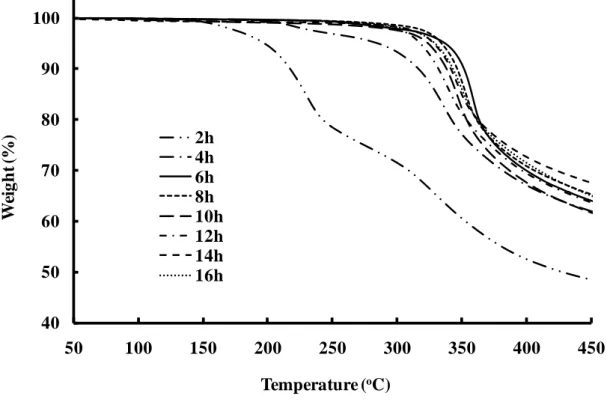
The thermal stability of poly(DHCA-co-4HCA)s was also estimated from the weight loss change upon increasing the temperature by thermogravimetry. A thermogravimetric curve of poly(DHCA-co-4HCA) with a CDHCA of 60 mol% is
shown in Fig. 8. The results for the 10 % weight loss temperature, T10, versus the
polymerization time are summarized in Fig. 9. From 2 h to 4 h, the polymer showed poor stability, probably due to the low molecular weight. However, the thermal stability increased significantly from a T 10 of 218 oC at 2 h to a T 10 of 353 oC at 6 h,
10 of 353 oC at 6 h to 331 oC at 12 h, and then the highest thermal stability was shown
in the polymer incubated for 6 h. The T10 decrease might be due to a decrease in the fDHCA because the homopolymer polyDHCA showed a higher degradation temperature
than the poly4HCA [30]. However, a higher thermal stability at 16 h (a T10 of 343 o
C) than at 12 h (a T10 of 331 oC) was obviously observed from Fig. 9, which could be
mainly attributed to a very high BD leading to an increased inter-branch force and thermal-decomposition temperature. A similar phenomenon in thermal stability can also be found in the polymerization of poly(DHCA-co-4HCA) with a CDHCA of 40
mol% and a CDHCA of 50 mol% (Fig. S5 and Fig. S6).
Furthermore, thermal stability of poly(DHCA-co-4HCA) was compared with non-branched homopolymer poly4HCA, which showed a lower degradation temperature, T 10 of 280 oC than those of poly(DHCA-co-4HCA)s with BD of around
0.1 prepared by polymerization for more than 6 h. Although BDs in copolymers were not high, T10 values were much higher than that of non-branching homopolymer,
which suggests that appropriate branching in poly(DHCA-co-4HCA)s played important role in increasing thermal decomposition.
3.4. Solubility
The solubility of the poly(DHCA-co-4HCA) with different CDHCA values in DMF
was evaluated (Table 2). The 4HCA homo-polymer poly4HCA is insoluble in DMF, whereas polyDHCA dissolved in DMF. The solubility of the copolymers increased with increasing CDHCA. In the poly(DHCA-co-4HCA)s with CDHCA values from 25 to
whereas the ones prepared for the longer polymerization times were insoluble. Overly-dense branching chains might restrict the chain mobility and solubilization of the polymer chains. The poly(DHCA-co-4HCA)s with CDHCA values of 60, 67, and 75,
as well as polyDHCA can be completely dissolved in DMF, even if the polymerization time was very long, thus resulting in a very high molecular weight.
4. Conclusion
We described a facile method for the one-pot synthesis of well-defined biodegradable hyperbranched polyesters, poly(DHCA-co-4HCA)s, in the presence of Na2HPO4 as an effectivecatalyst, from bio-available monomers of caffeic acid as a
multifunctional AB2 unit and p-coumaric acid as an ordinal AB unit. The polymer
structures such as the copolymer composition and branching degree were investigated by 1H NMR spectroscopy. Three stages of the hyperbranching process are proposed; in the first stage, DHCA-rich oligomers with short branches and a high branching degree were formed. During the second stage, the main chain was preferentially propagated, accompanied by a slow decrease in the BD. In the third stage, a preferential branching reaction was caused by monomer reactions with the side acetyl groups of the polymers. This hyperbranching strongly affected the glass transition temperature and degradation temperature of the polymers. The glass transition temperature increased with an increasing in the molecular weight, and saturated at a threshold polymerization time, but then increased again following further polymerization for over 12 h. The degradation temperature also showed an
unexpected increase at over 12 h. Further polymerization for over 12 h induced an increase in the BD, thus increasing the density of the polymer chain ends, which restricted the molecular mobility of the chain ends. As a result, the extremely high density of polymer chain ends enhanced their thermal stability. The results obtained here can lead to new applications in various fields such as biomedical and environmental materials with biodegradable properties.
Supporting Information Available
Experimental section, Structural characterizations of copolyesters, Additional datasets of DB, S/(S+E), Additional TGA curves and thermal degradation figures.
Acknowledgements
This research was financially supported from a Grant-in-Aid for Comprehensive Support Programs for Creation of Regional Innovation Science and Technology Incubation Program in Advanced Regions “Practical Application Research” (Kaneko project).
References and notes
[1] Tomalia DT, Fréchet JMJ. J Polym Sci Part A: Polym Chem 2002; 40: 2719. [2] Jikei M, Kakimoto M. Prog Polym Sci 2001; 26: 1233.
[5] Gao C, Yan D. Prog Polym Sci 2004; 29: 183. [6] Yates CR, Hayes W. Eur Polym J 2004; 40: 1257.
[7] (a) Newkome GR, Moorefield CN, Vögtle F. Dendritic Molecules; VCH: Weinheim, Germany, 1996. (b) Vögtle F, Gestermann S, Hesse R, Schwierz H, Windisch, B. Prog Polym Sci 2000; 25: 987.
[8] (a) Kim Y H. J Polym Sci Polym Chem 1998; 36: 1685; (b) Inoue K, Prog Polym Sci 2000; 25: 453; (c) Jikei M, Kakimoto M, Prog Polym Sci 2001; 26: 1233. (d) Gao C, Yan D, Prog Polym Sci 2004; 29: 183. (e) Voit B, J Polym Sci Polym Chem 2005; 43: 2679.
[9] Khalyavina A, Schallausky F, Komber H, Samman MA, Radke W, Lederer A. Macromolecules 2010; 43: 3268.
[10] Kim YH, Webster OW. J Am Chem Soc 1990; 112: 4592.
[11] Lach C, Müller P, Frey H, Mülhaupt R. Macromol Rapid Commun 1997; 18: 25.
[12] Mathias LJ, Carothers TW. J Am Chem Soc 1991; 113: 4043.
[13] Yoon K, Son D Y. Macromolecules 1999; 32: 5210.
[14] Malmström E, Trollsås M, Hawker CJ, Johansson M. Polym Mater Sci Eng 1997; 77: 151.
[15] Miravet JF, Fréchet JMJ. Macromolecules 1998; 31: 3461.
[16] Jikei M, Chon SH, Kakimoto M, Kawauchi S, Imase T, Watanebe J. Macromolecules 1999; 32: 2061. (b) Hao J, Jikei M, Kakimoto M. Macromolecules 2002; 35:5372.
[17] Fang J, Kita H, Okamoto, K. Macromolecules 2000; 33: 4639.
[18] (a) Lin Q, Unal S, Fornof A, Yilgor RI, Long TE. Macromol Chem Phys 2006; 207: 576. (b) Fornof A. R, Glass TE, Long T E. Macromol Chem Phys 2006; 207: 1197.
[20] Xu K. J Economy Macromol 2004; 37: 4146.
[21] Scheel A, Komber H, Voit B. Macromol Symp 2004; 210: 101.
[22] Smet M, Fu Y, Zhang X, Schacht EH, Dehaen W. Macromol Rapid Commun 2005; 26: 1458. [23] Kudo H, Maruyama K, Shindo S, Nishikubo T, Nishimura I. J Polym Sci Part A: Polym
Chem 2006; 44: 3640.
[24] (a) Yan DY, Gao C. Macromolecules 2000; 33: 7693. (b) Gao C, Yan D Y. Macromolecules 2001; 34: 156. (c) Gao C, Yan DY, Tang W. Macromol Chem Phys 2001; 202: 3035. (d) Gao C, Tang W, Yan DY, Zhu P F, Tao P. Polymer 2001; 42: 3437. (e) Gao C, Yan DY, Zhu X, Huang W. Polymer 2001; 42: 7603.
[25] Liu Y, Chung TS, J Polym Sci Polym Chem 2002; 40: 4563.
[26] Benthem RATM, Meijerink G NE, Koster G, Muscat CD, Froehling PE, Hendriks PHM, Vermeulen CJAA, Zwartkruis TJG. Macromolecules 2001; 34: 3559.
[27] Cain RB, Bilton RF, Darrah JA. J Biochem 1968; 108: 797.
[28] Kaneko T, Matsusaki MT, Hang M, Akashi M. Macromol Rapid Commun 2004; 25: 673 [29] Kaneko T, Tran HT, Matsusaki M. Akashi M. Chem Mater 2006; 18: 6220
[30] Kaneko T, Tran HT, Matsusaki M, Shi DJ, Akashi M. Nature Mater 2006; 5: 966. [31] Kaneko D, Kinugawa S, Matsumoto K, Kaneko T. Plant Biotechnology 2010; 27:293. [32] Yu DH, Wu C, Kong Y, Xue NH, Guo X F, Ding WP. J Phys Chem C 2007; 111: 14394. [33] Florian KW, Fery H. Macromolecules 2009; 42: 9443.
[34] (a) Wang Z, He J, Tao Y, Yang L, Jiang H, Yang Y. Macromolecules 2003; 36: 7446. (b) Liu BL, Kazlauciunas A, Guthrie JT, Perrier S. Macromolecules 2005; 38: 2131.
[36] Frey H, Holter D. Acta Polym 1999; 50: 67.
Table 1 Molecular weights of poly(DHCA-co-4HCA)s with different in-feed
compositions of DHCAa
CDHCAb Mw Mn Mw/Mn Yield c
(mol%) (g/mol) (g/mol)
25 210700 32400 6.51 75 40 125900 38200 3.30 78 50 91300 21100 4.42 76 60 52000 21000 2.50 85 67 83000 27100 3.05 81 75 170900 31300 5.46 80 a
Reactions were carried out in the presence of Na2HPO4 (1 wt% to total weight of
monomers) and acetic anhydride (120 mL) at 150 oC for 2 hrs at atmosphere pressure and then at 200 oC under vacuum till the reaction mixture became solid for 6-12 hrs.
b
DHCA molar composition to the total monomers in feed.
c
Table 2
Solubility of homo-polymers and copolymers poly(DHCA-co-4HCA) with different in-feed compositions of DHCA in DMFa
CDHCA Polymerization time in feed b 2h 4h 6h 8h 10h 12h 14h 16h 0 - - - N N N N N 25 + + + ± ± ± - - 33 + + + ± ± ± ± - 40 + + + + ± ± ± - 50 + + + + + ± ± ± 60 + + + + + + + + 67 + + + + + + + + 75 + + + + + + + + 100 + + + + + + + +
a Marks “+”, “-”, “± ” means soluble, insoluble, and partly soluble, respectively. b
Solubility was checked using DMF solvent with concentration 10 mg/10 ml and CDHCA refers to the composition of DHCA.
8h 2h 4h 6h 10h 12h 14h 16h
Retention time (min)
Mw=1.0x10 4 Mw=6.0x10 4 Mw=3.0x10 6 Mw=9.0x10 7
20
15
10
5
0
Fig. 1. Changes in the GPC chromatograms as a function of the polymerization time in
a a’’ d d’’ c, c’ b, b’ a’ Acetyl groups DCM TFA Chemical shift (ppm) 0 5 10 15 2.35 2.40 2.45 2.50 2.55 E4HCA SDHCA SDHCA EDHCA EDHCA
Fig. 2. (a) 1HNMR spectrum of poly(DHCA-co-4HCA) with an in-feed monomer composition of CDHCA = 60 mol%. (b) Close-up of the 1H NMR spectrum focusing on
the acetyl groups of poly(DHCA-co-4HCA) over a chemical shift range between 2.35-2.55 ppm. The acetyl peaks were composed of two small peaks marked by DHCA end chains, EDHCA, two peaks marked by DHCA side chains, SDHCA and one
peak marked by 4HCA end chain, E4HCA, in the spectrum, above which the
corresponding structures are shown.
a
Chemical shift (ppm)
b
0 0.2 0.4 0.6 0.8 1 1.2 0 2 4 6 8 10 12 14 16 18 Reaction time (h)
f
DH CAFig. 3. Influence of the reaction time on the percentage of DHCA in
0 0.05 0.1 0.15 0.2 0.25 0.3 0.35 0.4 0.45 0 2 4 6 8 10 12 14 16 18 0 0.05 0.1 0.15 0.2 0.25 0.3 0.35 0.4 0.45 0 2 4 6 8 10 12 14 16 18 Reaction time (h) B ranc h in g de gr ee Reaction time (h
)
E/ (S + E ) a bFig. 4. (a) Influence of the reaction time on the ratio of E/(S+E) in the polymerization
reaction of poly(DHCA-co-4HCA) with a CDHCA of 60 mol%. S: side groups, E: end
groups. E/(S+E): ratio of side group to all acetyl groups. (b) Influence of the reaction time on the hyperbranching degree in the polymerization reaction of poly(DHCA-co-4HCA) with a CDHCA of 60 mol%.
(a) (b)
D A
B C
E
Chain ends (acetyl groups)
Fig. 5. (a) Proposed scheme for the hyperbranching process for the copolymerization
of DHCA with 4HCA. (b) Inset: photo of processed resin p(DHCA-co-4HCA) copolymer.
50 60 70 80 90 100 110 120 130 140 0 2 4 6 8 10 12 14 16 18 DHCA=40 mol% DHCA=60 mol% Reaction time (h) G las s t rans it io n t em p er at ur e ( oC)
Fig. 6. Tg versus different polymerization time in poly(DHCA-co-4HCA) with
an in-feed monomer composition of CDHCA= 60 mol % and an in-feed monomer
50 60 70 80 90 100 110 120 130 140 0.4 0.5 0.6 0.7 0.8 0.9 1 DHCA=60 mol% DHCA=40 mol% f DHCA G la ss tra n si ti o n tem p era tu re ( oC)
Fig. 7. Tg versus composition of the fDHCA in copolymerization of
poly(DHCA-co-4HCA) with an in-feed monomer composition of CDHCA= 60 mol %
40 50 60 70 80 90 100 50 100 150 200 250 300 350 400 450 2h 4h 6h 8h 10h 12h 14h 16h Temperature (oC) We ig h t ( % )
Fig. 8. TGA curve of poly(DHCA-co-4HCA) with an in-feed monomer composition
150 175 200 225 250 275 300 325 350 375 400 0 2 4 6 8 10 12 14 16 18 Reaction time (h) D eco m p o si tio n t em p era tu re ( o C)
Fig. 9. T10 versus copolymerization reaction time of poly(DHCA-co-4HCA) with an