
Emotional Lighting Design of Indoor Spaces by Kansei Engineering
4
0
0
全文
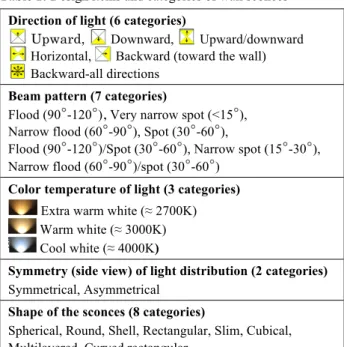
(2) 2. METHODOLOGY. words (KWs) used for the elevation of the lit lamp were determined through a procedure according to Nagamachi [3] with the initial set of words collected from customer reviews related to wall sconces. Cluster analysis was applied based on the data collected from a special questionnaire for evaluating the most appropriate KW for the expression of a space illuminated with wall sconces on a 5-point SD scale and mid-level of 26 KWs. 8 KWs were selected to create the emotional SD scale for the lit sconce: Relaxing, Attractive, Harmonious, Warm, Natural, Pleasant, Opens the space, Romantic.. A product is conventionally described by its size, color, shape, weight, and quality. An emitted light pattern has all those characteristics without the weight. It has its own size: the lit surface area; color: the color temperature of light; shape: the shape created by different directions of light and the beam angle; structure, created by the composition of light and shadow; and quality, which depends on how well it serves its purpose. 2.1 Procedure A total of 24 Greek people (9 females and 15 males), 23 to 32 years old, with normal vision and color acuity participated in the survey. All had wall sconces in their homes. The assumption that the evaluators will develop a good imagination of the light pattern emitted from wall sconces when shown an image was supported by the following: (a) the participants have seen many wall sconces because this type of wall lighting is very common in the Greek home lighting culture and (b) large online sales for this type of product show that people trust the mental images of their space lit by a specific lamp that they create based on its online image. 2.2 Product space To better define the space of properties for the Kansei analysis, the product domain was narrowed to the light patterns emitted from wall sconces displayed on typical online retailing sites with the following characteristics: Application: indoor; Type of bulb: LED; External and internal color: white; Material: plaster; Style: minimalistic; Size: small-to-medium; Non-movable; Architectural type. Images of 60 switched-on wall lamps that are sold online were analyzed and classified based on dissimilarities in their emitted light patterns by the use of the affinity diagram method. In analyzing many light patterns emitted from wall sconces, the main items and categories were extracted. The final set of 16 wall sconces used for the evaluation is shown in Figure 1. They represent 5 design items and 26 design categories shown in Table 1.. 1. 2. 3. 4. 5. 6. 7. 8. 9. 10. 11. 12. 13. 14. 15. 16. Figure 1. The 16 wall sconces selected for the study Table 1: Design items and categories of wall sconces Direction of light (6 categories) Upward, Upward/downward Downward, Horizontal, Backward (toward the wall) Backward-all directions Beam pattern (7 categories) Flood (90°-120°), Very narrow spot (<15°), Narrow flood (60°-90°), Spot (30°-60°), Flood (90°-120°)/Spot (30°-60°), Narrow spot (15°-30°), Narrow flood (60°-90°)/spot (30°-60°) Color temperature of light (3 categories) Extra warm white (≈ 2700K) Warm white (≈ 3000K) Cool white (≈ 4000K). 2.3 Semantic space The appeal of any lamp, when switched on in the dark, is very different from its impression when switched off in daylight. Therefore, two evaluations need to be performed for each lamp for these two appearances separately because the same semantic differential scale (SD scale) cannot be applied. In this context, the Kansei. Symmetry (side view) of light distribution (2 categories) Symmetrical, Asymmetrical Shape of the sconces (8 categories) Spherical, Round, Shell, Rectangular, Slim, Cubical, Multilayered, Curved rectangular. Next, a different emotional SD scale was created for the. 2.
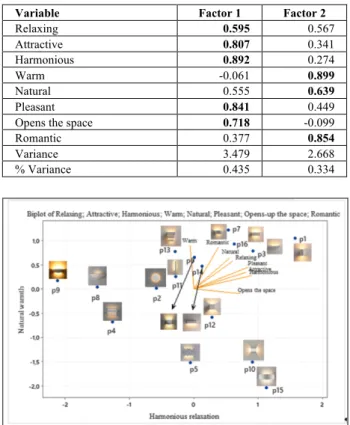
(3) evaluation of non-lit wall sconces by the use of 4 adjectives: simple, invisible, practical, and pleasant. The KWs for this second scale were “must-have” emotional expressions of non-lit sconces and were used to identify which products express such needed emotional appeal in daylight, according to the evaluators. The experiment was based on an online-distributed questionnaire that included: (a) a short description of the survey and the guidelines, requesting participants to perform the evaluation in the evening at a dark room and with full screen; (b) demographic information; and (c) the evaluation part. The evaluation part consisted of a plain page that set the scene for a follow-up page with the lit sconce. This plain page was in full size and had the color number of the background (the wall) extracted by the use of color analysis of the follow-up image of the lit sconce (12cmx12cm). The evaluator was asked to count up to 15 while observing the plain page, before continuing to the next page and to see the image with the lit sconce on the same background. In this way, the effect of a switched-on luminary on the previously observed plain wall (page) with some background was intended as well as to erase their main image from the previous sample. Participants were then asked to rate the lit luminary on a 5-point SD scale with the 8 KWs for lit sconces. Then the evaluator was asked to imagine the sconce switched off and to rate his/her impression on a 5-point SD scale with the 4 KWs for non-lit sconces. Factor analysis was performed by the use of the average values of the Kansei ratings. The results were analyzed by the use of Minitab.. 3.1 Factor analysis of the lit wall sconces Component loadings showed that the X-axis has the semantics of “relaxing”, “attractive”, “harmonious”, “pleasant” and “opens the space” and this was named “Harmonious relaxation”, while the Y-axis has the “warm”, “romantic” and “natural” and this was named “Natural warmth” (Table 2). The positions of the 16 lit wall sconces with different light patterns are shown on the Kansei map (Figure 2). The experiment showed that the emotional appeal of different light patterns emitted by the particular set of wall sconces can be distinguished and evaluated on the selected SD scale according to people’s visual perceptions. For example, P1, classified close to the “attractive” and “pleasant” vectors, has an asymmetrical and upward/downward direction of light, flood 90°-120°, a warm white color temperature of light, and a semicircular shape. Close to the “romantic” vector is P7 which has an asymmetrical, upward/downward direction of light, flood 90°-120°/spot (30°/60°), a warm white color temperature of light, and a soft round shape. Table 2: Rotated Factor Loadings of lit sconces Variable Relaxing Attractive Harmonious Warm Natural Pleasant Opens the space Romantic Variance % Variance. Factor 1 0.595 0.807 0.892 -0.061 0.555 0.841 0.718 0.377 3.479 0.435. Factor 2 0.567 0.341 0.274 0.899 0.639 0.449 -0.099 0.854 2.668 0.334. 3. RESULTS The internal consistency of the scales used in the survey for lit and non-lit sconces was acceptable, with Cronbach’s alpha values of 0.894 and 0.890, respectively. The results from one-way ANOVA with Tukey Post-hoc indicated a statistically significant difference in the emotional responses toward the KWs for the evaluation of the lit sconces: values of F(7,120)= 3.76; p=0.001; mean differences from 0.612 for “romantic-pleasant” to 0.015 for “pleasant-attractive” and the smallest mean difference of 0.008 for “opens the space-warm”. The same analysis for the KWs for the evaluation of the non-lit sconces revealed the following results: values of F(3,60)= 4.38; p=0.007 and mean differences from 0.054 for the pair “practical-invisible” to 0.621 for “simple-pleasant”, indicating a statistically significant difference of the KWs for the evaluation of the non-lit sconces.. Figure 2: Kansei map of factor loadings of the lit sconces. The product classified close to the “natural” vector was P16 which has an asymmetrical, upward/downward direction of light, flood 90°-120°, a warm white color temperature of light, and a rectangular shape. Although. 3.
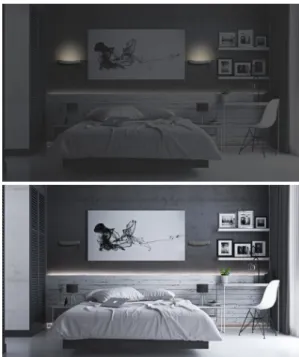
(4) P8 imitates the candlelight pattern, it was not within the positive Kansei space. Close to the “relaxing” vector was located the P3 wall sconce which has an asymmetrical upward direction of light, flood 90°-120°, daylight color temperature of light, and rectangular curved shape. The product classified close to the “warm” vector was P6 which has an asymmetrical upward/downward direction of light, flood 30°-60°, a warm white color temperature of light, and a semispherical shape. None of the emitted light patterns from the selected products were perceived to have the quality to make space feel bigger – to “open the space”. Close to the negative side of the vector “opens the space” were products P8 and P2 with a very narrow spot type lit area. The location of all products can be analyzed in detail in a similar way. Figure 3: Kansei map of factor loadings of the non-lit sconces. 3.2 Factor analysis of non-lit wall sconces Factor analysis was performed by the use of the average ratings from the emotional scales for non-lit sconces. Two factors were determined (Table 3). The first factor showed that the X-axis has the semantics of “invisible” and “simple” and was named “Invisible simplicity”. The second factor showed that Y-axis has the “practical” and “pleasant” and was named “Pleasant practicality”. Not big diversification towards “simple” was expected since the selected products do not have decorative value. The purpose was to identify the simplest non-lit sconce which, when painted with the color of the wall, will be invisible. As the Kansei map shows the non-lit P3 stands out from the other sconces on the Y-axis dimension and P16 stands out on the X-axis dimension.. Figure 4: Upper image: Relaxing lighting of bedroom according to people's perceptions. Lower image: Invisible simplicity of the sconces in daylight.. Table 3. Rotated factor loadings of non-lit sconces Variable Invisible Practical Pleasant Simple Variance % Variance. Factor 1 0.584 0.772 0.916 0.302 1.867 0.467. Factor 2 0.741 0.545 0.294 0.920 1.779 0.445. 4. CONCLUSIONS The study found that the created emotional scales were sensitive towards a set of lit and non-lit wall sconces and that people's impressions can be evaluated. These emotional preferences can be implemented in the lighting design of indoor space with intended mood in the dark and be invisible in daylight. This knowledge will be applied for further exploration of the relationship between the design elements of light patterns and the morphological elements of sconces, on one hand, and the people’s emotional perceptions, on the other.. The comparison of the location of each product on the Kansei map of the lit (Figure 2) and non-lit (Figure 3) sconces based on participant ratings can give information about which product combines the intended emotional expression in the dark and in daylight. For example, if a sconce is needed for creating a relaxing space in the dark and has to be invisible in the daylight, then P3 can be selected for the lighting of the bedroom (Figure 4).. REFERENCES [1] M. Nagamachi and M. Mohd Lokman; Innovations of Kansei Engineering; CRC Press, Boca Raton, 2010.. 4.
(5)
図
関連したドキュメント
4 because evolutionary algorithms work with a population of solutions, various optimal solutions can be obtained, or many solutions can be obtained with values close to the
An easy-to-use procedure is presented for improving the ε-constraint method for computing the efficient frontier of the portfolio selection problem endowed with additional cardinality
If condition (2) holds then no line intersects all the segments AB, BC, DE, EA (if such line exists then it also intersects the segment CD by condition (2) which is impossible due
Let X be a smooth projective variety defined over an algebraically closed field k of positive characteristic.. By our assumption the image of f contains
2 Combining the lemma 5.4 with the main theorem of [SW1], we immediately obtain the following corollary.. Corollary 5.5 Let l > 3 be
It is suggested by our method that most of the quadratic algebras for all St¨ ackel equivalence classes of 3D second order quantum superintegrable systems on conformally flat
Keywords: continuous time random walk, Brownian motion, collision time, skew Young tableaux, tandem queue.. AMS 2000 Subject Classification: Primary:
Our method of proof can also be used to recover the rational homotopy of L K(2) S 0 as well as the chromatic splitting conjecture at primes p > 3 [16]; we only need to use the
