Timed reading training:
Can it promote second language listening comprehension of Japanese learners of English?
Introduction
Numerous studies have attempted to clarify the mechanism of second language (L2) listening comprehension. This is simply because listening is an important skill in not only utilizing but also acquiring L2 and foreign languages (FL). However, little is known about the key variables contributing to promote listening performance, therefore deeper understanding of the mechanism and its application for practice is a tempting issue for language teachers. Specifically in the Japanese context, since the improvement of the reading comprehension has a priority in education and Japanese learners of English as an FL tend to relay on coding visual input, they feel difficulty in comprehending information by auditory input (Yamaguchi, 1999). In addition, although they could understand the meaning of each word when the words were pronounced one by one, they have difficulty understanding the stimuli as a whole sentence. Furthermore, even though they could catch all of the information at one time, they fail to succeed in listening tasks since the differences in syntactic relations between English and Japanese require them to complete timed parsing. Yet, it is reported that the optimal reading rates and listening rates are similar (Hirai, 1999), which suggests that the cognitive processes in reading and listening comprehension are interdependent or that they share a common route to an extent. Here we therefore, while taking the advantages of their superiorities in reading performance, address the question of whether a kind of reading training (i.e., timed reading) could contribute to better listening performance of Japanese EFL learners.
Review of Literature
The Relationship between Reading and Listening A substantial amount of theoretical and experimental evidence supports the notion of shared information processing in reading and listening (Bae & Bachman, 1998; Kintsch, 1998). As Vandergrift and Baker (2015) summarizes, reading and listening shares a lot of crucial features with reading, and they both require receptive language processing, which includes decoding and interpretation. From the theoretical point of view, de Bot, Paribakht, and Wesche (1997) described the shared route of processing written and speech input to grasp a concept in the L2 lexical comprehension and production model. Empirical data also support the shared route model. For instance, Hirai (1999) examined the relationship between the reading rate and the listening rate of Japanese college students of English, and found that the optimal reading and listening rates are similar. Most recently, Kajiura (2016) examined the influence of faster rate listening practice using compressed speech, accompanied by transcript reading, on the improvement of listening proficiency for Japanese learners of English as a foreign language, reported that it may enhance processing speed and increase access fluidity between speech and meaning, and concluded that it might be a potential method to improve the listening proficiency of Japanese EFL learners. These studies suggest that the cognitive processes in reading and listening comprehension interact with each other or that they utilize a common route to some degree.
The Difficulty of Timed Parsing in the L2 Listening Tasks
Contrary to the written language, sounds disappear
Yoshinori
OYAMA
1), Akira
NAKAYAMA
2)1) Faculty of Education, Chiba University
immediately after they are spoken. Even though, therefore, L2 learners could catch all of the oral information, they fail to succeed in listening tasks. Learners cannot return to the texts in listening tasks. Thus, an important skill the language learner uses in the listening task is the knowledge of the syntax of the target language, which is called “Serial Information Processing” skill. When the target language shares the same type of the surface structure (i.e., the word order such as subject-verb-object: SVO) as the mother tongue, as Glisan (1985) showed, the performance of the listening task in the L2 is positively affected by the transfer. However, for the learners whose first language differs in the word order from the target language, like Japanese learners of English, the differences in syntactic structure between Japanese (i.e., SOV) and English (e.g., SVO) would affect the degree of their listening comprehension in listening tasks. In listening tasks, where the learners are required to respond immediately to questions, the differences in the syntactic structures possibly contribute to a high load on their cognitive process, which in turn becomes an obstacle for low-proficiency learners. They must also accurately analyze the syntactic relations (i.e., parsing) under time constraints. Generally, advanced learners who are good at listening tasks can also read English from start to finish without having to translate the text into Japanese, and are not distracted by the word order of English. Therefore, advanced learners can understand phonetic sound information, which immediately disappears once it is orally produced. In contrast, low-proficiency learners who are poor at listening tasks are not accustomed to reading English in the SVO order; therefore, they read English while shifting their eyes back and forth. In reading tasks, learners can read the English sentences because they are allowed to reread them. However, in the listening tasks, they cannot return to the beginning. Thus, learners who are poor at listening exercises in English face difficulties in processing phonetic information in English, and as a consequence of that, they make mistakes.
The Difficulty in Timed Parsing
Even if L2 learners could hear all of the information, they cannot always succeed in listening tasks because of a critical problem: the differences in syntactic structures between the target language and the mother tongue, which must be considered when the listening process is studied in the L2 field. For instance, for Japanese
learners of English, the syntactic structures between Japanese and English are completely different; Japanese usually has an SOV construction in the surface structure, whereas English has an SVO construction. Because learners are required to quickly respond to listening tasks, they must also accurately analyze the syntactic relations (i.e., parsing) under time constraints. The models of EFL learners (e.g., Yamaguchi, 1997; Kadota, 2007) disregard the processing speed because of the differences in syntactic structures, and to the best of our knowledge, few attempts have been made to address this issue (See Figure 1). It is also important to devise a model that includes a module addressing the phonetic input immediately in listening tasks.
Figure 1. L2 Auditory word s cognitive perception model (Yamaguchi, 1997)
The Errors Produced by L2 Learners
Timed-reading Training for Serial Information Processing
Timed-reading is a type of reading where text is read three to ten times faster than during normal reading. According to Calef, Piper, and Coffey (1999), an eye movement analysis of speed readers revealed that after timed-reading training, the amounts of fixation (fixing eye movement) and regression (moving eyes leftward on a text) decreased. Timed-reading and the listening process are similar in that both activities swiftly process information in a serial manner. However, unlike visual information processing such as reading text, in listening, the learner cannot “listen back” because the auditory signals have already “evaporated” during the process. Therefore, learners need to develop information serial processing skills in order to comprehend auditory information. Given that the information processing is shared in reading and listening, timed-reading training might modify regressive auditory information processing in listening to more a serial manner, and improve English listening comprehension. This paper explores how timed-reading training affects EFL learners’ listening comprehension through the following three sub-studies (i.e., Study 1, Study 2, and Study 3).
Method
Study 1Serial information processing is a prerequisite for Japanese EFL learners to process English auditory information, and in turn, to comprehend English in listening. Based on the review of previous studies suggesting that both auditory information process and visual information processes share the same route, in Study 1, we utilized timed-reading training as a method to promote serial information processing in listening, and to examine its effect on listening scores.
Participants
We recruited 56 university students from two English education classes for Study 1. The participants were assigned to the timed-reading group (24 students) and the control group (32 students). In the timed-reading group, the participants received timed-reading training once per week for 10 weeks. Each session lasted 10 min. In contrast, the participants in the control group did not receive any timed-reading training. However, the rest of the lesson plan was the same for both groups.
To avoid unfairness, after this experiment, the control group received the same amount of training to avoid any potential ethical concerns.
Instruments
The teaching materials and instructional method for the timed-reading training were based on Igarashi (2002). Ten English passages were used for 10 weeks of training. The average number of words in the passage was 269.4.
Procedure
The timed-reading training in the experimental group was conducted in accordance with the method by Igarashi (2002), as follows:
1. The teacher hands out a timed-reading task sheet that contains one English passage on the top half, and five multiple-choice comprehension questions on the bottom half. The answers to the questions and the Japanese translation of the passage and the questions are printed on the reverse side of the sheet. Before starting, the teacher asks the students to fold the task sheet in half and hide the comprehension questions. 2. The teacher instructs the students to read the
English passage in silence as fast as they can while simultaneously trying to understand it.
3. On the teacher s signal, the students start reading the text. The teacher starts timing with a stopwatch, and notes the time on the blackboard.
4. After completing the reading, the students note the time spent on reading their task sheets.
5. Students answer the comprehension questions without re-reading the passage, and then grade their responses by looking at the answers on the reverse side of the sheet.
6. After calculating their own wpm with the formula (see below) expanded by Yamauchi (1985), students note their wpm on the wpm record sheet, and draw a chart to track their wpm growth.
Pretest and Posttest Measurements
The pretest assessed the participants’ listening proficiency in both the timed-reading group and the control group. We conducted an independent t test, and the result showed no statistically significant difference regarding listening proficiency between the timed-reading and control groups [t (84) = .062, n.s.]. Therefore,
the pretest showed that no difference exists between the timed-reading group and the control group for listening comprehension.
Results of Study 1
We performed repeated-measures two-way ANOVA to assess the effect of timed-reading training on listening comprehension. The result showed that the main effect of the test was statistically significant at the .05 level [F(1, 54) = 11.395, p < .01 ; η2=.17], the main effect of the group was not statistically significant [F(1, 54) = 0.480, n.s. ; η2=.01], and that the interaction between the test and the group was not statistically significant [F(1, 54) = 1.799, n.s. ; η2=.03]. However, the timed-reading group s simple main effect was statistically significant for the pretest and posttest listening scores (Table 1, Figure 2).
Table 1. Mixed-Design ANOVA Comparing Listening Score Across Timed-reading, Control groups, and Pre-Post test.
Source TypeⅢ SS MS df F p
Between Subject
Group 3.340 3.340 1 0.480 .491
Error 375.651 6.957 54
Within Subject
Test 39.019 39.019 1 11.395 .001
Group × Test 6.161 6.161 1 1.799 .185
Error 184.901 3.424 54
Figure 2. Timed-reading group and Control group s listening score
Discussion for Study 1
In Study 1, we examined the effect of timed-reading training on listening comprehension. Study 1 was conducted to test the following hypothesis: if learners had timed-reading training (information serial processing skill training), their listening comprehension would improve. After 10 weeks of timed-reading training, the timed-reading group s listening score increased. This result indicates that the visual information serial processing skill enhanced by timed-reading training
had a positive effect on auditory information processing. Previous studies on listening comprehension have focused mainly on its phonological factors. Our study is distinctive because it focused on the information processing mechanism. In listening, auditory information flows almost continuously, and the learner cannot “listen back”. Therefore, in addition to having to detect auditory information precisely, learners have to possess information serial processing skills. This study proposed that timed-reading is one method to train this skill, and the results suggest its positive effect on listening comprehension. However, the transfer phenomena or the interactions between visual and auditory information processing were not examined in this study. Therefore, in the following study, we measured the participants’ reading speed (wpm) and listening score before and after training to examine the relation between auditory information processing and visual information processing.
Study 2
Study 2 aimed at assessing the relationship between visual and auditory information processing. Based on previous studies that reported that both visual and auditory information processes share the same cognitive route in the mind, we hypothesized that if participants were able to process visual information in a serial manner after timed-reading training, their listening score would improve.
Participants
The participants of this study were 41 Japanese undergraduate students, who were different from those who joined Study 1. They had studied English from the first year of junior high school to university, accumulating approximately six years of English study. According to their demographic information, none of them had lived in English-speaking countries. In the timed-reading group, the participants received training once per week for nine weeks. The training procedure was the same as in Study 1 (Igarashi, 2002). In the control group, the participants had no timed-reading training; however, the rest of the lesson plan was the same for both groups.
Pretest and Posttest Measurements
short passage in English followed by a question, and then chose the most appropriate answer. In addition, both groups’ reading speed (wpm) was measured to assess the changes before and after training.
Results of Study 2
The participants who could not take either the pretest or the posttest were excluded from analysis. We examined the reading speed and the listening proficiency of the timed-reading group (16 participants) and the control group (14 participants) by employing two-way ANOVA.
Concerning the participants’ reading speed (WPM), the result showed that the main effect of the test [F(1, 28) = 15.223, p < .01 ; η2=.28], the main effect of the group [F(1, 28) = 7.659, p < .01 ; η2=.21], and the interaction [F(1, 28) = 11.454, p < .01 ; η2=.21] were statistically significant. The simple main effect was statistically significant for wpm for the timed-reading group and the control group (p < .05). Further, the wpm difference between the pretest and posttest was only statistically significant for the timed reading group (Table 2, Figure 3).
Table 2. Mixed-Design ANOVA Comparing WPM (Words Per Minute) Across Timed-reading, Control groups, and Pre-Post test
Source TypeⅢ SS MS df F p
Between Subject
Group 7809.817 7809.817 1 7.659 .001
Error 28553.210 1019.758 28
Within Subject
Test 10598.765 10598.765 1 15.223 .001
Group × Test 7974.643 7974.643 1 11.454 .002
Error 19494.755 696.241 28
Figure 3. Timed-reading group and Control group s WPM (words per minute)
Regarding listening proficiency, the participants who could not take either the pretest or the posttest were excluded from analysis. We examined the reading speed and the listening proficiency of the timed-reading group
(12 participants) and the control group (18 participants) by employing two-way ANOVA.
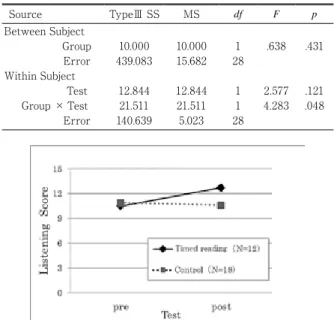
The two-way ANOVA results showed that the main effect of the test [F(1, 28) = 2.557, n.s. ; η2=.07] and the main effect of the group [F(1, 28) = 0.638, n.s. ; η2=.02] were not statistically significant. However, the interaction [F(1, 28) = 4.283, p < .05; η2=.12] was statistically significant. The simple main effect for the listening score difference between the pretest and posttest was statistically significant only for the timed-reading group (Table 3, Figure 4).
Table 3. Mixed-Design ANOVA Comparing Listening Score Across Timed-reading, Control groups, and Pre-Post test.
Source TypeⅢ SS MS df F p
Between Subject
Group 10.000 10.000 1 .638 .431
Error 439.083 15.682 28
Within Subject
Test 12.844 12.844 1 2.577 .121
Group × Test 21.511 21.511 1 4.283 .048
Error 140.639 5.023 28
Figure 4. Timed-reading group and Control group s listening score
Discussion for Study 2
auditory information serial processing, which improved the listening proficiency of the timed-reading group. However, based on this result, it remains unclear whether the participants’ visual information process became serial in manner or their reading speed merely improved, but they still process visual information by shifting their eyes back and forth. To clarify this point, the next study measured participants’ eye movement and listening proficiency before and after training to examine the relation between visual information processing and auditory information processing.
Study 3
The objective of Study 3 was to determine the relationship between participants’ regression frequency when reading and their listening proficiency. The previous studies showed that the visual and auditory information processes are shared. Therefore, visual information serial processing promoted by timed-reading training would transfer to auditory information processing, resulting in improvements in the participants’ auditory information serial processing. In the Study 3, we postulated that learners with low listening comprehension have low information serial processing, and if they are unable to follow the speed of auditory information, then their listening proficiency would remain low. However, if we could promote their information serial processing skill, their listening proficiency might improve.
Eye Tracking Device to L2 Listening Study
Eye tracking device has been used to investigate human cognitive process such as problem solving (Grant & Spivey, 2003), and reading (e.g., Rayner, 1998). In the field of linguistic, vocabulary acquisition (Williams & Morris, 2004), and syntactic process (Clifton Jr et al., 2003). However, only little studies have done to investigate listening process of L2 learners by eye-tracking device. The reason is probably due to the notion that listening process differs from reading process and detecting eye-movement would not prove the information process of listening. However, de Bot, Paribakht and Weschel (1997) proposed“lexical comprehension/ production model for oral and written modalities”. In the model, reading and listening information process, such as lexeme and lemma are shared. Therefore, this study assumes that, by investing learners’ eye-movement, we can speculate the learners’ listening information process, especially, syntactic processing.
Calef et al. (1999) reported that the frequency of regression (moving eyes leftward on a text) decreased after timed-reading training, and it is assumed that participants manage visual information in a serial manner if their regression frequency decreases. If the regression frequency decreased with an improved listening proficiency, this suggested a shared cognitive process between visual information serial processing and auditory information serial processing. de Bot et al (1997) s“lexical comprehension/production model for oral and written modalities”only claims“lexical”process of the information. However, this study hypothesized that shared syntactic information process exists in L2 listening and reading. If we can prove it, it would theoretically contribute to L2 studies, by adding new insight concerning syntactic cognitive process of listening and reading.
Participants
This study recruited three participants [two undergraduate students (both aged 22 years) and one graduate student (aged 27)]. They agreed on participating in timed-reading training three times per week for one month at home.
Materials and Procedures
In timed-reading training, training material containing 13 English timed-reading passages and a wpm recording sheet were handed to the participants, who were instructed as follows:
“Train yourself with the timed-reading training material three times per week. It is up to you to train once every two days or three consecutive days. However, ensure that you train three times per week and that you record your wpm on the sheet. After training completion, the material and recording sheet must be turned in.”
Before and After Measurements
the sentence disappeared from the screen, one multiple-choice comprehension question appeared to verify that they had read the sentence, and to prevent them from quickly shifting their eyes on the screen. Two practice sentences appeared before the measurement to allow the participants to accustom themselves to the procedure. Regression was defined as eye movement that is 0.5° leftward within 10 ms.
The listening proficiency test was a formatted test with 12 multiple-choice questions that measured the participants’ listening proficiency. An auditory English passage was played once, and a comprehension question was played once afterward. Participants were asked to circle the most appropriate answers printed on the sheet.
Results of Study 3
Because the training period lasted approximately one month, the participants trained themselves at home. The training period varied according to the participant (Participant A: 27 days, Participant B: 35 days, Participant C: 40 days). However, because the total amount of the material they trained in timed-reading was equivalent, the subtle differences in training length were considered to have a minimal impact on the objective of this study, and we decided to conduct the analysis as planned.
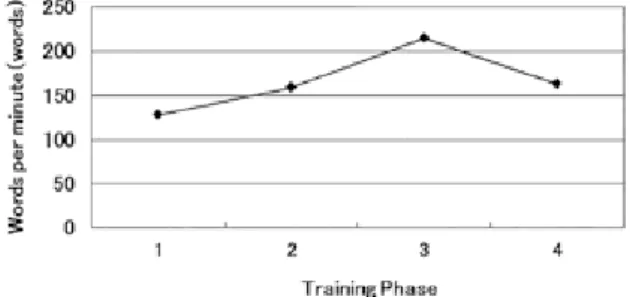
First, to analyze the changes in wpm, because the background knowledge of the training material affects the reading speed, the training period was divided into four phases (Phase 1: Materials 1-3, Phase 2: Materials 4-6, Phase 3: Materials 7-9, Phase 4: Materials 10-12). The wpm was calculated using the same formula (Yamauchi, 1985) used in the study 2 (Figure 5, 6, 7).
Figure 5. Participant A s change in WPM (words per minute)
Figure 6. Participant B s change in WPM (words per minute)
Figure 7. Participant C s change in WPM (words per minute)
Second, to determine whether timed-reading training promotes visual information serial processing, the participants’ regression frequency was counted before and after timed-reading training. The results showed that all participants’ regression frequency decreased after timed-reading training. Participant A had 28.5 regressions before training; however, after training it decreased to 16.4. Participant B had 13.2 regressions before training; however, after training it decreased to 5.8. Participant C s regressions changed slightly from 15.3 to 12.8 (Figure 8). The result was congruent with the finding by Calef, Piper, and Coffey (1999), who reported regression reductions after timed-reading training.
Figure 8. Participants’ change in regression
Figure 9. Participants’ change in listening score
Discussion for Study 3
Although this is a case study of three participants and not mass data, by combining the results of the changes in regression frequency and the listening proficiency score, we found that participants whose regression frequency decreased had an increased listening score (Participants A and B). However, Participant C, whose regression frequency changed only slightly after training, showed no improvement in the listening score. This result may suggest a weak relationship between visual information serial processing and auditory information serial processing. Timed-reading training might promote the participants’ visual information serial processing, and it reflects the reduction in the number of regressions when reading before and after training. We assumed that the serial processing of visual information transferred to auditory information, and that the participants became more proficient to process auditory information in a serial manner, and their listening scores increased.
General Discussion
In this paper, we aimed at investigating the effect of timed-reading training on listening comprehension
by conducting three sub-studies (i.e., Study 1, Study 2, and Study 3), and the results of those studies provided us the following three suggestions for further research recommendations. Firstly, under the audio and visual shared route model, the visual information processing promoted by timed-reading would have effect upon audio information processing. However, although the timed-reading group s listening score improved compared to the control group, it remain unclear whether the serial visual information processing can improve listening comprehension or not. Secondly, we attempted to measure both the timed-reading group and the control group s reading speed (wpm) and listening comprehension score before and after timed-reading training. The results showed that the timed-reading group s wpm improved, and the listening score increased, which suggests that the participants still process visual information by shifting their eyes back and forth. Lastly, by measuring the participants’ eye movement and listening proficiency before and after training, we tried to examine the relation between visual information processing and auditory information processing. The results illustrated an interesting aspect of the effects of timed-reading training that the regression of eye movement decreased and the listening score improved after the treatment.
Our study makes an important contribution to theoretical research and practical implications about L2 listening comprehension. The pedagogical implications of this study is that, previous studies of listening have mainly focused on audio factors (e.g., Fujinaga, 2002), and listening instruction in classrooms have tend to teach and differentiate words in similar sounds, or English / r/ and /l/ phonemes (e.g., Logan et al, 1991; Lively et al, 1994). However, little attention has been given to the L2 learners’ cognitive process during listening comprehension, but the result of this study showed that, especially for L2 learners, promoting the information serial processing skill should also be the objective of the classroom teaching. Details of both instructional and theoretical contribution of this study are discussed in next section.
comprehension. Concerning this issue, this study has shed some light on possible classroom instruction by proposing timed-reading training for L2 learners of English. Some might argue that utilizing both audio and visual information processing is more effective than training visual information processing alone by timed-reading. However, Moussa-Inaty, Ayres, and Sweller (2012) reported that L2 learners of English were asked to learn some English words and sentences either by reading them or by simultaneously reading and listening to the same spoken material, the participants exposed to reading alone performed better on listening tests than participants exposed to a reading and listening. This result showed that concerning cognitive load, especially for L2 learners, learners would improve listening skills better by reading the materials only rather than using both reading and listening. Therefore, considering participants cognitive burden, it is plausible to train L2 learners with timed-reading training to enhance their listening performance.
From theoretical perspective, this study confirmed the previous studies claim that visual and audio information processing is shared. For instance, in de Bot et al. (1997) s L2 lexical comprehension and production model, speech input and written input are processed through a shared route to grasp a concept. However, the model only stated that audio and visual“lexical information process”, but this study add new insights to L2 learners cognitive process that audio and visual“syntactic process”is also possibly shared. It is presently unknown whether providing timed-reading training is effective for all of L2 learners of English, this study s participants were all Japanese learners of English, and it is still unclear that serial process of syntactic visual information, such as timed-reading, would promote syntactic process of auditory information for L2 learners whose L1 is other than Japanese. Presumably, timed-reading training aiming to promote listening performance especially effective for L2 learners whose mother language has syntactic structure different from English, for instance, S (Subject) ‒ O (Object) ‒ V (Verb) order. L2 learners, with the L1 syntax order different from English, assumingly have difficulty processing English audio information. English listening requires L2 learners to process audio information in serial manner according to English syntactic order, since, unlike writing, the stream of speech disappears once it heard. However, L2 learners, whose syntactic structure is akin to English, have less
obstacle processing audio information of English, and least benefit from timed-reading training to promote listening performance, since they encounter a little difficulty processing the information in serial manner. We propose that future research investigates the role of the L1 syntactic structure, and how it plays to hinder or enhance the effect of timed-reading training on listening performance.
In summary, this study showed that visual information serial processing promoted by timed-reading training transferred to auditory information processing and improved listening comprehension. However, we recognize several limitations inherent to the study, for instance individual factors such as effect of L1 syntactic order, or the perception of auditory information were not included in the research design of this paper. Considering the cognitive process, in future research, such variables should be considered to maximize the effect of timed-reading on listening comprehension.
Note
This paper is a revised version of a poster presentation made in English at AAAL2018.
References
Bae, J., & Bachman, L. F. (1998). A latent variable approach to listening and reading: Testing factorial invariance across two groups of children in the Korean/English two-way immersion program. Language Testing, 15(3), 380-414. doi:
10.1177/026553229801500304
Berne, J. E. (2004). Listening comprehension strategies: A review of the literature. Foreign Language Annals, 37, 521-533.
doi: 0.1111/j.1944-9720.2004.tb02419.x
Calef, T., Piper, M. & Coffey, B. (1999). Comparison of eye movements before and after a speed-reading course. Journal
of the American Optometric Association, 70, 171-181.
Clifton Jr, C., Traxler, M. J., Mohamed, M. T., Williams, R. S., Morris, R. K., & Rayner, K. (2003). The use of thematic role information in parsing: Syntactic processing autonomy revisited. Journal of Memory and Language, 49, 317-334. doi:
10.1016/s0749-596x(03)00070-6
de Bot, K., Paribakht, T. S. & Wesche, M. B. (1997). Toward a lexical processing model for the study of second language vocabulary acquisition: Evidence from ESL reading. Studies
in Second Language Acquisition, 19, 309-329. doi: 10.1017/
S0272263197003021
difficult for Japanese college students? : An analysis of errors in students' dictation. Keizai Riron [Economic Theory] ,306,
1-22.
Glisan, E. W. (1985). The effect of word order on listening comprehension & pattern retention-An experiment in Spanish as a foreign-language-. Language Learning, 35, 443-472.
Grant, E. R., & Spivey, M. J. (2003). Eye Movements and Problem Solving: Guiding Attention Guides Thought.
Psychological Science, 14, 462-466. doi: 10.1111/1467-9280.02454
Hirai, A. (1999). The relationship between listening & reading rates of Japanese EFL learners. Modern Language Journal, 83,
367-384. DOI: 10.1111/0026-7902.00028
Igarashi, I (2002). Dokkai ryoku no kojo wo hakarutame no sokudoku
tadoku sidou no kufu, [Tips for speed-reading and extensive
reading instruction to improve students’reading skill.]
Fukushima ken kyoiku center kenkyu kiyo, 32, 54-55.
Kadota, S., Yoshida, S., & Yoshida, H.(1999). Processing Units in EFL Reading : An Effect of Presentation Units on Comprehension Rate and Time.ARELE, 10, 61-71.
Kadota, S.(2007). Shadowing to ondoku no kagaku [Shadowing and
Science in Reading]. Tokyo: Cosmopia.
Kajiura, M. (2016). Enhancing the Processing Speed of L2 Speech : The Effect of Practice Using Faster Rate (Compressed) Speech and Transcript Reading on Listening Proficiency. JACET JOURNAL, 60, 117-135.
Kintsch, W. (1998). Comprehension: A paradigm for cognition.
Cambridge university press.
Lively, S. E., Pisoni, D. B., Yamada, R. A., Tohkura, Y. & Yamada, T. (1994). Training Japanese listeners to identify English /r/and /l/: Ⅲ . Long term retention of new phonetic categories. Journal of the Acoustic Society of America, 96,
2076-2087. doi: 10.3758/BF03206911
Logan. J. S., Lively, S. E. & Pisoni, D. B. (1991). Training Japanese Listeners to identify /r/ and /l/: A first report.
Journal of the Acoustic Society of America, 89, 874-886.
Moussa-Inaty, J., Ayres, P., & Sweller, J. (2012). Improving Listening Skills in English as a Foreign Language by Reading Rather than Listening: A Cognitive Load Perspective. Applied
Cognitive Psychology, 26, 391-402. doi: 10.1002/acp.1840
Rayner, K. (1998). Eye movements in reading and information processing: 20 years of research. Psychological bulletin, 124(3),
372.
Vandergrift, L., & Baker, S. (2015). Learner variables in second language listening comprehension: An exploratory path analysis. Language Learning, 65(2), 390-416. doi: 10.1111/
lang.12105
Williams, R. S., & Morris, R. K. (2004). Eye movements, word familiarity, and vocabulary acquisition. European
Journal of Cognitive Psychology, 16, 312-339. doi:
10.1080/09541440340000196
Yamaguchi, T. (1997). Nihon jin EFL gakushusha no choukai
ryoku to goninnchi sokudo ni tsuite [Concerning listening
comprehension and words recognition speed for Japanese EFL learners]. Kyoikugaku kenkyuu [Educational Research], 43,
104-109.
Yamaguchi, T. (1999). Effects of training in rapid word recognition on listening comprehension: An analysis of translation-task data from Japanese EFL learners. Annual
Review of English Language Education in Japan (ARELE), 10,
83-91.
Yamauchi, Y. (1985) Chugakkou ni okeru dokkai sidou no kokoromi
[Reading instruction at junior high school], KATE bulletin,1,