■
Article■
Land
Leasing
in Contemporary
Rural
West
Bengal:
Case
Study
of a Village
under
Boro
Rice
Cultiva-tion
●
Hideki Mori
1. Introduction
In sharp contrast to the agricultural stagnation that existed before the 1980s, West Bengal has recently experienced high rates of growth in foodgrain production. Rice is the primary crop in West Bengal. Three kinds of rice have traditionally been grown there: aman (winter rice), aus (autumn rice) and boro (summer rice). Among them aman has been the main crop. High rates of growth in rice production during the 1980s can be attributed to yield increase in the aman and aus seasons and rapid expansion in area under the boro cultivation. In particular, the rate of growth in boro rice has been dramatic. According to the calculations made by Saha and Swaminathan, the annual rate of growth in the output of the aman and aus rice was 4.7% in the 1980s, while the corresponding rate for the boro rice was 12.4% (1994: A6). The proportion of boro rice
森 日出樹 Hideki Mori, Matsuyama Shinonome College, Ehime, Rural Development and Social Change in India.
Articles: "Impact of Poverty Alleviation Programmes in a Village of Karnataka ,
India: A Micro-level Study of JRY and IRDP", Geographical Reappraisal of Human Resources and Its Impact on Regional Development in India, Research Center for Regional Geography, Hiroshima University, 1996, pp. 37-56. "Rural Development Policy and Changing Rural Society in West Bengal, India: A Case Study of a Gram Panchayat Area under the Left Front Government" (in Japanese) , AJIA KEIZAI, Vol. 38, No. 8,1997, pp. 39-71.
2 Journal of the Japanese Association for South Asian Studies, 10, 1998
output to total rice production has increased from 11.6% in 1980-81 to 23.6% in 1990-91. Since boro rice is cultivated during the dry season, the expansion of area under cultivation means an expansion of irrigated area. In boro cultivation, all the cultivated area is sown with seeds of high yielding varieties (HYVs), which require more fertilizer and pesticide than traditional crops. The proportion of area under HYVs has also increased in aman and aus cultivation.1)
With the expansion of irrigated area and the increased adoption of HYVs and fertilizer use, West Bengal surpassed the situation called "ag-ricultural impasse" by Boyce, a situation where, despite being richly endowed with natural resources, agricultural growth was lower than the rate of population growth.2)
As to the introduction of new technology in agriculture, or the "green revolution," in India, many researchers have discussed its impact on rural society. From the early period of the "green revolution" in India, bias in favour of some farmers has been stressed. The main points in this kind of argument can be summarized as follows. As technological inno-vation requires intensive use of material inputs (HYVs, chemical fertil-izer and pesticide), controlled water supply and credit for production, large-scale farmers who have economic as well as political power can more easily adopt new technology and benefit most from technological innovation. On the contrary, the living conditions of poor, small-scale farmers or sharecroppers who cannot access such material inputs, irri-gated water and credit deteriorate with many losing their land and be-coming agricultural labourers. As a result, a process of polarization be-tween rich farmers and poor farmers is hastened by the introduction of new technology (see, for example, Frankel 1971, Griffin 1974, Gough
1989). This process may be called the proletarianization of peasantry, or depeasantisation.
However, we must not exaggerate such a process. For example, from extensive evidence, Byres (1981) stressed that although the process was certainly hastened by "new technology" during the 1970s in India, it was partial, because many small farmers or tenants had still retained plots of land.3) Further, Harriss (1992) has suggested from more recent data and research that depeasantisation had not universally taken place, although he recognizes that dependence on self-employment had declined with an
their attitudes toward new technology, small farmers have not necessar-ily given up in attaining it.5)
In West Bengal, it has been reported since as early as the mid-1970s that in some irrigated areas, relatively well-off peasants or tube-well owners have leased land for boro cultivation from small landowners and expanded their operational holdings (Bandyopadhyaya 1975; Ghosh 1981; Rogaly, Harriss-White and Bose 1995: 1865). In these cases, land is leased for one crop season on fixed rent.6)
Case studies, however, have also shown that even small land-owning or landless households have been able to lease land for boro cultivation with fixed rent, which might be considered more favourable to farmers capable of investing substantial sums in production (Ghosh 1981; Webster 1990: 183-184; Harriss 1993a: 1239; Gupta 1993: 88; Sengupta and Gazdar 1997: 154; Mori 1997: 49). Furthermore, it can be gathered from the results of an extensive study on tenancy relations in contempo-rary rural West Bengal that small land-owning households have tended to expand their operational holdings during the boro season, and that many of them have leased land paying fixed rent (Bhaumik 1993: 71-111). These trends in boro cultivation in West Bengal may be understood as a process opposing depeasantisation through leasing land. With the rapid spread of boro cultivation and increasing adoption of new technol-ogy in West Bengal during the 1980s, small land-owning or landless households have not necessarily been left behind in venturing into boro cultivation.
The concern of this paper is to investigate the actual condition of such small land-owning or landless people who obtain access to land and ven-ture into boro cultivation from village level data, which this author col-lected from a village in West Bengal. First, after a brief comment on the historical background of land lease practices in West Bengal and the village surveyed, the pattern of contemporary land leasing in the village surveyed will be described, and the circumstances under which small land-owning or landless households have been able to access land for boro cultivation will be examined. However, it should be noted that eco-nomic conditions may vary from one household to another, not solely but largely, on the basis of their non-agricultural incomes. It, therefore, seems to be necessary to pay attention to differences in their economic conditions. In the latter half of this paper, we will examine how differ-
4 Journal of the Japanese Association for South Asian Studies, 10, 1998
ences in such economic conditions could lead to different ways of partici-pating in boro cultivation.
The fieldwork was done from 1994 to 1995, during which time this author visited the village intermittently. A follow-up survey on some households in the village was also conducted in September 1997. 2. Location of the Village and Patterns of Land Ownership
The area in which the fieldwork was carried out is a gram panchayat (village council) constituency, not a judicial village (mauj ii) . But, for
venience' sake, let us call it a "village," namely "village N." The gram panchayat in which village N is located will be called B gram panchayat (B. GP), which is composed of 11 gram panchayat constituencies alto-gether. B.GP falls under the territorial jurisdiction of Mahishadal police station in east Medinipur district and is geographically adjacent to the Hooghly River (Fig. 1). Households surveyd in the village N numbered 327.
Table 1 shows patterns of land ownership among the households sur-veyed. About three-quarters of the households were landless or small landowners below 0.50 acres. The distribution of land ownership is very unequal: while small land-owning households (below 0.50 acres) ac-counted for 30.6% of the total but only 13.1% of the ownership of the total land, large land-owning households accounted for only 1.5%, and as much as 30.6%, respectively. As to caste composition, Mahishya, a culti-vator caste which is numerous in Medinipur district, was numerically dominant. Although the proportion of landless households was higher among Muslims, we cannot say that land concentrated exclusively in the hands of a certain caste. It may be worth noting here that there are some villages in B. GP, where some SC or Muslim households hold large amounts of land and enjoy an economically dominant position in their village. Therefore, caste can hardly be a useful indicator for
understand-Table 1 Land Ownership Patterns among the Households Surveyed (1994)
Source: Author's fieldwork.
Note: 'SC' includes Dhopa (29), Muci (10) and Paunclra (1). 'Others' include Baishfiab (6), Napit (8) and Kumbhakar (1).
6 Journal of the Japanese Association for South Asian Studies, 10, 1998
ing economic status of the households in this area.
The main crop in village N is rice, two kinds of which - aman and
boro - are cultivated. Betel leaf (pan) is also cultivated as a cash crop by
some villagers.
3. Sharecropping
and Land Reform
Sharecropping has a long history in Bengal. It developed in different
ways during the colonial period. Especially, during the depression of the
1930s and the Bengal Famine in 1943, much greater indebtedness and
pauperization among the poor peasants occurred, and the number of
sharecroppers increased (Cooper 1988: 17-78).
After Independence, the West Bengal government enacted some
legis-lative measures to protect the rights of sharecroppers. The Bargadar Act
of 1950 stipulated conditions under which sharecroppe*rs could be
evicted; and the Land Reform Act of 1955 spelt out the share to be paid
to sharecroppers. After the radical movement of the rural poor led by the
communists under the United Front government, the Act of 1955 was
amended in 1972, giving a larger share to sharecroppers. According to
the amended act, sharecroppers can take 75% of the product when they
contribute inputs. (If the landowners contribute all the inputs, the
pro-portion becomes 50: 50.) The amendment also made the rights of
share-croppers hereditary.
Despite of this legislation, the eviction of sharecroppers did not stop.
The attempt to define the rights of sharecroppers made landowners more
wary about renting their land to sharecroppers, and many landowners
began to evict their sharecroppers. As a result, the land cultivated by the
owners themselves and / or agricultural labourers has increased.7
Furthermore, the traditional share proportion of 50: 50, even when
sharecroppers contributed all the inputs, was also widely observed. The
legally stipulated share proportion was often being ignored even after the
act was amended in 1972 (Gupta 1977: 57-58; Rudra 1975b: A58; Bose
1984: 108-115).
The Left Front (LF) government led by the Communist Party of
India (Marxist) (CPM) came to power in 1977. Stressing structural
re-forms, the government gave priority to land reforms for rural
develop-ment. In particular, "Operation Barga," a massive drive to identify the
sharecroppers and register their names for the purpose of protecting
their rights, was a unique programme. The number of registered share-croppers did increase remarkably for a few years after 1978. The achieve-ments of the land reform programmes of the LF government have been positively discussed in several research works; for example, Kohli 1987: 120-136, Lieten 1992, and Lieten 1997: 30-49. However, it can be easily understood from village level studies that there are considerable differ-ences from one village to another in the proportion of registered share-croppers (Bandhyopadhyaya et al. 1985, Westergaard 1986).
In village N, sharecroppers have largely been evicted since the begin-ning of the 1970s. The advent of the LF government promoted sense of crisis on the part of the landowners, and merely furthered the practice of eviction, resulting in the decline of sharecropping itself. Although some sharecroppers were given some small plots or money from their land-lords as compensation, no sharecroppers were registered.
Most of the ex-sharecroppers in village N had cultivated the land of local landowners in and around their village, and they were poor. The local landowners played the role of patron, providing sharecroppers with advances of paddy or loans. Furthermore, landowners and their share-croppers enjoyed more or less close relations through frequent contacts within the social life of the village. It may be said that for the sharecrop-pers in village N, such financial dependency and close social relationships posed an obstacle to resisting the landowners and registering their names. 8)
We should also refer here to the redistribution of vested land, another major land reform programme. Among the 327 households surveyed, only 20 persons have so far benefited from such redistribution, and only
5 of them were the beneficiaries under the LF government. As far as agricultural land is concerned, the average size of land redistributed per beneficiary was about 0.20 acres before the LF government and 0.09 acres after its formation. Considering the large number of landless households in village N (see Table 1), the number of beneficiaries as well
as the amount of land redistributed was very small.
4. The Spread of Boro Cultivation and Changes in Land Leasing Patterns
While the land reform measures to protect sharecropper's rights and redistribute vested land did not bring satisfactory or successful results in
8 Journal of the Japanese Association for South Asian Studies, 10, 1998
village N, there has been agricultural growth due to the expansion of irrigated area. In B. GP, fresh water has become available from the river during the dry season since the beginning of the 1980s due to water control by the dam on the upper stream of the Hooghly River. Further-more, the main canal in B. GP was reconstructed and a sluice gate at-tached to it in 1984. Smaller canals inside the villages have also been constructed or repaired by the panchayat.
In this way the irrigated area has rapidly expanded, and, as in many parts of West Bengal, it has led to the rapid spread of boro cultivation in B. GP since the middle of the 1980s. The irrigated area in B. GP in 1981 , which was all irrigated by the water from private tanks (pukur), was only 6.9% of the total cultivated land. In 1994, however, the total area for boro rice cultivated by the surveyed households was 157.35 acres , which ac-counted for 78.1% of the total area for aman rice cultivation (201.43 acres). There is no land that is irrigated by tube wells in village N.
Land leasing patterns have largely changed with the spread of boro cultivation in the village. As mentioned above, there has been a decline in sharecropping practices for aman cultivation due to eviction of share-croppers. The villagers, however, have started to lease land for boro cul-tivation.
In the case of aman rice cultivated by the surveyed households in 1994, 95.0% of the total operational area was cultivated on their own land, while the remaining 5.0% was leased in. In contrast, the area leased in for boro cultivation during the same year accounted for 45.6% to the total operational area. As to the number of households, tenant cultivators (including tenant-cum-owner cultivators) represented only 9.4% to the total households of cultivators in the aman season in 1994, whereas the corresponding figure in the boro season was 58.4%.
There are two types of lease contract in village N, which can be distin-guished by the mode of payment. One is a crop-sharing contract, the
other a fixed-rent contract. Recently, the latter has become more popular than the former. In the case of fixed-rent, the rent is paid in cash, and is called "khajna" by the local people. In the cases of both khajnii and crop-share, the term of contract is one crop season, mostly for boro paddy.9)
Tables 2 and 3 show the area operated for paddy cultivation and the number of households engaged in paddy cultivation during 1994 by the landholding categories and the type of land operated. In the case of aman
cultivation, where land was rarely leased, more than 60% of the total cultivated area was operated by medium and large land-owning house-holds, and the area operated by landless and small land-owning (below 0.50 acre) households accounted for only 17.0% of the total. On the con-trary, in the case of boro cultivation, where land leasing was commonly
Table 2 Distribution of Rice Cultivation Area of the Surveyed Households according to Ownership or Non-ownership of Operational Land (1994)
(in acres)
10 Journal of the Japanese Association for South Asian Studies, 10, 1998
practised, landless and small land-owning (below 0.50 acre) households operated more than half of the total cultivated area (Table 2). 62 landless households, which accounted for 42.2 % of the total landless households among the surveyed households, and 47 small land-owning (below 0.50 acre) households, which accounted for 47.0% of the total small land-owning (below 0.50 acre) households, entered land lease market and cul-tivated boro rice (Tables 1 and 3). Land was leased mainly from the medium and large land-owning households. Despite the high cost of new
Table 3 Distribution of Surveyed Rice Cultivating Households according to Ownership or Non-ownership of Operational Land (1994)
technological inputs, boro cultivation is mainly put in the hands of the small land-owning and landless households. Therefore, although the av-erage area operated by each household is smaller in boro cultivation than in aman cultivation, more equal distribution of operational holdings can be seen in boro cultivation, because of the participation by the landless households and the expansion of the operational area of the small
land-owning households.
As far as boro cultivation in village N is concerned, the poorer sectors can be guaranteed access to land, and the concentration of operational holdings is not seen.
Why can the small landowners or landless households gain access to land and cultivate boro rice requiring the adoption of new technology? One may say that poor farmers could easily enter boro cultivation by leasing land, if the lessors would share the cost of inputs with the lessees. In fact, cost share arrangements between landlords and sharecroppers have been recognized in West Bengal (Rudra 1975b; Rudra and Bardhan 1983: 36-43). However, a recent study has showed that cost sharing was not common in boro cultivation (Khasnabis 1994: A194), and there are no cases of cost sharing between lessors and lessees involved in boro cultivation in village N.
In the following section, from technological, economic and political points of view, we will examine the circumstances under which land and new technology for boro cultivation has become available to households with small or no land.
5. Technological, Economic and Political Circumstances 5. 1 The Technological Conditions of Boro Cultivation
As is commonly known, rice cultivation requires more labour input than the cultivation of other crops, like wheat; and, as a result, labour absorption is relatively high. In India, it is reported that traditional rice cultivating states show higher rates of labour absorption in agriculture (Bhalla 1987: 543-544). This may be related to technological improve-ment in rice cultivation. It is said that technological improveimprove-ment in wet rice cultivation in Asia has traditionally been divisible and scale-neutral, and that it has tended to intensify productivity by intensification of labour input rather than expansion of holdings (Bray 1983).
mecha-12 Journal of the Japanese Association for South Asian Studies, 10, 1998
nization of agriculture has not progressed, and the elements of new tech-nology such as HYV seed, chemical fertilizer, pesticide and water are divisible and scale-neutral. In this sense, these characteristics of new technological innovation do not necessarily exclude poor, small-scale farmers from new technology.10) However, if the land were irrigated by a private tube-well, the situation would be somewhat different.
A survey of land leasing in two West Bengal villages has shown that in one village, where land was irrigated by a government canal, small farm-ers tended to lease land from substantial farmfarm-ers. On the contrary, in the other village, where land was irrigated by privately-owned tube-wells, substantial farmers who owned the tube-wells tended to lease land from smaller farmers (Ghosh 1981).
Although the number of privately-owned shallow tube-wells has been increased in West Bengal, their ownership seems to be, by and large, limited to a few rich farmers. Tube-well owners may try to optimize their resources by leasing in land within command areas of their tube-wells, resulting in land concentration by these rich farmers.11)
On the contrary, villagers can more easily access government canal water, if the canal network is extensive. Water charges are not demanded in the case of government canals.12) In the case of village N, farmers usually take water from the canals by means of diesel pumps. The num-ber of pump (diesel engine and hose) owners are limited, so most farmers rent pumps. However, even small farmers can obtain pumps, since it is less costly to purchase them than to install tube-wells with diesel (or electric) pumping engines. Among the 32 householders in village N, who individually or jointly owned pumps in 1994, 10 were small landholders, and 2 were landless. The rental fee for a pump is likely to be less than the water charge for the use of a private tube-well.13) Moreover, pumps are movable, so, if circumstances permit, they can be set anywhere according to the demand of the farmers. Therefore, since pumps are accessible to many farmers, the concentration of land by the pump-owning rich farm-ers is likely to be less. Moreover, even if a farmer cannot rent a pump, he can still take water with a traditional swing bucket, although more time and labour would be needed.
From a technological point of view, we can say that water from canals is more accessible to poor farmers, and that government canal irrigation tends to restrict concentration of operational holdings.
5.2 Improvement in the Economic Conditions of the Poor Besides the technological conditions discussed above, improvement in the economic conditions of the poor should be mentioned as an impor-tant reason why households with small or no land lease in land for boro cultivation. This improvement has been largely the result of increases in real wages for agricultural labourers as well as better non-agricultural employment opportunities. Real wages for agricultural labourers in West Bengal have increased significantly since the beginning of the 1980s.14)
In village N , according to villagers' statements, the daily wage for male agricultural labourers during the mid-1970s was around Rs. 4, equivalent at that time to 1.5-2.0 kg of rice. In 1995, however, it was Rs. 32, equivalent to around 4.5 kg of rice.15)
The introduction of HYV seed and the spread of double-cropped paddy have tightened the agricultural schedule, requiring more intensive and timely use of labour. The labour market has also been tightened, resulting in increased wage rates for agricultural labour.
Although only 54 households cultivated betel leaf in 1994, the spread of betel leaf cultivation has also contributed, although not remarkably, to better self- or wage- employment opportunities in agriculture.
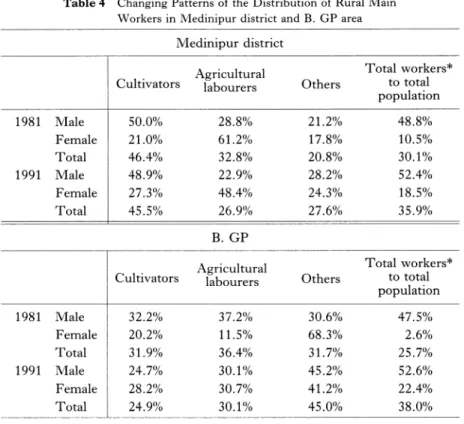
Further, the tightening of the labour market is likely to have been accelerated by an increase in non-agricultural opportunities. Table 4 shows the changing patterns in the distribution of rural main workers between 1981 and 1991. The table shows that while the percentage of cultivators and agricultural labourers among the total main workers has declined, the percentage of other workers has increased in Medinipur district. This trend is strong in B. GP area, and is not merely composi-tional change; rather, the absolute number of other workers has consid-erably increased because the percentage of workers among the total population has increased, especially in B. GP area.
What seems to be interesting here is that an increase of total female workers has also caused a rise in the percentage of female cultivators and agricultural labourers among the female workers in B. GP area. The spread of double cropping has contributed to the absorption of female labour in agriculture under the conditions where non-agricultural em-ployment opportunities for males have increased.
In village N, 46% of the adult males (280) engaged in non-agricultural occupations in 1994. Among them, 84% (234) were from landless and
14 Journal of the Japanese Association for South Asian Studies, 10, 1998
small land-owning households.
The number of rickshaw pullers has increased rapidly since the
begin-ning of the 1980s.16) This occupation accounted for 22% of all male
non-agricultural workers in 1994. Road construction and repair during the
1980s have increased the demand for rickshaws. Prior to the 1980s,
ac-cording to the villagers, the number of rickshaws was very small because
village roads were too muddy to cycle on during rainy season. The
num-ber of small shopkeepers has also increased with the expansion of village
markets. Furthermore, the development of Haldia, a newly emerging
industrial area in south-east Medinipur district, has, to some extent,
contributed to the increase in the number of factory workers and
me-chanics.
Table 4 Changing Patterns of the Distribution of Rural Main Workers in Medinipur district and B. GP area
Source: District Census Handbook, Medinipur, 1981 and 1991. Note: *`Workers' include both 'main workers' and 'marginal workers'.
The tightening of the labour market induced by the more intensive use of labour in agriculture as well as by the increase in non-agricultural employment opportunities has certainly contributed to the improvement in economic conditions of the poor. But to what extent have such eco-nomic conditions improved? Let us look more carefully into the charac-teristics of the labour market in village N.
Although employment opportunities for agricultural labourers have increased, it is difficult for agricultural labour households to make a living only through such labour of the householders. Boro cultivation requires one and a half times to twice as many labourers as aman cultiva-tion, but compared with the average number of hired labourers in aman cultivation (20.7 man-days per acre), the corresponding figure in boro cultivation (27.4 man-days per acre) was not very high in village N. This is because operational holdings become smaller during the boro season due to land leasing.17)
Increasing non-agricultural employment opportunities in the village have also brought about keen competition among villagers in the same line of work because of poor choices of occupations. This has led to an instability of income from non-agricultural employment in the village. Rickshaw pullers in village N complained that there were too many rick-shaw pullers. This author also saw some shops appearing and disappear-ing in the village market durdisappear-ing the fieldwork.
Thus, although employment opportunities have increased, this has not necessarily removed instability in income for the poor. That is why, despite an increase in non-agricultural and agricultural wage-employ-ment opportunities, demand for land to cultivate boro rice has not de-clined.
For large or medium landowners, leasing out their land for boro culti-vation ensures stable income. Otherwise, they have to venture into boro cultivation on a larger scale, which would require heavy investment and much labour. It would also involve high risk under the present condi-tions of agricultural labour market which has, to some extent, tightened, leading to increased wages.
5.3 Changes in Political Environment
It may be said that the improvement in the economic conditions of the poor has been supported by the pro-poor policy implemented by the LF
16 Journal of the Japanese Association for South Asian Studies, 10, 1998
government. Along with land reform, revitalization of the panchayat (lo-cal government) has been one of most important rural development programmes that the LF government has driven forward. Panchayat elections have been held regularly every five years since 1978. Domina-tion by the rural rich or the rural elite in local politics has declined considerably. Participation in local politics by the middle or lower classes has been enhanced in rural West Bengal, although it may be said that participation of the poor has not necessarily been satisfactory. Rural people have become more conscious of local politics and more informed about their own rights. Political mobilization through the panchayat, thus, has strengthened the bargaining power of the poor.18)
In village N, although direct participation of the poor in the process of decision-making is still limited, the panchayat led by CPM politicians has successfully created a social environment where the poor can claim their rights openly (Mori 1997).
Collective bargaining actions, including strikes, for higher agricultural wages have also been led by krishak sabha, a peasant union under control of the CPM. It seems that under the government led by the CPM, collective action by agricultural labourers, or the possibility of such ac= tion, has more or less successfully put pressure on large landowners not to act against agricultural labourers. Besides the economic factors dis-cussed above, political factors also should not be underestimated in ex-plaining the increases in wages for agricultural labourers.
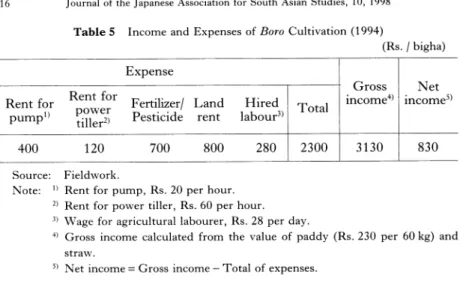
Table 5 Income and Expenses of Boro Cultivation (1994)
As to the crop-sharing or khajna contract for boro cultivation, political and social circumstances in favour of the poor have facilitated observance of legally prescribed share proportion. Even after the amendment of the act in1972, the traditional proportion of 50: 50 was common in village N. But, in recent sharecropping for boro cultivation, the legal proportion is being observed. There were only a few cases where the proportion did not conform to legal standards in 1994. Also in the case of the khajna contract in 1994, we found that rent did not largely deviate from the legal standard. In 1994, rent for khajna land was usually Rs700 to 800 per local bighel (=0.46 acre), which was equivalent to 22 to 29% of the value of the paddy and straw expected from one bigha.19)
Thus, there is no doubt that leasing of land for boro cultivation, whether under crop-sharing or khajna contract, is more profitable for the lessees than traditional sharecropping, if the lessees do not fail to culti-vate. It can be safely said that assurance of the legal share proportion in favour of the lessees has encouraged the poor to enter into the land lease market.
We have examined technological, economic and political factors that have enabled the poor to enjoy access to land for boro cultivation in village N. Let us now turn to a closer examination of conditions of boro cultivation on leased land on the basis of the data from the households with small or no land.
6. Different Ways to Participate in Boro Cultivation 6. 1 Income and Expenses in Boro Cultivation
The average size of area leased in was not large in 1994: 0.61 acres in the case of landless households, and 0.54 acres in the case of small land-owning households. Table 5 shows a model of expenses for cultivating boro rice on leased land and gross income per bighel. Fertilizer / pesticide and land rent make up most of the expenses. As to fertilizer and pesti-cide, many poor cultivators can buy them on credit from shops in the village.20) On the contrary, khajna, as a rule, is paid in advance. There-fore, poor households which have only small cash incomes tend to prefer the crop-share contract, which does not require rent in advance.
Table 6 shows the distribution of households according to farming method for boro cultivation and their non-agricultural income. While incidence of crop-sharing contract increases as non-agricultural income
18 Journal of the Japanese Association for South Asian Studies, 10, 1998
decreases, the khajna contract tends to be employed more with increases in non-agricultural income. It can be said that the crop-share contract has made it easier for poorer cultivators to enter the land lease market; and, in fact, households with smaller non-agricultural incomes are more eager to lease in land for boro cultivation (Table 6).
Among the items of expense, wages for hired labour seem to be the most variable from one cultivator to another. Boro cultivation requires more intensive labour inputs, but, as mentioned before, the number of hired labourers is not actually very high in the boro season. In this sense, it may be said that land leasing for boro cultivation promotes the utiliza-tion of family labour. Under circumstances where wages for agricultural labour have increased, it is natural for the cultivators to use family labour whenever they can. However, as shown in Table 7, family labour is not necessarily dominant in labour inputs for boro cultivation. Although the average share of hired labour in total labour inputs was around 35 % in village N in 1997, there were some households which depended largely on the labourers hired from outside (Table 7).
It can not be said that boro cultivation on leased land is highly profit-able (Tprofit-able 6), but considering the instability in the incomes of the poor, the income from boro cultivation is attractive. Further, it is important for the poor to secure food, so there are only a few land lessees who sell any
Table 6 Distribution of Boro Cultivating Landless and Small Land-owning Households according to Ownership or Non-ownership of Operational Land and Non-Agricultural Income (1994)
part of the boro rice they cultivate. 6.2 Productivity of Boro Cultivation
Productivity of boro paddy on leased land is not low, as shown in the yield rates for different types of households in Tables 8 and 9. These tables do not show exact differences in productivity between leased land and owned land, because the operational land of land-leasing households include some owned land. However, we can see from this data a tend-ency of difference in productivity between the two kinds of operational land. It can be said that the yield rates tend to be higher on leased land than owned land (Table 8). This lies in contrast to findings during the 1970s showing that output of owner-cultivated farms was higher than tenant-cultivated farms (Chattopadhyay 1982: 29).
However, small land-owning households tend to perform better on leased land than landless households (Table 8). Moreover, yield rates of the land-leasing households grow larger with the increase in non-agricul-tural income (Table 9).
These facts imply that although households leasing land seem to cul-tivate that land with more intensity, the landless households or those with smaller amounts of non-agricultural income are not able to cultivate the leased land any better than land-owning households or those with higher non-agricultural income.21)
6. 3 Loans by Land-Lessees
With the spread of boro cultivation, the relations between lessors and lessees have tended to be less dependent compared with traditional
Table 7 Distribution of Boro Cultivating Households by Proportion of Hired Labour to Total Labour (1997)
Source: Author's fieldwork.
Note: Proportion of hired labour was calculated from the proportion of hired labour (man-day) at the times of transplantation and harvest.
20 Journal of the Japanese Association for South Asian Studies, 10, 1998
sharecropping, which was often characterized by relations of dependency between the landlords and the sharecroppers.
We find from research conducted during 1970s that landlords were an important source of loans for poor sharecroppers in West Bengal, al-though they were not the only source and also did not always charge interest (Rudra 1975a; Khasnabis and Chakravarty 1982; Rudra and Bardhan 1983: 45). It seems that such an interlinkage between the land-lease contract and credit remains strong in agriculturally backward areas
even since the 1980s (Chattopadhyay 1996: 24-44; Ghosh 1996). It, however, is likely to decline with agricultural development.
From the 1994 data concerning loans (including both production and consumption loans) among 95 households of land-lessees who belonged to landless or small land-owning (below 0.50 acres) households, we could find only 6 cases where the landlords were the sources of their loans. The most important sources of their loans were their relatives or villagers
other than land lessors. Such cases amounted to 39.
In the case of production loans for boro cultivation in 1997, we can see almost the same picture as above. As is shown in Table 10, among 61 land-lessees belonging to landless or small land-owning households, only
Table 8 Differences in Productivity of Boro Cultivation according to Ownership or Non-ownership of Operational Land (1994)
Source: Author's fieldwork.
Table 9 Differences in Productivity of Boro Cultivation according to Non-agricultural Income (1994)
2 land-lessees depended on loans from their land lessors. On the con-trary, 28 households, which accounted for nearly half of the sample households, took out no loans for boro cultivation, and 21 households, or more than one third of the total sample households, depended on loans from their relatives or villagers other than their land lessors. This data tends to refute any idea that the relationship between lessors and lessees might be characterized by any interlinkage between the land-lease con-tract and credit.
However, it should be noted that credit from financial institutions (including banks, cooperatives and charitable organizations) for boro cul-tivation was also not common. It seems to be more difficult for landless households with small non-agricultural incomes to borrow from financial institutions due to the lack of resources which could be offered as secur-ity for their loans. Thus, the most needy households tend to be left out of the credit system of financial institutions. In contrast, small land-owning households with small non-agricultural income do have access to loans from financial institutions because they are able to offer their land as security (Table 10).
Table 10 Sources of Production Loans to the Land Lessees (61 Households) in Boro Cultivation (1997)
Source: Author's fieldwork.
Note:Total number of cases was more than the total sample households because there were a few cases where a household borrowed from two sources.
22 Journal of the Japanese Association for South Asian Studies, 10, 1998
6. 4 Durations of Lessor-Lessee Relationships
As mentioned before, lessors now usually lease their land for only one crop season, namely for boro cultivation. Moreover, many of them do not lease their land to the same lessees continuously. This is because, if the land were to be cultivated by the same lessees for several years, the lessees could register their names on the land as sharecroppers. Lessors, therefore, have been threatened with the possibility of registration by lessees under the regime of the pro-poor government, even if the lessees themselves have no intention of registering their names. Nevertheless, some lessees have been able to secure land for boro cultivation continu-ously from the same lessors.
Table 11 shows the duration of lessor-lessee relationships in 62 cases from the data for 1997. During the previous year, the majority of the lessees (37 of 62) had leased land from different lessors or had not leased any land at all. This fact implies that lessor-lessee relationships are rather flexible, but lessees who had leased land from the same lessors during the previous year included 20 who had continuously leased land from the same lessors for more than 2 years.
Continuation of the relation is the result, in the words of the villagers,
Table 11 Duration of the Lessor-Lessee Relationships (1997)
of "good behaviour" (bhalo byabahar) on the part of lessees or "trust" (bisvas) in them. If there is strong trust or good relationship between lessor and lessee, the former will be obliged to be more generous, thus strengthening the bargaining power of the latter. The crop-sharing con-tract is more likely to require such relations, because it would be less profitable for the lessors if the lessees did not cultivate well. This is why fixed relations between lessors and lessees can be seen as a characteristic feature of the crop-sharing contract. As discussed previously, the crop-sharing contract is more conspicuous among lessees with small non-agricultural incomes (Table 6, see also Table 11), and most of them have enjoyed continuous relations with their lessors (Table 11).22)
6.5 Changing Patterns in the Land Lease Market
Table 12 presents changes that occurred in the number of lessees during the period from 1994 to 1997 among 119 sample households. We can see from the table that the total number of lessees has been increas-ing, but it should be noted here that the khajna contract has increased,
Table 12 Changes in Land Lease Patterns between 1994 and 1997
24 Journal of the Japanese Association for South Asian Studies, 10, 1998
while the crop-sharing contract has decreased. This tendency can be seen
most remarkably among the small non-agricultural income groups.
In-crease in the total number has been due to the inIn-crease in lessees whose
non-agricultural income is more than Rs. 400 per month.
Rates of land rent in the khajna contract increased during the period
1994-1997. In 1997, rent for khajna land rose to Rs1000-1200 per
bigha, or about 26 to 35% of the value of output expected from one
bigha.23)
This increase in rent can be attributed to an increase in demand
for land for boro cultivation.
With the decline of the crop-sharing contract and increase in the rate
of rent for khajna land, it has become more difficult for the households
with small incomes to enter into the land lease market for boro
cultiva-tion.
7. Concluding Remarks
A recent study on rural development in West Bengal under the LF
government has noted that, along with agricultural growth, West Bengal
has been successful in sharing the growth. The same study also reveals
that even though the impact of land redistribution was not significant
(i.e., wage labour remained important source of income for
beneficia-ries), and though the wage rate for agricultural labourers rapidly
in-creased, income effects of land redistribution were, nevertheless, higher
than those of wage increase (Sengupta and Gazdar 1997). In village N,
the amount of land redistributed under the LF government was very
small, and sharecroppers have been evicted before they could register
their names. However, small land-owning and landless households have
been able to ensure access to land through leasing.
The technological, economic and political conditions in village N, and
probably in many other parts of West Bengal, have made it easy for the
poor to gain access to land. It may be said that depeasantisation has been
halted in village N. Rather, a process of repeasantisation is taking place
through land leasing. Share proportion or land rent does not deviate
largely from legally stipulated shares. Interlinkage between land lease
contracts and credit is barely recognized, and the productivity of
land-leasing households is not low. The impact of land land-leasing for boro
culti-vation on the improvement of economic conditions of the poor cannot be
underestimated. All the lessees with whom this author interviewed agreed that improvement occurred in their economic conditions after the spread of boro cultivation, although most of them felt only a small im-provement (ektu unnata). In this sense, the benefits of agricultural growth seem to have been distributed among the poor.
However, closer examination of lessees with different economic condi-tions cannot allow an optimistic view. Agricultural growth, increases in wage rates for agricultural labour, and better non-agricultural employ-ment opportunities have brought about development of the rural mon-etary economy. As a result, while incidence of the crop-sharing contract in boro cultivation has been gradually decreasing, the khiijna contract has come to prevail. Better employment opportunities (in agricultural wage-labour and non-agricultural occupations), however, have not been suffi-cient for the poor to stabilize their income, and the demand for land for boro cultivation is on the increase. Therefore, rates of land rent for the khajna contract has also been increasing, because of the intensification of competition for limited land. Credit from financial institutions is very limited, especially for the landless. Productivity on land leased in by the households with no land or small non-agricultural income tends to be less than that for those with their own land or higher non-agricultural income. Moreover, increases in wage rates for agricultural labour may not necessarily be welcomed by the agricultural labourers who would use hired labourers in boro cultivation on the land leased in.24)
It is likely that these have made, or will make, it more difficult for the poorer villagers to lease land and enter boro cultivation. This case study has shown that, in certain settings, a process acting against depeasan-tisation, or repeasandepeasan-tisation, may occur together with the adoption of new technology and agricultural growth, but it has also suggested that this process may involve contradictions.
Notes
1) In aman and arts cultivation, the percentage of area under HYVs was 22.9% and 35.7% respectively in 1980-81. The corresponding figures in 1990-91 were 45.5 and 66.2% (Saha and Swaminathan 1994: A6).
2) In his analysis of agriculture in Bengal before the 1980s, Boyce shows a strong correlation between irrigation and growth of boro cultivation, and suggests that irrigation, which facilitates the spread of HYVs and increase in fertilizer applica-tion, played the leading role in agricultural growth (1987: 196-199).
26 Journal of the Japanese Association for South Asian Studies, 10, 1998
that among agricultural labour households, agricultural labour households with land had largely increased between the mid-1960s and the mid-1970s (1984: 182) .
Referring to the case study in Bangladesh in the end of 1970s, Bhaduri, Rahman and Arn (1986) suggest that amidst a general process of polarization of land owner-ship, small farmers were able to retain their small plots of land by increased reliance on outside income, which could be mostly attributed either to wage labour or the leasing-in of land.
4) Case studies on a long-term impact of HYVs of rice on village society in Tamil Nadu also found that the distribution of land (owned or rented) had not worsened by the adoption of HYVs (Hazell et al. 1993), or that, although non-agricultural wage work had increased, small landholders had remained peasants (Harriss
1993b).
5) For example, from a survey in Panjab, where the "green revolution" has been advanced, Bhalla and Chadha note that small farmers were doing "everything pos-sible to follow the medium and the large farmers in the matter of use of new technology" (1983: 65).
6) However, concerning such enterprising farmers who leased in land from small landowners during the 1970s, Rudra points out that although this phenomenon should not be underestimated, it was no more than an important trend (1992: 318). 7) We see from several case studies that landowners have been unwilling to have their
land cultivated by sharecroppers, or a lot of sharecroppers have been evicted , in West Bengal since the mid-1950. See, for example, Frankel 1971: 168-169; Gupta 1977: 58; Bose 1984: 111; Chattopadhyay 1992: 655 .
8) From his survey on 300 registered sharecroppers in West Bengal, Kohli notes that about 80% of them have registered their names on the land of absentee landowners (1987: 129-130). Furthermore, Mallick insists that those sharecroppers who were most successful in resisting the landowners and registering their names were middle peasants in their economic status. On the other hand, the poorer sharecrop-pers could not resist the landowners nor register their names (1993: 50-61). 9) It seems that these characteristics of land lease-fixed rent and seasonal crop
contract•\have come to be seen more commonly in West Bengal with the spread of boro cultivation and new technology (Khasnabis 1994: A193-A194; Sengupta (Chakrabarty) 1997).
10) As to relationship between farm size and the adoption of HYVs of rice in India, Dayal reports that a positive relationship between them can not be found (1983: 95-96). Saha also reveals that farm size is not significantly associated with yield and fertilizer application in HYVs in West Bengal (1996: 89).
11) In Bardhaman district, Webster finds tube-well owners who have leased in land within their command areas on a take-it-or-leave-it basis. This was caused by a monopoly of irrigation water, which he calls "water blackmail" (Rogaly, Harriss-White and Bose 1995: 1865). Besides the concentration of operational holdings
, it has also been reported that, in Bangladesh, tube-well owners often sell water to farmers with land in the command areas (Uchida and Ando 1992; Rogaly , Harriss-White and Bose 1995: 1864; Fujita and Hossain 1995; Fujita 1996).
(local council) in West Bengal. The panchayat finances such projects out of a bud-get funded by the government for poverty alleviation programmes. Social organiza-tions of the local people for management of irrigation water can not be seen in village N. Under these circumstances, a tax or charge for controlling or using irrigation water is not collected. It is also pointed out that village organization or co-operation associated with communal irrigation has not developed in Bengal (see Van Schendel 1991: 296).
13) The rental fee for a pump was Rs. 18 to 20 per hour in 1994, totalling about Rs. 400 to cultivate one bigha (0.46 acre). In 1994, 60 kg of boro paddy was priced at Rs. 200 to 230 in the village market. Yield of paddy expected from one bigha is 20 man (=746 kg). The value of straw expected from one bigha was about Rs. 270 in 1994. Therefore, rental fee for a pump was equivalent to 13 to15% of the value of prod-ucts (paddy and straw). As to the water charge of tube-well, a case study from a village in Bangladesh shows that the tube-well owner's share was 33 or 40% of products in the case of share contract (Fujita 1996: 229).
14) According to Sengupta and Gazdar (1997: 177), the annual growth rate of real wages in West Bengal was 5.7% between 1980 and 1991, and the corresponding rate for India as a whole was 4.8.
15) Annual average minimum retail price of rice was used for the calculation. It was Rs. 2.62, Rs. 2.23, Rs. 1.98 and Rs. 6.97 per kg in 1974, 75, 76 and 95 respectively.
(Government of West Bengal, Economic Review, each year).
16) Rickshaw here means cycle rickshaw, called van rickshaw, which can be seen com-monly in rural West Bengal. It has a large flat wooden carrier in the rear. 17) In betel leaf cultivation, the average labourer hired by one household was only 29.4
man-days per year.
18) As to the impact of the panchayat on rural society in West Bengal under the LF government, see Westergaard 1986; Kohli 1987: 108-117; Lieten 1992: 88-118; Webster 1992; Echeverri-Gent 1992; Mukarji and Bandyopadhyay 1993; Lieten 1996; Mori 1997.
19) As to value of products expected from one bigha , see Note13).
20) It should be noted here that 34 among 59 households bought chemical fertilizer and pesticide on credit from fertilizer shops in the village. In this case, however, the shopkeepers did not charge any interest.
21) In the case of households that cultivate only their own land, there was no clear correlation between non-agricultural income and productivity, and the households with small non-agricultural income(below Rs400 per month) were able to achieve higher yield rates (Table 9). This seems to be due to a small scale of operational land when boro paddy is cultivated only on one's own land. Small land-owning households with small non-agricultural income , for whom agriculture is the main source of income, would try to cultivate well, and they do better when their land-holdings are small, or land is not expanded by leasing in. By contrast, for the small land-owning households with non-agricultural income of more than Rs400 per month, agriculture is not necessarily the main source of income. Therefore, they may not try to cultivate harder. If they are interested in boro cultivation and expand their operational land by leasing, they would try to cultivate as hard as they could,
28 Journal of the Japanese Association for South Asian Studies, 10, 1998
because failure in cultivation could bring about serious loss.
22) In this sense, it may be said that the crop-sharing contract has been supported by a kind of "moral economy" in which the generosity of the rich would be required for survival of the poor (Scott 1976).
23) In 1997, 60 kg of boro paddy was priced at Rs. 250 to 290 in the village market, and the value of straw expected from one bigha was Rs. 300.
24) In fact, although wages for agricultural labour have been increasing year by year, recently, collective action of agricultural labourers for higher wages has weakened. Local krishak sabha or the CPM also has become less interested in collective action by agricultural labourers these days, for they do not want to lose the support of small cultivators.
References
Bandyopadhyaya, N., 1975, "Changing Forms of Agricultural Enterprise in West Ben-gal", Economic and Political Weekly, vol. 10, no. 17, pp. 700-701.•\
, 1985, Evaluation of Land Reform Measures in West Bengal: A Report,
Calcutta, Centre for Studies in Social Sciences.
Bardhan, Pranab K., 1984, Land, Labor, and Rural Poverty: Essays in Development Economics, Delhi, Oxford University Press.
Bhalla, G. S. and G. K. Chadha, 1983, Green Revolution and the Small Peasant: A Study of Income Distribution among Punjab Cultivators, New Delhi, Concept Publish-ing Company.
Bhalla, Sheila, 1987, "Trends in Employment in Indian Agriculture, Land and Asset Distribution", Indian Journal of Agricultural Economics, vol. 42, no. 4, pp. 537-560. Bhaduri, Amit, Hussain Zillur Rahman and Ann-Lisbet Arn, 1986, "Persistence and
Polarisation: A Study in the Dynamics of Agrarian Contradiction", The Journal of Peasant Studies, vol. 13, no. 3, pp. 82-89.
Bhaumik, S. K., 1993, Tenancy Relations and Agrarian Development: A Study of West Bengal, New Delhi, Sage Publication.
Bose, Pradip Kumar, 1984, Classes in a Rural Society: A Sociological Study of Some Bengal Villages, Delhi, Ajanta Publications.
Boyce, James K., 1987, Agrarian Impasse in Bengal: Agricultural Growth in Bangladesh and West Bengal 1949-1980, New York, Oxford University Press.
Bray, Francesca, 1983, "Patterns of Evolution in Rice-Growing Societies", The Journal of Peasant Studies, vol. 11, no. 1, pp. 3-33.
Byres, T. J., 1981, "The New Technology, Class Formation and Class Action in the Indian Countryside", The Journal of Peasant Studies, vol. 8, no. 4, pp. 405-454. Chattopadhyay, Manabendu, 1982, Mahalanobis Survey Revisited: Prospects of
Agrar-ian Change in West Bengal, Calcutta, Indo Overseas Publications.
―
, 1996, Agrarian Structure and Peasant Mobilisation, Calcutta, K P Bagchi & Company.
Chattopadhyay, Sujit Narayan, 1992, "Historical Context of Political Change in Rural West Bengal: A Study of Seven Villages in Bardhaman", Economic and Political
Weekly, vol. 27, no. 13, pp. 647-658.
1930-1950, Calcutta, K P Bagchi & Company.
Dayal, Edison, 1983, "Regional Response to High Yield Varieties of Rice in India", Singapore Journal of Tropical Geography, vol. 4, no. 2, pp. 87-98.
Echeverri-Gent, John, 1992, "Public Participation and Poverty Alleviation: The Expe-rience of Reform Communists in India's West Bengal", World Development, vol. 20, no. 10, pp. 1401-1422.
Fujita, Koichi and Feroz Hossain, 1995, "Role of the Groundwater Market in
Agricul-tural Development and Income Distribution: A Case Study in a Northwest
Bangladesh Village", The Developing Economies, vol. 33, no. 4, pp. 442-463.
Fujita, Koichi, 1996, "Banguradeshu: Sen-kan-ido Kangai ni yoru Nouson no
Henbou", (Bangladesh: Rural Change as the Result of Shallow Tube-Well Irrigation) in Kenzo Horii et al. (eds.), Ajia no Kangai Seido (in Japanese) ,Tokyo, Shinhyouron, pp.215-249.(藤 田 幸 一 「バ ン グ ラ ー デ ー シ ュ:浅 管 井 戸 灌 概 に よ る 農 村 の 変 貌 」,堀 井 健 三 他 編 『ア ジ ア の 灌 概 制 度 』,新 評 論,215-249頁.)
Ghosh, Jiban Kr., 1996, "The Changing Agrarian Scene under the Impact of Land Reforms Programme: A Case Study of Operation Barga Programme in West Bengal", in Raychaudhuri, Ajitava and Debjani Sarkar (eds.), pp. 43-57.
Ghosh, M. G., 1981, "Impact of the New Technology on Land Structure through Changes in the Lease Market: A Study in a Bengal District", Indian Journal of Agri-cultural Economics, vol. 36, no. 4, pp. 148-158.
Gough, K., 1989, Rural Change in Southeast India 1950s to 1980s, New Delhi, Oxford University Press.
Gupta, Jayoti, 1993, "Land, Dowry, Labour: Women in the Changing Economy of Midnapur", Social Scientist, vol. 21, no. 9-11, pp. 74-90.
Gupta, Ranjit Kumar, 1977, Agrarian West Bengal: Three Field Studies, Calcutta, In-stitute of Social Research & Applied Anthropology, Deptt. of Anthropology, Calcutta
University.
Harriss, John, 1992, "Does the 'Depressor' Still Work? Agrarian Structure and Devel-opment in India: A Review of Evidence and Argument", The Journal of Peasant Stud-ies, vol. 19, no. 2, pp. 189-227.
―
, 1993a, "What is Happening in Rural West Bengal: Agrarian Reform, Growth and Distribution", Economic and Political Weekly, vol. 28, no. 24, pp. 1237-1247.―
, 1993b, "The Green Revolution in North Arcot: Economic Trends, House-hold Mobility, and the Politics of an 'Awkward Class"' in Peter B. R. Hazell and C. Ramasamy (eds.), pp. 57-84.Hazell, Peter B. R. and C. Ramasamy (eds.), 1993, The Green Revolution Reconsidered: The Impact of High- Yielding Rice Varieties in South India, Delhi, Oxford University Press.
Hazell, Peter B. R. et al., 1993, "Economic Changes among Village Households" in Peter B. R. Hazell and C. Ramasamy (eds.), pp. 29-56.
Khasnabis, R. and J. Chakravarty, 1982, "Tenancy, Credit and Agrarian Backward-ness", Economic and Political Weekly, vol. 17, no. 53, pp. A21-A32.
Khasnabis, Ratan, 1994, "Tenurial Conditions in West Bengal: Continuity and
30 Journal of the Japanese Association for South Asian Studies, 10, 1998
Kohli, Atul, 1987, The State and Poverty in India: The Politics of Reform, Cambridge, Cambridge University Press.
Lieten, G. K., 1992, Continuity and Change in Rural West Bengal, New Delhi, Sage Publication.•\
, 1996, Development Devolution and Democracy: Village Discourse in West Ben-gal, New Delhi, Sage Publication.
Mallick, Ross, 1993, Development Policy of a Communist Government: West Bengal since 1977, Cambridge, Cambridge University Press.
Mori, Hideki, 1997, "Rural Development Policy and Changing Rural Society in West Bengal, India: A Case Study of a Gram Panchayat Area under the Left Front Government", AJIA KEIZAI, vol.38, no.8. PP.39-71(in Japanese).(森 日 出 樹 「イ ン ド ・西 ベ ン ガ ル 州 に お け る 農 村 開 発 政 策 と社 会 ・政 治 変 容:左 翼 戦 線 政 権 下 の 1グ ラ ム ・パ ン チ ャ ー ヤ ト区 の 事 例 か ら 」 『ア ジ ア 経 済 』 第38巻 第8号,39-71頁).
Mukarji, Nirmal and D. Bandyopadhyay, New Horizons for West Bengal's Panchayats: A Report for the Government of West Bengal, Calcutta, Department of Panchayat, Gov-ernment of West Bengal.
Raychaudhuri, Ajitava and Debjani Sarkar (eds.), 1996, Economy of West Bengal: Prob-lems and Prospects, Calcutta, Allied Publishers Limited.
Rogaly, B., B. Harriss-White and S. Bose, 1995, "Sonar Bangla?: Agricultural Growth and Agrarian Change in West Bengal and Bangladesh", Economic and Political Weekly, vol. 30, no. 29, pp. 1862-1868.
Rudra, Ashok, 1975a, "Loans as a Part of Agrarian Relations: Some Results of a Pre-liminary Survey in West Bengal", Economic and Political weekly, 12 July, pp. 1049-1053.•\
, 1975b, "Share-Cropping Arrangements in West Bengal", Economic and
Po-litical weekly, vol. 10, no. 39, pp. A58-A63.•\
, 1992, Political Economy of Indian Agriculture, Calcutta, K P Bagchi &
Corn-pany.
Rudra, A. and P. Bardhan, 1983, Agrarian Relations in West Bengal: Results of Two Surveys, Bombay, Somaiya Publications.
Saha, A. and M. Swaminathan, 1994, "Agricultural Growth in West Bengal in the 1980s: Disaggregation by Districts and Crops", Economic and Political Weekly, vol. 29, no. 13, pp. A2-A11.
Saha, Anamitra, 1996, "Adoption of Modern Agricultural Technology in Rice Cultiva-tion in West Bengal", in Raychaudhuri, Ajitava and Debjani Sarkar (eds.), pp. 79-97. Scott, James C., 1976, The Moral Economy of the Peasant: Rebellion and Subsistence in
Southeast Asia, New Haven and London, Yale University Press.
Sengupta (Chakravarty), Srabani, 1996, "Agrarian Policies and Patterns of Rural Change in South Bengal", in Raychaudhuri, Ajitava and Debjani Sarkar (eds.), pp. 58-78.
Sengupta, Sunil and Haris Gazdar, 1997, "Agrarian Politics and Rural Development in West Bengal", in J. Dreze and A. Sen (eds.), Indian Development: Selected Regional Perspectives, Delhi, Oxford University Press.
Uchida, Haruo and Kazuo Ando, 1992, "Shallow Tubewell Irrigation in Jawar Village, Haor Region of Bangladesh" (in Japanese), Nougyou Doboku Gakkai Shi, vol. 60,
no.4, pp.317-324.(内 田 晴 夫 ・安 藤 和 雄 「バ ン グ ラ デ シ ュ ・ハ オ ー ル 地 域 ・ジ ャ ワ ー ル 村 の 浅 管 井 戸 灌 概 」 『農 業 土 木 学 会 誌 』 第60巻 第4号,317-324頁.)
Van Schendel, Willem, 1991, "Rural Transformation in Asia: Models and the Inter-pretation of Local Change", in Jan Breman and Sudipto Mundle (eds.), Rural Trans-formation in Asia, Delhi, Oxford University Press, pp. 281-309.
Webster, N., 1990, "Agrarian Relations in Burdwan District, West Bengal: From the Economics of Green Revolution to the Politics of Panchayati Raj", Journal of Contem-porary Asia, vol. 20, no. 2, pp. 177-211.
― , 1992, Panchayati Raj and the Decentralisation of Development Planning in
West Bengal, Calcutta, K P Bagchi & Company.
Westergaard, Kirsten, People's Participation, Local Government and Rural Development: The Case Study of West Bengal, Copenhagen, Centre for Development Research.