DECIGO
Seiji Kawamura, Takashi Nakamura, Kimio Tsubono, Takahiro Tanaka, Ikkoh Funaki, Naoki Seto, Kenji Numata, Shuichi Sato, Nobuyuki Kanda, Takeshi Takashima, Kunihito Ioka, Kazuhiro Agatsuma,
Tomotada Akutsu, Tomomi Akutsu, Koh-suke Aoyanagi, Koji Arai, Yuta Arase, Akito Araya, Hideki Asada, Yoichi Aso, Takeshi Chiba, Toshikazu Ebisuzaki, Motohiro Enoki, Yoshiharu Eriguchi, Masa-Katsu
Fujimoto, Ryuichi Fujita, Mitsuhiro Fukushima, Toshifumi Futamase, Katsuhiko Ganzu, Tomohiro Harada, Tatsuaki Hashimoto, Kazuhiro Hayama, Wataru Hikida, Yoshiaki Himemoto, Hisashi Hirabayashi, Takashi Hiramatsu, Feng-Lei Hong, Hideyuki Horisawa, Mizuhiko Hosokawa, Kiyotomo Ichiki, Takeshi Ikegami, Kaiki T. Inoue, Koji Ishidoshiro, Hideki Ishihara, Takehiko Ishikawa, Hideharu Ishizaki, Hiroyuki Ito, Yousuke Itoh, Shogo Kamagasako, Nobuki Kawashima, Fumiko Kawazoe, Hiroyuki Kirihara, Naoko Kishimoto, Kenta Kiuchi, Shiho Kobayashi, Kazunori Kohri, Hiroyuki Koizumi, Yasufumi Kojima, Keiko Kokeyama, Wataru Kokuyama, Kei Kotake, Yoshihide Kozai, Hideaki Kudoh, Hiroo Kunimori, Hitoshi Kuninaka, Kazuaki Kuroda, Kei-ichi Maeda, Hideo Matsuhara, Yasushi Mino, Osamu Miyakawa, Shinji Miyoki, Mutsuko Y. Morimoto, Tomoko Morioka , Toshiyuki Morisawa, Shigenori Moriwaki, Shinji Mukohyama, Mitsuru Musha, Shigeo Nagano, Isao Naito, Noriyasu
Nakagawa, Kouji Nakamura, Hiroyuki Nakano, Kenichi Nakao, Shinichi Nakasuka, Yoshinori Nakayama, Erina Nishida, Kazutaka Nishiyama, Atsushi Nishizawa, Yoshito Niwa, Masatake Ohashi, Naoko Ohishi, Masashi Ohkawa, Akira Okutomi, Kouji Onozato, Kenichi Oohara, Norichika Sago, Motoyuki Saijo, Masaaki Sakagami, Shin-ichiro Sakai, Shihori Sakata, Misao Sasaki, Takashi Sato, Masaru Shibata, Hisaaki Shinkai, Kentaro Somiya, Hajime Sotani, Naoshi Sugiyama, Yudai Suwa, Hideyuki Tagoshi, Kakeru Takahashi, Keitaro Takahashi, Tadayuki Takahashi, Hirotaka Takahashi, Ryuichi Takahashi, Ryutaro Takahashi, Takamori Akiteru, Tadashi Takano, Keisuke Taniguchi, Atsushi Taruya, Hiroyuki Tashiro, Mitsuru Tokuda, Masao Tokunari, Morio Toyoshima, Shinji Tsujikawa, Yoshiki Tsunesada, Ken-ichi Ueda, Masayoshi Utashima, Hiroshi Yamakawa, Kazuhiro Yamamoto, Toshitaka Yamazaki, Jun'Ken-ichi Yokoyama, Chul-Moon Yoo, Shijun Yoshida, Taizoh Yoshino
Masaki Ando
(Department of Physics, Kyoto University)
Original1. DECIGO
Overview and Science
Pre-conceptual Design
2. DECIGO Pathfinder
Overview and Science
Design and Status
1. DECIGO
Overview and Science
Pre-conceptual Design
2. DECIGO Pathfinder
Overview and Science
Design and Status
DECIGO
DECIGO
Space GW antenna ~2024
Obs. band around 0.1 Hz
10
–4
10
–2
10
0
10
2
10
4
10
–26
10
–24
10
–22
10
–20
10
–18
10
–16
Frequency [Hz]
S
trai
n
[
1/
Hz
1/
2
]
Terrestrial Detectors
(Ad. LIGO, LCGT, etc)
DECIGO
LISA
(Deci-hertz interferometer Gravitational wave Observatory)
‘Bridge’ the obs.gap between
Pre-Conceptual Design
Interferometer Unit:
Differential FP interferometer
Laser Photo-detectorArm cavity
Drag-free S/C
MirrorArm length:
1000 km
Mirror diameter:
1 m
Laser wavelength:532 nm
Finesse:
10
Laser power: 10 W
Mirror mass:
100 kg
S/C: drag free
3 interferometers
Targets and Science
DECIGO
(1 unit)
DECIGO
(Correlation)
NS inspiral
(z~1)
Merger
Merger
Frequency [Hz]
G
W
a
m
p
lit
u
d
e
[
H
z
-1 /2]
10
-410
-210
010
210
410
-2410
-2210
-2010
-1810
-1610
-26 3monthIMBH
binary inspiral
NS
binary inspiral
Stoch
astic background
Galaxy formation (Massive BH)
Cosmology
Constraint on dark energy
Information on
acceleration
of expansion of the universe
chirp waveform
Distance:
Redshift: host galaxy
Angular resolution
~10arcmin (1 detector) ~10arcsec (3 detectors)
at z=1
Determine cosmological parameters
Absolute and independent measurement
DECIGO will observe
10
4-5NS binaries at z~1
Precise ‘clock’ at cosmological distance
‘Standard Siren’
Relationship between
distance and redshift
NS-NS (z~1)GW DECIGO Output Expansion +Acceleration? Time S tr a in Template (No Acceleration) Real
Signal ? Phase Delay~1sec (10 years)
Seto, Kawamura, Nakamura, PRL 87, 221103 (2001)
Standard Sources
Absolute power
or amplitude
Supernova (EM wave)
Neutron-star binary (GW)
‘Standard Candle’
‘Standard Siren’
Extrapolated from
nearby events
General Relativity
Event rate
2000/yr (SNAP)
10
4-5/yr (DECIGO)
Error in distance
~10%
Identification
of host galaxy
Others
Uncertainty by
dust absorption
Negligible interaction
with matters
<
<
<
~
~
>
Require multiple detectors
or statistics
10% at z=1
Easy?
Fig. from SNAP web pageIMBH inspiral and Merger
戎崎俊一(理化学研究所) 先生のwebページより引用
http://atlas.riken.go.jp/~ebisu/smbh.html
DECIGO will observe
Intermediate-mass BH (
IMBH
)
binary merger with
SNR>6000 for z~1 source
Information on the
formation of
Supermassive BHs
LCGT and DECIGO
LCGT
(~2014)
Terrestrial Detector
High frequency events
Target: GW detection
DECIGO
(~2024)
Space observatory
Low frequency sources
1. DECIGO
Overview and Science
Pre-conceptual Design
2. DECIGO Pathfinder
Overview and Science
Design and Status
3. Summary
Pre-Conceptual Design
Interferometer Unit:
Differential FP interferometer
Laser Photo-detectorArm cavity
Drag-free S/C
MirrorArm length:
1000 km
Mirror diameter:
1 m
Laser wavelength:532 nm
Finesse:
10
Laser power: 10 W
Mirror mass:
100 kg
S/C: drag free
3 interferometers
Interferometer Design
Transponder type
vs
Direct-reflection type
10
–410
–310
–210
–110
010
110
210
310
–2510
–2410
–2310
–2210
–2110
–2010
–1910
–18Frequency [Hz]
S
tr
ai
n
[
1/
H
z
1/
2
]
LCGT
LISA
DECIGO
(LISA type, 5x10
4km)
DECIGO
(FP type, 1000km)
Laser: 10W, 532nm Mass: 100kg Mirror: 1m dia.Decisive factor:
Binary confusion noise
Arm length
Cavity arm length : Limited by diffraction loss
Effective reflectivity (TEM
00 TEM00
)
Laser wavelength : 532nm
Mirror diameter: 1m
Optimal beam size
10
110
210
310
410
510
610
710
810
910
1010
–410
–310
–210
–110
0Arm Length [m]
Ratio of av
ailable
power
LISA
LCGT
TAMA
DECIGO
Diffra
ction Loss
(5x10⁹m) (3x10³m)
(300 m)
Mirror diameter : 1m
Optimal beam profile
(1x10⁶m)
Nd:YAG laser : 532nm
1000 km
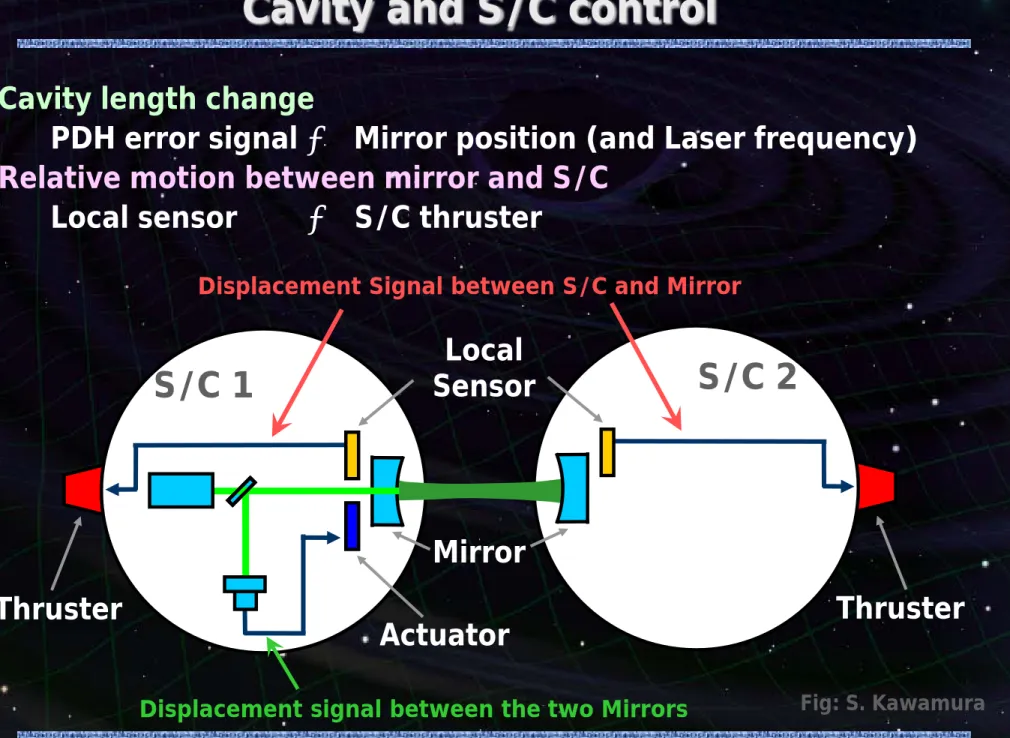
Cavity and S/C control
Local
Sensor
Actuator
Displacement signal between the two Mirrors
Thruster
Thruster
Displacement Signal between S/C and Mirror
Mirror
S/C 1
S/C 2
Fig: S. Kawamura
Cavity length change
PDH error signal Mirror position (and Laser frequency)
Relative motion between mirror and S/C
Requirements
Sensor Noise
Shot noise
3 x 10
-18m/Hz
1/2 (0.1 Hz)Acceleration Noise
Force noise
4x10
-17N/Hz
1/2 (0.1 Hz)Other noises should be well below the shot noise
Laser freq. noise:
1 Hz/Hz
1/2 (1Hz)Stab. Gain 10
5, CMRR 10
5x 10 of LCGT in phase noise
x 1/50 of LISA
External force sources
Fluctuation of magnetic field, electric field,
gravitational field, temperature, pressure, etc.
Orbit and Constellation
Constellation
Record-disk orbit around the Sun
Relative acc. 4x10
-12m/s
2Halo orbit around L2 (or L1)
Relative acc. 4x10
-7m/s
2(Mirror force ~
10
-9N
)
(Mirror force ~
10
-4N
)
4 interferometer units
2
overlapped
units Cross correlation
2
separated
units Angular resolution
overlapped
units
Separated
unit
Separated
unit
Candidate of orbit:
Roadmap
Figure: S.Kawamura 2007 08 09 10 11 12 13 14 15 16 17 18 19 20 21 22 23 24 25 26M
is
sio
n
O
bj
ec
tive
GW observation
Space test of key tech.
Detect GW
with min. spec
FP between S/C
GW astronomy
De
sig
n
Single small satellite
Short FP interferometer
3 S/C
1 interferometer unit
3 S/C
x 3-4 units
DECIGO
Pathfinder
(DPF)
Pre-DECIGO
DECIGO
R&D
Fabrication
Fabrication
R&D
Fabrication
R&D
Organization
PI: Kawamura (NAOJ)
Deputy: Ando (Tokyo)
Executive Committee
Kawamura (NAOJ), Ando (Tokyo), Seto (NAOJ), Nakamura (Kyoto), Tsubono (Tokyo), Tanaka (Kyoto), Funaki (ISAS), Numata (Maryland),
Sato (Hosei), Kanda (Osaka city), Takashima (ISAS), Ioka (Kyoto)
Pre-DECIGO Sato (Hosei) Satellite Funaki (ISAS) Science, Data Tanaka (Kyoto) Seto (NAOJ) Kanda (Osaka city)
DECIGO pathfinder
Leader: Ando (Tokyo)
Deputy: Takashima (ISAS)
Detector Ando (Kyoto) Housing Sato (Hosei) Laser Ueda (ILS) Musya (ILS) Drag free Moriwaki (Tokyo) Sakai (ISAS) Thruster Funaki (ISAS) Bus Takashim a (ISAS) Data Kanda (Osaka city) Detector Numata (Maryland) Ando (Kyoto)
Mission phase
Design phase
1. DECIGO
Overview and Science
Pre-conceptual Design
2. DECIGO Pathfinder
Overview and Science
Design and Status
3. Summary
DECIGO-PF
DECIGO Pathfinder (DPF)
Single satellite
(Payload ~1m
3, 350kg)
Low-earth orbit
(Altitude 500km, sun synchronous)
30cm FP cavity with 2 test masses
Stabilized laser source
Drag-free control
Local Sensor
Actuator
Thruster
First milestone mission for DECIGO
Shrink arm cavity
DPF and DECIGO
DECIGO
requirements
1000km FP cavity
IFO control in space
Low external force
Large optics
Ultra stable Laser
Stabilization of source
Stabilization by long arm
Formation flight
Stable orbit
Inter S/C Ranging
Drag-free control
Low-noise thruster
Observation
Data procession
Data analysis
Triggered search
DPF requirements
Satellite disp.
10
-9m/Hz
1/2Freq. Stability
0.5 Hz/Hz
1/2Disp. noise
6x10
-16m/Hz
1/24x10
-18m/Hz
1/2Force noise
10
-14N/Hz
1/210
-17N/Hz
1/2Thruster noise
10
-7N/Hz
1/20.1 Hz
band
Observation and
Data analysis
Precise meas.
by IFO
Stab. Laser
Drag-free
control
GW Obs.
1 Hz/Hz
1/2DPF mission payload
Fabry-Perot interferometer
Finesse : 100
Length : 30cm
Test mass : 1kg
Signal extraction by PDH
Drag-free control
Local sensor signal
Feedback to thrusters
Mission weight : ~150kg
Mission space : ~90 x 90 x 90 cm
Laser source
Yb:YAG laser (1030nm)
Power : 25mW
DPF Sensitivity
Satellite mass : 350kg, Area: 2m
2Altitude: 500km
Thruster noise: 0.1μN/Hz
1/2Laser source : 1030nm, 25mW
IFO length : 30cm
Finesse : 100, Mirror mass : 1kg
Q-factor : 10
5, Substrate: TBD
Temperature : 293K
(Preliminary parameters)10
–210
–110
010
110
210
–1810
–1710
–1610
–1510
–1410
–1310
–1210
–1110
–1810
–1710
–1610
–1510
–1410
–1310
–12No
is
e
l
e
v
e
l
[1
/Hz
1
/2
]
Frequency [Hz]
Shot noise
Mirror therma
l
Las
er
R
ad
iat
ion
Laser: 1030nm, 25mW
Finesse: 100
Mirror mass: 1kg
Q–value of a mirror: 10
6Cavity length: 30cm
press
ure n
oise
T
h
ru
st
er
n
o
ise
PM
ac
cel
er
at
ion
N
oise
G
eo
g
ravi
ty
Laser Frequency
noise
Dis
p
la
c
e
m
e
n
t No
is
e
[
m
/Hz
1
/2
]
DPF sensitivity
10
–4
10
–2
10
0
10
2
10
4
10
–26
10
–24
10
–22
10
–20
10
–18
10
–16
Frequency [Hz]
S
trai
n
[
1/
Hz
1/
2
]
DECIGO
LCGT
Core-collapse Supernovae NS binary inspiral ScoX-1 (1yr) Pulsar (1yr) Massive BH inspirals Galaxy binaries Gravity-gradient noise (Terrestrial detectors)DPF limit
Background GWs from early universe(Ωgw=10-14)
DPF sensitivity
h
~ 2x10
-15Hz
1/2(x10 of shot noise limit)
Foreground GWs
GW target of DPF
Observable range reaches
the Galactic center
(SNR~5 )
BH QNM
h
~ 10
-15, f
~ 0.3 Hz
Distance 1Mpc,
m
= 10
5M
sunIMBH inspiral and merger
Obs. Duration (~1000sec)
h
~ 10
-15, f
~ 4 Hz
Distance 10kpc,
m
= 10
3M
sunKAGAYA
Blackholes
events
in our galaxy
Hard to access by others
Original observation
10 3 104 105 106 10–1 100 101 102 O b s e rv a b le R a n g e Mass [M ] [k p c , SNR= 5 ] Galactic CenterBH QNM
BH Inspiral
DPF targets
Credit: NASA, STScI
BHs in Globular clusters
BH masses estimated from star motion
Estimate
SNR of GW signals
Equal mass, Mass ratio 1:1/3, 100Msun BH capture
(~150 Globular Clusters
in our Galaxy)
Gravity of the Earth
Measure gravity field of the Earth for Satellite Orbits
Determine global gravity field
Density distribution
Monitor of change in time
Ground water motion
Strains in crusts by
earthquakes and volcanoes
GPS satellite
東京大字地震研・新谷氏、
京都大学・福田氏の資料
/情報提供
Observation Gap
between GRACE and GRACE-FO
(2012-16)
DPF contribution
1. DECIGO
Overview and Science
Pre-conceptual Design
2. DECIGO Pathfinder
Overview and Science
Design and Status
DPF satellite
Stabilized.
Laser source
Interferometer
module
Satellite
Bus system
Solar Paddle
Mission
Thruster head
On-board
Computer
Bus thruster
Mast
structure
Satellite Bus
(‘Standard bus’ system)
DPF Payload
Size : 950mm cube
Weight : 150kg
Power : 130W
Data Rate: 800kbps
Mission thruster x12
Power Supply
SpW Comm.
Size :
950x950x1100mm
Weight : 200kg
SAP : 960W
Battery: 50AH
Downlink : 2Mpbs
DR: 1GByte
3N Thrusters x 4
Comparison with LPF
LPF
(LISA Pathfinder)
DPF
(DECIGO Pathfinder)
Stabilized Laser Interferometer Module Thruster Control Unit Solar Paddle Interfererometer Control Unit Housing Control Unit Mission Thrusters Central Processing Unit Bus Thrusters
Purpose
Launch
Weight
Orbit
Test Mass
Laser source
Interferometer
Sensitivity
Demonstration for LISA
2010
Dedicated launcher (Vega)
1,900 kg
Halo orbit around L1
Drag-free attitude control
Au-Pt alloy x2
Nd:YAG (1064nm)
Mach-Zehnder
3x10
-14m/s
2/Hz
1/2(1mHz)
Demonstration for DECIGO
GW observation
~2013
Dedicated launcher (M-V follow-on)
350 kg
SSO altitude 500km
Drag-free attitude control
TBD x2
Yb:YAG (1030nm)
Fabry-Perot
SWIM launch
Test of signal processing
and control system
Photo:
JAXA
CPU: HR5000 (64bit, 33MHz) System Memory: 2MB Flash Memory 4MB Burst SRAM 4MB Asynch. SRAM Data Recorder: 1GB SDRAM 1GB Flash Memory SpW: 3chSpaceCube2: Space-qualified Computer
SWIMµν : User Module
Processor test board GW+Acc. sensor FPGA board DAC 16bit x 8 ch ADC 16bit x 4 ch 32 ch by MPX Torsion Antenna x2 ~47g test mass Size: 71 x 221 x 171 Weight: 1.9 kg Power: 7W Data Rate : 380kbps Size: 124 x 224 x 174 Weight: 3.5 kg Power: ~7W Photo by JAXA Photo by JAXA
SWIM
(Space-wire Demonstration module)
on SDS-1 satellite
SWIMµν
Tiny GW detector ~47g test masses inside
Levitated control in space
Test mass
Photo sensor
Coil
TAM: Torsion Antenna Module with free-falling test mass
(Size : 80mm cube, Weight : ~500g)
Reflective-type optical displacement sensor Separation to mass ~1mm Sensitivity ~ 10-9m/Hz1/2
6 PSs to monitor mass motion ~47g Aluminum, Surface polished
Small magnets for position control
Used for test-mass position control Max current ~100mA
2 TAMs in the frame
Successful control
SWIM
In-orbit operation
z control on
yaw control on
Operation: May 12, 2009
Downlink: ~ a week
Test mass controlled
Damped oscillation
(in pitch DoF)
Error signal zero
Signal injection
OL trans. Fn.
Free oscillation
R&D for DPF (1)
Stabilized Laser
BBM development
Yb:YAG (NPRO) source
Saturated absorption by I
2 Stability test, Packaging
By
M.Musha
By
S.Sato
IFO and housing
BBM-EM development
Test of concepts
+ Earth gravity sensors
By
A.Araya
R&D for DPF (2)
Attitude control and Drag-free
Satellite structure (mass distribution)
Passive attitude stabilization
by gravity gradient
Mission thruster position
Control topology
Thruster
System design
with existing tech.
Noise meas. system
(thruster stand)
Development of Slit FEEP
By
I.Funaki
By
DPF mission status
DPF : One of the candidate of
JAXA’s
small satellite series
At least
3 satellite
in 5 years with
Standard Bus
+ M-V follow-on rocket
1
stmission (2012): SPRINT-A/EXCEED
2
ndmission (~20013) in selection
Candidates: 2 missions (ERG,
DPF
)
SPRINT-A /EXCEED