論 説 報 文
1
.緒 言国内外において地域の実情に即した循環型社会の構築 が重要な課題となっている1。
1994
年にグンター・パウ リにより提唱された「ゼロエミッション」2はその一つ の代表的な考え方である。これは廃棄物を発生しない自 然界を模範として工業団地を進化させることを目標とし ている「インダストリアル・エコロジー」2の考え方に 類似している。この「ゼロエミッション」の考え方を取 り入れ,1997
年に通商産業省(現在の経済産業省)と 環境庁(現在の環境省の管轄)により作られたのが「エ コタウン構想」3である。エコタウン(以下
ET)事業の目的としては,①個々
の地域におけるこれまでの産業蓄積を活かした環境産業 の振興を通じた地域振興,②地域における資源循環型社 会の構築を目指した産業,公共部門,消費者を包含した 総合的な環境調和型システムの構築,の2
つが掲げられている3。また,その内容について,i)地方公共団体が それぞれの地域の特性を活かして作成した『エコタウン プラン(環境と調和したまちづくり計画)』の基本構想 と具体的事業に独創性・先駆性が相当程度認められ,か つ,そのプランが他の地方公共団体のモデルとなりうる 場合には,通商産業省および環境庁はエコタウンプラン として共同承認するとともに,ii)地方公共団体および 民間団体が行う循環型社会形成に資する先導的なリサイ クル施設整備事業に対し財政支援を実施するものとされ ている。そして,この事業では「ゼロエミッション」を,
「あらゆる産業から出るすべての廃棄物を新たに他の分 野の原料として活用し,あらゆる廃棄物をゼロにするこ とを目指すことで新しい資源循環型の産業社会の形成を めざす構想」としている。
本研究では,エコタウン事業の構成要因や事業パター ンの調査・分析を行うとともに,特にエコタウンの主た る目的の
1
つである環境産業育成面において,技術的側 面を中心に事業構築に有効と考えられるコンセプトとそ の具体的展開法を検討する。2
.従来の研究と本研究の意義エコタウン(ET)事業は地域の循環型社会を構築す るために作られるものであるので,地域の産業や既存イ 環境資源工学
63 : 120–133 (2016)
エコタウン事業の環境産業育成における技術的要素
佐藤 明史
1,3* ・三木 理2
Technological Factors of Environmental Industry Promotion of Eco-town Projects Meiji SATO
1,3* and Osamu MIKI
21
Yawata Unit, Nippon Steel & Sumikin Technology Co., Ltd., Fukuoka 804-0001, Japan
2
Research Center for Sustainable Energy and Technology, Kanazawa University, Ishikawa 920-1192, Japan
3
Graduate School of Natural Science and Technology, Kanazawa University, Ishikawa 920-1192, Japan
Abstract
Eco-town projects are valued highly inside and outside of Japan as a way to build a local resource circulating soci- ety. The most important point of any Eco-town project is the implementation of a real recycling business, and building a reliable Eco-town brand. In various places in and outside of Japan, a lot of plans similar to Eco-town projects have been built, but many plans have not been fully realized. The main reasons for this are that the concept of plan did not fit the local specifications, and concrete methods for implementation of the projects were not sufficiently clear.
The purpose of this research is for the authors to show that the Eco-town project is suitable, and to present a con- crete method for creating resource circulation society that can be tailored to each local region. Then, we attempt to sys- temize technical elements and functions of Eco-towns, especially from the point of view for making environmental in- dustries.
Key words: Eco-town projects, Resource recycling society, Environmental industry, Recycling, Implementation
キーワード:エコタウン事業,循環型社会,環境産業,
リサイクル,事業化
1 日鉄住金テクノロジー(株)八幡事業所
2 金沢大学理工研究域サステナブルエネルギー研究セン ター
3 金沢大学大学院自然科学研究科 平成
28
年9
月21
日受理*e-mail: [email protected]
121
ンフラなどにどのような特徴があるかを理解し,それらを活かしてどのような
ET
を作るかについての明確な指 針が必要である。これまでに報告された
ET
研究の視点は,次の4
つに 分類することができる;(1
)事業内容の特徴,(2
)事業 の実現方法,(3)事業内企業の相互連携,(4)地域循環。それらの内容と課題について以下に述べる。
(1)事業内容の特徴に関する研究
事業の具体的内容の特徴に関する研究4–12や,複数の 事業の事業内容を比較検討した研究13–20が行われてい る。松永は,
7
ケ所の事業をその特徴から次の3
つのタ イプ,a)環境産業育成型:環境産業の振興に重点を置 く,b
)廃棄物処理対応型:廃棄物の広域的な処理を行う,c)コミュニティ形成型:環境と住民参加をキーワード
とした都市づくり,コミュニティづくりを行う,に分類 している7。外川は,14
の事業について,過疎地,小都市,鉱業地域,大都市の工業団地,臨海部工業コンビナート および広域などにより分類している14。また関らは,10 ケ所の事業を取り上げ,事業の方向としてエネルギー系,
中間系,環境系,および担い手として行政主導型,市民 主導型と企業主導型,により事業を分類している20。
現在,全国には
26
のET
事業が存在しているが,こ れらのET
事業について設置されている場所の地域の特 性と目指している方向の関係がより明確になれば,今後 のET
事業拡大に有益であると思われる。(2)ET事業の実現方法に関する研究
目指すべき
ET
事業の姿を構築した後,どのようにそ れを実現していくかに関する研究もある。数多くの事業 が実現した北九州ET
事業における政策や事業化のポイ ントを整理したもの21,22がある。また中国にET
を作る ために,北九州市の循環型都市協力事業の経験を活かし て,a)現状把握,b)課題の整理,c)目標の設定・基 本計画の策定,d
)支援政策の検討,e
)事業化の検討,などのステップに分けて,ET導入ガイドライン6が作 られている。
これらの研究によれば,ET事業の計画を立案し,実 際にリサイクル事業をスタートするまで多くの時間を費 やす例が多い。そのため
ET
事業の実現には,理想,理 念より,実現に重きを置いた実行計画をいかに立案し,スピーディーに実行する方法を明確にすることが必要で ある。
(3)ET内における企業の相互連携についての研究 事業の高度化に向けた取り組みとして,
ET
内におけ る企業の相互連携の在り方に関する研究も進められてい る23。そこでは連携の課題として,a
)設備,b
)購入,c
) 置場,d)ユーティリティ,e)メンテナンス,f)廃棄物 活用,g
)共同開発,などを挙げ,それらを企業活動の工程上から
A
)入口(廃棄物収集),B
)輸送(工場前後),C)工場間, D)出口(資源化物販売), E)全体連携(規
制緩和等),に分けて,事業内に立地する複数企業の協力,
シナジー効果を高めるための活動が提案されている。し かし,これら高度化に向けた連携を具体的にどのように 進めるかについては今後の検討課題としている。
(
4
)地域循環に視点を置いた研究地域内で循環可能な資源はなるべく地域で循環させ,
地域内での循環が困難なものについては循環の輪を広域 化させていくという「地域循環圏」という考えが示され ている。この地域循環圏の形成に
ET
事業が中心的な役 割を果たしているかどうかに関する研究も行われてい る24。以上のように,これまで行われた研究は,ETの分類 や導入・進化・高度化について個別に検討した事例が主 である。
この
ET
事業が特に注目され参考にしたいと考えられ ている点は,多数のリサイクル事業が現実に創出された 上,環境事故などが起きにくい信頼性の高いリサイクル 工業団地が構築されていることである4,5。しかし,国内 外のいくつかの地域においては,ET
事業やそれに類似 した考え方の計画が立案されたにもかかわらず,事業が 予定通り実現しない例も生じている。その主たる理由と して,地域の実情に即した事業のコンセプトが明確でな いことと,事業を実現するための具体的な展開方法が示 されていないことが挙げられている6。本研究では,これまでに報告された研究資料を参考と して,数多い
ET
事業の構成要因や事業パターンの調査・分析を行った後,特にエコタウンの主たる目的の
1
つで あり,重要度も高い環境産業育成面において検討した。その結果,事業構築におけるコンセプトの立案方法が明 確でないこと,またその事業実現への要件や具体的な展 開方法が確立されていないことが課題と考え,事業実現 に有効と考えられるコンセプトとその具体的展開の実行 策をリサイクルフローや
Material flow ayalysis
(MFA
) 分析等を意思決定ツールとして研究する。3
.地域特性に適合するエコタウン事業タイプの選択ET
事業の目的が,地域の実情に即した循環型社会構 築であることから,先ずET
事業に解決を期待する主要 課題を抽出した後,それぞれのET
が存在する地域の地 域特性を用いてET
の事業タイプの選定を行った。この 選定においては,松永の分類を参考に7,代表的なET
事業をそれらET
の設立目的から「環境産業育成型」,「廃 棄物適正処理型」および「環境意識醸成型」の3
つのタ イプに分類した。この分類の有効性については,各ET
事業との関連において検証が試みられている25。
3.1
ET
事業において解決が期待されている課題ET
事業の設立目的として,1
)環境産業を育成する,2
) 廃棄物を処理する,3)市民の環境意識を向上させる,などが挙げられている26。そこで,全国の全
26ET
の中 から,①ET
承認地域が都道府県など広域ではなく市町 村など狭い地域に集中している,②ET
プランにおいて,事業の目指す方向が比較的明確である,③複数の
ET
施 設(ET
ハード補助金が交付されている施設を含む)が 稼働している,という条件で,北九州市,川崎市,札幌 市,飯田市(長野県)および水俣市(熊本県)の5
都市 を調査対象に選んだ。そして経済産業省のET
環境産業 進行形・環境調和まちづくり事例集27を用いて,解決が 期待されている主な課題をTable 1(エコタウン地域承
認年を含む)のように分類した。Table 1
にはそれぞれ のET
の地域承認年を示す。Table 1
において,ET
の設立目的が新産業の育成である場合では,北九州市や川崎市のように,戦後発展して きた臨海工業地帯の重化学工業が曲がり角を迎え,少し でも新しい産業を育成したいとの狙いがある。そのため には既存の資産・インフラの活用が効率的であり,その 点から環境産業(重工業産業設備を活用したプラスチッ クリサイクル事業など)育成を重点に挙げている28。
廃棄物の適正処理が主目的である札幌市の場合は,エ コタウンの検討を開始した当時は人口増に伴う一般廃 棄物の増加が課題になっていたため,廃棄物の適正処理 としてリサイクルの拡大が求められて
ET
が作られた(1998年)。
また,目的が市民環境意識の向上である場合は,飯田 市や水俣市など比較的小規模都市において環境をテーマ に市民意識を向上させ,これを町の活性化につなげるた
め
ET
が有効に活用された。なお水俣市の場合は,ET
団地を造り環境産業を育成する目的も同時にあった。3.2
地域特性の評価地域に適合する
ET
事業を選定するためにはET
が設 置される地域,都市独自の地域特性を評価する必要があ る。まず,前節で取り上げた5
都市のET
を,Table 1の①環境産業育成型,②廃棄物適正処理型および③環境意 識醸成型の
3
つのタイプに分類し,各分類とそれぞれの 地域特性との関連を調べた29–55。Table 2
に環境産業の育成を目的とした北九州市と川崎市の地域特性を示す。それぞれのデータは
Table 2
~4
すべてにおいて,ET地域承認の影響を見るために,そ れぞれの地域のET
地域承認年における値を用い,増減 を示す場合は,地域承認年とその5
年前の値との変化を示した。
Table 2
における地域特性データから明らかなよ う に, 北 九 州 市 と 川 崎 市 は
a) 人 口 が 101.5
万 人,121.7
万人と多く,b
)工業製品出荷額も237
万円/
人,439
万円/
人と多いが–7.35%,–10.06%
と減少傾向であ り,c
)産業廃棄物が787,000 t
・年/
人,370,000 t
・年/
人と多く,d)製造業のインフラを有する。地域特性の 結果から,これらの都市のET
は,既存インフラの活用 による新産業の育成を目指した環境産業育成型であるこ とが分かる。Table 3
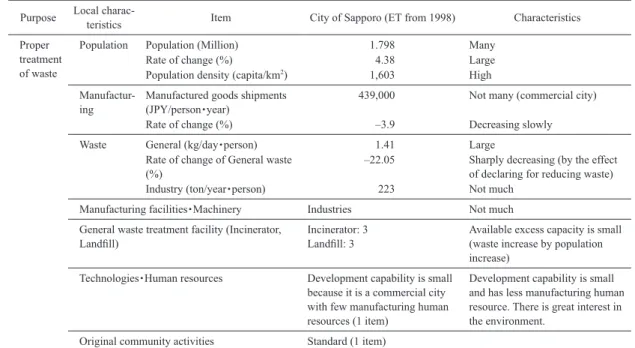
に廃棄物適正処理を目的とした札幌市の地域特性を示す。札幌市は北海道の中心都市として,急激な 人口増加(4.38%増加)による一般廃棄物の増加に苦慮 し,市長がゴミの非常事態を宣言するなど,ゴミの減量 や施設の増強に取り組むとともに,廃棄物の単純処理か らリサイクル活動に取り組んだ。この結果札幌市のリサ イクル団地内には全国のエコタウン事業の中で比較的早 くから多種多様な事業が集積していた55。しかし,地域
Table 1 Tasks potentially solved by ET projects
Purpose of ET Task City (Registered fiscal year for
ET)
New industry promotion (Recycling industry)
• Substitute declining heavy industries near seashore with new industries
• Utilize high leverage technologies in manufacturing to create environmental industries
• Utilize existing infrastructure for manufacturing to create environmental industries
City of Kitakyushu (1997) Kawasaki city (1997)
Proper treatment of waste
• Dealing with the increase of general waste due to increasing population (promote citizen actions to decrease the amount of general waste at source)
• Use more earth friendly action like recycling
City of Sapporo (1998)
Promoting citizen’s environmental mind Activating of communities
• To make more concrete community by using renewable
energy, segregation of waste and ISO14001 activities Iida city (1997)
Minamata city (2000)
123
に立地した大都市で商業都市であることから,一般廃棄物の削減に成功した後(
–22.05%
減少)は,産業廃棄物 も少ない(223,000 ton•year/person)ことから,特にそれ
以上の環境産業育成の必要性は小さかった。Table 4
に市民環境意識の向上やコミュニティの活性化を目的とした
ET
である飯田市と水俣市の地域特性を 示す。飯田市と水俣市は,a)人口(11,1
万人,3,11
万人)が小さく,人口密度(
341
人/km
2, 191
人/km
2)も小さ い都市ながら,b)化学工業や精密機械産業などものづ くりの企業が根づいている。また,c
)一般廃棄物の削 減 に 積 極 的 に 取 り 組 ん で い る こ と(0.88 kg/日・ 人,0.95 kg/
日・人)も特徴である(産業廃棄物のデータはないが量は少ない)。独自のコミュニティ活動としては,
d
)飯田市においては太陽光市民共同発電事業があり,e
)水俣市では環境を町の活性化の手段としてごみの
21
分 別(2015
年4
月1
日現在)により,月に数回地域の人々 が会話する場が作られている56。3.3
地域特性とET
タイプとの対応Table 2
~4
の地域特性の中から,人口,一般廃棄物量および産業廃棄物量を主要な要因として選定し,これ にソフト要因として技術・人材と独自のコミュニティ活 動内容の特徴を加えて分析した。次に,これら
5
都市の5
種類の地域特性について最も大きいものを1(基準)
として相対的に比較した。この結果を
Fig. 1
に示す。Fig. 1
から明らかなように,①北九州市と川崎市の特徴は人口(
0.57, 0.68
)および規模の大きい製造業が多い ため,一般廃棄物量(0.92, 0.82)と産業廃棄物(1.0, 0.42)を多量に発生することであるが,同時に環境に関連する
Table 2 Local characteristics of ET for environmental industry promotion
Purpose Local characteristics (Items) City of Kitakyushu
(ET from 1997) Kawasaki city
(ET from 1997) Characteristics New industry
promotion (Recycling industry)
Population Population (Million) 1.015 1.217 Moderate
Rate of change of Population
(%) –0.49 1.83 Slight increase~
decreasing Population density
(capita/km
2) 2,101 8,531 High
Manufac-
turing Manufactured goods
shipments (JPY/person
•year) 2,374,000 4,387,000 Much
Rate of change of Manufac-
tured good shipment (%) –7.35 –10.06 Decreasing; Mainly
heavy industries
Waste General (kg/day
•person) 1.30 1.17 Intermediate
Rate of change of General
waste (%) 3.01 –5.68 Kitakyushu: increase
Kawasaki: decreasing
Industry (ton/year
•person) 787 370 Much
Manufacturing facilities
Machinery Steel works: 1 (Blast
furnace, Coke oven), Power generation: 2
Steel works: 1 (Blast furnace, Coke oven), Power generation: 2
High temperature furnace, waste treatment General waste treatment facility
(Incinerator, Landfill) Incinerator for general
waste: 3, Landfill: Incinerator: 3, Landfill:
1 Incinerator &
Landfill Technologies
•Human resources Steel making technolo-
gy, cement production technology, waste treatment technology (Total 2 items)
Steel making technolo- gy, cement production technology, waste treatment technology (Total 2 items)
Development capabilities, human resource of manufac- turing, high interest in environment Original community activities Standard (1 item) Standard (1 item)
Notes)
• The data for local characteristics is population
29–34, population density
35,36, Manufactured goods shipments
37–43, General waste
44–46and industrial waste
47–49. All data is the data in each registered year for ET.
• Each rate of change is encompasses the 5 years before the registered year for ET until the registered year for ET.
• Manufactured goods shipments are not published in the case of small Municipalities.
• Date of industrial waste is only published by prefectures and Government-ordinance-designated city.
• When the data of target year cannot be obtained, the data is calculated by proportional distribution of closer years.
• The data of manufacturing facilities
51,52, treatment facilities for general waste
53, cement facilities
54, technologies
•human resources,
community activities is obtained by papers
27of each ET (Mainly present number).
技術・人材(0.66, 0.66)が豊富であることから,これら の都市の
ET
は環境産業育成型に位置付けることができ る。また,②札幌市は商業都市であることから産業廃棄 物は少ないが,人口が多いこと(1.0
)により一般廃棄物(1.0)の処理が課題であり,そのため
ET
は廃棄物処 理型といえる。それに対し,③飯田市・水俣市の場合は,人口の小さい地方都市であるため廃棄物(0.62, 0.67)の 問題は小さいが,中小都市に特徴的な製造業も多いこと
Table 3 Local characteristics of ET for waste treatment
Purpose Local charac-
teristics Item City of Sapporo (ET from 1998) Characteristics
Proper treatment of waste
Population Population (Million) 1.798 Many
Rate of change (%) 4.38 Large
Population density (capita/km
2) 1,603 High
Manufactur-
ing Manufactured goods shipments
(JPY/person
•year) 439,000 Not many (commercial city)
Rate of change (%) –3.9 Decreasing slowly
Waste General (kg/day
•person) 1.41 Large
Rate of change of General waste
(%) –22.05 Sharply decreasing (by the effect
of declaring for reducing waste)
Industry (ton/year
•person) 223 Not much
Manufacturing facilities
•Machinery Industries Not much
General waste treatment facility (Incinerator,
Landfill) Incinerator: 3
Landfill: 3 Available excess capacity is small (waste increase by population increase)
Technologies
•Human resources Development capability is small because it is a commercial city with few manufacturing human resources (1 item)
Development capability is small and has less manufacturing human resource. There is great interest in the environment.
Original community activities Standard (1 item)
Table 4 Local characteristics of ET for promoting environmental mind Purpose Local
characteristics Item Iida city
(ET from 1997) Minamata city
(ET from 2000) Characteristics Promoting
citizen’s envi- ronmental awareness Activating communities
Population Population (Million) 111,000 31,100 Small
Rate of change (%) 0.59 –5.16 Slight increase~decreasing
Population density
(capita/km
2) 341 191 Small
Manufactur-
ing Manufactured goods shipments (JPY/
person
•year)
359,000 309,100 Not much
Rate of change (%) –11.63 7.18 There is variation
Waste General (kg/day
•person) 0.88 0.95 Small
Rate of change of General
waste (%) No data 6.07 Increase (Minamata city)
Industry (ton/year
•person) No data No data Technolo-
gies
•Human resources
Technology, human
resource Human resource for
precision machinery industry (Total 3 items)
Human resource for chemical, liquid crystal
& electric components industries (Total 3 items)
Many human resource for environmental education
Original community activities
Activities to activate
community Cooperative solar power generation and biomass utilization by citizens, (Total 2 items)
Separation of general waste into 21 groups, Env. ISOEMS (Total 2 items)
Unique activities are done
energetically
125
から技術・人材(1.0
)やコミュニティ活動(1.0
)による環境意識醸成型
ET
を作り上げている。以上のような地域特性と
ET
タイプとの対応関係を利 用することにより,対象とする地域に適合するET
事業 の選定が可能になると思われる。4
.環境産業育成型事業実現への要件エコタウン(以下
ET
)の3
つのタイプのうち,最も 多くの地域が目指している環境産業育成型事業に成功す るための要件,それに必要なハード技術とソフト技術,および事業実現のための実行策について検討する。ここ でいうハード技術とは,廃棄物の処理・再資源化に用い られるプロセスおよびそれに関わる機械・設備・関連技 術を指している。またソフト技術とは,ハード技術の前 後にあって,廃棄物の処理・再資源化を効率よく推進す るために必要な業務・行動(広義の技術)を意味するも のとする。
4.1
環境産業育成型事業実現への要件3.1
で示したように,環境産業育成型ET
事業に期待 されている点は,①臨海工業地帯などの重厚長大工業の 陰りを新しい産業で補う,②高度なものづくり力を環境 産業創出に活用する,③既存ものづくりインフラを活用して環境産業を創出することである。これらを解決する ための要件について検討する。
(
1
)個別企業について個別事業のビジネスモデルを含む
ET
の全体計画を立 案し,ET
地域承認を得た後,個別企業による環境ビジ ネスを作る。そこではMFA
分析を用い,収集できる廃 棄物量を定量的に把握し,十分な廃棄物これを工場で資 源化した際の効率,資源化量を把握して,しかも安定的 に資源化物を販売できる定量的なビジネスモデルを構築 することが必要となる。採算性が確保できる場合には,リサイクルの質にも留意し,持続可能なビジネスとなり うるかの検討が必要である。また環境事故が起こらない 信頼性や,地域に認められる企業になるため地域の環境 教育に貢献するなども重要な要素となる。
(
2
)ET
内企業の連携次に,個別立地企業が設立されただけでは,環境産業 育成型の
ET
事業としては不十分である。立地企業は一 定の広さの工業団地または地域に集積していることや,その中で様々な連携が行われることが望ましい。理想的 には,各個別事業は
ET
事業会社の個別事業別の事業部 的に運営されることである。連携は,MFA
分析の観点 から,廃棄物収集(入口),運搬,工場,資源化物販売(出 口)のビジネス全般を定量的に把握して集積性があり,しかも環境事故が起こらないように相互監視すること や,
ET
内の廃棄物を限りなく資源化するための連携な どが重要となる。(
3
)ET
周辺地域・他地域との連携さらに
ET
は,地域の資源循環構築のための中核とな ることが望まれている24。循環型社会の構築はET
の団 地内のみならず,地域から有用な廃棄物をできる限り収 集して資源化し,地域産業の競争力が向上する形で資源 を供給するMFA
分析に基づき定量的に分析して,地域 循環圏構築に主導的な役目を果たすことが望まれる。以上の要件を纏めると
Table 5
のようになる。このよ うに地域の循環型社会を構築するための目指すべき環境 産業育成型ET
の条件を実現していくことが重要なテー マである。4.2
環境産業育成型事業実現における必要なハード技 術とその重要度ET
事業における業種別のハード技術の役割を,より 具体的に検証するために,全国26
のエコタウン事業に 存在するペットボトル,家電,自動車の主要3
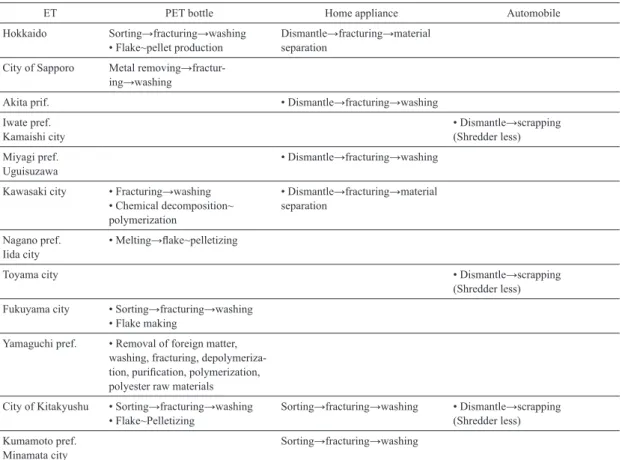
事業(エ コタウン補助金対象施設,非対称施設を含む)で適用さ れているハード技術をTable 6
に整理した。Table 6
57においてハード技術の適用状況をみると,ペットボトルは,選別
→
破砕→
洗浄という廃棄物処理業プ ロセスと,フレーク,ペレット製造というものづくり業Fig. 1 Comparison of local characteristics for five represent-
ative cities
プロセスの両方の技術を持っている場合が多い。工場運 営上から,両方の技術を持つということには廃棄物処理 工場と生産工場の両方を持つという難しさが存在する。
次に家電は,分解→破砕→素材分別という分解・分別 プロセスが中心である。素材分別精度が事業の採算性を 決めるために,最新技術を含め様々な種類の選別装置が,
Table 5 Business conditions for environmental industry promotion
Target Tasks
Each factory Business and technological necessity
Waste collection→recycling technologies→selling of resource Task • Profitability, Realization of higher recycling ratio
• Continuation of highly reliable waste treatment
• Contribution for local environmental education Cooperation in ET Cooperation
• Collection, transportation, factory, selling of resource, total Task • Highly technological waste treatment and mutual monitoring Cooperation among ET
and surrounding area and other area
Task • Deceasing local waste generation
• Foundation of recycling industries and enlarging local resource circulating
• Cooperation between material and resource circulating industries
• Promotion of local resource circulation area (Proper and efficient resource circulation, resource circulating utilizing local characteristics, resource circulation providing local vitality)
Table 6 Hard technologies in three main business in ET
ET PET bottle Home appliance Automobile
Hokkaido Sorting→fracturing→washing
• Flake~pellet production Dismantle→fracturing→material separation
City of Sapporo Metal removing→fractur- ing→washing
Akita prif. • Dismantle→fracturing→washing
Iwate pref.
Kamaishi city • Dismantle→scrapping
(Shredder less) Miyagi pref.
Uguisuzawa • Dismantle→fracturing→washing
Kawasaki city • Fracturing→washing
• Chemical decomposition~
polymerization
• Dismantle→fracturing→material separation
Nagano pref.
Iida city • Melting→flake~pelletizing
Toyama city • Dismantle→scrapping
(Shredder less) Fukuyama city • Sorting→fracturing→washing
• Flake making
Yamaguchi pref. • Removal of foreign matter, washing, fracturing, depolymeriza- tion, purification, polymerization, polyester raw materials City of Kitakyushu • Sorting→fracturing→washing
• Flake~Pelletizing Sorting→fracturing→washing • Dismantle→scrapping (Shredder less) Kumamoto pref.
Minamata city Sorting→fracturing→washing
127
多段式で活用されている。また自動車は,販売用パーツ回収,鉄・非鉄の分別回 収,スクラップ製造のプロセスが基本である。最初の段 階の販売用パーツ回収が収益的にも重要で,その後,シュ レッダー方式およびシュレッダーレス方式により鉄・非 鉄を分別回収する。特にシュレッダーレス方式は,ワイ ヤーハーネスを徹底的に回収することにより,鉄スク ラップ中の銅含有量を減らし,製鉄会社における転炉工 程での利用率を高めている。
次に
ET
事業の主要3
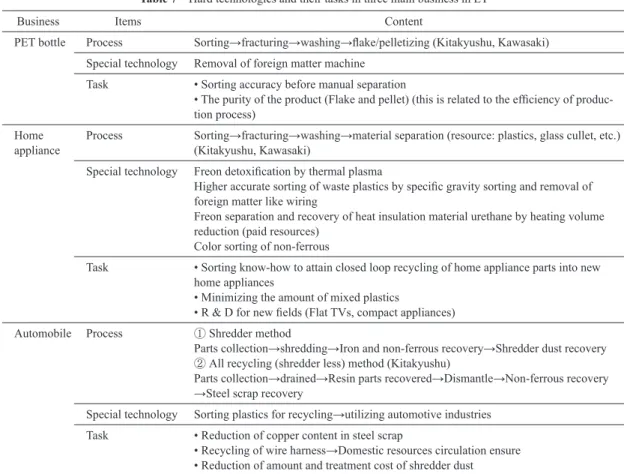
事業で適用されているハード技 術の課題をTable 7
にまとめる。Table 7より,工程別の 必要能力としては,(a
)選別前工程における完全な異物 除去(選別工程での製品ペレットの品質向上に必要),(b)選別機では,高速選別などの最新技術の導入,(
c
)破砕 工程では,安価な刃物の使用と長寿命化,などが技術課 題となっている。特に刃物は大量に使用する消耗品なの で,刃物の長寿命化は重要なテーマである。一方,ハード技術の総合力により決まるものとしては,
(d)生産効率の向上(要員,歩留・原単位・作業率),(e)
廃棄物という品質が安定しない不均質原料から高品質・
均一な資源をつくる(販売価格に寄与),(f)リサイク ル工程においてやむを得ず発生する発生廃棄物のミニマ ム化(処理費用および環境事故の低減に寄与),が重要 である。
このほか
ET
には多数のリサイクル事業が集積してい るので,発生する廃棄物をほかのリサイクル会社で原料 として受け入れてもらい,ET全体としてMFA
分析に 基づき廃棄物をミニマム,すなわちゼロエミッションを 目指すことも重要である。従って,今後リサイクル事業において強化すべきハー ド技術の課題は,新規製品のリサイクル技術開発(小型 家電,フラットテレビ,レアメタル,ソーラーパネル等),
海外の手選別との競争力維持のための省力化,自動化技 術開発(選別技術力の向上),装置の小型化,刃物の長 寿命化などなどが挙げられる。
以上の検討の結果から,環境産業育成型
ET
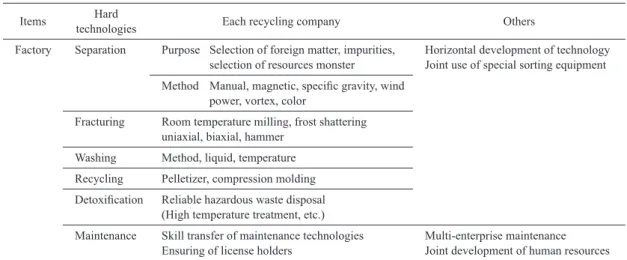
事業にな るために必要なハード技術をTable 8
にまとめた。環境 産業育成型ET
事業を実現するために必要なハード技術 は,個別立地企業においては,主として工場における競 争力を左右する。主要な工程である選別,粉砕,洗浄,Table 7 Hard technologies and their tasks in three main business in ET
Business Items Content
PET bottle Process Sorting→fracturing→washing→flake/pelletizing (Kitakyushu, Kawasaki) Special technology Removal of foreign matter machine
Task • Sorting accuracy before manual separation
• The purity of the product (Flake and pellet) (this is related to the efficiency of produc- tion process)
Home
appliance Process Sorting→fracturing→washing→material separation (resource: plastics, glass cullet, etc.) (Kitakyushu, Kawasaki)
Special technology Freon detoxification by thermal plasma
Higher accurate sorting of waste plastics by specific gravity sorting and removal of foreign matter like wiring
Freon separation and recovery of heat insulation material urethane by heating volume reduction (paid resources)
Color sorting of non-ferrous
Task • Sorting know-how to attain closed loop recycling of home appliance parts into new home appliances
• Minimizing the amount of mixed plastics
• R & D for new fields (Flat TVs, compact appliances) Automobile Process
①Shredder method
Parts collection→shredding→Iron and non-ferrous recovery→Shredder dust recovery
②
All recycling (shredder less) method (Kitakyushu)
Parts collection→drained→Resin parts recovered→Dismantle→Non-ferrous recovery
→Steel scrap recovery
Special technology Sorting plastics for recycling→utilizing automotive industries Task • Reduction of copper content in steel scrap
• Recycling of wire harness→Domestic resources circulation ensure
• Reduction of amount and treatment cost of shredder dust
資源化などの工程は,人員,エネルギー,部品寿命,資 源化率などを左右する重要な技術である。またどうして も発生する廃棄物の適正処理は,
ET
における環境事故 防止の信頼度を決める重要な要素であり,メンテナンス は重要である。これらのハード技術のレベルアップと技能伝承を可能 とするものが,
ET
内の連携である。刃物などの共通の 課題には,情報交換によりレベルアップを図れるものも あるし,メンテナンスにおいては,共通のメンテナンス マンの起用や,共同で技能伝承教育などを行うことも可 能である。このように個別企業における努力と合わせて,ET内 での連携がハード技術向上のキーであると考えられる。
4.3
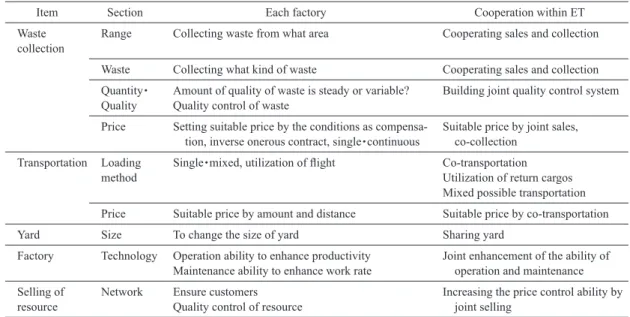
環境産業育成型事業において必要なソフト技術と その重要度この事業におけるソフト技術は,「廃棄物収集」,廃棄 物をリサイクルして資源として販売する「資源化物販売」
および「輸送」に大別される。これらソフト技術の業種 別の業務内容と課題と考えられるものを
Table 9
に挙げ た。Table 9に示すように,ソフト技術の基本は,廃棄 物収集に係る費用,輸送距離,資源化物の販売価格の最 適化である。廃棄物収集に関しては,ペットボトルおよ び家電はリサイクル法で支援されているが,自動車など の他業種では,個別の企業の営業努力に依存している。ただ
ET
の立地企業であることは,環境配慮企業である ことをアピールしやすく廃棄物収集において有利に働く 場合もある。また輸送においては,現状法律の規制が厳 しいので積載方法等の規制の緩和が期待されている。工 場においては,メンテナンス技術の向上,季節による集 荷量の変動に対応した置場能力の確保などが要点と思わ れる。さらに資源化物販売においては,動脈との連携の観点から,資源化物から製品を作る施設が
ET
内にある ことが理想である。そのほか,売れ筋パーツの判断と販 売ネットワークの構築,高品位鉄スクラップの販売先の 開拓などが必要と考えられる。現在のリサイクル関連
ET
事業における最大の課題は,MFA
分析の際にも重要な観点となる集荷量の確保に関 するソフト技術である。集荷量の向上には,廃棄物の生 成位置,量,品質の正確な把握が重要となる。また輸送 については,輸送距離に加えて,帰り空便の活用や,ほか の部品との混載など,輸送効率の向上が必要である。ま た,静脈物流は動脈物流に加えて,引取りタイミングが 厳格でない場合も多いのでコストダウンの余地がある。個別企業の廃棄物マーケッティングに加えて,廃棄物 の種類によっては,地元の廃棄物を確実に
ET
で処理す るため(地産地消)の規制強化への取組が期待される。また資源化物販売についても,海外に販売されるのでは なく,国内の動脈企業に確実に届けるネットワークの構 築が重要である。さらに国全体としても,資源セキュリ ティー(資源の確保,資源自給率向上)などの観点から 資源化物の国内確保も重要である。その実現には全国の 廃棄物のフローを明確化し,資源がより国内で循環する 方法を検討する必要がある。
以上の検討結果から,環境産業育成型
ET
事業に必要 なソフト技術をTable 10
に示す。動脈産業においては,工場のハード技術の重要度が非常に高い。しかしながら,
リサイクル事業においては,Table 9に示すように,ソ フト技術の重要性が大きい。その理由は,廃棄物収集が 前工程,すなわち他社の工場の都合に依存しているケー スが多いため,量的にも質的にも廃棄物収集が安定せず,
またバージン原料との競争に打ち勝ち,安定的な資源化 物販売先を確保することが難しいためである。
Table 8 Required hard technologies for ET of environmental industry promotion
Items Hard
technologies Each recycling company Others
Factory Separation Purpose Selection of foreign matter, impurities,
selection of resources monster Horizontal development of technology Joint use of special sorting equipment Method Manual, magnetic, specific gravity, wind
power, vortex, color
Fracturing Room temperature milling, frost shattering uniaxial, biaxial, hammer
Washing Method, liquid, temperature Recycling Pelletizer, compression molding Detoxification Reliable hazardous waste disposal
(High temperature treatment, etc.) Maintenance Skill transfer of maintenance technologies
Ensuring of license holders Multi-enterprise maintenance
Joint development of human resources
129
ソフト技術の中身をより具体的に示すと,①廃棄物収集においては,環境に配慮した,持続可能な社会を構築 するためには,単純焼却・単純埋立ではなく,リサイク ルを行う必要があることを顧客に理解してもらう営業 力,②輸送においては,より安価な輸送手段(帰り空便 の活用など)を使える企画力,③工場では,生産性を向 上させることができる操業力(刃物の長寿命化等),作 業率を向上させるメンテナンス力など,④廃棄物収集量 の大きな変動に対応できる置場の確保,⑤資源化物販売 においては,バージン資源と競争できる品質や資源化物 販売量の確保による価格支配力,などが必要である。さ
らに,それぞれの項目に関して個別立地企業で努力する だけでなく,⑥
ET
内連携を強化することが重要である。Fig. 2
に環境産業育成型ET
事業となるために必要なソフト技術とハード技術の関係を示す。中心に工場に必要 な技術として,ハード技術が存在し,その両側に,廃棄 物収集と資源化物販売に関するソフト技術が存在する。
4.4
目指すべきET
事業実現のための実行策ここまで
ET
事業に解決が期待されている課題および 地域特性評価を用いた事業の選定方法を示すとともに,環境産業育成型事業になるための条件と必要なハード・
ソフト技術を提案してきた。
Table 9 Soft technologies and their tasks in three main business
Business Item Content
PET bottle Waste collection • PET bottles from houses are recycled by bidding followed by containers and Packaging Recycling Law (Price optimization by amount, transportation length)
• PET bottles from companies are recycled by contracts with supermarkets and vendors (Price optimization by amount, transportation length)
Transportation • Collection by own company (partially consignment) (Loading method, transportation length, price optimization)
Selling of
resource • Selling to production companies (Maintaining price control by ensuring amount of resource) Task • Determination of the bid price (Balance ensure between treatment ability and volume of
orders)
• Consideration in handling the amount of balance between PET bottles from houses and companies
• Relaxation of regulations for mixture transportation and utilization of return cargo
• Getting lower price electricity by joint enterprise Home
appliance Collection • Regional sharing by home appliance recycling law (Efficient collection)
Transportation • Collection by own company (partially consignment) (Loading method, transportation length, price optimization)
Selling of
resource • Selling to production companies (Keeping the price control ability by ensuring amount of resource)
Task • Keeping the size of yard which corresponds to seasonal variation of the collection amount
• Getting lower price electricity by joint enterprise
• Ensuring maintenance technologies and technical transfer in/outside factories
• Education of home appliance recycling law for reducing to export home appliance
• Efficient transportation by mixture and relaxation of regulations Auto-
mobile Waste collection • Collection from dealers, automobile maintenance companies (Optimization of transportation length and price)
Transportation • Selling to production companies (Keeping the price control ability by ensuring amount of resource)
Selling of
resource • Parts collection and selling (Judgment of stocking parts, and join networks for used parts)
• Steel scrap and non-ferrous metal sales (Keeping the price control ability by ensuring amount of resource)
Task • Judgment of stocking parts, and closely cooperation with networks for used parts
• Ensuring high quality steel scrap to customers (low copper content)
• Getting lower priced electricity by joint enterprise
• Efficient trans. by mixture transportation and utilization of return cargo
• Reduction of amount and treatment cost of shredder dust (treatment facility selection by
length and price)
次に必要なことは,実際に
ET
事業を構築・実現する 作業である。そのためのET
事業実現のための実行策をFig. 3
にまとめた。目標とする事業を実現するためには,まず方針の明確化,現状の把握,課題の整理が重要であ る。最初に実施する事業の対象を決めるために体制を作 り,現状を把握するとともに,事業を始める上での課題 を明確にすることが必要である。次に事業の基本計画,
コンセプトを立案する。環境産業の実現には,地域に循 環型社会を作るなどのコンセプトを作り,地域のステー クホールダーの賛同をえることが必要である。個別の事 業計画が策定できたら,
ET
内企業や地域と連携して事 業を構築することが重要である。以下,北九州
ET
事業を具体的な展開事例として示す。鉄鋼業を中心とした重工業に陰りが見え,また臨海地に 広大な土地を抱え,その活用方法を模索していた。各種 の基礎検討の結果,静脈ビジネスが候補として挙がった が十分な収益を上げることは難しいと結論付けられた。
しかしリサイクル施設を作りたいとの思いと,通商産業 省,環境庁のリサイクル法の設置に伴う処理施設の設置 の必要性と思いが合致し,
ET
事業が始められた。従来 から公害を克服した町として環境への意識は高かった が,廃棄物ビジネスは住民の人気もなく,難しい決断で あったが,地域の活性化のために,環境を新しい産業と して育成することとした。北九州
ET
事業では,産学官ゼロエミッションを中心 とするET
プランを作成し,工業団地にリサイクル事業Table 10 Required soft technologies for ET of environmental industry promotion
Item Section Each factory Cooperation within ET
Waste
collection Range Collecting waste from what area Cooperating sales and collection Waste Collecting what kind of waste Cooperating sales and collection Quantity
•Quality Amount of quality of waste is steady or variable?
Quality control of waste Building joint quality control system Price Setting suitable price by the conditions as compensa-
tion, inverse onerous contract, single
•continuous Suitable price by joint sales, co-collection
Transportation Loading
method Single
•mixed, utilization of flight Co-transportation Utilization of return cargos Mixed possible transportation Price Suitable price by amount and distance Suitable price by co-transportation
Yard Size To change the size of yard Sharing yard
Factory Technology Operation ability to enhance productivity
Maintenance ability to enhance work rate Joint enhancement of the ability of operation and maintenance Selling of
resource Network Ensure customers
Quality control of resource Increasing the price control ability by joint selling
Fig. 2 Soft and hard technologies for environmental industry promotion
131
が集積した事業を目指した。その中で特に事業のスタート,インプリメンテーション(実現)に全力を傾注し,
できるものから小さく生んでいく方式を取った。これに は,北九州方式リサイクル事業検討会の事業化調査が大
きく貢献した。そして具体的な事業モデルを作り,補助 金を獲得して,多くのリサイクル事業をスタートさせた。
この実現には,モノづくりの地としての人材,経験,再 生資源の販売先の多さが大きく寄与している58。その中
Fig. 3 Action plan for implementing goals
で
ET
事業に必要なハード技術,ソフト技術も培われて いった。また必要な教育,事業内連携,周辺との連携な どを構築していった。現在まで北九州は環境首都を目指した環境の町として の街づくりを積極的に進め,環境モデル都市59,環境未
来都市60,
OECDグリーンシティプログラムのグリーンシ
ティの
1
つに選ばれ61,ハイレベルの静脈産業が存在す ることから動脈企業の誘致にも有利なポジションを得て いる。環境モデル都市計画の中で設立されたアジア低炭 素化センターは活発に活動している62。一方ゼロエミッ ション実現に関しても様々な研究が行われている63,64。 それらの知見を活かし,地域に根差した循環型社会が国 内外の地域に構築されることが期待されている。北九州市の事例のように,ET事業の構築には,地域 の特性と強みを十分に把握し,個別ビジネス,
ET
連携 について計画を立てた後は,これを大きく育てるやり方 が最も有効だと思われる。またそこには循環型社会を地 域に構築するという大きなヴィジョンも必要である。5
.結 言エコタウン(以下
ET)事業に解決が期待されている
課題を通して,地域特性評価を用いた目標とするET
事 業の選定のため,これを環境産業育成型,廃棄物適正処 理型,環境意識醸成型の3
つに分類した。その中で中心 的な環境産業育成型について,目標とする事業になるた めの要件,必要なハード技術・ソフト技術について検討 した。その上で,目標とするET
事業を実現するための 実行策について総括した。今後の
ET
の課題としては,以下が挙げられる。1
)ET
個別企業の高度化単にリサイクルするというレベルから,より高いレベ ルのリサイクル技術を追求することにより,単純焼却や 埋立処分などに対するリサイクルの競争力が高まり,収 益性を上げることができる。
また技術の向上には産学連携による技術開発力の向上 や,操業技術,メンテナンス技術に関する
ET
内連携も 重要である。2
)廃棄物収集に関する仕組みづくり地域循環圏の確立に向かって,その地域で出る廃棄物 は,海外などへの流出を抑え,すべてその地域の
ET
で リサイクルする仕組み(地産地消)の構築が必要である。地域の多くの廃棄物を一括して
ET
に運ぶことにより,廃棄物の輸送効率も向上し,資源化物の販売の効率が上 がる。このような仕組みを作るためにも,
ET
内のさら なる相互連携が必要で,理想的にはET
がまるでひとつ の企業のように,営業し,リサイクルし,販売することが望ましい。
3)地域循環圏と周辺地域および広域への拡大
廃棄物収集を拡大するためには,廃棄物収集地域を広 げる必要がある。廃棄物それぞれに適正は回収距離があ るので,廃棄物毎の収集戦略の立案が必要であるが,複 数の廃棄物収集の営業を共同で行うことにより,回収地 域を広げることが可能となる。