Global Marketing by Small and Medium-sized Enterprises
─ The Case Study of Snow Peak Inc. ─
TOMIYAMA Eiko
1Abstract
Emerging economies in Asia and elsewhere are achieving remarkable growth, resulting in an ongoing rise in the standard of living there. At the same time, Japan ʼ s population has been declining since 2011, a trend that is forecast to continue. Faced with declining domestic demand and changes in the industrial structure and market needs, a number of small and medium-sized enterprises (SMEs) have begun to look overseas for new markets as a means to ensure their survival. Tapping into overseas demand is essential to future corporate growth. Founded in 1958 and headquartered in the city of Sanjo, Niigata Prefecture, Snow Peak is a company that develops, manufactures, and sells outdoor lifestyle products. It began to export its products to the U.S.A. in 1996 and its net sales overseas have grown to account for approximately 20%
of total net sales (actual figure for FY2016). This paper provides an overview of the history of Snow Peak ʼ s overseas business expansion and analyzes its global marketing strategy from the perspective of Porter ʼ s (1986) configuration/coordination framework.
In analyzing its coordination strategy, this paper looks at not only the company ʼ s global marketing strategy, but also its people strategy.
Keywords: SME, global marketing, configuration, coordination, STP, 4P
1 Introduction
Emerging economies in Asia and elsewhere are achieving remarkable growth, resulting in an ongoing rise in the standard of living there. At the same time, Japan ʼ s population has been declining since 2011, a trend that is forecast to continue. Faced with declining domestic demand and changes in the industrial structure and market needs, a number of small and medium-sized enterprises (SMEs) have begun to look overseas for new markets as a means to ensure their survival. Tapping into overseas demand is essential to future corporate growth ( White Paper on Small and Medium Enterprises in Japan 2014
1).
Domestic market contraction and intensifying competition are expected to drive further
1
Professor, Graduate Institute for Entrepreneurial Studies.
overseas business expansion by companies in Japan ʼ s provincial regions, so marketing-focused analysis of how to create markets overseas is crucial.
The fields of international management and global marketing offer a substantial body of academic research concerning overseas business expansion (Douglas and Craig, 1989, 1992, 2011; Kotabe, 2001; Kotabe and Jiang, 2008; Kotabe and Helsen, 2010; Oishi, 2009; Oishi, 2013; Japan Society for the Study of Marketing History, 2014; Jain, 1989; Sorenson and Wiechmann, 1975). However, majority of these studies have focused on multinational corporations and global marketing research has paid little attention to overseas business expansion by companies based in Japan ʼ s provincial regions. Global marketing has been defined as “ marketing based on a global viewpoint ” (Oishi, 2013) and “ engaging in marketing in multiple markets in multiple countries simultaneously ” (Miura, 2009). It has also been described as
“ linking procurement, production, sales, research and development, and service centers serving global markets into a single network with the aim of securing a competitive advantage worldwide ” (Oishi, 2009). As overseas expansion by provincial Japanese companies increases, there will be a growing need for global marketing research focused on such companies. Although the White Paper on Small and Medium Enterprises in Japan (2014, 2015) contains some brief case studies of the form of overseas expansion employed by SMEs, there is hardly any research concerning their global marketing.
Accordingly, this paper highlights the example of Snow Peak Inc., whose head office is located in the city of Sanjo, Niigata Prefecture. Founded in 1958, Snow Peak develops, manufactures, and sells outdoor lifestyle products. The company began to export its products to the U.S.A. in 1996 and now exports to 28 countries worldwide, with net sales overseas growing to account for approximately 20% of total net sales (Table 1) as of 2016. While it is classified as an SME, with a stated capital of ¥99.52 billion and 218 employees
2, it was listed on the Mothers section of the Tokyo Stock Exchange (TSE) in December 2014, changing its listing to the first section of the TSE in December 2015. The only product that Snow Peak manufactures itself is its Pack & Carry Fireplace; it outsources everything else to other companies, enabling it to concentrate on product planning, development, and design. Although the company is classed as belonging to the manufacturing sector, it is a “ retail manufacturer ” that operates its own directly managed stores (Harada and Miura, 2016
3). While stores are the places where customers buy products and obtain services, businesses in the retail and service sector have to consider not only the products and services supplied in those stores, but also such matters as store location, store design, and the customer service experience (Harada and Miura, 2016
4), tailoring these to their customers. Snow Peak does not merely sell “ things; ” rather, it suggests a whole outdoor lifestyle and creates
“ experiences, ” such as camping trips for customers who share the same outlook and purchase its products. As the manufacturing sector becomes increasingly service-oriented, there is a growing need for studies of how such initiatives are rolled out to other countries.
Through the prism of global marketing, this paper explains how Snow Peak ʼ s overseas net
sales came to account for around 30% of its total net sales.
Table 1. Snow Peak Net Sales by Country
Note: Prepared by the author based on figures for earnings in the second quarter of the financial year ending December 2015, which were published in August 2015, and for those in the second quarter of the financial year ending December 2016, which were published in August 2016, and also the 52nd and the 53rd Securities Reports (January 1 – December 31, 2015 and 2016)
2 Company Overview
This chapter provides an overview of Snow Peak and its business
5.
Snow Peak ʼ s mission statement consists of three key goals: “ to be the world ʼ s leading company offering an outdoor, natural lifestyle; to constantly innovate and build new trends; and to think about things from the perspective of the user and offer goods and services that impress us as much as the customer. ” Based on this mission, Snow Peak engages in business activities as a market-driving company connecting people to nature and people to people by forging links to users through sales of its products
6. As a retail manufacturer, instead of following market trends, Snow Peak attaches importance to merchandising; that is to say, creating ways of attracting customers to its stores and inducing them to buy its products
7.
One of the inspirations for Snow Peak ʼ s business has been a concern that, while modern civilization has evolved remarkably, growing stress and other factors has been causing people to lose touch with humanity. As social structures become increasingly complex, there will be a growing need to restore our sense of what it is to be human. Snow Peak suggests the outdoor lifestyle as a means of enabling people to get back in touch with themselves as humans. In addition, it offers a way of connecting people to nature and people to people, by developing the ability to live in the great outdoors and enhancing communication with family and friends.
Snow Peak spent the latter half of the 1980s and the whole of the 1990s devising the SLS
(Snow Peak Layout System), a system for the efficient layout of a modular living area, kitchen, and dome tents based on measurements of the standard of comfort required for a comfortable campsite. In the process, the company created an archetype for today ʼ s style of auto-camping, based on dome tents, tarps, and the SLS. Moreover, Snow Peak creates markets from such lifestyle concepts as “ communication while eating around the campfire, ” as well as making products, developing modular systems of products from various categories that are relevant to a particular situation, and innovating styles that are not bound by preconceived notions
8.
Thus, Snow Peak does not market its products and services as standalone items (content). By evoking a context in the form of the various camping situations in which items could be used, the company undertakes cross-merchandising, increasing the value of the content and encouraging consumers to buy it
9.
The company ʼ s strengths are as follows.
1) Ability to develop original products: The starting point for Snow Peak ʼ s product development is suggesting new situations and styles for product usage, drawing upon its exceptional planning and development capabilities to devise new situations and styles, and making only products that offer new value, rather than imitating those of other companies. 2) High quality: The Tsubame-Sanjo area has for centuries been a center for metal processing; Snow Peak outsources production to a cluster of Tsubame-Sanjo SMEs, whose traditional metal processing technologies support Snow Peak ʼ s competitiveness. Of Snow Peak ʼ s 500 product lines, 45% are manufactured in Tsubame-Sanjo. 3) Long product life: Product development based on repeated hypothesis testing has resulted in a number of long-selling products, some of which have been part of Snow Peak ʼ s product range for more than 20 years. 4) Lifetime guarantee system: Snow Peak takes responsibility for its products by offering a lifetime guarantee system and after-sales service as part of this. 5) Excellent design: Snow Peak is meticulous about design, winning numerous prestigious design awards both within Japan and overseas. The company ʼ s unique perspective on the world is woven into the design of its stores and products. Rather than following the times, Snow Peak adheres to a policy of making the products that it wants to create.
It does not use market data to determine which products are selling well and which badly, or design products that it thinks will sell well
10. 6) It emphasizes connections and seeks to create these.
(1) Snow Peak uses face to face customer service to forge connections (it is directly connected
to end users through its 58 Snow Peak stores across Japan). (2) Snow Peak has attracted an
estimated 100,000 participants (as of March 17, 2016) to its various events, including Snow Peak
Way, a series of camping events that it has been holding since 1998, in-store events (launched in
2003), and the Snow Peak Festival, which it launched in 2001. A fixture in the company ʼ s
schedule since 1998, the Snow Peak Way camping events are a valuable opportunity for the
company to gain a first-hand understanding of the issues that it needs to overcome, as company
staff actually camp out with users of its products and can find out their views face to face. For
users, it is a chance to play a part in the company ʼ s business by expressing their opinions to Snow Peak ʼ s officers and staff first hand
11. The company ensures that these camping events are infused with its new philosophy of “ getting away from daily life into the great outdoors ” and its message about an outdoor, natural lifestyle. (3) Snow Peak creates connections via online communities (it connects users to each other through its own community forums and via Facebook, and has 147,100 Facebook Likes [as of March 17, 2016]).
3 History of Snow Peak’s Overseas Business Expansion
This chapter provides an overview of the history of Snow Peak ʼ s overseas business expansion.
July 1958 The company ʼ s first representative director, Yukio Yamai, founds Yamai Yukio Shoten in Sanjo City, Niigata Prefecture to sell metal products and other items.
October 1963 Snow Peak registered as a trademark.
January 1964 Yamai Shoten LLC established, turning the business into a corporation.
July 1986 Entered the auto-camping business in earnest.
December 1996 U.S. subsidiary Snow Peak U.S.A., Inc. established in Oregon.
January 2001 Began exports to Europe and entered the ROK and other Asian markets in earnest.
October 2001 Began exports to Oceania.
November 2008 ROK subsidiary Snow Peak Korea, Inc. established in Seoul.
September 2009 U.S. branch Snow Peak Inc. A Corporation of Japan established via a change of organization from Snow Peak U.S.A., Inc.
January 2013 Snow Peak Taiwan Branch opened.
March 2013 Opened a directly managed store in the U.S.A.
April 2013 Opened a directly managed store in the ROK.
September 2013 Opened Snow Peak stores in 5 shops in Taiwan.
November 2013 Opened a directly managed store in the ROK.
Snow Peak first began operating overseas in earnest in the U.S.A. After that, it expanded its
focus to Europe, followed by Asia and then Oceania; as of March 2016, the company sells its
products in a total of 28 countries. In December 1996, it established Snow Peak U.S.A., Inc. in
Oregon as its U.S. subsidiary and began exporting products there, but in 2009, it made this
subsidiary a branch of the head office in Japan. In 2001, the company began exports to the ROK,
establishing a sales subsidiary in Seoul in 2008. It began exports to Taiwan in 2013 and
established its Taiwan Branch the same year. The ROK accounts for the largest share of Snow
Peak ʼ s overseas net sales (13%), followed by the U.S.A. (12%), and Taiwan (8%) (Table 1)
12.
4 Snow Peak’s Global Marketing
4.1 Global Marketing Framework: Configuration and Coordination
There are two dimensions to global marketing: configuration and coordination (Porter, 1986).
The configuration strategy sets out which products and which modes of entry will be used in which countries when expanding overseas. Once this has been determined, the coordination strategy sets out the plan for standardizing and localizing the STP and 4P strategies in each country into which the company has expanded, and transferring/sharing the know-how of each country (Porter, 1986; Miura, 2009, pp.149-150). Global marketing can also be defined as
“ management activities aimed at transferring the company ʼ s marketing knowledge – the wellspring of customer value creation – to the rest of the world to achieve global optimization of turnover, profit, and other indicators of business performance ” (Hayashi, 2014). Accordingly,
“ because marketing knowledge is transferred from one person to another, diversity in HRM (human resource management) must be optimized globally ” (Hayashi, 2014). As such, in analyzing the coordination strategy, this paper looks at not only the 4P strategy, but also the people strategy.
4.2 Snow Peak’s Global Marketing Today
In its global marketing, the basic stance adopted by Snow Peak when it began to expand into the U.S.A. and Europe in 1996 differed from the approach it adopted when it began to expand into the ROK and Taiwan in 2001. The U.S.A. and Europe are backpacker cultures, rather than auto-camping cultures. Consequently, its main users in those regions are backpackers and other travelers, and its most popular products there are gas stoves and other heating gear, and titanium and stainless steel cookware and tableware, including small, portable cookers and mugs. In contrast, the ROK and Taiwan are auto-camping cultures, so Snow Peak mainly sells tents, tarps, tableware, and cookware in those countries. It is estimated that as many as 25 million of the ROK ʼ s population of 50 million people enjoy mountain climbing, so it was a market with great potential from Snow Peak ʼ s perspective. “ Worth around ¥55 billion, the auto-camping market in the ROK is huge
13. ”
However, according to company president Mr. Yamai (2015), “ The ROK is an aggressive
market and I have been told that around 30 companies are making exact copies of Snow Peak
products. Most of these companies sell mountain climbing apparel, with sales turnover ranging
between ¥3 billion and ¥40 billion, so they have the financial wherewithal to make exact copies
of all of Snow Peak ʼ s 600 product lines, down to the dies used in their manufacture. The business
schemes of most of these companies in the ROK are based on franchising, so they make exact
copies of Snow Peak ʼ s 600 product lines and sell them via their franchisees. The Snow Peak
Group has only 21 stores in the ROK. While Snow Peak is a company that creates originality, we
are drowning in the sea of copycat products that has flooded our distribution network in the
ROK. The auto-camping market in the ROK is growing, but the large volume of copycat products has resulted in the sector becoming overstocked, so there are widespread discount sales to dispose of excess inventory, giving rise to an ongoing situation that disadvantages Snow Peak as a company that sells high-quality, original products at an appropriate price.
14”
Thus, Snow Peak Korea is exposed to intellectual property risk and the ROK subsidiary ʼ s net sales fell by ¥506 million in 2016.
5 The Configuration Strategy in Snow Peak’s Global Marketing
As described above, in pursuing global expansion, Snow Peak has employed different strategies in Asia and the West. In Asia, the company offers the same products and services as it does in Japan, while in Europe and the U.S.A., it sells only heating gear, cookware, and tableware.
The following examines Snow Peak ʼ s configuration strategy in its global marketing.
5.1 Selection of Countries (Markets)
According to Mr. Yamai, he chose the U.S.A. as Snow Peak ʼ s first target for overseas expansion because America was the leading market in the outdoor sector. He believed that becoming the top company in the number one market for creating trends would be the best strategy for propagating the brand. The micro stoves that Snow Peak had spent four years developing had sold well in Japan, so the company began exporting them to the U.S.A. In Europe, Snow Peak established its Hamburg office in Cologne. It achieved net sales of ¥15 billion in Europe ʼ s largest outdoor stores. Subsequently, the company used Germany as its base for expanding into Switzerland, Italy, and France
15. Snow Peak does not export camping goods to countries with no auto-camping culture. It does sell camping goods in the ROK and Taiwan, where mountain climbing is a popular pastime and the average income is more than $20,000.
Going forward, it intends to cultivate Greater China, with a view to expanding into the Chinese and ASEAN markets
16.
5.2 Selection of Products
As described above, Snow Peak sells heating gear, cookware, and tableware in Europe and the U.S.A., which are backpacker cultures. In contrast, in Asia (primarily the auto-camping cultures of the ROK and Taiwan), it mainly sells tents, tarps, tableware, cookware, and furniture.
Thus, as well as selecting the countries into which it will expand, Snow Peak chooses which
products to sell in those markets. In doing so, it considers various external factors, including the
culture and customs of the country in question and the market situation there. Basically, it selects
its biggest-selling or most important products in each category
17.
5.3 Modes of Entry
The various modes of entry that a company can adopt including exports (direct and indirect exports), franchising, license agreements, and direct investment (joint ventures, full ownership, M&A) (Tomiyama, 2005
18); Snow Peak began with exports. To minimize risk when starting to export products, manufacturers sometimes adopt the approach of indirect exports via a trading company, but Snow Peak decided against using a trading company and opted for direct exports instead. To start with, it established a U.S. subsidiary and exported its products to that company.
However, turnover did not grow, because the U.S.A. is a backpacker culture, so it turned the subsidiary into a branch. Since then the head office branch located in the U.S.A. exports Snow Peak ʼ s products to Europe.
In 2001, Snow Peak began direct exports of its products to local distributors/dealers in the ROK. In 2008, it established a local sales subsidiary and exported its products to that company.
In 2007, Snow Peak also began direct exports of its products to distributors/dealers in Taiwan and then opened a branch office of the Japanese head office there in 2013.
Thus, Snow Peak ʼ s modes of entry in the ROK and Taiwan have brought it progressively closer to customers. This means that it can promote Snow Peak ʼ s perspective on the world directly to customers overseas as well. In addition, it can gain a first-hand understanding of consumer needs by coming into direct contact with customers ʼ requests and complaints about its products. This approach has a number of advantages, including making it easier to offer pre-sales instruction about such matters as how to use its tents, as well as maintenance and other after-sales services.
Other merits include facilitating the company ʼ s efforts to swiftly implement any appropriate measures required and achieve brand penetration.
6 The Coordination Strategy in Snow Peak’s Global Marketing
6.1 Standardization/Localization of STP
Snow Peak ʼ s coordination strategy in its global marketing adopts a basic stance of aiming to standardize products, while still localizing them to meet regional needs and situations. The same applies to its STP (segmentation, targeting, positioning).
Its target market in Asia is families with children of elementary school age. In the backpacker cultures of Europe and the U.S.A., its target market is broader. Its positioning is the same worldwide: to be the world ʼ s leading company offering an outdoor, natural lifestyle. In all markets, it has adopted a strategy of standardization, marketing itself as a global brand originating in Japan.
6.2 Standardization/Localization of the 4Ps
In contrast to its approach to STP, Snow Peak has adopted a stance of localization when it
comes to the 4Ps (product, prices, promotion, place). In its product strategy, its brand name is
standardized. Its promotion strategy aims to promote a global brand and the same applies to its method of presentation on its ROK website. However, its approach to PR differs in each country.
For example, in the ROK, Snow Peak developed its own mobile app in 2014 and is creating tools to facilitate interactive communication. In an interview, the Task Leader of Snow Peak Korea ʼ s Planning Department said, “ Both the camping cultures and eating cultures of Japan and the ROK differ. We have to offer tableware, materials, and ingredients tailored to Korean culture.
In the ROK, camping is most popular during the winter months, with tents pitched directly on the ground, but campers use electric blankets and hot water heating systems, so they stay warm and cozy. In 2005, we asked the head office to make a tent that was suitable for winter camping, so to go with the Living Shell tent, they came up with the Living Shell Inner Room Ground Sheet, which offered enhanced performance over existing products. Like in Japan, we hold camping events aimed at families, so that we can meet the end users and promote camping culture here in the ROK. The only thing that differs is the content of these events. In the ROK, we organize group games, dividing the participants up into teams. People here also like individual games and contests, so we give participants the chance to show off their cooking skills. Koreans also love novelty items, so we prepare great novelty items for our camping events. Many customers in the ROK are very demanding when it comes to quality. If they are dissatisfied about something, they will not hesitate to tell you about it. If you ignore what they say, your product will stop selling well. Korean people are short-tempered and users have a lot of influence. There are also consumers who lodge fraudulent or fictitious complaints. That is why we have to provide an instant response that goes above and beyond the expectations of the customer
19. ”
The camping events has a set process for booking/arrival/introduction, camping, and preparations for going home again, and Snow Peak needs to offer value throughout that process.
In particular, it needs to create a context of camping as a fun and fulfilling pastime. Accordingly, the events are adapted to suit local preferences.
The ROK subsidiary is not involved in product planning by the head office. It sells the products from Japan exactly as they are.
The place (distribution channel) strategy is determined by the characteristics of the local
distribution structure and the state of its development. Snow Peak localizes it in view of the
specific situation in each country. In the area of product sales, the company has adopted a policy
of standardization in regard to the opening of stores, attaching importance to the customer service
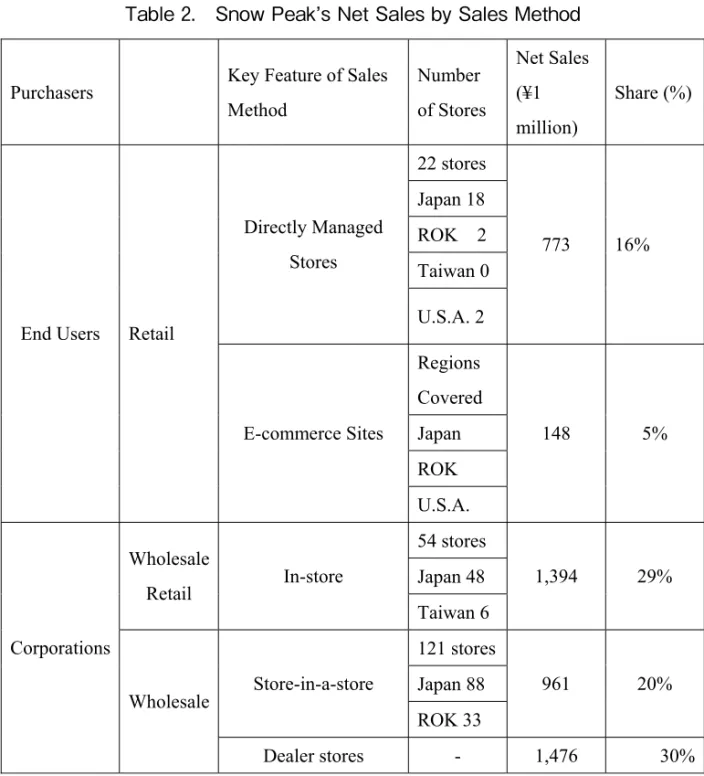
provided by staff. Table 4 shows Snow Peak ʼ s net sales by sales method. As shown in Table 4,
retail sales to end users are carried out via both directly managed stores and e-commerce sites,
which account for 16% and 5% of net sales respectively, when both domestic and overseas sales
are taken into account. The term “ retail ” refers to sales carried out in directly managed stores,
with Snow Peak staff explaining the products to customers face to face. Sales to corporations can
be categorized as either in-store (wholesale retail) or store-in-a-store (wholesale and dealer
stores).
Table 2. Snow Peak’s Net Sales by Sales Method
Note: Figures for the number of stores are current as of June 30, 2016/ Figures for net sales are results for the second quarter of the financial year ending on December 31, 2016. The term “ dealer ” refers to corporate customers.
The term “ in-store ” refers to a sales method in which the company ʼ s own staff are permanently stationed in a dedicated section of a mass merchandiser of sporting goods or a store specializing in outdoor goods (hereinafter “ the parent store ”
20), where they explain features of the company ʼ s products to customers. This sales method involves Snow Peak ʼ s own staff and accounts for 29%
of its net sales (48 stores in Japan and 6 in Taiwan).
Including both the aforementioned directly managed stores and e-commerce sites, sales by Snow Peak staff account for 52% of total net sales.
Store-in-a-store is a sales method similar to the in-store approach, in which a specific area of
the parent store is set aside for the company ʼ s products, but the staff selling the products are
employed by the parent store rather than the product manufacturer. After undergoing training in
the usage of the company ʼ s products, parent store staff are certified as Snow Peak Meisters, capable of conveying product features to potential customers at the same level as the company ʼ s own staff. This accounts for 20% of net sales (55 stores in Japan and 33 in the ROK). Combined with sales by Snow Peak ʼ s own staff, differentiated exclusive sales areas account for 70% of the company ʼ s net sales.
As described above, Snow Peak emphasizes sales methods that enable it to communicate information about its products, perspective on the world, and attention to detail to customers.
This is because its staff serve as ambassadors who can convey the value of Snow Peak.
The store-in-a-store approach is a sales method that was suggested to Japan by the ROK.
Almost all distribution channels in the ROK are operated by sole proprietors, who do not have the same financial wherewithal, sales capabilities, or management ability as corporations. That is why, having been unable to find any in-store options capable of satisfying its criteria, Snow Peak opted for the store-in-a-store approach. This is local adaptation tailored to the distribution situation in the ROK
21.
In terms of its price strategy, Snow Peak ʼ s products basically cost about 20% more in the ROK and Taiwan than they do in Japan. The company adopts a flexible local adaptation approach that also takes income levels into account.
To sum up, Snow Peak has adopted a basic approach of standardization in regard to its products, while adapting to local conditions to some degree. Its brand name has been standardized, with a view to becoming a global brand. Its approaches to service and promotion have been adapted to local conditions. The place strategy and price strategy are adapted to the local distribution structure and the market ʼ s level of economic development.
People Strategy
Company president Tohru Yamai also served as president of Snow Peak Korea until August 2013. In September 2013, he was succeeded by a Korean national, Mr. Kim Nam-hung. Business in the ROK moves at lightning speed. This requires swift decision making and adaptation to the market. Until that point, Japan had controlled everything, so it was not possible to make decisions suited to the situation at any given moment. Changes in market trends also happen quickly in the ROK and the Korean style of management is to respond accordingly, as appropriate. Snow Peak ʼ s subsidiary in the ROK prepares plans, but the final decision on them is taken after consultation with the head office in Japan. Two of Snow Peak Korea ʼ s four directors are Japanese nationals. The members of the board of directors share their views before taking decisions. This ensures that the decisions are also informed by Japanese ideas
22.
The senior manager overseeing both the U.S. and Taiwanese branches is an American, with Japanese nationals providing marketing support.
The company is a “ community business ” (Tohru Yamai, President). “ Snow Peakers ” form a
“ brand community ” sympathetic to and supportive of Snow Peak ʼ s perspective on the world.
Consequently, strengthening relationships between local staff and users in each country is crucial.
Accordingly, Snow Peak has appointed local people to the top posts in each country, with Japanese nationals providing support in facilitating the transfer of knowledge.
6.3 Transfer/Sharing of Know-how Between Bases
Snow Peak transfers and shares know-how between its bases worldwide and creates new products and ideas at their suggestion; for example, in response to suggestions from the ROK, the company introduced the store-in-a-store model, created camping goods suitable for winter, and developed a mobile app. The main focus is the transfer of know-how about the Snow Peak Way events by the head office in Japan, but Snow Peak Korea also transfers know-how about promotion and other aspects of marketing strategy.
Conclusion
The preceding chapters examined the history of Snow Peak ʼ s global marketing and where it stands today. Over the last 20 years, overseas net sales have come to account for 33% of total net sales. The key factor behind this has been the support that Snow Peak has gained from consumers for its perspective on the world, focused on “ making everyone involved with Snow Peak happy by connecting people to nature, and people to people ” via its championing of an “ outdoor, natural lifestyle. ” The unique design of its products, services, and stores, and the company ʼ s staff all serve as evangelists for this. Snow Peak has established directly managed stores in the ROK, Taiwan, and the U.S.A., as it attaches great importance to the role played by its stores. Its staff are ambassadors for the brand concept, communicating it to customers and advocating an outdoor, natural lifestyle. As well as being places where consumers can gain first-hand experience of the brand and purchase its products, the stores evoke a sense of sympathy among consumers for the brand ʼ s perspective on the world and the lifestyle that it advocates, while the camping events offer customers the opportunity to participate in creating value with the company.
Snow Peak takes a clear stance that it needs to offer even greater value to customers in the form of high-performance products with a high design sensibility, so it is pursuing economies of scale through standardization in the areas of product procurement, manufacture, and supply. At the same time, it also adapts to local markets, as demonstrated by the fact that its subsidiary in the ROK offers camping events that differ from those in Japan, creating ways of making the company ʼ s products, services, and stores more appealing to the local market. It gathers information about local market needs, ways of thinking, and lifestyles in the ROK and seeks to promote consumption via the products showcased in its stores and its mobile presence.
The company is a “ brand community ” business. Consequently, strengthening relationships
between local staff and users in each country is crucial. As such, Snow Peak shares its unified
vision with them, while transferring authority to each country.
Endnotes, including information of publications cited.
This paper is a substantially revised version of the earlier Japanese paper, Tomiyama (2016).
1
White Paper on Small and Medium Enterprises in Japan 2014, Chapter 4,
“Overseas Business Expansion:
Identifying Factors for Success and Failure.
”2
Snow Peak website (as of December 31, 2016). Accessed March 24, 2018.
3
Harada and Miura (2016), p.10.
4
ibid., p.39.
5
Snow Peak (2016).
6
ibid.
7
See Research Institute for Economics and Business Administration, Kobe University (2015), p. 39.
8
Snow Peak (2016), op. cit.
9
See Harada and Miura (2016), op. cit., pp.40-41.
10
Snow Peak (2016), op. cit.
11
ibid.
12
The White Paper on International Economy and Trade 2015 divides the 146 emerging economies into three groups according to their income levels, based on definitions established by the World Bank, and then adds the 76 high-income economies to this to form four groups. High-income economies are defined as those whose GNI per capita in 2013 was at least $12,746. This group consists of 76 countries and regions, including the G7 countries, the Eurozone countries, the ROK, Taiwan, Singapore, and other so-called developed countries (White Paper on International Economy and Trade 2015, Chapter 2, Section 1 Classification of Emerging Economies).
13
Yamai, Tohru (2015), p.10.
14
ibid., p.10.
15
Interview with company president Tohru Yamai (June 4, 2014).
16
Snow Peak (2016), op. cit.
17
See Miura (2009).
18
Tomiyama (2005).
19
Interview with the Task Leader of the Planning Department, Snow Peak Korea (on August 17, 2014).
20
The parent store is a dealer store in which the Snow Peak Group has an in-store or store-in-a-store presence (Excerpt from the 50th & 51st Securities Report (January 1 – December 31, 2014)).
21
Interview with the Task Leader of the Planning Department, Snow Peak Korea (on August 17, 2014).
22
Interview with the Task Leader of the Planning Department, Snow Peak Korea (on August 17, 2014).
Referenes