The Effects of Thermal Metamorphism on Organic Matter in the CO3 Carbonaceous Chondrite Meteorites
E. Bonato
1,2, A. J. King
1, P. F. Schofield
1, B. Kaulich
3, T. Araki
3, M. K. Abyaneh
3, M. R. Lee
2and S. S. Russell
11
Department of Earth Science, Natural History Museum, London SW7 5BD, UK 2 School of Geographical and Earth Sciences, University of Glasgow, Glasgow G12 8QQ, UK
3
Diamond Light Source, Didcot OX11 0DE, UK
Introduction: Primitive CO3 carbonaceous chondrite meteorites provide a detailed record of the geological processes and events that have shaped our solar system over the last 4.5 billion years. They contain a fine-grained (≤ 1 µm) matrix (> 50 vol%) of amorphous and crystalline silicates, oxides, sulphides and metals that have remained largely unaltered since the time they accreted into an asteroid [1]. The matrix of CO3 carbonaceous chondrites also contains ~5 wt% carbon in a wide variety of organic materials including soluble molecules, kerogen-like insoluble organic matter (IOM), and carbonaceous nanoglobules [2]. The formation and evolution of the organic materials and their relationship to the mineralogy remains poorly understood mainly because of the fine-grained and heterogeneous nature of the matrix. However, new analytical techniques are now making it possible to study the relationship between organics and minerals in extra-terrestrial materials in-situ at high spatial resolution [3]. Here, we present C K-edge X-ray absorption near edge structure (XANES) analyses of carbonaceous phases in the CO chondrites DOM 08006, NWA 7892 and Moss.
Methodology: DOM 08006 (CO3.00) is considered one of the most primitive carbonaceous chondrites due to the high abundance of presolar grains and amorphous silicates present in its matrix [4] although minor aqueous alteration may have taken place [5]. NWA 7892 is a hot desert find and is classified as a CO3.05 [6] and Moss (CO3.6) is a recent fall that experienced a peak metamorphic temperature of ~600 °C [7]. For each sample matrix regions were characterised using electron microscopy methods (SEM and EMPA) and then focused ion beam (FIB) sections (~15 × 7 µm and ~90 nm thick) were extracted. Scanning transmission X-ray spectroscopy (STXM) on beamline I08 at the Diamond Light Source was used to investigate the carbon speciation of carbon-rich areas in the FIB sections. Using STXM spatially correlated (pixel size ~40 nm) energy-dependent image stacks (~4 × 4 µm) were collected at the C K-edge 278 – 310 eV with an energy step size of 0.1 eV near the C K-edge. In order to minimize the beam damage to the organic phases, TEM imaging was done after the collection of the XANES data.
Results and Discussion: Initial results show that using STXM we are able to locate and characterise organic materials in-situ within the most primitive carbonaceous chondrite meteorites at the grain scale.
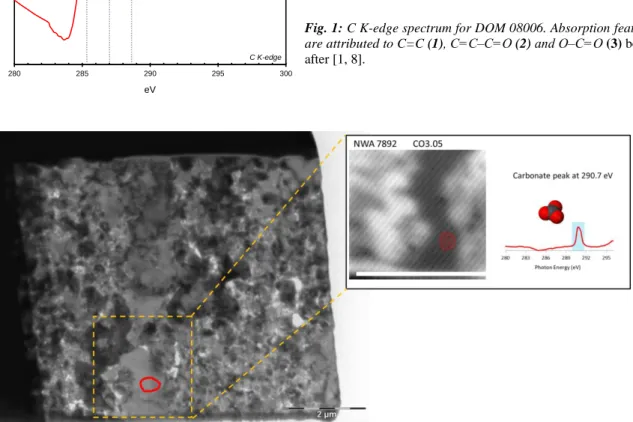
DOM 08006 (Fig. 1) shows the presence of absorption features at ~285 eV from the 1s‒π* of aromatic and olefinic carbon (C=C), ~287 eV from the 1s‒π* bond transitions of aryl,vinyl-ketone (C=C‒C=O), and ~289 eV from the 1s‒π* bond of carboxyl groups (O‒C=O). These absorption features have previously been reported in studies of organic matter in other primitive carbonaceous chondrites [e.g., 8, 9] Moreover, these results are also comparable to those reported for organic materials chemically extracted from meteorites and which give us an insight about the nature of the organic molecules present during the formation of the solar system. The high abundance of organic material present in DOM08006 further strengthens the hypothesis that it is a very pristine meteorite [10, 11].
The NWA 7892 (CO3.05) sample presents very similar features to DOM 08006, with the only difference being that we identified a carbonate vein (Fig. 2) in the FIB section from the absorption feature at ~290 eV (1s‒π* bond of CO
3). Aqueous processes did occur on some asteroids but the vein is likely to have formed during the meteorite’s residence in a hot desert environment.
In Moss we find that the C-rich regions are less common than in the more primitive meteorites. However, where present the C- rich regions show similar, although weaker, absorption features to those in DOM08006 and NWA 7892. Thermal metamorphism leads to the graphitization of the carbon and this is consistent with the finding of graphite feature at 291.7 eV [8, 10] in Moss.
We are now combining the results with TEM observations of the samples in order to determine how organic species are
spatially correlated with the mineralogy in CO chondrites. The application of analytical techniques capable of imaging this
relationship in-situ at high spatial resolution will be crucial for understanding samples returned from the surface of primitive asteroids and other solar system bodies.
Fig. 2: Bright Field TEM images of the FIB section of NWA 7892 (on the left) and image of a portion of the FIB section located on the carbonate vein obtained through STXM (at the top). As it is possible to notice the carbonate presents a very strong feature at 290.6 eV which is likely consequence of terrestrial weathering.
References
[1] Weisberg, M. K. et al. 2006. MESS II 19‒52. [2] Pizzarello, S. et al. 2006. MESS II 625- 651. [3] Ishii, H. A. et al. 2018.
Proceedings of the National Academy of Sciences 115: 26 6608-6613. [4] Nittler, L. R. et al. 2018. Geochimica and Cosmochimica Acta 226 107-131. [5] Krot, A. N. et al. 2017 LPSC abstract #1084. [6] Meteoritical Bulletin #102. [7] Huss, G. R. et al. 2006. MESS II 567-586. [8] Cody G. D., et al. 2008. Earth and Planetary Science Letters 272 446-455. [9]
Kebukawa Y., et al. 2014. Meteoritics Planetary Science 49 2095-2103. [10] Alexander, C. M. O’ D. et al. 2017. Chemie der Erde 77 227-256. [11] De Gregorio, B. T., et al. 2015. LPSC abstract #2951.
280 285 290 295 300
DOM 08006 (CO3.0)
1 2
3
eV
C K-edge