〔original article〕
就学前の子どもを持つ母親の家族力学と精神状況
関 戸 好 子・菅 原 京 子
Family Dynamics and Mental Status of Mothers of Preschool Children
Yoshiko Sekito, Kyoko Sugawara
Abstract
The purpose of this study was to identify relationships of the family dynamics, mental status and socio-demographic variables of mothers of preschool children.
Data were collected using Family Dynamics Measure II (FDM II) and a questionnaire that addressed socio-demographic characteristics and mental status. Population were mothers who brought their children under 5 years old to 3 local municipal health agencies in Yamagata prefecture in Japan. Participation was voluntary.
Findings: Participants were 130 mothers of preschool (under 5 years old) children.
Average age of participants was 32.2(SD = 5.3). Mothers were married (93.8%) and living with their parent(s) (24.6%). There was an average of 5.6 (SD = 1.7) persons in a family.
The participants had 1 child (n = 80, 61.5%) to 3 (2 or more n = 50, 38.5%) preschool children. One third had problems/changes and one fifth had illness in their family. Mental status score was 27.3 (SD = 6.9). Family size was strongly to mildly relate to family member’s age and positions in a family. Mental status related to negatively with family member’s age (age group of 12-17) and problems/ changes in a family. Number of children (one or more) was not related to age of participants, scores of mental status, and illness and problems/changes in a family. All 6 dimensions of FDM II were positively correlated with mental status, indicating more positive the family dynamics, better their mental health.
Professional (public health and home care)nurses who deal with mothers of preschool children should give an attention to mental status of these mothers since it was directly and positively related to dimensions of family dynamics. When assessing family health, problems/changes in the family should be identified due that a factor affecting negative relationship with mental status of these mothers. Supports and care needs for these mothers could be provided for them to gain problem solving skills and awareness to identify threatening changes in their family.
Key words : family dynamics, Family Dynamics Measure II (FDM II), mothers, preschool children, mental status, Yamagata Prefecture
(受付日2016.12.21,受理日2017.3.6)
Yoshiko Sekito, R.N., Ed.D.
A former professor, Department of Nursing, Yamagata Prefectural University of Health Sciences Kyoko Sugawara, R.N., P.H.N., LL.D.
Professor, Department of Nursing,
Yamagata Prefectural University of Health Sciences
Department of Nursing,
Yamagata Prefectural University of Health Sciences 260 Kamiyanagi, Yamagata-shi, Yamagata, 990-2212, Japan
Introduction
Women who are married and have young preschool children are challenged by many roles in their daily life. Particularly young mothers are said to face many difficulties around family matters/obligations and parenting. They are highly stressed, and may feel isolated and tensed. Preschool children are quite active absorbing and adapting to their social circumstances. Discipline in family in this age group requires maximum work and patience. Children need love and encouragement regarding what they do, in order to develop trust and warmth to others through these nurturing years. Children need to gain knowledge to avoid accident when playing outside;
and children develop sense of self, self- esteem/respect, and learn important social promises/rules before entering to the school system1). Most of these rules and responsibilities is usually provided and expected to be carried out by their mothers.
With these parental and family responsibilities, mothers with preschool children may overwhelm their tasks between mother and family obligations. They need to look for help and assistance from not only spouses but also other family members. Their family dynamics/function could be quite affective for their mental stability. Changes in parenting environment, i.
e. increased working mothers, choice of having fewer children, and divorce, may result diversified family and lowered family function2). A study carried on Japanese mothers of young children in New York found that mental health of the mothers was poor. And there were significant relationship between poor mental health, child rearing, dissatisfaction with life, isolation, and lack of support, due husband was busy with his work/business3). Similar factors could be found in the newest Japanese government report. The report titled “One day in Japan” that surveyed episodes happened in Japan during a day, focused on child- rearing of parents who have children under 6 years old.
A Japanese husband involved in family choirs and caring children is minimal among developed countries, i.e. a Japanese husband spends parenting for 1 hour 7
minutes and a wife does for 7 hours 41 minutes in Japan4). It looks quite clear that a Japanese wife spends her time for parenting almost 7 times more than her husband.
A region of northern part of Japan is known among Japanese to maintain traditional Japanese family system/custom in even these recent times, than other areas of Japan comparatively. The Journal of Health and Welfare Statistics 2014/2015 reported that families of this region could be characterized by lower percentages of single family and nuclear family and higher percentage of extended/three generation family compared to the national average5). Particularly Yamagata prefecture where this study was carried showed these typical characteristics strongly.
According to a study in Yamagata prefecture with mothers of 5 years old child, employment rate was very high among women ages 25-47 compared to the national average6). Since Yamagata prefecture kept the highest rate of three generation families for many years, we could speculate the women in this prefecture may expect to play many roles of parenting and family tasks. Young mothers are quite possibly expected to serve many roles in a family, e. g. mother, spouse, daughter (adult child living with parent), daughter-in- law, sister-in-law, aunt, and worker (employed and/or a member of family business).
The effort of present study is based on conditions already described, that mothers of young children were highly stressed and family dynamics and some socio- demographic variables were said to mitigate factors of stresses. Thus, young mothers in Yamagata prefecture could be ideal to identify those relationships.
Purpose:
The purpose of this study was to identify relationships among the family dynamics, mental status and selected socio-demographic variables of mothers of preschool children.
Research questions are;
1.What dimensions of FDM II relate with selected socio-demographic variables?
2.What selected socio-demographic variables
relate with mental status of mothers of preschool children?
3.What dimensions of FDM II relate with mental status of mothers of preschool children?
4.What is the relationship among number of preschool children in a family and mothers’
selected socio-demographic variables and mothers’ mental status?
Method:
1.Data collection period; 2011-2012.
2.Participants; The participants obtained for this study was 130 mothers (valid response rate:
73.4%) and the selection method used, as below, was convenience sampling. Population consisted of 391 mothers of preschool children (under 5 years old), who attended a child health screening program operated by three local municipal health agencies in Yamagata prefecture. Two kinds of measurement instruments were enclosed when an official notice of the program of health screening schedule for a child was mailed to a mother. The face letter of the study asked mothers to fill-in and bring the questionnaires when they came to visit the program, if they agreed to participate in the study. A locked box was prepared and placed in a hallway outside the screening site, thereby guaranteed for mothers’ voluntary participation.
(Number of surveys collected: 177; Collection rate:
45.3%).
3.Measurement ;
Two kinds of measurement were used to obtain data.
1)The Family Dynamics Measure II (FDM II) The Family Dynamics Measure II (FDM II) has been developed by nurse researchers in the United States, and recognized as a scale of measuring family daynamics / function7). FDM II consisted of 66 positively and negatively worded items on a six- point Likert scale with 6 dimensions was used to measure family dynamics. 6 dimensions were Individuation-Enmeshment (Individuation),
Mutuality-Isolation (Mutuality), Flexibility- Rigidity (Flexibility), Stability-Disorganization (Stability), Clear communication-Unclear communication (Communication), and Role reciprocity-Role conflict (Role). The FDM II (scores) meant the higher the score the more positive the family dynamics. The original FDM II was written in English and was translated into Japanese, the version used in this study7). Cronbach’s alpha of 6 dimensions obtained at past studies ranged from . 47 to .878-13). For this study of mothers of preschool children Cronbach’s alpha ranged .52 to .89 2)A socio-demographic questionnaire including
items of mental status
A socio-demographic questionnaire was to ask selected back ground information regarding participants’ age, education, and position in family;
and family matters regarding age of family members, number of persons in a family, illness and problems/changes in family (answer; Yes or No) etc.
Seven items with a six-point scale, ranged between all of the time and none of the time were used to measure mental status. Cronbach’s alpha of mental status obtained at past studies ranged from .75 to
.8511‑13)and the mothers of preschool children at this
study was .87.
4.Ethics committee: Approved by the university that the first author was employed at the time.
Findings:
1.Main characteristics of the participants were: Mean age of participants were 32.2(SD = 5.3), married (93.8%) ,living with parent (24.6%), and other role and function of mother in family (50.8%). Number of persons in a family was 5.6 (SD = 1.7). (see Table 1)
2.Age-groups of family members were: 30-49 age- group (79.2%), 50-69 age-group (59.2%), and 5- 11 age-group (34.6%). Within preschool children, mothers had either one child (61.5%) or two or more children (38.5%). (see Table 2)
3.Reliability range of 6 dimensions was .52 to .89.
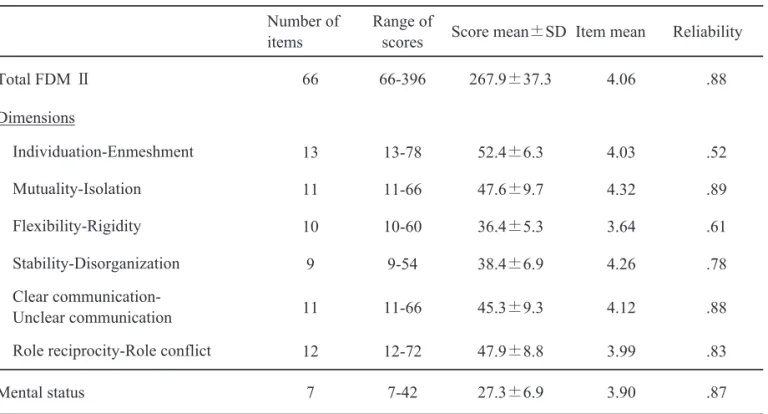
The highest reliability was found Mutuality- Isolation and the lowest was Individuation- Enmeshment. Mental status was .87. The highest score of 6 dimensions was Mutuality-Isolation and the lowest one was Flexibility-Rigidity. Score of mental status was the second lowest next to Flexibility-Rigidity when included among the 6 dimensions. (see Table 3)
4.Correlation between some of selected socio- demographicvariables and 6 dimensions were found to have small to moderate relationships.
Main characteristics of positive relationships were
found between years in school of other family member (husband, etc) and Stability- disorganization (r = .243, p<.01), and Clear communication-Unclear communication (r = .212, p<.05). Lest of relationships were found to be negative relationships: Somewhat moderate relationships were found between other role and function of mother in family and Flexibility-Rigidity (ρ=-.358, p<.01), and Clear communication-Unclear communication (ρ
= -. 278, p<.01). Number of persons in family and Flexibility-Rigidity (r =-.288, p<
Table䚷 1:Characteristics of participants
N䠙130
Attributes N (%) Mean±SD
Age (years) 32.2±5.3
Married 122 (93.8)
Living with parent 32 (24.6)
Other role and function of mother
in family 66 (50.8)
Number of persons in family 5.6±1.7
Years in school of paricipants 14.0±2.6
Years in School of other family
members (husband, etc) 13.6±2.7
Illness in family 31 (23.8)
Problems/changes in family 45 (34.6)
Persentage is of respondents in all instances. Multiple answers possible.
Table2:Age groups of family members
N䠙130
Age groups N %
over70 49 (37.7)
17 (13.1)
50-69 77 (59.2)
30-49 103 (79.2)
18-29 52 (40.0)
12-17 5 (3.8)
5-11 45 (34.6)
under5 130 (100)
number of children 1 80 (61.5)
number of children 2 48 (36.9)
number of children 3 2 (1.6)
Persentage is of respondents in all instances. Multiple answers possible.
(two members over70)
N䠙130 Number of
items
Range of
scores Score mean㼼SD Item mean Reliability
Total FDM ϩ 66 66-396 267.9s37.3 4.06 .88
Dimensions
13 13-78 52.4㼼6.3 4.03 .52
11 11-66 47.6㼼9.7 4.32 .89
10 10-60 36.4㼼5.3 3.64 .61
9 9-54 38.4㼼6.9 4.26 .78
11 11-66 45.3㼼9.3 4.12 .88
12 12-72 47.9㼼8.8 3.99 .83
Mental status 7 7-42 27.3㼼6.9 3.90 .87
Clear communication- Unclear communication Role reciprocity-Role conflict Individuation-Enmeshment Mutuality-Isolation Flexibility-Rigidity Stability-Disorganization
Table3:Score mean (SD) and reliability of 6 dimensions and mental status
.01) were also found to have negative relationship. (see Table 4)
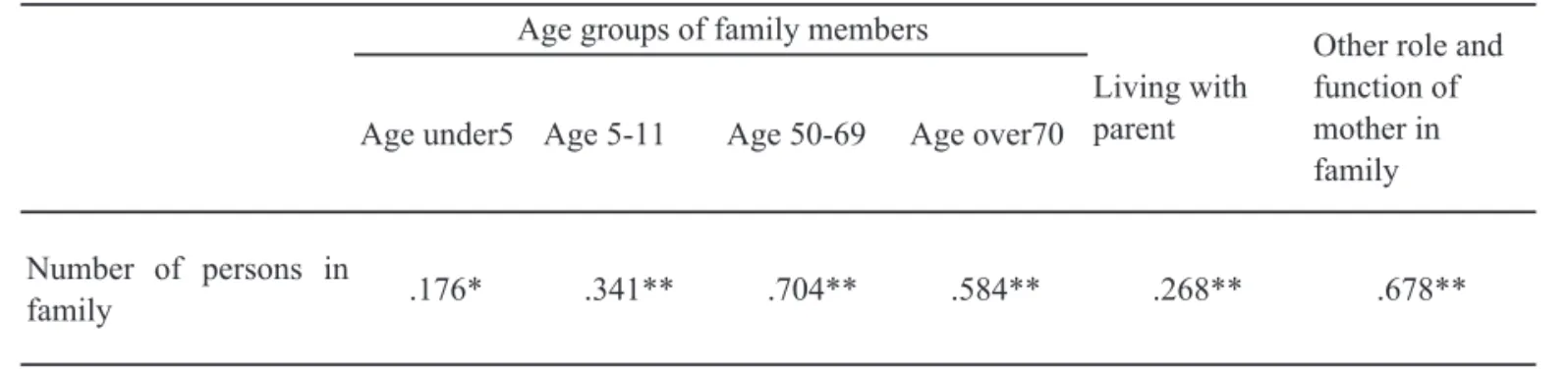
5.Number of persons in family showed strong positive relationships between 50-69 age-group (ρ
= . 704, p<.01), other role and function of mother in family (ρ =. 678, p<.01) and age over 70 (ρ=.584, p<.01). (see Table 5) 6.Mental status was affected negatively by
problems/changes in family (ρ=-.396, p<.01) and positively by years in school of other family member (husband, etc) (r = .223, p<.05) and age-group 30-49 (ρ = .178, p<.05). (see Table 6)
7.Six dimensions of FDM II were found to have positively strong relationships with each other, to name a few: Stability-Disorganization and
N䠙130
Age 50-69 2)
Age over70 2)
Age 18-29 2)
Age 12-17 2)
Individuation-Enmeshment -.178* -.275** -.219*
Mutuality-Isolation -.228* -.195* -.214*
Flexibility-Rigidity -.288** -.358** -.269** -.247** -.246**
Stability-Disorganization -.244** -.234** -.211* .243** -.237**
Clear communication-
Unclear communication -.278** -.203* -.176* .212*
Role reciprocity-Role conflict 1) Pearson r correlation 2) Spearman’ s Rho correlation
*p<.05 **p<.01 Years in
School of other family members (husband, etc)1)
Problems/
changes in family2)
Number of persons in family1)
Other role and function of mother in family 2)
Age groups of family members
Table4:Correlations between selected socio-demographic variables and 6 dimensions
ࠉ
N䠙130
Age under5 Age 5-11 Age 50-69 Age over70
Number of persons in
family .176* .341** .704** .584** .268** .678**
Spearman’ s Rho correlation *p<.05ࠉ**p<.01
Age groups of family members
Living with parent
Other role and function of mother in family Table5:Relationships among number of persons in family and selected socio-demographic variables
Table6:Relationships among mental status and selected socio-demographic variables
N䠙130
Age 12-17 2) Age 30-49 2)
Mental status .223* -.210* .178* -.396**
*p<.05 **p<.01 1) Pearson r correlation
2) Spearman’ s Rho correlation
Age groups of family members
Problems/changes in family 2)
Years in School of other family members (husband, etc) 1)
Mutuality-Isolation (r =. 840, p<. 01), Mutuality- Isolation and Clear communication-Unclear communication (r =. 831, p<. 01), and Clear communication-Unclear communication and Stability-Disorganization (r =.799, p<.01). All 6 dimensions showed strong to mild relationships with mental status. (see Table 7) 8.Number of preschool children were divided to two groups (one vs. two or more children), and correlated with some selected socio-demographic variables of mothers, namely: Number of persons in family, average age of mother, illness in family, problems/changes in family and mental status.
There was no significant relationship found
between two groups of mothers’ of preschool children and selected socio-demographic variables (see Table 8)
Discussion:
Yamagata prefecture this study had carried was known to keep traditional family system and customs.
Typical of these evidences were, in 2013 when national average of person in a family was 2.4, the least Tokyo was 2.0, and Yamagata prefecture was 2.9. The family size was the largest in Japan5). However, participants lived in a larger family, their family size was 5.6. This was more than twice as large as the N䠙130 Individuation
-Enmeshment
Mutuality- Isolation
Flexibility- Rigidity
Stability- Disorganization
Clear
communication- Unclear communication
Role reciprocity- Role conflict Individuation-Enmeshment
Mutuality-Isolation .433**
Flexibility-Rigidity .330** .495**
Stability-Disorganization .436** .840** .438**
Clear communication-Unclear
communication .318** .831** .529** .799**
Role reciprocity-Role conflict .279** .667** .442** .683** .635**
Mental status .351** .574** .322** .610** .456** .516**
Pearson r correlation **p<.01
Table7:Correlations among 6 dimensions and mental status
Table8:Relationships between 2 groups of number of children and socio-demographic variables
N䠙130 One child (n=80) 2 䠃3 children (n=50)
32.7±5.0 31.6±5.7 ns †
5.4±1.8 6.0±1.6 p<.05 †
26.7±7.0 28.4±6.6 ns †
yes, etc 28 (35.0%) 17 (34.0%)
no 52 (65.0%) 33 (66.0%)
yes, etc 22 (27.5%) 9 (18.0%)
no 58 (72.5%) 41 (82.0%)
† T test
†† Chi-square test
Significance
ns = no significance ns ††
Number of persons䚷in family (Mean㼼SD) Age (Mean㼼SD)
Mental status (Mean㼼SD) Problems/changes in family
Illness in family
ns ††
national average and even larger than the average of the prefecture. This family size is shown positive relationships with family members consisting of different age groups (age under 5, age 5-11, age 50-69, and age over 70) and residing with their parents/in- laws. In fact, participants who were living with their parents was 24.6%, one out of 4 participants belonged in three generation family. Considering 50.8% of other role and function of mother in family, three generation families might be rather higher than the average of prefecture that was 38.0%14). Yamagata prefecture has high rate of both working among young couples that was 57.8% whereas national rate was 44.
4%15). This high rate of working couples might be supported by many members of another family living with. As for the participants it looked as though there were always 2-3 persons in a family available to look after a child among family members excluding themselves. This condition was quite fortunate for the mothers to seek help from family members if she was to work or expected to manage many family roles.
Mental status of participants showed negative and mild relationship with problems/changes in a family.
In fact 33.1% of participants reported problems/changes in family. This means that almost one person in three participants had problems/changes in family. When compared with past studies, problems/changes in family seemed to show similar trends of negative relationships among Japanese families in the U.S.A and in Japan8‑13). Mental status score of participants was 27.3 (SD = 6.9). This score is lower than previous studies: 31.6 (Japan) 10), 31.4 (U. S. A.) 10), 31. 5 (Thailand) 11), and 27. 4 (care providers in Japan)12) respectively. However, higher than ordinary residents in Yamagata that was 25.913). The study in A city in Japan compared with mothers in New York, 31 mothers with ages 31-35 of whom 41%
had one child. Among these mothers average number of children was 1.66 (SD = 0.61). Mothers who were working were 42.5% and were stressed. Most affected stress factor was child-rearing and the reason of stress was they had no time to relax. Isolation and no time to relax were at great risk of poor mental health3).
Yamagata participants were fortunate to have help from family and far less feeling isolated, indicating the highest score (47.6) of Mutuality-Isolation among 6 dimensions. Role enhancement theory suggested multiple works and family commitments had beneficial effects on health, due that multiple roles might mitigate health, whereas the role strain model postulated multiple role occupancy was associated with poor health16). This study was based on mid-life wives 45- 59 years old in Britain. Wives’ level of social participation was found to be negatively related to their husbands’ intensive care role. It concluded that care- giving should be viewed as shared activity where one partner provides the caring and the other partner provides a support function to the care-giver16). In this study, British participants were older than the present study participants. If care sharing encouraged social interaction, it contributed for less stress and feeling of isolation. One could say husbands/ family members’
involvement to child-rearing/ parenting could be a critical factor to achieve good mental health of mothers.
Work-family conflict was expected to be the highest with working-parents of child under 6 years old17)and sense of burden was greater from younger children18). Mental health was related to positive dealing with role adjustment and sharing expected family role between the couple19). Working mothers have strong/ great conflict of feeling toward child and child-rearing20). Emotional support, anxiety of child development, and career satisfaction affected parenting satisfaction17). Most (90%) of Yamagata participants was working.
However, mental status of these mothers was positively related with all 6 dimensions of FDM II, particularly strong relationships were shown with Stability-Disorganization and Mutuality-Isolation.
Role reciprocity-Role conflict did not have any relationship with socio-demographic variables.
However, it showed moderately positive relationships with all other dimensions. Role reciprocity-Role conflict acceptance and adjustment supported by husbands and family members for these mothers could be key factors to maintain their mental status and to adopt multi-roles satisfactorily20, 21).
Large size of family and family position were negatively related with Flexibility-Rigitity: more persons in a family and position of an in-law, mothers feel less flexible among family matters. Less work- family conflict maintained could enforce satisfaction from child-rearing experience.
Number of children was not affected mothers’
mental status nor problems/changes and illness in a family. There was study anticipation that more number of preschool children could cause stressful situation and troublesome for a mother to manage roles properly during the child-rearing period. However, this was not the case for these mothers in Yamagata prefecture. It could imply that family support could mitigate enough to lessen feeling of much stress of mothers doing child-rearing.
Lower score of mental status could be interpreted due that their position in their family. In traditional family system, daughter/daughter-in-law may have permitted only to express limited and subtle wish and opinions in the family in order to maintain peace in a family.
Conclusions:
High rate of mothers of preschool children in Yamagata prefecture belonged to traditional three generation family system. Child-rearing and multi- roles in family matters were seemed supported by this family system, many persons in a family. Mental status of them was mainly supported by positive relations with all 6 dimensions of family dynamics. A factor problems/changes in family showed negative relationship to mental status of participant mothers of preschool children. Lower score of mental status could mean their delicate and subtle position in a family, indicative of a traditional family system.
Implication:
In order for these mothers of preschool children to maintain mental status well, health care professionals
should be aware and should pay an attention to the problems/changes in their family. Due that this factor showed negative relationship with mental status of these mothers. This recognition and understanding are quite important to provide appropriate care and needed supports to these mothers. For example, health care professionals could provide problem-solving skills and awareness training to mothers to identify and deal with threatening problems/changes in their family at the early stages of development.
Disclosure of Conflict of Interest; First author and co- author have no COI with regard to our paper.
References:
1.Narama M. Introduction to pediatric nursing, introduction to clinical pediatric nursing, Pediatric Nursing 1. Igaku- shoin Pub. Co.
Tokyo, 2012. p.100-15.
2.Watanabe H. Support for mothers with infants.
Pediatric Nursing. 2001; 24(13): 1886-91.
3.Ozeki N, Mizoguchi M. Japanese mothers living in New York with young children: Transcultural and child rearing stress factors and mental health.
Journal of Japan Society of Psychosomatic, Obstetrics and Gynecology. 2007; 12(3): 506-18.
4.The Ministry of Health, Labor and Welfare. The White Paper of the Ministry of Health, Labor and Welfare 2014 Appendix.; 2014.
5.Health, Labor and Welfare Statistics Association. Journal of Health and Welfare Statistics 2014/15. 2014; 61(9):54-55.
6.Endo K, Sato Y, Misawa S, Komatsu Y, Katagiri C. Perception of maternal and gender roles of mothers in Yamagata Prefecture. Yamagata Journal of Health Science. 2003; 6: 17-24.
7.Sekito Y. Developing a Japanese version of family dynamics measure (FDM II). Yamagata Journal of Health Sciences. 2005; 8: 33-40.
8.Sekito Y. Family dynamics among Japanese families in the United States.
Annual of Keio Junior College of Nursing. 1999;
9: 25-31.
9.Sekito Y. Characteristics of family dynamics among Japanese families In Japan.
Bulletin of Health Sciences Kobe. 2002; 18: 11- 21.
10.Sekito Y. Comparative study of family dynamics and selected psycho-socio-demographic factors between Japanese families who live in U.S.A. and in Japan. Bulletin of Health Sciences Kobe.
2003; 19: 33-45.
11.Sekito Y. Family dynamics and mental status of Japanese families in Thailand.
Yamagata Journal of Health Sciences. 2008;11:
63-70.
12.Sekito Y. Family dynamics and mental status of Japanese family care providers.
Yamagata Journal of Health Sciences. 2007; 10:
21-28.
13.Sekito Y. Family dynamics and mental status of Japanese families who live in a northern prefecture of Japan. Yamagata Journal of Health Sciences. 2010; 13: 55-60.
14.Ranking of residents’ characteristics by statistics of 47 prefectures of Japan
[database on the Internet] [cited 2013 Dec.12 ].
http://www.facebook.com/todofukenRanking/posts/
680597825313975?stream_ref = 10
15.What prefecture has higher rate of couple- working? [database on the Internet] [cited 2009
March.15 ]. http://allabout.co.jp/gm/gc/12462/2/
16.Glaser K, Evandrou M, Tommassini C. Multiple role occupancy and social participation among midlife wives and husbands in the United Kingdom. Int’l J. Aging and Human Development, 2006;63(1): 27-47.
17.Kosaka C. The sources of parenting satisfaction in mothers of infants: A study of career patterns.
Human Developmental Research. 2004;18: 73-87.
18.Aramaki M, Muto T. Factors related to negative and positive feelings about child-rearing: A survey of mothers of young children. Japanese Journal of Developmental Psychology. 2008; 19 (2): 87-97.
19.Kato Y, Kanai A. The effect of coping behavior with work-family conflict in dual-career couples.
The Japanese Journal of Psychology. 2006; 76(6):
511-18.
20.Katayama R, Naitoh N. Family functions of mothers and fathers raising babies and support of their child care. Journal of Japan Society of Psychosomatic, Obstetrics and Gynecology.
2011; 15(3): 294-304.
21.Kazui M, Muto T, Sonoda N. The role of marital quality and parenting stress in mother- preschooler relationships: A family system perspective. Japan Society of Developmental Psychology. 1996; 7 (1): 31-40.
和文要旨
本研究の目的は、就学前の子どもを持つ母親の家族力学、精神状況、属性との関 係を把握することにある。山形県の3地域在住で5歳以下の子どもを持つ母親に対 して無記名自記式の質問紙を391人に配布し、個別返信により177人から回収した
(回収率45.3%)。家族力学については家族力学尺度II(FDM II)を用いた。有効回
答は130名(有効回答率73.4%)であった。母親の平均年齢は32.2±5.3歳で、ほ ぼ全員(93.8%)が結婚しており、三世代同居が24.6%あった。家族の平均人数は 5.6±1.7人で、子ども1人が61.5%、2人以上が38.5%であった。精神状況は平均 27.3±6.9点であった。家族数は家族の年齢や母親の家族内の位置づけと正の相関 があった。家族の年齢と家族の問題・変化は精神状況と負の相関を示した。子ども の数は、母親の年齢、精神状況、家族の病気、家族の問題・変化に関係がなかった。
家族力学尺度IIの全6側面は精神状況と正の相関を示した。就学前の子どもを持 つ母親とかかわる看護職者は、母親の精神状況が密接に家族力学と関係あることに 留意し、母親の問題解決スキルや家族問題・変化への気付きに対する支援を提供す る必要がある。
キーワード:家族力学、家族力学尺度
II(FDM II)、就学前の子どもの母親、精神状況、山形県在住