奈良教育大学学術リポジトリNEAR
The Indoor‑climate of Old Temple Buildings in Nara City and its Suburbs (I) On the Diurnal Range of Air‑temperature
著者 NAGATA Shiro
journal or
publication title
奈良学芸大学紀要
volume 9
number 2
page range 43‑48
year 1960‑02‑15
URL http://hdl.handle.net/10105/4819
Jour. Nara Gakugei Univ., Vol.9, No.2, 1960
The Indoor-climate of Old Temple Buildings in Nara City and its Suburbs
(I) On the Diurnal Range of Air-temperature
Shiro NAGATA
CDepertment of Science Education, Nara Gakugei University) (Received November 20, 1959)
§ 1. Introduction
In Nara city and its suburbs, there are many old temple buildings which enshrine many invaluable antiques within their doors and most of them are open to the public at large.
In connection with the problem of the preservation of these antiques in better state, surveys of the indoor-climate of these temple buildings have been considered essential in recent years.
Since 1952 the author have been making a series of surveys on some old temple buildings in Nara city and its suburbs, and the reports containing the full observational data have already been published. CD,(2),(3),(4)
Using our observational results , the author attempts to give some general considerations upon the subject. In the first step,the diurnal range of indoor air-temperature was taken up as a primary controlling factor of indoor-climate. The present paper dealt with the data obtained
in this respect.
§ 2. Statistical Treatments and Results of the Observed Data
The observed data of three temple buildings , Yakushiji-kodo , Yakushiji-toindo and Tosho- daiji-kondo were treated statistically.
These buildings are all built of wood, and have good ventilations common to Japanese styles of architecture. But they are different in the capacity, and, in detail, they have some characteristics in their styles of architecture. Figures 1 , 2, 3 and 4 show the general views of these buildings and their surroundings.
The data were obtained through the readings of weekly type thermographs and hygrogra- phs set near the centers of these buildings and also set under the high floor of "Azekura"
in Toshodaiji.
The data of the one year from August 1956 to July 1957 were employed for this study.
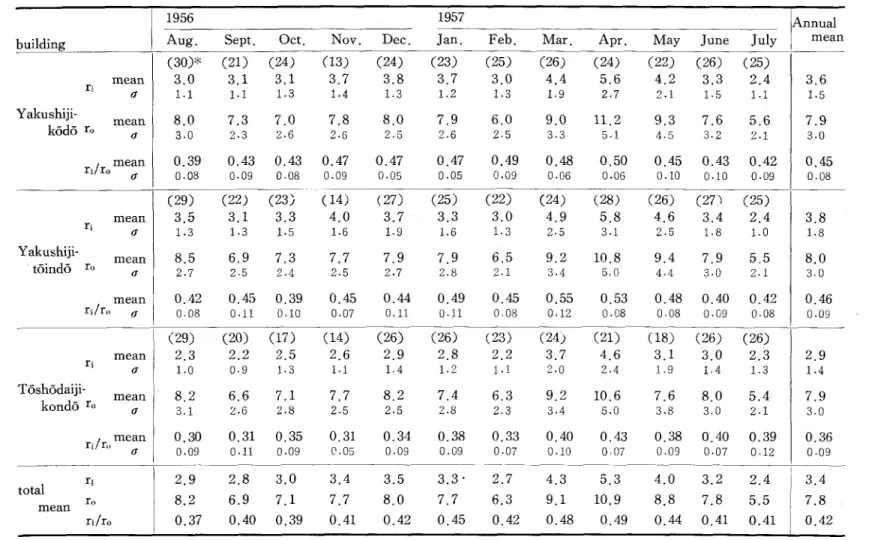
The diurnal ranges which show the normal mode, i. e. , maximum appears early in the afternoon and minimum early in the morning, were picked up and were treated statistica- lly. The results are given in Tables 1, 2, 3 and 4.
Table 1. Monthly mean values on diurnal range of air-temperature
( r i in d o o r d i u r n a l r a n g e ( ‑ c ) , r O o u t d o o r d i u r n a l r a n g e ( ‑ c ) , cr ‑ s t a n d a r d d e v i a t i o n ) 1 9 5 6 1 9 5 7
b u il d in g A u g . S e p t . O c t . N o v . D e c . J a n . F e b . M a r . A p r . M a y J u n e J u ly A n n u a l m e a n
( 3 0 ) * ( 2 1 ) ( 2 4 ) ( 1 3 ) ( 2 4 ) ( 2 3 ) ( 2 5 ) ( 2 6 ) ( 2 4 ) ( 2 2 ) ( 2 6 ) ( 2 5 ) 3 . 6 m e a n 3 . 0 3 . 1 3 . 1 3 . 7 3 . 8 3 . 7 3 . 0 4 . 4 5 . 6 4 . 2 3 . 3 2 . 4 r ,‑ 1 . 1 1 . 1 1 . 3 1 . 4 1 . 3 1 . 2 1 . 3 1 . 9 2 .7 2 . 1 1 ‑5 1 . 1 1 . 5 Y a k u s h ij i ‑ m e a n 8 . 0 7 . 3 7 . 0 7 . 8 8 . 0 7 . 9 6 . 0 9 . 0 l l . 2 9 . 3 7 . 6 5 . 6
7 . 9 k o d o r サ 3 . 0 2 . 3 2 . 6 2 . 6 2 . 5 2 . 6 2 ‑ 5 3 . 3 5 ‑ 1 4 . 5 3 . 2 2 . 1 3 .0
r . t .. ( i : '.! ・ 0 . 0 8 0 . i: ; 0 ‑ 0 9 i t . i: ; 0 ‑ C n . r , 0 . 0 9 i i . 1 7 0 . 0 5 0 . 0 5 I I . ] ! 1 0 . 0 9 0 . I S 0 . 0 6 i i . .u 0 . 0 6 i i . i. < 0 . 1 0 i i . i: ; 0 ‑ 1 0 0 ‑0 9 0 . 4 5 0 . 0 8 ( 2 9 ) ( 2 2 ) ( 2 3 ) ( 1 4 ) ( 2 7 ) ( 2 5 ) ( 2 2 ) ( 2 4 ) ( 2 8 ) ( 2 6 ) ( 2 7 ) ( 2 5 )
3 . 8 m e a n 3 . 5 3 . 1 3 . 3 4 . 0 3 . 7 3 . 3 3 . 0 4 . 9 5 . 8 4 . 6 3 . 4 2 . 4
a 1 . 3 1 .3 1 ‑ 5 1 .6 1 . 9 1 . 6 1 . 3 2 ‑ 5 3 . 1 2 . 5 1 .8 1 . 0 1 . 8 Y a k u s h i ji ‑ m e a n 8 . 5 6 . 9 7 . 3 7 . 7 7 . 9 6 . 5 9 . 2 1 0 . 8 9 . 4 7 . 9 5 . 5
8 . 0 to in d o r ‑ r i / r om e a n 3 . 0 0 . 4 6
0 . 0 9 ( 2 9 ) ( 2 0 ) ( 1 7 ) ( 1 4 ) ( 2 6 ) ( 2 6 ) ( 2 3 ) ( 2 4 ) ( 2 1 ) ( 1 8 ) ( 2 6 ) ( 2 6 )
m e a n 2 . 3 2 . 2 2 . 5 2 . 6 2 . 9 2 . 8 Q 2 . 2 3 . 7 4 . 6 3 . 1 3 . 0 2 . 3 2 . 9 r j 1 .0 0 ‑ 9 1 . 3 1 . 1 1 . 4 l . i 1 . 1 2 . 0 2 . 4 1 . 9 1 . 4 1 . 3 1 . 4 T o s h o d a ij i ‑k o n d o r サ m e a na 8 . 23 . 1 6 . 62 . 6 7 . 12 . 8 7 . 72 . 5 82 . 5 . zo 7 . 42 .8 6 . 32 . 3 9 . 23 . 4 1 0 . 65 . 0 7 . 63 . 8 8 . 03 . 0 5 . 42 . 1
7 . 9 3 . 0 I I ." .I I n . : : i ( l .'!.") I I. .l l i i . : '.s i i in n . : ;.s i i in o . ." .!i
) .O 9 0 ‑ l l 0 ‑0 9 0 . 0 5 0 . 0 9 0 . 0 9 0 ‑0 7 0 . 1 0 0 ‑ 0 7 0 . 0 9 0 .0 7 0 . 1 2 0 . 3 6
0 ‑0 9
t otal mean
ri ro ri /r0
2.9 8.2 0.37
2.8 6.9 0.40
3.0 7.1 0.39
3.4 7.7 0.41
3.5 8.0 0.42
3.3- 7.7 0.45
2.7 4.3 5.3 4.0 3.2 2.4
6.3 9.1 10.9 8.8 7.8 5.5
0.42 0.48 0.49 0.44 0.41 0.41
3.4 7.8 0.42
3 2>
o
>
* numbers within the blacket show the monthly numbers of selected days
The Indoor-climate of Old Temple Buildings in Nara City and its Suburbs 45
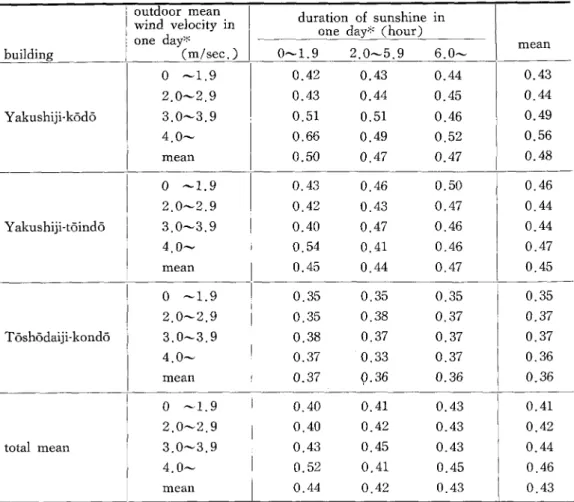
Table 2. Dependency of rj/ro on daily mean wind velocity and duration of sunshine
b u il d i n g
d u r a ti o n o n e d a y * o f s u n s h i n e ( h o u r ) in
0 1 . 9 2 . 0 ‑ 5 . 9 6 . 0 ‑ m e a n
Y a k u s h i ii ‑k o d 5
‑ 1 . 9 0 . 4 2 0 . 4 3 0 .4 4 0 . 4 3 2 . 0 2 . 9 0 . 4 3 0 . 4 4 0 . 4 5 0 . 4 4 3 . 0 ‑ 3 . 9 0 . 5 1 0 . 5 1 0 . 4 6 0 . 4 9 4 . 0 0 . 6 6 0 . 4 9 0 . 5 2 0 . 5 6
m e a n 0 . 5 0 0 . 4 7 0 . 4 7 0 . 4 8
‑ 1 . 9 0 . 3 5 0 . 3 5 0 . 3 5 0 . 3 5 2 . 0 ‑ 2 . 9 0 . 3 5 0 . 3 8 0 . 3 7 0 . 3 7
T o s h o d a ij i‑ k o n d o 3 . 0 ‑ 3 . 9 0 . 3 8 0 . 3 7 0 . 3 7 0 . 3 7 4 . 0 0 . 3 7 0 . 3 3 0 . 3 7 0 . 3 6
m e a n 0 . 3 7 0 . 3 6 0 . 3 6 0 . 3 6
t o t a l m e a n
‑ 1 i 2 . 0 2 . 9 3 . 0 ‑ 3 . 9
0 . 4 0 0 . 4 1 0 . 4 3 0 . 4 1 0 . 4 0 0 . 4 2 0 . 4 3 0 . 4 2 0 . 4 3 0 . 4 5 0 . 4 3 0 . 4 4 4 . 0 ‑ 0 . 5 2 0 . 4 1 0 . 4 5 0 . 4 6 m e a n 0 . 4 4 0 . 4 2 0 . 4 3 0 . 4 3
* the data at Nara Meteorological Observatory
Table 3, Dependency of n and ri/r,, on wind direction
b u ild in g r (/ ro
o u td o o r r i/ r o w in d d ir e c tio n s w r i/ r,,* N
r i/ ro
Y a k u s h iji‑k o d o Y a k u s h iii‑to in d o
3 . 7 0 .5 7 3 . 3 0 .4 7
4 . 1 0 .4 5 4 . 0 0 .4 6 4 .5 0 .5 0 4 .3 0 .4 6
3 . 2 0 .4 3 3 .3 0 .4 2 T o s h o d a iii‑k o n d S 3 .0 0 .3 8 3 .6 0 .4 0 3 .4 0 . 3 6 2 .5 0 .3 4
t o ta l m e a n 3 .2 0 .4 8 4 .1 0 .4 5 3 .9 0 . 4 2 3 .0 0 . 4 0
* the direction of biggest wind velocity in one day at Nara Meteorological Observatory
S h ir o N A G A T A
T ab le 4 . D ep en d e n cy o f ri/ro on o u td o o r d iu rn a l ran g e of a ir‑te m p era tu re (ro)
b u ild in g
o u td o o r d iu rn al ran g es o f air‑ tem p eratu re ( ‑c) 0 5 .9 6 .0 8 .9 9 .0 1 1 .9 12 .0 ‑ 14 .9 15 .0 ‑
Y ak u sh iji‑k o d o 0 . 44 0 . 4 4 0 . 4 5 0 . 48 0 . 4 7 Y ak u sh iji‑to in d o 0 . 4 1 0 . 4 4 0 . 4 7 0 . 56 0 . 5 6 T o sh o d aiji‑k o n d o 0 . 36 0 . 3 6 0 . 3 7 0 . 43 0 . 4 5
to ta l m ea n 0 .40 0 .4 1 0 .4 3 0 .49 0 .5 0
§ 3. Consideration
Monthly and annual mean values of diurnal range of air-temperature for indoor (r,) and outdoor (r0), and of these ratios (ri/rn) are given in Table 1.
Inspecting the table , we find that the ratios are kept nearly constant throughout the year , though we see some remarkable seasonal variations of n and r0 themselves.
The monthly mean values of n/ro show, however, some slight deviation from its annual mean, and the origins of the deviation are examined statistically as follows.
CO. The deviations depend slightly on the outdoor wind velocity, and the statistical results are given in Table 2.
For Yakushiji-kodo we see a systematical , slight increase of the ratios with increasing of wind velocity, and for Yakushiji-toindS and Toshodaiji-kondo we can not see such a syste- matical tendency. The former building is kept in almost constant state, i. e. , its doors are usually shut in whole day throughout the year, and in the latter buildings their doors are
usually opened by day and shut by night.
In view of these facts, we can conclued that the ratio depends slightly, through the change of ventilation of the buildings, on the outdoor wind velocity.
Through the change of ventilaton speed of the buildings , the slight wind effect on the ratio may be explained. In fact, the ventilation speed may be effected differently with the degree of exposure to wind of building. A statistical result shown in Table 3 gives some informa- tion in this respect. The minimum of the mean ratio of the three buildings appears as 0.40 for North wind. This fact may be supposed if we refer to the fact that larger portions of the north side are occupied by the unventilated walls such as mortar-wall, than other sides.
(ii). The statistical examination of the dependency of the ratio (ri/r0) on the weather condition in question, is tried by employing the duration of sunshine in one day as the indi- cator of the weather condition. And the results are given in Table 2, in which we can not find out any systematical tendency. We can find out, however, in Table 4 some systematical tendency between the ratio and the outdoor diurnal range of air-temperature (ro) itself, i. e. , systematical, slight increase of the ratio (rj/ro) with increasing of ro.
The Indoor-climate of Old Temple Buildings in Nara City and its Suburbs 47
§ 4. Conclusion
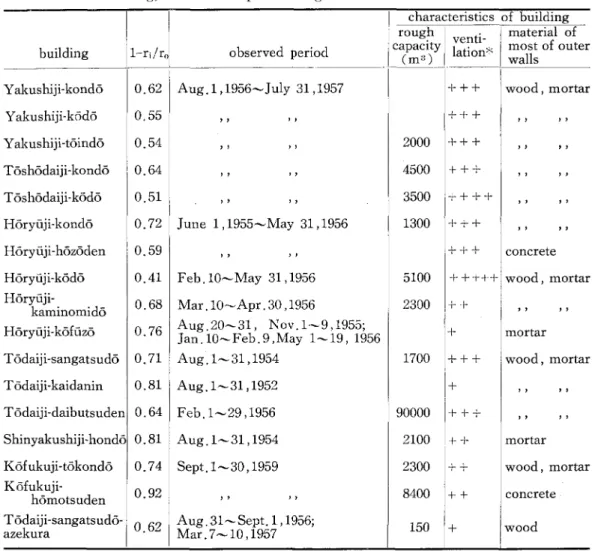
In conclusion, the author proposes to introduce the ratio (ri/r0), i. e. , the ratio of indoor to outdoor diurnal range of air-temperature, as a important parameter of indoor- climate, and to adopt 1-ri/ro as an indicator showing the climatic controlling power of building. The values of the indicator for some temple buildings obtained by the author's surveys are listed in Table 5.
Table 5. Mean values of 1-x\/rn (an indicator showing the climatic controlling power of building) of some temple buildings
b u ild in g o b s e r v e d p e r io d
c h a ra c te ris tic s o f b u ild in g m a te r ia l o t m o s t o f o u te w a lls
Y a k u sh iii‑k o n d o 0 .6 2 A u g .1 ,1 9 5 6 J u ly 3 1 ,1 9 5 7 + + ++ + + w o o d , m o r ta r Y a k u s h iii‑k o d o 0 .5 5
Y a k u sh iii‑to in d o 0 .5 4 2 0 0 0 + + + T o sh o d a iii‑k o n d o 0 .6 4
> > > > 4 5 0 0 + + +
T o sh o d a iii‑k o d o 0 .5 1 3 5 0 0 + + + +
> ) ) ' H o r y u ji‑k o n d o 0 .7 2 J u n e l , 1 9 5 5 M a y 3 1 , 1 9 5 6 1 3 0 0 + + +
H o ry u ji‑h o z o d e n 0 .5 9
) ) サ ) m o r ta r
H o r y u j i‑k o d o 0 .4 1 F e b .1 0 M a y 3 1 ,1 9 5 6 H o r y u ji‑ k a m in o m id o
0 .6 8 M a r . 1 0 ‑ A p r .3 0 ,1 9 5 6
H o r y u j i‑ k o f u zo 0 .7 6 A u g J a n . 1 0 ‑ F e b .9 ,M2 0 ‑ 3 1 , N o v .1 ‑a y 1 ‑9 ,1 9 5 5 ;1 9 , 1 9 5 6 T o d a iji‑s a n g a t su d o 0 .7 1 A u g .1 ‑ 3 1 , 1 9 5 4
T o d a iji‑k a id a n in 0 .8 1 A u g . 1 ‑ 3 1 , 1 9 5 2 +
> > サ ) T o d a ij i‑d a ib u ts u d e n 0 .6 4 F e b . l 2 9 ,1 9 5 6 9 0 0 0 0
2 1 0 0 + + +
‑t‑ + m o r ta r S h in y a k u s h ij i‑ h o n d o 0 .8 1 A u g .1 ‑ 3 1 , 1 9 5 4
K o f u k u ji‑to k o n d o 0 .7 4 S e p t . 1 ‑ 3 0 ,1 9 5 9 2 3 0 0 + + w o o d , m o r ta r K o fu k u ji‑ h o m o ts u d e n
0 .9 2 8 4 0 0 + + c o n c r e te T o d a iji‑sa n g a t su d o ‑
a z e k u r a
0 .6 2 A u g M a r .73 1 ‑1 0 , 1 9 5 7S e p t. 1 , 1 9 5 6 ;
1 5 0 + w o o d
•Ethe more numbers of + , the better ventilation
Some more detailed and theoretical studies are now being continued and the results will be published in the near future.
48 Shiro NAGATA
Acknowledgements
The author wishes to express his sincere thanks to Prof. T. Namekawa, the Directer of Meteorological Research Institute , Kyoto University, for his kind guidance.
References
S. Nagata (1953): The Meteorological Observation in Old Temple Buildings(l). The Journal of Nara Gakugei University, Vol.3, No.2 (in Japanese)
S. Nagata (1956): The Meteorological Observation in Old Temple Buildings(2). The Journal of Nara Gakugei University, Vol.6, No.2 (in Japanese)
S. Nagata (1957): The Meteorological Observation in Old Temple Buildings(3). The Journal of Nara Gakugei University, Vol.7, No.2 (in Japanese)
S. Nagata (1959): The Meteorological Observation in Old Temple Buildings(4). The Journal of Nara Gakugei University, Vol.8, No.2 (in Japanese)