1
The use of non-Brachionus plicatilis species complex rotifer in larviculture 1
Atsushi Hagiwaraab, Helen S. Marciala 2
a Graduate School of Fisheries and Environmental Sciences 3
b Organization for Marine Science and Technology, 4
Nagasaki University, Nagasaki, Japan.
5
E-mail: [email protected] 6
Telephone number : +81-095-819-2830 7
Fax number: +81-095-819-2830 8
2 Abstract
9
Due to the expanding world aquaculture production, the demand for high quality and quantity of 10
fish larvae has also increased. Up to date, the bottleneck in larviculture is the stable and ample production 11
of appropriate live food such as rotifers and copepods. Among rotifers, Brachionus plicatilis species 12
complex, which encompasses 15 species with varied sizes ranging from 100-400 µm, is commonly used 13
in most hatcheries. The use of B. plicatilis species complex (B. plicatilis, B. koreanus and B.
14
rotundiformis) in larviculture is reported in several review papers. In this review, we first described rotifer 15
species not classified under B. plicatilis species complex, some of which are already used in larviculture, 16
while some have high potential for use based on their characteristics, life history, and distribution.
17
Rotifers, Brachionus angularis, Brachionus calyciflorus and Proales similis are described in details in 18
comparison with B. plicatilis species complex. Furthermore, we discussed some characteristics of rotifers 19
which can affect their predation.
20
Keywords: Rotifera, live food, larval culture, rotifer mass culture, Brachionus, Proales similis 21
3 Introduction
22
Aquaculture is the world’s fastest growing food producing sector, with an annual growth rate of 23
8.8% compared to 1.2% for capture fisheries and 2.8% for terrestrial meat production (FAO, 2016).
24
Parallel to the growth of aquaculture is the demand of high quality and quantity of larvae needed to be 25
stocked in either cages or fish ponds. Although aquaculture had advanced this far, larviculture for most 26
fishes is still dependent on live food such as rotifers, copepods, cladocerans, and Artemia, especially 27
during the transition from endogenous to exogenous feeding. This is due to the fact that most fish larvae 28
cannot readily assimilate formulated diets during the first days of feeding (Conceição et al., 2010). In 29
addition, fish larvae are believed to be predominantly visual feeders, therefore preferably selecting 30
moving prey items (Conceição et al., 2010).
31
Among live feed, rotifers (genus Brachionus) are ideal for larviculture because of their varied 32
body size, their nutritional quality which can be controlled with commercial enrichment products, and 33
their established culture techniques (Lubzens, 1987; Dhert et al., 2001; Hagiwara et al., 2017). The use of 34
rotifer, Brachionus plicatilis species complex (which comprises approximately 15 species; Mills et al.
35
2017), in larviculture is well established since its first usage as live food in the 1960s. Papakostas et al.
36
(2006) found five species from hatcheries around the world. Brachionus plicatilis Muller, Brachionus 37
koreanus Hwang, Dahms, Park & Lee and Brachionus rotundiformis Tschugunoff, corresponding to L, S, 38
and SS morphotype, repectively (Hagiwara et al., 2007), are widely used, and their biological 39
information is well examined. Production techniques of these species are already established and, due to 40
their varied sizes, culturists can choose the rotifer species to use according to the mouth size of their 41
cultured species, and are given to the fish larvae upon hatching up to 10-20 days after its mouth opening 42
(Lubzens et al., 1987; Conceição et al., 2010). Thereafter, larvae are fed with larger live feed such as 43
Artemia, copepods and cladocerans, or artificial formulated diet.
44
4
The demand for the ornamental fishes is always high (Lim et al., 2003; Whittington & Chong, 45
2007). Most (about 90%) of the ornamental fish in the market are freshwater species and are farm-bred, 46
while marine species are predominantly from the wild (Whittington & Chong, 2007). Therefore, the 47
major goal of the aquaculture industry is to reduce collection pressure on wild populations by developing 48
captive culture techniques of marine species (Majoris et al., 2018). At present, larviculture of marine fish 49
species is usually done by using the so-called “green water technique” and feeding with small brachionid 50
rotifers (e.g. B. rotundiformis with 150-190 µm in lorica length ) from hatching up to 14 days, or by 51
raising the breeders in a fish pond where hatchlings can eat a variety of live food from the environment 52
(Lim & Wong, 1997; Majoris et al., 2018). At commercial scale, ornamental marine fish species with a 53
too small mouth size to ingest B. rotundiformis are either not cultured successfully or fed with inert food 54
such as milk powder, egg yolk, and powder feeds (Lim et al., 2003; Hirai et al., 2012). Therefore, there is 55
a high demand for rotifer species smaller than B. rotundiformis for the commercial production of 56
ornamental fishes.
57
Culture of rotifers can either be done intensively or extensively. In intensive culture, rotifers are 58
reared in a highly controlled environment, fed with condensed or concentrated food, and supplied with 59
either aeration or pure oxygen. Under these conditions, culturists can produce as high as 2.1 billion of 60
rotifers per day in 1 m3 culture volume (Hagiwara et al., 2017). Although this procedure produces high 61
quality and quantity of rotifers, it also entails skills and high costs. On the other hand, in extensive 62
culture, rotifers are grown in a fish pond and animal manures/excreta are supplied to promote plankton 63
productivity (Dahril, 1997; Agbakimi et al., 2017). Animal excreta enter the food web in the pond through 64
direct consumption by phytoplankton. These wastes also serve as source of minerals and organic 65
substrates for heterotrophic microorganisms. Phytoplankton and microorganisms are, in turn, consumed 66
by zooplanktons (including rotifers). In this practice, however, the environmental factors that would affect 67
the growth of rotifers, such as temperature, pH, and ammonia concentration, are difficult to control. In 68
addition, rotifer density in the pond is relatively low, probably due to competition with other zooplankton 69
5
with the same food or due to predation by other rotifers. Therefore, although extensive aquaculture has 70
lower operating costs and easier management, this method was found to be not effective for mass 71
production of larval fish in terms of labor cost and space.
72
High population growth, appropriate size, ubiquitous distribution, and ease of culture are among 73
the most important qualities of a rotifer species to be considered as a good candidate for use in 74
commercial hatcheries. Therefore, research efforts are being directed into finding rotifer species with 75
these characteristics.
76
In this review, we described non-B. plicatilis species which are already used in larviculture, in 77
comparison to B. plicatilis species complex. Next, we listed some of the species with high potential for 78
usage for larviculture based on their characteristics, life history, and distribution. Third, we discussed 79
some characteristics of rotifers which can affect their predation.
80
81
Brachionus plicatilis sp. complex
82B. plicatilis, B. koreanus and B. rotundiformis 83
The euryhaline rotifer B. plicatilis species complex, which encompasses around 15 species with 84
varied sizes ranging from 100-400 µm (Mills et al., 2017), is the most common species used in marine 85
fish hatcheries worldwide. Their culture techniques and usage as live food are well known and reviewed 86
by several authors (e.g. Dhert et al., 2001; Conceição et al., 2010; Sakakura, 2017; Hagiwara et al., 2017).
87
With several modifications through the years of experimentation, a stable, reliable, economical and 88
continuous culture system which can produce up to 2.1 billion of rotifers in 1 m3 culture volume on daily 89
basis have been produced (Hagiwara et al., 2017). The highest density obtained for these species 90
complex was 160,000 ind/ml (Yoshimura et al., 2003; Yoshimatsu & Hossain, 2014).
91
6
Reproductive characteristics of B. plicatilis species complex in comparison to other rotifer 92
species that are currently used in aquaculture are presented in Table 1. Because of changes in taxonomy 93
of this group, S-morphotype species such as Brachionus koreanus was recognized as B. rotundiformis in 94
some literatures (e.g. Yoshimura et al., 2003).
95
The importance of the B. plicatilis complex in larviculture is difficult to overestimate and 96
reviewed by many authors (e.g. Lim et al., 2003; Conceição et al., 2010; Sakakura, 2017).
97
98
Non-Brachionus plicatilis sp. complex
99Species used in larviculture 100
1) Brachionus angularis 101
Brachionus angularis Gosse is a common freshwater species. Its body size ranges from 85 to 140 102
mm; tropical species isolated from Kenya and Laos are smaller compared to those isolated from 103
temperate countries (e.g. from Europe and China; Ogello et al., 2016; Ogata, 2017). B. angularis isolated 104
from Laos has a round-shaped lorica, can reproduce both sexually and asexually, and
lorica length of
105adult egg-carrying females has a size
(86.0 ± 4.9 μm), smaller than that of other B. angularis and 106strains in B. plicatilis species complex (Ogata et al., 2011). Ogata et al. (2011) found that the optimum 107
culture conditions for this strain include culture temperature between 24 to 27oC and feeding with 7×10⁶ 108
cells/ml of Chlorella vulgaris Beyerinck. At these culture conditions, they obtained rotifer density of 109
more 2,000 ind/ml within 10 days. During their experiments, the highest density they obtained for this 110
species was 3,300 ind/ml.
111
Ogata (2017) used B. angularis to culture silver barb, Hypsibarbus malcolmi (Smith), a Laotian 112
indigenous cyprinid. The larvae were fed with an increasing number of B. angularis at 5-10 ind/ml 113
7
starting from hatching to day 12, and growth and survival were compared to those without feeding. After 114
12 days of culture, survival was 100% with food, while none survived in without food treatment.
115
Rotifer-fed larvae also grew from 2.8 mm to 5.8 mm, proving that rotifer supported the growth of silver 116
barb larvae. After confirming that B. angularis is useful for rearing H. malcolmi larvae, Ogata (2017) 117
conducted another experiment to compare H. malcolmi fed with B. angularis, Artemia, copepods, Moina 118
spp., and catfish pellets from 2 days after hatching (2DAH) to 28DAH with H. malcolmi fed with mixed 119
natural zooplankton collected from an aquaculture pond. Results showed that the first group and second 120
group have 94% and 6% survival rate on 28DAH, respectively, and there is a large variation in total 121
length of the survivors in the second group, while the first group grew from 2.8 mm to 15.2 mm at 122
28DAH.
123
Ogata & Kurokura (2012) tested B. angularis, paramecium Paramecia sp., and Artemia as live 124
food sources for Siamese fighting fish, Betta splendens Regan. Larviculture of B. splendens is presently 125
done by feeding protozoans. Their results showed that survival (97.5–100%) was high in all fed 126
treatments. The fastest growth rate was observed in larvae fed a combination of rotifer and Artemia, 127
wherein growth increased by 282% by 18 DAH relative to 3 DAH. The next fastest growth rate was 128
observed in rotifer-fed larvae and then in paramecia-fed larvae with 158% increase and 54.3% increase 129
in growth, respectively.
130
In 2016, we had isolated B. angularis from a pond in Kegati, Kenya. The size of the lorica (length 131
= 85.6 ± 3.1 µm; width = 75.4 ± 3.6 µm) is slightly smaller to that found in Laos (Ogello et al., 2016).
132
The optimum conditions for culturing this species were at 25°C and fed 2.5 × 10⁶cells/ml C. vulgaris.
133
Under these conditions, the net reproductive rate and intrinsic rate of natural increase (r) were 8.43 ± 0.24 134
and 0.74 ± 0.02/ day, respectively. Under mass culture (300 ml total volume) and optimum culture 135
conditions, the highest population of 255.6 ± 12.6 ind/ml was obtained (Ogello et al., 2016). We also 136
found that addition of chicken manure at 2.0 ml/l enhances the population growth of this strain (Ogello &
137
Hagiwara, 2015).
138
8
In China, Hu & Xi (2006, 2008) found that different strains of B. angularis isolated from 139
different provinces within the country vary in size and life history parameters (generation time, r, and life 140
span) and are influenced by food they consumed. Rotifers fed Scenedesmus obliquus (Turpin) 141
Kützing had higher reproduction rates than those fed Chlorella pyrenoidosa H. Chick. As is known in B.
142
plicatilis species complex (Hagiwara et al., 1995, 2001; Mills et al., 2017), B. angularis strains with 143
smaller size show higher population growth even though their net reproduction rates are similar. The r 144
and net reproductive rates of these strains fed S. obliquus were 0.059-0.115 per hour and 13.38-16.35, 145
respectively.
146
2) Brachionus calyciflorus 147
Brachionus calyciflorus Pallas is one of the widely studied freshwater rotifer with ubiquitous 148
distribution (Rico-Martinez & Dodson, 1992).
149
The lorica length of B. calyciflorus from different geographic region in China ranges from 187 to 150
227 µm with an average r of 0.84/day at 20-30°C (Xi et al., 2005). The net reproductive rate of the three 151
strains collected from different regions varies according to temperature, and ranging from 10-27 ind/ml 152
(Xi et al., 2005). In Mexico, Rico-Martinez & Dodson (1992) found that the optimum culture conditions 153
of B. calyciflorus isolated from a fish pond were at 30°C and fed 107 cells/ml C. vulgaris. Under these 154
culture conditions, and at a volume of 500 ml, they were able to produce 81,080 rotifers/day. Bennett &
155
Boraas (1988) was able to maintain B. calyciflorus in a turbidostat for eight months with maximum 156
specific growth rate of 0.08/h which is equivalent to a doubling time of 8.7h.
157
Some studies have shown that animal and human excreta can promote B. calyciflorus growth. For 158
example, Agbakimi et al. (2017) found that B. calyciflorus reared with cow dung and chicken droppings 159
can reach 217 ind/ml after 5 days of culture. Dahril (1997) also showed that B. calyciflorus can grow up 160
to 120 ind/ml using low concentrations of human and animal excreta including humans, chicken, duck, 161
quail, horse, and buffalo by promoting the growth of Chlorella, which in turn serves as food for B.
162
9
calyciflorus. Under intensive culture, Park et al. (2001) conducted a batch culture (5-li vessel) 163
experiments on B. calyciflorus at 28oC, feeding with freshwater Chlorella and supplied with pure oxygen.
164
With these conditions, a maximum density of 19,200 ind/ml was reached, in contrast to 8,600 ind/ml 165
obtained when usual aeration is supplied. They improved their system further by adjusting the pH of the 166
culture water. At pH 7.0 and at 32oC with a continuous oxygen supply, a density of 33,500 ind/ml was 167
obtained (Park et al., 2001).
168
There are considerable reports on the success and high growth rate of fish larvae when using B.
169
calyciflorus as live food. For example, Lim & Wong (1997) showed that Dwarf gourami, Colisa lalia 170
larvae (2-12 DAH), have higher growth and survival compared to those fed with egg yolk. At 171
metamorphosis, the overall survival rate of larvae fed rotifers (65.1-74.4%) was about four times of those 172
cultured in an open pond (17.5%). Similarly, Lim & Wong (1997) successfully cultured larvae of Brown 173
discus, Symphysodon aequifasciata axelrodi L. P. Schultz using B. calyciflorus. Larviculture of Brown 174
discus is usually done by rearing them together with their parents, where the larvae are eating body slime 175
of the parents (called “parental feeding”) during the first two weeks of endogenous feeding (Lim &
176
Wong, 1997). Results of their study showed that growth and survival rate of Brown discus fed on rotifers 177
and parental feeding were comparable. Feeding solely with rotifer is advantageous because it eliminates 178
the risk of the larvae to be eaten by the parental fish. The use of B. calyciflorus is also reported on 179
zebrafish Danio rerio (Aoyama et al., 2015). Zebrafish larviculture was previously done by feeding 180
marine rotifer B. plicatilis, which either or both rotifer or fish experience salinity shock, resulting in 181
mortality (Aoyama et al., 2015). Nandini & Sarma (2000) also found that mollies, Poecilia sphenops 182
Valenciennes continuously fed on B. calyciflorus from day 5 to day 55 of culture. Harzevili et al. (2003) 183
obtained significantly higher survival of B. calyciflorus-fed turbot Lota lota compared to Artemia-fed 184
group. The survival is further enhanced in the presence of “green water” (Chlorella sp.). Awaiss et al.
185
(1996) obtained 95.5% survival rate on gudgeon, Gobio gobio (Linnaeus) fed with B. calyciflorus versus 186
10
63.7% on dry diet, with the final weight 15.5 mg versus 10 mg. Awaiss et al. (1996) also successfully 187
used B. calyciflorus to feed catfish Clarias gariepinus (Burchell) during the first week of larval feeding.
188
3) Proales similis 189
Proales similis de Beauchamp is one of the common rotifer in saline systems, and so far in many 190
countries including Mexico and Japan. In 2004, our group isolated a P. similis in an estuary of Okinawa, 191
Japan. This rotifer is small (body length = 82.7 ± 11 µm; body width = 40 ± 6 µm), which is 38% smaller 192
and 60% narrower than the SS-type rotifer, B. rotundiformis (Wullur et al. 2009). We also found that this 193
species is also illoricate, has high population growth rate, and has nutritional value that can be 194
manipulated just like other rotifer species (Wullur et al., 2009; Hagiwara et al., 2014). Since we found 195
that this species is a promising species for larviculture, we conducted experiments to mass culture and 196
fish feeding experiments using this species.
197
Wullur et al. (2009) found a female P. similis that can produce 4.3-7.8 offspring during its 2.9-3.4 198
day reproductive period. P. similis grew well at temperatures 25 to 35oC, salinities between 2 to 15 ppt 199
and both N. oculata and C. vulgaris as feed. Under above conditions, the r is ranging between 0.68 to 200
0.81/day, and a density of 250 to 1030 ind/ml can be obtained. In mass culture, starting from 25 ind/ml, 201
the density can reach up to 2,400 ind/ml, with an average r of 0.42/day after 11 days was obtained.
202
We also observed that P. similis tends to stay at the bottom of the culture container. We 203
hypothesized that if we increase the culture surface area of the container, then we can obtain more 204
rotifers. Two containers, one with a total surface area of 2,240 cm2 and the other with 507 cm2 were 205
tested. From an initial density of 1 ind/ml, we obtained a density of 2,840 ind/ml and 717 ind/ml on the 7th 206
day of culture from 2,240 cm2 and 507 cm2 surface area, respectively (Hagiwara et al., personal 207
communication). We are currently innovating a rotifer apartment-like culture container to provide wider 208
spaces for P. similis to graze.
209
11
We also conducted an experiment to determine if bacteria coming from decomposing animal 210
wastes could sustain P. similis culture as other rotifer species. Our results showed that addition of fish 211
wastes (0.75 g/ml) is beneficial to P. similis. At initial stocking density of 53 ind/ml, a density as high 212
1,605 ± 45 ind/ml could be obtained on day 10 (Kagali et al., 2018). We hypothesized that P. similis uses 213
micro-aggregates of organic materials present in the decomposing fish wastes to enhance probiotic 214
bacterial bloom. Indeed, Le et al. (2017) showed that bacterial community is important in the proliferation 215
of P. similis. The population density of P. similis with the addition of live mixture of bacteria was 755%
216
higher than those fed with probionts in the presence of antibiotic (Le et al., 2017). Although P. similis can 217
thrive in the presence of some species of bacteria, the presence of protozoa in the culture water is 218
detrimental to the culture (Hagiwara et al., personal communication). Therefore, it is necessary to provide 219
clean and protozoa-free culture water to P. similis.
220
Several experiments to determine if aeration is necessary for the proliferation of P. similis were 221
also conducted. Our studies showed that culture of P. similis starting from a 1 ind/ml can exponentially 222
increase and be stable for up to 13 days, with a peak density of 4,046 ± 47 ind/ml even without aeration;
223
and a similar density with aeration (Hagiwara et al., personal communication).
224
Unlike the Japanese strain, the Mexican strain of P. similis is more resilient to high salinities.
225
Reyes et al. (2017) found that P. similis isolated from a fish pond in Mexico can thrive at 5-35 ppt, with 226
an r ranging from 0.46 to 0.51/day, and a duplication time ranging from 1.36 to 1.51 days. Although the 227
maximum density at 35 ppt (1,703 ind/ml), was lower than that at 5-25 ppt (maximum values were 228
between 2,488 to 2,560 ind/ml).
229
We also successfully tested the usefulness of P. similis to fish larvae with very small mouth gape 230
including grouper, angelfish, and humphead wrasse as well as fish with complicated digested system such 231
as eel (Wullur et al., 2009; Wullur et al., 2011; Hagiwara et al., 2014). So far, P. similis is one of the most 232
promising smallest rotifer that can be used in culturing larvae that cannot accept SS-type rotifer.
233
12 Potential rotifer species for larviculture
234
In this review, we listed some of the non-B. plicatilis species complex with high potential for 235
usage for larviculture based on their characteristics, life history and distribution. The summary of the life 236
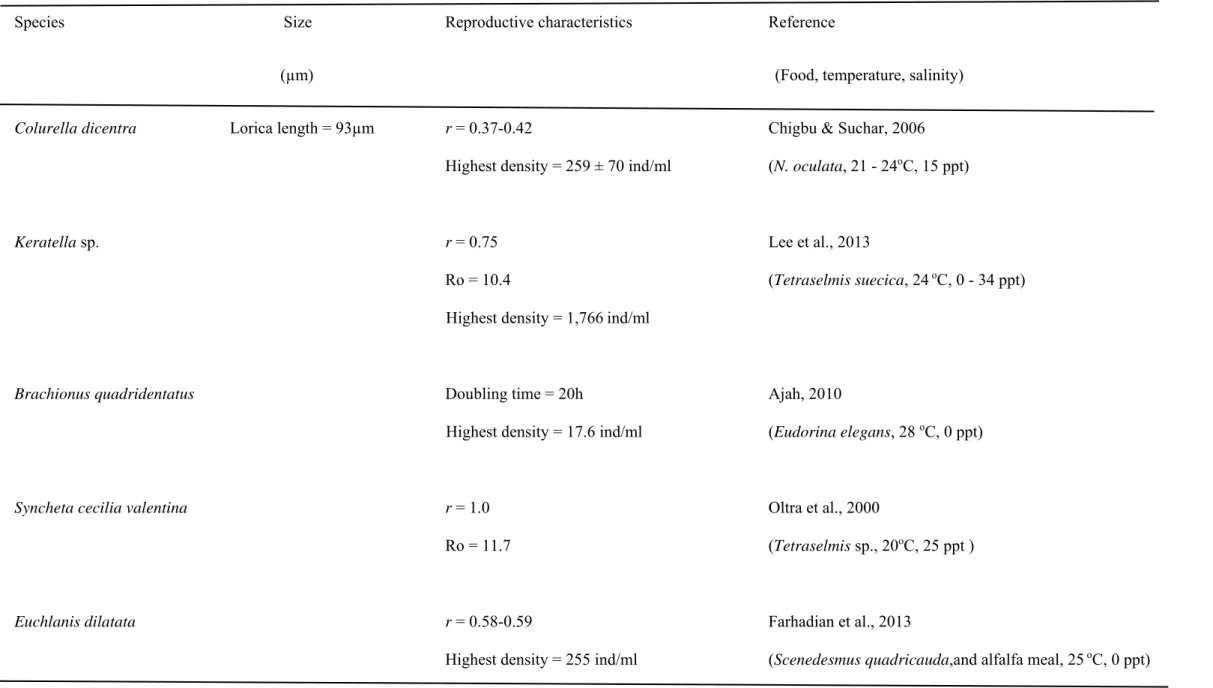
history of these rotifer species is presented in Table 2.
237
Chigbu & Suchar (2006) evaluated the possibility of culturing Colurella dicentra (Gosse) isolated 238
from a Mississippi Gulf Coast estuary. The average lorica length of this species is 93 mm and a width of 239
49 mm. They conducted experiments to determine the effects of salinity (10–47 ppt) on its population 240
growth rate, fed with N.oculata at a density of 100,000 cells/ml. The culture duration is 15 days. Their 241
results showed that C. dicentra survived in 10–47ppt. The best salinity to cultivate this species is at 15ppt, 242
with an r ranging from 0.37–0.42/day, and the highest density was 259 ± 70 ind/ml.
243
Another species potential for larviculture is Keratella sp. Lee et al. (2013) investigated the 244
optimum salinity and temperature conditions for the mass culture of Keratella sp. The maximum density 245
of 1,007 ind/ml was observed in freshwater or 0‰. Also the highest number of offspring per female 246
(10.2) and lifespan of the female (10.7 days) were obtained at 0‰, but were not significantly different at 247
5‰. In their temperature experiments (16-32℃), the highest maximum density (1,766 ind/ml) was 248
observed at 24℃. The number of offspring per female significantly increased with increasing temperature, 249
and the highest number of offspring per female was 10.4 individual. At 24℃, the lifespan of female 250
increased with decreasing temperature, with the longest lifespan lasting 12.8 days.
251
With the aim of using rotifer in larval rearing of catfish in Nigeria, Ajah (2010) conducted a mass 252
culture experiment on local rotifer species, the Brachionus quadridentatus Hermann. Result of his study 253
showed that best food for this species is Scenedesmus quadricauda (Turpin). Using 3m3 concrete tank, 254
he was able to maintain the culture for two years, with the density of 176,000 ind/l. The doubling time is 255
at the average of 20 h.
256
13
Oltra et al. (2000) also conducted series of studies to mass culture a marine rotifer Synchaeta 257
cecilia valentina Oltra & Todolí, a species ubiquitously found in Spain. Under culture conditions of 258
24oC, 20-37 ppt, and fed Tetraselmis sp., this species can reach up to 4,800 ind/l. The fatty acid content 259
of this species is similar to those of B. plicatilis when given Tetraselmis species (both Tetraselmis sp., and 260
Tetraselmis chuii Butcher) as food at a concentration of 5.55 µg/ml dry weight.
261
Farhadian et al. (2013) studied the population growth and production of the freshwater rotifer, 262
Euchlanis dilatata Ehrenberg fed different microalgal food with the addition of alfalfa (Medicago spp.) 263
meal. The highest density they attained with this species is 255 ind/ml in treatment fed with Scenedesmus 264
quadricauda and alfalfa meal. The mean population growth rate is also high (0.58/d) in this treatment 265
which is not significantly different from those fed with C. vulgaris (0.59/d).
266
Factors affecting predation of rotifers 267
Although rotifers are superior among live food, rotifers possess defensive structures e.g. long 268
spines, and have the capability to adjust their morphology and behavior to prevent predation (Gilbert, 269
2014; Yin et al., 2017; Zhang et al., 2017 Xue et al., 2017). For example, Yin et al. (2017) found that B.
270
angularis increased lorica thickness and enhanced lorica hardness in the presence of the predator 271
Asplanchna brightwellii Gosse, while B. calyciflorus developed longer posterolateral spines and increased 272
in body size within the presence of the same predator. Gilbert (2014) found that Brachionus variabilis 273
Hempel when cultured with Asplanchna girodi Guerne have larger (13%) lorica, longer (30-40%) anterior 274
spines, and longer (150%) posterior spine. B. calyciflorus, which originated from different environments 275
in China, developed stable long posterior lateral spines and smaller body size in the presence of predators 276
including fish, copepods and Asplanchna (Xue et al., 2017). Rotifer Keratella cochlearis (Gosse) is 277
somewhat special in which they are known to have bi-directional change in spine length, depending on 278
the size of the predator (Zhang et al., 2017). Zhang et al. (2017) both on laboratory and field studies 279
showed that, in the presence of larger predators, K. cochlearis shortened or reduced their spine length and 280
14
then elongated it in the presence of small-sized predators. In the case of fish as the predator, our group 281
found that the swimming speed of rotifer B. plicatilis is significantly faster (0.49 vs. 0.58 mm/sec) when 282
cultured in a culture medium with the seven band grouper Epinephelus semtemfasciatus (Thunberg) as the 283
predator. In addition, Alanis et al. (2009) found that the larvae of red-eyed tetra, Moenkhausia 284
sanctaefilomenae (Steindachner) prefers to prey on Brachionus rubens (Ehrenberg) and B. calyciflorus 285
which has shorter spines (about 10 µm) than Brachionus havanaensis Rousselet and Brachionus patulus 286
Varga, which have longer spines.
287
Acknowledgement 288
This research was supported by JSPS KAKENHI Grant Number JP17H03862 to Atsushi 289
Hagiwara.
290
References 291
Agbakimi, I.O., F.O. Arimoro, A.V. Ayanwale, U.N. Keke, J. Gana & J. Abafi, 2017. Mass culture and 292
growth response of rotifer (Brachionus calyciflorus) fed different combinations of manure filtrates and 293
algae. International Journal of Applied Biological Research 81: 70-84.
294
Ajah, P.O, 2010. Mass culture of rotifer (Brachionus quadridentatus [Hermann, 1783]) using three 295
different algal species. African Journal of Food Science 4: 80-85.
296
Alanis, J.G., S.S.S. Sarma, & S. Nandini, 2009. Prey selectivity and functional response by larval red 297
eyed tetra Moenkhausia sanctaefilomenae (Steindachner, 1907) (Characiformes: Characidae). Brazilian 298
Archives of Biology and Technology 52: 1209-1216.
299
Aoyama, Y., N. Moriya, S. Tanaka, T. Taniguchi, H. Hosokawa, & S. Maegawa, 2015. A novel method 300
for rearing zebrafish by using freshwater rotifers (Brachionus calyciflorus). Zebrafish 12: 288-295.
301
15
Awaiss, A., P. Kestermonth & J.C. Micha, 1996. Fatty acid profiles of two freshwater fish larvae 302
(gudgeon and perch) reared with Brachionus calyciflorus Pallas (rotifer) and/or dry diet. Aquaculture 303
Research 27: 651-658.
304
Bennett, W.N & M. E. Boraas, 1988. Isolation of a fast-growing strain of the rotifer Brachionus 305
calyciflorus Pallas using turbidostat culture. Aquaculture 73: 27-36.
306
Chigbu, P. & V.A. Suchar, 2006. Isolation and culture of the marine rotifer, Colurella dicentra (Gosse, 307
1887), from a Mississippi Gulf Coast estuary. Aquaculture Research 37: 1400-1405.
308
Conceição L.E.C., M. Yúfera, P. Makridis, S. Morais & M.T. Dinis, 2010. Live feeds for early stages of 309
fish rearing. Aquaculture Research 41: 613-640.
310
Dahril, T., 1997. A study of the freshwater rotifer Brachionus calyciflorus in Pekanbaru, Riau, Indonesia.
311
Hydrobiologia 358: 211–215.
312
Dhert, P., G. Rombaut, G. Suantika & P. Sorgeloos, 2001. Advancement of rotifer culture and 313
manipulation techniques in Europe. Aquaculture 200: 129–146.
314
FAO, 2016. The state of world fisheries and aquaculture; contributing to food security and nutrition for 315
all. Food and Agriculture Organization of the United Nations, Rome, pp. 200.
316
Farhadian, O., L. Daghighi & E. E. Dorche, 2013. Effects of microalgae and alfalfa meal on population 317
growth and production of a freshwater rotifer Euchlanis dilatata (Rotifera: Monogononta). Journal of 318
World Aquaculture Society 44: 86-95.
319
Gilbert, J.J., 2014. Morphological and behavioral responses of a rotifer to the predator Asplanchna.
320
Journal of Plankton Research 36: 1576-1584.
321
Hagiwara, A., C.-S. Lee, G. Miyamoto & A. Hino, 1989. Resting egg formation and hatching of the S- 322
type rotifer Brachionus plicatilis at varying salinities. Marine Biology 103: 327-332.
323
16
Hagiwara, A., K. Hamada, A. Nishi, K. Imaizumi & K. Hirayama, 1993 Mass production of 324
rotifer Brachionus plicatilis resting eggs in 50m3 tanks. Nippon Suisan Gakkaishi 59: 93-98.
325
Hagiwara, A., Kotani, T., Snell, T. W., AssavaAree, M. & K. Hirayama, 1995a. Morphology, 326
reproduction and genetics of the tropical minute marine rotifer Brachionus plicatilis strains. Journal of 327
Experimental Marine Biology and Ecology 194: 25-37.
328
Hagiwara, A., M. Jung, T. Sato & K. Hirayama, 1995b. Interspecific interaction between marine rotifer 329
Brachionus plicatilis and zooplankton species found in the rotifer mass culture tanks as 330
contaminants. Fisheries Science 61: 623-627.
331
Hagiwara, A., Gallardo, W. G., Assavaaree, M., Kotani, T. & A. B. de Araujo, 2001. Live food 332
production in Japan: recent progress and future aspects. Aquaculture 200: 111-127.
333
Hagiwara, A., K. Suga, A. Akazawa, T. Kotani & Y. Sakakura, 2007. Development of rotifer strains with 334
useful traits for rearing fish larvae. Aquaculture 268: 44-52.
335
Hagiwara, A., S. Wullur, H.S. Marcial, N. Hirai & Y. Sakakura, 2014. Euryhaline rotifer Proales similis 336
as initial live food for rearing fish with small mouth. Aquaculture 432: 470-474.
337
Hagiwara, A., H-J. Kim & H. Marcial, 2017. Mass culture and preservation of Brachionus plicatilis sp.
338
complex. In Hagiwara, A & T. Yoshinaga (eds), Rotifers: Aquaculture, Ecology, Gerontology, and 339
Ecotoxicology. Springer, Singapore: 35-55.
340
Harzevili, A.S., D. de Charlero, J. Auwerx, J. Van Slycken, P. Dhert & P. Sorgeloos, 2003. Larval 341
rearing of burbot (Lota lota L.) using Brachionus calyciflorus rotifer as starter food. Journal of Applied 342
Ichthyology 19: 84-87.
343
Hirai N, M. Koiso, K. Teruya, M. Kobayashi, T. Takebe, T. Sato, K. Okuzawa & A. Hagiwara, 2012.
344
Success of seed production of humphead wrasse Cheilinus undulatus with improvement of spawning 345
17
induction, feeding and rearing conditions. Proceedings of the 40th U.S.-Japan Aquaculture Panel 346
Symposium, Honolulu, Hawaii pp.108-111.
347
Hu, H. & Y. Xi, 2006. Differences in population growth and morphometric characteristics of three strains 348
of Brachionus angularis. Journal of Freshwater Ecology 21: 101-108.
349
Hu, H. & Y. Xi, 2008. Demographic parameters and mixis of three Brachionus angularis Gosse 350
(Rotatoria) strains fed on different algae. Limnologica 38: 56–62.
351
Hwang, D.-S., H.-U. Dahms, H. G. Park & J.-S. Lee, 2013. A new intertidal Brachionus and intrageneric 352
phylogenetic relationships among Brachionus as revealed by allometry and CO1-ITS1 gene analysis.
353
Zoological Studies 52: 13.
354
Kagali, R.N., E.O. Ogello, Y. Sakakura & A. Hagiwara, 2018. Fish-processing wastes as an alternative 355
diet for culturing the minute rotifer Proales similis de Beauchamp. Aquaculture Research 49: 2477-2485.
356
Le, D.V.B., P.N. Nguyen, K. Dierckens, D.V. Nguyen, P. De Schryver, A. Hagiwara & P. Bossier, 2017.
357
Growth performance of the very small rotifer Proales similis is more dependent on proliferating bacterial 358
community than the bigger rotifer Brachionus rotundiformis. Aquaculture 476: 185-193.
359
Lee, B.I., S.K Kim, O.N. Kwon, H.G. Park & J.C. Park, 2013. The optimal salinity and temperature 360
condition for the growth of rotifer, Keratella sp. (in Korean with English abstract). Journal of Fisheries 361
and Marine Education 25: 1205-1213.
362
Lim, L.C. & C.C. Wong, 1997. Use of the rotifer, Brachionus calyciflorus Pallas, in freshwater 363
ornamental fish larviculture. Hydrobiologia 358: 269–273.
364
Lim, L.C., P. Dhert & P. Sorgeloos, 2003. Recent developments in the application of live feeds in the 365
freshwater ornamental fish culture. Aquaculture 227: 319-33.
366
Lubzenz, E., 1987. Raising rotifers for use in aquaculture. Hydrobiologia 147: 245-255.
367
18
Majoris, J.E., F.A. Francisco, J. Atema & P.M. Buston, 2018. Reproduction, early development, and 368
larval rearing strategies for two sponge-dwelling neon gobies, Elacatinus lori and E. Colini. Aquaculture 369
483: 286-295.
370
Mills, S., A. Alcántara-Rodríguez, J. Ciros-Pérez, A. Gómez, A. Hagiwara, K.H. Galindo, C.D. Jersabek, 371
R. Malekzadeh-Viayeh, F. Leasi, J-S. Lee, D.B. Mark Welch, S. Papakostas, S. Riss, H. Segers, M. Serra, 372
R. Shiel, R. Smolak, T.W. Snell, C-P. Stelzer, C.Q. Tang, R.L. Wallace, D. Fontaneto, E.J. Walsh, 2017.
373
Fifteen species in one: deciphering the Brachionus plicatilis species complex (Rotifera, Monogononta) 374
through DNA taxonomy. Hydrobiologia 796: 39-58.
375
Nandini, S. & S.S.S. Sarma, 2000. Zooplankton preference of two species of freshwater ornamental fish 376
larvae. Journal of Applied Ichthyology 16: 282-284.
377
Ogata, Y., 2017. Use of freshwater Brachionus for aquaculture. In Hagiwara, A & T. Yoshinaga (eds), 378
Rotifers: Aquaculture, Ecology, Gerontology, and Ecotoxicology. Springer, Singapore: 75-85.
379
Ogata, Y., & H. Kurokura, 2012. Use of the freshwater Brachionus angularis as the first food for the 380
larvae of the Siamese fighting fish Betta splendens. Fisheries Science 78: 109-125.
381
Ogata, Y., Y. Tokue, T. Yoshikawa, A. Hagiwara, & H. Kurokura, 2011. A Laotian strain of the rotifer 382
Brachionus angularis holds promise as a food source for small-mouthed larvae of freshwater fish in 383
aquaculture. Aquaculture 312: 72-76.
384
Ogello, E.O. & A. Hagiwara, 2015. Effects of chicken manure extract on the population growth, mixis 385
induction and body size of the freshwater rotifer Brachionus angularis Gosse 1851. Asian Fisheries 386
Science 28: 174-185.
387
Ogello, E.O., H-J. Kim, K. Suga & A. Hagiwara, 2016. Lifetable demography and population growth of 388
the rotifer Brachionus angularis in Kenya: influence of temperature and food density. African Journal of 389
Aquatic Science 41: 329-336.
390
19
Oltra, R., R. Todoli, T. Bosque, L.M. Lubian & J.C. Navarro, 2000. Life history and fatty acid 391
composition of the marine rotifer Synchaeta cecilia valentina fed different algae. Marine Ecology 392
Progress Series 193: 125-133.
393
Park, H.G., K.W. Lee, S.H. Cho, H.S, Kim, M-M. Jung & H-S. Kim, 2001. High density culture of the 394
freshwater rotifer, Brachionus calyciflorus. Hydrobiologia 446/447: 369-374.
395
Reyes, J.R.C., C. J. L. Monteón, H. C. Urreta, M. C. M. Dosta & G. A. R. Montes de Oca, 2017.
396
Population growth and protein and energy content of Proales similis (Rotifera: Monogononta) reared at 397
different salinities. Turkish Journal of Fisheries and Aquatic Sciences 17: 767-775.
398
Rico-Martinez, R. & S.I. Dodson, 1992. Culture of the rotifer Brachionus calyciflorus Pallas.
399
Aquaculture 105: 191-199.
400
Sakakura, Y., 2017. Application of rotifers for larval rearing of marine fishes cultivated under various 401
conditions. In Hagiwara, A & T. Yoshinaga (eds), Rotifers: Aquaculture, Ecology, Gerontology, and 402
Ecotoxicology. Springer, Singapore: 63-73.
403
Suchar, V. A. & P. Chigbu, 2006. The effects of algae species and densities on the population growth of 404
the marine rotifer, Colurella dicentra. Journal of Experimental Marine Biology and Ecology 337: 96–
405
102.
406
Whittington, R.J. & R. Chong. 2007. Global trade in ornamental fish from an Australian perspective: The 407
case for revised import risk analysis and management strategies. Preventive Veterinary Medicine 81: 92- 408
116.
409
Wullur, S., Y. Sakakura, & A. Hagiwara, 2009. The minute monogonont rotifer Proales similis de 410
Beauchamp: culture and feeding to small mouth marine fish larvae. Aquaculture 293: 62-67.
411
20
Wullur, S., Y. Sakakura, & A. Hagiwara, 2011. Application of the minute monogonont rotifer Proales 412
similis de Beauchamp in larval rearing of seven-band grouper Epinephelus septemfasciatus. Aquaculture 413
315: 355–360.
414
Xi, Y-L., Y-L. Ge, F. Chen, X-L. Wen & L-L. Dong, 2005. Life history characteristics of three strains of 415
Brachionus calyciflorus (Rotifera) at different temperatures. Journal of Freshwater Ecology 20: 707-713.
416
Xue, Y-H., X-X. Yang, G. Zhang &. Y-L. Xi, 2017. Morphological differentiation of Brachionus 417
calyciflorus caused by predation and coal ash pollution. Scientific Reports 7: 15779.
418
DOI:10.1038/s41598-017-16192.
419
Yin X., W. Jin, Y. Zhou, P. Wang & W. Zhao, 2017. Hidden defensive morphology in rotifers: benefits, 420
costs, and fitness consequences. Scientific Reports 7: 4488/DOI: 10254/DOI: 10.1038/s41598-08772-7.
421
Yoshimatsu, T. & M. A. Hossain, 2014. Recent advances in the high-density rotifer culture in Japan.
422
Aquaculture International 22: 1587-1603.
423
Yoshimura, K., K. Tanaka & T. Yoshimatsu, 2003. A novel system for the ultra-high-density production 424
of the rotifer, Brachionus rotundiformis- a preliminary report. Aquaculture 227: 165-172.
425
Zhang, H., J. Hollander & L-A. Hansson, 2017. Bi-directional plasticity: Rotifer prey adjust spine length 426
to different predator regimes. Scientific Reports 7: 10254/DOI: 10.1038/s41598-08772-7.
427
Table 1. Characteristics of rotifer species commonly used in larviculture
Species Size of egg bearing females Reproductive characteristics Reference
(µm) (Food, temperature, salinity)
Brachionus plicatilis species complex
Brachionus plicatilis Lorica length = 325 ± 24 r = 0.29 - 0.31 Hagiwara et al. (1993, 2007)
Highest density = 425 ind/ml (Nannochloropsis oculata and baker's yeast, 18-21 oC, 10-15 ppt)
Brachionus koreanus Lorica length = 192 - 213 r = 0.57 - 0.64 Hagiwara et al. (1989); Hwang et al. (2013)
Highest density = 950 ind/ml (Tetraselmis tetrathele, 25.5 - 34 oC, 8 -32 ppt)
Highest density = 160,000 ind/ml Yoshimura et al. (2003) ; Yoshimatsu & Hossain (2014)
(Chlorella vulgaris, 32 oC, 33 - 35 ppt)
Brachionus rotundiformis Lorica length = 187 ± 5 r = 0.23 - 1.57 Hagiwara et al. (1995a, b)
Highest density =3,500 ind/ml (N. oculata, 25 - 35 oC, 11 - 34 ppt )
Brachionus angularis Lorica length = 86.0 ± 4.9 Highest density =3,500 ind/ml Ogata et al., 2011; Ogata, 2017
(C. vulgaris, 24 - 27 oC)
Lorica length = 85.6 ± 3.1 r = 0.41-0.74 Ogello et al., 2016
Ro = 4.7- 6.3 (C. vulgaris, 20-30 oC)
Highest density = 256 ind/ml
Body size = 2.7 - 4.8 (x105 µm3) r (/h) = 0.06-0.12 Hu & Xi, 2006, 2008
Ro = 13.4 - 16.4 (Scenedesmus obliquus, 25 oC)
Brachionus. calyciflorus Lorica length = 231 r = 1.04 Park et al., 2001;
Highest density = 33,500 ind/ml (C. vulgaris, 32 oC)
r =0.9 - 1.7 Xi et al., 2005
Ro = 22 (S. obliquus, 25 oC)
Proales similis Body length = 83 ± 11 r = 0.63 - 0.93 Wullur et al., 2009;
Highest density = 4,046 ind/ml (N. oculata, C. vulgaris, 25-35 oC , 2-25 ppt)
r =0.46 - 0.52 Reyes et al., 2017
Highest density = 1,703-2,560 ind/ml (N. oculata, 25 oC, 5-35 ppt)
Highest density = 1,605 ind/ml Kagali et al., 2018
(Fish waste diet, 26 oC, 8 ppt, )
r (/day) – intrinsic rate of natural increase; Ro-net reproductive rate
Table 2. Characteristics of rotifer species with potentials for use in larviculture
Species Size Reproductive characteristics Reference
(µm) (Food, temperature, salinity)
Colurella dicentra Lorica length = 93µm r = 0.37-0.42 Chigbu & Suchar, 2006 Highest density = 259 ± 70 ind/ml (N. oculata, 21 - 24oC, 15 ppt)
Keratella sp. r = 0.75 Lee et al., 2013
Ro = 10.4 (Tetraselmis suecica, 24 oC, 0 - 34 ppt)
Highest density = 1,766 ind/ml
Brachionus quadridentatus Doubling time = 20h Ajah, 2010
Highest density = 17.6 ind/ml (Eudorina elegans, 28 oC, 0 ppt)
Syncheta cecilia valentina r = 1.0 Oltra et al., 2000
Ro = 11.7 (Tetraselmis sp., 20oC, 25 ppt )
Euchlanis dilatata r = 0.58-0.59 Farhadian et al., 2013
Highest density = 255 ind/ml (Scenedesmus quadricauda,and alfalfa meal, 25 oC, 0 ppt) r – intrinsic rate of natural increase; Ro-net reproductive rate