Fukushima Medical University
福島県立医科大学 学術機関リポジトリ
This document is downloaded at: 2021-11-07T23:22:14Z
Title Characteristics and changes in the mental health indicators of expecting parents in a couple-based parenting support program in Japan( 本文 )
Author(s) 石井, 佳世子
Citation
Issue Date 2019-03-22
URL http://ir.fmu.ac.jp/dspace/handle/123456789/977
Rights
This is an original manuscript / preprint of an article published by Taylor & Francis in Health Care for Women International on 23 Jul 2019, available online:
http://www.tandfonline.com/10.1080/07399332.2019.1643350.
DOI
Text Version ETD
1
学 位 論 文
学位論文名
Characteristics and changes in the mental health indicators of expecting parents
in a couple-based parenting support program in Japan
(夫婦を対象とした妊娠期育児支援プログラムの参加者の特徴と 精神的健康指標の変化)
福島県立医科大学大学院医学研究科 疫学・地域保健学分野 公衆衛生学講座
申請者氏名 石井佳世子
2 Characteristics and changes in the mental health indicators of expecting
parents in a couple-based parenting support program in Japan
Kayoko Ishii, MW, MS1, Aya Goto, MD, PhD2, Kazuyo Watanabe, MW, MS3, Hiroshi Tsutomi, PhD4, Mie Sasaki, CP, MS5, Hiromi Komiya MD, PhD6, Seiji Yasumura MD, PhD7
1 Radiation Medical Science Center for the Fukushima Health Management Survey, Fukushima Medical University, Fukushima, Japan
2 Center for Integrated Science and Humanities, Fukushima Medical University, Fukushima, Japan
3 Department of Midwifery and Maternal Nursing, Fukushima Medical University School of Nursing, Fukushima, Japan
4 School of International Relations, University of Shizuoka, Shizuoka, Japan
5 Faculty of Humanities, Saitama Gakuen University, Saitama, Japan
6 Center for Gender-Specific Medicine, Fukushima Medical University, Fukushima, Japan
7 Department of Public Health, Fukushima Medical University, Fukushima, Japan
Address correspondence to: Kayoko Ishii, Radiation Medical Science Center for the Fukushima Health Management Survey, Fukushima Medical University, 1 Hikarigaoka, Fukushima City, Fukushima 960-1295, Japan, [email protected],
Phone: +81-24-547-1723
Abstract
Evidence is scarce on the effectiveness of couple-targeted antenatal interventions aimed at preventing postpartum depression in Asia. We therefore implemented an antenatal parenting support program in Japan, and assessed the characteristics of participating
couples and changes in their mental health indicators. Among 60 participating mothers, 20% screened positive for maternal depression symptoms. Changes in both paternal and maternal empathy were negatively correlated with maternal postpartum depression as assessed by the Edinburgh Postnatal Depression Scale. At the 4-month well-child visit, the participation group had more problems at home and were in poorer physical health than non-participation groups. Our results indicate that a key in preventing postpartum depression is paternal involvement and long-term support.
3
Background
Postpartum depression is a serious problem not only for mothers, but also for their children and families. Previous studies have found that postpartum depression is associated with poor interaction between mother and child (O'Hara, 2009; Stein et al., 1991) and with infant behaviors such as limited eye contact and hypersensitivity to environmental stimuli (Cohn et al., 1990). Moreover, postpartum depression impacts the child’s cognitive, social, and emotional development into toddlerhood and beyond (O'Hara, 2009; Zhu et al., 2014).
Previously reported prevalence rates of postpartum depression (including minor
depression) ranged from 7% to 13% of all women during the 3 months following delivery (O'Hara, 2009; Craig & Howard, 2009; Gavin et al., 2005). In Japan, the prevalence rates of postpartum depression symptoms were reported to be 13.4% in 2001 and 8.4% in 2013 (Ministry of Health, Labor and Welfare, 2017).
Risk factors for postpartum depression largely fall into three categories: (a) physical and psychological conditions (e.g., antenatal depression or history of psychiatric disorder), (b) an insufficient social support network (e.g., a poor marital relationship or lack of family support), and (c) unstable economic conditions (e.g., poverty or unstable employment) (Craig
& Howard, 2009; Fathi-Ashtiani et al., 2015; Werner et al., 2015). Identified risk factors in Japan are similar to those in western countries (Fujioka et al., 2014; Tachibana et al., 2015).
Among identified risk factors for postpartum depression, antenatal depression is generally recognized as the strongest predictor (Milgrom et al., 2008; Werner et al., 2015).
Previous studies in western countries have found that the prevalence of antenatal depression ranges from 7.4% to 13.7%—the same level as reported for postpartum depression (Bennett et al., 2004; Rubertsson et al., 2005). Antenatal and postpartum depression share most risk factors, as has been indicated by findings in Japan and other countries (Biaggi et al., 2016;
Leigh & Milgrom, 2008; Tachibana et al., 2015; Morikawa et al., 2015).
Trials have examined a number of intervention types including pharmacological, psychological (Craig & Howard, 2009; Wadephul et al., 2016; Werner et al., 2015), and psychosocial interventions using antenatal or postnatal classes (Terasaka & Okayama, 2015). While their effects are not yet clearly established, some researchers report a decreased probability of depression among women who received psychological and psychosocial interventions relative to those who received usual care (Dennis & Dowswell, 2013). However, most of these programs targeted only antenatal and postnatal women
4
(Goto et al., 2010; Arai, 2010). Evidence for the effectiveness of educational interventions for couples in the antenatal phase, especially interventions to improve marital relationships (Gagnon & Sandall, 2007), remains scarce. Across multiple antenatal intervention
programs for couples, Matthey and colleagues in Australia conducted a randomized
intervention study that compared women in an experimental group (empathy sessions) and two control groups. The empathy sessions aim to increase fathers’ level of empathy and understanding toward mothers to prevent maternal depression. Empathy is defined as the capacity to understand or feel what another person is experiencing from within the other person's frame of reference (Bellet & Maloney, 1991). They observed a significant decline in depression level among mothers with low self-esteem when their partner attended the empathy session (Matthey et al., 2004). The results indicate that maternal postpartum adjustment is facilitated by their partners’ having higher awareness of their experience of motherhood.
Goto and colleagues adapted this antenatal program to health care settings in Japan, and confirmed the program’s feasibility and acceptability (Goto et al., 2012). They selected a relatively simple intervention (one session with two mail-outs) that could be integrated into current group-based antenatal classes managed by local midwives or public health nurses.
The present study aimed to assess the characteristics of Japanese couples participating in this program and changes in their mental health indicators following the program. Specifically, we analyzed maternal postpartum depression scores and the correlation of those scores with changes in maternal and paternal empathy levels before and after the program. This study adds to existing data on parenting support by paying specific attention to partners’ empathy.
Methods
Design and setting
This quasi-experimental non-randomized study involved implementing and evaluating an antenatal couple-based parenting support program at three sites in two cities. The program ultimately aimed to prevent mothers’ postpartum depression by increasing couples’ empathy.
Program evaluation involved two designs: a comparison of before (during pregnancy) and after (6 weeks postpartum) participation, and a comparison of participation group and non-participation groups (groups of mothers who did not apply to our program) at 4 months postpartum.
5
Recruitment and subjects
Participants were mother-father dyads. We excluded women in the first trimester (to focus on women in an obstetrically stable period) and those with no partner. The program was
implemented at three sites with different management styles. First site was the Health and Welfare Center (HWC) in Fukushima City, which is in a northern region of Japan and has a population of 300,000. Health centers in Japan provide parenting classes for expecting women and health checkups for children. The second site was the Fukushima Red Cross Hospital (hereinafter, the hospital) in Fukushima City. The hospital also provides parenting classes and health checkups for both pregnant women and children. The third site was a nonprofit organization (NPO) providing child-rearing support in Shizuoka City, which is in a central region of Japan and has a population of 700,000. The NPO collaborates with a local health center to provide both antenatal and postnatal parenting classes.
At all three sites, we disseminated the program information widely. The title of a program brochure was “Welcoming your baby soon. What can you do to remain a great couple?”. We emphasized that the program was to confirm and talk about each other’s values.
At the HWC (Fig. 1), program brochures for recruitment were sent to 1,246 pregnant women in the second or third trimester. Such information provision to women who registered their pregnancy is commonly conducted as a part of public health services in Japan. In total, 74 couples responded to the brochure, and 64 couples participated in the program in November and December 2015 and February and July 2016. We evaluated 60 couples after excluding 4 couples who declined to participate in the program evaluation. At the hospital, we introduced this program as a part of routine parenting classes, targeting 23 couples who participated in April–October 2016. Of these couples, 22 were evaluated after excluding 1 couple who declined to participate in the program evaluation. At the NPO, we distributed brochures widely at public facilities and called couples with whom NPO staff were already in contact.
Thirteen couples participated (December 2015; March 2016).
As a part of the program evaluation, we mailed self-administered questionnaires to couples at 6 weeks postpartum. Among the HWC participants, 44 of 60 couples responded (response rate: 73.3%), and the data from 41 couples were analyzed after excluding 1 couple with twins, considering known differences in parenting between singleton and multiple births, and 2 couples with missing data on couples’ empathy. At the hospital, 14 of 22 couples
responded (63.6%), and data from 12 couples were analyzed after excluding 1 foster parent couple and 1 couple with missing data of couples’ empathy. At the NPO, 8 of 13 couples
6
responded (61.5%), and data from 7 couples were analyzed after excluding 1 couple because of missing data on couples’ empathy.
Figure 1. Flow chart of study participation. HWC, Health and Welfare Center; NPO, nonprofit organization.
7
We collected data on mothers’ condition from 4-month well-child visit files at the HWC only. The participation group included 55 mothers, after excluding 1 with twins and 4 who were lost to follow-up due to relocation. The participation group was compared with two non-participation groups to clarify specific characteristics of the program participants.
The first non-participation group (only routine classes) included 37 mothers who attended the HWC’s routine parenting classes during the study period, after excluding 22 cases lost to follow-up, 4 who attended our program, and 2 who had twins. These couples participated in HWC classes voluntarily just like the participants in our program. The second
non-participation group (no classes) consisted of 98 mothers who attended neither our program nor the HWC’s routine parenting classes in the same childbirth period, after excluding 1 single mother and 1 mother who had twins. The participants in the second non-participation group were selected from the 825 mothers who gave birth during the same period as the participation group. They were mothers of the first 20 consecutive births each month.
Antenatal program content
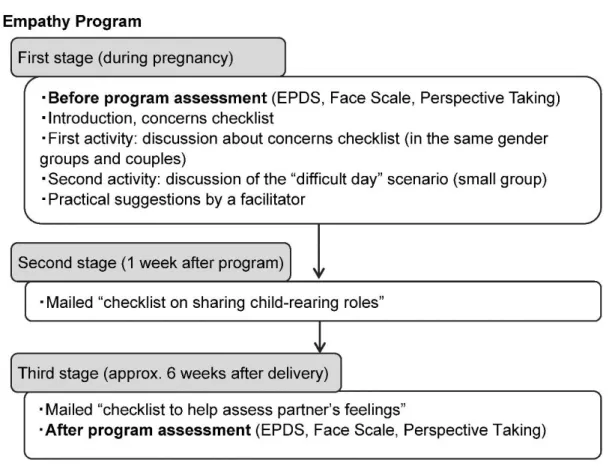
This “empathy program” (Fig. 2) was developed in Australia (Matthey et al., 2004) and adapted to a Japanese public health service setting. The program addresses gender roles and childcare sharing, which we considered applicable in Japanese culture. The tools were modified taking into account cultural and social factors (e.g. the partner’s time of returning home from work in the discussion scenario was revised from 6 p.m. in the original to 8 p.m.
in the Japanese version) to fit with Japanese parenting and family styles (Goto et al., 2012).
This program is divided into three steps. The first step is a 2-hour group session. In the first activity, participants complete the “checklist of concerns during pregnancy,”
followed by a group discussion with same-gender members and then discussion with their partner. In the second activity, couples participate in a small-group discussion of a “difficult day” scenario of a tired mother taking care of a crying baby when the father comes home at night. The second step is completion of a checklist on sharing child-rearing roles, which is mailed to parents 1 week after the group session. The third step is an additional checklist to assess each other’s understanding and condition, which is mailed approximately 6 weeks after delivery. The aims of the second and third steps were to supplement and reiterate the information provided during the first step.
Before implementing this program, facilitators received instruction from the Japanese
8
program developer and worked with pilot participants at three study sites to provide unified services. Afterwards, we held discussions with the developer aimed at improving program management. There was no qualification system for this program, but the research team provided continuous support in the program implementation at each site.
Figure 2. Empathy program content. EPDS, Edinburgh Postnatal Depression Scale.
Program evaluation measurements
The primary outcomes of this study concerned maternal mental health and paternal empathy.
The former was assessed using the Edinburgh Postnatal Depression Scale (EPDS) and the Face Scale, and the latter was assessed via the Perspective Taking component of the
Multidimensional Empathy Scale. We compared levels before (= at the start of the program) and after (= 6 weeks postpartum) the program. Secondary outcomes involved
between-groups comparisons of maternal physical and mental health at the time of the 4-month well-child visit.
The EPDS is used to screen maternal postpartum depression (Cox et al., 1987). This is a 10-item self-report measure and each item is scored on a 4-point scale from 0 to 3. Total
9
score ranges from 0 to 30, with a score of 9 or higher indicating symptoms of depression in Japanese respondents (Okano, 1996). EPDS can also be used as an effective mental health screening tool during pregnancy (Tachibana et al., 2015). When assessing changes in depression score (i.e., the difference between the pre-participation score and the post- participation score), a change of zero or a decrease respectively indicates a maintained or improved status while an increase indicates a worsened status.
To measure the empathy level, the Multidimensional Empathy Scale (MES) for Japanese was used, which was developed by Suzuki (Suzuki & Kino, 2008) and validated using the Interpersonal Reactivity Index (IRI) by Davis and the Questionnaire Measure of Emotional Empathy (QMEE) by Mehrabian and Epstein as reference indicators. It is a 24-item self-report measure which consists of five subscales (Other-oriented Emotional Reactivity, Self-oriented Emotional Reactivity, Emotional Susceptibility, Perspective Taking, and Fantasy). Each subscale can be used independently. In this study, we used the
Perspective Taking subscale, which assesses the level of taking others’ psychological viewpoint on one’s own accord and matches the aim of the program. The sum score of this subscale was divided by five (i.e., the number of items). For change in the Perspective Taking score (post-participation score minus pre-participation score), a change of zero or an increase indicates maintained or improved status, respectively, while a decrease indicates worsened status.
The Face Scale measures the temporary quality of life score developed by Lorish and Maisiak (Lorish & Maisiak, 1986). The images provided were 20 faces showing a range from No. 1 representing the most positive mood and No. 20 representing the most negative mood.
We collected data on the following items from 4-month well-child visit records of the HWC: parents’ basic characteristics (e.g., parents’ age, employment, and physical and mental condition), child sex, child’s low birth weight or abnormalities at birth, family problems at home, mother’s parenting support network, and maternal confidence. Answer options for the physical condition question (“How is your physical condition?”) were “good,” “tired,” “poor sleep,” “not good,” “poor appetite,” and “other” (multiple selections allowed). In regard to mental condition (“How is your mental condition?”), mothers were asked to select “good,”
“unsure,” or “not good.” Maternal confidence was assessed by one question asking, “Are there any moments when you don’t feel confident about child-rearing?” and answer options were “yes,” “unsure,” or “no.”
10
Statistical analysis
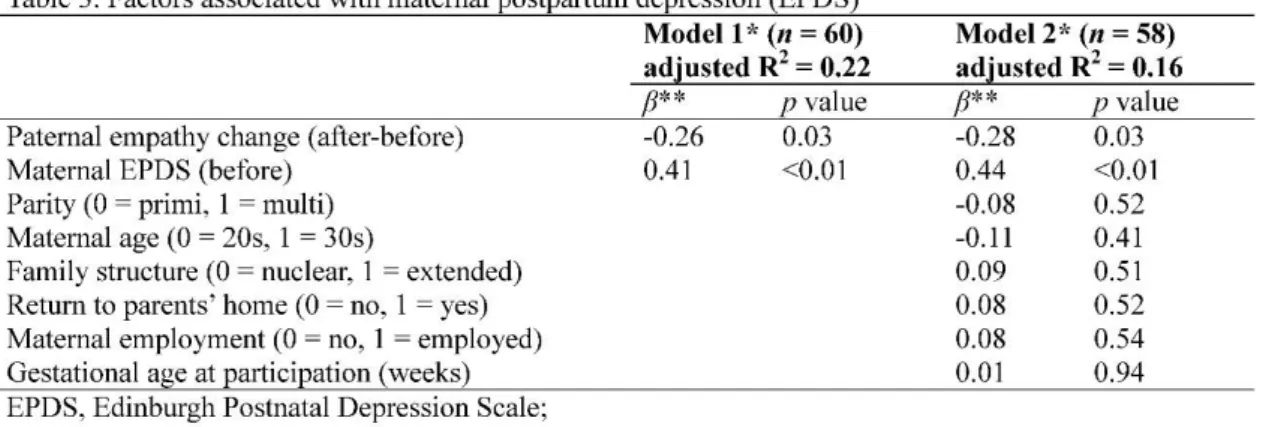
We compared EPDS, Perspective Taking, and Face Scale scores before and after the participation among the 60 couples. Chi-square test or McNemar test was used for categorical variables, while one-way analysis of variance or paired t-test was used for continuous variables. Next, we performed Pearson’s correlation analysis between maternal postnatal depression as assessed by EPDS and change in paternal and maternal empathy (Perspective Taking). Moreover, to explore factors related to maternal postpartum depression scale scores, a two-step hierarchical regression analysis was conducted using the forced entry method: Model 1 analyzed the major factors of interest, and Model 2 was adjusted for the individual characteristics listed in Table 1, which are reported to be associated with postpartum depression in Japan. Of note, it is a tradition in Japan for a pregnant woman to return to her parents’ home shortly before delivery and to stay there for about a month after delivery. This tradition is reported to be associated with postpartum depression (Yoshida et al., 2001) and was included in our analyses. In Model 2, we excluded paternal age due to a significant moderate correlation between paternal and maternal age (r = 0.48, p < 0.01), while adding gestational age at participation, which differed significantly across the three sites. In other words, two independent variables (change in paternal empathy and maternal EPDS score before participation) were entered into Model 1, parents’ basic characteristics (parity, maternal age, family structure, return to parents’ home, maternal employment and gestational age at participation) were added in Model 2.
To compare participation group and non-participation groups, Fisher’s exact test was used for mother’s physical and mental health status and maternal confidence at the 4-month well-child visit. Multiple logistic regression analysis was then used to investigate the association of the maternal health status (physical and mental) and confidence with
participation in the program as dependent variables with adjustment for infant abnormality, parity, and problems at home. These variables were reported to be associated with parenting in previous research. For all analyses, we performed supplementary analyses that excluded multiparas since antenatal parenting classes in Japan mostly target first-time mothers.
Statistical analyses were performed using IBM SPSS Statistics 21.0. This study was approved by the ethics review committee of our institution (No. 2411) and was performed in accordance with the ethical standards of the 1964 Declaration of Helsinki. All participants gave written, informed consent prior to enrollment in the study.
11
Results Participants
In total, 100 couples attended our program. Five couples declined to participate in program evaluation. Characteristics of the remaining 95 couples by study site are shown in Table 1.
Among them, 60 couples (63.2%) were registered at the HWC, 22 couples (23.2%) at the hospital, and 13 couples (13.7%) at the NPO. Of the couples with parity data available after
excluding 1 couple who were foster parents, 90.4% (85/94) included a first-time mother.
Mean gestational age at participation was 28.9 ± 5.1 weeks (min 14, max 36), which significantly differed across three sites (p <0.01).
Pre- and post-program comparison by study site
Paired t-test was used to compare EPDS, Face Scale, and Perspective Taking scores before and after the program (Table 2). Total average maternal EPDS score after the program was higher than that before (p < 0.05), especially for the NPO group. A dichotomized score (EPDS score ≥9 or lower) did not show a statistical difference (p = 1.00). Prevalence of maternal depression symptoms among our participants was approximately 20.0%, which was higher than the Japanese national average of 8.4% previously reported by the Ministry of Health, Labour and Welfare. Paternal Face Scale scores improved significantly after program (p <0.01). On the other hand, there was no significant difference in paternal Perspective Taking scale before and after the program (p = 0.60). In the supplementary analyses that were limited to primiparas, the results were similar.
12
Correlation between change in paternal and maternal empathy (Perspective Taking) and maternal postpartum EPDS score
As shown in Figure 3, there was a weak negative correlation not only between changes in paternal empathy and maternal postpartum EPDS score (r = −0.28, p = 0.03, n = 60) but also between changes in maternal empathy and maternal EPDS score (r = −0.27, p = 0.04, n = 60).
There also was a positive correlation between changes in paternal empathy and change in maternal empathy (r = 0.34, p < 0.01, n = 60).
Figure 3. Correlation between changes in paternal empathy and maternal postpartum EPDS score (n =
13
60). Pearson product-moment correlation coefficient was used. r = −0.28; p = 0.03.
Factors associated with maternal postpartum EPDS score
We performed a hierarchical analysis of whether change in paternal empathy scale was associated with maternal postpartum EPDS score. The results are shown in Table 3. In Model 1, change in paternal empathy (β= −0.26) and maternal EPDS score during pregnancy
(before program) (β = 0.41) were significantly associated with maternal postpartum EPDS score. These remained significant in Model 2 (β = −0.28 and 0.44, respectively). The variance inflation factor was 1.00 in Model 1 and 1.03-1.16 in Model 2. Multicollinearity was not detected. Furthermore, in our supplementary analyses of primiparas, change in paternal empathy and maternal EPDS score during pregnancy (before program) were significantly associated with maternal postpartum EPDS score in Model 1 (β = −0.26 and 0.38, respectively) and in Model 2 (β = −0.27 and 0.41, respectively).
Comparisons between the participation group and non-participation groups at the 4-month well-child visit at HWC
Table 4 shows a comparison of the basic characteristics between the participation group and non-participation groups at the 4-month well-child visit at HWC. The proportion of couples with financial problems was significantly higher in the participation group than in
non-participation groups 1 and 2. Also, the proportions of couples with interpersonal problems at home and those with first-time motherhood were higher in the participation group compared with non-participation group 2. In our supplementary analyses of primiparas, the significant differences between financial and interpersonal problems were decreased when compared with group 2.
14
Table 5 shows a comparison of maternal physical and mental condition between the participation and non-participation groups at the 4-month well-child visit at HWC. Although we excluded participants with medical complication, this participation group had a higher risk of having poor maternal physical condition than non-participation group 1 (adjusted odds ratio [aOR] = 2.7) or non-participation group 2 (aOR = 3.2).
15
Discussion
Mean maternal EPDS scores after the program increased relative to baseline levels across the three sites. Furthermore, at HWC and Red Cross Hospital, the proportions with depression symptoms, defined by an EPDS score greater than 9, decreased following the program, but not at the NPO. Previous reports from outside Japan are not consistent regarding changes in the prevalence of depression symptoms from the antenatal to postnatal phase (Milgrom et al., 2008; Rubertsson et al., 2005). Some studies in Japan reported an increase in prevalence (Tachibana et al., 2015; Otake et al., 2014). In contrast to these reports, our study indicated that participants showed no obvious increase in the prevalence of depression symptoms following exposure to the program. However, the mean maternal EPDS scores after the program increased relative to baseline levels across the three sites.
To elucidate the mechanism connecting the empathy program to prevention of postpartum depression, we confirmed that maternal depression level decreased as paternal and maternal empathy levels increased following the empathy program. Hierarchical
regression analysis suggested that change in paternal empathy scale scores in particular was significantly associated with maternal postpartum depression score in both Model 1 and Model 2. Efforts to increase paternal empathy can potentially prevent postpartum depression, which is consistent with previous reports of insufficient partner support and a strained marital relationship as risk factors for postpartum depression (Milgrom et al., 2008).
Another factor found to be strongly associated with one’s maternal postpartum depression score was one’s depression score during pregnancy, which is in line with well-established evidence (Biaggi et al., 2016). It is important to perform depression screening among pregnant women, and provide mental health support when needed before birth. The childcare environment in Japan is rapidly changing in conjunction with the growing number of nuclear families, declining birth rate, and weakening community ties.
Maternal mental health has thus gained more attention among health professionals and a national maternal and child health plan was launched in 2001(Ministry of Health, Labor and Welfare, 2017), and one of the goals proposed in the plan is to decrease the prevalence of postpartum depression symptoms by providing continuous and comprehensive support from pregnancy to childbirth.
To ameliorate a methodological limitation caused by the lack of randomized group assignment, we compared mothers who participated in our program to those who did not. At
16
the time of their 4-month well-child visit, we found that our participants had more financial and interpersonal problems at home and were more likely to be in poor physical health than the non-participation groups. These findings suggest that couples with interpersonal
problems were more likely to sign up for the program. In a previous study about the characteristics of participants who attended Triple P (a positive parenting program), participating parents were likely to use stricter childcare and to perceive their children as having more problems (Wells et al., 1987). Our results obtained at follow-up suggest that this program could function as a screening opportunity for couples at high risk of parenting difficulty, which could enable provision of continuous support after their participation.
Four important methodological limitations must be acknowledged. First is a lack of a rigorous clinical diagnosis of mothers’ mental status. The EPDS scale is a screening tool and we cannot specifically differentiate depression from anxiety and other stressors. In addition, we did not measure mothers’ self-esteem, which was used in a previous Australian study. The second limitation is the intervention content, which is in need of improvement. The empathy session was selected for its simplicity, but our assessment of participant characteristics suggested a need to provide continuous support. The third limitation is the lack of randomized group assignment. This makes it difficult to reach conclusions about the
program’s effectiveness. Couples who voluntarily participated in this program might have a greater ability to improve their marital relationship compared with non-participants.
Although waiting list control groups are commonly used in intervention studies in a public service setting, the short duration of pregnancy and childbirth makes it unfeasible to set up a list to act as a control group. The fourth limitation is the small sample size of 60 couples, paired with a high prevalence of maternal depression symptoms, leading to limited generalizability of the obtained results. In addition, we could not analyze in detail the differences among the three study sites. Currently, we plan to collaborate with childcare support groups in various regions for wider implementation and evaluation of the program’s effectiveness.
Conclusions
In conclusion, we confirmed a weak negative association between maternal postpartum depression level and changes in paternal empathy level following an empathy program, indicating the program’s potential effectiveness to increase partners’ empathy levels and
17
thereby prevent postpartum depression. Future modifications to the program are expected to bring about increased impact on partners’ empathy. Since participants were likely to have household problems and physical health issues at the time of the 4-month checkup, it is important to consider the empathy program as an entry point for continuous long-term support.
Acknowledgments: We thank the following people for their assistance in this study: Isuzu Endo and Mitsuko Komatsu from the Fukushima City Health and Welfare Center; Hisae Ishida, Kazuko Tamanoe, Yuko Endo, Miho Ohtsuki, Ayumi Sato, Ai Yamaki, Yukari Kaneko, and Chizuko Tachibana from Fukushima Red Cross Hospital; Mifumi Mizuno, Mayuka Saito, Hisayo Miyamoto, and Tomoko Tanaka from the nonprofit organization for child-rearing support (Place of Peace) in Shizuoka City; Taeko Suzuki, Kimi Saito, and Kiyotaka Yasui from Fukushima Medical University; and Shunichi Shibata and Yumiko Sano from Tokoha University.
Funding sources: This work was funded in part by the Fukushima Medical University School of Nursing and a JSPS KAKENHI Grant (17K12297).
Disclosure statement: The authors declare that they have no conflicts of interest.
References
Arai Y. The effect of the preventive nursing intervention program on postpartum depression.
Japan Society of Maternal Health. 2010; 51(1):144-152. Japanese with English summary.
Bellet PS, Maloney MJ. The importance of empathy as an interviewing skill in medicine.
JAMA. 1991; 266(13):1831-1832.
Bennett H A, Einarson A, Taddio A, Koren G, Einarson TR. Prevalence of depression during pregnancy: systematic review. Obstetrics & Gynecology. 2004; 103(4):698-709.
Biaggi A, Conroy S, Pawlby S, Pariante CM. Identifying the women at risk of antenatal anxiety and depression: A systematic review. Journal of Affective Disorders. 2016;
191:62-77.
Cohn JF, Campbell SB, Matias R, Hopkins J. Face-to-face interactions of postpartum depressed and nondepressed mother-infant pairs at 2 months. Developmental Psychology. 1990; 26(1):15-23.
18
Cox JL, Holden JM, Sagovsky R. Detection of postnatal depression. Development of the 10-item Edinburgh Postnatal Depression Scale. British Journal of Psychiatry. 1987;
150:782-6.
Craig M, Howard L. Postnatal depression. BMJ Clinical Evidence. 2009; 1-20.
Dennis CL, Dowswell T. Psychosocial and psychological interventions for preventing postpartum depression. Cochrane Database System Review. 2013;
doi:10.1002/14651858.CD001134.pub3.
Fathi-Ashtiani A, Ahmadi A, Ghobari-Bonab B, Azizi MP, Saheb-Alzamani SM.
Randomized trial of psychological interventions to preventing postpartum depression among Iranian first-time mothers. International Journal of Preventive Medicine. 2015;
6:109.
Fujioka N, Kamezaki A, Kawamoto E, Shiomichi A, Tsuboi Y, Fujii Y. The factors of the childcare difficulty feelings that primiparas have in a childbed early stage. Japan Society of Maternal Health. 2014; 54(2):563-570. Japanese with English summary.
Gagnon AJ, Sandall J. Individual or group antenatal education for childbirth or parenthood, or both. Cochrane Database System Review. 2007; 3:CD002869.
Gavin NI, Gaynes BN, Lohr KN, Meltzer-Brody S, Gartlehner G, Swinson T. Perinatal depression: a systematic review of prevalence and incidence. Obstetrics & Gynecology.
2005; 106(5):1071-1083.
Goto A, Yabe J, Sasaki H, Yasumura S. Short-term operational evaluation of a
group-parenting program for Japanese mothers with poor psychological status: adopting a Canadian program into the Asian public service setting. Health Care for Woman International. 2010; 31:636-651.
Goto A, Reich MR, Suzuki Y, Tsutomi H, Watanabe E, Yasumura S. The process of adapting an Australian antenatal group-based parenting program to Japanese and Vietnamese public service settings. International Electronic Journal of Health Education. 2012;
15:191-202.
Leigh B, Milgrom J. Risk factors for antenatal depression, postnatal depression and parenting stress. BMC Psychiatry. 2008; 8:24.
Lorish C, Maisiak R. The face scale: A brief, nonverbal method for assessing patient mood.
Arthritis & Rheumatism. 1986; 29(7):906-909.
Matthey S, Kavanagh DJ, Howie P, Barnett B, Charles M. Prevention of postnatal distress or depression: an evaluation of an intervention at preparation for parenthood classes.
19
Journal of Affective Disorders. 2004; 79:113-26.
Milgrom J, Gemmill AW, Bilszta JL, Hayes B, Barnett B, Brooks J, et al. Antenatal risk factors for postnatal depression: a large prospective study. Journal of Affective Disorders. 2008; 108(1-2):147-557.
Ministry of Health, Labour and Welfare. Healthy parents and children 21. 2017. Retrieved October 2, 2018 from: http://sukoyaka21.jp/healthy-parents-and-children-21.
Morikawa M, Okada T, Ando M, Aleksic B, Kunimoto S, Nakamura Y, et al. Relationship between social support during pregnancy and postpartum depressive state: a prospective cohort study. Scientific Reports. 2015; 5:10520.
O'Hara MW. Postpartum depression: what we know. Journal of Clinical Psychology. 2009;
65(12):1258-69.
Okano T, Murata M, Masuji F, Tamaki R, Nomura J, Miyaoko H. Validation and reliability of a Japanese version of the EPDS. Archives of Psychiatric Diagnostics and Clinical Evaluation. 1996; 7:525-33. Japanese with English summary
Otake Y, Nakajima S, Uno A, Kato S, Sasaki S, Yoshikoka E, et al. Association between maternal antenatal depression and infant development: a hospital-based prospective cohort study. Environmental Health and Preventive Medicine. 2014; 19:30-45.
Rubertsson C, Wickberg B, Gustavsson P, Rådestad I. Depressive symptoms in early pregnancy, two months and one year postpartum-prevalence and psychosocial risk factors in a national Swedish sample. Archives of Womens Mental Health. 2005;
8(2):97-104.
Stein A, Gath DH, Bucher J, Bond A, Day A, Cooper PJ. The relationship between post-natal depression and mother-child interaction. British Journal of Psychiatry. 1991; 158:46-52.
Suzuki Y, Kino K. Development of the Multidimensional Empathy Scale (MES): Focusing on the distinction between self- and other-orientation. Japanese Association of
Educational Psychology. 2008; 56:487-97. Japanese with English summary.
Tachibana Y, Koizumi T, Takehara K, Kakee N, Tsujii H, Mori R, et al. Antenatal risk factors of postpartum depression at 20 weeks gestation in a Japanese sample: psychosocial perspectives from a cohort study in Tokyo. PLoS One. 2015; 10(12):e0142410.
Terasaka T, Okayama H. Effects of health guidance in preventing postpartum depression in the term pregnancy and early postpartum periods. Japan Society of Maternal Health.
2015; 56(1):87-94. Japanese with English summary.
Werner E, Miller M, Osborne LM, Kuzava S, Monk C. Preventing postpartum depression:
20
review and recommendations. Archives of Womens Mental Health. 2015; 18(1):41-60.
Wadephul F, Jones C, Jomeen J. The impact of Antenatal Psychological Group interventions on psychological well-being: A systematic review of the qualitative and quantitative evidence. Healthcare. 2016; 4:32.
Wells MB, Sarkadi A, Salari R. Mothers' and fathers' attendance in a community-based universally offered parenting program in Sweden. Scandinavian Journal of Public Health. 2016; 44(3):274-80.
Yoshida K, Yamashita H, Ueda M, Tashiro N. Postnatal depression in Japanese mothers and the reconsideration of 'Satogaeri bunben'. Pediatrics International. 2001; 43:189-93.
Zhu P, Sun MS, Hao JH, Chen YJ, Jiang XM, Tao RX, et al. Does prenatal maternal stress impair cognitive development and alter temperament characteristics in toddlers with healthy birth outcomes? Developmental Medicine & Child Neurology. 2014;
56(3):283-289.