Knowledge marketing in the licensing of innovative drug development in Japan
著者(英) Kenji Tomita
journal or
publication title
Doshisha Shogaku (The Doshisha Business Review)
volume 71
number 6
page range 1473‑1490
year 2020‑03‑13
権利(英) Doshisha Daigaku Shogakkai
The Association of Commerce Doshisha University
URL http://doi.org/10.14988/pa.2020.0000000157
Knowledge Marketing in the Licensing of Innovative Drug Development in Japan
Kenji TOMITA
ⅠIntroduction
ⅡFactors influencing licensing interests of pharmaceutical companies
ⅢThe actual licensing situation
ⅣInterview investigation
ⅤDiscussion
ⅥConclusion
Abstract
This paper investigates the knowledge marketing strategy applied to the licensing of innovative drug development, focusing on the human promotion of negotiation activities in Japan. Several characteristic propositions were derived from interviews, suggesting that knowledge depends on the situation; the boundary between unrevealed and revealed knowledge fluctuates by the negotiating situation; knowledge traded is an unfinished product; small quantities of knowledge difference exist between seller and buyer; and customeroriented motivation is very important. We present the notion that business managers, or perhaps the president, should perform the business of selling the knowledge product. This differs from extant studies that focused on the importance of the middle manager and the sales force. In addition, we found two original characteristics of knowledge marketing : great asymmetries of knowledge between seller and buyer are very rare; and a buyer purchases knowledge to bypass research and development even if the level of knowledge transfer between seller and buyer results in the equality of levels.
Key words: Licensing, Knowledge, Knowledge product, Innovative drug development, Business manager
Ⅰ Introduction
In the pharmaceutical industry, many companies advocate open innovation strategies. Open innovation often equates to the licensing of research and development (R&D). The interest of companies has increased in this area; however, it is difficult to judge whether companies license R&D effectively and efficiently.
This type of transaction deals with knowledge transfer. Companies’ situations and strategies, as always, lay a great deal of emphasis on dealmaking. Sellers (e.g., innovative drug
(1473)243
development ventures1) desire to sell their knowledge during earlystage drug discovery because they typically do not have enough funding to perform largescale clinical studies and manufacturing. However, buyers (e.g., pharmaceutical companies) do not wish to purchase this knowledge at an early stage because they want to evade risk. Therefore, there are many cases in which promising new drug manufacturers are buried because they cannot perform their clinical studies or sell their ideas.
Licensing is not often conducted for such needs, but nor is it handled well via the marketing strategy of the seller. Therefore, we focus on the seller’s marketing strategy from the perspective of human promotion. Because knowledge is transmitted from one person to the other, communication is the mechanism. For any business activity, it is important to market the product well. Therefore, we consider the business activity of entering into a contract, and we focus on the process of negotiations in which the seller communicates to the buyer, conveys value regarding the knowledge product, and secures a contract. The result is that we provide a series of propositions regarding pharmaceutical licensing that can be used for future research.
The remainder of this study is as follows. Section 2 presents factors affecting pharmaceutical companies with licensing interests. Section 3 explains the current situation of licensing within innovative drug development ventures and pharmaceutical companies in Japan. Section 4 presents interview results, revealing how licensing is performed. Section 5 discusses the findings of this investigation. Section 6 presents the conclusion.
Ⅱ Factors influencing licensing interests of pharmaceutical companies
Recently, a few major pharmaceutical companies seeking new drug development have shown interest in licensing. Each company desires new candidate technologies because they will not succeed without releasing an epochal new drug in the near future. The second reason is that major pharmaceutical companies that license the innovations of ventures can develop a new drug early, resulting in profits for both. Typically, the first company to secure a patent wins; however, the idea must still be marketed. The third reason is that the possibility of new drug development increases when all companies conduct basic research. A pharmaceutical company needs to perform drug innovation research and wants to buy knowledge effectively
────────────
1 The number of innovative drug development ventures in Japan increased remarkably after 2002. Approximately 90% of sales of these developments were biomedicine advancements (Takatori, 2009). Therefore, we presume that innovative drug development ventures indicate bio ventures. However, companies handling compound pharmaceutical products exist in the innovative drug development venture.
同志社商学 第71巻 第6号(2020年3月)
244(1474)
and efficiently. Otherwise, there is an extremely low probability of success. Thus, it is a risk reduction strategy. Therefore, pharmaceutical companies are active in licensing. There are two reasons behind an innovative drug development venture expecting licensing.
First, a company without funding cannot perform enough R&D because of the tremendous need for money and time, particularly in phases 2 and 3 of clinical trials. Therefore, underfunded drug development ventures perform basic research and preclinical tests, and the pharmaceutical companies perform the clinical trials. This is a strategy of choice that is based on resource concentrations. The second reason is that most innovative drug development ventures wish to sell useful knowledge to obtain funding so that they can start new innovative research. Companies do not wish to enter late in the development of lifestylerelated drugs because major pharmaceutical companies already fund high R&D in this area. However, rare diseases have small markets, and major pharmaceutical companies do not focus a lot on this area. If an innovative drug development venture can find a promising new drug candidate for rare diseases, major companies may choose to license it.
This leads to the question, “how much licensing is really performed?”
Ⅲ The actual licensing situation
It is extremely difficult to accurately calculate the true licensing amount across the industry because most innovative ventures are not listed on the stock exchange and are not required to reveal transactional details. Therefore, we count the number of the licenses reported in the securities reports of 10 major domestic pharmaceutical companies in Japan.
From Fig. 1, we see that a relatively large number of overseas ventures sell to pharmaceutical companies and that the number of domestic venture companies is tiny in comparison. If many innovative drug development ventures existed, we would expect to see a considerable amount of licensing. However, from Fig. 1, it is apparent that most ventures cannot do so because there simply is not enough action.
The nature of licensing between pharmaceutical companies and innovative drug development ventures is global, and its form varies. However, we choose to investigate domestic pharmaceutical companies and domestic innovative drug development ventures because it presents the most reliable results2.
────────────
2 There are many domestic ventures licensing to overseas pharmaceutical. However, it is difficult to calculate the real number.
Knowledge Marketing in the Licensing of Innovative Drug Development in Japan(TOMITA)(1475)245
Ⅳ Interview investigation
Ⅳ1. Method
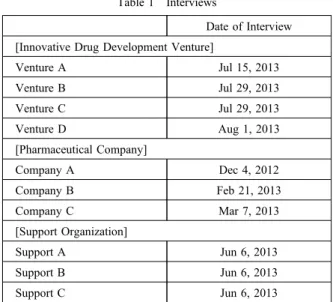
We performed eight semistructured interviews with three innovative drug development ventures (four people), two pharmaceutical companies (three people), and one support organization of innovative drug development ventures (three people) in Japan (see Table 1).
We spent 24 hours in each interview and conducted supplementary interviews via email and telephone. The subjects are referred to as “Venture A,” “Venture B,” “Venture C,” “Venture
Fig. 1 Number of Licenses of 10 Major Domestic Pharmaceutical Companies
Note :
・We referred to the securities reports of the following 10 pharmaceutical companies : Takeda Pharmaceutical Company Limited, Astellas Pharma Inc., Daiichi Sankyo Co., Ltd., Eisai, Mitsubishi Tanabe Pharma Corp., Otsuka Pharmaceutical, Chugai Pharmaceutical, Dainippon Sumitomo Pharma Co., Ltd., Shionogi & Co., Ltd., Ono Pharmaceutical.
・We counted to the number of licenses for R&D that were newly contracted each year.
Table 1 Interviews
Date of Interview [Innovative Drug Development Venture]
Venture A Jul 15, 2013
Venture B Jul 29, 2013
Venture C Jul 29, 2013
Venture D Aug 1, 2013
[Pharmaceutical Company]
Company A Dec 4, 2012
Company B Feb 21, 2013
Company C Mar 7, 2013
[Support Organization]
Support A Jun 6, 2013
Support B Jun 6, 2013
Support C Jun 6, 2013
同志社商学 第71巻 第6号(2020年3月)
246(1476)
D,” “Company A,” “Company B,” “Company C,” “Support A,” “Support B,” and “Support C,” as shown in Table 1.
Ⅳ2. Content of Interview investigation
1. How does the innovative drug development venture perform human promotion of knowledge to the pharmaceutical company?
Venture A replied that human promotion conveys value. See the following two quotes :
Generally, companies say, “help us understand this new information.” Thus, ventures prepare packages of nonconfidential data. For us, this technical information does not affect R&D.
Because everybody shows a car engine early, negotiations become difficult. With drug information, we also show the “speed” earlier. We show that our product works and that the rival’s product does not work. If a buyer is interested in our solution, we conclude a confidential agreement (nondisclosure agreement) with them.
Fig. 2 Promotional Document of An Innovative Drug Development Venture
Knowledge Marketing in the Licensing of Innovative Drug Development in Japan(TOMITA)(1477)247
When an innovative drug development venture performs human knowledge promotion, it first presents abstract and publicly available information (i.e., nonconfidential data). Fig. 2 refers to documents that innovative drug development ventures use. The adaptation and the effect of the candidate material, the situation of patent acquisition, and its R&D progress are shown briefly3.
If a pharmaceutical company is interested in nonconfidential data briefs, an innovative drug development venture may attempt to enter into nondisclosure agreement with the company.
While this is currently unlikely, the venture would then be able to impart concrete confidential data after the agreement is signed. To succeed, the venture must somehow differentiate their drug technology. Notwithstanding this, it is extremely difficult to express degrees of superiority. Still, this is the representative means of showing significant advantages.
2. What is the characteristic of the knowledge product?
We asked Support C regarding the different character of knowledge products vs. tangible goods. They responded as follows :
I think only the president of the company can negotiate, and tactics are necessary for the negotiations. At the beginning of negotiations, the seller hands a confidential document and discusses its nondisclosure requirements. However, depending on the interest of the buyer, the seller may speak important secret information impartially. I think that only the president can do this during negotiations.
The negotiation process is highly important. A seller sometimes teases confidential information to raise the interest of a buyer. Thus, the boundary between open and closed knowledge fluctuates during negotiations. The seller must offer information while observing the buyer’s reaction. Because this process is extremely important to the seller, the president should be the person negotiating, not the sales staff. For the venture company, many presidents are founders who established their firms on the basis of knowledge they originally owned. The president should at least attend the final stages of negotiations because they presumably know the most about the knowledge product.
Venture B and Venture C commented respectively as follows :
────────────
3 In contrast, the document of most innovative drug development ventures is technical and includes a great deal of concrete information. A buyer typically does not seek this kind of information because they could not then perform similar R&D after ingesting the confidential data.
同志社商学 第71巻 第6号(2020年3月)
248(1478)
The knowledge that a buyer and a seller share may be the same, but the realms of development imagination are totally different.
Points of view are entirely different. I think that the directions to which a seller looks and the direction to which a buyer looks are entirely different.
Perspective differs between ventures and companies, such that the venture seeks novelty and better effects and the company seeks marketability. The knowledge involved has many aspects, and the value varies according to the perspectives taken.
Venture A stated the following :
A buyer cannot develop candidate biomedicine material for a patient tomorrow. We show tremendous data, and the buyer predicts “this may become the epochmaking new drug in the future.” It seems like a buyer develops an idea monopolistically and conducts the business. A company cannot develop pharmaceutical products if it does not have a patent. We do not trade finished products.
Probably it is impossible to do the business based on the information difference in the pharmaceutical field.
A buyer buys a candidate material after it understands the content completely. The only difference is having a patent. The buyer, at an early stage, focuses on buying time.
Knowledge is a corpus, and a company cannot usually cover all of it at once. Knowledge trading is needed to improve the state of the corpus. This contrasts the tangible goods and service trades, where finished products are produced. During negotiations, the quantity of knowledge between a seller and a buyer is small. For tangible or service goods, there is a quite large information difference, and it affects the business models used in various markets.
For this case, differences in knowledge quantity are small. Furthermore, purchasing knowledge purchases time for R&D.
3. What is the point and the difficulty in negotiations?
Support B stated that, at first, it was difficult to find a partner for negotiations :
Knowledge Marketing in the Licensing of Innovative Drug Development in Japan(TOMITA)(1479)249
There are two methods for finding a negotiating partner. First, an agent for anticancer drugs negotiates with a pharmaceutical company doing cancer R&D. This is difficult, because the buyer does not buy our knowledge if cannot beat the buyer’s R&D. As for the other, an agent negotiates with a partner that does not do cancer R&D but want to start.
It can be difficult to find a customer, and it is important to differentiate conventional pharmaceutical products. However, several companies have described difficulties in differentiating their products prior to the nondisclosure agreement. Venture A stated :
We cannot show the most pertinent information about our compound presenting a bigger difference than existing products because it is secret.
There are many such pessimistic answers. However, Venture A replied as follows :
When I established my company, the product of a certain foreign machine maker was broken immediately. However, the maker improved the product little by little, and it gradually released a good product. The company became capable of developing a good product to take the biggest share of the market. For example, Microsoft releases operating system versions before they are perfected. Thus, they never provide a finished product. However, I think that we can sell a perfect product because the Japanese are faithful. It is important for us to sell a complete product and to precisely nail the market needs. There is no meaning if our perfect product is not evaluated in the market. We improve our product while we watch the state of the market and chase pharmaceutical companies’ requirements like the playing catch.
The seller distributes nonconfidential data on paper and actively promotes a product to a potential client. At first, sellers should market their unfinished products. A seller must then seek customers widely and convince them of their interest. It is a multi-stage process.
4. How does the pharmaceutical company gain knowledge of the innovative drug development venture?
Company B assessed knowledge as follows :
同志社商学 第71巻 第6号(2020年3月)
250(1480)
Academic reports and articles. I read articles about things my company focuses on very much. Otherwise, the face-to-face is most effective.
The probability of successful business negotiations with a company such as J.P. Morgan is high. However, the probability of success is considerably lower in medium-to-big conferences.
The main tasks for pharmaceutical companies include interviews and conferences, database retrievals, and academic reports and articles. However, their importance depends on the development readiness of the innovative drug for phase II clinical trials. In either case, success is extremely low.
5. Does an intermediary relating a pharmaceutical company and an innovative drug development venture exist?
Regarding the existence of a person looking around the industry and academic society, Company A and Company B replied as follows :
All pharmaceutical companies have a list of venture companies. I can easily discover information about a venture. We do not need intermediation.
Many ventures and trading companies support the venture companies in which they invested. I think that there are investment bankers and consultants elsewhere.
Pharmaceutical companies exchange information once per year. The business development supervisors have a good relationship with them, and when we are troubled, we can easily call and work it out.
There is often an intermediary involved, such as a venture capital, a trading company, an investment banker, a consultant, and a pharmaceutical company. A company overlooks the industry and uses its network. A company uses a strong network, and there are just a few weak networks with accidental encounters.
Knowledge Marketing in the Licensing of Innovative Drug Development in Japan(TOMITA)(1481)251
6. Does a pharmaceutical company choose licensing and collaborative research properly as a strategy?
Company A stated :
When we cannot predict the future, we are apt to choose collaborative research on the basis of hedging risk. In the early stages, we have several choices. On the contrary, there are few possibilities of collaborative research and licensing.
Support B replied as follows :
A venture company does not have the authority to decide licensing or collaborative research.
Power relationships emerge between innovative drug development ventures and pharmaceutical companies. The buyer typically owns the option. The collaborative research is chosen at an early stage of research, and licensing is typically the only choice during latter periods of clinical trials.
7. What is the attractive knowledge of the innovative drug development venture?
Company B stated :
So that we call it a late item, every company wants compounds as proof of concept at the last part of phases II or III of clinical trials. However, there are very few. We want compounds at the early stage, before toxicology tests of preclinical trials. We want to fill our pipeline with those.
A pharmaceutical company needs advanced phase-III knowledge; however, this knowledge is scarce in the marketplace. When a company can acquire breaking technology, they must then fund expensive clinical trials. This involves risk.
Regarding such ventures, Venture A stated :
My company does not perform cancer research at all. There are extremely few venture companies researching respiratory organs. Nonetheless, respiratory organ research is very important to most people.
同志社商学 第71巻 第6号(2020年3月)
252(1482)
Many innovative drug development ventures specialize in the cancer domain. However, Venture A specializes in respiratory organs. For them, there are only a few competitors in their market. Respiratory patients typically suffer from chronic illnesses that require routine medications for the rest of their lives. However, cancer patients generally require temporary care.
Venture A also said :
A product with high specifications, such as Windows 8, is often unnecessary. Windows XP and Windows 7 are more convenient for many cases. It is important to balance downgrades against the value of avoiding over-specifications. Sometimes, the advanced product is sold 20 years later, but we do not need it now.
This contrasts the tendency for a venture to market advanced knowledge. A venture company downsizes their knowledge base when they sell it, while still investigating advanced knowledge for R&D.
We have a list of the 20 target customers in Japan and a list of 30-40 target foreign customers. We know what they want solutions for the disease domain. A company wants to buy only cancer drugs after phase IIa, but another company wants to buy Alzheimer drugs at an earlier stage. This is common. We have the capacity to select a negotiating partner and narrow the customer base.
Venture A grasps the needs of the customer and offers knowledge that is based on those needs. It is not always the most valuable product; however, it is easy to manufacture and provides customer value.
Venture C and Support B respectively stated :
A common company, not a venture company, provides easy manufacture and convenience.
Many bio ventures want to sell their product because they have unique techniques outside of market demands.
Many ventures recognize that they should investigate advanced knowledge. They are
Knowledge Marketing in the Licensing of Innovative Drug Development in Japan(TOMITA)(1483)253
technique-oriented but not customer-oriented. They create a product that may or may not meet customer needs, but they do a good marketing job and make sales. This is the posture of the general innovative drug development venture, and it is the main reason behind there being few incidences of licensing. This is in contrast to the reports of Venture A.
8. What does the innovative drug development venture not have?
Generally, a great idea, funding, and talent, applied with a customer-oriented tactic, is all that is needed. Company B discussed their knowledge level :
I think that there is not a difference of potential knowledge between an overseas company and Japanese company, and the Japanese company is not inferior technically.
When there is little difference of knowledge between the venture and the company, what happens when the venture is not very licensing savvy? Support A and Support B respectively stated :
I think that Japanese innovative drug development ventures dream of greatly making breakthroughs. However, they do not have strategies for resources and skills.
I look at companies that beat market rivals and gain superiority. Many ventures do not have this focus. Most focus simply on selling their current product. However, even if they knew the needs of the buyer, they do not have a new drug on par with their strategy.
They cannot improve their product to fit their needs. Deficiencies persist in the product, and the buyer search continues worldwide. The venture company should consider the customer view.
Venture C replied as follows :
Professors do not typically focus on customer needs. The university-originated venture must grasp those needs.
Because a venture is typically small, it owns just a little knowledge. In such situations, the offered knowledge may not meet customer demands. Many companies, however, market knowledge without deeply considering customer needs. What is foremost is that ventures
同志社商学 第71巻 第6号(2020年3月)
254(1484)
should focus on the customer’s domain and demonstrate potential for future manufacture.
Venture A said :
I had about 10 research themes beforehand, but I recently narrowed it down to three. My company makes efforts in only one, and it stops at seven of ten now. I always try to refocus on the circumstances of the market. However, this strategy is not tenable if we do not have 10 at the first stage. The university-led venture by one professor typically only has one.
Unlike many ventures, Venture A applies a knowledge strategy that is based on customer needs. Any venture should understand that pharmaceutical companies are competitors and that their knowledge should be superior.
Ⅴ Discussion
This research presents 10 numbered propositions.
[1] The boundary between unrevealed and revealed knowledge fluctuates with the negotiating situation, and a seller must make decisions immediately during negotiations.
[2] Knowledge has many aspects, and its value varies according to the situation of the buyer.
[3] A knowledge product is always unfinished, but a buying company improves it after trading.
[4] A deal is typically inked when the quantity of knowledge difference between a seller and a buyer is small.
[5] At first, a seller looks widely for customers, and it negotiates strongly when it finds a candidate.
[6] A pharmaceutical company (i.e., buyer) uses small and strong networks.
[7] An innovative drug development venture chooses the domain of the business with a few competing companies.
[8] An innovative drug development venture downsizes their knowledge when sold and should consider the convenience of the customer while investigating advanced R&D.
[9] An innovative drug development venture grasps the needs of the customer and offers knowledge in accordance with those needs.
[10] Many innovative drug development ventures exhibit behavior that belies their lack of
Knowledge Marketing in the Licensing of Innovative Drug Development in Japan(TOMITA)(1485)255
awareness that a pharmaceutical company is a rival company.
From [1] and [2], knowledge and the human promotion of knowledge greatly fluctuate by person and situation. The value of knowledge varies according to the buyer’s situation.
Moreover, the value changes on the basis of the relationship between a seller and a buyer. It also depends on the context because knowledge value fluctuates according to the circumstances.
From [1], the boundary between closed and open knowledge fluctuates with the type of negotiations. During marketing and negotiations, knowledge is usually presented abstractly at first, with detailed knowledge gradually added. In particular, it changes from nonconfidential data to confidential data after the nondisclosure agreement is signed. The seller desires to protect their knowledge because of its potential value. This makes it difficult to convince buyers to agree to a licensing deal. To succeed, the venture requires savvy human promotion.
Communication and dialog are important. Per [6], the pharmaceutical company (i.e., buyer) uses small and strong networks. A pharmaceutical company could obtain a great deal of new knowledge via wide and weak networks because most innovative drug development ventures are large, and many of them are new companies. A wide and weak network is more suitable because of the ease of knowledge uptake (Granovetter, 1973). Unfortunately, reality is based upon narrow and strong networks because of the need for secrecy. A seller cannot convey essential value of the knowledge just as a buyer cannot make a judgment if a seller does not show the secret information. Therefore, as the disclosure of material information is required of a seller in order for the buyer to make a judgment for them to conclude a contract (nondisclosure agreement in particular), a seller cannot avoid an exhibition of knowledge.
However, a seller should show knowledge only to a trustworthy partner because it cannot show knowledge at random. Thus, an innovative drug development venture prefers the small and strong network and discloses knowledge progressively.
From [3] and [5], traded knowledge is a perpetually unfinished product. With tangible goods and services, a company trades finished products. Knowledge is an unfinished product and never becomes a finished product. It is as difficult for one company to conclude a deal involving a knowledge product by themselves as it is to acquire (develop) a high degree of knowledge. Therefore, a company transfers the knowledge regarding the process of development, and the other company develops the knowledge from there on, puts the knowledge together, and creates new knowledge. Briefly, we can confirm that the right combination of knowledge and marketing of the knowledge is indispensable. The confluence
同志社商学 第71巻 第6号(2020年3月)
256(1486)
of varying degrees of knowledge can be the key for success with venture and company teamwork. The improvement of knowledge, as indicated in [5], behaves similarly to produced goods. The producer provides parts and production apprati that adjust specifications based on customer needs and improve products in a vertical business relationship (i.e., Keiretsu). In this case, the seller creates a product that is adjusted to the needs of the buyer on the basis of the technology that they have. However, when a seller creates a knowledge product, they must also establish their goals on the basis of customer needs. However, it is not at all a finished product, and the seller improves the knowledge product to satisfy the needs of the customer in a modified stage of the latter period. After licensing, the buyer improves the knowledge product such that it is close to a finished product and manufactures it (Fig. 3). In other words, there is a big difference from deals involving producer goods in that the seller and the buyer do not create the knowledge product jointly in deals involving knowledge products.
From [4], small quantities of knowledge also differ between seller and buyer. With conventional company dealings resource asymmetry is used as a competitive advantage. On the other hand, with knowledge, the seller effectively seeks to befriend the buying company.
However, because the innovative drug development venture tries to investigate into the advanced knowledge, a quantity of knowledge difference exists between venture and company.
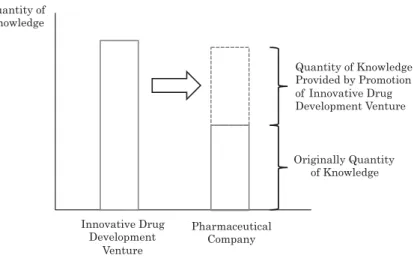
The buyer cannot recognize the value of the knowledge product if they do not have enough knowledge to evaluate the new knowledge product. Therefore, during the promotion process,
Fig. 3 Deal of Knowledge That Is An Unfinished Product
Knowledge Marketing in the Licensing of Innovative Drug Development in Japan(TOMITA)(1487)257
ventures must raise the knowledge level of the buyers (Fig. 4). This task is considerably different from conventional marketing.
von Hippel (1994) and Sugiyama (2001) paid attention to the costs of knowledge transfer, using the terms, “sticky information” and “sticky knowledge.” These costs could be considered the “evils” of knowledge transfer. However, with the human promotion aspect, the stickiness becomes less of a hazard.
From [7] and [9], we ascertain the importance of being customer-oriented. The investigation of advanced knowledge is indispensable for a venture company, and the company is technique -oriented in that sense. However, the buyer may not be able to create an idea and manufacture it as a new drug if the knowledge product is overly novel. Or, the clinical trials could be very complicated because the innovative new drug needs a great deal of data for them to receive approval for their application for the new drug. Therefore, a big risk such as the inevitability of the prolongation of R&D time and the enlargement of expenses occurs. Eventually, the value of the knowledge product for it to be purchased decreases. An innovative drug development venture and a pharmaceutical company have contrasting perspectives on this. See Fig. 5. The innovative drug development venture watches the novelty of the candidate material first and then watches the possibility of the manufacture and the marketability. Or, some venture companies do not consider the possibility of the manufacture and the marketability, instead watching only the novelty of the candidate material. While the venture focuses on innovation and technology, the company focuses on marketability and manufacture. They need profit. Therefore, innovative drug development ventures must take product development to the point right before clinical trials and estimate the means of manufacturing it so that the knowledge can be presented with more value.
Fig. 4 Quantity of Knowledge Difference with Innovative Drug Development Venture and Pharmaceutical Company
同志社商学 第71巻 第6号(2020年3月)
258(1488)
From [10], we encourage the selling venture to view the pharmaceutical company as a competing company. Thus, the innovative knowledge being offered by the venture must be superior to that already owned by the competing company. This opens the door to licensing, which is the desired result. Just as in the initial stage of Fig. 5, it is important for an innovative drug development venture to settle an obvious difference in the quantity of knowledge and to make the pharmaceutical company lose the will to compete. A great deal of time is required for a pharmaceutical company to do R&D by themselves and catch up with an innovative drug development venture. In the innovative drug development activity, a company must acquire a patent first. Therefore, the best strategy for a pharmaceutical company is licensing, and it is possible to participate in the competition for manufacturing with other companies by “buying time” for previous R&D.
Ⅵ Conclusion
We presented several propositions, such as “knowledge depends on the situation,” “the boundary between unrevealed and revealed knowledge fluctuates with the negotiating situation,” “knowledge traded is an unfinished product,” “there are small differences in the knowledge between seller and buyer,” and “it is important to be customer-oriented.” A business manager with authority, including the president, should be in charge of the human promotion of knowledge marketing. Middle and project managers are critical to knowledge creation and transfer (Nonaka and Takeuchi, 1995; Aoshima, 1997). The human promotion and negotiation of knowledge marketing is the role of the business manager and president.
Previous research in marketing field favored sales representatives for these tasks (Ishii and Shimaguchi, 1995; Ishii, 2012). From our research, we can now show the implications of business managers being in charge of the business of the knowledge product.
Researchers have shown that, for example, a car-buyer becomes skeptical about a used car’s quality because of the propensity of used goods that are of poor quality to be distributed in the customer’s market (Akerlof, 1970). The buyer could not overcome this skepticism because
Fig. 5 Perspective of Innovative Drug Development Venture and Pharmaceutical Company
Knowledge Marketing in the Licensing of Innovative Drug Development in Japan(TOMITA)(1489)259
of the lack of information. Similar asymmetries exist between a patient and a doctor, which results in health insurance inefficiencies (Arrow, 1963). However, in business, a positive asymmetry can become a key advantage. For knowledge, the selling venture needs positive asymmetry, no matter how small. Otherwise, they will have trouble licensing their ideas. In contrast, we got a completely opposite result in that asymmetry of knowledge between a seller and a buyer must be small for the knowledge product to be sold. If the knowledge level of a buyer is low, the buyer is not interested in the knowledge product because a buyer needs enough knowledge to judge the value of the knowledge product. Therefore, a seller must raise the knowledge level of a buyer and must raise it to the level at which there is almost symmetry. A seller may raise the knowledge level of a buyer to their own if we extremely say. The reason is that a company needs long-term time for R&D of the new drug. A buyer does not do the R&D from the beginning for themselves but chooses means to carry on the R
&D from the deal stage on the way quickly by licensing to win the manufacturing competition with other pharmaceutical companies. In other words, a buyer buys the time for previous R&
D. When successful, buyers license this knowledge to save on R&D even if afterward the quantity of knowledge of both parties becomes equal.
References
Akerlof, G. A. (1970), “The Market for ‘Lemons’ : Quality Uncertainty and the Market Mechanism,” The Quarterly Journal of Economics,84(3), pp.488-500.
Arrow, K. J. (1963), “Uncertainty and the Welfare Economics of Medical Care,” The American Economic Review,53(5), pp.941-973.
Granovetter, M. (1973), “The Strength of Weak Ties,”American Journal of Sociology,78(6), pp.1360-1380.
Nonaka, I. and H. Takuchi (1995),The Knowledge-creating Company : How Japanese Companies Create the Dynamics of Innovation,Oxford : Oxford University Press
von Hippel, E. (1994), “‘Sticky Information’ and the Locus of Problem Solving : Implications for Innovation,”
Management Science,40(4), pp.429-439.
(in Japanese)
Aoshima, Y. and K. Nobeoka (1997), “Purojekuto Chishiki no Manejimento [Management Project Knowledge in New Product Development],”Soshiki Kagaku[Organizational Science], 31(1), pp.20-36.
Ishii, J. (2012),Eigyou wo Manejimento Suru[Managing Sales Force], Tokyo : Iwanamishoten.
Ishii, J. and M. Shimaguchi (1995),Eigyou no Honshitsu : Dentou to Kakushin no Soukoku [Essence of Sales Force : Conflict of Tradition and Innovation], Tokyo : Yuuhikaku.
Sugiyama Y. (2001), “Guroubaruka suru Seihin Kaihatsu no Bunseki Shikaku [Analysis Visual Angle of the Development of Products to Globalize],”Soshiki Kagaku[Organizational Science], 35(2), pp.81-94.
Takatori, T. (2009), “Seiyaku Kigyou to Souyaku Bentyaa tono Araiansu [Alliance with Pharmaceutical Company and Innovative Drug Development Venture : Characteristic of Alliance in the International Comparison],”Seisakuken Nyuusu [OPIR News Views and Action], Iyaku Sangyou Kenkyuujo [Office of Pharmaceutical Industry Research], 27, pp 9-12.
同志社商学 第71巻 第6号(2020年3月)
260(1490)