The word ‘career’ means etymologically “carriage (road), track for wheeled vehicles.” This article discusses the road to career education in Japan. The developmental process of career education shows three phases of career education, which are divided into three areas. The first phase is Vocational Education in 1915, the second phase is Career Guidance in 1957, and the third phase is Career Education in 1999. The three phases are an evolution of career education today. Each phase examines the developmental aspects of career education in Japan. Whether by accident or happenstance, each phase progressed every 42 years. In the 42-year cycle, career education in Japan is advanced.
Each of the three phases appeared at a time when there was a paradigm shift in Japanese education.
The purpose of this paper is to explore the central features that promoted career education in each phase. In this article, consideration is given to the impact of education during each of the three phases and the evolving characteristics of career education. Historical perspectives are introduced within each of the three phases and the direction of how career education was promoted in each of the three phases is reviewed.
1.0 Vocational Guidance Phase (1915)
The concept of “vocational guidance” was introduced historically to Japan in 1915. It was the age of the work force shift under the influence of the Industrial Revolution. The workforce of the primary industries moved to the secondary industries and the tertiary industries. During the time when people were in the primary industries they had no need to choose vocations because children were to choose their parents’ vocation, such as, agriculture, stockbreeding, fishing, and other vocations. In 1920 the first National Census was conducted. According to National Census, the population rate of the primary indus- tries was 54.9% in 1920 and 49.8% in 1930, which decreased 5.1 points.
Vocational Guidance, Career Guidance, and Career Education phases in Japan
Takao Mimura
研究論文
1.1 Soju Irisawa
Soju Irisawa translated the term vocational guidance into Japanese and introduced the concept of vocational guidance in his book, the Present Education (1915). In his book, he wrote,
“vocational education and vocational guidance are emphasized and drawn in U.S. However, this is a new word and U.S. society has not recognized this word till these days. The word is not known in our country, however I translated it into Japanese, that is, Shokugyo-Shido.” Shokugyo means vocation and shido means guidance in Japanese. And after that, he continued to define the word, referring to “when students choose an occupation, they need vocational guidance.
However, vocational guidance is not only to introduce an occupation to them, but also let them understand their good point and what occupation is, so that they will be prepared not to commit any errors in choosing an occupation. Namely the word consists of student research, vocational research, guidance to employment and vocational education and so forth.” This definition is influenced by Frank Parsons’ matching theory written in Choosing a Vocation (1909). Frank Parsons is considered the father of vocational guidance, and where career counseling is consid- ered to have its beginning in the vocational guidance movement (Brown, 2006).
1.2 Osaka City Child Guidance Center
From its early humble inception, career counseling and guidance took roots when the Osaka City Child Guidance Center was established in 1919 (Mimura, 2005). Dr. Hiraku Sandaya, an official with the Osaka city government, had gone to Germany and studied vocational assessment and guidance. After his return to Osaka, he, along with other staff, provided a comprehensive educational, health, and vocational assessment of young people. Systematically vocational guidance for young people in Japan began with the establishment of the Osaka City Child Guidance Center in 1919. Interestingly, there are parallels between the Osaka City Child Guidance Center and the Vocational Bureau that was pioneered by Frank Parsons in Boston’s Civic Service House in the early 20th century. Both places pioneered and provided vocational guidance services to meet the employment and dire needs of young people as they adjusted to the changes towards an industrial society. From 1919 to 1923, the statistics of the Osaka City Child Guidance Center demonstrated a yearly increase in the number of cases for educational counseling and vocational choice and guidance and placement in jobs (Mimura, 2005). “Child”
in Osaka City Child Guidance Center referred to anyone up to the age of 20 (Bulletin of Osaka City Child Guidance Center, 1922).
The first vocational guidance institute for young people was not a school, but a child guidance center. Schools were dedicated to children hoping to go on to higher education. With
regards to employment teachers did not consider it their responsibility, but the responsibility of the children’s parents and families.
In 1925, 4.23% of male elementary school graduates and 4.81% of female elementary school graduates went to junior high schools (Ministry of Education, 1932). There was fierce compe- tition to enter junior high school from elementary school. Some teachers devoted themselves excessively to preparing students to entrance examinations. As a result, this contributed to 17,000 students who dropped out of the junior high schools. The drop-out rate reached 5.5% in 1925 (Masuda, 1935).
1.3 The 20th Status Report of 1927
In 1925, both the Ministry of Domestic Affairs and the Ministry of Education announced a vocational guidance directive whereby elementary schools and placements offices were to cooperate and establish a basic foundation for organizing vocational guidance and structuring collaborative ways for student placement in employment. The main objective of the directive in 1925 was to establish a committee where teachers, employment officers, doctors and others collaborate for student placement and to have elementary schools be a gateway to placement offices for elementary school students who wish to seek employment.
As for school education, the 20th Status Report of 1927 issued by the Ministry of Education introduced career guidance in the schools. This Status Report stated that students need to obtain knowledge about many vocations and to achieve the attitude of respecting work. This atti- tude is the characteristic of the vocational guidance phase. The attitude is affected by the sense of values. At times, the government used this sense of values; especially in wartime. In Japan, the attitude was transformed into the sense of values pushing forward work mobilization during the wartime. The attitude was actually incorporated into the military industry. The attitude of respecting work was an important element in vocational guidance, but attention was necessary for promotion.
It is notable that the 19th Status Report by the Ministry of Education ordered the junior high schools to abolish the academic entrance examination. In 1927 the government introduced vocational guidance into school education and improved the entrance examination to junior high school.
2.0 Career Guidance Phase (1957)
After World War II, Japan was suffering from inflation, unemployment and shortages of resources.
In 1947, School Education Law set out a single track 6-3-3-4 system of schooling: 6 years for elementary
school, 3 years for junior high school, these two school levels were compulsory, 3 years for high school, and four years for university. High school is not compulsory, but in 2013, 98.4% of junior high school graduates entered high schools (MEXT. 2014a). In 1949, junior high school education became com- pletely compulsory and vocational guidance in elementary schools where it had been a core educational imperative disappeared. In 1950, the Korean War broke out and the increasing production of wartime goods and materials led the Japanese economy to revive and to be vigorous. Human resources where people with higher academic career incentives and technological skills were highly needed and valued which created a high demand for employment. Thus, in 1957, career guidance was first used in the place of vocational guidance. “Career” was associated with academic guidance rather than “vocational” guid- ance.
From 1957, Japan managed to regain economic stability. By the 1970s and 1980s, Japan extended its domination in global industrial technology. During this period, the rate of students going onto high school and university had increased rapidly from year to year as the economy grew. The rate of enroll- ment in senior high school increased: 51.5% in 1955, 70.7% in 1965, and 91.9% in 1975. Concurrently, the rate of enrollment in university and college increased: 10.1% in 1955, 17.0% in 1965, and 38.4% in 1975.
2.1 Career Guidance as a Process
In 1971, career guidance was defined by the Ministry of Education(1971). It stated that “career guidance” is the process by which teachers guide and assist individual students systematically and continuously so that they can develop their own competencies and attitudes to choose or plan future careers, get employment or go on to higher stages of education, and to adapt themselves to, or make progress in, their subsequent lives by taking full advantage of lifetime personal data, career information, enlightening experiences, and counseling.
Senzaki(2001) also pointed out that this definition was affected by D. E. Super’s theory of Career Development. The biggest characteristic of this definition is to have emphasized career guidance as a process.
In order to promote career guidance as a process, the Ministry of Education demonstrated that career guidance is a function of school education through the following six activities:
(1) Self-awareness: activity that requires students’ self-understanding based on knowledge concerning themselves.
(2) Career information: activity that requires student to acquire knowledge concerning career.
(3) Exploratory experience: activity that requires students obtain exploratory experiences.
(4) Counseling: activity that requires students obtain the opportunity of counseling and communication about career plans.
(5) Preparing for transition: activity of instruction and assistance about employment, entrance into a school of higher grade, etc.
(6) Follow-up research: activity to implement a follow-up survey of graduates
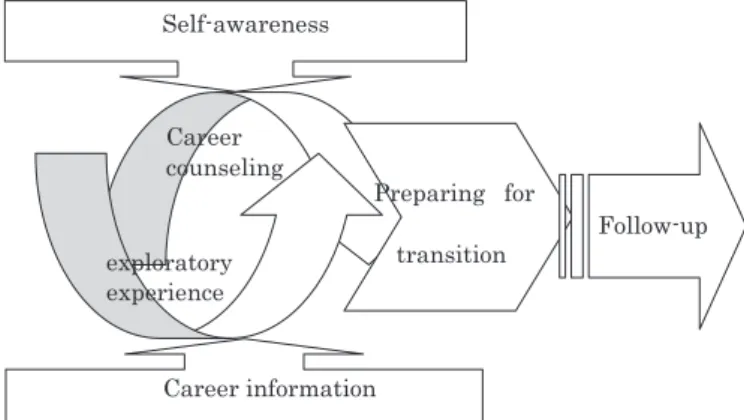
2.2 Structure of Six Activities (Figure 1)
For a long time in Japan, career education has had these six types of activities (Ministry of Education, 1977). As these activities were considered to be independent, a structure which connected these activities was suggested because it was easy for teachers to implement career guidance at school. The structure is explained as follows.
The main purpose of career guidance is to require students to know themselves. For this purpose, students are required to obtain career information and they use the information to know themselves as they use a mirror to see themselves. The interaction of the two activities is driven by the next two activities, i.e. self-awareness and career information, which are driven by exploratory experience and career counseling. Exploratory experience means work experience, volunteering, visits to secondary and tertiary schools and so on. Counseling means individual and group counseling and communication with others in daily life. In Japan there are few career counselors in the schools so teachers (i.e., career guidance teachers) have to use their career counseling skills with students in career guidance. In 2013, 98.6% of junior high school students have undergone work experience for more than one day. 14.4% of the students have experienced more than 5 days of work experience (MEXT, 2014).
As students graduate from one school level to the next level, leave school for another
Figure 1 Structure of 6 activities (Takao Mimura, 2004) exploratory
school, or seek employment, teachers prepare students for this transition. The fifth activity is preparation for transition. Students face several problems, for example, what school to enter, what occupation to pursue and other problems so on. These problems make students uneasy.
This uneasiness is called “transition anxiety, or non-adaptation.” Preparation for transition is an important activity that reduces transition anxiety. The last activity is following up on school graduates. Follow-up is also an important activity for teachers. The main function of this activity is to assess whether graduates, and dropouts have adapted themselves to the school or occu- pation they entered and, if not, teachers can help them to improve the situation. Teachers call graduates, send a letter to graduates, and visit the graduates workplace or school.
The structure of six activities is useful for career guidance teachers. By the structure, career guidance teachers can find their own activity in the structure, which assists teachers to implement career guidance effectively.
3.0 Career Education Phase (1999)
Japan’s “Economic Miracle” during the Career Guidance Phase; especially from the 1970’s and into the 1990’s, molded the notion “better school, better company, better life.” Eventually the bubble burst in late 1990, and everything including the way of life changed. Society was forced to reflect upon its way of life and soon realized that it was be necessary to promote the zest for living at school.
It was becoming more important in Japanese schools to provide guidance about work value and a good work ethic. For this reason, in 1999, the Central Educational Council adopted a new policy, career education through school education activities. This whole school approach promotes an organized, systematic career education tailored to the students’ developmental stage (Central Educational Council:
1999).
In 1999, career education appeared as an official educational nomenclature. Its first definition was that career education is the education, which enables the development of desirable attitude concerning work and occupation, and the acquisition of knowledge and skills, which also fosters competencies and attitudes to understand one’s own individuality and proactively make career decision.
From the beginning of career education there have been two reasons why career education was necessary and to be promoted. One has been growing concerns over several school problems, such as, violence, bullying, non-attendance at schools, and a high school drop-outs. The other reason has been an immature attitude of youth toward work.
In 2002, Sample Framework of Learning Programs to Foster Work Values concerning Occupation and Work: Perspective for Promoting Career Development Competencies in Japan was designed for career education in Japan’s schools (MEXT. 2002). This competency-based program was influenced by
NOICC’s National Career Development Guideline (1989).
3.1 School Problems: Problems of Transition
We have three phases of school problems; namely, ‘Shoichi-problerm’ , ‘Chuichi-gap’ and
‘Koichi-crisis.’
‘Shoichi-problem’ means the problem of 1st grade(year) students in elementary school.
This phenomenon occurs when children cannot make a smooth transition from home or kin- dergarten into the start of elementary school first grade. ‘Chuichi-gap’ refers to the problem of transition from elementary school 6th grade into 7th grade(first year) of junior high school.
These first year junior high school students cannot adapt themselves to new junior high school life. Such students will not attend school. School violence and bullying are also caused by the transition anxiety or non-adaptation. “Koichi-crisis” denotes the problem when 9th grade(third year) junior high school students cannot make a smooth transition into high school. These 10th grade(first year) high school student cannot adjust well to high school. In Japan high school is not compulsory and most junior high school students have to take entrance examination to go to high school. Scores on the entrance examination help determine what high schools a student is eligible. Depending on the score, students may not enter the high school of their choice and enter a high school they do not hope for.
There are growing concerns over violence, bullying and non-attendance at schools. Causes and backgrounds of these problematic actions are different in each and every case. In general, the causes are assumed to be the elements that are entangled among aggravating social envi- ronments that surround youth today.
These elements are 1) inadequate parental discipline at home, 2) condition of schools inadequately equipped and lacking the capacity to deal with the various abilities and potential of children, 3) absence of actual life experience, lack of consideration for others and a low sense of unity. In addition, there are increasing cases of crimes against children and child abuse in recent years (MEXT. 2015b).
(1) Violence
Statistics show that the occurrence of assault and battery (against teachers, among stu- dents, against others, property destructions) in schools committed by students of state-owned elementary, junior high, or high schools across the country is recorded at 59,345 cases in 9,700 schools in School Year (hereinafter referred to as “SY”) 2014.
(2) Bullying
The number of bullying cases in the state owned elementary, junior high and high schools,
or special education schools across the country in SY 2014 is 185,860 cases in 20,004(51.8% of the all school in the nation) schools.
(3) Non-attendance at school
The number of students who missed schools for more than 30 days in SY 2014 with reasons of “non-attendance at school” in state-owned and private elementary and junior high schools across the country is 119,617 (1.17% of the whole students in the nation). That of high schools is 55,657(1.67% of the all high school students in the nation).
(4) High school dropout
The total number of state-owned and private high school dropouts is 59,742 and the ratio of dropout among all students (dropout rate) is 1.6% in SY 2014
3.2 Immature Attitudes towards Work: Japanese Freeter and NEET
Immature attitudes are becoming more common and the basic quality and abilities of employees are declining. “Freeter” and NEET are two words that describe these phenomena among young people. “Freeter” is a word that combines the words of “free” and “arbeiter”
(arbeiter is a German word meaning “worker” ) and the combined word means “free worker”
in English. In Japan, the word indicates a worker who is from fifteen to thirty-four years old and spends time on part-time, mostly unskilled work. The numbers of freeter in 2013 is estimated at about 1,820,000 (Labour Force Survey. 2014). The word, NEET, is borrowed from a British report. The word means young people who are Not in Education, Employment or Training.
3.3 Competency and Attitude; Characteristics of Career Education Phase
In January 2011, the Central Council for Education published a policy entitled “The Future Vision on Career Education and Vocational Education at School.” Then the Central Council presented the new definition of Career Education, that is, “Education which encourages career development by cultivating the competencies and attitudes needed to raise the social and vocational independence of individuals.” In reference to this new definition of career education, social independence and vocational independence mean the decision making in social and vocational matters. At the elementary and secondary school levels, social independence means that students decide what to learn at school and vocational independence means that students decide what role and vocation they will take now and in the future. (Mimura; 2014)
It is important to consider the competencies and the attitudes in this definition. What are competencies and attitudes? An analogy is used to describe competency and attitude. For exam- ple, the competencies become the engine and the manners become the steering wheel. The
competencies propel a car, and the attitudes determines its direction.
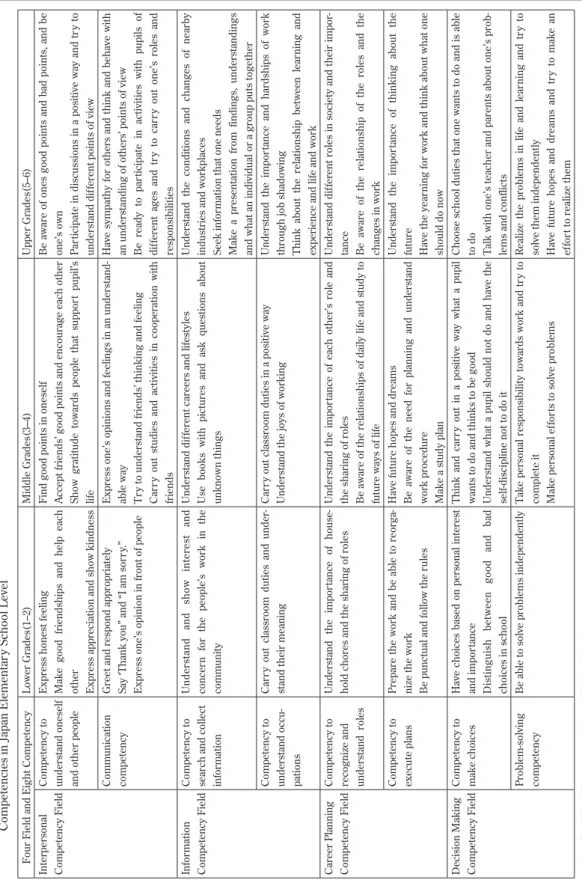
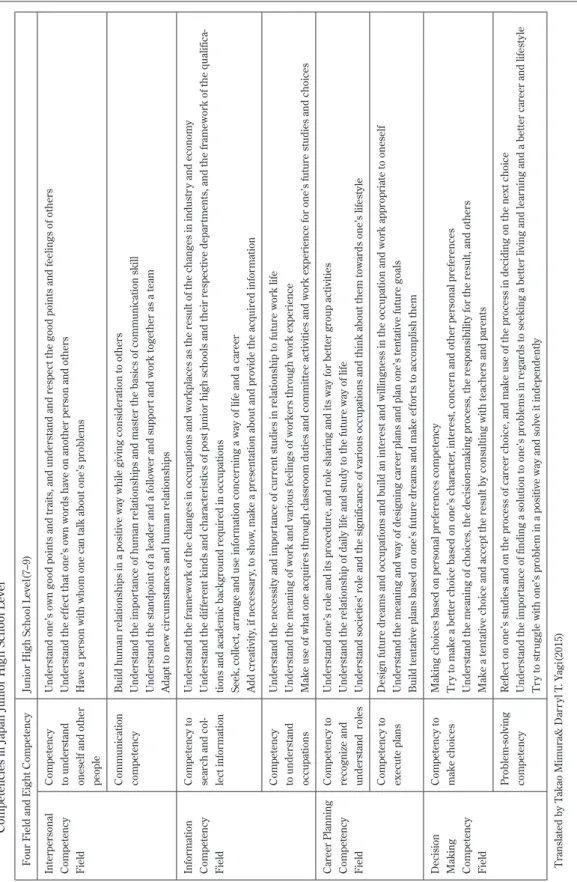
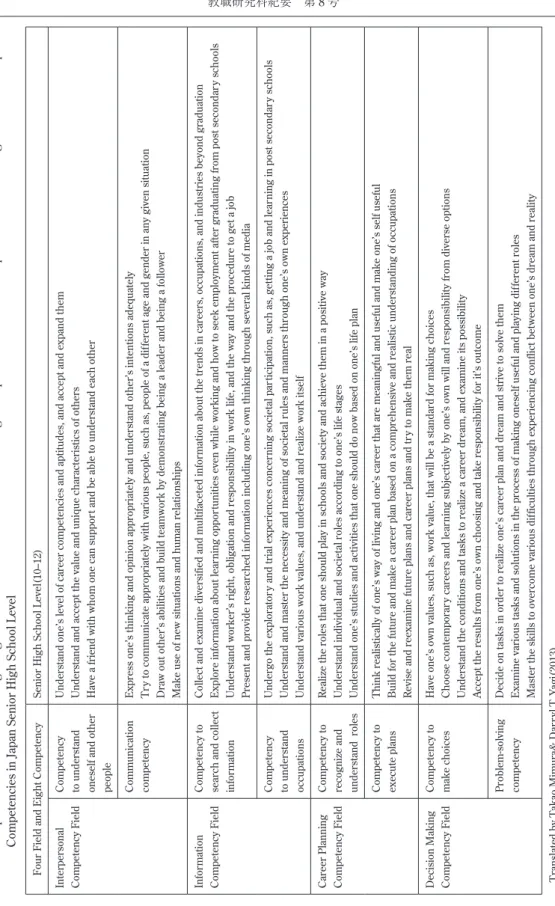
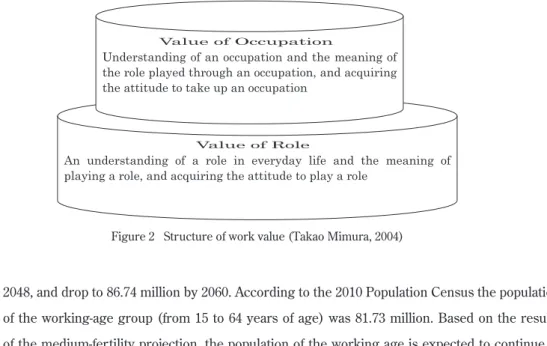
In 2002 Competencies were developed in career education as Sample Framework of Learning Programs to Foster Work Values concerning Occupation and Work: Perspective for Promoting Career Development Competencies in Japan (Table1-3). Work values are repre- sentative in attitude. Work values in Japan consist of two senses of values. One is the sense of value for playing a role to others and the other is the sense of value for work or occupation. The former sense of value, value of role, assists elementary school teachers to introduce career edu- cation into their schools. Teachers can develop career education programs where students are playing roles to others. (Figure 2)
Almost all the Japanese school students, especially elementary school students, have two major roles at school. The first is to clean their own school, for example, classrooms, toilets, special rooms, corridors and other places. They usually have time to clean school every day.
The second role is to serve their lunch by themselves. At lunchtime, assigned students go to the kitchen and carry their meal and tableware to their classroom and serve lunch to their class- mates. They learn to respect the role of daily work through these practices. These are easily connected to career education. Teachers in elementary school understand what they are to do as career education and that they do not necessary deal with occupations as career education.
Students accepting these practices have more chances to play roles at school. The value of role stands for the value of occupation. Before students undergo work experience to develop work value, the value of playing a role should be formed beforehand.
After a long consideration and deliberation, the Central Council for Education in 201l developed a new competencies named ‘Basic and General Competencies.’ These new compe- tencies comprise of four sub-competencies, that is, competency to establish relationship and community, competency to understand and manage oneself, problem-solving competency and career-planning competency. The Council shows the relationship between the two former sub-competencies and the latter two sub-competencies (Central Educational Council: 2011).
The characteristics of career education phase is composed of the two emphases of career education, that is, competencies and attitudes.
3.4 Newest Problem: Decline in General Population and Working Age
The newest problem that Japan is facing is the decline of the population and the work- ing-age population. According to the 2010 Population Census the population in Japan was 128.06 million (total population including non-Japanese residents). Based on the results of the medi- um-fertility projection, the population is expected to fall below 100 million to 99.13 million in
Table 1 Sample Framework of Learning Programs to Foster Work Values concerning Occupation and Work: Perspective for Promoting Career Development Competencies in Japan Elementary School Level Four Field and Eight CompetencyLower Grades(1–2)Middle Grades(3–4)Upper Grades(5–6) Interpersonal Competency FieldCompetency to understand oneself and other people Express honest feeling Make good friendships and help each other Express appreciation and show kindness Find good points in oneself Accept friends’ good points and encourage each other Show gratitude towards people that support pupil’s life Be aware of ones good points and bad points, and be one’s own Participate in discussions in a positive way and try to understand different points of view Communication competencyGreet and respond appropriately Say ‘Thank you” and “I am sorry.” Express one’s opinion in front of people
Express one’s opinions and feelings in an understand- able way Try to understand friends’ thinking and feeling Carry out studies and activities in cooperation with friends Have sympathy for others and think and behave with an understanding of others’ points of view Be ready to participate in activities with pupils of different ages and try to carry out one’s roles and responsibilities Information Competency FieldCompetency to search and collect information
Understand and show interest and concern for the people’s work in the community Understand different careers and lifestyles Use books with pictures and ask questions about unknown things
Understand the conditions and changes of nearby industries and workplaces Seek information that one needs Make a presentation from findings, understandings and what an individual or a group puts together Competency to understand occu- pations
Carry out classroom duties and under- stand their meaningCarry out classroom duties in a positive way Understand the joys of workingUnderstand the importance and hardships of work through job shadowing Think about the relationship between learning and experience and life and work Career Planning Competency FieldCompetency to recognize and understand roles Understand the importance of house- hold chores and the sharing of rolesUnderstand the importance of each other’s role and the sharing of roles Be aware of the relationships of daily life and study to future ways of life Understand different roles in society and their impor- tance Be aware of the relationship of the roles and the changes in work Competency to execute plansPrepare the work and be able to reorga- nize the work Be punctual and follow the rules
Have future hopes and dreams Be aware of the need for planning and understand work procedure Make a study plan
Understand the importance of thinking about the future Have the yearning for work and think about what one should do now Decision Making Competency FieldCompetency to make choicesHave choices based on personal interest and importance Distinguish between good and bad choices in school
Think and carry out in a positive way what a pupil wants to do and thinks to be good Understand what a pupil should not do and have the self-discipline not to do it Choose school duties that one wants to do and is able to do Talk with one’s teacher and parents about one’s prob- lems and conflicts Problem-solving competencyBe able to solve problems independentlyTake personal responsibility towards work and try to complete it Make personal efforts to solve problems
Realize the problems in life and learning and try to solve them independently Have future hopes and dreams and try to make an effort to realize them Translated by Takao Mimura& Darryl T. Yagi(2015)
Table 2 Sample Framework of Learning Programs to Foster Work Values concerning Occupation and Work: Perspective for Promoting Career Development Competencies in Japan Junior High School Level Four Field and Eight CompetencyJunior High School Level(7–9) Interpersonal Competency Field Competency to understand oneself and other people
Understand one’s own good points and traits, and understand and respect the good points and feelings of others Understand the effect that one’s own words have on another person and others Have a person with whom one can talk about one’s problems Communication competency Build human relationships in a positive way while giving consideration to others Understand the importance of human relationships and master the basics of communication skill Understand the standpoint of a leader and a follower and support and work together as a team Adapt to new circumstances and human relationships Information Competency Field
Competency to search and col- lect information
Understand the framework of the changes in occupations and workplaces as the result of the changes in industry and economy Understand the different kinds and characteristics of post junior high schools and their respective departments, and the framework of the qualifica- tions and academic background required in occupations Seek, collect, arrange and use information concerning a way of life and a career Add creativity, if necessary, to show, make a presentation about and provide the acquired information Competency to understand occupations
Understand the necessity and importance of current studies in relationship to future work life Understand the meaning of work and various feelings of workers through work experience Make use of what one acquires through classroom duties and committee activities and work experience for one’s future studies and choices Career Planning Competency Field
Competency to recognize and understand roles
Understand one’s role and its procedure, and role sharing and its way for better group activities Understand the relationship of daily life and study to the future way of life Understand societies’ role and the significance of various occupations and think about them towards one’s lifestyle Competency to execute plansDesign future dreams and occupations and build an interest and willingness in the occupation and work appropriate to oneself Understand the meaning and way of designing career plans and plan one’s tentative future goals Build tentative plans based on one’s future dreams and make efforts to accomplish them Decision Making Competency Field
Competency to make choicesMaking choices based on personal preferences competency Try to make a better choice based on one’s character, interest, concern and other personal preferences Understand the meaning of choices, the decision-making process, the responsibility for the result, and others Make a tentative choice and accept the result by consulting with teachers and parents Problem-solving competencyReflect on one’s studies and on the process of career choice, and make use of the process in deciding on the next choice Understand the importance of finding a solution to one’s problems in regards to seeking a better living and learning and a better career and lifestyle Try to struggle with one’s problem in a positive way and solve it independently Translated by Takao Mimura& Darryl T. Yagi(2015)
Table 3 Sample Framework of Learning Programs to Foster Work Values concerning Occupation and Work: Perspective for Promoting Career Development Competencies in Japan Senior High School Level Four Field and Eight CompetencySenior High School Level(10–12) Interpersonal Competency FieldCompetency to understand oneself and other people
Understand one’s level of career competencies and aptitudes, and accept and expand them Understand and accept the value and unique characteristics of others Have a friend with whom one can support and be able to understand each other Communication competencyExpress one’s thinking and opinion appropriately and understand other’s intentions adequately Try to communicate appropriately with various people, such as, people of a different age and gender in any given situation Draw out other’s abilities and build teamwork by demonstrating being a leader and being a follower Make use of new situations and human relationships Information Competency FieldCompetency to search and collect information
Collect and examine diversified and multifaceted information about the trends in careers, occupations, and industries beyond graduation Explore information about learning opportunities even while working and how to seek employment after graduating from post secondary schools Understand worker’s right, obligation and responsibility in work life, and the way and the procedure to get a job Present and provide researched information including one’s own thinking through several kinds of media Competency to understand occupations
Undergo the exploratory and trial experiences concerning societal participation, such as, getting a job and learning in post secondary schools Understand and master the necessity and meaning of societal rules and manners through one’s own experiences Understand various work values, and understand and realize work itself Career Planning Competency FieldCompetency to recognize and understand roles
Realize the roles that one should play in schools and society and achieve them in a positive way Understand individual and societal roles according to one’s life stages Understand one’s studies and activities that one should do now based on one’s life plan Competency to execute plansThink realistically of one’s way of living and one’s career that are meaningful and useful and make one’s self useful Build for the future and make a career plan based on a comprehensive and realistic understanding of occupations Revise and reexamine future plans and career plans and try to make them real Decision Making Competency FieldCompetency to make choicesHave one’s own values, such as, work value, that will be a standard for making choices Choose contemporary careers and learning subjectively by one’s own will and responsibility from diverse options Understand the conditions and tasks to realize a career dream, and examine its possibility Accept the results from one’s own choosing and take responsibility for it’s outcome Problem-solving competencyDecide on tasks in order to realize one’s career plan and dream and strive to solve them Examine various tasks and solutions in the process of making oneself useful and playing different roles Master the skills to overcome various difficulties through experiencing conflict between one’s dream and reality Translated by Takao Mimura& Darryl T. Yagi(2013)
2048, and drop to 86.74 million by 2060. According to the 2010 Population Census the population of the working-age group (from 15 to 64 years of age) was 81.73 million. Based on the results of the medium-fertility projection, the population of the working age is expected to continue to decrease to 44.18 million by 2060. The population in Japan 2060 is expected to be two third of what it is now. Thus, the working population to support the whole population would be mostly half, which would mean that the same working population would have to support 1.5 times more people in 2060 in Japan. Though increasing population is very difficult, Japan needs to increase the general polulation to improve the quality of each individual.
4.0 Summary
It is 100 years since the concept of “vocational guidance” was introduced to Japan in 1915. During one hundred years, the concept of career support for children and youth has changed as described in the three phases. Within the hundred years, there were significant historical milestones; namely, voca- tional guidance phase(1915), career guidance phase(1957), and career education phase(1999), which occurred every 42 years. Each phase developed in response to a paradigm shift in education and evolved in response to societal needs and changes. Each phase characterizes the changing nature of career support and education’s innovative answer to the career support of students. Career support was con- sidered not only for students’ vocational life but also for the effect on their social lives after graduation.
Each phase, as noted, had been influenced from the vocational guidance, career guidance, and career education movement in the United States.
In the vocational guidance phase(1915), it was necessary for students to obtain knowledge about many vocations and to achieve the attitude of respecting work. Education had to consider what direction to take and how the attitude of respecting work would be achieved. In this phase elementary school
Figure 2 Structure of work value (Takao Mimura, 2004)
children were the direct recipients of vocational guidance.
In career education phase(1957), career guidance complemented the modernization of Japan after World War II. Career guidance was implemented for junior and senior high school students. Career guidance had disappeared substantially in the elementary schools. When junior high school education in 1949 had become completely compulsory and vocational guidance was no longer integral to the elemen- tary schools. From 1957 to 1999 is considered “the lost 50 years” for career support at the elementary school level. During this phase, career guidance was considered a function of education. Ministry of Education(1977) implemented 6 career guidance activities in the schools. Mistakenly, “career” was often associated with academic guidance. As the economy soared, the concept of career guidance gradually became distorted. The phrase of this phase “better school, better company, better life” was the symbol of the phrase where people chose schools and companies based on others’ “good” standards.
In the career education phase(1999), the economic bubble burst in the 1990’s and Japan faced the stagnation of economy and had to recognize how and what to provide career support to students. This phase of career education was adopted instead of career guidance which gradually became estranged from its original meaning. In 1999, career education appeared and career education was emphasized from elementary school to high school. 6-3-3 schools were expected to make efforts to develop compe- tencies and attitudes required for achieving social and vocational independence through overall educa- tional activities. In this phase, competencies were stressed rather than attitude. This can be highlighted in the development of the Sample Framework of Learning Programs to Foster Work Values concerning Occupation and Work : Perspective for Promoting Career Development Competencies in Japan and Basic and General Competencies.
Career education was implemented at each level (6-3-3). Elementary school is the period to form the basis required for social and vocational independence. Junior high school is the period for pragmatic exploration and provisional decisions. Senior high school is for pragmatic exploration/trial and transi- tion to mainstream society.
With the exception of “the lost 50 years” of elementary school career support, career support continues today from its inception 100 years ago. Each phase of career support has transitioned with the changing times, which has been every 42 years. With an aging and diminishing population and added natural disasters and declining birth rate, career education in the schools face the challenging task to address the changing times in Japan. In a global society with high technology career support in the schools requires taking innovative steps towards advancement of the human potential. Will career support of students in Japan wait another 42 years?
References
Brown, S. (2006). Career counseling. In J. Greenhaus, & G. Callanan (Eds.) Encyclopedia of Career Development. p.
88. Thousand Oaks: Sage Publication.
Central Educational Council.(1999). Regarding of Continuity Between Primary and Lower and Upper Secondary Schools, and Universities (Policy Report) [in Japanese]. http://www.mext.go.jp/b_menu/shingi/old_chukyo/
old_chukyo_index/toushin/1309737.htm (accessed June 7, 2013)
Central Educational Council. (2011). Report on the Future Vision on Career Education and Vocational Education at School. [in Japanese] http://www.mext.go.jp/component/b_menu/shingi/toushin/__icsFiles/afieldfile/
2011/02/01/1301878_1_1.pdf (accessed October 6, 2015) Irisawa, S. (1915). the Present Education, Kodokan.
Masuda, K. (1935). Twenty Lectures on Vocational Guidance. Sanseido. p. 33.
Mimura, T. (2005). Study of Vocational Guidance Theories and Services at the Beginning of Vocational Guidance of Youth in Japan —Focusing on the Establishment of the Osaka Municipal Child Guidance Center—. [in Japanese]. Bulletin of the Japanese Society for the Study of Career Guidance, 23(1) , pp. 11–21.
Mimura, T. (2013). Development Process Career Education in Japan, Proceedings of The International Conference on New Careers in New Era (Surabaya, Indonesia, July 5–6th, 2013), Adi Buana University Press, pp.8–18.
Mimura, T. (2015). Vocational Guidance, Career Guidance, and Career Education in Japan, IAEVG International Conference 2015 Program Book & Abstracts, International Association for Educational and Vocational Guidance, The Japanese Society for the Study of Career Education, p. 64.
Ministry of Education. (1970). Guides for Career Guidance edited for homeroom teachers of junior high school.
Ministry of Education. (1977). The Handbook of Guidance officers of junior high school and senior high school, Japan Career Guidance Association, pp. 22–28.
Ministry of Education, Culture, Sports, Science and Technology, Guidance and Counseling Research Center, National Institute for Educational Policy Research of Japan. (2002). Regarding Promotion of Educational that Fosters Attitudes concerning occupation and Work. [in Japanese].
https://www.nier.go.jp/shido/centerhp/sinro/1hobun.pdf#search= (accessed October 6, 2015)
Ministry of Education, Culture, Sports, Science and Technology. (2014a) Announcement on FY2013 School Basic Survey. [in Japanese]. http://www.mext.go.jp/component/b_menu/houdou/__icsFiles/afieldfile/
2014/08/07/1350732_02.pdf (accessed August 29, 2014)
Ministry of Education, Culture, Sports, Science and Technology. (2015b). Statistics on Student Guidance (2014) [in Japanese]. http://www.mext.go.jp/b_menu/houdou/26/10/__icsFiles/afieldfile/2014/10/16/1351936_01_1.
pdf. (accessed October 4, 2015)
Ministry of Education, Culture, Sports, Science and Technology, Guidance and Counseling Research Center, National Institute for Educational Policy Research of Japan. (2013c). The result of research of FY 2011 workplace experi- ence and internship enforcement (summary). [in Japanese]. http://www.nier.go.jp/shido/centerhp/i-ship/h24i- ship.pdf. (accessed October 29, 2014)
Ministry of Education, Culture, Sports, Science and Technology, Guidance and Counseling Research Center, National Institute for Educational Policy Research of Japan, .(2013) Creating Career Education. November 2011 (Translated in March 2013)
Ministry of Internal Affairs and Communication, Statistics Bureau(2013) Annual Report on the Labour Force Survey 2012. [in Japanese]. http://www.stat.go.jp/data/roudou/sokuhou/nen/dt/pdf/index1.pdf. (accessed June 7, 2013)
Osaka City Child Guidance Center. (1922). Bulletin of the Osaka City Child Guidance Center (reprint edition 1992). [in Japanese]. p. 1. Tokyo: Author.
Online etymology dictionary
http://www.etymonline.com/index.php?term=career (accessed October 6, 2015) Parsons, F. (1909). Choosing a vacation. Boston: Houghton Mifflin.
Takeshi Senzaki (2001) The contribution of D. E. Super to career guidance and counseling research in Japan, Bunkyo University Educational Research Bulletin vol. 10.
Younnjung Gong, Chi-Ping Deng, Darryl Takizo Yagi, Takao Mimura, Maehyang Hwang, and Donghyuck Lee, Career Counseling in Asian Countries: Historical Development, Current Status, Challenges and Prospects, Journal of Asia Pacific Counseling, Volume 3, Number 1, The Korean Counseling Association, pp. 9–33.