*Department of Mechanical Engineering, Faculty of Science and Engineering, Doshisha University, Kyotanabe City, Kyoto 610-0394
Telephone : +81-774-65-6405, Email: [email protected]
An Experimental Investigation of Bio-Hydro Fined Oil and Waste Cooking Oil in Direct Injection Diesel Engine
Annisa BHIKUNING*, Xin LI*, Shoi KOSHIKAWA*, Eriko MATSUMURA*, Jiro SENDA* (Received July 9, 2019)
Bio-hydro fined oil is biodiesel made from second generation process that not using the trans-esterification process but using hydro finning process. Waste cooking oil is biodiesel made from collected waste cooking oil in Kyoto and it is first generation process that uses the trans-esterification process to make biodiesel. In this study, bio-hydro fined oil (BHD) and waste cooking oil (WCO) were analyzed for the performance, combustion, and emissions. Furthermore, BHD and WCO were compared to light oil JIS No.2. The speeds engine were varied from 1500 and 2000 rpm. The results show that BHD can be one of the alternative fuel in the future. At 2000 rpm, BHD can increase the thermal efficiency up to 8.49% higher than JIS. Moreover, using BHD can decrease CO and hydrocarbon emissions. Other than that, thermal efficiency in WCO was lower than JIS and BHD. Also, using WCO can increase CO and NOx emissions compared to JIS and BHD. However, hydrocarbon and smoke emissions were lower than JIS.
Key words:bio-hydro finned oil, waste cooking oil, engine performance, emissions, alternative fuel
1. Introduction
Due to the rising of cost in fossil fuels and environmental concerns, recently, the studies of alternative fuels have taken more attention. The alternative fuels such as biodiesel can be interested to reduce emissions in the environment and can achieve a sustainable economy thus can reduce the dependence to fossil fuels.
Bio-hydro fined oil is made from the second generation oil that produced some biodiesels not using the trans-esterification process but using bio hydro finning process. Hydrogenation in second generation oil is the process that vegetable oils are decompressed down to a molecular weight that similar to components in diesel oil and saturated hydrocarbons are converted to saturated hydrocarbon in vegetable oils1). Moreover, biodiesel from waste cooking oil is made from the first
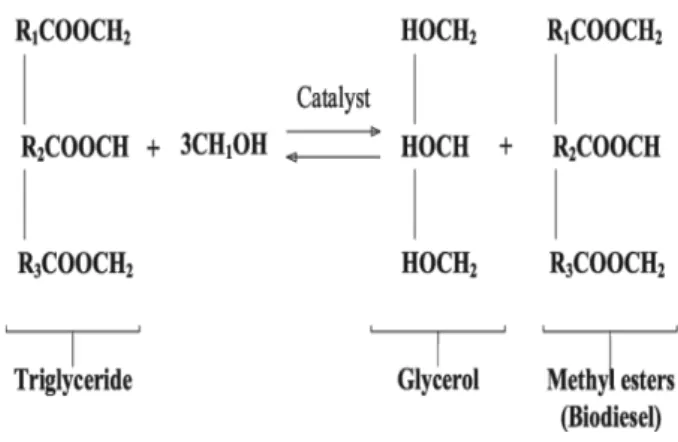
generation oil that trans-esterification is required to produce biodiesel. Fig.1 shows the trans-esterification is the process of exchanging the group of the ester with the organic of alcohol2).
Fig. 1. Trans-esterification process from biodiesel.
In order to reduce the emissions in the diesel engine, many researchers are recommended to use biodiesel. Using biodiesel in a diesel engine can reduce carbon monoxide, carbon dioxide, particulate matters and unburned hydrocarbons3,4).
Many researchers study the effect of waste cooking oil biodiesel in the combustion and emissions in the diesel engine. Abed et al5). studied the effect of waste cooking oil biodiesel (WCO) in blending B10, B20, and B30. Their results show that the thermal efficiency of WCO were lower compared to diesel fuel.
Moreover, CO, HC, and other emissions were lower for WCO than diesel fuel. Nevertheless, NOx and CO2
emissions were increased than diesel fuel. Gopal at al6). noticed that the thermal efficiency of WCO and its blends have slightly lower than diesel fuel. This is due to the fact that WCO has high density and viscosity that can lead poor atomization and fuel vaporization.
Furthermore, CO and smoke emissions can be reduced for WCO compared to diesel fuel. However, NOx emissions of WCO are higher than diesel fuel. Sanli et al.7) investigated that WCO has higher break specific fuel consumptions and thermal efficiency than diesel fuel. WCO emitted less CO and HC emissions but higher in NOx emissions than diesel fuel.
In this study, the combustion and emissions from bio-hydro fined oil (BHD) and waste cooking oil (WCO) were analyzed. The EGR rate was zero, the load was at 2 kW, and engine speeds were 1500 and 2000 rpm.
2. Material and Methods 2.1 Materials
In this study, there are three fuels tested. There are light oil of JIS No.2, BHD is second generation oil and waste cooking oil (WCO) is first generation oil. All fuel properties can be seen in table 1.
Table 1 shows that second generation oil (BHD) has fuel properties that nearly similar the same as diesel oil JIS No.2 (JIS). The BHD has good caloric value
because near to diesel oil JIS No.2. WCO has higher in density and viscosity compare to JIS and BHD, but the value of LHV is low. Oxygen content in WCO is higher than JIS and BHD. The higher oxygen content in WCO can affect the combustion process and the oxidation potential could decrease. It can be seen also that BHD has oxygen content of 0.4%. Oxidation stability is one of the problems in technical issues because it can affect the quality of the fuel. In biodiesel, the fatty acid chains of Polyunsaturated can affect the oxidation stability in the fuel8).
Table 1. Fuel properties of fuels.
Properties Unit Light Oil JIS No.2
BHD WCO
Density (15oC)
g/cm3 0.8414 0.8358 0.886
Viscosity (40oC)
mm2/s 2.7 2.925 4.365
Oxygen Content
% 0 0.4 11.5
Carbon Content
% 86.5 85.89 77.1
Hydrogen Content
% 13.5 12.8 12.64
LHV MJ/kg 42.88 42 38
2.2 Experimental Method
In this study, a single-cylinder direct injection diesel engine connected with a low pressure EGR system (bore x stroke: φ 85 x 96.9 mm, exhaust 550 cc air volume and compression ratio 16.3). However, in this study, EGR system was not used. Table 2 shows the specifications of the diesel engine, and Fig. 2 shows the schematic diagram of experiment. During the experiment the temperature of the cooling water is set to 80 ± 5 ° C, and the air temperature enters to 40 ° C. Also, S / C (Super Chargers), SCV (Swirl Control Valve)
In order to reduce the emissions in the diesel engine, many researchers are recommended to use biodiesel. Using biodiesel in a diesel engine can reduce carbon monoxide, carbon dioxide, particulate matters and unburned hydrocarbons3,4).
Many researchers study the effect of waste cooking oil biodiesel in the combustion and emissions in the diesel engine. Abed et al5). studied the effect of waste cooking oil biodiesel (WCO) in blending B10, B20, and B30. Their results show that the thermal efficiency of WCO were lower compared to diesel fuel.
Moreover, CO, HC, and other emissions were lower for WCO than diesel fuel. Nevertheless, NOx and CO2
emissions were increased than diesel fuel. Gopal at al6). noticed that the thermal efficiency of WCO and its blends have slightly lower than diesel fuel. This is due to the fact that WCO has high density and viscosity that can lead poor atomization and fuel vaporization.
Furthermore, CO and smoke emissions can be reduced for WCO compared to diesel fuel. However, NOx emissions of WCO are higher than diesel fuel. Sanli et al.7) investigated that WCO has higher break specific fuel consumptions and thermal efficiency than diesel fuel. WCO emitted less CO and HC emissions but higher in NOx emissions than diesel fuel.
In this study, the combustion and emissions from bio-hydro fined oil (BHD) and waste cooking oil (WCO) were analyzed. The EGR rate was zero, the load was at 2 kW, and engine speeds were 1500 and 2000 rpm.
2. Material and Methods 2.1 Materials
In this study, there are three fuels tested. There are light oil of JIS No.2, BHD is second generation oil and waste cooking oil (WCO) is first generation oil. All fuel properties can be seen in table 1.
Table 1 shows that second generation oil (BHD) has fuel properties that nearly similar the same as diesel oil JIS No.2 (JIS). The BHD has good caloric value
because near to diesel oil JIS No.2. WCO has higher in density and viscosity compare to JIS and BHD, but the value of LHV is low. Oxygen content in WCO is higher than JIS and BHD. The higher oxygen content in WCO can affect the combustion process and the oxidation potential could decrease. It can be seen also that BHD has oxygen content of 0.4%. Oxidation stability is one of the problems in technical issues because it can affect the quality of the fuel. In biodiesel, the fatty acid chains of Polyunsaturated can affect the oxidation stability in the fuel8).
Table 1. Fuel properties of fuels.
Properties Unit Light Oil JIS No.2
BHD WCO
Density (15oC)
g/cm3 0.8414 0.8358 0.886
Viscosity (40oC)
mm2/s 2.7 2.925 4.365
Oxygen Content
% 0 0.4 11.5
Carbon Content
% 86.5 85.89 77.1
Hydrogen Content
% 13.5 12.8 12.64
LHV MJ/kg 42.88 42 38
2.2 Experimental Method
In this study, a single-cylinder direct injection diesel engine connected with a low pressure EGR system (bore x stroke: φ 85 x 96.9 mm, exhaust 550 cc air volume and compression ratio 16.3). However, in this study, EGR system was not used. Table 2 shows the specifications of the diesel engine, and Fig. 2 shows the schematic diagram of experiment. During the experiment the temperature of the cooling water is set to 80 ± 5 ° C, and the air temperature enters to 40 ° C. Also, S / C (Super Chargers), SCV (Swirl Control Valve)
rotating is independent of the engine. Low pressure Recirculation Gas EGR (Recirculation System) with Control Valve and DPF (Diesel Particulate Filter) were also used. Gas analyzer is horiba MEXA-1500D and AVL smoke meter is used to determine the filter smoke number (FSN according to ISO 10054) and the soot content in exhaust diesel engine. Moreover, the experimental conditions are showed in Table 3.
Table 2. Engine specifications.
Type Supercharged
Direct-Injection Single Cylinder 4 Stroke Bore [mm] 85 x 96.9 Displacement [cm3] 550
Compression ratio 16.3
Combustion chamber shape
Re-entrant
Fuel Injection system Common rail
Number of holes 7
Nozzle diameter [mm] 0.125 Injection angle [deg.] 156
EGR system Low-pressure loop EGR
Fig. 2. Schematic diagram of experiment.
Table 3. Experimental conditions.
Test fuel Light Oil
JIS#2, BHD, BDF Pilot injection timing [deg.BTDC] 18.0 Main injection timing [deg.BTDC] 2.0 Rail pressure [MPa] 160 Boost pressure [kPa] 130 Load [kW] 2.0 Engine Speed 1500 rpm 2000 rpm
Main injection quantity (mg/str.)
8.4 27.4
Pilot injection quantity (mg/str.)
2.0 2.0
Total injection quantity (mg/str.)
10.4 29.4
3. Results and Discussions 3.1 Spray Observation
The spray evolution process of BHD and WCO can be seen in Fig. 3. Fig.3 shows that those spray characteristics are developed by the elapsed time. It can be seen that at the beginning of injection start, spray tip penetration of all fuels seems no differences. However, after time injection increased, WCO has larger tip penetration than BHD. This happened because WCO has high viscosity and density than BHD. Therefore, these conditions can make larger in spray tip penetration and narrower spray angle as compared to BHD. Moreover, the fuel viscosity affects the mass flow inside the injector nozzle, and pressure injector might also
0 2 4 6 8
-20 -15 -10 -5 0 5 10 15 20 25 30
Cylinder Pressure (MPa)
Crank Angle (oCA) 1500 rpm
JIS BHD WCO
-10 0 10 20 30 40 50 60
-20 -15 -10 -5 0 5 10 15 20 25 30 Heat Release (J/oCA)
Crank Angle (oC) 1500 rpm
JIS BHD WCO
0 2 4 6 8
-20 -15 -10 -5 0 5 10 15 20 25 30
Cylinder Pressure (MPa)
Crank Angle (oC) 2000 rpm
JIS BHD WCO
-10 10 30 50 70 90
-20 -15 -10 -5 0 5 10 15 20 25 30 Heat Release (J/oCA)
Crank Angle (oCA) 2000 rpm
JIS BHD WCO influence the spray tip penetration in the fuel.
Fig. 3. Spray evolution process from BHD and WCO at Pinj = 100 MPa and Ta= 500 K.
3.2 Engine Combustion Analysis
Fig. 4. Cylinder pressure and heat release from several fuels at 1500 rpm.
Fig. 5. Cylinder pressure and heat release from several fuels at 2000 rpm.
The cylinder pressure and heat release from JIS, BHD, and WCO at 1500 and 2000 rpm are plotted in Fig.4 and 5. It can be seen that peak cylinder pressure of WCO in Fig.4 and 5 are the highest than BHD and JIS.
The peak cylinder pressure is increased with engine speed. The main cause for the higher peak in-cylinder pressure in WCO is due to the high oxygen content, leading to an increase rate in combustion, peak temperature, and pressure. Cylinder pressure depends on the fuel combustion fraction during the premixed phase and the ability of the fuel to mix well with air. The first mixed phase is produced by a period of ignition delays and mixed preparations during the delay period. Peak pressure depends on the level of combustion at the initial stage which in turn affects the amount of fuel burned at a certain phase9).
0 2 4 6 8
-20 -15 -10 -5 0 5 10 15 20 25 30
Cylinder Pressure (MPa)
Crank Angle (oCA) 1500 rpm
JIS BHD WCO
-10 0 10 20 30 40 50 60
-20 -15 -10 -5 0 5 10 15 20 25 30 Heat Release (J/oCA)
Crank Angle (oC) 1500 rpm
JIS BHD WCO
0 2 4 6 8
-20 -15 -10 -5 0 5 10 15 20 25 30
Cylinder Pressure (MPa)
Crank Angle (oC) 2000 rpm
JIS BHD WCO
-10 10 30 50 70 90
-20 -15 -10 -5 0 5 10 15 20 25 30 Heat Release (J/oCA)
Crank Angle (oCA) 2000 rpm
JIS BHD WCO influence the spray tip penetration in the fuel.
Fig. 3. Spray evolution process from BHD and WCO at Pinj = 100 MPa and Ta= 500 K.
3.2 Engine Combustion Analysis
Fig. 4. Cylinder pressure and heat release from several fuels at 1500 rpm.
Fig. 5. Cylinder pressure and heat release from several fuels at 2000 rpm.
The cylinder pressure and heat release from JIS, BHD, and WCO at 1500 and 2000 rpm are plotted in Fig.4 and 5. It can be seen that peak cylinder pressure of WCO in Fig.4 and 5 are the highest than BHD and JIS.
The peak cylinder pressure is increased with engine speed. The main cause for the higher peak in-cylinder pressure in WCO is due to the high oxygen content, leading to an increase rate in combustion, peak temperature, and pressure. Cylinder pressure depends on the fuel combustion fraction during the premixed phase and the ability of the fuel to mix well with air. The first mixed phase is produced by a period of ignition delays and mixed preparations during the delay period. Peak pressure depends on the level of combustion at the initial stage which in turn affects the amount of fuel burned at a certain phase9).
0 5 10 15 20 25 30 35
JIS BHD WCO
Thermal Efficiency (ηth)
Fuel 1500 rpm
2000 rpm
0 50 100 150 200 250 300 350 400 450
JIS BHD WCO
BSFC (g/kW.h)
Fuel 1500 rpm
2000 rpm
0 2 4 6 8 10 12
JIS BHD WCO
CO (g/kW.h)
Fuel 1500 rpm
2000 rpm Heat release from JIS, BHD, and WCO are can be
seen in Fig.4 and Fig.5. Those figures show that WCO has the highest peak heat release as compared to JIS and BHD. This phenomenon can be explained that the content of oxygen in WCO can cause air-mixed fuel in the cylinder to burn completely and increase the heat release rate10).
3.3 Thermal Efficiency
Fig. 6. Thermal efficiency from several fuels at 1500 and 2000 rpm.
Fig.6 shows thermal efficiency from several fuels at 1500 and 2000 rpm. Fig.6 shows that thermal efficiency reduced by increasing the engine speed. Fig. 6 indicates that at 1500 and 2000 rpm, BHD has the highest thermal efficiency than JIS and WCO. In 2000 rpm, the thermal efficiency of BHD can increase up to 8.49% than JIS. The highest thermal efficiency is BHD because of the 0.4% oxygen content in the fuel. The oxygen content in BHD can cause complete combustion that can extend premixed in the combustion phase.
Nevertheless, the thermal efficiency of WCO is the lowest from JIS and BHD. This can be concluded that WCO has poor combustion characteristics and volatility comparing to JIS. The density and viscosity in WCO are higher than JIS. Caloric value in WCO is higher than JIS and BHD. Therefore, thermal efficiency in WCO is slightly reduced than JIS and BHD.
3.4 Break Specific Fuel Consumption (BSFC)
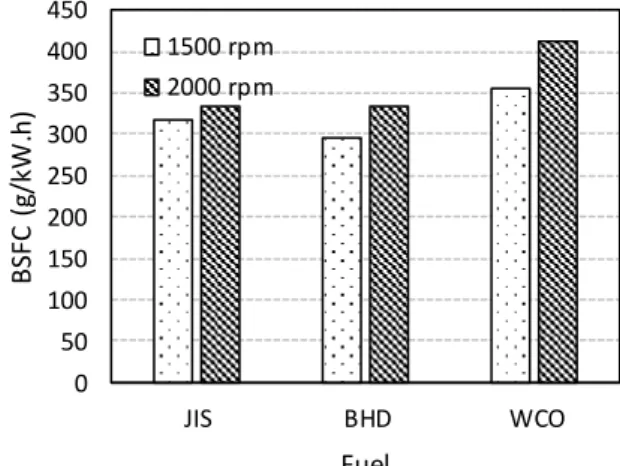
Fig. 7. BSFC from several fuels at 1500 and 2000 rpm.
Brake specific fuel consumption from JIS, BHD, and WCO are shown in Fig.7. Fig.7 shows that BSFC of WCO is the highest from JIS and BHD. It is believed that higher density, viscosity, and low in caloric value can be affected in increasing of BSFC. At 1500 and 2000 rpm, BSFC in WCO was raised to 10.93 and 18.85% than JIS.
Fig.7 shows that at 2000 rpm, the value of BSFC between JIS and BHD are nearly the same. This because of the density and the viscosity between JIS and BHD are nearly the same but BHD has slight higher in density and viscosity.
3.5 Emissions Analysis CO (Carbon Monoxide)
Fig. 8. CO emissions from several fuels at 1500 and 2000 rpm.
4 5 6 7 8 9 10
JIS BHD WCO
NOx (g/kW.h)
Fuel 1500 rpm
2000 rpm
0 0.1 0.2 0.3 0.4 0.5 0.6
JIS BHD WCO
THC (g/kW.h)
Fuel 1500 rpm
2000 rpm Fig. 8 shows the CO emissions from JIS,
BHD, and WCO at 1500 and 2000 rpm. CO emissions increased with increasing of speed engine. From Fig.8, it can be shown that at 1500 and 2000 rpm, WCO has the highest CO emissions among JIS and BHD. This tendency happened due to incomplete combustion in WCO can affect CO emissions high.
At 1500 rpm, CO emissions in BHD were higher 1.88% than JIS. Nevertheless, at 2000 rpm, CO emissions in BHD can reduce to 33.12% than JIS.
Nitrogen Oxides (NOx)
Fig. 9. NOx emissions from several fuels at 1500 and 2000 rpm.
NOx emissions from several fuels are plotted in Fig.9. NOx emissions increased by increasing engine speed. Fig.9 described that NOx emissions from WCO are the highest of all fuels. This is believed that because of the oxygen content in WCO.
Fig. 9 shows that NOx emissions in BHD at 1500 rpm are reduced to 0.44% than JIS. Also from Fig.6 are shown that at 2000 rpm, NOx emissions in WCO rose to 18.87% than JIS. Moreover, NOx emissions in BHD increased to 13.47% than JIS. This is happened due to the 0.4% oxygen content in BHD.
Nevertheless, JIS has no oxygen content.
Hydrocarbon Emissions (THC)
Fig. 10. THC emissions from several fuels at 1500 and 2000 rpm.
THC or the total hydrocarbon emission is the emission of unburned hydrocarbon and is an indicator of efficiency of combustion or completeness11). THC emissions from JIS, BHD, and WCO are shown in Fig.
10. In this figure, THC emissions at 1500 and 2000 rpm in JIS is the highest than BHD and WCO. Nevertheless, THC emissions in BHD and WCO are the smaller than JIS. This happened due to high cetane number causes shorter ignition delay and improves efficiency of the combustion which in return reduces unburned hydrocarbon. In addition to this, the presence of oxygen in the molecules of biodiesel intensifies the post-flame oxidation process of unburned hydrocarbons in the combustion chamber12).
In Fig.10, at 1500 rpm, THC emissions in BHD can reduce up to 21.29% than JIS. While THC emissions in WCO can diminish up to 40.88% than JIS.
At high load, THC emissions in BHD can cut up to 25.87% than JIS. Moreover, at 2000 rpm, THC emissions in WCO can reduce to 8.38% than JIS.
4 5 6 7 8 9 10
JIS BHD WCO
NOx (g/kW.h)
Fuel 1500 rpm
2000 rpm
0 0.1 0.2 0.3 0.4 0.5 0.6
JIS BHD WCO
THC (g/kW.h)
Fuel 1500 rpm
2000 rpm Fig. 8 shows the CO emissions from JIS,
BHD, and WCO at 1500 and 2000 rpm. CO emissions increased with increasing of speed engine. From Fig.8, it can be shown that at 1500 and 2000 rpm, WCO has the highest CO emissions among JIS and BHD. This tendency happened due to incomplete combustion in WCO can affect CO emissions high.
At 1500 rpm, CO emissions in BHD were higher 1.88% than JIS. Nevertheless, at 2000 rpm, CO emissions in BHD can reduce to 33.12% than JIS.
Nitrogen Oxides (NOx)
Fig. 9. NOx emissions from several fuels at 1500 and 2000 rpm.
NOx emissions from several fuels are plotted in Fig.9. NOx emissions increased by increasing engine speed. Fig.9 described that NOx emissions from WCO are the highest of all fuels. This is believed that because of the oxygen content in WCO.
Fig. 9 shows that NOx emissions in BHD at 1500 rpm are reduced to 0.44% than JIS. Also from Fig.6 are shown that at 2000 rpm, NOx emissions in WCO rose to 18.87% than JIS. Moreover, NOx emissions in BHD increased to 13.47% than JIS. This is happened due to the 0.4% oxygen content in BHD.
Nevertheless, JIS has no oxygen content.
Hydrocarbon Emissions (THC)
Fig. 10. THC emissions from several fuels at 1500 and 2000 rpm.
THC or the total hydrocarbon emission is the emission of unburned hydrocarbon and is an indicator of efficiency of combustion or completeness11). THC emissions from JIS, BHD, and WCO are shown in Fig.
10. In this figure, THC emissions at 1500 and 2000 rpm in JIS is the highest than BHD and WCO. Nevertheless, THC emissions in BHD and WCO are the smaller than JIS. This happened due to high cetane number causes shorter ignition delay and improves efficiency of the combustion which in return reduces unburned hydrocarbon. In addition to this, the presence of oxygen in the molecules of biodiesel intensifies the post-flame oxidation process of unburned hydrocarbons in the combustion chamber12).
In Fig.10, at 1500 rpm, THC emissions in BHD can reduce up to 21.29% than JIS. While THC emissions in WCO can diminish up to 40.88% than JIS.
At high load, THC emissions in BHD can cut up to 25.87% than JIS. Moreover, at 2000 rpm, THC emissions in WCO can reduce to 8.38% than JIS.
0.001 0.006 0.011 0.016 0.021 0.026
JIS BHD WCO
Smoke (g/kW.h)
Fuel 1500 rpm
2000 rpm Smoke
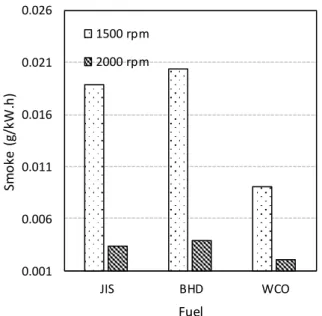
Fig. 11. Smoke emissions from several fuels at 1500 and 2000 rpm.
Smoke emissions from JIS, BHD, and WCO at 1500 and 2000 rpm can be seen in Fig.11. Fig. 11 shows that smoke emissions in BHD at 1500 rpm and 2000 rpm are the highest from JIS and WCO. This happened due to the insufficient pressure and temperature can cause incomplete combustion and increase smoke emissions in the engine. However, the increased CO emissions can affect high smoke emissions.
Fig.11 shows that smoke emissions of BHD at 1500 rpm were higher 7.72% than JIS. Moreover, at 2000 rpm the smoke emissions of BHD is also higher 13.33% than JIS.
Smoke emissions of WCO at 1500 rpm can reduce up to 52.07% than JIS. Other than that, smoke emissions of WCO at 2000 rpm can down up to 38.33%
than JIS.
4. Conclusion
According to the results of this study, the following conclusions can be shown:s
• BHD can be one of the alternative fuel in the future. BHD has high in thermal efficiency compared to JIS and WCO. CO and hydrocarbon emissions were decreased.
Moreover, NOx emissions can be reduced up to 0.44% than JIS at 1500 rpm.
• Thermal efficiency of WCO was lower than JIS and BHD. Furthermore, CO, NOx emissions were increased more than JIS and BHD.
However, hydrocarbon and smoke emissions were lower than JIS.
The first author would like to be grateful for Indonesia Directorate General of Higher Education Ministry of Education and Culture (DIKTI) and LLDIKTI III for their support.
References
1) S. Loganathan, “Biohydro-fined Diesel (BHD) and Biodiesel (BOD) Production Process and Property Review”, in Institution of Mechanical Engineers, Innovations in Fuel Economy and Sustainable Road Transport, (Woodhead Publishing Limited, India, 2011), pp. 97-107.
2) O. Junzo, “Transesterification”, Chemical Reviews, 93 [4], 1449–1470 (1993). doi:10.1021/cr00020a004.
3) M. J. Abedin, H. H. Masjuki, M. A. Kalam, A.
Sanjid, S. M. A, Rahman and I. M. R. Fattah,
“Performance, Emissions, and Heat Losses of Palm and Jatropha Biodiesel Blends in a Diesel Engine”, Ind Crops Prod, 59, 96–104 (2014).
4) M. H. Mosarof, M. A. Kalam, H. H. Masjuki, A. M.
Ashraful, M. M. Rashed and H. K. Imdadul,
“Implementation of Palm Biodiesel Based on Economic Aspects, Performance, Emission, and Wear Characteristics”, Energy Convers Manage, 105, 617–29 (2015).
5) K. A. Abed, A. K. El Morsi, M. M. Sayed and M. S.
Gad, “Effect of Waste Cooking-Oil Biodiesel on Performance and Exhaust Emissions of a Diesel
Engine”, Egyptian Journal of Petroleum, 27 [4], 985-989 (2018).
6) K. N. Gopal, A. Pal, S. Sharma, C. Samachi, K.
Sathyanarayanan and T. Elango, “Investigation of Emissions and Combustion Characteristics of a CI Engine Fueled with Waste Cooking Oil Methyl Ester and Diesel Blends”, Alexandria Engineering Journal, 53 [2], 281-287 (2014).
7) H. Sanli, M. Canakci, E. Alptekin, A. Turkcan and A.
N. Ozsezen, “Effects of Waste Frying Oil Based Methyl and Ethyl Ester Biodiesel Fuels on the Performance, Combustion and Emission Characteristics of a DI Diesel Engine”, Fuel, 159 [1], 179-187 (2015).
8) J. Pullen, and K. Saeed, “An Overview of Biodiesel Oxidation Stability”, Renew Sust Energ Rev, 16[8], 5924-5950 (2012).
9) M. S. Shehata, “Emissions, Performance and Cylinder Pressure of Diesel Engine Fuelled by Biodiesel Fuel”, Fuel, 112, 513-522 (2013).
https://doi.org/10.1016/j.fuel.2013.02.056.
10) B. Tesfa, R. Mishra, F. Gu and A. D. Ball,
“Combustion Characteristics of CI Engine Running with Biodiesel Blends”, International Conference on Renewable Energies and Power Quality, (2011).
11) K. Cheenkachorn and B. Fungtammasan, “Biodiesel as an Additive for Diesohol”. Int. J. Green Energy, 6, 57–72 (2009).
12) M. L. Randazzo and J. R. Sodré, “Exhaust Emissions from a Diesel Powered Vehicle Fuelled by Soybean Biodiesel Blends (B3–B20) with Ethanol as an Additive (B20E2–B20E5)”, Fuel, 90, 98–103 (2011).