Oxford Advanced Learner’s Dictionary of
Current English
第9版の‘Express yourself’
notes
の分析と英語教育への活用
藤本 和子
1 Oxford Advanced Learner’s Dictionary of Current English第9版(以下OALD9)が オックスフォード大学出版局から 2015 年に出版された。同辞典の編者であった 英国人の A S Hornby は、1920 年代から 1942 年まで日本に滞在し、大分高等商業 学校などで教鞭を執った。彼は自らの英語教育からコミュニケーションに役立 つ英語教授の必要性を感じ、そのことが、後に学習者のための辞典であるOALD 出版につながり、世界中の英語教育に影響を与えていくこととなるのである。
OALD初版は、1948 年に Learner’s Dictionary of Current English として出版された。 第2版は1963年、第3版は1974年、第4版は1989年、第5版は1995年、その後、 第 9 版まで 5 年ごとに改訂されている。OALD9 の Managing Editor の一人である Margaret Deuterは、その前書きにおいて、‘Hornby’s principles continue to guide our work’ (p. vi).のように、OALD は改訂を重ねても、なお Hornby の辞典編纂方針を 受け継いでいると述べている。
OALD9 の編纂は、モニターコーパスである the Oxford English Corpus の分析に 基づいている。オックスフォード大学出版局のウェブサイトによると、2015 年
10月現在、このコーパスは、およそ 25 億語の 21 世紀の英語から成り、様々な
グ、メディアなどの英語データが収められており、さらに、英語が世界語である ことから、イギリス英語、アメリカ英語のみならず、アイルランド、オーストラ リア、ニュージーランド、カナダ、インド、南アフリカなどで使用される英語も
収集されている。1 OALD9は、185,000 を超える語(句)、語義を掲載し(OALD8
では、184,500であった)、新たに700の新語(句)や語義が加えられた。例えば、 省略語のAFAIK (‘(especially in TEXTMESSAGES, emails, etc.) as far as I know’)、テク
ノロジーやインターネットの分野では、flipped classroom (‘a method of teaching in which students study new material at home, for example with videos or over the Internet, and then discuss and practise it with teachers in class, instead of the usual method where teachers present new material in school and students practise at home’)などがある。従 来の語に新たな意味が加えられた例として、achievement は、OALD9 で、第 3 義 と し て ‘a reward that you can earn in some video games by completing a challenge or level’という意味が加えられた。
OALD9が対象とする学習者レベルは、Oxford 2016 ELT Catalogue (pp. 60-62) に よると、CEFR 基準の B2 から C2 レベルである。TOEIC○® スコアでは 700 点以上、 英検準1級以上のレベルである。
OALD9の裏表紙には、‘the ultimate speaking and writing tool for developing the skills you need for passing exams and communicating in English’とあるように、巻末 には、Oxford Speaking Tutor とOxford Writing Tutor を掲載し、学習者のスピー キング力、ライティング力の向上もねらいとしている。さらに、英語運用には語 彙力や言語使用場面に応じた英語表現も重要であるため、新たなボックスノー トとして、Wordfinder notes と Express yourself notes が設けられた。前者は、関 連語に関する情報を与えるもので、例えば、accidentの項目には、この語に関連 する ambulance、casualty などの語のリストが見られる。後者の Express yourself notesは、‘help you find the right words in everyday situations’ (p. ix)とあるように、 日常生活の中での場面に応じた適切な表現を提示している。
1 Oxford Dictionaries. 2015. Oxford University Press. Available at http://www.oxforddictionaries.com/ (accessed 4 October 2015).
本稿では、OALD9 で、英語でのコミュニケーションに役立つよう新たに設け られたExpress yourself notesに焦点をあて、その内容を分析し、日常生活の様々 な場面で、どのような言語表現が使用されているのかについて把握するとともに、 『高等学校学習指導要領』の記述に照らしながら、高等学校、及び大学におけ る英語教育において、Express yourself notesをどのように活用できるか、さらに、 高等学校、大学の英語教育において、コミュニケーション能力養成のために、ど のような点に留意して英語指導をするとよいかについて検討することを目的とす る。 2 『高等学校学習指導要領』(第8節 外国語 第1款)には、外国語の目標が、 以下のように記されている。 外国語を通じて,言語や文化に対する理解を深め,積極的にコミュニケー ションを図ろうとする態度の育成を図り,情報や考えなどを的確に理解した り適切に伝えたりするコミュニケーション能力を養う。(下線筆者) 外国語の目標の中にも見られる「コミュニケーション能力」とはいったいどの ようなものであろうか。村野井 他 (2012: 19)は、主にBachman (1990)、Bachman and Palmer (1996)、Byram (1997) に基づき、外国語コミュニケーション能力が以 下の5つから成り立つとの見解を述べている。 (1) 言語能力 (language competence) (2) 方略能力 (strategic competence) (3) 認知能力 (cognitive abilities) (4) 世 界 の さ ま ざ ま な 事 柄 に つ い て の 知 識・ 考 え (real-world knowledge / thoughts) (5) 態度・姿勢 (attitudes)
ここではそれぞれの能力について詳細に述べることはしないが、村野井 他 (2012: 21-22)には、(1) の「言語能力」に関係する「機能能力」、「言語機能」に ついて、「言語機能は、言語の『働き』ということばで、『場面』とともに、学 習指導要領に盛り込まれており、機能能力を育てることが求められている。」と ある。『高等学校学習指導要領英訳版(仮訳)』には、「言語の使用場面の例」 は、‘Examples of Language-use Situations’、「言語の働きの例」は、‘Examples of Functions of Language’とされている。「言語の使用場面の例」と「言語の働きの例」 は、『中学校学習指導要領』と『高等学校学習指導要領』の両方に具体的な例が 挙げられている(以下、『中学校学習指導要領』、『高等学校学習指導要領』、『中 学校学習指導要領解説』、『高等学校学習指導要領解説』の記述については、「外 国語」の中のものである)。『高等学校学習指導要領』(第 3 款 英語に関する各 科目に共通する内容等1)の記述を見てみよう。 [言語の使用場面の例] a 特有の表現がよく使われる場面: ・ 買物 ・ 旅行 ・ 食事 ・ 電話での応答 ・ 手紙や電子メールのやりとり など b 生徒の身近な暮らしや社会での暮らしにかかわる場面: ・ 家庭での生活 ・ 学校での学習や活動 ・ 地域での活動 ・ 職場での活動 など c 多様な手段を通じて情報などを得る場面: ・ 本,新聞,雑誌などを読むこと ・テレビや映画などを観ること ・ 情報通信ネットワークを活用し情報を得ること など [言語の働きの例] a コミュニケーションを円滑にする: ・ 相づちを打つ ・ 聞き直す ・ 繰り返す ・ 言い換える ・ 話題を発展させる ・ 話題を変える など b 気持ちを伝える:
・ 褒める ・ 謝る ・ 感謝する ・ 望む ・ 驚く ・ 心配する など c 情報を伝える: ・ 説明する ・ 報告する ・ 描写する ・ 理由を述べる ・ 要約する ・ 訂正する など d 考えや意図を伝える: ・ 申し出る ・ 賛成する ・ 反対する ・ 主張する ・ 推論する ・ 仮定する など e 相手の行動を促す: ・ 依頼する ・ 誘う ・ 許可する ・ 助言する ・ 命令する ・ 注意を引く など 「言語の働きの例」については、『中学校学習指導要領』と『高等校学習指導要 領』において、「a コミュニケーションを円滑にする」から、「e 相手の行動を促す」 までの5つの項目名は全く同じであるが、aからeの中の具体的な例は、両学習指 導要領において同一ではない。なお、下線を付したものは『中学校学習指導要領』 にも取り上げられているものである。2 『中学校学習指導用要領解説』には、それぞれの言語の働きについての表現例が 挙げられているが、『高等学校学習指導要領解説』には、表現例は挙げられてい ない。従って、OALD9のExpress yourself notesの言語表現を分析することにより、 英語を用いた日常の様々な場面の中でどのような表現が使用されているのかにつ いて知ることは、高等学校における「言語の使用場面」や「言語の働き」におけ る表現提示の 1 つの示唆になるのではないかと考える。さらに、『高等学校学習 指導要領』(第 3 款 英語に関する各科目に共通する内容等 2)には、「言語活動 2 『高等学校学習指導要領』の「b 気持ちを伝える」の「感謝する」は、『中学校学習指導要領』の「礼 を言う」に、「e 相手の行動を促す」の「誘う」は、『中学校学習指導要領』の「招待する」に関連 すると考え、下線を付してある。参考までに『中学校学習指導要領』の「言語の使用場面の例」と「言 語の働きの例」をAppendix Aに記す。
を行うに当たっては…言語材料の中から,それぞれの科目の目標を達成するのに ふさわしいものを適宜用いて行わせる。」とあり、言語材料の中の「ウ文法事項」 として、以下の8つの文法項目が挙げられている。 (ア) 不定詞の用法 (イ) 関係代名詞の用法 (ウ) 関係副詞の用法 (エ) 助動詞の用法 (オ) 代名詞のうち,itが名詞用法の句及び節を指すもの (カ) 動詞の時制など (キ) 仮定法 (ク) 分詞構文 「言語の働きの例」の例えば、「b 気持ちを伝える」、「d 考えや意図を伝える」、「e 相手の行動を促す」などを見ても、これらの「言語の働き」には、話し手、書き 手の心的態度を表すモダリティをはじめ、ポライトネスやためらいが関係してく るため、「言語材料」の文法事項中の「(エ)助動詞の用法」、「(カ)動詞の時制」 などを、英語を使用したコミュニケーションの中で、ネイティヴスピーカーは巧 みに使用していると考えられる。 『高等学校学習指導要領』(第 3 款 英語に関する各科目に共通する内容等 1) には、英語の各科目の「言語活動を行うに当たっては…言語の使用場面や言語の 働きの中から,各科目の目標を達成するのにふさわしいものを適宜取り上げ,有 機的に組み合わせて活用する。」とあり、上で述べたように、『高等学校学習指導 要領』(第3款 英語に関する各科目に共通する内容等2)において、言語活動を 行う際の文法事項を含む「言語材料」が挙げられている。 本稿では、この『高等学校学習指導要領』の「言語活動」を行う際の、「言語 の使用場面」、「言語の働き」そして「言語材料」としての文法事項提示の流れに沿っ
notesで例示されている言語表現から、『高等学校学習指導要領』の「言語材料」 の文法事項を絞り、コミュニケーションに役立つ英語指導への示唆を得ることを ねらいとする。
3 Express yourself notes は、第 1 章でも述べたように、日常生活の中での場面 に応じた表現を例示している。本章では、まず、Express yourself notesの項目と 『高等学校学習指導要領』の「言語の働き」を比較する。次に、Express yourself notesに例示されている言語表現からデータセットを作成し、使用語句の頻度を 調査する。 『オックスフォード現代英英辞典 第 9 版』を出版した旺文社のサイトには、 同辞典の対象は、一般、大学生、高校生とあり、高校生も対象に含まれている。3 しかしながら、第 1 章でも述べたように、OALD9 の対象学習者レベルは、CEFR 基準の B2 から C2 レベル、TOEIC○® スコアでは 700 点以上、英検準 1 級以上であ り、高校生でこれらのレベルをもつ日本人英語学習者はまさに上級学習者と言っ てよいだろう。従って、高等学校から大学での英語教育の流れの中で、Express yourself notesに出てくる言語表現を活用するという立場から考察することが必要 であろう。
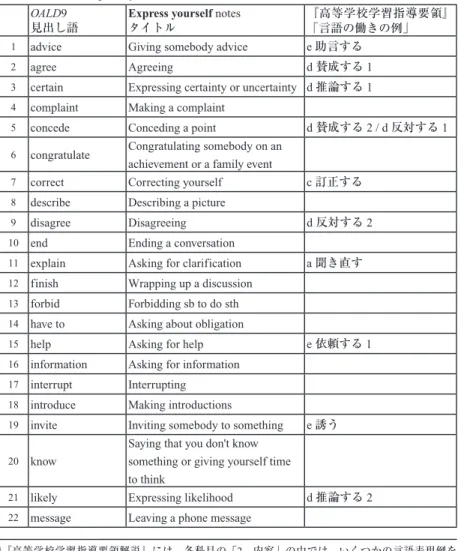
3.1 Express yourself notesは39項目ある。Table 1は、OALD9のExpress yourself
notesと『高等学校学習指導要領』の「言語の働きの例」の対照表である。この
対照表は、Express yourself notesのタイトルと『高等学校学習指導要領』の「言 語の働きの例」の日本語及び『高等学校学習指導要領英訳版(仮訳)』での対応 する英語をもとに作成したものである。『高等学校学習指導要領』及び『高等 学校学習指導要領解説』には、「言語の働きの例」のそれぞれの言語表現例が 提示されていないため、例文を手がかりに対応させることができない。従って、
Express yourself notesと『高等学校学習指導要領』の「言語の働きの例」の両者
が完全に一致するものではないことを断っておきたい。4
Table 1: OALD9 Express yourself notesと『高等学校学習指導要領』「言語の働きの例」
OALD9
見出し語 Express yourself notes タイトル 『高等学校学習指導要領』「言語の働きの例」
1 advice Giving somebody advice e 助言する
2 agree Agreeing d 賛成する 1
3 certain Expressing certainty or uncertainty d 推論する 1
4 complaint Making a complaint
5 concede Conceding a point d 賛成する 2 / d 反対する 1
6 congratulate Congratulating somebody on an achievement or a family event
7 correct Correcting yourself c 訂正する
8 describe Describing a picture
9 disagree Disagreeing d 反対する 2
10 end Ending a conversation
11 explain Asking for clarification a 聞き直す
12 finish Wrapping up a discussion
13 forbid Forbidding sb to do sth
14 have to Asking about obligation
15 help Asking for help e 依頼する 1
16 information Asking for information
17 interrupt Interrupting
18 introduce Making introductions
19 invite Inviting somebody to something e 誘う
20 know
Saying that you don't know something or giving yourself time to think
21 likely Expressing likelihood d 推論する 2
22 message Leaving a phone message
4『高等学校学習指導要領解説』には、各科目の「2 内容」の中では、いくつかの言語表現例を
示している。例えば、「コミュニケーション英語Ⅰ」では、「(1) 事実を伝える表現」として、It’s
stated/known/said (that). . . . など、「(2) 意見を伝える表現」として、I think/guess/believe/surmise/
23 offer Offering somebody something d 申し出る 1
24 open Conversation openers
25 permission Asking for permission/a favour e 依頼する 2
26 please Asking for something e 依頼する 3
27 prefer Expressing a preference
28 question Dealing with questions
29 recommendation Asking for and making a
recommendation
30 shall Offering to do something d 申し出る 2
31 sorry Apologizing b 謝る
32 speculate Speculating d 推論する 3
33 suggest Making suggestions
34 sympathy Expressing sympathy
35 tell Telling sb to do sth e 命令する
36 thank Thanking somebody for something b 感謝する
37 think Asking for somebody's opinion and involving others in a conversation
38 warn Warning people of danger
39 why Giving reasons, justifying a choice c 理由を述べる
『高等学校学習指導要領』「言語の働きの例」に付されたアルファベットは、第
2章で記した「言語の使用場面の例」のaからeを意味する。5
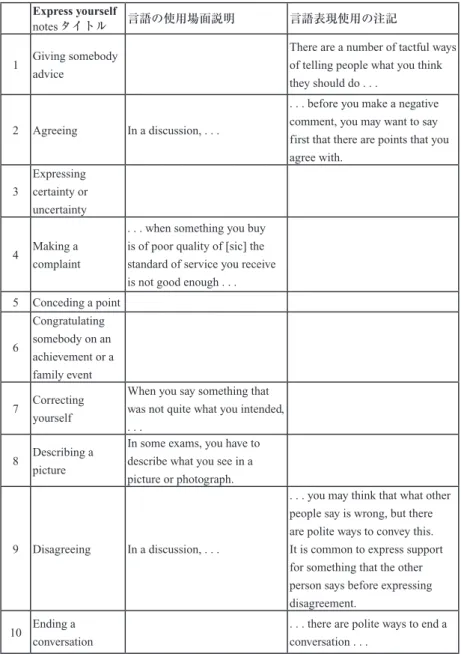
Table 1から、Express yourself notesの39項目と『高等学校学習指導要領』の「言 語の働きの例」の30項目中13項目(「賛成する」、「推論する」、「反対する」、「依 頼する」、「申し出る」の重複のため累計20)が互いに関連していることが分かる。 Table 2は、Express yourself notesにおいて設定された場面の説明と、それぞれ の場面での言語使用の注意点について抜粋したものである。特定の記述が無い場 合やExpress yourself notesのタイトルから場面が明確な場合には、空欄にしてある。
5 参考までに、Express yourself noteのMaking a complaintは、『中学校学習指導要領』の「言語の働き」
Table 2: OALD9 Express yourself notesで設定された場面と言語使用についての注記
Express yourself
notesタイトル 言語の使用場面説明 言語表現使用の注記
1 Giving somebody
advice
There are a number of tactful ways of telling people what you think they should do . . .
2 Agreeing In a discussion, . . .
. . . before you make a negative comment, you may want to say first that there are points that you agree with. 3 Expressing certainty or uncertainty 4 Making a complaint
. . . when something you buy is of poor quality of [sic] the standard of service you receive is not good enough . . .
5 Conceding a point 6 Congratulating somebody on an achievement or a family event 7 Correcting yourself
When you say something that was not quite what you intended, . . .
8 Describing a picture
In some exams, you have to describe what you see in a picture or photograph.
9 Disagreeing In a discussion, . . .
. . . you may think that what other people say is wrong, but there are polite ways to convey this. It is common to express support for something that the other person says before expressing disagreement.
10 Ending a
conversation
. . . there are polite ways to end a conversation . . .
11 Asking for clarification 12 Wrapping up a discussion In a formal meeting or conference, . . . 13 Forbidding sb to do sth When speaking to sb, . . .
. . . we usually use indirect language to ask them not to do sth . . .
14 Asking about obligation
When you are unsure about what is expected of you in a situation, . . .
15 Asking for help . . . people are more likely to react favourably if you ask politely . . . 16 Asking for
information
. . . it sounds more polite if you can phrase your questions in an indirect way . . .
17 Interrupting
You may need to say something when somebody else is speaking, or you may be chairing a discussion where you have to stop one person talking too much.
If you start talking at the same time as someone else, this will seem rude. To interrupt politely, you can say . . .
18 Making
introductions
There are different ways of introducing people to one another, depending on how formal the situation is . . .
19 Inviting somebody
to something
20
Saying that you don't know something or giving yourself time to think 21 Expressing likelihood 22 Leaving a phone message
23
Offering somebody something
Particularly when you are the host, . . .
. . . you may want to make polite offers to your guests . . .
24 Conversation openers
. . . when you have to speak to someone for the first time or when you have to open a meeting . . . 25 Asking for permission/a favour
You are more likely to get what you want if you can ask for it politely.
26 Asking for something
Whether you are in shops or restaurants or in somebody's home, . . .
. . . you can use polite questions to get what you want . . .
27 Expressing a preference
Note that we sometimes discount our own expertise or authority before expressing our preference . . .
28 Dealing with questions
If you give a talk, for example at a conference, . . . 29 Asking for and making a recommendation 30 Offering to do something 31 Apologizing
. . . they [somebody] are less likely to be very angry if you can make a polite apology . . .
32 Speculating
In some exams, you have to talk about what you can see in a picture and speculate about the situation or a wider issue prompted by the picture.
33 Making suggestions 34 Expressing sympathy 35 Telling sb to do sth
36
Thanking somebody for something
When someone gives you something, or does something for you, . . .
. . . you often want to say more than just a brief ‘thank you’. . .
37 Asking for somebody's opinion and involving others in a conversation
In a meeting or a discussion you may need to find out what other people think. In some exams, you have to show that you can control the conversation by asking for contributions from the examiner. 38 Warning people of danger 39 Giving reasons, justifying a choice
In various exams, you are asked to make a choice and give reasons for it. In conversation or in a meeting, you need to explain and justify your decisions . . .
Express yourself notesにおいて、設定された場面の説明を見ると、買い物、サー ビスを受ける、催し物の主催者として、初対面の人との会話、店・レストラン・ 他人の家にて、発話訂正、ディスカッション、試験、フォーマルなミーティング や会議、議長として、会議での発表など、日常生活における場面や、アカデミッ クあるいはフォーマルな状況といった、学習者や社会人が、日常経験する場面設 定がなされている。興味深いことは、言語の使用場面における、言語使用に関 する注記がなされている点である。例えば、‘tactful ways’、‘polite(ly)’、‘indirect language’、‘an indirect way’ といったポライトネスやためらいに関するものや、 ‘formal’といったスピーチレベルの情報が記されている。さらに、次のような、 相手を尊重する態度や円滑なコミュニケーションを図るための心得といったア ドバイスもなされている。例えば、Agreeingの項目には、‘ . . . before you make a negative comment, you may want to say first that there are points that you agree with’や、 Asking for permission/a favourの項目には、‘You are more likely to get what you want if you can ask for it politely’、さらにApologizingの項目には、‘ . . . they [somebody] are less likely to be very angry if you can make a polite apology . . . ’などの記述がみら
れる。これらのことから、英語を使用した日常のコミュニケーションの中で、場 面によって、相手への配慮を表したり、控え目で、断定を避ける言語表現の使用 の必要性が分かる。
3.2 Express yourself notesで例示された言語表現において、どのような語(句) が使用されているのか調べてみたい。Express yourself notesの例文から、小規模
ではあるがデータセットを作成し、ソフトウェアAntConc 6 を用い、使用頻度の
高い語を抽出してみよう。このデータセットには、Express yourself notesの例示 する言語表現を用いた例文の全文が含まれている。Word Tokens は、3206、Word Typesは、673である。
Table 3 は、AntConc の Word List ツールを用いて、使用頻度の高い順に、上位 50の語を挙げてある。分析ツールの検索結果の表示をそのまま掲載しているため、 いくつかの点について説明を加えておきたい。使用頻度が同じ場合には、アルファ ベット順に順位が示されている。第1位のiは、Express yourself notes中では、す べて大文字である。第7位のs、第10位のm、第22位のd、第40位のre、第44位 ll、第 45 位 ve は動詞、助動詞の短縮形及び、s には、let’s の省略された us の s や 例文中のアルファベットsも含まれる。第12位t、13位nは、否定の短縮形の一部、 そして、t には、例文中のアルファベット t も含まれる。第 42 位の bre は、BrE の 一部である。 第1位から第3位を見てみると、第1位は、i [I](頻度207)、第2位は、you(頻 度142)でありいずれも代名詞である。第3位のto(頻度116)は、to不定詞のto と前置詞である。すべて 3 桁以上の頻度である。冠詞の the と a も、それぞれ第 4位と第6位であり、上位10位に入っている。注目したいのは、助動詞のランキ ングである。上位 50 位の中に、第 14 位 would(頻度 33)、第 17 位 can(頻度 31)、 第24位could(頻度25)が含まれている。助動詞は、『高等学校学習指導要領解説』 (英語に関する各科目に共通する内容等 2)の中で、言語材料の1つである文法
6 Anthony, L. 2014. AntConc (Version 3.4.3) [Computer Software]. Tokyo, Japan: Waseda University. Available online at http://www.antlab.sci.waseda.ac.jp/
事項の助動詞に以下の記述がある。
助動詞の代表的なものは,can, may, must, will などである。これらは,話 し手の心的態度を表す重要な表現であり,丁寧な依頼などに不可欠である。
Table 3: OALD9 Express yourself notesで例示された言語表現中の語の頻度 Rank Frequency Word Rank Frequency Word
1 207 i 26 25 not 2 142 you 27 25 sorry 3 116 to 28 25 there 4 92 the 29 24 on 5 68 that 30 24 this 6 64 a 31 24 your 7 63 s 32 21 what 8 52 we 33 20 like 9 50 it 34 18 name 10 43 m 35 17 in 11 42 do 36 17 my 12 38 t 37 17 please 13 35 n 38 17 very 14 33 would 39 16 here 15 32 for 40 16 re 16 32 if 41 16 right 17 31 can 42 15 bre 18 30 have 43 15 go 19 29 me 44 15 ll 20 27 think 45 15 ve 21 26 be 46 14 but 22 26 d 47 14 no 23 26 of 48 14 with 24 25 could 49 13 and 25 25 is 50 13 ask
中学校では慣用表現以外では過去形を指導しないが,高等学校では必要に応 じて過去形も指導する。(下線筆者)
『高等学校学習指導要領解説』の記述にもあるように、助動詞は、コミュニケー ションにおいて、「話し手の心的態度を表す重要な表現」とある。ここで注目し たいのは、上記引用部の「中学校では慣用表現以外では過去形を指導しないが, 高等学校では必要に応じて過去形も指導する」である。Express yourself notesでは、 助動詞の過去形would (33件)とcould (25件)の頻度が上位25位に入っている (would 33件とwouldの短縮形’d 26件を合計すると59件となり、Table 3において、would (’d含む)は、厳密には第8位となる)。
これら 2 つの助動詞が、Express yourself notes のどのような働きを果たすため に使用されているか、そして、これら2つの助動詞の例文中の意味を分析してみ よう。
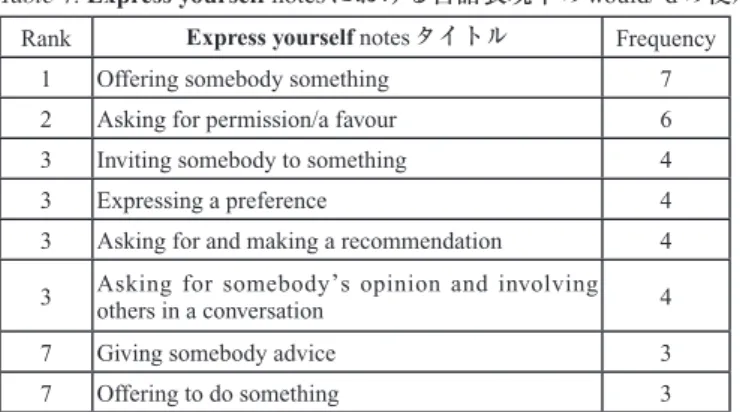
3.2.1 Would (’d含む ) と could は、Express yourself notes の中で、どのような機能 を果たすためによく使用されているかについて見てみよう。Table 4 と Table 5 は、 それぞれ上位10のものをまとめてある。
Table 4: Express yourself notesにおける言語表現中のwould/’dの使用 Rank Express yourself notesタイトル Frequency
1 Offering somebody something 7
2 Asking for permission/a favour 6
3 Inviting somebody to something 4
3 Expressing a preference 4
3 Asking for and making a recommendation 4 3 Asking for somebody’s opinion and involving others in a conversation 4
7 Giving somebody advice 3
7 Disagreeing 3
10 Asking for clarification 2
Table 5: Express yourself notesにおける言語表現中のcouldの使用 Rank Express yourself notesタイトル Frequency
1 Asking for permission/a favour 4
2 Asking for help 3
2 Interrupting 3
2 Leaving a phone message 3
5 Giving somebody advice 1
5 Asking for clarification 1
5 Forbidding somebody to do something 1
5 Asking for information 1
5 Offering somebody something 1
5 Conversation openers 1
Express yourself notes タ イ ト ル を 見 る と、would は、 第 1 位 は、Offering somebody something における7例、第2位がAsking for permission/a favourにおける 6例、could は、第 1 位が Asking for permission/a favour における 4 例、そして、第 2位は、Asking for help、Interrupting、Leaving a phone messageにおけるそれぞれ3 例である。
Tables 4-5から、would、couldは、申し出、依頼、勧誘、意思伝達、提案、反対、 妨害、禁止などの場合に用いられていることが分かる。
3.2.2 次に would と could の Express yourself notes 言語表現例の中の用法を見てみ よう。助動詞の意味に関しては、文脈により、解釈があいまいな場合や、複数の 意味に解釈が可能であることはよく知られているが、Express yourself notesのタ イトル及び、例文からつかむことのできる文脈から意味分析を試みた。意味は Quirk et al. (1985)、Biber et al. (1999)を参考にし、意味を表す日本語は『ジーニア ス英和辞典 第5版』を参考にした。
Table 6: Express yourself notesにおける言語表現中のwould/’dの意味 Meanings Frequency 1 控え目な希望・考え 28 2 丁寧な依頼・勧誘 15 3 可能性・推量 9 4 意思 7 Total 59
Table 7: Express yourself notesにおける言語表現中のcouldの意味
Meanings Frequency 1 丁寧な依頼・提案・命令 12 2 許可(丁寧な表現) 10 3 可能性・推量 2 4 能力(丁寧な表現) 1 Total 25 Tables 6-7は、頻度順に意味を並べてある。Wouldは、第1位「控え目な希望・考え」、 第2位「丁寧な依頼・勧誘」、第3位「可能性・推量」である。第1位、第2位の「控 え目な希望・考え」、「丁寧な依頼・勧誘」には、would/’d like/love to、would/’d like、would you mind if . . . ?、would you like to . . . ?、would you like . . . ?などの表 現が含まれる。Could は、第 1 位「丁寧な依頼・提案・命令」、第 2 位「許可(丁 寧な表現)」、第 3 位「可能性・推量」である。第 1 位、第 2 位の「丁寧な依頼・ 提案・命令」、「許可(丁寧な表現)」には、could you . . . ?、I wonder if you could . . . 、could I . . . ?などの表現が使用されている。どちらの助動詞の場合も、第1 位、第2位には、慣用的な表現が含まれているため、学習者にもなじみのあるも のが多いだろう。しかしながら、wouldとcouldのいずれも第3位の「可能性・推 量」の意味に関しては、日本人英語学習者の使用はどのようであろうか。第3位 の「可能性・推量」の意味は、第1位、第2位の意味の頻度と比較すると、would は9例、couldは2例のように、頻度は高いとは言えないが、これらの助動詞の過 去形を、現在あるいは未来の「可能性・推量」の意味で用いることは、話し手、 書き手の心的態度や確信度を表すのに重要であろう。「可能性・推量」の意味を もつwouldとcouldの用例をいくつか挙げてみよう。
a) That would be very nice, thank you. (a response) [Inviting somebody to something] b) Would it help if I spoke to Julie before you call her? [Offering to do something] c) What do you think would be best? [Asking for and making a recommendation] d) They might/may/could be related. (BrE or formal, NAmE) [Speculating]
『高等学校学習指導要領解説』(英語に関する各科目に共通する内容等 2)の文 法事項の助動詞について、「中学校では慣用表現以外では過去形を指導しないが, 高等学校では必要に応じて過去形も指導する」とある。Express yourself notesの 中でも「可能性・推量」の意味をもつ助動詞の過去形が、言語表現の中で使用さ れていることから、学習者のレベルに配慮しつつも、高校生、大学生に指導をす ることにより、学習者はより効果的な言語表現ができると考える。
4 本稿では、OALD9 で新たに設けられた Express yourself notes の内容と言語表 現について、『高等学校学習指導』の「言語の使用場面」、「言語の働き」、「言語 材料」などの記述に照らしながら分析をした。『高等学校学習指導要領解説』 (英語に関する各科目に共通する内容等 1)の「言語の働きの例」の解説には、 「適切な表現を選択し」とあるが、具体的な表現は提示されていないことから、
Express yourself notesで例示された言語表現を活用することも一つの方法であろ う。さらに、本稿では、『高等学校学習指導要領』(英語に関する各科目に共通す る内容等 2)に記された言語材料の文法事項の中から、助動詞の過去形にフォー カスを絞り、実際のコミュニケーションの中で、心的態度や、確信度を表すこと が求められるため、高等学校及び大学の英語教育において、学習者のレベルも踏 まえながら、助動詞の過去形の指導の必要性について提示した。話し手、書き手 の心的態度や確信度は、助動詞のみならず、副詞、動詞、時制などによっても表 すことができるため、これらも含めたさらに幅広い研究は今後の課題としたい。7
7 Express yourself notesのExpressing certainty or uncertainty、Expressing likelihood、Speculatingは、
本稿では、『高等学校学習指導要領』の「言語の働きの例」のうち、「推論する」に対応させた(Table
今後、語用論や比較文化論などの分野からの知見の導入もますます必要であろう。 Appendix A: 『中学校学習指導要領』「言語の使用場面の例」と「言語の働きの例」 [言語の使用場面の例] a 特有の表現がよく使われる場面 ・ あいさつ ・ 自己紹介 ・ 電話での応答 ・ 買物 ・ 道案内 ・ 旅行 ・ 食事 など b 生徒の身近な暮らしにかかわる場面 ・ 家庭での生活 ・学校での学習や活動・地域の行事 など [言語の働きの例] a コミュニケーションを円滑にする ・ 呼び掛ける ・ 相づちをうつ ・ 聞き直す ・ 繰り返す など b 気持ちを伝える ・ 礼を言う ・ 苦情を言う ・ 褒める ・ 謝る など c 情報を伝える ・ 説明する ・ 報告する ・ 発表する ・ 描写する など d 考えや意図を伝える ・ 申し出る ・ 約束する ・ 意見を言う ・ 賛成する ・ 反対する ・ 承諾する ・ 断る など e 相手の行動を促す ・ 質問する ・ 依頼する ・ 招待する など いはそれらが重ねて用いられた例が挙げられている。
「言語の働きの例」において、下線を付したものは、『中学校学習指導要領』に はあるが、『高等学校学習指導要領』にはないものである。ただし、『中学校学習 指導要領』の「b 気持ちを伝える」の「礼を言う」は、『高等学校学習指導要領』 の「感謝する」に、『中学校学習指導要領』の「e 相手の行動を促す」の「招待する」 は、『高等学校学習指導要領』の「誘う」に関連すると考え、下線を付していない。 Acknowledgements この論文は、科学研究費補助金の交付を受けて行った研究成果の一部である (JSPS KAKENHI Grant Number 25370654)。
References
Anthony, L. 2014. AntConc (Version 3.4.3) [Computer Software]. Tokyo, Japan: Waseda University. Available online at http://www.antlab.sci.waseda.ac.jp/
Bachman, L. 1990. Fundamental Considerations in Language Testing. Oxford: Oxford University Press. Bachman, L. and Palmer, A. 1996. Language Testing in Practice. Oxford: Oxford University Press. Biber, D. et al. 1999. Longman Grammar of Spoken and Written English. Harlow: Pearson Education
Limited.
Byram, M. 1997. Teaching and Assessing Intercultural Communicative Competence. Clevedon: Multilingual Matters.
藤本和子.2007.「Oxford Advanced Learner’s Dictionary of Current English 第 6 版と第 7 版の比較 ―
Usage Notesについて」『英語英文学研究』第31巻2号, 97-111.創価大学英文学会.
村野井 仁 他.2012.『統合的英語科教育法』東京:成美堂.
Quirk, R. et al. 1985. A Comprehensive Grammar of the English Language. Harlow: Longman Group Limited.
『ジーニアス英和辞典 第5版』2014.東京:大修館書店.
Oxford Advanced Learner’s Dictionary of Current English. 8th ed. 2010. Oxford: Oxford University Press.
(OALD8)
Oxford Advanced Learner’s Dictionary of Current English. 9th ed. 2015. Oxford: Oxford University Press.
(OALD9)
『オックスフォード現代英英辞典 第9版』2015.オックスフォード大学出版局編.東京:旺文社.
Oxford 2016 ELT Catalogue. 2015. Oxford: Oxford University Press. The Man Who Made Dictionaries. 2004. Oxford: Oxford University Press.
『中学校学習指導要領』2008.文部科学省.Available at http://www.mext.go.jp/a_menu/shotou/new-cs/youryou/chu/__icsFiles/afieldfile/2010/12/16/121504.pdf (accessed 5 October 2015 ).
『中学校学習指導要領解説 外国語編』2008.文部科学省.Available at http://www.mext.go.jp/ component/a_menu/education/micro_detail/__icsFiles/afieldfile/2011/01/05/1234912_010_1.pdf (accessed 5 October 2015 ).
『 中 学 校 学 習 指 導 要 領 英 訳 版( 仮 訳 )』2010. 文 部 科 学 省.Available at http://www.mext.go.jp/ a_menu/shotou/new-cs/youryou/eiyaku/1298356.htm (accessed 8 October 2015 ).
『高等学校学習指導要領』2009.文部科学省.Available at http://www.mext.go.jp/component/a_menu/ education/micro_detail/__icsFiles/afieldfile/2011/03/30/1304427_002.pdf (accessed 5 October 2015 ). 『高等学校学習指導要領解説 外国語編 英語編』2009.文部科学省.Available at http://www.
mext.go.jp/component/a_menu/education/micro_detail/__icsFiles/afieldfile/2010/01/29/1282000_9.pdf (accessed 5 October 2015 ).
『高等学校学習指導要領英訳版(仮訳)』2010.文部科学省.Available at http://www.mext.go.jp/ a_menu/shotou/new-cs/youryou/eiyaku/1298353.htm (accessed 8 October 2015 ).
Obunsha. 2015. Obunsha Co., Ltd. Available at http://www.obunsha.co.jp/ (accessed 5 October 2015). Oxford Dictionaries. 2015. Oxford University Press. Available at http://www.oxforddictionaries.com/
(accessed 4 October 2015).
Oxford Learner’s Dictionaries. 2015. Oxford University Press. Available at www.oxfordlearnersditionaries. com (accessed 5 October 2015).