表面置換型人工肘関節のショート・ステムと ロング・ステムの比較検討
―
有限要素解析による応力分布の生態力学的研究
―昭和大学医学部整形外科学講座
西川 洋生* 新 妻 学 池 田 純
臼井 勇樹 稲垣 克記
東京工業大学大学院理工学研究科機械制御システム専攻
木 村 仁 伊能 教夫
抄録:人工肘関節全置換術は,関節リウマチ,変形性肘関節症,上腕骨遠位粉砕骨折,強直肘 やその他の肘関節疾患に対して有用かつ効果的な治療方法である.Kudo 人工肘関節は,国内 および欧州で最も使用されている表面置換型人工肘関節であり,その理想的なデザインによ り,良好な長期成績が得られているが他の人工肘関節と同様に,ときに緩みを生じ,再手術を 要することがある.とくに,尺骨コンポーネント先端周囲には上腕骨に比べ約 10 倍の応力が かかっており,cyclic loading により緩みをきたす可能性があることは,われわれの前研究で 報告した.尺骨コンポーネントには 2 つの異なるステム長(ロング・ステム,ショート・ステ ム)があり,多彩な疾患の治療戦略にあたり選択肢が与えられている.人工肘関節に関する 中・長期成績や,合併症に関する報告は散見されるが,異なるステム長のコンポーネントが周 囲組織に及ぼす影響についての報告はこれまでにない.本研究では Kudo 人工肘関節尺骨コン ポーネント周囲にかかる生態力学的な応力分布を,ショート・ステムとロング・ステムついて 比較解析し考察した.前研究では人工肘関節が挿入された状態の肘関節のモデルにおいて,角 度を準静的に変化させ各角度の肢位保持に必要な筋力を計算した.本研究では 3D-CAD ソフ トウェアを用いて 4 面体要素から成る尺骨・尺骨コンポーネント・骨セメントのより詳細な有 限要素モデルを作成し,応力分布を解析した.2 つの異なるステム長(45 mm,65 mm)につき,
各肘関節角度での,周囲組織への最大応力値を比較解析した.結果,すべての条件下で尺骨ス テム先端周囲の海綿骨・骨セメントに最大応力が見られ,臨床的に緩みが起きる部位と一致し ていた.ロング・ステムでは肘関節屈曲 70°,ショート・ステムでは 110°で最大値を示した.
また解析した肘関節屈曲 伸展運動のほとんどすべての角度においてショート・ステムでより 高い最大応力値がみられた.人工肘関節尺骨コンポーネントの選択についてはショート・ステ ムの方が高い応力を生じ緩みに繋がる可能性があり,より至適な設置となるよう注意深い術中 操作が求められると考えられた.
キーワード:表面置換型人工肘関節,有限要素解析,生体力学
緒 言
人工肘関節全置換術は,関節リウマチ,変形性肘 関節症,上腕骨遠位粉砕骨折,強直肘やその他の肘 関節疾患に対して有用かつ効果的な治療方法であ る1‑5).コンポーネントのデザインは大きく結合型 と非結合型の 2 タイプに分類され,基礎疾患や年
齢,骨質,骨欠損の程度,靭帯バランス,関節安定 性等を評価し適切な機種が選択される6).Kudo 人 工肘関節は,国内および欧州で最も使用されている 表面置換型人工肘関節であり,その理想的なデザイ ンにより,良好な長期成績が得られているため,そ の信頼性は高い7‑12).しかしながら,力学的破綻や 緩みなどの長期合併症により,再手術を要する症例 原 著
*
責任著者
も存在する13‑15).インプラントの不適切な選択や設 置は,上腕骨・尺骨コンポーネントの緩みや,尺骨 側ポリエチレンの摩耗のリスクを高める16‑18).無菌 的緩みなどの合併症に関する諸報告では尺骨側に多 く散見され,またわれわれの前研究でも尺骨ステム の先端には,上腕骨に比べておよそ 10 倍の応力が かかることが分かっている11,13).尺骨コンポーネン トには 2 つの異なるステム長(45 mm,65 mm)が あり,多彩な疾患の治療戦略にあたり選択肢が与え られている.本研究では,人工肘関節が挿入された 状態を想定し前研究で確立した筋骨格力学モデルを 改良し,尺骨コンポーネントのショート・ステムと ロング・ステムについて,それぞれの応力状態を有 限要素法にて比較解析し,両ステムの適応と適切な 選択につき考察した.
研 究 方 法 全体の流れ
人工肘関節が挿入された状態の力学モデルを設定 した.有限要素法を用いて,肘関節屈曲 伸展運動 においてショート・ステムおよびロング・ステム尺 骨コンポーネントが周囲に及ぼす応力につき解析し た.
力学モデルの設定と計算
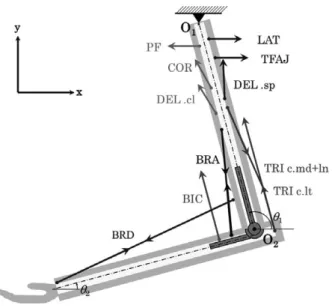
腕の姿勢を維持するためには尺骨,上腕骨のそれ ぞれにおいて各筋力と関節反力による力とモーメン トが釣り合う必要がある.前研究で作成した,物体 を把持した場合の肘関節周囲の応力状態のコン ピューター・シミュレーションによる力学的モデル は主要な筋の作用のみを設定していたが,本研究で は肘関節運動に関与する筋をすべて考慮した力学モ デルへと改良した(Fig. 1).設定した上腕骨側およ び尺骨側の筋肉を Table 1a, b に示す.前腕に付着 している屈曲運動に作用する主な筋肉として上腕 筋,上腕二頭筋,腕橈骨筋があるが,このうち上腕 二頭筋と腕橈骨筋は橈骨に付着している.しかし尺 骨と橈骨は硬い骨間膜でつながれているため,橈骨 の先端を切除した人工肘関節挿入状態においても腕 の屈曲運動時には骨間膜を通じて尺骨に伝達される と想定した.また上腕筋,腕橈骨筋,上腕三頭筋長 頭以外の筋肉の他端は肩周辺に付着しているものと した.設定した力学モデルを上腕骨側,尺骨側に分 け,それぞれの xy 方向について力のつり合いを考
え,モーメントを算出した.上腕骨側は肩関節の中 心 O1周りのモーメント,尺骨側は肘関節の中心 O2
周りのモーメントのつり合いを考えた.上腕骨側の モーメントの中心 O1からの距離を Fig. 2a, b, c に,
尺骨側のモーメントの中心 O2からの骨に水平な方 向の長さ lFiを Fig. 3 のように定義した.n = 2 と して Lagrange の未定乗数法を用いて,筋力の 2 乗 和の最小化を行うことにより腕周りの各筋力および 関節反力の推定を行った.筋力の推定を行うにあた り,力学モデルのパラメーターは文献を基に身長 170 cm 体重 65 kg の一般成人男性を想定して設定 した16).計算に使用した上腕骨・尺骨の長さ,腕の 自重を Table 2a に,筋肉の付着位置および各筋肉 の生理学的筋断面積(physiological cross-sectional area : PCSA)を Table 2b, c に示す.手で把持する 荷重は人工肘関節置換術後の患者が無理なくできる ものとし,1 kgw
≒
10 N とした.手関節は 15°掌 屈で固定とした.有限要素法による応力解析
以上の結果を用いて,コンポーネント周囲の骨組 織に生じる応力解析を行った.3 次元有限要素モデ ル作製ソフトの Pro/ENGINEER(PTC corporate,
Fig. 1 Overview of the musculoskeletal model of the elbow used to examine the mechanical effects of post-elbow prosthesis insertion scenarios
Each muscle force acting on the humerus and forearm
bones was estimated. The muscle forces were balanced so
that no movement occurred in the shoulder or elbow joints
and the arm position was maintained.
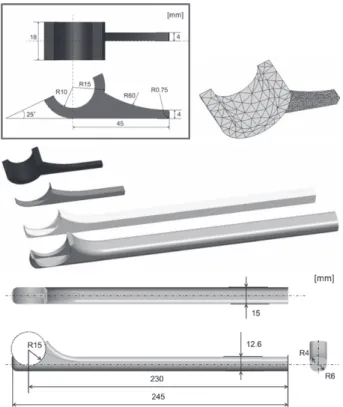
Needham, USA)を用いて有限要素モデルを作製し た.上腕骨,上腕骨用コンポーネント,尺骨,尺骨 用コンポーネントに分けて 4 面体 1 次要素で構成さ れるモデルを作製した(Fig. 4).人工肘関節モデル
は Kudo type 5 の short stem(45 mm) お よ び long stem(65 mm)とし,前研究に比べてより詳 細でインプラントの形状に近いものを使用した.骨 については本研究では当院施設で手術後の関節リウ
Fig. 2 Muscular attachment points of humerus side a : BRA, BRD, TRI c.lt. + TRI c.md.
b : PEC.m, COR, DEL.cl c : LAT, TMAJ, DEL.sp.
Table 1a Muscles acting on humerus
記号 筋肉 Muscle Abbreviation
上腕筋 Brachialis BRA
上腕三頭筋外側頭 上腕筋内側頭 +
Triceps lateral head Triceps medial head +
TRI c.lt.
TRI c.md. +
腕橈骨筋 Brachioradialis BRD
三角筋前方挙上成分 Deltoid clavicularis DEL.cl.
大胸筋主要部 Pectoralis major PEC.m
烏口腕筋 Coracobrachialis COR
三角筋後方挙上成分 Deltoid spinata DEL.sp.
広背筋主要部 Latissimus dorsi LAT
大円筋 Teres major TMAJ
Table 1b Muscles acting on ulna
記号 筋肉 Muscle Abbreviation
上腕筋 Brachialis BRA
上腕二頭筋 Biceps BIC
上腕三頭筋外側頭 上腕筋内側頭 +
Triceps lateral head Triceps medial head +
TRI c.lt.
TRI c.md. + 上腕三頭筋長頭 Triceps long head TRI c.ln.
腕橈骨筋 Brachioradialis BRD
マチ患者の単純 X 線画像から,直径,皮質骨の厚 み,セメントの挿入状態などのパラメーターにつき 平均値を基にデザインした(Fig. 5).41 名 42 肘(男 性 2 名 2 肘, 女 性 39 名 40 肘 ), 平 均 年 齢 62.0 歳
(33 〜 82 歳)の術後早期 X 線画像より尺骨ステム 先端での尺骨径(平均 12.6 mm),前方・後方皮質 骨の厚み(平均 1.67 mm, 2.10 mm)および,先端 から末梢へのセメントの深さ(平均 9.99 mm)を得 た.尺骨幅については X 線画像正面像では正確な 平均値の計測が困難であったため,15 mm に設定
Fig. 3 Muscular attachment points of ulna side
Table 2a Geometrical and mass-inertial characteristics of the upper extremity Upper arm(m
1) Forearm(m
2) Hand
Mass[kg] 1.76 1.05 1.76
Length 240 230 1.73
Location of the gravity
center[mm] 108 98.3 0.40
Central inertial moment
(fontal axis)[kg cm
2] 95.4 51.6 7.68
Table 2b Distance from rotation centre of elbow joint , from central axis of bone and physiological cross-sectional area of muscles
Symbol Abbreviation [mm] [mm] PCSA[cm
2]
BRA 104 10.0 6.2
DEL.cl. 35 10.0 4.5
PEC.m 51 10.0 2.4
COR 69 10.0 6.3
TRI c.lt.
TRI c.md. + 82 10.0 11.5
DEL.sp. 47 10.0 2.8
LAT 60 10.0 9.5
TMAJ 75 10.0 8.6
BRD 153 10.0 1.5
Table 2c Distance from rotation centre of elbow joint , from central axis of bone and physiological cross-sectional area of muscles
Abbreviation [mm] [mm] PCSA[cm
2]
BRA 40 4.6 6.2
BIC 50 7.2 5.3
TRI c.lt.
TRI c.md. + 13 20.0 11.5
TRI c.ln. 13 20.0 5.6
BRD 214 8.0 1.5
した.有限要素モデルを構成する部品のヤング率,
ポアソン比,密度は Table 3 の如く設定した.肘関 節屈曲 伸展運動における各関節角度において,双 方が周囲の骨セメントおよび海綿骨に及ぼす応力に つき解析,比較した.
結 果
尺骨ステムが尺骨軸に水平に,髄腔の中心に設置 された状態では,Fig. 6a, b の如くステム先端部分 の周囲骨セメントおよび海綿骨に生じる応力が変化 した.
最大応力値はロング・ステムでは 70°(骨セメン ト 2.63 MPa,海綿骨 0.86 MPa),ショート・ステム では 110°(骨セメント 3.2 MPa,海綿骨 1.22 MPa)
でみられ,海綿骨・骨セメントいずれにおいても ショート・ステムの方が高い応力値となった.また 30°から 150°にかけての肘関節屈曲 伸展運動にお いてロング・ステムでの最大応力値の変動は約 1.5 倍(範囲:骨セメント 1.78 〜 2.63,海綿骨 0.57 〜 0.86)であるのに対しショート・ステムでは約 1.3 倍から 1.8 倍(範囲:骨セメント 1.78 〜 3.2,海綿 骨 0.92 〜 1.22)であった.
考 察
本研究では表面置換型人工肘関節の術後成績の向 上を目的とし,臨床上の問題点を明らかにするため に確立されたコンピューター・シミュレーションを 用いて,異なるステム長の尺骨コンポーネントにつ き比較検討した.解析した肘関節屈曲 伸展運動に おけるほぼすべての角度において,ショート・ステ ムのほうが高い最大応力を周囲組織に及ぼした.ま たショート・ステム,ロング・ステムともに最大応 力値は常にステム先端周囲の組織に認められ,臨床 現場で実際に緩みを認める位置と一致した11, 14). これまでに人工肘関節そのものにかかる応力を有
Fig. 4 3D finite element models of the Kudo type 5 prosthesis
Models consist of tetrahedral primary elements created using Pro ENGINEER software.
Fig. 5 The model used in the stress analysis
Parameters were determined from plain radiographs of post-TEA patients. Ulna
diameter 12.6 mm, anterior cortex thickness 1.67 mm, posterior cortex thickness
2.10 mm.
限要素法で解析した報告は存在したが20, 21),人体に 挿入された状態での解析はなかった.われわれの前 研究では,実際に人工肘関節を人体に挿入した状態 で関節を動作させた場合の,コンポーネント周囲組 織に生じる応力を解析するという手法を初めて報告 した13).今回われわれは,術後特に問題となる尺骨 コンポーネントの緩みに着目し,有限要素モデルを 実際の Kudo type 5 尺骨コンポーネントおよび関 節リウマチ患者の尺骨に近く,より詳細に作り直し て解析した.また実際には金属と緻密骨が直接接す るのではなく間に骨セメントに加えて海綿骨も介在 するため,これを新たに設定した.人工肘関節に関 する中・長期成績や,合併症に関する報告は散見さ れるが,異なるステム長のコンポーネントが周囲組 織に及ぼす影響についての報告はこれまでにない.
骨温存の観点から,一般的には壮年期の初回人工 肘関節置換術にはショート・ステムが用いられ,ロ ング・ステムは再置換時に大きな骨欠損が生じる場 合などに,より遠位で固定を得るためのステムとし て用いられる.予想に反してショート・ステムの方 が高い最大応力を生じたが,Burr らの骨モデリン
グは 2,000 µε(σ=Eε=10 GPa
×
2,000 µε=20 MPa)から生じるという説を考慮すると22,23),今回の解析 ではそれ程の応力は認めていない.今回の解析では インプラントが至適位置に設置されたと仮定してい ることを考慮すると,設置条件によっては値が大幅 に変わる可能性もある.比較的大きな応力が発生す るショート・ステムでは,より至適な設置となるよ う注意深い術中操作が求められるが,今後はこの至 適な設置についての検証が必要と考えられる.応力 を増強させるさまざまな要因について解析,検証す ることで,ステム長よりも影響を及ぼすものがある とすれば,これを改善させることでショート・ステ ムを安心して使用できる根拠となるであろう.
本研究にはいくつかの制限がある.生理的内外反 は,有限要素法の計算を大幅に煩雑にするため考慮 しなかった.また回転トルクやインプラント設置の 内外反誤差など,応力に影響を与え得るその他の要 素については考慮しておらず,これらの検証につい てはより煩雑な 3 次元的なモデルでの解析が必要で ある.これを実現するためには,CT ベースの骨モ デルと肘関節運動に関与するすべての筋を考慮した
Table 3 Material property Young modulus
[GPa] Poissonʼs ratio Mass density[g/cm
3]
Cortical bone 17.2 0.3 2.3
Cancellous bone 1.1 0.3 1.9
Ulnar component 230 0.321 8.2
Bone cement 2.0 0.3 1.0
Fig. 6 Stress in the structures around the stem-tip during elbow flexion- extension motion
Ulnar component inserted in the centre and parallel to the ulnar shaft.
モデルが必要と考えられる.本研究はコンピュー ター解析であり,その妥当性を実験的に立証するこ とはできなかった.また過去に尺骨ステム長が機械 的破綻にどう関与したかについて報告した文献はな く,間接的検証も困難であった.
将来的には,理想的なデザインとサイズのインプ ラントを,より確実に設置するための術中デバイス 等の開発と,症例ごとの CT ベースの術前計画を駆 使することにより,人工肘関節の長期成績を改善さ せることができるだろう.緩みへ繋がるすべてのリ スク因子とその寄与について更なる研究が必要であ る.そのためには,前述の回転トルクなどを含んだ 3 次元的な解析が必要である.また日常生活におけ るさまざまな運動についても解析し,より明確で理 解し易いガイドラインを作成し,インプラント周囲 組織に過度な応力がかからないよう安全に日々を 送ってもらうことができるだろう.
利益相反
本研究に関連し,開示すべき利益相反関係にある企業 等はない.
文 献
1)Dee R. Total replacement arthroplasty of the elbow for rheumatoid arthritis.
. 1972;54:88‑95.
2)Evans BG, Daniels AU, Serbousek JC, . A comparison of the mechanical designs of articu- lating total elbow prostheses.
1988;3:235‑248.
3)Ewald FC, Simmonds ED Jr, Sullivan JA, . Capitellocondylar total elbow replacement in rheumatoid arthritis. Long-term results.
. 1993;75:498‑507.
4)Levy RN, Volz RG, Kaufer H, . Progress in arthritis surgery. With special reference to the current status of total joint arthroplasty.
. 1985;200:299‑321.
5)Lowe LW, Miller AJ, Allum RL, . The de- velopment of an unconstrained elbow arthro- plasty. A clinical review. . 1984;66:243‑247.
6)Inagaki K. Current concepts of elbow-joint dis- orders and their treatment. . 2013;18:1‑7.
7)Kudo H, Iwano K. Total elbow arthroplasty with a non-constrained surface replacement prosthesis in patients who have rheumatoid ar- thritis. A long-term follow-up study.
. 1990;72:355‑362.
8)Kudo H, Iwano K, Nishino J. Cementless or hy- brid total elbow arthroplasty with titanium- alloy implants. A study of interim clinical re- sults and specific complications. . 1994;9:269‑278.
9)Kudo H, Iwano K, Nishino J. Total elbow ar- throplasty with use of a nonconstrained humer- al component inserted without cement in pa- tients who have rheumatoid arthritis.
. 1999;81:1268‑1280.
10)Little CP, Graham AJ, Karatzas G, . Out- comes of total elbow arthroplasty for rheuma- toid arthritis: comparative study of three im-
plants. . 2005;87:2439‑
2448.
11)Qureshi F, Draviaraj KP, Stanley D. The Kudo 5 total elbow replacement in the treatment of the rheumatoid elbow: results at a minimum of ten years. . 2010;92:1416‑
1421.
12)Tanaka N, Sakahashi H, Ishii S, . Compari- son of two types of ulnar component in type-5 Kudo total elbow arthroplasty in patients with rheumatoid arthritis: a long-term follow-up.
. 2006;88:341‑344.
13)新妻 学,池田 純,西川洋生,ほか.表面置 換型人工肘関節周囲骨組織に生じる各肘関節角 度における生体工学的コンピュータ応力解析.
昭和学士会誌.2015;75:95‑103.
14)Cohen MS, Chen NC. Total elbow arthroplasty.
In , ʼ
. 7th ed. Philadelphia: Elsevier; 2017.
pp905‑920.
15)van der Lugt JC, Rozing PM. Systematic re- view of primary total elbow prostheses used for the rheumatoid elbow. . 2004;23:291‑298.
16)Brinkman JM, de Vos MJ, Eygendaal D. Fail- ure mechanisms in uncemented Kudo type 5 elbow prosthesis in patients with rheumatoid arthritis: 7 of 49 ulnar components revised be- cause of loosening after 2-10 years.
. 2007;78:263‑270.
17)Potter D, Claydon P, Stanley D. Total elbow replacement using the Kudo prosthesis. Clini- cal and radiological review with five-to seven-
year follow-up. .
2003;85:354‑357.
18)van der Heide HJ, de Vos MJ, Brinkman JM,
. Survivorship of the KUDO total elbow pros-
thesis--comparative study of cemented and un-
cemented ulnar components: 89 cases followed
for an average of 6 years. . 2007;78:258‑262.
19)森 於莵,小川鼎三,大内 弘,ほか.上肢骨.
解剖学; 1.改訂第 11 版.東京: 金原出版; 1982.
pp122‑140.
20)Completo A, Pereira J, Fonseca F, . Biome- chanical analysis of total elbow replacement with unlinked iBP prosthesis: an in vitro and finite element analysis. (Bristol, Avon). 2011;26:990‑997.
21)Shih KS, Lu TW, Fu YC, . Biomechanical analysis of nonconstrained and semicon- strained total elbow replacements: a prelimi-
nary report. . 2008;24:103‑110.
22)Burr DB. Orthopedic principles of skeletal growth, modeling and remodelin. In
. Ann Ar- bor: University of Michigan, Center for Human Growth and Development; 1992. pp15‑50.(Cra- niofacial growth series; 27).
23)Vidyasagar L, Apse P. Biological response to dental implant loading/overloading. Implant overloading: empiricism or science?
. 2003;5:83‑89.
A COMPARISON OF BIOMECHANICAL STRESS DISTRIBUTION IN THE SHORT AND LONG STEMS OF UNLINKED TOTAL ELBOW PROSTHESES
BY FINITE ELEMENT ANALYSIS
Hiroki N
ISHIKAWA,
Gaku NIITSUMA
, Jun IKEDA
, Yuki USUI
and Katsunori INAGAKI
Department of Orthopedic Surgery, Showa University School of Medicine
Hitoshi K
IMURA
and Norio INOU
Department of Mechanical Engineering, Tokyo Institute of Technology
Abstract Total elbow arthroplasty is achieving good long-term results due to improvements in implant designs and surgical techniques. However, some cases require revision surgery due to loosening.
The purpose of this study was to compare and evaluate the biomechanical stress distribution within bone tissues and bone cement surrounding the short- and long-stem ulnar components of unlinked total elbow prostheses, and to determine which component is more likely to cause loosening. Quasi-statically changed scenarios of a post-arthroplasty elbow(Kudo elbow)undergoing flexion-extension motion while holding a 1-kg hand weight were generated on a computer. The minimum muscle forces needed to maintain the limb position were determined for each elbow angle. A finite element model of the ulna, ulnar compo- nents and bone cement, consisting of tetrahedral primary elements, was created using 3D-CAD software.
Stress distribution in the ulna was assessed, and the maximum stress that occurred at each elbow angle was compared between the short(45 mm)and long stems(65 mm). Maximum stress occurred at the structures surrounding the stem tips. The highest maximum stresses in the elbow joint during flexion- extension motion occurred at 110 degrees of flexion for the short stem and 70 degrees for the long stem.
The maximum stress was higher in the short stem at all of the elbow angles tested, with the exception of 30 degrees. The distribution of maximum stress in this study was correlated with the site where clinical loosening occurs. This study suggests that the short stem places more stress upon the adjacent struc- tures throughout the flexion-extension motion of the elbow joint and therefore, may lead to loosening.
Key words: surface-replacing elbow arthroplasty, finite element analysis, biomechanics
〔受付:1 月 16 日,受理:2 月 2 日,2017〕
![Table 2c Distance from rotation centre of elbow joint , from central axis of bone and physiological cross-sectional area of muscles Abbreviation [mm] [mm] PCSA[cm 2 ] BRA 40 4.6 6.2 BIC 50 7.2 5.3 TRI c.lt](https://thumb-ap.123doks.com/thumbv2/123deta/7050417.2300027/4.892.159.734.386.525/table-distance-rotation-central-physiological-sectional-muscles-abbreviation.webp)