The current state and problems regarding teacher training in
Japan as seen from the point of view of fostering practical
teaching performance.
Hirofumi MORI
Takashi NAKAI
Seiichiro KIHARA
(Kyoto Womens Junior College) (Nara University of Education) (Hiroshima University)
Abstract
This study aimed to clarify the teacher education status and problems of Japan seen from the point of view of fostering practical teaching abilities based on the results of questionnaires and interviews target-ing teachers of faculty members of traintarget-ing organizations that offer elementary school and Lower Secondary PE teacher education courses.
The results of our questionnaire indicate that the following five points can be presented as future tasks for fostering practical teaching performance through practical training in Japan.
The first challenge is extending the period of student teaching. The second challenge is establishing cooperation between student teaching schools and universities. The third challenge is to solidify an assessment system for student teaching. The fourth challenge is to nurture the instruction abilities of stu-dent teaching school teachers. The last challenge is to hire university teachers who are capable of giving student teachers appropriate instructions and advice.
Keywords : Student teaching, Pre-service teacher training, Practical teaching performance, Questionnaire research
I . Introduction
A lot of educational reform have been taken place in recent Japan and one of the major topics is how to secure the high quality teachers. In fact, the Central Government revised the Law for Licensing Educational Personnel which provides the basic standing point of education as a whole and which had continued for nearly 60 years after the ¥Torld War 2, and the new Fundamental Law of Education launched last year with some revision of LLEP. In particular, The Central Council for Education (2006) made a proposal pointing out the principles, firstly, Enhancement of quality level of teacher training, secondly,
Establishment of graduate school for teaching profession, thirdly, Introduction of teacher license renewal system and also it recommend-ed to the universities to promote to develop the original curriculum for the student who pre-pared for the teaching profession in the future.
The expected quality and the ability for teach-ers depend on the situation, but it is much more important how to raise practical teaching ability (skill) among students. It consists of wide range of experience at student teaching school and the curriculum at the university stage to enable it. In the latter case, all academic mem-ber of the faculty or department are expected to
The current state and problems regarding teacher training in Japan as seen from the point of view of fostering practical teaching performance.
participate to develop such curriculum as much as they can.
However, under the current teacher education system in Japan, the student teaching period is relatively short (for example, it requires only 3 weeks to acquire a Lower Secondary PE teach-ing certificate). Also, it can never be said that the training classes are practical as they are more similar to an educational cram school where the students learn by rote and just listen to their teachers one-sidedly.
IT • Objectives
The purpose of this research is just to know the standard how much classes have been provided which are intended to improvement the practical skills among the students, and also it could be quite helpful for us if we could pick up the cur-rent situation of the quality of education and some points to be resolved in the teacher train-ing courses or department.
ill. Method
We tried to clarify whether reform of curricu-lum and program of student teaching has been taken place in each university and we chose the questionnaire research to the office and the department in such universities.
From this point of view, we actually asked them a lot of questions such as the period and timing when student teaching is undertaken, critical thinking of academic staff against student teach-ing, thirdly, number of classes in which some improvements are recognized to strengthen the practical teaching skill to students as much as possible, finally, as to the assessment and evalu-ation of each class and student teaching.
The procedure of the research is as follows. From the mid June to the first half of this September 2007, the questionnaires were sent to 167 univer-sities that have teacher training courses either for primary school or for teachers of physical
education of junior high or high school. The valid response number was 100 (national and public are 47, private are 53) and its rate was 59. 9% (Chart 1 shows the numbers of teachers' and clerical staff's responses by area.).
Chart 1 : The numbers of teachers' and clerical staff's responses by area
Hokkaido Kanto Chubu Kinki Chugoku Kyushu
and and
Tohoku Shikoku Teachers 7 20 15 19 11 14 Clerical workers 8 22 17 22 12 11
The collected data was statistically analyzed, firstly frequency distribution and secondly, cross tabulation by the difference of providers of such universities (national or private) and of courses either for primary school or secondary school. Test of significance was checked by Chi-square test. In addition, we applied factor analyses to examine the potential awareness of respondents for student teaching programs.
N. Results and Discussion
1 . The current situation and teachers' awareness of on-site training based on student teaching programs
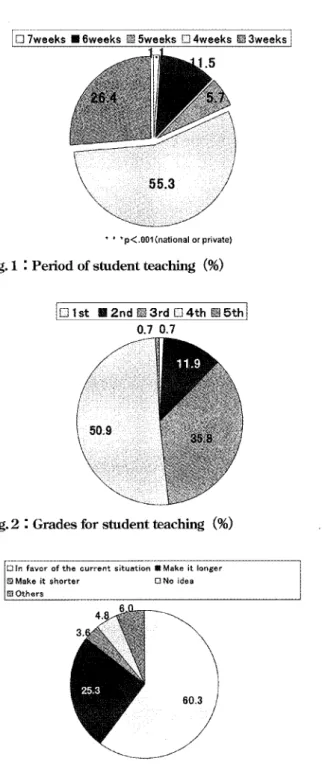
The first topic is as to the fact of student teach-ing in Japan. The Fig1, and Fig.2 shows the result of answers as to the period of student teaching, and the difference of grade in which student teaching is undertaken. You can recog-nize that 4 weeks student teaching is very much accepted among more than half of universities, and nearly 80% support the period between 3 and 4 weeks. The only 1.1% is quite exceptional which has 7 weeks student teaching. This trend differs from the actual situation in US and UK completely. And Fig. 2 tells that more than 50% ask to participate it at 4 th grade and next majori-ty is 3 rd grade. The grade of student teaching depends on the grade proceedings. From the
above, we are able to see that almost all
] apanese universities ask to the student of three
or fourth grade to attend the student teaching of three or four weeks.
What are the ] apanese academic staff likely to think the period and allotted grade? A little bit more than 60% of them support the present state, but opinion of much longer and much earlier is largely supported and they seem to make it more effectively form this result (Fig. 3).
In the Fig. 4 shows the results of any questions, one is as to the general principle to visit to stu-dent teaching school by the university staff. Nearly half of the Universities have the kind of rule to visit any schools, but the rest is going to visit only nearer school and also the schools from which such formal visit is asked.
Next question is as to the job by the university staff to do at the student teaching school. The majority tells us that to observe the class by the students but nearly 15% responses said ceremo-nial visit that they are likely to meet the head teacher or the other staff concerned.
Third question is the actual relation between schools and the university. We can recognize that about 60% has not any particular cooperative relation with the student teaching school, and only 4.9% universities have the regular contact with them.
Last question of these matters is as to the actu-al personactu-al relation between university staff and the teachers of such schools. Only 8. 5% reply that there are close contacts. On the contrary, more than the half belongs to the sector of "Nothing" and "Almost nothing" is shown.
From these 4 results, we are able to think that there are not any positive and close relation between university and student teaching school. And of course same with teachers and academic
staff.
• • 'p<.001 (national or private)
Fig. 1 : Period of student teaching (%)
lo
1st IIIII 2nd !!l3rd 0 4th I! 5thI
0.7 0.7Fig. 2 : Grades for student teaching (%)
0 In favor of the current situation II Make it longer 19 Make it shorter D No idea Ill Others
60.3
Fig. 3 : Teachers' awareness of the duration of student teaching (%)
Almost nothing (36.6)
0 50 100(%)
Fig. 4 : About student teaching (principle, job, coop eration etc.)
The current state and problems regarding teacher training in Japan as seen from the point of view of fostering practical teaching performance.
2 . Teacher instructions and assessments with a focus on nurturing teaching abil ities through practical training
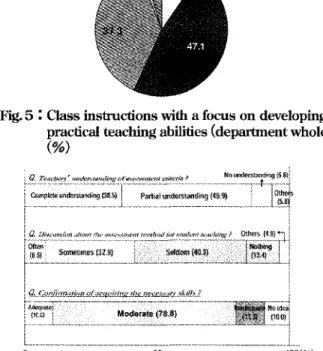
The next topic relates to some attempt to improve the quality of class instructions at uni-versity. Fig. 5 tells the degree of trial to raise the practical teaching skill among students, and we are able to know that the only 9. 6% universities make the effort to do that as a whole. The rest is not organized implementation. We can recog-nize the trend that such attempt is held by a small portion of the university staff. From Fig. 5, many university staff is likely to know its impor-tance, but there is quite rare case to undertake to improve by the effort by department or faculty
(organized effort) .
The next topic is about the assessment and evaluation of student teaching and class instruc-tion. The fig. 6 shows the results concerning with them. First, the general trend as to how far the academic staffs understand criteria and measuring procedure of student teaching. Less than 40% staff understand them completely and on the contrary we can observe that the rest does no or partial understanding, surprisingly.
Second, the percentage of the answer which agrees the fact of discussion of the criteria and method of student teaching was below to 10% and we can find that the majority of the universi-ty has not discussed this topic so frequently so far. Third graph points out the result of research how far the confirmation of acquiring the neces-sary skills and abilities. The only 10% agree that they are sufficient, and at the same time the majority belong to the answer of "moderate".
From these results we can point out that the academic staff as a whole are not so positive atti-tude to improve the criteria and method of stu-dent teaching.
0 1.0rganizad implementation 11112.Frequent implementation ll3.Partial implementation 0 4.No implementation ll5.0thers
Fig. 5 : Class instructions with a focus on developing practical teaching abilities (department whole) (%)
I Complete understanding (38.5) Partial understanding (49.9)
0 50 100(%)
Fig. 6 : About the evaluation and assessment concern ing student teaching and class instruction
3 . Survey results by cross-tabulations and Teachers' awareness of student teaching programs
Cross-tabulations based on the variable "national and public or private" obtained a level of significance with regard to the following ques-tion items.
First, regarding the duration of student teach-ing programs, national and public universities had longer programs than private universities
( X2 = 22. 829, D.f. =4, p<. 001). A level of sig-nificance was also observed between national and public universities, and private universities, with respect to program schools, attached schools, alma mater or cooperative schools
( X2 = 19.972, D.f. =4, p<. 001). In addition,
regarding the method used to decide on pro-gram schools, private universities were found to be more aggressive than national and public uni-versities about deciding on program schools on their own initiative ( X2 = 15. 582, D .f. = 1,
p<.
001).Incidentally, We were able to know any con-tents and duration of practical training by this survey.
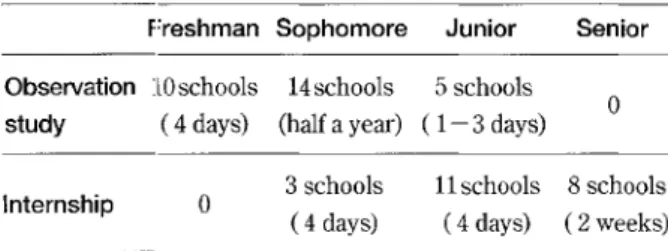
Chart 2 ~;hows the contents and duration of practical training other than student teaching programs
Chart 2 : nu~ contents and duration of practical training
Freshman Sophomore Junior Senior
Observation :lOschools 14schools 5 schools
study ( 4 days) (half a year) ( 1-3 days) 0
Internship 0 3 schools
( 4 days)
11 schools 8 schools
( 4 days) ( 2 weeks)
In the chart 2 shows the results of the contents and duration of practical training
Observation study except Student teaching and Internship are executed at each of 29 universi-ties and 22 universiuniversi-ties.
The grade executed Observation study and Internship are each of 1 ~ 3 rd grade and 2 ~ 4 th grade.
From these results we comprehend that few universities in Japan execute the practical train-ing. However the current state regarding the contents and duration of practical training in
Fig. 7 Rate of each answer
Japan is less rich than US and UK
4 . Teachers' awareness of student teach ing programs
Question < 2 >®to teachers: What ability do you think student teaching programs help stu-dent teachers to nurture most? Circle your most likely choice for each item. (The choices are A 1. Sure, A 2. Positive, A 3. Less positive, A 4. Negative and A 5. No comment.)
Q 1 ) A sense of mission and pride as a teacher Q 2) Understanding of students' development Q 3 ) Educational affection for students
Q 4 ) Specialized knowledge about textbooks and other educational matters
Q 5 ) Extensive and rich knowledge Q 6 ) Practical teaching skills Q 7 ) Group instruction abilities Q 8 ) Class organization abilities
Q 9 ) Ability to conduct effective learning instruction and devise good class schemes QlO) Ability to closely examine teaching mate
rials
Qll) Rich humanity and social skills Q12) Ability to build good relations Q13) Communication ability
0 1.Sure Ill 2.Positive 0 3.Less positive 0 4.Negative • 5.No coment
Q.1 Q.3 Q.5 Q.7 Q.9 Q.11 !-' Q.13 JO! /0 -~---~---~---20% 40% 60% 80%
..
-
I-..
I..
1-
100%The clllTent state and problems regarding teacher training in Japan as seen from the point of view of fostering practical teaching performance.
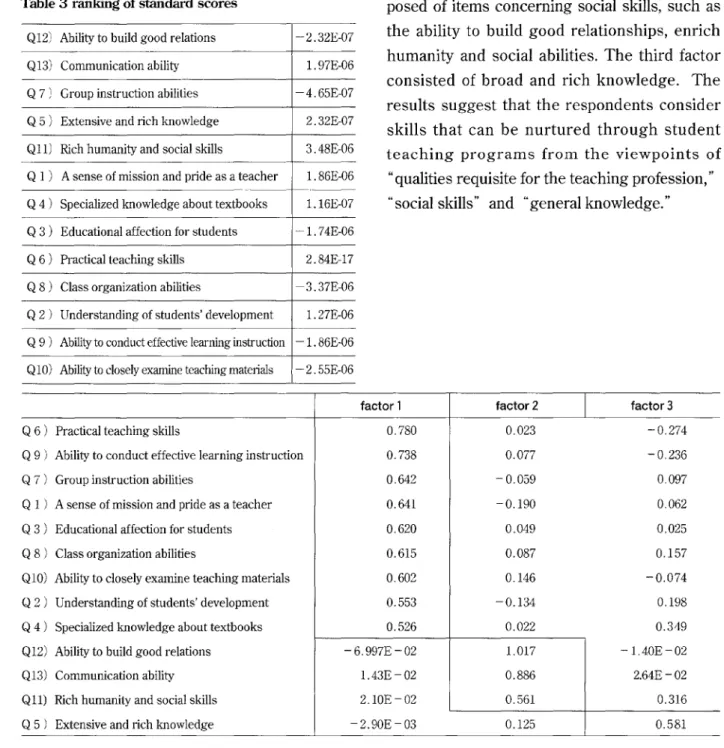
Figure 7 illustrates the results of simple tabula-tions. The figure suggests that many respon-dents consider student teaching programs to be helpful in developing the abilities described in Questions 1, 3 and 6. Conversely, they do not believe the programs will help them improve the skills described in Questions 5, 8 and 11. Table 3 shows the rankings of standard scores obtained on the basis of the overall tendency of the answers of respondents to question items.
Table 3 ranking of standard scores
Q12) Ability to build good relations -2.32E-07
Q13) Communication ability 1.97E-06 Q7) Group instruction abilities -4.65E-07 Q5) Extensive and rich knowledge 2.32E-07 Qll) Rich humanity and social skills 3.48E-06 Q 1) A sense of mission and pride as a teacher 1.86E-06 Q4) Specialized knowledge about textbooks 1.16E-07 Q 3) Educational affection for students -1. 74E-06 Q 6) Practical teaching skills 2. 84E-17 QS) Class organization abilities -3.37E-06 Q 2) Understanding of students' development 1.27E-06 Q 9 ) Ability to conduct effective learning instruction -1.86E-06
Q 10) Ability to closely examine teaching materials -2.55E-06
Q 6 ) Practical teaching skills
Q 9 ) Ability to conduct effective learning instruction Q 7 ) Group instruction abilities
Q 1 ) A sense of mission and pride as a teacher Q 3) Educational affection for students QS) Class organization abilities
Q10) Ability to closely examine teaching materials Q2) Understanding of students' development Q 4) Specialized knowledge about textbooks
5 . Results of factor analyses
Factor analyses (the maximum likelihood method and promax rotation) were conducted to examine the potential awareness of respon-dents with regard to skills they believe they can develop through student teaching programs. Table 4 itemizes three factors that were
extract-ed. The first factor consisted of items closely related to the teaching profession, such as prac-tical teaching skills, learning instructions and class organization. The second factor was com-posed of items concerning social skills, such as the ability to build good relationships, enrich humanity and social abilities. The third factor consisted of broad and rich knowledge. The results suggest that the respondents consider skills that can be nurtured through student
teaching programs from the viewpoints of
"qualities requisite for the teaching profession," "social skills" and "general knowledge."
factor 1 factor 2 factor 3
0.780 0.023 -0.274 0.738 0.077 -0.236 0.642 -0.059 0.097 0.641 -0.190 0.062 0.620 0.049 0.025 0.615 0.087 0.157 0.602 0.146 -0.074 0.553 -0.134 0.198 0.526 0.022 0.349
Q12) Ability to build good relations -6.997E-02 1.017 -1.40E-02
Q13) Communication ability 1.43E-02 0.886 2.64E-02
Qll) Rich humanity and social skills 2.10E-02 0.561 0.316
V. Conclusion
The results of our questionnaire indicate that the following five points can be presented as future tasks for developing practical teaching abilities through practical training in Japan.
The first challenge is extending the period of student teaching. Needless to say, student teaching program is most effective for boosting practical teaching abilities through practical training. The current period of three to four weeks is too short.
The second challenge is establishing coopera-tion between student teaching schools and uni-versities. Currently, the teachers at student teaching schools instructions to student teach-ers, while university teachers give only ceremo-nial visits to the schools. It is essential as a future task for the school and university teach-ers to develop close relationships on a constant basis and cooperate in instructing student teach-ers.
The third challenge is to solidify an assessment system for student teaching. Currently, a pri-mary focus is placed on the evaluation of the final stage at the end of student teaching and practical training at university, which means that a valid assessment is virtually nonexistent to examine how much of the necessary abilities student teachers acquire during the process of student teaching and on-site class instructions. In order to help student teachers acquire practi-cal teaching abilities, it is indispensable to con-duct assessments as needed and consistently make the necessary modifications on their per-formance.
The fomth challenge is to nurture the instruc-tion abilities of student teaching school teachers. Currently, Teachers of student teaching school are not given the necessary special training for instructing: student teachers. However, to pro-mote more effective student teaching programs, it is vital for teachers of student teaching school
to have special training to develop the necessary knowledge and skills for instructing student teachers.
The fifth challenge is to hire university teach-ers who are capable of giving student teachteach-ers appropriate instructions and advice. Currently, many university teachers find it challenging to instruct student teachers despite their excel-lence in individual specialties as professional researchers. In response to this situation, it is necessary to secure people with rich on-site teaching experience as the staff for student teaching or to launch study programs for facili-tating university teachers acquiring practical skills.
In order to tackle these five challenges, it is essential to reform teacher training "institu-tions," such as the revision of the Law for licensing Educational Personnel, and to establish a solid system to guarantee the "quality" of the whole teacher training curriculums.
Reference
The Central Council for Education (2006) About the Ideal Method of The Future Teacher Pre-Service Training I License System (in Japanese)
http:/ /www.mext.go.jp/b_menu/shingi/c hukyo/ chukyo0/toushin/06071910.htm Takashi NAKAI (2006) Standards and Reformation
for Physical Education Teacher Education in Japan, NASPE PETE Conference. Long Beach,CA, USA
Takashi NAKAI & Michael W. Metzler (2005) Standards and Practice for K- 12 Physical Education in Japan. Journal of Physical Education, Recreation & Dance 76 (7): 17-22.
Seiichiro KIHARA (2006) The Trend of Current Initial Teacher Training in Japan, International Symposium to Establish an Education Community in Asia,. Cheongwonkun, KOREA Gendaikyosyokukenkyukai (1999) Study on
con-tinuity of teacher education. (in Jpanese) Shizumasa Fujieda (2003) Study on basic theory
The current state and problems regarcling teacher仕aininginJ apan as seen企omthe point of view of fostering practical teaching performance. │ 教 員 用 │ く 1>教員に必要とされる実践的指導力の育成 に関連してお尋ねします。 ①近年,教員養成段階において,実践的指導力 の育成が課題のーっとされていますが,あな たは,教員養成段階において実践的指導力を 育成することは重要だと思いますか。最も近 いと思われる回答番号を
O
で囲んでください。 1.とても重要だと思う 2.かなり重要だと思う 3.少しは重要だと思う 4.まったく重要だと思わない 5.わからない ②貴学の教職課程では,実践的指導力の育成を 意図した授業が実施されていると思いますか。 最も近いと思われる回答番号をO
で囲んでく ださい。 1.組織的な取り組み(学科聞や専攻間での 内容の整合性や連続性などを図ること)を 通して,実践的指導力の育成が図られてい ると思う。 2.多くの教員が実践的指導力の育成を意図 した授業を実践していると思う。 3.一部の教員は実践的指導力の育成を意図 した授業を実践していると思う。4
.
実践的指導力の育成を意図した授業を実 践している教員はいないと思う。5
.
わからない 6.そ の 他 ( ③保健体育関連授業科目では,実践的指導力の 育成を意図した授業が実施されていると思い ますか。最も近いと思われる回答番号をO
で 囲んでください。 1.組織的な取り組み(保健体育関連科目担 当者間での内容の整合性や連続性などを図 ること)を通して,実践的指導力の育成が 図られていると思う。 2.多くの保健体育関連科目担当教員が実践 的指導力の育成を意図した授業を実践して いると思う。 3.一部の保健体育関連科目担当教員は実践 的指導力の育成を意図した授業を実践して いると思う。 4.実践的指導力の育成を意図した授業を実 践している教員はいないと思う。 5.わからない 6.そ の 他 ( ④上記③で,1
.
または2
.
または3
.
と答え た方にお尋ねします。 学生がその実践的指導力をどの程度身につけ たかをアセスメン卜(チェック・確認)する 具体的な基準・方法はありますか。最も近い と思われる回答番号をO
で囲んでください。 1 .保健体育関連科目担当者間で統ーした基 準を設けて,合議によりアセスメントして いる。 2.保健体育関連科目担当者間で統ーした基 準はないが,教員個々の基準でアセスメン トしている。 3.実践的指導力のアセスメントについては 今後の課題である。4
.
そ の 他 ( ⑤あなたは,実践的指導力の育成を意図した授 業を実践していますか。最も近いと思われる 回答番号をO
で囲んでください。 1 .よくしている 2. ときどきしている 3.ほとんどしてない4
.
まったくしていない ⑥上記⑤で, 1.または 2. と答えた方にお尋 ねします。 実践的指導力の育成のために,どのような取 り組みをされていますか仁コに具体的に書い てください。 ⑦上記⑤で, 1.または2.と答えた方にお尋 ねします。 あなたの授業で学生が実践的指導力をどの程 度身につけたかをアセスメント(チェック・ 確認)する具体的な基準・方法はありますか。 最も近いと思われる回答番号をO
で囲んでく ださい。発 達 教 育 学 部 紀 要 1 .ある 2.なしh 3.どちらともいえない
4
.
そのイ也( く2>
教育実習の実施形態に関連してお尋ねし ます。 ①貴学の教育実習の期間(時間)について,ど のようにお考えですか。最も近いと思われる 回答番号をO
で囲んでください。 1 .現状でよい 2. もう少し長い期間が必要である 3. もう少し短い期間でよい 4.わからない 5.そ の 他 ( ②貴学の教育実習の実施時期はいつですか。 ( )に実施学年を記入してください。ま たその実施時期についてどのようにお考えで すか。最も近いと思われる回答番号をO
で囲 んでください。 実 施 学 年 → ( )年※複数学年で 実施の場合はすべての学年を記入してくだ さい。 1 .現状でよい 2.実施学年を早くした方がよい 3.実施学年を遅くした方がよい4
.
わからない 5.そのイ也( ③貴学では教育実習の巡回(訪問)指導時に教 職員はどのような活動を行っていますか。最 も多いと思われる回答番号をO
で囲んでくだ さい。 1 .実習校への儀礼的な挨拶をする 2.実習生の授業を参観する 3.実習生へ指導を行う(研究討議会や反省 会への参加を含む) 4.そ の 他 ( ④貴学と実習校との協力体制(打合せ,研究会, 研修会等)について,最も近いと思われる回 答番号をO
で囲んでください。 1 .実習中に訪問する程度で実質的な協力体 制はない 2.授業研究会や研究発表会での協力体制が ある 3.授業研究会や研究発表会にとどまらず, カリキュラム開発や教材研究など日常的な 協力体制がある4
.
そ の 他 ( ⑤あなたは教育実習が大学での教員養成におい て重要な活動であると思いますか。最も近い と思われる回答番号をO
で囲んでください。 1 .重要だ 2.ある程度重要だ 3.あまり重要でない4
.
重要でない 5. どちらともいえない ⑥あなたは教育実習でどのような資質能力が身 につくと思いますか。以下の項目ごとにあな たの考えに最も近い回答番号をO
で囲んでく ださい。 選 択 肢 : し そ う 思 う 2.ある程度そう思う 3.あまりそう思わない 4.そう思わない 5.どちらともいえない 1 )教員としての使命感や誇り 2 )児童・生徒の発達についての理解 3 )児童・生徒への教育的愛情や責任感 4 )教科等に関する専門的知識 5 )広く豊かな教養 6 )実践的指導力 7 )集団指導の力 8 )学級づくりの力 9 )学習指導・授業づくりの力 10)教材解釈の力 11)豊かな人間性や社会性 12)対人関係能力 13) コミュニケーション能力 く3>
教育実習の評価に関連してお尋ねします。 ①貴学では,実習生の評価基準はどのように決 めていますか。最も近いと思われる回答番号 をO
で囲んでください。 1 .教職課程委員会で決めている 2.教育実習担当者が決めている 3.所属学科・専攻の教員が決めている4
.
統ーした基準はなく個々の教員が決めて いるThecほTentstate and problems regarding teacher training in Japan as seen企om血epoint of view ofif凶teringpracせ.calt回chingperformance. 5.実習校の評価基準に準じている 6.そ の 他 ( ②上記①で, 1.または2. または3. と答え た方にお尋ねします。 決められた基準は全教員に共通理解されてい ますか。最も近いと思われる回答番号を
O
で 囲んでください。 1.全教員に共通理解されている 2.あまり共通理解されていない 3.全く共通理解されていない4
.
そ の 他 ( ③あなたの所属する学科や専攻で,教育実習の 評価のあり方についてどの程度議論したこと がありますか。 1.よく議論している 2.ときどき議論している 3.ほとんど議論していない 4.全く議論したことがない 5.そ の 他 ( ④上記③で, 1. または2. と答えた方にお尋 ねします。 議論した結果,それまでの評価基準が改正さ れたことはありますか。 1.ある 2.ない 3.そ の 他 ( ⑤実習生を評価するにあたって,実習校の指導 教員と大学の教員が意見交換等をすることは ありますか。該当する回答番号をO
で囲んで ください。 1.全くない 2.ほとんどない 3.ときどきある 4.よくある 5.そ の 他 ( ⑥貴学では,実習校の指導教員に対して実習生 の評価基準を示していますか。該当する回答 番号をO
で囲んでください。 1.示している 2.示していない 3.わからない 4.そ の 他 ( ⑦貴学では,実習校の指導教員に対して実習生 の評価方法を示していますか。該当する回答 番号をO
で囲んでください。 1 .示している 2.示していない 3.わからない 4.そ の 他 ( ⑧上記⑥⑦の評価基準・方法はどのようにして 実習校に伝達されていますか。該当する回答 番号をO
で囲んでください。 1 .直接訪問(含;電話)して伝達している 2.実習日誌とは別に用意した文書によって 伝達している 3.特に伝達することはない 4.そ の 他 ( ⑨貴学では教育実習の評価はどのように行って いますか。該当する回答番号すべてをO
で囲 んでください。 1.教職課程委員会が行っている 2.教職課程担当者が分担して行っている 3.教育実習の担当者が行っている4
.
ゼミ・卒論の指導教員が行っている 5.所属学科・専攻の教員が行っている 6.所定の基準により実質的には事務担当者 が行っている 7.実習校からの評価をそのまま記入している 8.そ の 他 ( ⑩貴学の評価基準で,実習生が教育実習でねら いとする資質能力を,どの程度身につけたか を捉えることができると思いますか。最も近 いと思われる回答番号をO
で囲んでください。 1 .十分できる 2.少しはできる 3.あまりできない 4.わからない ⑪貴学の教育実習について, 1 )現状のままでよ いと思われる点, 2 )今後,改善をすべきだと 思われる点,があれば仁コにお書きください。発 達 教 育 学 部 紀 要 く
1>
貴学の教職課程に関連してお尋ねします。 ①貴学で取得できる教員免許状の種別について, 該当するすべての番号をO
で囲んでください (専修,一種,ニ種の別は聞いません)。 1 .小学校教諭免許 2.中学校教諭免許(保健体育) 3.高等学校教諭免許(保健体育) ②貴学の教職課程はいつごろ開設されましたか。 設置している免許課程の質問に対して,該当 する回答番号をO
で囲んでください。 ③貴学が教職課程に開設している小学校体育 (中・高保健体育)科に関連する科目の現状 について,次表に必要事項(科目名,科目種 別,学年,必修・選択の別,単位数,授業回 数,該当免許)をご記入ください。 く2>
貴学における実地教育に関連してお尋ね します。 ①教育実習の期間は次のどれに該当しますか。 該当する回答番号をO
で囲んでください。な お,複数の教免課程(小中,中高,小中高) を設置されている場合は,いずれか 1つの免 許だけを取得する場合の実習期間をお答えく ださい。 ※複数回に分けて実施する場合は,合算した 期間でお答えください。 1 .三週間以下 2.四週間 3.五週間 4.六週間 5.七週間 6.八週間 7.九週間以上 ②教育実習校は次のどれに該当しますか。該当 する回答番号をO
で囲んでください。 1 .附属校で行う 2.出身校で行う 3.協力校で行う 4.附属校と出身校で行う 5.附属校と協力校で行う 6.出身校と協力校で行う 7.附属校と出身校と協力校で行う 8. その他( ③教育実習校はどのように決定されますか。該 当する回答番号をO
で囲んでください。 1 .大学が決定し学生に配分する 2.教育委員会が決定し大学に通知する 3.大学の指導のもとに,学生が学校と交渉 して決定する 4. 1と2の併用 5. 1と3の併用 6. 2と3の併用 7.その他( ④下表の該当する欄にその期間を数字で記入し てください(例:2週間, 5日間など)。なお, 記載事項以外に実地教育を実施されている場 合は,空欄に名称、を書き加えて記入してくだ さい。なお,複数の教免課程を設置されてい る場合は,お手数ですがそれぞれの課程につ いて個別にご回答ください。 ⑤教育実習校への巡回(訪問)指導の一般的原 則について,該当する回答番号をO
で囲んで ください。 1 .全員について行う 2.大学近隣校について行う 3.実習校から要望されれば行う 4.特定の教科に限り行う 5 .行かない 6. ( ⑥巡回(訪問)指導は,原則として,どのよう な教職員が行っていますか。該当する回答番 号をO
で囲んでください。 1 .すべての教員 2.学生の所属する学科や専攻の教員 3.ゼミ・卒論の指導教員 4.教職課程を担当する教員 5.教職課程を担当する事務職員 6. そのイ也( ⑦事前指導の実施形態について,該当する回答 番号をO
で囲んでください。 1 .通常授業として,時間割に位置づけてThe CillTent s匂teand problems regarcling teacher仕ainingin ]apan as seen企'Om出epoint of view of fostering practical teaching performance. 行っている 2.集中講義形式で、行っている 3.オリエンテーションとして行っている 4.特に行っていない 5.そ の 他 ( ⑧事前指導の担当者はどなたですか。該当する 回答番号すべてを
O
で囲んでください。 1.学生の所属する学科・専攻の教員 2.教職関係科目担当教員 3.教育実習担当教員4
.
附属校の教員 5.学外の講師 6.大学の事務担当者 7.そ の 他 ( ⑨事前指導の実施内容について,該当する回答 番号すべてをO
で囲んでください。 1.実習の一般的ガイダンス(意義,注意事項 等) 2.附属校等の協力を得ての授業観察や学校 見学 3.現職小中学校教員による講演4
.
先輩学生の体験談 5.指導案の作成方法 6.実習日誌の記入方法 7.そ の 他 ( ⑩事後指導の実施形態について,該当する回答 番号をO
で囲んでください。 1.通常授業として,時間割に位置づけて実 施している 2. 日時を特定して実施している 3.個別に実施している 4.特に行っていない 5.そ の 他 ( ⑪事後指導の担当者はどなたですか。該当する 回答番号すべてをO
で囲んでください。 1.学生の所属する学科・専攻の教員 2.教職関係科目担当教員 3.教育実習担当教員 4.附属校の教員 5.学外の講師 6.大学の事務担当者 7.そのf
也 ( ⑫教育実習の手引き(含;実習日誌)等は作成 されていますか。該当する番号をO
で囲んで ください。また,1
1
.
はい」と回答された 方は,つづく質問にもお答えください。 1 .はい→どなたが中心になって作成してい ますか。最も近い香号をO
で囲んでくださ し¥0 1 )教育実習担当者 2 )教職課程担当者 3 )学科・専攻の教員 4 )教職担当事務担当者 5 ) そ の 他 ( 2.いいえ ⑮教育実習の手引き(含;実習日誌)はどのよ うな内容ですか。該当する回答番号すべてをO
で囲んでください。 1 .実習の意義や心得が書かれている 2. 実習の目的や内容が書かれている 3.実習のスケジュールが書かれている 4.実習生を評価する基準・方法が書かれて いる 5.教育基本法や教免法等の法令が書かれて いる 6.実習生の実施授業時間数のめやすが書か れている 7.実習生を評価するためのチェックリスト や授業評価シートなどの資料が添付されて いる 8.指導教員のコメント欄がある 9.実習生の自己評価欄がある 10.そ の 他 ( ⑩貴学の実地教育に関連して,問題だと感じて おられる点,改善を望まれる点などがありま したら,自由にお書きください。発 達 教 育 学 部 紀 要 6 5 4 3 2 27 24 <3>①評価基準 図 崎 番 無 回 答 1 ②共通理解 回答番 無回答 1 教員回答 く1>任痩蹴備導力の重要性 回答番号 ~ 1 2 3 4
。
5 32 46 4 3 2 3 26 5 4 4 11 3 35 2 27 3 4 2 15 5 6 4 3 -一 一 泊 2 31 4 3 8 4 4 3 8 4 3 2 16 14 41 7 24 6 5 4 3 目 お。
2 19 2 32 34 20 q瀞価離論 回 答 番 無 回 答 1 嘩湛準改正 回 答 議 無 回 答 1 49 18e
意見交換 回答番 無沼答 1 2 15 喧瀞価基準 回 答 番 銀 閣 答 1 3 5 1 d瀞価方法 回答替 無回答 1 2 4 0 ⑧伝達方法 回 答 番 無 回 答 1 11 4e
痩 鶴 湘 回答番 1 2 骨資賞能力 回答番 無関犠 1 4 8 6 4 3 6 5 4 3 詰問 2 2 4 3 31 2 43 4 0 3 2 11 4 3 5 3 4 22。
4 31 39 49 31 3 2ロ 26 2 ロロ= 19 4 3 2 1 10 @根業実襲:体育科 回答番号。
1 - ヰ = 2 12 ④アセスtント基準 回答番号 o 1 喧輝業実践蛇兄 回答番号 鮒自答 1 1 43 ⑦アセスメント基準 回答番号 網野答 1 く2>CI演習期間 回答番号 無百熔 1 ②-1賓館学年 回答番号 1 26 4 3 70 49 4 3 3 2 13 2 4 国 8 3 = 9 2 = 57 事務担当者回答 <2><1演習期間 回答番号 1 7 =。
食 u v 一 一 n u 5 4 12 3 5 2 Z 51 5 Z 4 4 3 E 31 2 39 10 告演習校 問答番号 1 8 3 7 6 回 目 5 官 21 4 7 3 怠 2 26 17 7 8 6 6 6 22 6 17 5 4 22 54 4 28 3 28 1 48 5 14 5 2 3 27 4Z 刊 M 4 2 出 俗 5 出 1 7 2 一2 一q 三 5 一 1 一 2 一 2 一 1 一 2 一 5 一 2 一 3 3 20 3 = 16 4 12 2 国 5 2 25 4 出 1 -2 一 O 一 4 一 日 一 O 一 2 一 6 一 O 一 2 一 5 一 2 一 1 告瀧定方法 回答番号 1 告灘囲原則 回答毎号 1 45 ⑥巡回教員 回答醤号 1 d膿施形態 回答番号 1 3zt 一 9 一 5 一 均 一 お 一 2 一 同 一 犯 一 叩 一 時 一 幻 一 行 一 位 2 一 三 引 一 拍 一 特 一 組 一 部 一 白 一 回 一 引 一 回 一 回 一 朝 一 日 一 拍 1 一 ぬ 一 部 一 泊 一 行 一 8 一 幻 一 間 一 5 一 回 一 ロ 一 8 一 均 一 ゆ 9 15 ②-2劃 師 繍 回答番号 網目崎 5 @激員活動 回答番号 1 16 ④協力体制 回答番号 鮒E答 2 ⑤重要性 回答番号 無@答 ⑥資質能力 回答番号 無回答 使命感 2 発達理解 O 愛情責任 O 専門知識 1 広豊教養 O 実 関 鵠 O 集団指導 O 学級づくり O 授業づくり O 教材解釈 O 人間社会 1 対人関係 O コミュニケ‘ンヨン 2 2 2 53 3 4 2 20 5 4。
3 19 2 26 52The current state and problems regarding teacher training in Japan as seen from出epoint of view of fostering practical teaching performance. 告滞前指耕一当者 回答番号 1 2 18 41 ⑨事前指導肉容 回答番号 1 2 87 33 ⑩事後指導形態 回答番号 1 2 31 47 @晴後指導担当者 回答番号 1 2 26 32 ⑫ー 1手引き作成 いL