The Japanese Psychonomic Society
NII-Electronic Library Service
The JapanesePsychonomic Society
The1inPanese.tou・rnatofPkychonomicScience
201e,VoL 29,No.1,Sl-82
Summary
ofAwardedPresentation6-114
Suppression
of
patterndetection
inapparent
motion
trajectory
Souta
HiDAKA*'#,
Masayoshi
NAGAI**,
Allison
B.
SEKuLER***,
Patrick
J.
BENNETT***,
andJiro
GyoBA*
7bhohu
University*,IVdtionalfnstituteofAdvanced
IndustrialScienceand
7]echnotogy:
(AJST}**,
andMcMaster
U)iiversily***
Letterdiscriminationisirnpairedwhen theletter
is
presented within an apparent motion(AecO
trajectoryof a spoL
This
finding
$uggests that the internalrepresentation of AM stimuli caninterferewith
perception
at a relatively high processing level.Here,we investigated whether AMinterferencealso occurs at an earlier processing
Ievel.
We
found
that thedetection
threshold ofpatterns
defined
by
aluminance
dimension
wasimpaired
in
anAM
trajectory. Further, thissuppressive effect of AM
became
weaker when the contrast polarity,orientation, or shape of theinducers of the AM and thetargetwas
inconsistent,
These
findings
suggest thatAM stimuli andtheirinternalrepresentation affect early visual processes involved indetectinga pattern and that
the internalrepresentation of an
AM
stimulus reflects thestimulus's attribute.Key
words: apparent motion, internalrepresentation, pattern detection,contrast polarity,
tien,
shapeln
an apparent motion (AM) display,illusorymo-tionperception vividly occurs even
in
a motiontra-jectory
where no physical inputs exist. Thisindi-cates thatthe representation ofan object undergoing AM can be established inthe whole trajectory,For
example, Yantisand Nakama
(1998)
found thatletterdiscrimination was irnpaired when the letter
fell
within the path of an AM trajectoryof a spot. This suggests that theinternaErepresentation of AIL,I
stim-uli ean interfcrewith our perception. However. ithas
remained unclear whether thisAM
interference
oc-curs only ina relatively high processing stage
(letter
processing) or
in
a morebasic,
earlier perceptualproce$s Cpattern detection}. The current research
investigated
whether thedetection
performance ofLhepattern definedinluminance
dimension
could beimpaired
inan AM trajectory.
General
MethodStimuli.We presentedtwo inducers and one target
(a
square, 1×1deg,Figure 1)at5
deg
below
a fixationcross on a gray
background
(29,96
cd/m2). The hori-zonta] gap between theinducers was 5 deg,and thatbetween
aninducer
and the targetwas 2.5deg.
The
*
Deparment
ofPsychology,
Graduate
School
ofArts
andLetters,
Tohoku University, 27-1,Kawauchi, Aoba-ku, Sendai, 980-8576
#
Current
arnliation: Deparment of Psychology,Rikkvo Universitv
On-AM-path
OfAM-path
FL
lnducer farget lnducer
Figure
1.Schematics
of thestimuli andtlons,
nme
ffme
lmecondi-inducers'
durations and interstimulusintervals<ISIs)
were 106 ms, and the target'sduration
was 26 ms.Procedure. In one condition, the target was
pre-sented
in-betwecn
theinducers
COn-AM-path,
Figure
1),Ina second condition, thevertical positionof the
inducers was displacedrelative tothetarget
by
2
deg
(Off-AM-path).
And, ina thirdcondition, two induc-ers simultaneousl;r flickeredso that an AM was notperceived
(FL).
The
targetwas randomly presentedonce within 20 cycles of the AM sequences. Twe
series of 1 up,
-1
down staircases, were run forestimating the 50% thrcshold. Whereas the Weber
contrast of thc inducers was constant
(100%),
thetarget luminance varied along 32 tog-scaledsteps
from
±2
te =100% of the Weber contrast. Thethreshold was calculated
by
averaging the lastfour reversal data.Three
conditions(each
containing two Copyright2010.TheJapanese
Psychonomic Suciety,AIIrights reserved,The Japanese Psychonomic Society
NII-Electronic Library Service
The JapanesePsychonomic Society
82
The
Japanese
Journal
ofPsychonomic
Science
VoL
29,
No. 1staircases presented
in
apseudo-random order) werepresented in a randorn order and counterbalanced
among theparticipants.
The
taskof the participantswas toreport whethcr they perceived the targetor
did
not(target
detection),
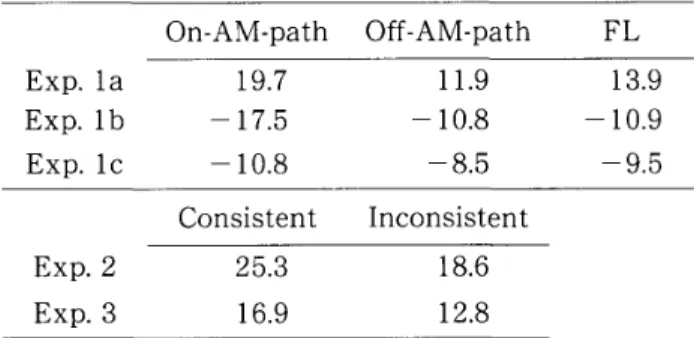
Table
1.
Contrast
thresholds(Weber
contrast,%)
obtainedin
Experiments
1,2,and3,
On-AM-path
Off-AM-pathFLExperiment
1:Contrast
polarityExp.
IaExp.
IbExp,
lc19.7-17.5-10.8
1L9-10.8
-8.5
13.9-10.9
-9.5
Whereas the contrast polarityof both theinducers
and targetwas posjtive
(white)
in
Experiment
la,it
was negative
(black)
inExperiment 1b, In Experi-ment 1c,the contrast of theinducers
was positive,and the contrast of the target was negative. Five observers participated ineach of theexperiments.
Results
andDiscussion.
In
experimentsla
and 1b(Table
1),a one-way repeated ANOVA revealed asignificant main effect ofthe conditions (Experiment
la; F(2,8)=8.97,
p<.01/
Experiment lb; F(2,8)=13.02,P<.O1). A
post
hoc
comparison(Tukey's
HSD)
found that the contrast threshold intheOn-AM-path
condition became higher relative tothat inthe
Off-AM-path and FL conditions. The same tendency was
also found
in
Experiment lc(F(2,
8)=7,90,P<,05).
However, the effect size
(d,
Cohen, 1988) in theOn-AM-path condition compared to the
Off-AM-path
and FL conditions, was weaker inExperiment 1c
<d
-O.69and O,81,respectiveLy) than thatinExperiment
la
(d=:2.08
and 2,29,respectively) andExperiment
lb
(d==3.25
and 2.90,respectively}. These resultssuggest thattherepresentation ofan object
undergo-ingAM can impair even early visual processes,such
as
pattern
detection.
Moreover,
this suppressiveeffect can be modulated by the consistency of a
stimulus attribute Ccontrast)between the
inducers
and target, ConsistentInconsistentExperiment
2:
Orientation
Exp. 2Exp,3
25.316.9 18.612,8IN'emanipulated the orientation of the stimuli
in
Experiment 2 in order to further investigate the
effect of the consistcncv of stimulus attribute on AM
intcrfcrence,We used Gabor patches with vertical
stripes
(45
×45 pixel(1.5
deg),O.06cycle/pixel, o= 1Opixel)as the stimulL
Whereas
theinducers
andtargetwere tiltedat 45 deg intheConsistent
condi-tion,theorientation of thetargetwas
-45
deg
intheInconsistentcondition. Only the
On-AM-path
situa-tionwas tested. Four observers participatedinthe experlment,
Results and Discussion. A two-tailedt-te$t
re-vealed thatthecontrast threshold inthe
Consistent
condition was smaller than that inthe Inconsistent condition(t(3}=
-2.35,P<.05,
d-2.93: TableD.
Thisindicates
thatAM
interference
was ]argerwhen the orientation of the target and inclucerswas consistent.Experiment
3:
Shape
In Experiment 3,we tested the effect of shape
consistency on
AM
interference,Whereas theinduc-ers and targetwere square
(area:
1deg2)intheCon-sistent condition, theshape of the target was circular
{diameter:
1.12deg,area: O.96deg2)inthe Inconsis-tentcondition.Only
theOn-AM-path
situation was tested. Sixobservers participatedintheexperiment.Results
and Discssion.A
two-tailedi-testrevealed that the contrast threshold inthe Consistent condi-tionwas smaller than thatin
theInconsistent
condi-tion
(t{5)=2.97,P<.05,
d=2.74; Table 1}.This resultsuggests thatthe AM interferencewas largerwhen
theshape of the targetand inducers was consistent.
General
Discussion
The present study showed that the detection of
patterns
defined
by
luminance wasimpaired
whenthe patternwas presented within an AM trajectory.
Moreover,
this suppressive effect ofAM
became
stronger when astimulus attribute
(contrast,
orienta-tien,or shape} of the target pattern was consistent
with thatof theobjects jnAM. These findings indi-cate that AM stimuli and their representation affect
early visual processes
involved
in
detecting
apat-tem, and that the internalrepresentation of an AM
stimulus reflects thestimulus's attribute,
References
Cohen,
J.
(1988).
StatisticalPozver
analJ,sisfor
thebehaviorat
sciences.2nd
ed. New York:Academic
Press.
Yantis,
S.
& Nakama,T,
(1998).
Visual
interactions
in
the path of apparent motion. Nature Neu7oscience,