Rewriting Dogen
著者
William M.BODIFORD
journal or
publication title
INTERNATIONAL ZEN STUDIES
number
4
page range
219-302
year
2019-12
Dōgen 道元 (1200-1253) was an especially prolific author. He not only wrote a great number of works, in a wide variety of formats and genres, both in Chinese and in Japanese, but he also rewrote them. In other words, he rewrote himself. He rewrote so often that many of his works survive in multiple versions, and it is difficult to know for certain if he ever truly completed any of his compositions. While the practice of rewriting Dōgen began with Dōgen himself, it could not end with him. Others rewrote Dōgen, first by gathering his works together to form new compilations, and occasionally by assigning them new titles or chapter numbers.1 Second, and most significantly, others rewrote Dōgen
when printing his works and, in some cases, by combining two or more different versions of a work to form a new composite version. Printing Dōgen entails not just rewriting Dōgen, but also demands the adoption of editorial strategies for compiling, correcting, and rewriting Dōgen. In this essay I focus only on the Shōbōgenzō 正法眼藏, the most well-known of Dōgen’s works. I will begin with examples of how Dōgen rewrote Dōgen. To fully appreciate the process by which Dōgen rewrote himself, we must also consider the ways that the Dōgen we read today already has been rewritten by others. It is impossible to fully understand how Dōgen rewrote himself if we do not have access to what he wrote first in his initial versions of his compositions and how he subsequently
Rewriting Dōgen
William M. Bodiford
**
Professor, Buddhist Studies and Japanese Religions, UCLA Asian Language & Cultures.
rewrote them in his revisions. Until recently this kind of information was difficult to find. It was obscured by the ways that published editions of Dōgen selected, corrected, and sometimes had combined together different versions of what he wrote. There exists a large body of scholarship by Japanese scholars regarding the compilation and editing of Dōgen’s works.2 My essay sometimes repeats information available in
Japanese publications. Nonetheless I hope it will be helpful to review it. The scholarship on this topic can be difficult to understand because it typically is addressed to specialists and assumes a level of technical knowledge beyond the ken of the average reader. I want to summarize this topic in a manner that will be accessible to a wider audience.
Abbreviations
Because Dōgen has been rewritten so many times, the source texts for the Shōbōgenzō exist in many version. We can glimpse some of its textual complexity simply by listing its major compilations, which henceforth I will cite by abbreviations based on the number of chapters (jō 帖 or maki 卷) traditionally attributed to each compilation. In most manuscripts, the chapters are bound together in fascicles (satsu 册), but there is no standard number of chapters per fascicle. For each compilation I also identify the manuscript exemplar(s) with which it is most often associated.
12-SBGZ “New draft” (shinsō 新草) version: titled Shōbōgenzō; 12 chapters; only 1 witness: manuscript in 3 fascicles, dated 1446, owned by Yōkōji 永光寺 (Ishikawa Pref.; EST 1). Manuscript tradition: copied by an otherwise unidentified
novice monk (shinkai biku 新戒比丘) based on a manuscript dated 1420.
28-SBGZ “Secret” (himitsu 秘密) version: titled Himitsu shōbōgenzō 祕蜜正法眼藏; 28 chapters (with Shin fukatoku 心不可得 and Butsudō 佛道 each repeated); only 1 witness: incomplete manuscript in 3 fascicles, with the second and third chapters (Shizen biku 四禪比丘 and Shukke 出家) of fascicle 3 mostly lost. No date, but possibly as early as the middle of the 14th century (?). Owned by Eiheiji 永平寺
(Fukui Pref.; EST 1).
Manuscript tradition: unknown. The designation “secret” (himitsu) dates to 1723 when Shōten Sokuchi 承天則地 (d. 1744), abbot of Eiheiji, had new covers attached to the fascicles and a new wooden storage box constructed for them. He labeled the box: Himitsu shōbōgenzō sankan 祕蜜 正法眼藏 三卷 (“Secret Shōbōgenzō in three fascicles”; writing the glyph mitsu as “honey” 蜜). No earlier documentation survives.
60-SBGZ “Sōgo” 宋吾 version: titled Shōbōgenzō; 60 chapters (with Gyōji 行持 counted as 2 chapters); One of 6 witnesses: manuscript in 20 fascicles, dated 1510, owned by Tōunji 洞 雲寺 (Hiroshima Pref.; EST 6).
Manuscript tradition: copied by Kinkō Yōken 金岡用兼 (1437-1513?), based on a manuscript dated 1480 by Kōshū 光周 (1434-1492?), the fifteenth abbot of Eiheiji, which in turn was based on a manuscript dated 1389 by Sōgo, the
ninth abbot of Eiheiji. The Sōgo and Kōshū witnesses do not survive.
75-SBGZ “Seventy-five Chapter” (shichijūgo jō 七十五帖) version; titled Shōbōgenzō; 75 chapters (with Gyōji counted as 1 chapter); Three of more than 24 witnesses: (a) manuscript in 15 fascicles, dated 1488, owned by Kenkon’in 乾坤院 (Aichi Pref.; EST 1); (b) incomplete manuscript in 27 (originally 30) fascicles, dated 1512, owned by Shōbōji 正法 寺 (Iwate Pref.; EST 1); (c) manuscript in 76 fascicles, dated 1547, owned by Ryūmonji 龍門寺 (no. 1; Ishikawa Pref.; EST 2).
Manuscript traditions: (a) The Kenkon’in 75-SBGZ was copied by Shikō Sōden 芝岡宗田 (d. 1500), the second abbot of Kenkon’in, based on a manuscript dated 1430 owned by Dairinji 大林寺 (destroyed; formerly Toyama Pref.), which in turn was based on a manuscript dated 1333 by Tsūgen 通源 at Sōjiji 總持寺 (Ishikawa Pref.). (b) The Shōbōji 75-SBGZ was copied under the supervision of Juun Ryōchin 壽雲良椿 (d. 1516), the seventh abbot of Shōbōji, based on a manuscript dated 1472 by Bokudō Ryōjun 朴堂良淳 (d. 1500), the first abbot of Ryūmonji (no. 2; Yamagata Pref.), which in turn was based on a manuscript dated 1333 by Tsūgen at Sōjiji (Ishikawa Pref.). (c) The Ryūmonji (no. 1) 75-SBGZ was copied at Kōtokuji 興悳寺 (destroyed; formerly Ishikawa Pref.) by Tessō Hōken 喆囱芳賢 (d. 1551), the second abbot of Ryūmonji (no. 1), based on a manuscript dated 1430, which in turn was based on a
manuscript dated 1333 by Tsūgen. The Dairinji, Bokudō (Ryūmonji no.2), Kōtokuji, and Tsūgen witnesses do not survive. Note that the Tsūgen who copied the 75-SBGZ in 1333 should not be confused with the well-known Tsūgen Jakurei 通幻寂靈 (1322-1391), a mere child in 1333.
84-SBGZ “Bonsei” 梵清 version: titled Shōbōgenzō; 84 chapters (with Gyōji counted as 1 chapter); One of more than 54 witnesses: incomplete manuscript in 13 (originally 25) fascicles, dated 1419, owned by Tokuunji 德雲寺 (Hiroshima Pref.; EST 4). Manuscript tradition: The Tokuunji 84-SBGZ was copied by Taiyō Bonsei 太容梵清 (d. 1427) at Butsudaji 佛陀寺 (Ishikawa Pref.) based on a preexisting manuscript of unknown history. It combines two compilations. Before being partially destroyed by fire, its main section (20 fascicles) consisted of the 75-SBGZ, while its supplemental section (5 fascicles) included 9 chapters from the 60-SBGZ. Bonsei’s 84-SBGZ was the most widely disseminated, copied, and studied version of the Shōbōgenzō prior to the publication of the Honzan 95-SBGZ.
89-SBGZ “Manzan” 卍山 version: titled Eihei shōbōgenzō 永平正法眼 藏; 86 chapters (with Gyōji counted as 1 chapter); One of more than 66 witnesses: manuscript in 20 fascicles, dated 1686, owned by Daijōji 大乘寺 (Ishikawa Pref.; EST 7). Manuscript tradition: Holograph by Manzan Dōhaku 卍山 道白 (1636-1714), who compiled the 89-SBGZ with an innovative chronological arrangement. It includes 5
chapters not found in either the 60-SBGZ or 75-SBGZ. 95-SBGZ “Honzan” 本山 xylographic edition: titled Eihei shōbōgenzō;
95 chapters. Compiled by Daigu Shunryō 大愚俊量 (d. 1803), Sodō Ontatsu 祖道穩達 (d. 1813), and Tōkan Etetsu 透關惠 徹 (d. 1816). It includes 8 chapters not found in either the 60-SBGZ or 75-SBGZ.
This 1814 xylographic edition is the first version of an entire Shōbōgenzō compilation to appear in print. In its originally form it was compiled, edited, carved into woodblocks, and printed at Eiheiji in 20 fascicles. Its table of contents lists 95 chapters (with Gyōji counted as a single chapter, and with “Shin fukatoku” and “Butsudō” each repeated), but the initial abridged printing (in 1814) included only blank sheets of paper for 5 chapters. The unabridged xylographic version with all 95 chapters was first printed in 1906.
Reprints (a) as modern typeset editions, unabridged with 95 chapters, edited in 1 vol. by Ōuchi Seiran 大内青巒 (1845-1918): 1885, 1896; edited in 1 vol. as Honzanban shukusatsu Shōbōgenzō zen 本山版縮刷 正法眼藏 全 by Eiheiji: 1926, 1952; edited by Kishizawa Ian 岸澤惟安 (1865-1955) as part of the Taishō Canon (T no. 2582): 1931; edited in 3 vols. as part of the Iwanami Bunko 岩波文庫 paperback series by Etō Sokuō 衛藤即應 (1888-1958): 1939-1943, 1959, 1989, 2004 (etc.); and (b) as a xylographic reprint, unabridged with 95 chapters: 1974-1975.
Scholars have surveyed more than three hundred premodern manuscript witnesses of the Shōbōgenzō. The seven variations listed above do not represent all the major compilations or configurations of chapters that they have uncovered. Most of the other configurations, though, are based on one or more of the above compilations with the addition or deletion of textual materials. Also note that in terms of the manuscript tradition as a whole, the practice of identifying variant compilations by their number of chapters can invite confusion. In some cases, completely unrelated compilations can have the same number of chapters, while differing in the arrangement or content of those chapters. Nonetheless, it is common practice in scholarship about the Shōbōgenzō to refer to the manuscript exemplars identified above by the number of chapters traditionally attributed to the compilation family that they represent. The relationships among these compilations will be discussed below.
The seven Shōbōgenzō compilations listed above all consist of essays that Dōgen wrote in a mixture of Japanese (kana 假名) and Chinese (mana 眞名) scripts. Dōgen also composed another Shōbōgenzō that consists almost entirely of kōan 公案 (Zen stories) quoted from Chinese sources, written entirely in Chinese scripts. I refer two these two different varieties of Shōbōgenzō as follows:
Kana-SBGZ Shōbōgenzō with Japanese script: titled Shōbōgenzō; essays by Dōgen; written in a mixture of Japanese and Chinese scripts and collected into one of several compilations with a certain number (e.g., 12, 60, 75) of chapters.
of Chinese kōan compiled by Dōgen based on Chinese source texts; with a preface composed by Dōgen (dated 1235). One of 7 witnesses: manuscript in 1 fascicle with 6 chapters, dated 1752, owned by Jōkōji 成高寺 (Tochigi Pref.; EST 1).
Manuscript tradition: copied by Rogyo 露曉, based on a manuscript dated 1715, which in turn was based on a manuscript dated 1481 owned by Hōdōji 法幢寺 (Gifu Pref.). The earlier witnesses are presumed lost.
Dōgen’s Rewriting the Shōbōgenzō
Primary evidence for Dōgen’s methods of rewriting Dōgen consists of the textual differences found within the surviving manuscripts. Secondary evidence can be found in Dōgen’s postscripts (okugaki 奥書), which survive only in some of the manuscripts. Sometimes the postscripts provide both types of evidence. I will present two examples to illustrate this kind of evidence.3 Example 1 reproduces Dōgen’s
postscript to the chapter Washing the Face (Senmen 洗面) as it appears in the 60-SBGZ.
Example 1. Washing the Face, Postscript in 60-SBGZ 正法眼藏洗面第五十
天竺・震旦國等には、國王・王子、大臣・百官、在家男女、朝野の佰姓、 みな洗面す、神廟等も、あしたごとに洗面するあり。かくのごとく洗面し て、祖宗を拜し、現在せる父母・師匠を拜す、三界萬靈・十方眞宰をも拜 す、主君をも拜するなり。 いまは漁父・樵翁までも、洗面おこたらず。しかあれども、楊枝はしらず、 一得一失なり。日本國は嚼楊枝あり、洗面なし。 いま嚼楊枝・洗面、ともに修證せん、補虧闕の紹隆なり。正傳のうへの正 傳なるべし、佛祖の照臨なるべし。 爾時寛元元年癸卯十月二十日、在越州吉峰精舍示衆。
(punctuation added; see page 382 of the Japanese language version of this article, Example 1)
Shōbōgenzō: Washing the Face Chapter 50
Presented to the assembly at Kannon Dōri Kōshō Hōrin Monastery, Yōshū, twenty-third day, tenth month of the junior earth year of the pig, the first year of En’ō [1239].
In lands such as Sindhu and Cīnasthāna, the kings and princes, great ministers and high officials, men and women of the household, courtiers and peasants all practice face-washing, and in their shrines to the gods, face-washing is offered every morning. Washing their faces in such manner, they pay obeisance to the ancestors, pay obeisance to their present fathers, mothers, and teachers, pay obeisance to the myriad spirits of the three realms and to the true lords of the ten directions, and pay obeisance to
their lord.
Nowadays, fishermen and woodsmen take care to wash their faces. Yet ignorant of the willow twig, it is “one gained, one lost.” In the land of Japan there is willow-twig chewing, yet no face-washing.
Now, by practicing and verifying both willow twig chewing and face-washing, we repair the deficiency by outdoing our predecessors. It is the direct transmission upon the direct transmission; it is the illuminating presence of the buddhas and ancestors.
Please compare the postscript from Example 1 (which appears in the 60-SBGZ), with the postscript in Example 2, which comes from Dōgen’s rewritten version of this same chapter, Washing the Face (Senmen), as it appears in the 75-SBGZ (Ryūmonji).
Example 2. Washing the Face, Rewritten Postscript in 75-SBGZ (Ryūmonji)
正法眼藏第五十
延應元年己亥十月二十三日、在雍州觀音導利興聖寶林寺示衆
姓萬民、ミナ洗面ス。家宅ノ調度ニモ面桶アリ、アルイハ銀、アルイハ鑞 ナリ。天祠神廟ニモ、毎朝ニ洗面ヲ供ズ。佛祖ノ塔頭ニモ、洗面ヲタテマ ツル。在家・出家、洗面ノノチ、衣裳ヲタダシクシテ、天ヲモ拜シ、神ヲ モ拜シ、祖宗オモ拜シ、父母ヲモ拜ス。師匠ヲ拜シ、三寶ヲ拜シ、三界萬 靈・十方眞宰ヲ拜ス。 イマハ農夫・田夫、漁夫・樵翁マデモ、洗面ワスルルコトナシ。シカアレ ドモ、嚼楊枝ナシ。日本國ハ、國王・大臣、老少・朝野、在家・出家ノ貴 賤、トモニ嚼楊枝・漱口ノ法ヲワスレズ、シカアレドモ洗面セズ。一得一 失ナリ。 イマ洗面・嚼楊枝、トモニ護持セン、補虧闕ノ興隆ナリ、佛祖ノ照臨ナリ。 寛元元年癸卯十月二十日、在越州吉田郡吉峰寺重示衆。 建長二年庚戌正月十一日、在越州吉田郡吉祥山永平寺示衆。 (punctuation added; see page 382 of the Japanese language version of this article, Example 2)
Shōbōgenzō: Chapter 50
Presented to the assembly at Kannon Dōri Kōshō Hōrin Monastery, Yōshū, twenty-third day, tenth month of the junior earth year of the pig, the first year of En’ō [1239].
In the Land of Sindhu and the Land of Cīnasthāna, the kings and princes, great ministers and high officials, renunciants and householders, men and women of court and countryside, peasants and commoners, all practice face-washing. Among their household implements as well, there is a face bucket, whether of silver or of tin. In their temples to the devas and shrines to the gods,
face-washing is offered every morning; in the stūpa sites of the buddhas and ancestors, as well, face-washing is offered. Householders and renunciants, after washing their faces, don proper clothing and pay obeisance to the devas, pay obeisance to the gods, pay obeisance to their ancestors, and pay obeisance to their fathers and mothers. We pay obeisance to our teachers, pay obeisance to the Three Jewels, pay obeisance to the myriad spirits of the three realms, and pay obeisance to the true lords of the ten directions.
Nowadays, even farmers and paddy workers, fishermen and woodsmen never forget to wash their faces; yet they lack chewing the willow twig. In the land of Japan, the kings and great ministers, old and young, in court and countryside, householders and renunciants of high and humble status do not neglect the practice of chewing the willow twig and rinsing the mouth; yet they do not wash the face. It is “one gained, one lost.”
Now, our maintaining both face-washing and chewing the willow twig constitutes a florescence that repairs the deficiency: it is the illuminating presence of the buddhas and ancestors.
Presented to the assembly again at Kippō Monastery, Yoshida District, Esshū, twentieth day, tenth month of the junior water year of the rabbit, the first year of Kangen [1243].
Presented to the assembly at Eiheiji, on Mount Kippō, Yoshida District, Esshū, eleventh day, first month of the senior metal year
of the dog, the second year of Kenchō [1250].
When comparing these two sample texts, the first thing we notice is that the second one is much longer. It consists of and additional 101 glyphs (with punctuation marks excluded, 342 in example 2 versus only 241 in example 1). Second, we notice the dates. Example 1 has only one date (1239) while example 2 has three dates: 1239, 1243, and 1250. We might assume that example 1 represents an initial draft composed 1239 and that example 2 represents the version rewritten in 1243 or in 1250, or both in 1243 and again in 1250. The text is not explicit about the relationship between its composition (ki 記) and its presentation to the assembly (jishu 示衆), though. Third, someone familiar with Japanese scripts will notice that example 1 is written in cursive script (hiragana, or zokukana 俗假字), while example 2 uses block forms (katakana, or magana 眞假字; for this terminology, see T 82.8c). Finally, we can notice that many words and phrases have been deleted, added, and rewritten. Example 2 deletes . . . 等 現在せる 主君をも拜するなり 正傳のうへの正傳なるべし Example 2 adds . . . 出家 家宅の調度にも面桶ありあるいは銀あるいは鑞なり 佛祖 の塔頭にも洗面をたてまつる在家出家洗面ののち衣裳をただし
くして天をも拜し神をも拜し 三寶を拜し 國王 大臣老少朝野在家出家の貴賤ともに嚼楊枝漱口の法をわすれず しかあれども Example 2 rewrites . . . 王子 → 皇子 佰姓 → 百姓萬民 神廟等も → 天祠神廟にも あしたごとに → 毎朝に 洗面して → 洗面を供ず 祖宗を拜し → 祖宗をも拜し 父母師匠を拜す → 父母をも拜す師匠を拜し 漁父樵翁 → 農夫田夫漁夫樵翁 おこたらず → わするることなし 楊枝はしらず → 嚼楊枝なし 洗面なし → 洗面せず 嚼楊枝洗面 → 洗面嚼楊枝 修證 → 護持 紹隆 → 興隆 照臨なるべし → 照臨なり
This process of deleting, adding, and rewriting is typical of Dōgen. It is his usual method of composition. The results produced by his rewriting must be judged by each individual reader.4 In my estimation,
example 2 is much more polished. The vocabulary is more refined. The long and short expressions are better balanced, and the central point about “one gained, one lost” (ittoku isshitsu 一得一失) is easier to
understand. His religious justification for promoting both practices (face-washing and willow-twig chewing) seems more compelling. Based on the limited evidence of these two examples, the version in the 75-SBGZ seems more balanced, polished, and effective than the one in the 60-SBGZ.
Evidence for Dōgen’s method of rewriting also can be found in the colophons (shikigo 識語) by Ejō 懷弉 (1198-1280), which survive only in some of the manuscripts. First, let me explain the terminology. It is common for scholars to refer to all notations appended to the end of a chapter of the Shōbōgenzō as the okugaki, which translators render into English either as “postscript” or as “colophon.” Here I am following the suggestion of Danno Hiroyuki (1980, 6) to distinguish the author’s postscript (okugaki) from the copyist’s colophon (shikigo). In other words, I refer to the notations appended by Dōgen as the postscript and refer to the notations added by Ejō (or another copyist) as the colophon. This usage conforms more closely to the usual meaning of these terms both in Japanese (okugaki vs. shikigo) and in English (“postscript” vs. “colophon”).
Ejō served as Dōgen’s acolyte (jisha 侍者), a monastic office that (among other duties) placed him in charge of Dōgen’s papers (i.e., assuming the responsibilities of shojō jisha 書狀侍者). Ejō eventually became Dōgen’s successor as abbot of Eiheiji monastery, and during his term as abbot he copied and supervised the copying of Dōgen’s compositions. Example 3 reproduces a colophon by Ejō to the chapter Deep Faith in Cause and Effect (Jinshin innen 深信因果) as it appears in the 28-SBGZ. Notice that Ejō mentions the steps followed by Dōgen during the process of rewriting.
Example 3. Deep Faith in Cause and Effect Colophon by Ejō in 28-SBGZ 正法眼藏深信因果 彼御本奧書ニ云、 建長七年乙卯夏安居日、 以御草案書寫之。 未及中書清、 定有可再治事也、 雖然書寫之。 懷弉。
(punctuation added; see page 383 of the Japanese language version of this article, Example 3)
Shōbōgenzō: Deep Faith in Cause and Effect In his postscript of his autograph, he [Ejō] writes:
Day of the summer retreat, junior wood year of the rabbit, seventh year of Kenchō [1255], copied from his [Dōgen’s] rough draft. He [Dōgen] had not yet reached an intermediate draft or clean copy, and surely he would have improved it again. Nevertheless, I have copied it.
Ejō
The first line is by an unknown copyist who probably was one of Ejō’s disciples, since he uses an honorific prefix (go 御) to refer to Ejō’s
colophon, which he quotes. In the quotation Ejō identifies the text he copied as an “rough draft” (sōan 草案) and uses an honorific prefix (go) which implies that it was by Dōgen, most likely Dōgen’s holograph. Ejō distinguishes it from an intermediate draft (chūsho 中書) or a clean copy (seisho 清書), which would refer to a cleanly rewritten manuscript without insertions, overwrites, cross outs, or other alterations. Ejō clearly expected that Dōgen, had he lived longer, would have wanted to improve it more than once (saiji 再治). Ejō’s comment about the manuscript not having reached a clean copy seems to imply that he normally would have received a clean copy from Dōgen. It is important to note that Ejō states that he simply copied Dōgen’s rough draft. No where in his colophon does Ejō suggest that might have been tempted to revise it himself.
Dōgen’s role in rewriting Dōgen, and the steps in his process of rewriting can be detected only partially in the extant manuscripts. The surviving colophons in some manuscripts reveal a little more about Ejō’s role in copying and supervised the copying of Dōgen’s compositions, but the documentary record remains fragmentary and subject to conjecture. In the Tōunji 60-SBGZ manuscript, for example, only 44 chapters have postscripts (okugaki) by Dōgen while 43 chapters have colophons (shikigo) by Ejō. In the Ryūmonji 75-SBGZ manuscript, 71 chapters have postscripts by Dōgen, but there is not a single colophon by Ejō (see Table 1). Such a great difference in the number of postrscripts and colophons probably could not have happened by accident. We might assume that there must be some reason for it, but we lack solid evidence to determine what its significance might be. I will return to this question below. Since neither of these processes ─ Dōgen’s of rewriting and Ejō’s copying ─ are well documented or fully understood, the precise
relationship between them cannot be discerned with certainty. As the accepted understanding of these processes evolved over time, the ways that scholars have rewritten Dōgen ─ collected, compiled, corrected, edited, and printed Dōgen ─ also has evolved.
Table 1. Number of Postscripts and Colophons in the 60-SBGZ and 75-SBGZ Postscripts by Dōgen 道元の奥書 Colophons by Ejō 懐奘の識語 60-SBGZ Tōunji 洞雲寺所蔵 60巻本 44 43 75-SBGZ Ryūmonji 龍門寺所蔵 75巻本 71 ─
We can discern this process of editorial evolution by examining the four most important and most influential printed versions of the Shōbōgenzō. In chronological order, they are:
1815 “Honzan” edition 本山版: 95-SBGZ (see above).
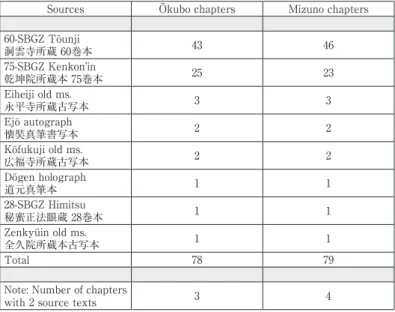
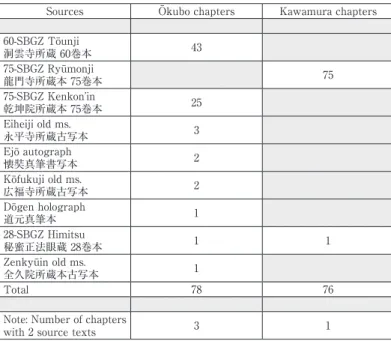
1969 Ōkubo edition 大久保版: 75-SBGZ + 12-SBGZ (= 87 total). Titled Shōbōgenzō, edited by Ōkubo Dōshū 大久保道舟. Included in Dōgen zenji zenshū 道元禪師全集 (Complete Works of Zen Master Dōgen), volume 1. Includes 7 supplemental chapters (included in the 95-SBGZ but not found in either the 75-SBGZ or 12-SBGZ) as well as 3 alternative versions of chapters.
zen 古本校定 正法眼藏 全 (The Complete Shōbōgenzō: the critically collated old texts).
1970 Mizuno edition 水野版: 75-SBGZ + 12-SBGZ (= 87 total). Titled Shōbōgenzō, edited by Mizuno Yaoko 水野彌穗子. Included as volumes 12-13 of the Nihon Shisō Taikei 日本思想大系 (Compendium of Traditional Japanese Thought) series. Includes 1 supplemental chapter (included in the 95-SBGZ but not found in either the 75-SBGZ or 12-75-SBGZ). Reprinted in 1990 as volumes 7-8 of Genten Nihon Bukkyō no Shisō 原典日本仏教の思想 (Original Texts for Japanese Buddhist Thought) series.
Mizuno edition reprinted as an independent work and revised in 1990: Shōbōgenzō, in 4 volumes as part of the Iwanami Bunko paperback series (supplanting the previous 95-SBGZ version in 3 vols. edited by Etō Sokuō). Includes 6 supplemental chapters (included in the 95-SBGZ but not found in either the 75-SBGZ or 12-SBGZ).
1991 Kawamura edition 河村版: 75-SBGZ + 12-SBGZ (= 87 total). Titled Shōbōgenzō, edited by Kawamura Kōdō 河村孝道. Included in Dōgen zenji zenshū (herein abbreviated as DZZ), volumes 1-2. Includes 9 supplemental chapters (included in 95-SBGZ but not found in either the 75-SBGZ or 12-SBGZ) as well as 7 alternative versions of chapters.
1814 Honzan Edition: Why was it Printed?
The 1814 (95-SBGZ) Honzan edition could be published appeared only after the lifting of a legal ban (Shōbōgenzō kaihan kinshirei 正法眼藏開版 禁止令) on the printing of the Shōbōgenzō (Bodiford 2006, 18-20). Throughout the previous century Sōtō monastic practices had been embroiled in conflicts due to the efforts by some Sōtō clergy to institute major reforms to the temple lineage system ─ the so-called Lineage Restoration Movement (shūtō fukko undō 宗統復古運動; see Bodiford 1991). The publication of early Japanese Sōtō literature played a major role in their reform efforts. One of the key leaders of the movement, Manzan Dōhaku 卍山道白 (1636-1714) is an especially noteworthy example. He edited and published his own editions of a number of classical Sōtō texts:
1672 Dōgen’s recorded sayings (under the title: Eihei kōroku 永平廣録; 10 fascicles)
1678 monastic procedures attributed to Keizan Jōkin 瑩山紹瑾 (1264-1325) (under the title: Keizan shingi 瑩山清規; 2 fascicles) 1684 The Retreat (Ango 安居) chapter of Shōbōgenzō
1700 Face-to-Face Conferral (Menju 面授) chapter of Shōbōgenzō Meanwhile Manzan also compiled his own version (89-SBGZ) of the Shōbōgenzō, which he clearly intended to publish. Manzan’s critics noted, however, that his edition of Face-to-Face Conferral differs considerably in content from other versions ─ including the one subsequently published in the 1815 (95-SBGZ) Honzan edition. In his missives in support of monastic reforms, Manzan quotes not just from
Face-to-Face Conferral but also from Mountain Abbot (Jūsan 住山), an otherwise completely unknown chapter title (Yoshida 1982, 909-915). In short, Manzan’s reforms sowed opposition and his methods of editing (or rewriting) and publishing Sōtō literature sparked fears. Suddenly the content of the Shōbōgenzō had become the subject of controversy and a threat to the established order. Accordingly in 1722 the Tokugawa military government (bakufu) banned any attempts to publish, to copy, to amend, or to delete the “genuine text of the Shōbōgenzō at Eiheiji” (Eiheiji shitsunai no shinpon 永平寺室内之眞本). In 1727 the government stated that the purpose of the ban was to prevent people from extracting passages from the text to use as a tool for promoting reform (katsuyō inkatsu 撮要隱括; Kumagai 1982, 1028-1029).
Eiheiji received an exemption from the ban at the end of 1796 due to petitions submitted by Daigu Shunryō 大愚俊量 (d. 1803) and Sodō Ontatsu 祖道穩達 (d. 1813). They argued that the publication of an official version of the text would end controversies. Daigu and Sodō proposed the idea of printing only an abridged edition that excluded five chapters related to the reform efforts. In their petition, though, they did not mention the reforms but gave the pretext that these chapters had to be excluded because they contain language critical of other Buddhist denominations (tashū e shōshō sashisawari no genku 他宗江少々差障之言 句). The excluded chapters are:
Buddhas and Ancestors (Busso 佛祖) Receiving the Precepts (Jukai 受戒) The Inheritance Certificate (Shisho 嗣書)
The Samādhi of Self Verification (Jishō zanmai 自證三昧) Transmitting the Robe (Den’e 傳衣)
granting the exemption, again emphasized the dangers presented by “copyist errors” (gyoro no hitsugo 魚魯之筆誤; Kumagai 1982, 1031-1035).
1814 Honzan Edition: Goals
The Honzan (95-SBGZ) edition was compiled with the clear intention to provide the world with a new Shōbōgenzō, unique to Eiheiji. It would be unrivalled by any other versions because it would be the most authoritative, the most well collated, the most complete, the most comprehensive, and include within it the most features. It would incorporate all other versions in a manner that could not be found anywhere else. Sodō Ontatsu wrote the introduction (“Chōkoku eihei shōbōgenzō en’yū” 彫刻永平正法眼藏縁由; T 82.7a-c) and editorial notes (“Chōkoku eihei shōbōgenzō bonrei” 彫刻永平正法眼藏凡例; T 82.7c-10c) to the Honzan edition. In his remarks (which I summarize in the paraphrased excerpts below) he begins by emphasizing the problems with all the other extant versions of the text:
(1) Dōgen originally wrote one hundred chapters. (2) Because authorization to print them was lacking until now, (3) every copyist introduced new errors. (4) Today the versions kept at Sōtō temples have passages of different lengths [in sections that] are either expanded or abbreviated. (5) These difference create doubts and (6) some people say that passages are missing as an excuse to make reckless additions to the text, (7) while others delete passages that they label as later interpolations. (8) As a result, in later generations so many errors have been handed down that people no longer know upon which teachings to rely or
the difference between correct and deviant doctrines. 1 説示シ玉フ所ノ書、都盧一百卷。 2 祖師滅後ステニ五百五十ノ星霜ヲ經ルトイヘトモ、コレ書イマ タ梓ニ鐫ルコトヲ許サレズ。 3 故ニ展轉拜寫ノ毎度ニ、文字章句ノ詳略、烏焉魚魯ノ錯誤無キ コトアタハズ。 4 諸山古刹ノ室内ニ秘在スル所ノ諸本ト考讐シ、文句ノ長短廣略 アルヲ見テ。 5 小見ノ邪疑ヲ生シ。 6 筆寫ノ疎脱ト謂テ妄ニコレヲ増補シ。 7 マタ後人ノ妄添ト爲シテ私ニ削除シ。 8 後來ノ晩學ヲシテ非非相傳ヘ、宗ノ邪正、法ノ實歸ヲ知ラザラ シムルニ至ル。
(T 82.7a-b; with voicing marks, dakuten 濁点, added)
According to Sodō Ontatsu’s editorial notes (bonrei), people are lead astray not just by the numerous textual errors in extant manuscripts, but also by the fact that Sōtō temples preserve the Shōbōgenzō in compilations that differ greatly from one another. Again, I will summarize his remarks:
(9) This composition has been compiled by many different teachers who each arranged the chapters in his own different order without any consistency. (10) Because their editorial methods differed, their compilations likewise differed. (11) In subsequent generations each lineage faction has become strongly attached to the compilations used by their predecessors to the
point of arguing over the validity of one another’s compilations. 9 コノ書、卷目ノ多寡編集ノ列次、古今ノ諸師家家不同ナリ。 10 編集ノ手各別ナルガ故ニ、編次モ亦隨テ差異ス。 11 是ヲ以テ後世各自ニ其家家先人ノ編集ヲ固執シテ、卷目多寡是 非ノ諍論出ルニ至ル。 (T 82.9a, 10b)
The Honzan (95-SBGZ) edition avoided taking sides in these disputes by adopting a completely different method for determining the order of its chapters. It arranges the chapters in chronological order based first on the dates in Dōgen’s postscripts or, if those are absent, based secondly on the dates in Ejō’s colophons. Chapters of unknown date are grouped together at the very end.
The Honzan edition proved to be a great success. Although initially only about 300 to 400 copies were printed ─ and these were distributed only to Sōtō temples ─ it instantly became the “Eihei” Shōbōgenzō (as stated by its printed title), both in the senses of “Eihei” as a designation for Dōgen and as a designation for Dōgen’s temple, Eiheiji. Once this edition became widely available in modern typeset editions it helped create the Dōgen now known throughout the world. It is the version most often printed, studied, quoted, excerpted, anthologized, and translated into other languages. It is the version studied at the annual Genzō-e 眼藏會 (seminars on Shōbōgenzō) sponsored every year at Eiheiji. It is the version known by all teachers and practitioners of Sōtō Zen. Its very existence reinforces the unstated, but nonetheless implied assertion that Eiheiji alone is the institution best qualified to produce a authoritative version of Dōgen’s writings. It implies that other Sōtō temples and the other versions of Shōbōgenzō
they might own must be unreliable guides to Dōgen’s legacy simply because they are not Dōgen’s home temple.
In consideration of the time and circumstances under which it was produced, the Honzan edition certainly achieved high standards of excellence. By today’s standards, though, it has many shortcomings. Certainly it did not attempt to reproduce a Shōbōgenzō that would have been recognizable to Dōgen. Rather, it represents what its editors imagined as the Shōbōgenzō that Dōgen would have produced had he lived long enough to supervise its publication. We cannot identify with certainty the source texts upon which it was based because none of its chapters correspond exactly with any of them. It is doubtful if its editors would have had direct access to many of the manuscript exemplars used by scholars today. The “genuine text of the Shōbōgenzō at Eiheiji” (Eiheiji shitsunai no shinpon) mentioned in the authorization to print this edition probably was more of an ideal type than a concrete reality. Rather than an authoritative text, the Honzan edition is an eclectic text. In other words, an “eclectic text” refers to newly compiled composite version that conflates together several previously available source texts in a manner that is not identical with any of them.
The Honzan edition cites textual variations found in other versions (such as the 28-SBGZ, 60-SBGZ, or 84-SBGZ), but it does not appear to follow any explicit methodology to identify which variant version might be more or less reliable. Consider, for example, the case of Talk on Pursuing the Way (Bendō wa 辦道話). The existence of this early composition by Dōgen was unknown to the world prior to its publication in 1788. Nonetheless the Honzan edition lists a total of 20 alternative wordings for this chapter, each of which is identified as being based on another version (ippon 一本). What other version could possibly
have provided these alternatives? Perhaps someone who made a handwritten copy of the 1788 printed edition had suggested corrections to the text. At the very least, the inclusion of these textual alternatives hints at two likely scenarios. First, the editors assumed that the text would be read by well-educated clerics who could and should participate in the task of selecting which wording to follow (see Cherniack 1994, 13-14). Second, the editors avoided editorial judgements that might have caused a temple to lose face if the wording of its version of the text was completely absent from the authorized publication (Mizuno 1970, 583). As the officially authorized version, intended for a audience of religious adherents, printed at a time when the Shōbōgenzō’s manuscript history was almost completely unknown, the editorial methods of the Honzan edition ─ an eclectic text, with nonjudgmental, ecumenical textual collations ─ were a reasonable approach. But today’s readers must bear in mind that these editorial choices were not intended to produced a text that reproduces as accurately as possible the content and arrangement that Dōgen actually wrote and rewrote. The textual inaccuracies of the Honzan edition have grown ever more apparent as previously unknown early manuscripts have became available for scholarly examination and as our understanding of the manuscript history of the Shōbōgenzō has progressed.
Before discussing the evolution of Shōbōgenzō textual history, it will be helpful first to review how the Honzan edition explains it. Once more I will summarize Sodō Ontatsu’s editorial notes (bonrei).
(1, as stated previously) Dōgen originally wrote one hundred chapters, (12) but traditionally they lacked any assigned numbers. (13) In 1255 Ejō compiled the 75-SBGZ based on Dōgen’s rough
drafts. (14) In 1329, Giun 義雲 (1253-1333), the fifth abbot of Eiheiji, compiled the 60-SBGZ and composed a verse for each chapter. (15) This version is known as the “Sōgo” 宋吾 text. (16) In 1419 Taiyō Bonsei 太容梵清 (d. 1427) compiled the 84-SBGZ by adding nine missing chapters to Ejō’s 75-SBGZ. (17) Eiheiji’s storehouse holds a Secret 28-SBGZ, which was copied in 1288 (?!). (18) Adding eight chapters from this 28-SBGZ to the 84-SBGZ produces a total of ninety two chapters. (19) Handō Kōzen 版橈晃全 (1625-1693), the thirty-fifth abbot of Eiheiji, added three more chapters to produce a total of ninety-five chapters (i.e., 95-SBGZ).
12 コノ書全部ノ册數。舊來定數有ルコト無シ。 13 七十五帖ハ . . . 建長七年乙卯ニ至テ、永平二代懷奘禪師、祖師 ノ御草本ニ就テ書寫シ。 14 嘉暦四年 . . . 義雲和尚自ラ正法眼藏六十卷ヲ集メテ、毎卷ニ題 號ノ頌ヲ述作シ玉フ。 15 世ニイハユル宋吾本ト稱スル。 16 大容梵清和尚 . . . 奘翁編集ノ七十五帖ニ散逸セル九卷ヲ寫シテ . . . 卷數都テ八十四卷トナス . . . 應永二十六年 . . . 17 永平寺寶庫ニ秘在スル所ノ秘密正法眼藏ト題號スル本、二十八 卷アリ . . . 弘安十一年戊子ノ九月晦日ニ寫ス。 18 秘密ノ中ヨリコノ八卷ヲ拔采シ、梵清本ノ八十四卷ニ増加シテ、 都盧九十二卷トス。 19 永平三十五世晃全禪師 . . . 三卷ヲ捃摭シテ、上ノ九十二卷ニ參 合シテ、都テ九十五卷トナシ。 (T 82.9a, 10b; 9b; 9c; 10a; )
problematic, or simply incorrect. Taken together, they imply that Ejō revised or rewrote Dōgen’s rough drafts, that Ejō, Giun, and Bonsei collected different numbers of chapters and arranged them in random order due to happenstance. They treat Ejō, Giun, and Bonsei as equals, without regard for Ejō’s status as Dōgen’s constant companion, acolyte (jisha), dharma-heir (hossu 法嗣) and hand-picked successor as abbot of Eiheiji. Sodō Ontatsu attributes an unrealistically early date to the compilation of the Secret 28-SBGZ (and elsewhere even refers to its manuscript as being in Ejō’s handwriting; T 82.8c). He implies that Handō Kōzen is responsible for increasing the size of the Honzan edition to ninety-five chapters ─ ignoring the fact that Kōzen died more than a century before work would begin on carving its first woodblocks. Most significant, Ontatsu never mentions Manzan Dōhaku’s 94-SBGZ, which preceded Kōzen’s own personal compilation by six years. Dōhaku’s compilation already included the three extra chapters that Ontatsu credits to Kōzen’s initiative. And Dōhaku likewise had pioneered the chronological order of chapters subsequently adopted by the Honzan edition. But regardless of the inaccuracies in Ontatsu’s comments, they constituted the conventional wisdom for over a century. People accepted as fact that about three years after Dōgen’s death Ejō had compiled the first (75-SBGZ) Shōbōgenzō and that about seventy-three years later Giun had compiled an alternative (60-SBGZ) version.
1969 Ōkubo Edition: Background
Ōkubo Dōshū (1896-1994) is the person most responsible for challenging the authority of the Honzan (95-SBGZ) edition. Ōkubo enjoyed a distinguished career at the Historiographical Institute (Shiryō Hensanjo
史料編纂所), the University of Tokyo, and served as the president of Komazawa University. He helped pioneer the collection, cataloging, photographing, and transcribing of historical documents from Sōtō temples. Today he is most remembered for writing the first authoritative biographic study of Dōgen’s life based on primary documents (Dōgen zenji den no kenkyū 道元禪師傳の研究, 1953; enlarged 1966). He also compiled several resources for researchers: a detailed chronology of Sōtō history based on original documents (1935) and a multi-volume collection of important documents (1972), transcribed and annotated, from Sōtō temples across Japan. In addition he edited several major collections of Dōgen’s complete works (1930; 1944; 1969).
In his biographical study of Dōgen (1953, 345-346; 1966, 312), Ōkubo quotes and then rejects Sodō Ontatsu’s assertion that Ejō was responsible for the first “Shōbōgenzō” compilation. Ōkubo’s arguments begin with his discussion of the 12-SBGZ, a previously unknown version of the Shōbōgenzō in twelve chapters discovered at Yōkōji in 1936 by Kohō Chisan 孤峰智燦 (1879-1967) and Nagahisa Toshio 永久俊雄 (a.k.a. Gakusui 岳水; 1890-1981). This compilation is especially noteworthy because its twelfth chapter is titled The Eightfold Awareness of the Great Person (Hachi Dainin Gaku 八大人覺). The colophon to this chapter in the 12-SBGZ reads as follows.
Example 4. Colophon to Hachi Dainin Gaku in 12-SBGZ 正法眼藏八大人覺第十二
建長五年正月六日書永平寺 今應永廿七稔孟夏上旬日、於永安精舍衣鉢閣下拜書之、 于時文安三年三月八日、能州藏見保於藥師堂書之、 之意趣者、以此良結縁、 生生世世、見佛聞法、出家得道、供養三寶、濟度衆生、成等正覺。 永平末流小新戒比丘
(punctuation added; see page 383 of the Japanese language version of this article, Example 4)
Shōbōgenzō: The Eightfold Awareness of the Great Person (Hachi Dainin Gaku)
Chapter 12
The postscript to his manuscript says:
Written [at] Eiheiji, on the sixth day, first month, fifth year of Kenchō [1253].
Respectfully copied at the beginning of summer [fourth month], twenty seventh year of Ōei [1420], in the Robe and Bowl Hall (Ehatsukaku) at Eianji.
Copied on the eight day of the third month, the third year of Bun’an [1446] at the Yakushidō, at Kurami Estate, Noshū.
after birth, life after life, I will see the Buddhas and hear the Dharma, serve the Three Jewels, save living beings, and attain perfect awakening.
A novice bhiks4u, a humble descendant of Eihei
By itself this colophon does not seem very informative. This same chapter, however, also exists as chapter 95 of the Honzan (95-SBGZ) edition and as chapter 9 of fascicle 2 (chūsatsu no ku 中册ノ九) in the Secret (28-SBGZ) manuscript.5 The Honzan version clearly derives from
the Secret text, but in the Honzan edition the colophon is rewritten to eliminate all references to chapter numbers (i.e., it was “corrected” to agree with the editor’s views). Below is the uncorrected text as it appears in the Secret 28-SBGZ. Note that in recent decades scholars have suggested many mutually exclusive ways of interpreting the words of this colophon. My English translation is greatly indebted to the detailed analysis published in 1989 by Kagamishima Genryū 鏡島元隆 (1912-2001). I regard Kagamishima (1989) as an essential reference for any meaningful consideration of this colophon, but I alone am responsible for any errors of interpretation.
Example 5. Colophon to Hachi Dainin Gaku in the Secret 28-SBGZ 正法眼藏八大人覺第十二
建長五年正月六日書于永平寺 如今建長七年 乙卯 解制之前日、令義演書記書寫畢。同一挍之。 右本、先師最後御病中之御草也。仰以前所撰假名正法眼藏等皆書改、并新 草具都盧一百巻、可撰之 云云。 既始草之御此巻、當第十二也。此之後、御病漸々重増。仍御草案等事即止 也。所以此御草等、先師最後教勅也。我等不幸不拜見一百巻之御草、尤所 恨也。 若奉戀慕先師之人、必書此十二巻、而可護持之。此釋尊最後之教勅、且先 師最後之遺教也。 懷弉記之。
(punctuation added; see page 384 of the Japanese language version of this article, Example 5)
Shōbōgenzō: The Eightfold Awareness of the Great Person (Hachi Dainin Gaku)
Chapter 12
[Dōgen’s] manuscript said:
Written at Eiheiji, on the sixth day, first month, fifth year of Kenchō [1253].
Now, on the day before the end of the retreat, the junior wood year of the rabbit, the seventh year of Kenchō [1255], once Secretary Gien had finished copying [that one], I collated it with
this one.
This text is the last rough draft composed during my late master’s illness. He had recounted: “The new rough drafts, along with the previously composed Shōbōgenzō with Japanese script, which is completely rewritten, will constitute a new draft with a total of one hundred chapters.”
He started the drafts, and this chapter was number twelve. Thereafter, his illness gradually became more and more serious. As a result, work on his rough drafts came to an end. Therefore, [my and Gien’s copies of] this rough draft constitute my late master’s final directives. How regrettable that unfortunately we will never see his [new] draft in one hundred chapters. To be a person of devotion to my late master, one must [i.e., I must] copy this twelfth chapter and preserve it. These final directives of Śākyamuni Buddha constitute the final bequeathed teachings of my late master.
Ejō wrote this.
The penultimate sentence of Ejō’s colophon alludes to the contents of this chapter, which consists of excerpts from the Buddha’s Bequeathed Teachings Sūtra (Yuikyōgyō 遺教經; T no. 389). Although this chapter and its colophon by Ejō had been preserved in the 28-SBGZ and included (albeit in rewritten form) in the Honzan 95-SBGZ edition, its implications had not been fully comprehended. Previously the colophon had been used merely to date the month when illness forced Dōgen to
cease work on the Shōbōgenzō. The discovery of the Yōkōji 12-SBGZ, consisting of a single fascicle with rough drafts of twelve chapters, numbered from 1 to 12, provided the necessary context in which the colophon preserved in the Secret 28-SBGZ manuscript now assumed new relevance.
It prompted Ōkubo (1953, 312-313; 1966, 282-283) to ask, what did Dōgen mean by “the previously composed Shōbōgenzō with Japanese script, which is completely rewritten” (以前所撰假名正法眼藏等皆書改)? At the very least these words implied two key points: First, Dōgen himself (not Ejō) had affixed the title “Shōbōgenzō” to his essays. Second, Dōgen himself (not others) had compiled at least two sets of “Shōbōgenzō”, the incomplete “new draft” (shinsō 新草) consisting of twelve chapters (numbered 1 to 12) as well as a “previously composed” (zen shosen 前所撰) collection (which Ōkubo labeled the “former draft”; kyūsō 舊草) that already had been rewritten. Ōkubo argued that when examined according to the principles of textual criticism (shoshigakuteki tachiba kara mite 書誌學的立場から觀て) the former draft must consist of the 75-SBGZ. It is the only known compilation, for example, that does not include any of the same chapters as found in the 12-SBGZ. Accordingly, when taken together the 75-SBGZ and the 12-SBGZ form a natural set of 87 chapters (13 short of Dōgen’s goal).
Before Ōkubo could establish the validity of this 75-plus-12 relationship, first he had to disprove the statement in the editorial notes to the Honzan edition that Ejō (not Dōgen) had compiled the 75-SBGZ in 1255 several years after Dōgen’s death. Ōkubo’s arguments (1953 345-351; 1966, 312-317) can be summarized as follows. First, Dōgen’s direct disciple Senne 詮慧 (d.u.) wrote a commentary on the Shōbōgenzō (the Gokikigaki 御聞書, completed 1263) that focuses exclusively on the
chapters included in the 75-SBGZ, which Senne’s commentary number in the identical order from 1 to 75. If these seventy-five chapters had been selected and ordered by Ejō, then we would rightly expect Senne to have made his own selection. Second, Senne’s commentary uses the term “seventy-five chapter” (shichijūgo jō 七十五帖) in ways that suggest that it is an established designation for the entire compilation.
Ōkubo does not cite actual examples of this kind of usage, but Kawamura Kōdō 河村孝道 does. For example, Senne writes:
Any fellows who admit to not having read the Seventy-Five Chapter Shōbōgenzō with Japanese Script, which states this principle in my late master’s own words, are not his proper dharma heirs and cannot be referred to as having been members of my late master’s assembly.
此義先師ノ御調ナレドモ、七十五帖ノ假名ノ正法眼藏ニハ不見トコ タヘム輩ハ、 非正嫡、 先師ノ會下トハ不可謂 (punctuation added; EST 11.306; cf. Kawamura 1986, 490)
And in his comments on the first chapter, The Realized Kōan (Genjō kōan 現成公按 ), Senne writes:
These Seventy-Five Chapters, while assigning each book, in order one after the other, its own title, all could be called The Realized Kōan . . . from [chapter] number one, The Realized Kōan, down to [chapter] number seventy-five, Leaving Home (Shukke 出家), they express the identical principle.
今ノ七十五帖、ツラネラルル一々ノ草子ノ名字ヲアゲテ、現成公按 トモ云ベシ . . . 第一ノ見成公按ニテ、第七十五ノ出家マデヲナジ義 ヲノプル也 (punctuation added; EST 11.8 and 10; cf. Kawamura 1986, 490)
These two quotations demonstrate that Senne regarded the 75-SBGZ as a single, unified composition. Moreover, the first quotation clearly identifies the 75-SBGZ as Dōgen’s own composition, one in which each one of his dharma heirs (hossu 法嗣) would have received instruction. The second quotation implies that there is a reason why The Realized Kōan is this work’s first chapter. It constitutes the theme for the entire seventy-five chapters. It seems very likely, therefore, that Dōgen did not arrange the chapters in a random order.
Ōkubo’s third item of evidence consists of the dates following Dōgen’s death when the various colophons state that Ejō copied this or that chapter. Ōkubo (1953, 346; 1966, 313) points out that there is no apparent relationship between the number assigned to the chapters and the dates when it was copied. Ōkubo argues that this lack of relationship indicates that he chapters already had been assigned chapter numbers prior to period after Dōgen’s death when Ejō copied them. Moreover, during this same period Ejō also copied chapters that are not found within the 75-SBGZ. Most notably, he copied chapters found in the 12-SBGZ. And Ejō continued copying various chapters throughout the reminder of his life. Ōkubo states that the dates clearly indicate that Ejō was not compiling a new collection, but merely copying for future preservation numbered chapters from compilations that already existed. Finally Ōkubo (1953, 347; 1966, 313) presents his most compelling piece of evidence. He asks if there is any direct, concrete textual
evidence that conclusively demonstrates that Dōgen himself had compiled the 75-SBGZ. He answers: yes there is. Ōkubo cites Ejō’s colophon to Buddha Nature (Busshō 佛性) as found in an autograph manuscript dated 1258, which was discovered at Eiheiji. Before looking at the text of Ejō’s autograph version, it will be helpful to first examine the postscripts and colophons for Buddha Nature as they are appear in the 75-SBGZ and 60-SBGZ.
Example 6. Postscript and Colophon to Buddha Nature in 75-SBGZ (Ryūmonji)
正法眼藏佛性第三
爾時仁治二年辛丑十月十四日、在雍州觀音導利興聖寶林寺示衆 天文丁未二月廿四日書焉 挍了
(punctuation added; see page 384 of the Japanese language version of this article, Example 6)
Shōbōgenzō: Buddha Nature Chapter 3
Presented to the assembly at Kannon Dōri Kōshō Hōrinji, Yōshū, on the fourteenth day, tenth month, of the junior metal year of the ox, the second year of Ninji [1241]
day, second month, junior fire year of the ram, Tenbun [1547]
The Ryūmonji 75-SBGZ says very little. It simply provides Dōgen’s postscript with a creation date (1241) and location (Kōshōji). It is followed by a colophon by Tessō Hōken, the second abbot of Ryūmonji, giving the date (1547) when Tessō completed his copy. We can identify this colophon with Tessō because this handwriting and date match other colophons at the end of other chapters in the manuscript which bear this date and his name.
Example 7. Postscript and Colophons to Buddha Nature in 60-SBGZ 正法眼藏佛性第三 爾時仁治二年辛丑十月十四日、在雍州觀音導利興聖寶林寺示衆 于時弘長元年辛酉夏安居日、在越州吉田郡 吉祥山永平寺以 先師御草本書寫之。彼本所々散々書 消入或書入或被書直、仍今挍合書寫之也 小師比丘懷弉 建治三年夏安居日、書寫之 寛海 嘉慶三年正月廿日、在永平寺衆寮奉書寫之 宗吾
(punctuation added; see page 385 of the Japanese language version of this article, Example 7)
Shōbōgenzō: Buddha Nature Chapter 3
Presented to the assembly at Kannon Dōri Kōshō Hōrinji, Yōshū, on the fourteenth day, tenth month, of the junior metal year of the ox, the second year of Ninji [1241]
I copied my late master’s [Dōgen’s] holograph on the day of the summer retreat, the junior metal year of the cock, first year of Kōchō [1261] at Eiheiji, Kishōzan, Yoshida District, Esshū. His version text was riddled here and there with overwrites, inserted phrases, and rewritten passages. Accordingly, I collated and copied it.
His disciple, bhiks4u Ejō
Copied on the date of the summer retreat, third year of Kenji [1277] Kankai
Copied on twentieth day of the first month, third year of Kakyō [1389] in the common quarters of Eiheiji. Sōgo
The 60-SBGZ adds more information. It reproduces the exact same postscript as before, and also provides a date (1261) when Ejō
copied it. In addition, it goes on to comment on the numerous overwrites (kakikeshi-ire 書消入), inserted phrases (kakiire 書入), and rewritten passages (kakinaosare 被書直) in Dōgen’s manuscript. There are also secondary colophons by Kankai (a disciple of Giun) and by Sōgo (the ninth abbot of Eiheiji) concerning the dates of its manuscript tradition. Taken together, though, the 75-SBGZ and the 60-SBGZ versions do not actually reveal much information about the evolution of the original text. Contrast them with the text of Ejō’s autograph below.
Example 8. Postscript and Colophon to Buddha Nature, Ejō Autograph 佛性 ‹正法眼藏佛性第三 仁治二年辛丑十月十四日記于觀音導利興聖寶林寺 同四年癸卯正月十九日書寫之 懷弉 爾時仁治二年辛丑十月十四日在雍州觀音導利興聖寶林寺示衆 再治御本之奥書也 正嘉二年戊午四月廿五日以再治御本交合了
(see page 385 of the Japanese language version of this article, Example 8)
Buddha Nature<Shōbōgenzō: Buddha Nature Chapter 3
tenth month, of the junior metal year of the ox, the second year of Ninji [1241].
Copied on the nineteenth day, first month, of the senior water year of the tiger, the fourth year of the same era [1243]. Ejō Presented to the assembly at Kannon Dōri Kōshō Hōrinji, Yōshū, on the fourteenth day, tenth month, of the junior metal year of the ox, the second year of Ninji [1241]
[above text is] The rewritten postscript to [Dōgen’s] holograph.
On the twenty-fifth day, fourth month, senior earth year of the horse, the second year of Shōka [1258] I collated this text with [Dōgen’s] rewritten holograph.
All three versions agree that Dōgen composed Buddha Nature in the year 1241 at Kōshōji. When the colophons to the 60-SBGZ is read along side Ejō’s autograph, we discover a rather complicated process of rewriting. Ejō first made a clean copy of the text in 1243. Later Dōgen rewrote the text. Accordingly in 1258 Ejō collated his copy with Dōgen’s revised copy. Finally, in 1261 Ejō produced a clean copy of his collated version. In Ejō’s autograph version one can easily see that the 1243 copy was titled simply Busshō (Buddha Nature). Later that title was overwritten with a new title: Shōbōgenzō Busshō Daisan (Chapter Three).
Ōkubo (1953, 349-352; 1966, 315-318) interprets this evidence as follows. First, he personally examined the original document. Based on the tone of the black ink and the vigor of the brushstrokes, he determined that the ink and vigor of the title “Shōbōgenzō Busshō Daisan” matches that of the 1258 collated copy. Ōkubo saw the difference in ink tone as proof that when Ejō first copied the text in 1243 (and when Dōgen first composed it in 1241), Dōgen had not yet adopted the title “Shōbōgenzō.” Sometime before his death, however, Dōgen had rewritten his own text, which Ejō then used as the basis for marking up his copy. For Ōkubo, Dōgen’s role in the rewriting is crucial. It shows that Ejō merely copied. Ejō did not rewrite according to his own whims. And, as Ōkubo points out, it was Dōgen himself who overwrote the words Buddha Nature with the title Shōbōgenzō and who added the chapter number. Ōkubo argues that this document presents conclusive evidence that Dōgen himself had compiled the chapters into a numerical sequence and had assigned them the title Shōbōgenzō. Based on this evidence along with the colophon to Hachi Dainin Gaku (The Eightfold Awareness of the Great Person) as preserved in the 28-SBGZ, Ōkubo concluded his convincing case not only that Dōgen’s designed the Shōbōgenzō as a whole, but also that Dōgen intended it to be read, copied, and preserved as combined 75-plus-12 (=87) numbered sequence. At this point, we should step away from Ōkubo and re-examine the above colophons. Since they concern only one chapter, it is difficult to know how representative the procedures they depict might have been. Nonetheless, the evolution of this single chapter reveals important clues about the methodology of rewriting practiced by Dōgen and by Ejō. For his part, Ejō evidently followed an especially laborious process to rewrite copies of Dōgen’s holographs. When Dōgen rewrote his text,
Ejō did not simply write a new clean copy based on Dōgen’s revision notes. Instead, in this case at least, Ejō first rewrote his own previous copy. He carefully reproduced Dōgen’s handwritten overwrites, inserted phrases, and rewritten passages by making the same notations in his own previous clean copy. Just as importantly, Ejō wrote meticulous comments to describe his own progress. Later, when Ejō finally wrote a clean copy of the rewritten original, he thereupon composed a new colophon (as seen in the 60-SBGZ) to briefly summarize the previous process. Most likely Ejō wrote these comments for his own benefit. It seems likely that when Ejō produced the final clean copy of Dōgen’s rewritten version ─ the copy that would be read and copied by a wider audience ─ he completely omitted his own colophons. It is easy to imagine that Ejō would not want others to see either how much Dōgen had rewritten or how many times Ejō had needed to write a new clean copy. He probably intended for his colophons to function only as private notes to himself. My omitting his own colophons, Ejō allowed the reader’s attention to focus exclusively on Dōgen’s role as the author of the work. This reasoning could explain why both the 75-SBGZ and the 12-SBGZ lack any colophons by Ejō. (Cf. Kawamura 1986, 504-511 for an alternative explanation of these colophons).
Ejō’s holograph also provides clues regarding how Dōgen wrote and rewrote. First, note that even after Dōgen had rewritten this text, he kept its original date. This fact indicates that Dōgen’s postscripts indicate only the date when he began working on a text, not the date when he finished rewriting it. For this reason, the extant manuscripts do not permit us to construct a reliable chronology of the dates of individual chapters as had been attempted by the Honzan 95-SBGZ edition. Second, in 1241 Dōgen wrote the term “compose” (ki 記) but
sometime after 1242 when he rewrote the chapter, he deleted that term and instead wrote the phrase “present to the assembly” (jishu 示衆). It is difficult to interpret the significance of this rewrite. Do these terms refer to the same or different processes? Third, when Dōgen wrote his initial rough draft he assigned only a thematic title, such as Buddha Nature. He did not immediately designate it a chapter in the Shōbōgenzō or assign it a chapter number until after it had been rewritten. Some rough drafts ─ such as Birth and Death (Shōji 生死) and, perhaps, Only Buddhas with Buddhas (Yuibutsu yobutsu 唯佛與佛) ─ seem never to have been rewritten sufficiently for elevation to Shōbōgenzō status. These two chapters, at least, were never included in the 12-SBGZ, 60-SBGZ, or 75-SBGZ compilations.
This third point reflects the fact that today it is difficult to accept Ōkubo’s reasoning that as late as 1243 Dōgen had not yet adopted the title “Shōbōgenzō.” In 1953 when Ōkubo published his analysis the conventional wisdom assumed that the compilation of the Shōbōgenzō was a historical accident: somehow after Dōgen’s death his followers had gathered his sermons in Japanese (kana hōgo 假名法語), edited them, combined them together, and designated the result as Shōbōgenzō. It was radical to suggest, as Ōkubo did, that this process was performed by Dōgen himself. At that time even the idea that Dōgen would have used the title Shōbōgenzō ─ a designation then better know as the title of a Chinese work (Zhèngfǎyǎnzàng 正法眼藏) by Dàhuì Zōnggǎo 大慧宗 杲 (J. Daie Sōkō; 1089-1163) ─ was difficult to accept. Accepting it rasies two questions that Dōgen does not address. First, why would Dōgen have wanted to use a title that had already been used by someone else? Second, why Dàhuì of all people? After all, Dōgen’s essays include criticism of Dàhuì. Also, we must remember that in the 1950s when
Ōkubo wrote, scholars still doubted the authenticity of the Mana-SBGZ as a work composed by Dōgen. Within this academic environment, Ōkubo demanded irrefutable evidence that Dōgen himself had written a document with the title Shōbōgenzō. He considered the best evidence available to be Ejō’s autograph copy of the Buddha Nature chapter (not the Mana-SBGZ).
Today we know better. The authenticity of the Mana-SBGZ is well established. Dōgen completed it, wrote a preface for it, and crowned it with the title Shōbōgenzō in 1235, right at the beginning of his teaching career. Both Kawamura Kōdō (1987; etc.) and Ishii Shūdō 石井 修道 (1988; etc.) have published careful textual analyses that demonstrate the existence of intimate and sustained relationships between Dōgen’s Shōbōgenzō in Chinese script (Mana-SBGZ) and his Shōbōgenzō with Japanese Script (Kana-SBGZ). It is safe to say that Dōgen’s initial efforts to rewrite himself ─ to rewrite Dōgen ─ began when he first decided to use Japanese idioms and Japanese script to give expression to the teachings he had collected in his Mana-SBGZ. We cannot say with certainty when Dōgen first began to collect his individual essays in Japanese script and rewrite them into a larger compilation that he referred to as his “Shōbōgenzō with Japanese Script” (kana no shōbōgenzō 假名ノ正法眼藏). There can be no doubt, though, that the designation “Shōbōgenzō” was very early. Most likely his determination to compose a long, multi-volume Shōbōgenzō in Japanese script (Kana-SBGZ) occurred soon after or even before he wrote the preface to his Mana-SBGZ.
In 2001 Tsunoda Tairyū 角田泰隆 published a precise diplomatic transcription (honkoku 翻刻) of Ejō’s holograph of the entire Busshō chapter in which he carefully reproduces all of Dōgen’s overwrites,
inserted phrases, and rewritten passages. His article is essential reading for anyone interested in Dōgen or in the Shōbōgenzō. It reveals Dōgen as a wordsmith ─ not just as a writer but also as a rewriter ─ at work. Very few sections of Busshō escaped Dōgen’s critical eye and skillful writing brush. Dōgen rewrote vocabulary terms, phrases, sentences, and long paragraphs of text. These rewrites demonstrate beyond any doubt just how much Dōgen labored over his compositions. He cared about each and every single word. He never wrote casually or without critical reflection. Dōgen’s laborious efforts to rewrite his expositions serve as admonitions to us that we should likewise take care to select modern editions of his texts that provide the most accurate reproductions of what Dōgen finally wrote.
1969 Ōkubo and 1970 Mizuno Editions
By the 1960s Ōkubo’s argument in favor of the 75-plus-12 Shōbōgenzō had gained wide acceptance among scholars. No one knew yet, however, exactly what form such a Shōbōgenzō might take. Here are some of the questions one must ask before attempting to produce a modern 75-plus-12 version of Dōgen’s text. (1) Could one simply re-arrange the Honzan edition into a new chapter sequence? (2) Would it be better to start with a blank slate? (3) If one attempts the latter option, then what criteria should be used for selecting the source texts on which the new edition will be based? (4) Which manuscripts would best meet such criteria? (5) How should the manuscripts with the appropriate source texts be transcribed, corrected, and edited for publication? These are not easy questions to answer. No single approach to any one of them could possibly satisfy everyone. Below we will see how Ōkubo, Mizuno, and