On Partitions and k−Polygons
By
Takuya Doi and Shin-ichi Katayama Department of Mathematical Sciences, Faculty of Integrated Arts and Sciences
The University of Tokushima, Tokushima 770-8502, JAPAN e-mail address : [email protected]
: [email protected] (Received September 30, 2010)
Abstract
Let C be a circle divided into n parts equally. The set of the ends of these parts on C are denoted by S = {P0, P1, . . . , Pn−1}.
Let Ck(n) be the number of incongruent k−polygons inscribed in C,
where the vertices of k−polygons are chosen from S. In this note, we shall investigate the generating functions of C4(n) and C5(n).
2000 Mathematics Subject Classification. Primary 05A17; Sec-ondary 11P81
Introduction
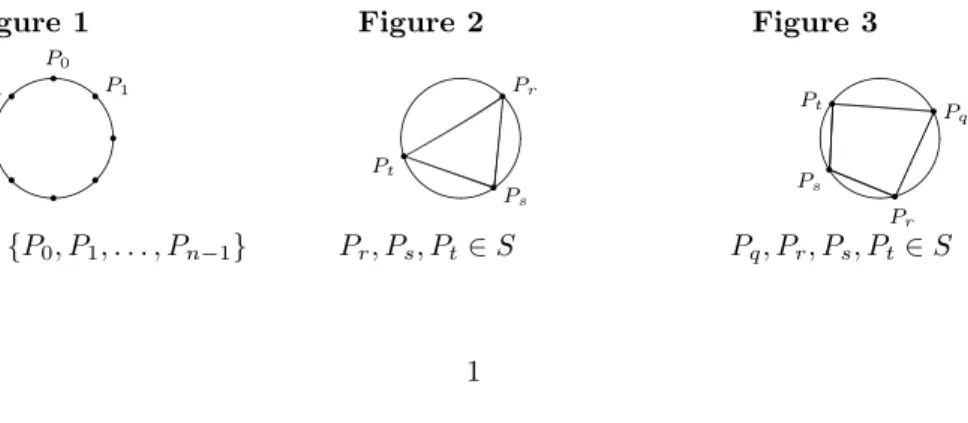
Let C be a circle divided into n parts equally and the ends of parts be labeled S = {P0, P1, . . . , Pn−1} as in the following Figure 1:
Figure 1 Figure 2 Figure 3
P0 P1 Pn−1 q q q q q q q q &% '$ P r Ps q q q Pt &% '$ Pq Pr q q q q Ps Pt &% '$ S = {P0, P1, . . . , Pn−1} Pr, Ps, Pt∈ S Pq, Pr, Ps, Pt∈ S 1
Let C3(n) be the number of incongruent triangles 4PrPsPt with vertices
Pr, Ps, Pt chosen from S = {P0, P1, . . . , Pn−1} as in Figure 2. In our prvious
paper [4], we have proved
C3(n) = p(n − 3, 3),
where p(n, m) denotes the number of partitions of n with each part ≤ m, that is
p(n, m) = p(n | parts in {1, 2, . . . , m}). It is well known that p(n, 1) = 1 and p(n, 2) = h n
2 i
+ 1, where [x] denotes the greatest integer ≤ x. In the case m = 3, it has been known that(see for example [3] Chapter 3) p(n, 3) = ½ (n + 3)2 12 ¾ ,
where {x} denotes the nearest integer to x. One can easily verify that p(n, m) has the following generating function:
∞
X
n=0
p(n, m)qn= 1
(1 − q)(1 − q2) · · · (1 − qm).
Let Ck(n) be the number of incongruent k−polygons Pi1Pi2. . . Pikinscribed
in C, where the vertices {Pi1, Pi2, . . . , Pik} (1 ≤ k ≤ n) are chosen from S. In
our previous paper [4], we have shown:
Ck(n) = p(n − k, k) for 1 ≤ k ≤ 3.
and
C4(n) 6= p(n − 4, 4), and C4≥ p(n − 4, 4) for small n.
In this paper, we shall show
C4(n) > p(n − 4, 4) for n ≥ 6,
and more precisely,
C4(n) = p(n − 4, 4) + p(n − 6, 4) + p(n − 8, 4),
where p(n, m) are defined to be 0 for n < 0. Moreover, we shall show C5(n)
has much complicated representation in the last section.
Quadratics
Here we shall introduce several notations. Let S = {P0, P1, . . . , Pn−1} be as
i1 < i2 < · · · < ik ≤ n − 1) are took from S. Put a1 = i2− i1, a2 =
i3− i2, . . . , ak−1 = ik − ik−1 and ak = n + i1− ik. Let O be the center of
the given circle C. Then the central angles of k−polygon Pi1Pi2· · · Pik are
6 Pi jOPij+1= 2πaj n (1 ≤ j ≤ k − 1) and6 PjkOPi1 = 2πak n .
Then a1, a2, . . . , ak satisfies a1, a2, . . . , ak ≥ 1 and a1+ a2+ · · · + ak = n. In
the following, we shall denote the k−polygon P0Pa1Pa1+a2· · · Pa1+a2+···+ak−1
by P (a1, a2, . . . , ak). Then any k−polygon Pi1Pi2· · · Pik is congruent to the
k−polygon P (a1, a2, . . . , ak), where a1 = i2 − i1, . . . , ak−1 = ik − ik−1 and
ak= n + i1− ik as above.
We shall use the notation ∼= when two k−polygons P (a1, . . . , ak) and P (b1, . . . , bk)
are congruent.
In our previous paper [4], we noted that P (a1, a2, a3) ∼= P (aσ(1), aσ(2), aσ(3))
for any permutation σ ∈ S3. Here we note that these properties do not hold
for the cases k ≥ 4. For example, let us verify the case n = 6 and k = 4. Then a partition 6 = 2 + 2 + 1 + 1, corresponds to the following two incongruent quadrangles P (2, 2, 1, 1) and P (2, 1, 2, 1). q q q q q q &% '$ P (2, 2, 1, 1) q q q q q q &% '$ P (2, 1, 2, 1)
Hence, in the case of quadrangles, we must consider the congruent classes of quadrangles which correspond to the same partition n = a + b + c + d. Thus we shall consider the following 8 cases of the partitions of n separately. (1) P (n | n = a + b + c + d, with a > b > c > d ≥ 1), (2) P (n | n = 2a + b + c, with a > b > c ≥ 1), (3) P (n | n = a + 2b + c, with a > b > c ≥ 1), (4) P (n | n = a + b + 2c, with a > b > c ≥ 1), (5) P (n | n = 2a + 2b, with a > b ≥ 1), (6) P (n | n = 3a + b, with a > b ≥ 1), (7) P (n | n = a + 3b, with a > b ≥ 1), (8) P (n | n = 4a, with a ≥ 1).
Firstly, we shall consider the case (1).
It is easy to see that each partition n = a + b + c + d corresponds to exactly 3 incongruent quadrangles P (a, b, c, d), P (a, c, d, b) and P (a, d, b, c). On the other hand, we have
P (n | n = a + b + c + d, with a > b > c > d ≥ 1)
= P (n − 10 | n − 10 = (a − 4) + (b − 3) + (c − 2) + (d − 1), with a − 4 ≥ b − 3 ≥ c − 2 ≥ d − 1 ≥ 0)
= P (n − 10 | n − 10 = 4x + 3y + 2z + w, with x, y, z, w ≥ 0) = P (n − 10 | parts in {1, 2, 3, 4}).
Thus the generating function of the partition P (n | n = a + b + c + d, with a > b > c > d ≥ 1) is ∞ X n=0 P (n | n = a+b+c+d, with a > b > c > d ≥ 1)qn= q 10 (1 − q)(1 − q2)(1 − q3)(1 − q4).
Now we denote the subset of congruent classes of quadrangles ℘4/ ∼= which
correspond to this case (1), by ℘4(a, b, c, d). We also denote the number of
congruent classes ℘4(a, b, c, d) by C4(a, b, c, d). Since C4(a, b, c, d) = 3P (n −
10 | parts in {1, 2, 3, 4}), we have ∞ X n=0 C4(a, b, c, d)qn= 3q 10 (1 − q)(1 − q2)(1 − q3)(1 − q4).
Now we shall consider the case (2), similarly.
It is easy to see that each partition n = 2a + b + c corresponds to exactly 2 incongruent quadrangles P (a, a, b, c) and P (a, b, a, c). Moreover we have
P (n | n = 2a + b + c, with a > b > c ≥ 1)
= P (n − 9 | n − 9 = 2(a − 3) + (b − 2) + (c − 1), with a − 3 ≥ b − 2 ≥ c − 1 ≥ 0) = P (n − 9 | parts in {2, 3, 4}).
Thus the generating function of the partition P (n | n = 2a + b + c, with a > b > c ≥ 1) is ∞ X n=0 P (n | n = 2a + b + c, with a > b > c ≥ 1)qn= q9 (1 − q2)(1 − q3)(1 − q4).
We denote the subset of congruent classes of quadrangles ℘4/ ∼= which
corre-spond to this case (2), by ℘4(a, a, b, c). We also denote the number of
con-gruent classes of ℘4(a, a, b, c) by C4(a, a, b, c). Since C4(a, a, b, c) = 2P (n −
9 | parts in {2, 3, 4}), we have ∞ X n=0 C4(a, a, b, c)qn= 2q 9 (1 − q2)(1 − q3)(1 − q4).
Now we shall consider the case (3), similarly and define the symbols ℘4(a, b, b, c) =
C4(a, a, b, c) as above. Then each partition n = a + 2b + c corresponds to
ex-actly 2 incongruent quadrangles P (a, b, b, c) and P (a, b, c, b). The generating function of the partition P (n | n = a + 2b + c, with a > b > c ≥ 1) is
∞ X n=0 P (n | n = a + 2b + c, with a > b > c ≥ 1)qn = q 8 (1 − q)(1 − q3)(1 − q4).
Since C4(a, b, b, c) = 2P (n − 8 | parts in {1, 3, 4}), we have ∞ X n=0 C4(a, b, b, c)qn= 2q 8 (1 − q)(1 − q3)(1 − q4).
In the case (4), we shall use the similar definition of the symbols ℘4(a, b, c, c) =
C4(a, b, c, c) as above. Since each partition n = a+b+2c corresponds to exactly
2 incongruent quadrangles P (a, b, c, c) and P (a, c, b, c), we have C4(a, b, c, c) =
2P (n − 7 | parts in {1, 2, 4}). Hence ∞ X n=0 C4(a, b, c, c)qn= 2q 7 (1 − q)(1 − q2)(1 − q4).
In the case (5), we shall use the similar definition of the symbols ℘4(a, a, b, b) =
C4(a, a, b, b) as above. Since each partition n = 2a + 2b corresponds to exactly
2 incongruent quadrangles P (a, a, b, b) and P (a, b, a, b), we have C4(a, a, b, b) =
2P (n − 6 | parts in {2, 4}). Thus we have
∞ X n=0 C4(a, a, b, b)qn= 2q 6 (1 − q2)(1 − q4).
In the case (6), we shall use the similar definition of the symbols ℘4(a.a, a, b) =
C4(a, a, a, b) as above. Since each partition n = 3a + b corresponds to exactly
one quadrangle P (a, a, a, b), we have C4(a, a, a, b) = P (n − 7 | parts in {3, 4}).
Thus we have ∞ X n=0 C4(a, a, a, b)qn = q 7 (1 − q3)(1 − q4).
In the case (7), we shall use the similar definition of the symbols ℘4(a.b, b, b) =
C4(a, b, b, b) as above. Then each partition n = a + 3b corresponds to exactly
one quadrangle P (a, b, b, b) and C4(a, b, b, b) = P (n − 5 | parts in {1, 4}). Thus
we have ∞ X n=0 C4(a, b, b, b)qn = q 5 (1 − q)(1 − q4).
In the case (8), we shall use the similar definition of the symbols ℘4(a, a, a, a) =
C4(a, a, a, a) as above. Then each partition n = 4a corresponds to exactly one
quadrangle P (a, a, a, a) and C4(a, a, a, a) = P (n − 4 | part in {4}). Thus we
have ∞ X n=0 C4(a, a, a, a)qn= q 4 1 − q4.
From the definition of the symbols, we have P∞ n=0C4(n)qn = P∞ n=0C4(a, b, c, d)qn+ P∞ n=0C4(a, a, b, c)qn +P∞n=0C4(a, b, b, c)qn+ P∞ n=0C4(a, b, c, c)qn +P∞n=0C4(a, a, b, b)qn+ P∞ n=0C4(a, a, a, b)qn +P∞n=0C4(a, b, b, b)qn+ P∞ n=0C4(a, a, a, a)qn. Thus we have P∞ n=0C4(n)qn = 3q10 (1 − q)(1 − q2)(1 − q3)(1 − q4)+ 2q9 (1 − q2)(1 − q3)(1 − q4) + 2q 8 (1 − q)(1 − q3)(1 − q4)+ 2q7 (1 − q)(1 − q2)(1 − q4) + 2q6 (1 − q2)(1 − q4)+ q7 (1 − q3)(1 − q4)+ q5 (1 − q)(1 − q4)+ q4 1 − q4 = q 4 (1 − q)(1 − q2)(1 − q3)(1 − q4)+ 2q10 (1 − q)(1 − q2)(1 − q3)(1 − q4) + q9 (1 − q2)(1 − q3)(1 − q4)+ q8 (1 − q)(1 − q3)(1 − q4) + q 7 (1 − q)(1 − q2)(1 − q4)+ q6 (1 − q2)(1 − q4) = q 4+ q6+ q8 (1 − q)(1 − q2)(1 − q3)(1 − q4) = ∞ X n=0 (p(n − 4, 4) + p(n − 6, 4) + p(n − 8, 4))qn, where p(m, 4) = 0 for m < 0.
Hence we have shown the following theorem:
Theorem 1. With the above notation, we have
C4(n) = p(n − 4, 4) + p(n − 6, 4) + p(n − 8, 4), ∞ X n=0 C4(n)qn= q 4+ q6+ q8 (1 − q)(1 − q2)(1 − q3)(1 − q4).
Pentagons
In this section we shall briefly show the generating function of C5(n).
In the case of pentagons, we must also consider the congruent classes of pentagons which correspond to the same partition n = a + b + c + d + e. For the sake of simplisity, we shall borrow the name of poker hands. Thus we shall treat the following 16 cases of the partitions of n separately.
(1) High card P (n | n = a + b + c + d + e, with a > b > c > d > e ≥ 1), (2) One pair (2-1) P (n | n = 2a + b + c + d, with a > b > c > d ≥ 1), (2-2) P (n | n = a + 2b + c + d, with a > b > c > d ≥ 1), (2-3) P (n | n = a + b + 2c + d, with a > b > c > d ≥ 1), (2-4) P (n | n = a + b + c + 2d, with a > b > c > d ≥ 1), (3) Two pair (3-1) P (n | n = 2a + 2b + c, with a > b > c ≥ 1), (3-2) P (n | n = a + 2b + 2c, with a > b > c ≥ 1), (3-3) P (n | n = 2a + b + 2c, with a > b > c ≥ 1), (4) Three card (4-1) P (n | n = 3a + b + c, with a > b > c ≥ 1), (4-2) P (n | n = a + 3b + c, with a > b > c ≥ 1), (4-3) P (n | n = a + b + 3c, with a > b > c ≥ 1), (5) Full house (5-1) P (n | n = 3a + 2b, with a > b ≥ 1), (5-2) P (n | n = 2a + 3b, with a > b ≥ 1), (6) Four card (6-1) P (n | n = 4a + b, with a > b ≥ 1), (6-2) P (n | n = a + 4b, with a > b ≥ 1), (7) Five card P (n | n = 5a, with a ≥ 1).
Now we shall verify that the number of incongruent pentagons which cor-respond to the same partition n = a + b + c + d + e.
In the case of high card (1), we see there are 12 incongruent pentagons P (a, b, c, d, e), P (a, b, d, c, e), P (a, b, d, e, c), P (a, b, e, d, c), P (a, b, e, c, d), P (a, b, c, e, d), P (a, c, b, d, e), P (a, c, d, b, e), P (a, c, b, e, d), P (a, c, e, b, d), P (a, d, b, c, e), P (a, d, c, b, e).
the same partition. Her we shall list up for the case (2 − 1), i.e., the case n = 2a + b + c + d. Then there are 6 incongruent pentagons
P (a, a, b, c, d), P (a, a, c, d, b), P (a, a, d, b, c), P (a, b, a, c, d), P (a, c, a, b, d), P (a, d, a, b, c).
In the case of two pair (3), we see there are 4 incongruent pentagons for the same partition. Her we shall list up for the case (3 − 1), i.e., the case n = 2a + 2b + c. Then there are 4 incongruent pentagons
P (c, a, a, b, b), P (c, a, b, a, b), P (c, a, b, b, a), P (c, b, a, a, b).
In the case of three card (4), we see there are 2 incongruent pentagons for the same partition. Her we shall list up for the case (4 − 1), that is for the case n = 3a + b + c. Then there are 2 incongruent pentagons
P (a, a, a, b, c), P (a, a, b, a, c).
In the case of full house (5), we see there are 2 incongruent pentagons for the same partition. Her we shall list up for the case (5 − 1), that is for the case n = 3a + 2b. Then there are 2 incongruent pentagons
P (a, a, a, b, b), P (a, a, b, a, b).
In the cases four card and five card, there is exactly one pentagon which corresponds to each partition.
The case (1)
Firstly we shall consider the case of high card. Then the Young diagram of the partition n = a + b + c + d + e with a > b > c > d > e ≥ 1 satisfies the following relations. a b c d e = a−5 b−4 c−3 d−2 e−1 + Put x = e − 1, y = d − e − 1, z = c − d − 1, u = b − c − 1, v = a − b − 1. Then x, y, z, u, v ≥ 0 and the following conjugate of Young diagrams impies:
a−5 b−4 c−3 d−2 e−1 ←→ v u z y x
Thus we know that P (n | n = a + b + c + d + e, with a > b > c > d > e ≥ 1) = P (n − 15 | n − 15 = (a − 5) + (b − 4) + (c − 3) + (d − 2) + (e − 1), with a − 5 ≥ b − 4 ≥ c − 3 ≥ d − 2 ≥ e − 1 ≥ 0) = P (n − 15 | n − 15 = 5x + 4y + 3z + 2u + v, with x, y, z, u, v ≥ 0) = P (n − 15 | parts in {1, 2, 3, 4, 5}).
Hence the generating function of the partition
P (n | n = a + b + c + d + e, with a > b > c > d > e ≥ 1) is ∞ X n=0 P (n | n = a + b + c + d + e, with a > b > c > d > e ≥ 1)qn = q15 (1 − q)(1 − q2)(1 − q3)(1 − q4)(1 − q5).
We denote the number of incongruent pentagons which corresponds to the partition n = a + b + c + d + e by C5(a, b, c, d, e). Then we have
∞ X n=0 C5(a, b, c, d, e)qn= 12q 15 (1 − q)(1 − q2)(1 − q3)(1 − q4)(1 − q5). The case (2-1)
Now we shall consider the case of one pair (2-1). We know the partition n = 2a + b + c + d with a > b > c > d ≥ 1 corresponds to a a b c d = x x x x x y y y y z z z w w + Here x = d − 1, y = c − d − 1, z = b − c − 1, w = a − b − 1. Then x, y, z, w ≥ 0 and the conjugation of Young diagrams imply that n − 14 = 5x + 4y + 3z + 2w with x, y, z, w ≥ 0.
Thus we know that
P (n | n = 2a + b + c + d, with a > b > c > d ≥ 1)
= P (n − 14 | n − 14 = 2(a − 4) + (b − 3) + (c − 2) + (d − 1), with a − 4 ≥ b − 3 ≥ c − 2 ≥ d − 1 ≥ 0)
= P (n − 14 | n − 14 = 5x + 4y + 3z + 2w, with x, y, z, w ≥ 0) = P (n − 14 | parts in {2, 3, 4, 5}).
Hence the generating function of the partition P (n | n = 2a+b+c+d, with a > b > c > d ≥ 1) is ∞ X n=0 P (n | n = 2a + b + c + d, with a > b > c > d ≥ 1)qn = q 14 (1 − q2)(1 − q3)(1 − q4)(1 − q5).
We denote the number of incongruent pentagons which corresponds to the partition n = 2a + b + c + d by C5(a, a, b, c, d). Then we have
∞ X n=0 C5(a, a, b, c, d)qn= 6q 14 (1 − q2)(1 − q3)(1 − q4)(1 − q5). The case (2-2)
For the case of one pair (2-2), we see that n = a + 2b + c + d with a > b > c > d ≥ 1. Denote the number of incongruent pentagons which corresponds to the partition n = a + 2b + c + d by C5(a, b, b, c, d). Then similary as above, we
have ∞ X n=0 C5(a, b, b, c, d)qn= 6q 13 (1 − q)(1 − q3)(1 − q4)(1 − q5). The case (2-3)
Consider the case of one pair (2-3) similarly. Then n = a + b + 2c + d with a > b > c > d ≥ 1. Denote the number of incongruent pentagons which corresponds to the partition n = a + b + 2c + d by C5(a, b, c, c, d). Then we have
∞ X n=0 C5(a, b, c, c, d)qn = 6q 12 (1 − q)(1 − q2)(1 − q4)(1 − q5). The case (2-4)
Consider the case of one pair (2-4). Then n = a + b + c + 2d with a > b > c > d ≥ 1. Denote the number of incongruent pentagons which corresponds to the partition n = a + b + c + 2d by C5(a, b, c, d, d). Then we have
∞ X n=0 C5(a, b, c, d, d)qn= 6q 11 (1 − q)(1 − q2)(1 − q3)(1 − q5). The case (3-1)
Consider the case of two pair (3-1). Then n = 2a + 2b + c with a > b > c ≥ 1. Denote the number of incongruent pentagons which corresponds to the partition n = 2a + 2b + c by C5(a, a, b, b, c). Then we have
∞ X n=0 C5(a, a, b, b, c)qn= 4q11 (1 − q2)(1 − q4)(1 − q5).
The case (3-2)
Consider the case of two pair (3-2), similarly. Then n = 2a + b + 2c with a > b > c ≥ 1. Denote the number of incongruent pentagons which corresponds to the partition n = 2a + b + 2c by C5(a, a, b, c, c). Then we have
∞ X n=0 C5(a, a, b, c, c)qn= 4q10 (1 − q2)(1 − q3)(1 − q5). The case (3-3)
Consider the case of two pair (3-3). Then n = a + 2b + 2c with a > b > c ≥ 1. Denote the number of incongruent pentagons which corresponds to the partition n = a + 2b + 2c by C5(a, b, b, c, c). Then we have
∞ X n=0 C5(a, b, b, c, c)qn= 4q 9 (1 − q)(1 − q3)(1 − q5). The case (4-1)
Now we shall consider the case of three card (4-1). Then n = 3a + b + c with a > b > c ≥ 1. Denote the number of incongruent pentagons which corresponds to the partition n = 3a + b + c by C5(a, a, a, b, c). Then we have
∞ X n=0 C5(a, a, a, b, c)qn = 2q 12 (1 − q3)(1 − q4)(1 − q5). The case (4-2)
Consider the case of three card (4-2). Then n = a + 3b + c with a > b > c ≥ 1. Denote the number of incongruent pentagons which corresponds to the partition n = a + 3b + c by C5(a, b, b, b, c). Then we have
∞ X n=0 C5(a, b, b, b, c)qn= 2q 10 (1 − q)(1 − q4)(1 − q5). The case (4-3)
Consider the case of three card (4-3). Then n = a + b + 3c with a > b > c ≥ 1. Denote the number of incongruent pentagons which corresponds to the partition n = a + b + 3c by C5(a, b, c, c, c). Then we have
∞ X n=0 C5(a, b, c, c, c)qn= 2q 8 (1 − q)(1 − q2)(1 − q5). The case (5-1)
Now we shall consider the case of full house (5-1). Then n = 3a + 2b with a > b ≥ 1. Denote the number of incongruent pentagons which corresponds to
the partition n = 3a + 2b by C5(a, a, a, b, b). Then we have ∞ X n=0 C5(a, a, a, b, b)qn= 2q 8 (1 − q3)(1 − q5). The case (5-2)
Consider the case of full house (5-2). Then n = 2a + 3b with a > b ≥ 1. Denote the number of incongruent pentagons which corresponds to the partition n = 2a + 3b by C5(a, a, b, b, b). Then we have
∞ X n=0 C5(a, a, b, b, b)qn= 2q 7 (1 − q2)(1 − q5). The case (6-1)
Now we shall consider the case of four card (6-1). Then n = 4a + b with a > b ≥ 1. Denote the number of incongruent pentagons which corresponds to the partition n = 4a + b by C5(a, a, a, a, b). Then we have
∞ X n=0 C5(a, a, a, a, b)qn= q 9 (1 − q4)(1 − q5). The case (6-2)
Consider the case of four card (6-2). Then n = a+4b with a > b ≥ 1. Denote the number of incongruent pentagons which corresponds to the partition n = a + 4b by C5(a, b, b, b, b). Then we have
∞ X n=0 C5(a, b, b, b, b)qn= q 6 (1 − q)(1 − q5). The case (7)
Now we shall consider the case of five card (7). Then n = 5a with a ≥ 1. Denote the number of incongruent pentagons which corresponds to the partition n = 5a by C5(a, a, a, a, a). Then we have
∞ X n=0 C5(a, a, a, a, a)qn= q 5 (1 − q5).
From the definition of the symbols, we have P∞ n=0C5(n)qn = 12q 15 (1 − q)(1 − q2)(1 − q3)(1 − q4)(1 − q5)+ 6q14 (1 − q2)(1 − q3)(1 − q4)(1 − q5) + 6q 13 (1 − q)(1 − q3)(1 − q4)(1 − q5)+ 6q12 (1 − q)(1 − q2)(1 − q4)(1 − q5) + 6q 11 (1 − q)(1 − q2)(1 − q3)(1 − q5)+ 4q11 (1 − q2)(1 − q4)(1 − q5) + 4q 10 (1 − q2)(1 − q3)(1 − q5)+ 4q9 (1 − q)(1 − q3)(1 − q5) + 2q12 (1 − q3)(1 − q4)(1 − q5)+ 2q10 (1 − q)(1 − q4)(1 − q5) + 2q 8 (1 − q)(1 − q2)(1 − q5)+ 2q8 (1 − q3)(1 − q5)+ 2q7 (1 − q2)(1 − q5) + q9 (1 − q4)(1 − q5)+ q6 (1 − q)(1 − q5)+ q5 1 − q5 = q 5+ q7+ q8+ 2q9+ 2q10+ 2q11+ q12+ q13+ q15 (1 − q)(1 − q2)(1 − q3)(1 − q4)(1 − q5)
Hence we have shown the following theorem:
Theorem 2. With the above notation, we have the formulae
∞ X n=0 C5(n)qn = q5+ q7+ q8+ 2q9+ 2q10+ 2q11+ q12+ q13+ q15 (1 − q)(1 − q2)(1 − q3)(1 − q4)(1 − q5) .
References
[ 1 ] G. E. Andrews, A note on partitions and triangles with integer sides, American Mathematical Monthly, 86, (1979), 477-478.
[ 2 ] G. E. Andrews, MacMahon’s partition analysis: II, Annals of Combi-natorics, 4, (2000), 327-338.
[ 3 ] G. E. Andrews and K. Eriksson, Integer Partitions, Cambridge Univer-sity Press, Cambridge 2004.
[ 4 ] T. Doi and S.-I. Katayama, A remak on partitions and triangles, Journal of Mathematics, The University of Tokushima, 43, (2009), 1-7.