国際化推進共同研究概要
No. 1
タイトル:
Electron heating of QUEST start-up plasmas, with and without coaxial helicity injection.
研究代表者:
Taylor, Gary
所内世話人: 出射浩 研究概要: 米国、 プリンストン ・ プラズマ物理研究所では、NSTX
装置でCHI
による非誘導プラズマ 電流立ち上げの際、電子温度が低いため、電子サイクロトロン加熱による追加熱が検討されている。QUEST
装置で、 同様にCHI
による非誘導プラズマ電流立ち上げ、 さらに電子サイクロトロン加熱に よる非誘導プラズマ電流立ち上げが行われている。QUST
装置で、CHI
単独、 電子サイクロトロン加 熱単独の非誘導プラズマ電流立ち上げが行い、 各々有効な電流立ち上げを確認した。Electron heating of QUEST start-up plasmas, with and without Coaxial Helicity Injection
Gary Taylor
Princeton Plasma Physics Laboratory, Princeton, NJ, US.A ..
A long-term goal of the National Spherical Tokamak Experiment Upgrade (NSTX-U) at the
Princeton Plasma Physics Laboratory (PPPL) is non-inductive start-up of plasmas with 28 GHz
electron cyclotron heating (ECH) and electron Bernstein wave heating (EBWH). Prior to the recent
major repair of NSTX-U Coaxial Helicity Injection (CHI) was also being planned for non
inductive start-up on NSTX-U, with the addition of ECH when it became available, but with the
planned removal of the electrical break required for CHI this will no longer be possible in the
future. QUEST has 28 GHz and 8.56 GHz heating and CHI, so a collaboration between PPPL and
QUEST researchers on the topic of non-inductive start-up scenarios that use ECH, ECH + CHI
and EBWH to start-up the QUEST plasma non-inductively would greatly benefit the planning of
these future NSTX-U start-up experiments and it would provide an opportunity for NSTX-U
researchers to learn how to implement and program non-inductive start-up discharges.
Non-inductive plasma start-up with high density and current is a key issue for advanced tokamak
reactor concepts as well as for the spherical tokamak concept. The ECH system with a 28 GHz
gyrotron has been prepared for non-inductive electron cyclotron (EC) plasma ramp-up in the
QUEST. There are two important aspects of conducting the present ECH current ramp-up
experiments. One is beam focusing, and the other is incident polarization control. All elliptical
polarization states can be controlled in combination with two corrugated directions of the
polarizers with respect to incident planes of the waves. Two corrugated plates were designed and
fabricated with careful attention to reduce Ohmic losses by means of high-precision milling, not
wire-electrical discharge machining [1]. The two-mirror launcher system has been developed to
obtain a narrow beam size of w ~ 0.05 m. The mirror area should cover the 1 % intensity edge of
1.5w in the beam. The final 2
ndfocusing-mirror diameter was 0.37 m for sharp beam focusing.
Considering the principle of the least propagating-phase, the Kirchhoff integral and the Gaussian
optics were used to evaluate mirror surface design by analyzing the propagating-phases before and
after the first mirror reflection, respectively. The incident beam can be steered from perpendicular
to tangential injections. The steering capability with focusing property was confirmed at the low
power test facilities.
The local ECH effect was confirmed with incident polarization scanning by rotating the corrugated
polarizer-plates. The 140 kW 28 GHz-wave with a parallel refractive index N11 = 0.78 at the 2
ndharmonic ECR layer was obliquely injected into the QUEST. The ramped plasma current (Ip) was
observed on the incident polarization. The experiment with each polarization was conducted after
a shot with the default polarizer-angle setting to ramp upんnormally. The Ip ramp up was observed
to depend on the incident polarization, indicating the local ECHCD effect. Although 140 kW
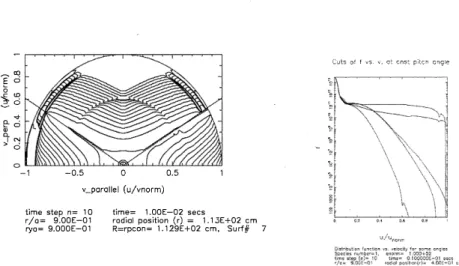
g ·o g ·o -i, ·o z--o (E 」 OUA \ n) d.iadー> o! f VS v, Qミens: pitcゎcngle -0.5
。
0.5 v_porollel (u/vnorm) time step n= 10 r/o= 9.00E-01 ryo= 9.000E-01time= 1.00E-02 secs
radial position (r) = 1.13E+02 cm R=rpcon= 1.129E+02 cm, Surf# 7
Figure 3. (a) Electron distributionfunctionf(v;;, v1) at rla = 0.9; (b) electron distribution function for a fixed pitch angle at rla=0.9 ..
Regarding the latter point, additional work is necessary and still ongoing. For instance, a better
representation of the plasma profiles and a different magnetic equilibrium reconstruction should
be considered in the future simulations.
oz ー 0寸1 09-OB ー (ZEQ\く)全suep .un::J ' , 、 9 , . , ' . �・看 9,�. • .\ . \ i ! \ ’ 0.2 0.4 0.6 0.8 rho
Figure 4. Electron current density evaluated by CQL3D corresponding to a total current off CD= 34 kA.
Future plans
We plan to continue on this work particularly performing additional CQL3D simulations in
collaboration with Prof. Hiroshi Idei. In particular, we would like to use more realistic data,
different dispersion relation and magnetic field equilibrium. Finally, a comparison between the
SXR data with the corresponding CQL3D synthetic diagnostic is foreseen.
References
[1] A. P. Smimov and R. W. Harvey, Bull. Am. Phys. Soc. 40, 1837 (1995). [2] N. Bertelli et al, Phys. Plasmas 19, 082510 (2012).
[3] Harvey W and McCoy M 1992 Proc. IAEA Technical Committee Meeting on Simulation and Modeling of Thermonuclear Plasmas p 489.
Corresponding &
are shown in Fig. 3(b), provides deep (PF35-12), shallow (PF26), and negative
(& <l for PFl 7) potential wells, respectively.
Spectral features of fluctuations
A. Cross-correlation
Cross-correlation coefficient (C
入:y) is calculated among a reference pixel and for all the pixels.
It is defined as:
C = Ixy -n珂 籾沿区
x 2 -nぞ応
y2 -炉)
(2)
Where x and y are two intensity time series signals, the bar denotes ensemble average and n is
the number of samples. It is the zeroth lag of the normalized covariance function. Here we will
refer this quantity as C&, CR�
mand C&J, where the subscript stands for the radial location of the
reference pixel at Z=0.2 m. Thus, C& stands for the correlation coefficient matrix for the
reference pixel at R
sand Z
=0.2 m with all the other pixels. Fig. 3 shows the C& and CRi
mfor
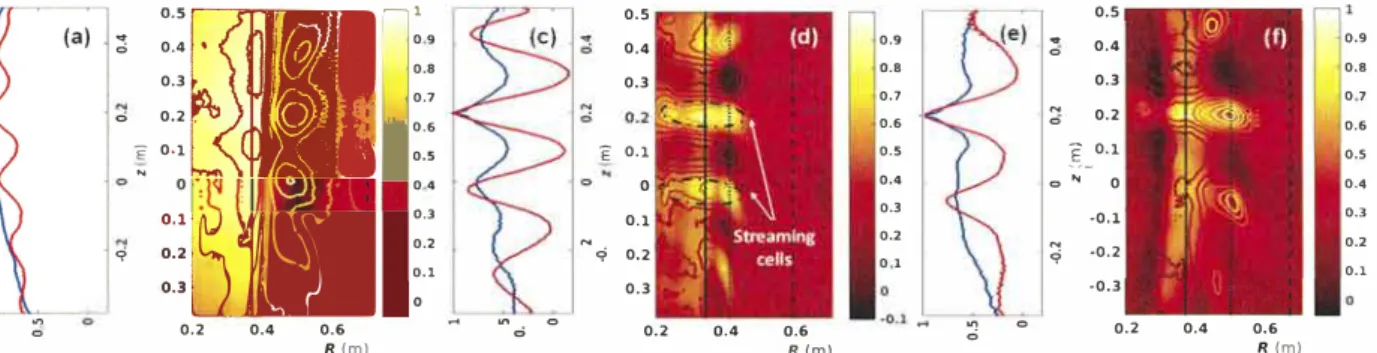
all the three Sm values for Le~ 14 m. The background image represents C&, while the overlaid
contours represent CRi
m-.,
暑
!
し
0.5 0.5`
0 . 0.4 0 9 0.4 09 彎゜9 0.4 0.9 0.8 OB 0.8 0.3 0.3 0.3 07 0.7 07 ci 0.2 06 N ゜ 0.2 0.6 06 -E 0 1 0.5 百0.1 05 一E _ ・. . 0 . 1 o.s " 0.4 0 " 0 04゜
04''
WIi
i
"
0.3 -0,l 0.3 01 0.2 02 ~ 9 0.2 0.2 9 0,2 N 9 -0.2 0.1 0 l 0.1 0.3゜
0.3 -0.3 .... ゜"' 0.2 0.4 0.6 .... .,, 0 ゜ 0.2 04 06 “ ゜ ゜ 0.2 0.4 0.6 R(m) R(m) R (m)Fig. 3: Cross-correlation coefficient (C
.xy) is shown for (b) HiMS, (d) InMS and (f) LoMS
respectively. The background image is C
.xywith the reference pixel at凡and the overlaid
contour is the same with the reference pixel at Rim- Vertical lines from left show the positions
of Rs, Rim and Rs
/respectively; (a), (c) and (e) show the C& at Rs
(blue) and C
凡mat Rim
(red)
respectively.
Correlation between Rs and Rim
is smallest for the highest Sm
value and intermediate for the
least Sm
value, while maximizing for the intermediate Sm
(InMS). The connection between Rs
and Rim
is quite prominent for InMS, showing up like well-connected streaming cells, shown
with broken elliptic eye-guides in Fig. 3 (d), in the cross-co
汀elation coefficient image. For
LoMS, these cells are still forming up, while for HiMS, such connections are not at all apparent
at similar Le. This strong connection between Rs
and Rim
is the most plausible reason for
formation of detached blobs with InMS. As it has been seen later, InMS slabs are most
susceptible to blob formation and ejection, while LoMS slabs are likely to generate detached
blobs at a slightly lower value of Le as compared to InMS. On the contrary, HiMS slabs,
featuring highestふand
& < 1. A distinct spatial mode can be seen at Rimin all the three cases.
Wavelength (k) along Z for this mode grows with decreasingふfor similar Le, as the PF coils
are changed. Longest k (= 0.3 m) was observed for the least Sm
(LoMS).
mode) propagation is vertically upward in the ion diamagnetic drift direction (IDD). The
measured kゴspectra can be fitted by a single linear dispersion relation (f
=v(k)k I 2司up to
moderate range of frequencies such that poloidal
Vph = Vgfor a broad range, as shown in Fig. 5.
The black solid line represents the linear fit and hence poloidal phase velocity
Vphcan be
calculated. For the representative case with InMS and Lc
=5.9 m,
Vphat Ri
mis 1.1 km s-1.
Vphstays in the range of 1
士0.1 km s-1 for the L
evariation considered in this experiment. However,
for LoMS,
Vphis 0.5
士0.1 km s王
Summary of the analysis done
Fluctuation characteristics are observed to differ considerably'Yith the variation in magnetic
shear (S
m). Slab plasmas with intermediate magnetic shear (InMS) are more susceptible to
generate blobs with decreasing connection length (Le). Slabs with low magnetic shear (LoMS)
feature triggering of a coherent mode at ~ 3 kHz as L
eis decreased below ~ 18 m. Slabs with
high magnetic shear (HiMS) are the most stable and are not likely to generate blobs or coherent
modes even at similar L
eas that of their other Sm
counterparts. At InMS, fluctuations are
dominated by broadband turbulence while, at LoMS, drift wave predominance is observed.
Propagation direction of fluctuations remains in the ion diamagnetic drift direction (IDD)
similar to tokamak SOL. Propagation velocity is double in case of InMS as compared to LoMS.
Finally, when the PF coil pairs for InMS and LoMS cases are combined, considerably stronger
blobs with similar average blob frequency are observed in the presence of the coherent mode.
Hence, such suitable combination of magnetic shear can be used as a tool to modify the density
gradient scale length at the edge, edge turbulence characteristics and thereby control the cross
field convective intermittent transport across the LCFS in tokamaks.
Acknowledgements
I gratefully acknowledge the support of my collaborator Prof. H. Idei and PhD supervisor Prof.
H. Zushi. I also acknowledge the help and support offered by my collaborator Dr. T. Onchi,
and all other AFRC staff during the tenure of this collaborative effort. This work was supported
by the International Joint Research Program of the Research Institute for Applied Mechanics
(RIAM), Kyushu University, JAPAN.
Publications and presentations regarding this collaboration during 2017-18.
Publications:
1. Santanu Banerjee, H. Zushi, N. Nishino, K. Hanada, H. Idei, K. Nakamura, M. Hasegawa,
A: Fujisawa, Y. Nagashima, K. Mishra, S. Tashima, T. Onchi, A. Kuzmin, and K. Matsuoka,
"Effect of magnetic shear on edge turbulence in SOL-like open field line configuration in
QUEST', submitted to Plasma Phys. Control. Fusion, 201 7.
at
<
8f(1)8f(2) > +T(1,2)=
P(1,2), T(1,2) = r�1 lnF(え_, v_)<
of c1)of(2)>,
where of is the fluctuating part of distribution function, P(l,2) is the production term with free energy release, r�1 is the inverse of ExB mixing time (correlation time), and F(え,サ_) is the function of the difference of space and velocity. Specific form of the factor differs for the models of turbulence. The case of slab-ITG with 1D drift kinetic equation is given in [5].
The evolution of heat flux is obtained by averaging over the velocity space:
atQ = -f五1xCQ - Q。),
互1:=
疇f △ v dvて;:-1InF(:L, V_), —△ vThe integration can be performed analytically and the inverse of the mixing time typically scales with the ion transit time k11vth·We note that the procedure can be applied to TEM turbulence as we11[4]. In this case, in addition to the form factor, we also need to consider the effect of non-adiabatic electrons, which can appear as additional contribution in the heat flux evolution equation. More detailed analysis, as well as implications on the formation of corrugated profiles, is currently on-going and will be reported in future.
References
1. Y. Xiao and Z. Lin, Phys. Rev. Lett. 103 (2009) 085004 2. Lei Qi, et al., Nucl. Fusion 57 124002 (2017)
3. Y. Kosuga, et al., Phys. Rev. Lett. 110 105002 (2013) 4. G.J. Choi and T.S. Hahm Phys. Plasmas 23 (2016) 072301 5. Y. Kosuga, et al., Nucl. Fusion 57 072006 (2017)
Research members
T.S. Hahm (SNU), Y. Kosuga (Kyushu Univ.), G.J. Choi (SNU), K. Hasamada (Kyushu Univ.), F. Kin (Kyushu Univ.)
A short report on, "Study of EC induced intrinsic rotation in QUEST
tokamak"
By Kishore Mishra
Institute for Plasma Research, Gandhinagar, India, 382 428
Background and Motivation:
Plasma rotation stabilizes magneto hydro dynamics ( MHD) instabilities. Torque to rotate plasma in toroidal direction can be given externally by neutral beam injection or resonant magnetic perturbation. However, at high beam energy and density like the conditions to be prevailed in ITER or DEMO reactors, externally momentum driven rotation may not be significant. Spontaneous rotation with radio frequency ( RF) heating on the other hand has been observed in many tokamaks and is intrinsic in nature without any external torque injection. The mechanism of the RF induced intrinsic rotation and the ways to control it has not been understood adequately. Therefore, mechanism of spontaneous rotation after RF heating is an important topic to understand.
In QUEST spherical tokamak, plasma current is non-inductively started up and driven by Electron Cyclotron Waves ( ECW). Spontaneous rotation of such ECW driven plasma has been observed with the help of Doppler spectroscopy and Mach probe measurements. Recent experiment with 28 GHz-ECW shows that plasma current Jp > 80 kA, could be driven with ECW s alone. Local heating is enhanced using
two quasi-optical mirrors, where the beam waist at resonance is about 5 cm in diameter. For instance, the power density around EC resonant layer reaches 5 MW /m2 at 150 kW incident power.
In addition, the polarizer for incident EC wave has been installed. It consists of two phase shifters (入/4 and入/8), where入is a wavelength of 28 GHz EC wave. Incident wave polarization can be adjusted to select 0- and X-modes by turning the plates around and changing the polarizer angles. In the QUEST plasma experiment, dependence of plasma current on
-30
Plasma Current [kA] -20
-10
恥
。
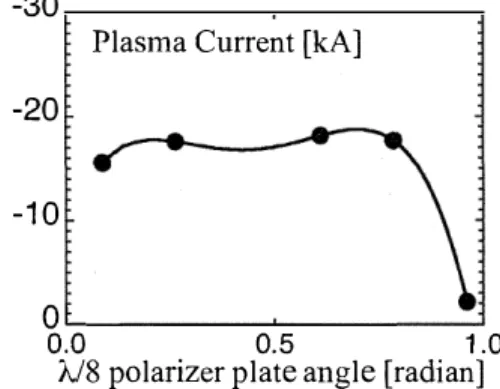
.5 1.0扇polarizerplate angle [radian] Fig. I: Non-inductively ramped plasma current, depending on one-eighth入polarizer plate angles
the polarizer angles has been observed. Relationship between the入/8 plate and plasma current is presented in Fig. 1. As current start-up failed at the angle around 1.0 radian, attained plasma current depends on angle of the入/8 plate. According to such tendency, it is clear that plasma response depends on polarization of incident wave. Spontaneous rotation can be changed by condition of the cu汀ent drive. Therefore, fine polarization control is required to understand the mechanism how incident EC-wave generates spontaneous rotation. Unfortunately, relationship between the plate-angle combination and the polarization had not been well surveyed when the dependence shown in Fig.1 was investigated.
and fruitful discussions with Dr. Santanu Banerjee. Part of this research is with a collaboration with Prof. Shikama of Kyoto University, Kyoto.
Publication and presentation
H Idei, T Kariya, T Imai, K Mishra, T Onchi, 0 Watanabe, H Zushi, K Hanada, J Qian, A Ejiri, MM Alam, K Nakamura, A Fujisawa, Y Nagashima, M Hasegawa, K Matsuoka, A Fukuyama, S Kubo, T Shimozuma, M Yoshikawa, M Sakan1oto, S Kawasaki, H Nakashima, A Higashijima, S Ide, T Maekawa, Y Takase, K Toi, "Fully non-inductive second harmonic electron cyclotron plasma ramp-up in the QUEST spherical tokamak", Nucl. Fusion 57,
Control of plasma generated by the new CHI system on QUEST•
2 January 2018
R. Raman
1, K. Kuroda
2, K. Hanada
2, T. Onchi
2, H. Canbin
2, M. Hasegawa
2, M. Ono
3, B.A. Nelson
1, T.R. Jarboe
1,
M. Nagata
4, 0. Mitarai
51 University of Washington, Seattle, WA, USA
2
Kyushu University, Kyushu, Japan
3 Princeton Plasma Physics Laboratory, Princeton, NJ, USA
4
University of Hyogo, Himeji, Japan
5 Institute for Advanced Fusion and Plasma Education, Japan
Introduction
Methods for starting a plasma discharge in a spherical tokamak (ST) without reliance of the center
solenoid are essential for the validity of the ST concept. These methods could also simplify and
reduce the cost of tokamak-based systems and make them more economical by eliminating
components that are not needed during steady-state operation. Coaxial Helicity Injection (CHI) for
an ST, first developed on HIT-II at the Univ. of Washington, is the leading method adopted by
NSTX-U to genrate the initial current during a planned full non-inductive current start-up and
current ramp-up scenario. On QUEST, this method would be further developed using the unique all
metal capability of QUEST, which is predicted to reduce low-z impurities. In addition, CHI on
Abs::>rber
or wer t Lo B ol↑
x
p
JFigure
1:Layout of the transient CHI startup
systems in NSTX. The blue circle is the
poloidal injector flux produced by the lower
divertor coils. This connects the two lower
divertor plates, which are insulated. Gas is
injected in the region below the divertor gap.
On NSTX typically a 5 to 15mF capacitor bank
charged up to
1. 7kVis used to produce the
injector current.
QUEST will develop a new configuration that is much
more suited to ST-FNSF. CHI start-up on QUEST
could be used to provide an alternate, and when
combined with induction, higher current targets for RF
current drive studies. There are a number of new and
important studies that would be possible on QUEST.
These are: (a) Benefits of high-power ECH for CHI
discharge initiation and heating of CHI plasmas, (b)
impact of an all metal wall configuration for reducing
low-z impurities, and (c) development of a simpler
electrode configuration
_
that is much more suitable for
a fusion reactor as described in the Reference. [Raman,
et al., Fusion Science & Technol., 68 (2015) Pg. 674].
All these objectives are well aligned with the
long-term mission of QUEST to develop steady-state
fusion reactor technologies. This document discusses
the near-term plans for CHI studies on QUEST.
*
We acknowledge helpful discussions with Prof. Zushi, Mr. Noda (V-Tech Limited) and Mr.
injected gas was reduced by a factor two compared to the gas injection amounts used during the
May campaign and to
16%
of the gas injection amounts used during the very first CHI discharges
on QUEST. Initiation of CHI discharges at sufficiently low levels of injected gas is quite
important, and necessary, as described in a recent NSTX CHI paper (K.C. Hammond, et al.,
2018
Nuclear Fusion 58
016013).
With these hardware improvements above, improved toroidal currents
up to 50kA were generated that showed toroidal current persistence after the injector current was
reduced to zero (Figure 4). The reliability of absorber arc-free CHI discharges also considerably
h. 魯
improved, even though much less fuel gas was injected during t 1s run. The run campaigns dunng
May and December have allowed us to make good steady progress towards developing the new
CHI electrode configuration for future application to a ST based reactor.
国際化推進共同研究概要
No.9
タイトル:
Towards high mode purity in ECRH transmission lines for ITER
研究代表者:
KASPAREK, Walter, Hermann
所内世話人:
出射浩
概要:
トカマクにおける不安定性抑制には、 揺動の回転に同期した電子サイクロトロン電流
駆動が有効であることが示されている。回転周波数が10kHz程度であることから、 こ
れまでの同期手法は入射電力のオン
・オフであった。 近年、 入射位置のスイッチング
により同期手法が検討されている。 2周波数の電子サイクロトロン電流駆動の入射位
置のスイッチングにつき、 これまでの検討の検証と、 さらにその評価法の再検討を進
めた。
Towards high mode purity in ECRH transmission lines for ITER
Applicant: Walter Kasparek
Institute of Interfacial Process Engineering and Plasma Technology (IGVP) Electron Cyclotron Heating (ECH) using high power millimetre waves is an attractive method for plasma production, auxiliary heating, and current drive in a nuclear fusion research. Accordingly, the ECH system at the International Thermonuclear Experimental Reactor (ITER) will have a total injected power of 20 MW at an operating frequency of 170 GHz. For 20 MW injections to the plasma, 24 high-power gyrotron oscillators of 14 MW each will be used. The output beam from each gyrotron oscillator is led to a Circular Corrugated (CC) waveguide line, and transmitted as an HE11 mode of a main eigen-mode in the waveguide. 24 CC waveguide lines will be prepared to
transmit the total 20 MW power. Excitation of unwanted.
国
gher-order modes in the oversizedwaveguide causes many problems such as excessive transnnss1on loss, arcing, thermal overload of components due to stray radiation, and finally deviations of the launched beams from the nominal direction. In earlier works, transmission losses in the ITER ECH system due to higher-order mode excitation in misaligned components have been estimated, and the impact on the launched beams was studied.
This collaboration has been established to excite and transmit the high-purity main HE11 mode under monitoring and controlling of the transmitted wrong modes for the CW high power application.
The International Joint Research team consisted (besides the applicant) of Hiroshi Idei (RIAM, Kyushu), Keishi Sakamoto (JAEA Naka), Takashi Shimozuma (NIPS, Toki), Richard Temkin (MIT PSFC Cambridge), Michael Shapiro (MIT PSFC Cambridge), Alexander Zach (IGVP Stuttgart), Carsten Lechte (IGVP Stuttgart), and Burkhard Plaum (IGVP Stuttgart).
lnvesti ations of the beam s littin erformance of a s uare corru ated wave uide
Burkhard Plaum, Hiroshi IdeiFor JT-60 a high power capable resonant diplexer for the frequency bands around 110 GHz and 137.55 GHz is designed. It is based on square corrugated waveguides (SCWs), which act as beam splitters. These splitters can be combined with phase reversing mirrors and arranged in a sequence to form ring resonators [ 1].
In the traditional approach, an SCW, which is fed by a Gaussian.beam under a small angle釦,acts as a beam splitter if the length L is chosen as
2a
L=
—
with the waveguide width a and the free space wavelength入If one investigates, however, a larger range of lengths and angles, additional branches can be found, where a beam splitting behavior is observed. These higher branches are necessary to realize a beam splitter, which works in two frequency bands.
In order to search for good operating parameters, we need to define a figure of merit which indicates the quality of a beam splitter. For this, we calculate the field distribution at the end of the waveguide and calculate the power contents p 1 and p2, which correspond to the beams radiated under 釦and -Bin respectively. The beam parameters (e.g. the Gaussian waist radius w0) at the
0.2
0.0
< -30 dB
(a)
O
O
O
B
0
4
2
3
は�
(b)
[ElA< -30 dB
-0.2
L--0.2
0.0
X[m]
0.2
-0.2
0.0
X[m]
0.2
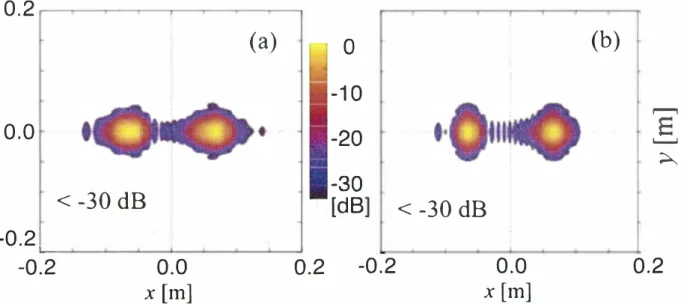
Fig 5: Radiation pattern calculated with the Kirchhoff Integral method for 110 GHz (left) and 138 GHz (right) [1}The horizontal intensity and phase profiles of the field patterns
agreement is, again, perfect. are shown in Figs 6-8. The
A弓uaiu! paZ!IB E』ON 0.9 0.8 0.7 0.6 0.5 0.4 0.3 0.2 -0.1
゜
-100 40 20゜
-20 -40 -60 [ ue1pe.1] ese4d Al!SU81Ut paz,1et E ON 0.9 0.8 0.7 0.6 0.5 0.4 0.3 0.2 0.1゜
x[mm]Fig 6: Horizontal intensity- and phase profile calculated with the FFT algorithm from PROFUSION at 110 GHz -50 50 100 -80
゜
-100 40 20゜
-20 -40 [ UB!PBJ] 8SBLjd -60゜
x [mm]Fig 7: Horizontal intensity- and phase profile calculated with the FFT algorithm from PROFUSION at 138 GHz
11: 10 - 11 :50 Satoru Yajima
Comparison of Ip Start-up by Outboard-Launch and Top-Launch LHW on TST-2
11 :50 - 12:20 Yuichi Takase
LH Ip Start-up Experiments on TST-2: Past and Future
12:20 - 13:00 Masayuki Uchida
Progress and Plans of LATE Experiments (Tentative)
1 February PM 14:30 - 15:20
Masayuki Ono
Status of NSTX-U recovery and solenoid-free start-up I current ramp-up program
15:20 - 16:00 Nicola Bertelli
Initial & preliminary Fokker-Planck simulations by using the CQL3D code for QUEST plasmas
16:00 - 16:40
Luis F. Delgado-Aparicio
Multi-energy SXR imaging and its applications to QUEST plasmas
2 February AM
9:30-10:10
Kengoh�uroda
CHI Experiments in QUEST
10:10 -10:50
Taiichi Shikama
Spectroscopic measurements of intrinsic toroidal rotation in QUEST
10:50 -11 :30
Sadayoshi Murakami
Simulation study of toroidal flow generation by ECH in non-axisymmetric toroidal
plasmas
11:30-12:10
Shin Kubo
Plan for a direct detection of EBW by sub-THz gyrotron scattering in QUEST
2 February PM (Drafting of proposals for experiments, diagnosis, and analysis)
14:00 -All Suggested focus and output for this joint drafting session
16:30 -Vladimir Shevchenko
The presentation summaries are as following:
Vladimir Shevchenko
ECRH
andECCD
Potential onST40
Overview of present status of the ST40 project was presented. Main objectives of the project, parameters of the tokamak, physics program issues are described, and physics and engineering challenges of this device are discussed. A set of ST40 diagnostics were discussed briefly. Fast cameras, visible and UV spectroscopy, magnetics and dual color interferometry were installed on the machine for the first plasma operation.
ST40 power supplies for toroidal field, merging compression coils, vertical field and divertor coils are currently under commissioning. However, first plasma has been achieved in ST40 using merging compression technique in a relatively low toroidal field of 0.3T. Plasma currents up to 30kA have been measured transiently even in the absence of vertical field. Merging compression plasma formation with vertical field will be attempted this week during commissioning of the vertical field power supply. ECRH and ECCD have a great potential in ST40. During full scale operation the magnetic field should reach 3T at the magnetic axis. This corresponds to the frequency of 170GHz for the second EC harmonic at the plasma centre. Gyrotrons with output power up to lMW are widely available for this frequency (developed for ITER). Detailed ray-tracing and Fokker- Planck modelling has been conducted for ST40 around fundamental EC resonance and second harmonic EC resonance. It was found that heating and current drive can be achieved at both harmonics. For the fundamental EC resonance RF power around 84GHz must be launched from the high field side (HFS), which possible in ST40 but technically challenging. Second EC harmonic allows more convenient low field side (LFS) launch at the
frequency around 170GHz. In both configurations the current drive efficiency around'720 = 40
kA・1020m-3·keV-1 is expected. However, the HFS launch can also provide very efficient non-inductive
plasma start-up and current ramp-up while LFS launch requires presence of the optically thick plasma in the vessel. Both options are considered for potential use on ST40 in addition to NBI heating.
Hiroshi ldei Pro ress and Plans on Non-Inductive Plasma Current Ram -u Ex eriment in UEST The EC heating and current drive (ECHCD) system with a 28 GHz gyrotron has been prepared for non inductive EC plasma ramp-up in the QUEST. Non-inductive plasma start-up using the EC waves is a key issue for advanced tokamak reactor concepts as well as for the ST concept. There are two important aspects of conducting the present ECHCD current ramp-up experiments. One is a beam focusing, and the other is incident polarization control. A new transmission. line (TL) and an antenna system composed of polarizers and a large focusing mirror has developed for the local ECHCD. The waist-size of the launched beam was about 0.05 m at the ECR layer. The incident beam can be steered from perpendicular to tangential injection. The steering capability with focusing property was confirmed at the low power test facilities. The local ECHCD effect was observed with the focusing beam in the incident polarization scan. The 86 kA plasma current was achieved using the new TL and launcher. The
right-hand cut-off density neut of the 2nd harmonic 28 GHz-wave is~ 3 x 10e18 mA-3 for the oblique
beyond the cutoff density, then the HX count started to increase. The HXs with 60 keV energy range were measured at the forward tangential viewing radius of 0.32 m for current-carrying electrons. Electron density was one order of magnitude higher compared to the previous experiments with no beam focusing. The current might be generated by energetic electrons, accelerated at the relativistic Doppler-shifted resonance, due to the local ECHCD effect with the incident focused beam, as well as the multiple reflection effect after the cut-off.
Hatem Elserafy1 HFS injection for EBW excitation in QUEST
This presentation contains the High Field Side (HFS) injection scenario for QUEST spherical tokamak. There are several methods _for Electron Bernstein Wave (EBW) excitation including 0-X-B (Ordinary eXtranordinary-Bernstein) mode conversion injected from the Low Field Side (LFS), and X-8 (extraordinary-Bernstein) mode conversion injected from the HFS. 0-X-B mode conversion from LFS was attempted in QUEST without any successful EBW conversion. The primary issue was aligning the injection antenna with the polarizing mirror at the HFS that is responsible of the conversion from 0-mode to X-0-mode. X-8 0-mode conversion takes it one step closer, which guarantees not to suffer from the alignment problem. X-8 mode was proposed in previous literature mentioning conversion efficiency from X-mode to EBW of 100% at the upper hybrid resonance (UHR) layer. However, those systems used mirrors to transmit the wave to the HFS causing undesired power loss. Our proposed system is to extend the waveguide all the way from the LFS to the HFS to maximize power transmission. One drawback is that the waveguide has to pass through the ECR layer and will induce breakdown inside of the waveguide. To avoid that problem, the waveguide will be filled with SF6 gas to suppress breakdown, while using a sapphire safety window to prevent SF6 leakage inside the vessel. This scenario was externally tested using an electromagnet to emulate the ECR layer and 12 kW were successfully transmitted without arcing. Another problem that might arise is the wave absorption at ECR layer, decreasing the amount of power reaching UHR, and thereby decreasing the efficiency. To tackle this problem, optical absorption coefficient was calculated in order to design the horn antenna parameters. The optical absorption dictates that the antenna should be highly directive in order to maximize conversion efficiency at the UHR. However, due to physical space limitation, the antenna has to be as compact as possible. Antenna size was optimized trading off size and directivity, and the experiment is yet to be conducted. Future plans include integrating 2 other klystrons, and reverting plasma current based on antenna location.
Satoru va·ima Com arison of I Start-u b Outboard-Launch and To -Launch LHW on TST-2 Significant increase of the plasma current and the soft X-ray intensity is obtained by top injection. So far, achievable current is 21.5 kA by outboard launch and 26.7 kA by top launch with top limiter position of z=350 mm and bottom limiter position of z=-390 mm.
GENRAY/CQL3D calculation showed the different characteristics among top, outboard, and simulated bottom injection (TF CCW with top launch). Top launch can extend the tail of velocity distribution by the absorption in wide parallel wavenumber range. Simulated bottom launch can further extend the tail due to initial downshift in wavenumber.
Achievable plasma current is mainly proportional to Bt, but top & bottom limiter can reduce the plasma current and induce fast electron loss.
From full wave calculation
Top launch: Optimum distance between antenna and plasma is 17-27 mm Outboard launch: Reflection is suppressed when the limiter is displaced 70 mm
Yuichi Takase LH I Start-u Ex eriments on TST-2: Past and Future
ST plasma initiation and /p ramp-up by the lower hybrid wave (LHW) were demonstrated on the TST-2
spherical tokamak. Progressive improvements in the achieved /p were accomplished using different
methods of wave excitation. High wave directivity of the newly-developed capacitively-coupled combline (CCC) antenna was confirmed by the co/counter asymmetry of hard X-ray emission. Since numerical modeling indicates n11 upshift and strong single-pass absorption for top-launched LHW, the top-launch CCC antenna was installed in addition to the outboard-launch CCC antenna. In LHW-driven
plasmas, both Pe and j are dominated by energetic electrons, ne profile is peaked whereas the Te and
j profiles are hollow, and the driven /p increases with ne, and higher ne requires higher Bt. The top
launch LHW is found to be more effective than the outboard-launch LHW for both directions of Bt,-and
/p ramp-up to> 25 kA has been achieved with less than 100 kW of RF power. The improvements being
considered based on numerical modeling include: TF power supply upgrade to enable higher Bt for longer pulse, optimization of launcher positions and n11 spectra, 3-D control of wavevector (toroidal and poloidal wavenumbers), combination of 450 MHz (for core heating) and 200 MHz (for current drive), and reduction of SOL losses by improved single-pass damping. Since orbit losses of high energy
electrons should decrease at higher /p and ne, a substantial improvement in the /p ramp-up efficiency
may be possible
Masa uki Uchida Pro ress and Plans of LATE Ex eriments
Highly overdense plasma is non-inductively started up and sustained by ECH/ECCD by EB
waves mode-converted in their first propagation band. The electron density reaches 6x10¹⁷
m-3 which is ~g times the plasma cutoff density, where Ip reaches 12 kA by injecting 2.45GHz
power of 65kW. In the 5GHz 70kW experiment, the electron density reaches 1.Sx1018m-3
which is ~s times the plasma cutoff density, where Ip is ramped-up to ~gkA. EBW heating with multi-EC resonances using both the 2.45GHz and 5GHz microwaves is demonstrated during the non-inductive start-up. A 5GHz power of 70 kW is injected into a plasma of
ne~Sx1017m-3 and Ip = 8.SkA which is generated by the fundamental CEBW heating with a
2.45GHz power of 35kW. The plasma current increases up to 14kA with a significant increase of HX emission intensity, suggesting a current carrying fast electron tail is strongly developed by the 2nd harmonic EBW heating of the 5GHz power.
Masa uki Ono NSTX-U Plasma Start-u Research Pro ram and Collaboration Strate
National Spherical Torus Experiment Upgrade is a low-aspect-ratio (A~ 1.6 - 1.8} spherical tokamak
facility at PPPL with Br~ 1 T, Ip~ 2 MA, PNs1 ~ 14 MW, and PRF ~ 4 MW. The unique operating regimes ·
of NSTX-U can contribute to important physics issues for the ST development path. After the PF-1A (a divertor control coil} failure, a recovery project was formed. A number of internal and external reviews were conducted, and it was concluded that the NSTX-U lower ceramic insulation will be removed which preclude the conventional coaxial helicity injection (CHI} capability. This resulted in a reexamination of our plasma start-up program. The NSTX-U Ramp-Up studies will continue using inductively generated targets with HHFW & NBI, as in original plan. NSTX-U solenoid-free start-up activities will be conducted in other ST facilities in the near term: The NSTX-U team will support the more reactor relevant CHI research being conducted on QUEST. If successful, it would be possible to implement an CHI system on NSTX-U without toroidally continuous ceramic insulator. It should be also noted that the PEGASUS group is developing the localized helicity injection (LHI} system. The NSTX-U team would like to enhance collaboration on ECH / EBW start-up studies being conducted on QUEST through theory/modeling and multi-energy soft x-ray camera collaborations. The ultimate goal of NSTX-U is to start-up and sustain high回回 plasma fully non-inductively without use of central solenoid.
Nicola Bertelli Initial & reliminar Fokker-Planck simulations b usin the C L3D code for UEST plasmas
1. Performed initial Fokker-Planck CQL3D simulations for QUEST plasma a. Parabolic profiles
b. Work still in progress
2. Found very strong tail representing high energetic electrons on the location of 2nd harmonic
resonance
3. Total current driven by high energy electrons lower than experiment a. Probably need to improve some parameters for the simulations COLLABORATION with QUEST
Tasks:
1) Continue work on CQL3D simulations in collaboration with ldei-sensei a. More realistic data (?)
b . Different dispersion relations
2) Comparison of SXR data with CQL3D synthetic diagnostic
consequence of atom penetration. The latter effect was checked by calculating the ion loss-cones
using ion orbit calculation. The ensemble averaged toroidal velocity became larger for o+ than c2+ by
a few km/s in the edge region, and this may explain observed velocity difference between c2+ and
o+
ions.
Sada oshi Murakami Simulation stud of toroidal flow eneration b ECH in non-axis mmetric toroidal plasmas
The important role of the plasma flow and its shear in the transport improvement is suggested by many experimental observations. The spontaneous toroidal flow driven by ECH was observed in many tokamak and helical devices. In LHD, when ECH was applied to the NBI heated plasma, the toroidal velocity profile changed drastically and turned over in the core region. ECH generates a radial flux of suprathermal electrons in non-axisymmetric plasmas. We assume that the energetic electron current enhances the bulk ion current to cancel the electron current, and the jxB torque has a significant role in generating a toroidal flow. In this study, we investigate the roles of the」xB torque due to the radial current of energetic electrons and the collisional torque by the energetic electrons, and compare with the LHD experiment results. As a result, the」xB torque generated by ECH has the same order as the NBI torque, and its direction is opposite to NBI torque in the inner region. Also, we evaluate the torque by ECH in the tokamak with finite toroidal field ripple.We find that the significant torque by ECH is obtained in the case the toroidal field ripple > 0.1%.
Shin Kubo Plan for a direct detection of EBW b sub-THz rotron scatterin in UEST
The electron Bernstein wave (EBW) heating/current drive is the most attractive method in QUEST, because EBW can propagate over the cut-off density and give a chance to drive current steadily at over the cut-off density. Since the EBW can. be excited through mode conversion process, it is important to clarify and optimize the injection condition by checking the excited EBW near the core region.
Direct detection of the density fluctuations associated with the EBW is planned. Expected wavenumber in the perpendicular to the magnetic field ranges 104-105 m-1. The direct and detailed measurement of the density fluctuation associated with the EBW gives clear evidence of the excited EBW inside the core, since it is an electro-static wave. Such measurement can be performed by measuring the sub-Tera-Hz wave scattering. The adoption of Littrow mount grating enables flexible scattering configuration under limited port access.
Sub-THz gyrotron at 300-400 GHz gyrotrons at the power level of more than 50 kW have been developed in the Univ. of Fukui. One of such gyrotrons is planned to be introduced in the the QUEST as well as highly sensitive detectors developed for CTS in LHD.
Several Proposals were submitted: Luis F. Delgado-Aparicio:
PPPL scientists (Luis F. Delgado-Aparicio with Nicola Bertelli and Masayuki Ono) are establishing collaboration with scientists at Kyushu University to discuss the possibility of installing a Multi-Energy Soft X-ray (ME-SXR) system at QUEST. A silicon PILATUS3 detector can be used to resolve details of SXR emission between 2 and 30 keV with adequate time-resolution (~1 ms), excellent spatial resolution (~ 1-2 mm) and coarse photon energy (~500 e V) resolution. This new imaging capability can support experiments aiming at studying start-up and sustainment of non-inductive plasma cu汀ent in
spherical tokamaks. Delgado-Aparicio has requested a tangential view aligned with the equatorial midplane at QUEST in order to circumvent the complications from performing a conventional (radial) poloidal tomography. A parallel activity will take place to obtain a synthetic non-Maxwellian x-ray spectra using CQL3D.
Nicola Bertelli:
All the codes above can be used for EC/EBW studies on QUEST plasmas under the collaboration between NSTX-U and QUEST teams.
Tasks:
1} Continue work on CQL3D simulations in collaboration with ldei-sensei a. More realistic data (?}
b. Different dispersion relations
2} Comparison of SXR data with CQL3D synthetic diagnostic
a. Including future data from Luis F. Delgado-Aparicio's camera
3) Collaboration also with R. Harvey (waiting answer from a proposal to work on QUEST submitted in 2017}