The Implementation Process of Enterprise Risk
Management in Higher Education Institutions
journal or
publication title
International review of business
number
14
page range
61-80
year
2014-03
1. Introduction
Higher Education Institutions (HEIs) have been struggling to survive in a changing and competitive environment, especially in advanced countries. For example, many HEIs are threatened by declining student enrollments due to low birth rates and the reduction of national subsidies. Moreover, unpredictable events like natural disasters and terrible accidents may cause major damage to HEIs, as happened in Japan when it suffered an enormous earthquake in 2011.
Furthermore, HEIs today have established relationships with various kinds of public stakeholders, which require them to provide many kinds of services related to their core missions of education, research and public services.
In these situations, HEIs have faced enormous anxieties and uncertainties in their environment and must know how to deal with any adverse event that may cause them significant damage.
This seem to be common in the U.S., the U.K. and Japan and some of HEIs have thus started implementing the strategic and organizational risk management called Enterprise Risk Management (ERM).
Higher Education Institutions
Aiko KAGEYAMA*
Abstract
This study aims to show a sample framework of Enterprise Risk Management (ERM) for Higher Education Institutions (HEIs), especially for those that have been slow in its implementation, using as a case study of the institution that has been most successful in implementing ERM, the University of California. This case shows that building the ERM process and systems takes years and requires cross-functional groups and leaderships have the significant role. Many HEIs in the U.S. have implemented ERM but ERM may be implemented using different methodologies and processes in different countries and cultures, which should be a future research topic.
Keywords: risk, Enterprise Risk Management (ERM), Higher Education Institutions (HEIs)
This study considers how ERM is implemented in HEIs with unique missions and environments, and how ERM is customized for the individual organization. Therefore this study starts by defining ERM and how a process of ERM is created in HEIs; it then considers the case of the University of California (UC) as one of the successful organization implementing ERM in the U.S.. The case is expected to provide a model of ERM for other HEIs concerned with introducing or improving their current risk management.
To achieve its aim above, this study utilizes information obtained from papers published by several HEIs- related organizations including UC.
Chapters 2 and 3 draw on the guidelines presented in a paper by Arthur J. Gallagher & Co. for introducing and launching ERM; these show the several definitions and the structured phases for the development of ERM.
Chapter 4 uses the model of development indicated in the chapter 3 to discuss the case of UC, whose annual reports of risk management, among others, show the phases of its ERM development.
2. Enterprise Risk Management
2.1 Background
In the U.S., between the 1990’s and the early 2000’s, the catastrophic and terrible events that caused huge damages to the nation and economy occurred.
After these, as a preventive step, the Sarbanes-Oxley Act of 2002 was enacted and the Committee of Sponsoring Organization of the Treadway Commission (COSO)1 published the “Enterprise Risk Management-Integrated Framework” (ERM Framework) in 2004.
COSO had been working on developing ERM from about 2000 to provide guidance on the assessment of the business risks and its management especially in the wake of Enron and the September 11 attacks [Hatta and Chuo-Aoyama Audit Corporation with PriceWaterhouseCoopers, 2006, p.v].
This ERM Framework has become the de facto standard of ERM and is accepted internationally and its concept has been adopted by many HEIs in the U.S. for their development of risk management practices.
1 In 1992, COSO had already published the “Internal Control-Integrated Framework” to provide a
framework for all types of organizations with three categories of objectives, as operations objectives, reporting objectives, and compliance objectives, and the five components including control environment, risk assessment, control activities, information and communication, and monitoring activities. This publication indicated why internal control is important and how companies could achieve the profitability and other goals including good fiscal health using appropriate management techniques. This framework provided a common understanding of internal control and sped up the evolution of risk management concepts and techniques in the marketplace [NACUBO and PriceWaterhouseCoopers, 2001, p.3].
2.2 Definitions in general
COSO’s ERM framework offers the following definition, “Enterprise risk management is a process, effected by an entity’s board of directors, management and other personnel, applied in strategy setting and across the enterprise, designed to identify potential events that may affect the entity, and manage risk to be within its risk appetite, to provide reasonable assurance regarding the achievement of entity objectives” [COSO, 2004, p.2].
ERM focuses on the four categories of an entity’s objectives related strategy, operations, reporting and compliance. It consists of eight components of internal environment, objective setting, event identification, risk assessment, risk response, control activities, information and communication and monitoring.
2.3 Definitions for HEIs
Before COSO’s 2004 ERM framework was introduced, there was already a discussion about ERM among HEIs and related-organizations, which led to the dissemination of a paper by the National Association of College and University Business Officers (NACUBO) and PricewaterhouseCoopers. This paper, “Developing a strategy to manage enterprisewide risk in higher education” contained the definition of risk, risk drivers, how to implement a risk management program and to proactively engage the campus community. However it did not clearly define what ERM was at that time. Another paper also published by NACUBO in 2007 showed COSO’s ERM framework to be a definition commonly adopted by HEIs.
The papers published by NACUBO are very useful in explaining ERM practices and their practical application but a paper published in 2009 by Arthur Gallagher & Co. also focused on ERM in the HEIs and it embraced the International Standards Organization (ISO) 31000 definition of risk management policy. The latter defines risk management policy as “the commitment to managing risk as an integral component of an entity’s operations in order to maximize opportunities and minimize setbacks to the entity’s mission, strategies and objectives” [Arthur J. Gallagher & Co., 2009, p.4].
Moreover, according to this paper, ERM helps HEIs to sustain competitive advantage, respond effectively when a significant event occurs, avoid financial surprises, effectively manage scarce resources, define risk appetite and tolerance level, determine the effectiveness of existing risk management controls, improve risk assessments, increase management and business-unit accountability and allocate resources more effectively to address risk [Arthur J. Gallagher & Co., 2009, pp.5-6].
These definitions and the description do not seem peculiar to HEIs and the frameworks adopted by HEIs are, therefore, common. But the process and the detailed methodology could be different for HEIs and customized to their needs as may be found through the case studies or interviews.
2.4 The stage of the evolution of risk management
Risk management evolves through three stages: the traditional risk management, the advanced risk management and the strategic risk management including ERM.
The first stage, traditional risk management takes the “silo approach” that risk management is not integrated across the institution. For example safety and emergency management are handled separately or compliance issues are addressed separately [Arthur J. & Gallagher Co., 2009, p.10]. Purchasing insurance which is the most traditional management style is the typical risk management approach at this stage, where risk is recognized as a negative elements and it tends to be transferred [Arthur J. Gallagher & Co., 2009, p.10].
The second stage is called advanced risk management. Advanced risk management focuses on reducing the cost of risk. Alternative risk financing techniques are frequently used for this purposes and organizations become proactive about preventing and reducing risks, integrating safety and emergency management, claims management, and contracts review into the risk management process; cost allocation is used to determine accountability, and there is more collaboration as well as fewer silos [Arthur J. Gallagher & Co., 2009, p.10].
The final stage, strategic risk management, views risk as an uncertainty and this stage focuses on optimizing risk taking to achieve organization goals. For example, a top-down approach is taken to align the risk management process with strategy and organization’s mission and a wide range of risks are identified and evaluated [Arthur J. Gallagher & Co., 2009, p.10]. In strategic risk management, risks are owned by all the constituents and mitigated at the departmental and individual level. In addition, to achieve organizational goals, many risk mitigation and analytical tools are used [Arthur J. Gallagher & Co., 2009, p.10].
The risk management process evolves gradually in many institutions but the tools or methodology of earlier stages may continue to be used. As the risk management evolves, the previous stage forms a part of the next stage. Hence the institutions still buy the insurances, while building an information system and combining with other offices in the campuses for the cooperation.
3. Enterprise Risk Management of HEIs in the U.S.
3.1 Background
Over the past ten years, HEIs in the US have experienced many changes as globalization, economical hardship, competitions between the institutions, growing student demands, the threat of campus violence, and enactments of new laws and regulations [Arthur J. & Gallagher Co., 2009, pp.4-5]. With these changes, the number of risk surrounding the HEIs
become so numerous, for example, competitive risk, market risk, financial risk, operational risk, technological risk, environmental risk, regulatory risk, litigation risk, political risk, strategic risk, business model risk [Arthur J. Gallagher & Co., 2009, p.5], and each institution or campus have difficulty to address these risks and related matters.
Thus when COSO published its ERM framework in 2004, many institutions adopted it, because its definition served the interests of both for-profit business entities and not-for-profit entities such as the HEIs and made it easier for them to implement ERM.
Moreover, ERM attracted the attention of HEIs when the rating agency, Standard and Poor’s announced that it would expand its rating analysis of nonfinancial corporations to include a review of ERM in 2007 [Standard and Poor’s, 2008, p.2]. In the evaluation, three elements of an entity’s risk control practices are analyzed, including its policies, infrastructure and methodology; the firm’s preparation for emerging risks; and the firm’s strategic risk management [Arthur J. Gallagher & Co., 2009, p.7].
These developments led many HEIs to accelerate and implement ERM in their organizations.
3.2 Introducing ERM into an institution
This section shows the steps for developing ERM, which draw on the guidelines laid out in “Road to Implementation Enterprise Risk Management for Colleges and Universities” published by Arthur J. Gallagher & Co. in 2009.
3.2.1 Phase One: The steps to create ERM
It is possible that HEIs can implement and customize its ERM system and process to fit
Table 1. Phase One: Building the case for ERM Step1: Understand the institution’s plans, environment, and culture.
Step2: Determine the status of the existing risk management processes.
Step3: State the goals and objectives
Step4: Present the case
Step5: Obtain top-level commitment, support, and participation
their organization type, culture and objectives. But according to the paper, there are 20 steps in 4 phases for implementing the ERM. Table 1 shows phase 1 with the 5 steps.
Before building the base of ERM (Step 1), it is important to understand and verify the institution’s strategy, goal, history and the condition of the campus including students, facilities, resources, and so on.
To evaluate the institution’s condition, the following documents are useful to review [Arthur J. Gallagher & Co., 2009, p.12]:
• Organization charts for the institution, business units, and academic departments • Key management documents such as accreditation reports
• Board meeting material and minutes • Student and employee handbooks
• Environmental health and safety (EH&S) and other related policies and procedures • Research, technology transfer, and intellectual property policies and procedures • Business continuity plans
• Available financial reports for the three most recent years • Current annual and long-range budgets
• Information on grant sources, type, and amounts • Act information and incident reports
• List of contracted vendors
• IT security and usage policies, including software licenses • Institutional review board meeting agendas and minutes • Radiation Safety Committee meeting agendas and minutes • Animal care committee agendas and minutes
• External audit reports and management recommendations • Internal audit reports
With the above information, institutions can decide on the direction their risk management should take their focus.
In step 2, the institutions should determine their risk management status quo. For example, how is risk information generated, is the definition of risk common throughout the institution, who is responsible and monitors the status quo, what has been is found in internal audits, which departments are particularly supportive, and are a cross-departmental review and activities possible? [Arthur J. Gallagher & Co., 2009, pp.13-14].
Next, in step 3, the institutions should consider how ERM is related to their mission or strategy and decide on a goal and objective for its implementation.
In the step 4, the institutions should prepare a case statement including the following [Arthur J. Gallagher & Co., 2009, p.15].
• A description on how well the institution is positioned to implement ERM • A statement on how ERM will fit in within the institution’s culture
• The potential value of ERM as articulated by associations such as Association of Governing Board (AGB), NACUBO, and University Risk Management and Insurance Association (URMIA)
• The value of ERM in the institution’s financial ratings
• Example of other institutions that have successfully implemented ERM programs • Example of the greatest risks to the institution
• A description of existing capabilities and gaps for managing risks
• Scenario analyses illustrating the upside and downside impacts of the societal, technological, environmental, economic, and political changes associated with each of the institution’s strategic initiatives
• What human and financial resources will be needed • Who will lead the process
• A description of anticipated challenges • How success will be measured
In the final step of phase 1, it is important to secure the commitment and cooperation of the chair of the board of trustees or the president of the institution; it is also advisable to include such commitment in a mission statement. There are three elements of support to ensure the successful implementation of ERM, which is senior leadership’s commitment to the process, the expectations of senior leadership regarding the success of the initiative and the involvement and commitment of staff and faculty [Arthur J. Gallagher & Co., 2009, p.16].
3.2.2 Phase Two: Building an ERM foundation
Table 2 shows the practical foundation necessary to begin ERM, having identified an institution’s background and obtained the necessary endorsement to implement ERM.
The ERM initiative may be undertaken by an internal candidate or a newly hired person from outside the institution. Most often, the initiative tends to be taken by the financial officer, followed by the president. In fact, some institutions created the position of Chief Risk Officer (CRO) following the enactment of the Sarbanes-Oxley Act (SOX) in 2002 [Arthur J. Gallagher & Co., 2009, p.18].
Desirable attributes of an ERM leader include strong working knowledge of the institution’s major functions and structures, good project management skills, effective communication and relationship-building skills and knowledge about ERM, or an interest in learning [Arthur J. Gallagher & Co., 2009, p.18].
Table 2. Phase Two: Building an ERM Foundation Step6: Name an ERM leader
Step7: Plan the project and create a timeline
Step8: Select or design an ERM framework that best fits the institution’s goals and culture
Step9: Create a cross-functional risk council
Step10: Create a mission and goals statement for the risk council
Step11: Develop a shared vocabulary and definitions
(Source: Arthur J. Gallagher & Co., 2009)
The next step is to plan the ERM project, for which the following elements should be considered [Arthur J. Gallagher & Co., 2009, p.18]:
• Involve the right people in the planning process.
• Define the goals-establish the outcome that institution seek from the ERM process • Define objectives
• Identify needed resources including budgets, people, materials, and technology • Assign responsibilities for achieving various goals and objectives with deadlines
• Communicate the plan including the mission and goals. Disseminate the plan to the campus community
• Acknowledge completion of goals and objectives
When institutions begin to implement ERM, many of them also adopt some formal standards that are promulgated and designed to improve corporate governance (Step8) [Arthur J. Gallagher & Co., 2009, p.21]. Apart from the COSO’s ERM framework, there are the ISO 31000 Risk Management principles and guidelines that are applicable to any organization and to all kinds of risks [Arthur J. Gallagher & Co., 2009, p.20]. The latter also have been adopted by many organizations as frequently as COSO’s ERM framework has been.
ERM becomes more effective when the cross-functional members join the risk council or committee to discuss and address risk. This cross-functional cooperation helps the staff and faculty mitigate any risk that may threaten the institution’s benefit [Arthur J. Gallagher &
Table 3. Phase Three: Implementation Step12: Develop a risk portfolio
Step13: Assess the risks: Validate and prioritize Step14: Assign ownership and take action
(Source: Arthur J. Gallagher & Co., 2009)
Co., 2009, p.22].
After organization of the risk council or an advisory committee, the creation of a mission and goals statement is helpful in ensuring the success of ERM as it provides direction, describes the council’s activities, and guides the council’s purpose and goals (Step10) [Arthur J. Gallagher & Co., 2009, p.23]. It also serves as a reminder of the institution’s commitment to the ERM process on the campus and attracts more attention to it [Arthur J. Gallagher & Co., 2009, p.23].
For when all in the institution begin to recognize the ERM process, the risk council should develop and promote a common language of risk management, which would contribute to creating a risk culture, taking risks, and sharing in risk management (Step11) [Arthur J. Gallagher & Co., 2009, p.24].
3.2.3 Phase Three: Implementation
Table 3 shows the steps in Phase 3 which should be reviewed on a regular basis in a cycle of the ERM process.
Many kinds of documents and reports, based on interviews, surveys, SWOT analysis and workshops are used to develop a risk portfolio (Step12). Any changes in the internal and external environment as well as local and state trends in higher education may affect an institution’s portfolio [Arthur J. Gallagher & Co., 2009, p.25]. One recommended approach to developing a risk portfolio includes identifying the ranking risks, to be presented in a worksheet to the president and members of the institution’s governing board, and to the academic affairs, compliance, external relations, facilities, finance, human resources, information technology, research, and student affairs department [Arthur J. Gallagher & Co., 2009, p.25].
After identifying the risks at step 12, the next step is to assess the risk by applying the existing risk management controls to see if they are adequate for addressing the priority risks. For this process, a validation workshop is useful to accurately prioritize risks, build
Table 4. Phase Four: Sustaining the ERM program Step15: Assess the results
Step16: Meet and report
Step17: Review and realign risk treatment with available resources Step18: Do not neglect traditional risk management functions Step19: Review any ERM framework selected to follow Step20: Develop an institution-wide system for communicating
(Source: Arthur J. Gallagher & Co., 2009)
support for and buy-in to the process, assign risk ownership, and establish acceptable mitigating techniques and agreements [Arthur J. Gallagher & Co., 2009, p.29].
When the institutions assess a priority risk, their risk appetite and risk tolerance are then determined. Risk appetite is defined by COSO as the amount of risk an organization is willing to accept in pursuit of value [COSO, 2012, p.1]. The following questions are helpful to determine risk appetite [Arthur J. Gallagher & Co., 2009, p.30]:
• What risks will the institution not accept?
• What risks will the college or university take with any new initiatives? • What risks will the institution accept for competing objectives?
According to COSO, risk tolerance is “the acceptable level of variation an entity is willing to accept regarding the pursuit of its objectives” [COSO, 2012, p.4], and risk tolerance helps establish acceptable boundaries around entrepreneurial behavior and the implementations process [Arthur J. Gallagher & Co., 2009, p.30].
After step13, risk owners are identified and each of them develops a plan for treating risk. A Risk owner chooses from options including reduction, control, transfer, acceptance and avoidance [Arthur J. Gallagher & Co., 2009, p.33].
3.2.4 Phase Four: Sustaining the ERM program
To sustain the ERM program successfully, continuous improvement, assessment, and reviewing are requisites.
After the first validation meeting and assignment of risk ownership, the risk council needs to assess the owners’ work and assess their performance to see if the goals were achieved (Step15) [Arthur J. Gallagher & Co., 2009, p.35].
It is important to repeat the following steps for sustaining and improving the ERM program [Arthur J. Gallagher & Co., 2009, p.35].
• Identify and measure the risk
• Define the goals and mitigation tasks • Select risk owner(s)
• Agree on process
• Establish a measurement means • Agree on time, personnel, and budget • Establish milestones
• Report to Risk Council
The assessment of the implemented ERM should be presented at a meeting or in a report to show how successful it has been and to state measurable outcomes (Step16). If after the assessment, a different priority risk is identified and the appropriate resource is not available, the plan for risk treatment should be revised and appropriate resources allocated to achieve more effective results (Step17) [Arthur J. Gallagher & Co., 2009, p.37].
Although the risk management evolves as shown in chapter 2, the traditional risk management approach that focuses on purchasing risks, claims management, and safety compliance remains an important part of ERM and continuous reviews of those areas should be conducted (Step18).
Finally, throughout the program and process, good communication is necessary because ERM becomes more effective when all the members of an institution are involved. ERM should be explained in layman language, and information and reports should be presented with the aim of holding the interest of constituents at every level and area the institutions. This type of information enable the continuous improvement of ERM since it allows institutions to obtain different useful kinds of information that are needed to review the existing process including the standards adopted, the operations, activities of departments and individuals including the staffs, faculty and students and decision makings (Step20).
4. Creating ERM- The case of the University of California (UC)
In this chapter, the development of ERM at the UC is discussed in line with the steps shown in the previous chapter.
4.1 Phase One: Building the case for ERM at UC
campuses, as well as national laboratories and medical centers.
Before the publication of COSO’s ERM framework in 2004, a group at UC Davis had already discussed and tried to address the risks on campus in 2003 [UCOPRS, 2007b, p.4].
In 2005, an organization-wide group, the ERM Panel was formed, the members of which included management representatives from the Office of the President and the campuses. The mission of the ERM Panel was to develop a request for proposal for consultation services related to coordinating and implementing ERM initiatives at UC [UCOPRS, 2006a, p.1].
The Risk Management Leadership Council (RMLC) was next formed by 2006; this was “an organization of the risk management senior leadership from UC campuses, Office of the President, medical centers, and Agriculture and Natural Resources” [University of California Risk Management Leadership Council, 2010, p.2]. This Council works in partnership with UC leadership to articulate goals, strategies, priorities and solutions that support the university’s missions of teaching, research, public service and patient care. The Council seeks opportunities to address common risk management challenges and to advance the collective risk management priorities of its constituent organizations [UCRMLC, 2010, p.2].
When starting the ERM with the assistance of KPMG International, UC reviewed the existing programs and data to identify the components for its ERM framework, gathered information, and held meetings with key stakeholders on areas such as employment practices, infrastructure and construction, student life, strategic sourcing, budget, safety & emergency preparedness, research, internal controls, IT risk, and so on [UCOPRS, 2006b, p.1] (Step1 and related to Step14). At this time, risk managers already existed on each campus and there were internal audit and controllers in the Office of the President who collaborated on risk management.
The ERM goals or benefits were reviewed as the situation changed. According to the annual report for the year 2007 to 2008, the importance of ERM to the university was described as follows [UCOPRS, 2008, p.3].
• ERM is a best practice. The majority of universities across the US are implementing ERM programs.
• Rating agencies are beginning to focus on ERM activities2
.
• ERM increases awareness of campus and medical center activities and risks, allowing for better management of those activities.
• ERM provides a common language to communicate, a process to identify and mitigate risks, and criteria to evaluate and prioritize resources, which creates efficiencies.
2 In November 2007, Standard & Poor’s indicated its intention to assign scores of ERM quality to all
companies it reviews and to incorporate an ERM segment into its ratings reports, mentioned in chapter 3.
• It will save the University money
The goals of the ERM program as UC a result for the year 2011 to 2012 were as follows (related to Step3) [UCOPRS, 2012, p.12]:
• Articulate and promulgate the philosophy for managing risk • Define the amount of risk the campus is willing to accept
• Establish a culture that promotes innovation consistent with their willingness to accept risk and that allows managers to manage their risks within established tolerances
• Develop an environment in which the assessment and management of risk is integrated into all business practices and decision-making activities
• Develop a portfolio view of current and emerging risks across the enterprise
• Promote an efficient and repeatable methodology for identifying, prioritizing and treating risks
• Ensure the risk responses (avoiding, accepting, reducing, or sharing risk) align with management’s risk tolerances and willingness to accept risks
• Identify risk indicators and develop action plans to mitigate risks
• Regularly monitor the risks identified and the effectiveness of mitigation activities; and communicating findings to responsible executives
• Continuously assess risk management strategies to assure they remain current with regulatory, operational and legal changes; emerging risks and opportunities; and strategic plans
UC has issued an annual report since 2005 and these reports are distributed at the meeting of regents. Also when needed, the Chief Financial Officer and Chief Risk Officer (CRO) make presentations to explain the ERM and ask for the formal endorsement of ERM (Step4).
The regents endorsed the ERM in 2012 with the recommendation of the President and according to the meeting handout, the President’s formal endorsement would strengthen the program, ensuring sustainability, which was in keeping with best practices as reflected in the common standards of the COSO ERM Framework and ISO 31000 Risk Management Standards [UCOP, 2012, p.2] (Step5).
4.2 Phase Two: Building an ERM Foundation at UC
UC established the position of CRO in 2004. Also the Department of Risk Management changed its name to the Office of Risk Services (the Risk Services), to broaden the new approach to identifying and managing risk and to strengthen its service-based approach to leading and supporting the institution [UCOPRS, 2005, p.3] (Step6). The mission statement of the Risk Services describes its major mission, as represented below (Step7) [UCOPRS, 2005, p.3].
“Our mission is to enable the University faculty, staff, and students to identify and manage risks associated with their activities, consistent with the University’s missions of teaching, research, and public service. By strategically managing risk we can reduce the chances of loss, create greater financial stability, and protect our resources.”
Around 2005, UC has adopted the COSO’s ERM framework and in 2012, added the ISO 31000 as its basic concept for ERM (Step8).
In addition, a main initiative of the ERM, as mentioned in 4.1, was UC’s formation of the RMLC, the purpose of which is “to identify issues of common concern, best practices, create work products, position papers and recommended outcomes that improve UC in a way that cannot be effectively achieved by the efforts of any one individual risk management location”. It “works in partnership with UC leadership to articulate goals, strategies, priorities and solutions that support the University’s missions of teaching, research, public service and patient care” [UCRMLC, 2010, p.1]. There are also the working groups for eight kinds of risk areas (risks to minors, operational risks, property risks, research risks, student related risks, faculty/staff risks, general liability risks, and professional liability risks). Another eight groups that make up a council liaison (including academic affairs, emergency managers, ergonomics, field safety, hazardous waste, sports recreation, and workers’ compensation) work to understand the university’s risk, offer support and provide information related to risk management [UCRMLC, 2010, p.5, 2011, p.1] (Step9 and 10).
UC has built a comprehensive website for communicating with its internal and external constituents. The site provides detailed and clear explanations with graphics of the ERM, as well as linking to a host of related documents. The website provides the answers for questions as “What is ERM and why does UC need it ERM?” and “Getting started (or keeping going) with ERM” for visitors and beginners (Step 11).
4.3 Phase Three: Implementation at UC
UC has identified risks at individual and at departmental level, as well as at each campus and on a system-wide level.
When UC began to lay the foundation for ERM at the individual and departmental level, it interviewed 33 executives and program managers at UCOP and more than 300 senior executives and key process owners at the campuses, medical centers and Agriculture and Natural Resources departments [UCOPRS, 2006e, p.2], to develop a list of key performance indicators (KPIs) (related to Step12). KPIs are based on the local business and operations and are used to measure risk. It identified 550 KPIs of which 430 of them were unique and not duplicated [UCOPRS, 2006d, p.1].
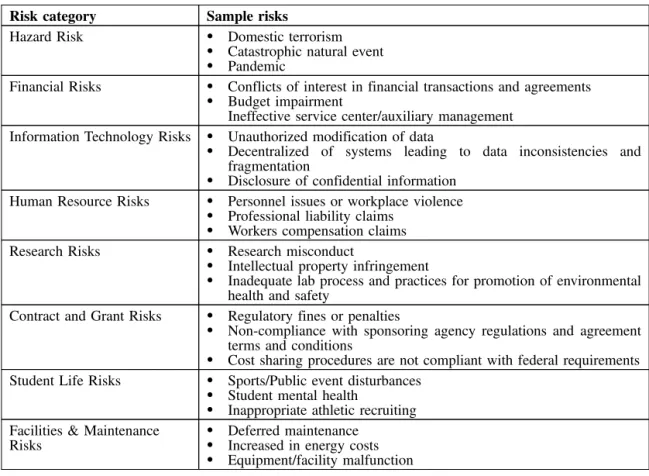
Table 5. Risk category and sample risk
Risk category Sample risks
Hazard Risk • Domestic terrorism • Catastrophic natural event • Pandemic
Financial Risks • Conflicts of interest in financial transactions and agreements • Budget impairment
Ineffective service center/auxiliary management Information Technology Risks • Unauthorized modification of data
• Decentralized of systems leading to data inconsistencies and fragmentation
• Disclosure of confidential information Human Resource Risks • Personnel issues or workplace violence
• Professional liability claims • Workers compensation claims Research Risks • Research misconduct
• Intellectual property infringement
• Inadequate lab process and practices for promotion of environmental health and safety
Contract and Grant Risks • Regulatory fines or penalties
• Non-compliance with sponsoring agency regulations and agreement terms and conditions
• Cost sharing procedures are not compliant with federal requirements Student Life Risks • Sports/Public event disturbances
• Student mental health
• Inappropriate athletic recruiting Facilities & Maintenance
Risks • Deferred maintenance• Increased in energy costs • Equipment/facility malfunction
(Source: UCOPRS, 2010b) These KPIs were screened and KPIs dashboards reports3 were developed to monitor and improve the performance of individuals or departments. Risk Services provides various kinds of tools to meet various purposes. One of the tools is an Excel book called the risk ranking tool, which helps to consider event Likelihood, time to impact, financial severity, injury severity, reputational impact severity [UCOPRS website] and features scores for the potential risk events.
Risk Services conducted a study at the system-wide level to identify the most common risks in higher education by 2010. In the study, about 40 risks were identified and categorized, as partly shown in Table 5 below.
3 The information gathered initially through interviews and from the existing systems stored in the
warehouse integrated into ERM Information System (ERMIS). ERMIS is a central depository of date from many sources [UCOPRS, 2012, p.6] and “provide(s) a variety of qualitative and quantitativetools to help UC locations identify their risks and determine where to strategically deploy resources” [UCOPRS, 2010, p.1]. KPIs and dashboards are updated with requests; the risks focused on by individuals, departments and system-wide vary over time.
Table 6. ERM components and the number of activities Internal Environment/Objective Setting (32 activities) Event Identification/Risk Assessment (24 activities) Risk Response/Control Activities (25 activities) Information and Communication (13 activities) Monitoring (13 activities)
(Source: UCOPRS, 2010c)
Related to the table 5 is the following list that shows the top10 risks in 2012 for all the campuses combined [UCOPRS, 2012, p.16] (related Step13).
• Budget impairment • Laboratory safety
• Disclosure of confidential information
• Inadequate lab processes and practices for the promotion of environmental health and safety
• Deferred maintenance • Student mental health
• Unethical/unapproved human/animal subject research
• Research misconduct, such as falsification of data or results, or non-disclosure of research dangers
• Acts of intolerance
• Threats to safety of researchers
4.4 Phase Four: Sustaining the ERM program at UC
ERM in each UC location is measured and its maturity monitored annually (Step15). UC adopted the assessment methodology of Standard and Poor’s for the first time in 2009 to 2010 because the rating agencies were concerned about the maturity of ERM practices.
The methodology was based on COSO’s ERM Framework and 107 ERM activities were categorized into five areas, as shown in the Table 6 [UCOPRS, 2010c, p.7].
ERM maturity is assessed by five levels, namely, level 5 (Leadership), level 4 (Managed), level 3 (Repeatable), level 2 (Initial), level 1 (Ad hoc).
ERM maturity is also assessed by the institution’s achievement of initiative goals, common objectives and additional objectives. The initiative goals are achieved by each location accomplishing with the local objectives and programs, the common objectives are agreed by all the locations and the additional objectives are location specific and added to
the localized ERM work plan [UCOPRS, 2012, p.14, UC ERM Panel, 2012, p.9].
The results of the assessment are presented in the published annual report of the Office of Risk Services. This report also includes a restatement of risks, the purpose of the service, policy (strategy), achievements, the highlights of ERM, the result of the ERM program and its assessment, prizes, new tools and programs, the traditional risk treatment activities, advanced risk treatment, and so on (the contents vary year by year) (Step16 and Step18). The annual report is also useful for both an internal and external communication.
UC also organizes a Risk Summit every year to share the information about ERM (Step 20). There were 800 hundreds registrants for the summit of 2012, including continuity planners, controllers, counseling professionals, directors of recreational sports, EH&S officials, emergency managers, fire marshals, human resources/disability managers, representative of the Office of the General Counsel, police chiefs, risk managers, representatives from Student Affairs, Student Health Services, and the officials from other HEIs and countries [UCOPRS, 2012, p.9].
To perpetuate a culture of ERM and make ERM a part of constituents’ daily routine or activity, the Risk Services website carries many tools and aids that are linked with the catchphrase “Everyone is a Risk Manager”, which has ERM as its acronym. This website is visited by over 130,000 people a year and ERM is one of the top five search used [UCOPRS, 2012, p.5].
The Office of Risk Services also provides a “My Managed Risk Portal (MMRP)” for authorized users to access all the related tools, applications and information on ERM that have been developed over the years. Over 500 users requested for authorization to access the UC portal during 2011-2012 [UCOPRS, 2012, p.5].
5. Conclusion
5.1 Conclusion
This study indicated mainly how ERM could be implemented and what preparations are required, using the guidance provided by Arthur J. Gallagher & Co. and the case study of UC. The paper by Arthur J. Gallagher & Co. shows that there are the four phases to implementing the ERM process, using 20 steps. These 20 steps are not indispensable, but most need to be achieved depending on the situation and the purpose for the successful implementation of ERM. The development of ERM at UC is much similar to the phases shown by Arthur J. Gallagher & Co.. However the ERM systems at UC have become very complicated for outsiders wishing to learn about it.
In the case of UC, the university took years to prepare and build the process and system which is still developing to be a distinguished strategic risk management model. For these years, UC has consolidated the entire ERM process for addressing local risks and
institution-wide risks, having combined the local offices and managers. As a distinction, UC has focused on developing a risk culture in the institution with the huge systems for information, applications, and solution sets so that all constituents can understand and easily participate in the ERM process.
As the paper by Arthur J. Gallagher & Co. shows, the essential keys to success are found in the UC case, namely, leaderships4 at the local and system-wide level with the endorsement of the President and council, the clear goals5 to be achieved by responsible offices and continuous institution-wide initiatives6that includes ERM.
It is also important to note that any ERM process and activity should contribute to the sustainability of the institution after all, as ERM at UC has contributed to generate institutional savings and revenue for years.
5.2 Limitation
Because this study focused on showing the process for how to start and implement ERM, it could not have discussed further to the detail of each development phases, though using a case of UC which is the excellent model that other institutions can use for launching or improving their own process and system. And also the UC was the only case provided in this study among many cases of ERM with HEIs.
Another limitation of this study is that it was difficult to track the exactly 20 steps shown in chapter 2 in the case of UC. More direct interviews or materials would have been practical and useful to track the implementation phases accurately without skipping some steps in this study.
Many HEIs have already implemented ERM or strategic risk management in the U.S. and other countries, and the methodologies must be customized to suit the size of institutions, their objectives and environment, which is not referred in this study with any comparison.
4 There had been a talented CRO at the Risk Services since the 2005 and her leadership worked well and
the effort and supports of the member of the office and the working groups which members are gathered from the different functions and department made to earn the recognition from the rating agency as the first non-financial agency and the American Productivity and Quality Center that selected one of the top5 best practice organization in ERM out of over 300 organizations.
5 The goals established by the Risk Services at UCOP are “Create Efficiency, Reduce the Cost of Risk,
Improve Cost of Borrowing, Reduce IT and Cost Redundancy”.
6 UC has launched the institution-wide initiative called “Working Smarter Initiative” since 2009 to brings
together an ongoing administrative efficiency initiative to system-wide, regional, and campus-level efforts under one umbrella with one strong commitment from the top [UC, 2011, p.4].
5.3 For a future research
Now, no HEIs can ignore the risks of their environment and HEIs in advanced countries like the U.S., the U.K. and Japan have implemented ERM or the strategic risk management (ERM may be called different name outside of the U.S.) or have shown strong interest in ERM to support their missions. HEIs have common and similar missions and goals but their organizational culture, customs and circumstances are different and so their ERM will be too. Therefore, it would be interesting to categorize ERM methodologies for each country or kind of institution (public or private), because the features of ERM unique to each country are currently unclear. However, more examples and model cases would be helpful to institutions with undeveloped ERM systems.
References
Association of Governing Boards of Universities and Colleges (AGB) and United Educator (UE). (2009). “The State of Enterprise Risk Management at Colleges and Universities Today”.
Arthur J. Gallagher & Co. (2009). “Road to Implementation Enter Risk Management for Colleges and Universities”.
Hatta, Shinji and Chuo-Aoyama Audit Corporation with PriceWaterhouseCoopers. (2006) Translation of “Enterprise Risk Management-Integrated Framework (COSO) (2004)”.
National Association of College and University Business Officers (NACUBO) and PriceWaterhouse Coopers. (2001). “DEVELOPING A SRATEGY TO MANAGE ENTERPRISEWIDE RISK IN HIGHER EDUCATION”.
NACUBO and AGB. (2007). “Meeting the challenges of Enterprise Risk Management in Higher Education”.
Standard and Poor’s. (2008). “Credit FAQ: Enterprise Risk Management For Rating Of Nonfinancial Corporations”.
The Committee of Sponsoring Organization of the Treadway Commission (COSO). (1992). “Internal Control-Integrated Framework”.
The Committee of Sponsoring Organization of the Treadway Commission (COSO). (2004). “Enterprise Risk Management-Integrated Framework Executive Summary”.
The Committee of Sponsoring Organization of the Treadway Commission (COSO). (2012). “Thought Leadership in ERM Enterprise Risk Management − Understanding and Communicating Risk Appetite”. University of California, ERM Panel. (2008). “University of California Enterprise Risk Management
Report to the Vice Chancellors of Administration and Medical Center CEOs”.
University of California, ERM Panel. (2010). “University of California Enterprise Risk Management Report to the Vice Chancellors of Administration and Medical Center CEOs”.
Report”.
University of California, Office of the President (UCOP). (2012). “TO MEMBERS OF THE COMMITTEE ON FINANCE ACTION ITEM For Meeting of March 28, 2012)”.
University of California, Office of the President, Risk Services (UCOPRS). The page of ERM. http://www. ucop.edu/enterprise-risk-management/index.html (accessed 8 January 2014)
UCOPRS. (2005). “UCOP Office of Financial Management Risk Services Annual Report 2004/2005”. UCOPRS. (2006a). “University of California, Office of the President, Enterprise Risk Management (ERM)
Bulletin #1”.
UCOPRS. (2006b). “University of California, Office of the President, ERM Bulletin #2”. UCOPRS. (2006c). “University of California, Office of the President, ERM Bulletin #3”. UCOPRS. (2006d). “University of California, Office of the President, ERM Bulletin #4”.
UCOPRS. (2006e). “University of California, Office of the President, Department of Financial Management, Office of Risk Services, Annual Report 2005/2006”.
UCOPRS. (2007a). “University of California, Office of the President, ERM Bulletin #5”.
UCOPRS. (2007b). “University of California, Office of the President, Department of Financial Management, Office of Risk Services, Annual Report FY2007”.
UCOPRS. (2008). “University of California, Office of the President, Department of Financial Management, Office of Risk Services, Annual Report FY2008”.
UCOPRS. (2009). “University of California, Office of the President, Department of Financial Management, Office of Risk Services, Annual Report FY2009”.
UCOPRS. (2010a). “University of California, Office of the President, ERM Bulletin #9”. UCOPRS. (2010b). “University of California, Office of the President, ERM Bulletin #11”. UCOPRS. (2010c). “CFO Division, Office of Risk Services, Annual Report 2009/2010”. UCOPRS. (2011). “CFO Division, Office of Risk Services, Annual Report 2010/2011”. UCOPRS. (2012). “CFO Division, Office of Risk Services, Annual Report 2011/2012”.
UC Risk Management Leadership Council (UCRMLC). (2010). “University of California, Risk Management Leadership Council Procedures”.