A Mathematical
Aspect
for Liesegang Phenomena
in
two space dimensions
(
空間
2
次元のリーゼガング現象とその数理
)
広島大学大学院理学研究科数理分子生命理学専攻
1 大西
勇 (Isamu Ohnishi)Dept.
of
Mathematical and Life
sciences,
Graduate School
of
Science,
Hiroshima
University
1
Introduction
$\mathrm{H}^{\backslash }1$: Liesegangband [1]
$\mathrm{H}2$: Liesegang ring [2]
We
can see
very beautiful pattern formationas snow
in a single crystal. Incase of
mak-ing precipitation after crystallization, there
are some cases
where verystrikinglyregularmacro-scopicpatterns
can
beseen.
Especially,it iswell-known that spacio-temporallyperiodic patternsemergein reaction-diffusion processwith precipitation in gel, if there is adequate difference of initial densities betweentwo chemical reaction substances. In Germany, Linge first discovered
this phenomena in 1855, and in 1896 Professor R.E.Liesegang studied it first
as
a science. Invitro,
we can
find band pattern andring pattern inone space dimension andtwo spacedimen-sions, respectively (Fig. 1 and Fig. 2). These
are called
Liesegang band and Liesegang ring,respectively,after ProfessorLiesegang. Theinterestingpointis that such
a
spacio-temporaldis-continuous pattern is formed in spiteofchemical reaction
occurs
continuously, and this patter$\underline{\mathrm{s}\mathrm{a}\mathrm{t}\mathrm{i}\mathrm{s}\mathrm{f}\mathrm{i}\mathrm{e}\mathrm{s}}$
very
strikingly regular laws(timelaw, spacing law, andwidth
law).iThisnoteisbasedonthejoint work with ProfessorM. Mimura inMeiji Universityand Dr. D. Ueyama in
Hiroshima University, although, if therearemistypesormistakes undermisunderstanding,then all of themare
duetotheauthor. If youhaveaquestion,would youplease mail himtothe address: [email protected]&
In this note, we report
our
recent studies about such very interesting problem of Liesegang phenomena.2
History
There have been made of tons of researches about Liesegang phenomena since the previous
century. Forexample, there
are
$\mathrm{A})\mathrm{T}\mathrm{h}\mathrm{m}\mathrm{r}\mathrm{y}$of pre-nucleation: 1. super-saturationtheory ([6], [7])
2. diffusiontheory ([8])
3. diffusion
wave
theory ([9])4.adsorption theory ([10])
5. membranetheory ([11])
$\mathrm{B})\mathrm{T}\mathrm{h}\infty \mathrm{r}\mathrm{y}$ of post-nucleation:
1.theoryof
colloid
growth and dissoluton ([3],[12])2. theoryof
colloid
coherence ([13]).In the former
group
oftheories, they consider that positionofpattern is determinedjust whenthe chemical reaction
occures
before nucleation. This is very old way of thinking about thisphenomena. On theother hand, in thelatter group oftheories, they consider ofthepositionof
pattern is decided after nucleation. There
are
some
facts which cannot be explained from theformer theories; for example, spiral structure
or
double periodicstructure. Briefly speaking,we
cannot understandthatthe followingproperties:
1) Colloid particles
can
beseen
inwiderareabefore precipitation,2) Band
or
ring patterncan
be formed ifcolloid
solution witha
mean radius of particlestouches
another
withanother
mean
radius,3) Gavityaffects the position ofpattern,
4) Subring pattern
can
beoftenseen,5) The Second structure canbe made in
a
ringor
bandpattern,6) Spacialbifurcation oftenoccurs,
7) Spacinglaws
can
bestochastic ifthedensity difference is less.Keller-Rubinow model is famousin the super-saturation theory. Inthenextsection webriefly
statesomenumericalsimulations and insufficientpoints inthis$\mathrm{m}o\mathrm{d}\mathrm{e}\mathrm{l}$
.
3
Super-saturation
theory
3.1
Summary
1) Precipitation
occurs
ifthedensityreach the super-saturationdensitybigger than the satu-ration density,2) Reaction speed is much faster than diffusion speed,
and tried to explain Liesegangphenomena. Especially, accourding to themodel, the
discontinu-ous
presipitationemerges.
In the nextsection,we introduce
Keller-Rubinow model in detail tomakenumericalsimulations.
$\wedge\S V3$ $\frac{\mathrm{C}}{\infty}$ $\cup$ $. \frac{.\mathcal{Q}\mathrm{C}}{\mathrm{g}}$ $\overline{\mathrm{C}}$ $\not\in \mathrm{S}$
$\mathrm{H}3$: Super-saturationtheory [3]
3.2
Keller-Rubinow model
In 1981,Professors J.B.Keller and S.I.Rubinow made the model called Keller-Rubinow model
nowaday,with effect ofadsorption
of
colloid combined withthesuper-saturationtheory. This isthefollowing:
$v_{A}A^{+}+v_{B}B^{-}\Leftrightarrow v_{C}Ck$
, (1)
with$k_{+},$ $k$-chemicalreactionconstants,$v_{A},$ $v_{B},$ $v_{B}$,stoichiometriccoefficients,$qP$precipitation
rate, $q$ precipitation coefficient. Here,
we
make $v_{A}=v_{B}=v_{C}=1,$ $k_{-}=0$.
Wecan
make thisbe the following system of partialdifferentialequations:
$\{$ $at=D_{A}\Delta a-kab$, $b_{t}=D_{B}\Delta b-kab$, $c_{t}=D_{C}\Delta c+kab-qP(c, d)$
,
$d_{t}=qP(c,d)$, (3)where, $a,$ $b,$ $c,$ $d$
are
density of each ingredient, $D_{A},$ $D_{B},$ $D_{C}$are
diffusion
coefficients, $k=k_{+}$chemical reactionconstant. The diffusion of$D$
can
benegligible. $P(c,d)$ has thefollowingform:$P(c,d)=\{$ $(c-C_{a})_{+}$
,
if$c>C_{\epsilon}$
or
$d>0$ $0$, otherwise(4)
where$C_{a},$ $C_{s}$
are
saturation density and super-saturation density of$C$, respectively $(C_{s}>C_{a}>$$0)$
.
(Fig. 4)$\mathrm{H}4$: Precipitation $P(c, d)$
3.3
Numerical simulation
3.3.1 One
space
dimensionThe initialconditon is
$a(\mathrm{O}, x)=c(\mathrm{O},x)=d(\mathrm{O}, x)=0,$ $b(\mathrm{O},x)=B_{0}$, (5)
andthe boundarycondition is
$a(t,\mathrm{O})=A_{0},b_{x}(t,0)=c_{x}(t,0)=0,0<t<T$
(6)
$a_{x}(t, L)=b_{x}(t,L)=c_{x}(t, L)=0,0<t<T$
with $A_{0}>>B_{0}>0$
.
(parametersare
the followings: $A_{0}=10.0,$ $B_{0}=1.0,$ $D_{A}=D_{B}=D_{C}=$0.001, $C_{a}=0.2,$ $C_{\delta}=0.8,$ $k=50.0,$$q=50.0,L=1.5$ )
The result is Fig. 7. Spacing law and time law
are
satisfied enough very well, but widthprecipitation
occurs
discretely, although it is not enough inpointof viewof
width ofprecipita-tion. But
Keller-Rubinow
model issimple andgood forunderstanding the mechanismby which precipitationoccurs
discretely and satisfies timelaw and spacing law. In fact, we havealreadygiven
a
mathematically rigorous proofwhichensure
Keller-Rubinow modelhasa
mathematicallyrigorous solution satisfying time law and spacing law under natural assumptions. See indetail
[15], [16], [17], and [18].
$X_{\prime\iota_{1\prime}},\cdot.*\cdot’..\cdot\ldots:**\cdot...\cdot...\ldots..\cdot|u^{--}\prime_{\overline{\mathrm{m}u\cdot\cdot u}\cdot \mathrm{b}\cdot l\cdot\cdot\cdot\cdot u}’\overline{\wedge\neg^{r}\prime}$
$X_{N}$
$\mathrm{H}5$: spacinglaw
$’.’ !.\cdot\cdots\cdots\cdots\cdots\cdots\cdot\cdots\cdots\cdot\cdot\cdots\cdots\cdot\cdot\cdots\cdots\cdots\cdot\cdots\cdot\cdot r-\overline{--\rfloor^{1}\}}$
.
$|_{1}^{\mathrm{t}}$ $\sqrt{t},$$\cdot:$..
$.\prime\prime|.\cdot\bullet \mathrm{i}_{;P_{-\dot{u}\overline{\mathrm{r}}}}\ldots.\ldots\ldots$ .-.. $-*\cdot u\rfloor$ $11$ $X_{N}$$\mathrm{H}6$: timelaw
4
Theory
of
colloid growth
and dissolution
4.1
Kai’s theory
Professor
S.
Kai (Kyushu University) madea
theorywhichexplainedmechanismof Liesegangphenomena in view of colloid growth and dissolution in [4]. We
use
it to try to makea new
mathematical
model ofLiesegang phenomena.pa
8:
colloid growthanddissolution
4.2
Simple application of Kai
$‘ \mathrm{s}$theory
We consider about the followingsystem ofequations:
$v_{A}A^{+}+v_{B}B^{-}\Leftrightarrow v_{C}Ck$ (7) $Carrow DP$ (8) $\{$ $a_{t}=D_{A}\Delta a-kab$, $b_{t}=D_{B}\Delta b-kab$, $c_{t}=D_{C}\Delta c+kab-P$
,
$d_{t}=P$, (9)where
we
rewrite the term$P$as
follows:$P=q \frac{\partial}{\partial t}(\frac{4}{3}\pi R^{3})$
(10)
$R$ : radius ofcolloidparticle, $q,$$M$: constants, $C_{a}(R)$ is the Gibbs-Thomson formula, which isexacly the following;
$C_{a}(R)=C_{e}(1+ \frac{\alpha}{R})$
$\alpha=\frac{2\sigma V}{k_{B}T}$
Here
$C_{\mathrm{e}}$ :
saturation
densityof
the idealparticlewith radius
$\infty$, $\sigma$:
surfaceenergy,
$V$: volume, $k_{B}$ : Boltzmann constant, $T$: templature.
4.3
Numerical
simulation
4.3.1 One space dimension
We make comuter simulation withparameters: $A_{0}=10.0,$ $B_{0}=1.0,$ $D_{A}=D_{B}=D_{C}=0.001$, $k=20,$ $q=0.5,$ $M=1.\mathrm{O},$ $\alpha=0.05,$ $L=10.\mathrm{O}$
.
$\mathrm{H}9$:
One space
dimensionWe try to verify the three charasteristic lawsofLiesegang phenomena. Timelaw and spacing
law
are
satisfied verywell likethecase
ofKeller-Rubinow
model. But widthlaw is notsatisfied,$\mathrm{n}"\ldots\ldots..-..---\cdots\wedge\cdots\cdot-\sim\cdots\cdots\cdot\cdots\cdot\cdots\ldots\ldots.’\ldots\ldots..\cdots\ldots\ldots\ldots...\ddot{\acute{\ddot{\ddot{\ddot{\ddot{\dot{\mathrm{r}}}}}}}},.:..\cdot.\cdots.\urcorner|$
$X_{N+1^{(:_{k\prime\cdot\cdot\cdots\cdots\cdot\cdot:^{-\cdots\ldots\ldots\sim\ldots\iota\ldots\ldots\ldots\ldots\ldots\ldots..l.\ldots\ldots\ldots\ldots\ldots.\prime}j|\dot{u}}|}}\ldots,..\cdot\ldots..\ldots|\ldots..\bullet\nearrow\cdot\bullet’|\ddot{n}\ldots\ldots\ldots\ldots\ldots\ldots\ldots\ldots\ldots\ldots..A\ldots\ldots..\rfloor$
$X_{N}$
$\mathrm{H}10$: spacinglaw $\mathrm{H}11$: timelaw
4.3.2 Two
space
dimensionsWe make two
sapce dimensional
simulation to get Fig. 12.$t=50.0$ $t=1240.0$
$\mathrm{H}12$: Two space dimensions
In thismodel,
we can
makesimulations of
thetwodimensinalringpattern, althoughthe patternsdissapearafter much time goesby. Theresultisbetterthanin the
case
of Keller-Rubinowmodel,but
we
cannot be satisfied with it. In the next sectionwe
improvethis model to get the resultmuch better to discuss about theinterestingview pointsofLiesegang phenomena.
5
Improvement
of the model
We improvethe modelto set the ringpattern fixed adequately. Let
us
$\mathrm{c}o$nsiderthefollowing6
Improved
model
$\{$ $a_{t}=D_{A}\Delta a-kab$ $b_{t}=D_{B}\Delta b-kab$ $c_{t}=D_{C} \Delta c+kab-q\frac{d}{dt}(\frac{4}{3}\pi R^{3})$ $R_{t}=F(c, R)$ (11) $F(c, R)=\{$ $\frac{\Lambda f}{R}(c-\frac{\alpha}{R})_{+}$ if$R_{1}<R$ $\frac{M}{R}(c-\frac{\alpha}{R})$ if$R_{0}<R\leq R_{1}$ $\frac{M}{R_{0}}(c-\frac{\alpha}{R_{0}})$ if$0\leq R\leq R_{0}$ $-hR$ if$R<0$(12)
Here
$R_{0}$ : minimum radius of colloidparticle, $R_{1}$
:
minimum radius of precipitated colloidparticle$q,$$h$: positive constants, $h\gg 1$ and $f(x)_{+}$ satisfies $f(x)_{+}=\{$ $f(x)$ $0$ if$f(x)\geq 0$ if$f(x)<0$
7
Numerical simulation
7.1
One space dimension
$\mathrm{Q};-\mathrm{T}\mathrm{l}\mathrm{l}\mathrm{a}*:-\mathrm{n}\mathrm{r}\mathrm{a}\mathrm{o}$
”$1+;_{\mathrm{Q}}\mathrm{f}-11_{\cap \mathrm{m}}\mathrm{i}\mathfrak{n}\sigma(\mathrm{F}\mathrm{i}\sigma 1?)$
.
Pa
13: simulation ofthe model (11), (12)The threelaws arethe followings (Fig. 14, Fig. 15,andFig. 16):
$X_{N}$
$\mathrm{H}14$: spacing law $\mathrm{H}15$: time law
$1\mathcal{V}_{N}^{\cdot}.\alpha_{r_{}}..,,-\sim.-...-....--\alpha_{1}rightarrow;\wedge u:^{j}::|.||\overline{\wedge|}1$
$.\mathrm{u}_{\mathfrak{l}}\backslash ,,.‘.(-_{:--arrow-*----\cdot\cdot\infty\cdot\cdot r}1|\sim---[]^{\sim m}-\mathrm{a}x^{1}$
.
$X_{N}$
7.2
Two
space
dimensions
The result is Fig. 17. ($A_{0}=10.0,$ $B_{0}=1.0,$ $D_{A}=D_{B}=D_{C}=$ 0.001, $k=20,$ $q=0.5$,
$M=1.0,$ $\alpha=0.04,$$R_{0}=0.1,$ $R_{1}=1.0,$$R=2.0)$ (a) $\ovalbox{\tt\small REJECT}_{\Psi^{:}}u\mathfrak{B}$
1.0
o.o
(b)$\mathrm{H}17:(\mathrm{a})$
Chemical
experiment, (b) Numerical simulationBy use of the improved model, we realize the similar pattern to the real chemical experiment
unlike in the caseof Keller-Rubinow model. We make anobservation of the pattern in details
(Fig. 18).
$\mathrm{t}=185.8$ $\mathrm{t}=187.825$ $\mathrm{t}=194.425$ $\mathrm{t}=196.125$
@18:
Process ofmaking ring 17(b)We can consider of this model
as
much better than the previousones.
Therefore, we try tomake
more
simulation to realize otherpatternsin two space dimensions introducedinSection 2.$|_{4}* \int_{\mathrm{B}}\#$
1.0
o.o
(a) (b)
$\mathrm{H}19:(\mathrm{a})$ Realexperiment, (b) Numericalsimulation
Thering patternis madecut accourding to going awayfrom the center,which is similarto the
real chemical expariment. Moreover, the characteristic property ofcutting ring is verysimilar
tothe realone (Fig. $20(\mathrm{b})$).
(a) (b)
OP
20: (a) Expanded figureof19(a), (b) ExpandedfigureofFig. 19(b)$\mathrm{R}_{\mathrm{r}\mathrm{e}\mathrm{a}1_{\mathrm{C}}^{\mathrm{r}\mathrm{I}}\mathrm{R}_{\mathrm{e}\mathrm{m}\mathrm{i}\mathrm{c}\mathrm{a}\mathrm{i}\mathrm{e}\mathrm{x}\mathrm{p}\mathrm{e}\mathrm{r}\iota \mathrm{m}\mathrm{e}\mathrm{n}\theta_{\mathrm{s},\mathrm{r}1\mathrm{n}\mathrm{g}\mathrm{p}\mathrm{a}}^{1\mathrm{i}\mathrm{z}\mathrm{e}\mathrm{t}\mathrm{h}\mathrm{e}\mathrm{s}}\#\dot{\mathrm{t}}_{\mathrm{e}\mathrm{r}\mathrm{n}\mathrm{c}\mathrm{a}\mathrm{n}\mathrm{s}\mathrm{p}1\mathrm{i}}^{\mathrm{r}\mathrm{a}1\mathrm{p}\mathrm{a}\mathrm{t}\mathrm{t}\mathrm{e}\mathrm{r}\mathrm{n}}\S_{\mathrm{W}1}^{\mathrm{S}\mathrm{S}}\not\in \mathrm{R}_{1\mathrm{n}\mathrm{i}}^{\mathrm{w}\mathrm{n}}i_{1}^{\mathrm{n}_{\mathrm{a}}}F\mathrm{a}\mathrm{s}1\mathrm{t}\mathrm{b}^{\mathrm{b}}\lambda_{\mathrm{f}B}}^{\mathrm{o}\mathrm{r}\mathrm{e}\mathrm{t}1\mathrm{i}\mathrm{s}\mathrm{m}\mathrm{o}\mathrm{d}\mathrm{e}1\mathrm{r}\mathrm{e}}}^{\mathrm{r}\mathrm{t}\mathrm{h}}\mathrm{n}^{\mathrm{Z}}$
more
andmore.
$|_{\vee}\#\mathrm{k}1.0$
0.0
(a) (b)
Pa
21: (a) Real chemical experiment, (b)Numerical
spiral pattern;
$\mathrm{t}=600.0$
$\iota_{\backslash :}:_{n},$
.
$\mathrm{t}=1200.0$
$\ovalbox{\tt\small REJECT}\ovalbox{\tt\small REJECT}$
$\mathrm{t}=835.0$
$\ovalbox{\tt\small REJECT}_{\triangleleft_{3_{:}}}.\cdot$
$\mathrm{t}=2000.0$
$b_{0}=1.0$ $b_{0}=2.0$
$\mathrm{H}23$: Ring splitting
Becauseoftheabove simulationresults, the model 11, 12is much better than
Keller-rubinow
model especially in two
space
dimensions. Therefore,we
understand thatprocess
ofcolloid
growth and dissolution is
very
important for Liesegang phenomena. Butso
far, it is not clear how the growth and dissolution mechanismcan
stop at adequatetime.8
Important
suggestion
OP
24: Splitting patternIn this section
we
discuss about splitting phenomenaofring pattern.As
longas
we
know,the splitting is due to the
ununiformness of
the realworld like impurityor
bruiseofpetri dish.But
our
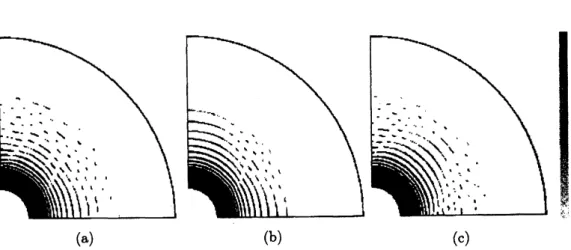
simulation suggests that this system hasan essentialinstablity to maketheringpattern(a) (b) (c)
$\mathrm{H}25$: (a), (b), (c) has different 5 % perturbation with different ways.(Parameters
are
thefollowing: $A_{0}=10.0,$ $B_{0}=2.0$
.
$D_{A}=D_{B}=D_{C}=$ 0.001, $k=20,$ $q=0.5$.
$M=1.0$,$\alpha=0.04,$$R_{0}=0.1,$$R_{1}=1.0)$
Very tinynonuniformness trigger it tobesplitting and tobedestroyed
as
timegoes
by.$\iota_{i}::$
:
(a) (b) (c)
$\mathrm{H}26:(\mathrm{a})B_{0}=1.6,$ $(\mathrm{b})B_{0}=2.0,$ $(\mathrm{c})B_{0}=3.0$
Fig.
26
showsthattime at which the ring splits is dependent of the initial densityof$B$.
Butsplittingtriggersdestroy
of
thering pattern. Because of thsfact,we consider
that there issome
kind ofmechanism by whichthe ring patternspontaneously split and isdestroy\’e.
Rrthermore,
we
consider about the problem ofwhat kind ofpattern isnatural
? In other$\mathrm{H}^{\backslash }\backslash 27:B_{0}=2.0$
As much time goes by, the ring pattern split and is destroyed to get the
final
pattern withadequatesizecluster. We make
a
conjecturethat the final patternis checker boardpattern.See
Fig. 28.
(a) (b)
op
28: $(\mathrm{a})B_{0}=1.6,$ $B_{0}=3.0$Finaly
we
would
like to state the pointofour
study briefly. Accourdingtoour
study,we
can
consider ofthis phenomena
as
result of contradiction and compromization between smoothingeffect of
diffusion
and positive feedbackeffect
ofOstwald ripning of colloid. Asan
importantresult, the flnal checker boardpatternis regarded
as
very natural. This should bean
importantconjecture for the pattern formationin Liesegang phenomena.
参考文献
[1] 『教師と学生のための化学実験\sim , 日本化学会編, 東京化学同人, (1987).
[2] I. Das, S. Chand and A. Pushkarna, “Chemical Instability and Periodic Precipitation of
$CuCr_{4}$ in
Continuous-Flow
Reactors : Crystal Growth in Gel andPVA
Polymer Films”,[3] S. Kai, S. C. Muller and J. Ross, “Curiosities in PeriodicPrecipitation Patterns”, Science.
216, (1982),635-637.
[4] S. Kai, “Pattern Formation in Precipitation”,
FORMATION
DYNAMICS ANDSTATIS-TICS
OF PATTERNS
$(\mathrm{V}\mathrm{o}\mathrm{l}2)$, World Scientific, 54, (1993),206-265.
[5] 伊勢村壽三,「リーゼガング現象」, 昭和 13 年東京帝國大学理学部理学博士論文
[6]
S.
Prager, “Interaction of Rotational andTranslational
Diffusion “, J. Chem. Phys. 25,(1956),
279-283.
[7] J. B. Keller and
S.
I. Rubinow,“Recurrent precipitation andLiesegangrings”, J.Chem.Phys.74,(1981),
5000-5007.
[8] R. Fticke, “Untersuchungen an einem Liesegangschen
“rhythmischen”Fallungssystem”,
Z.Phys. Chem. 124, (1926), 359-393.
[9] W. Ostwald,“ZurTheoriederLiesegang’schenRinge”, Kolloid-.Z. 36, (1925),
380-390.
[10]
S.
C. Bradford,“XVII. AdsorptiveStratification
inGels”,Biochem J. 10, (1916),169- 175.
[11] M. H. Fischer and
G.
D. $\mathrm{L}4\mathrm{c}\mathrm{L}\mathrm{a}\mathrm{u}\mathrm{g}\mathrm{h}\mathrm{l}\mathrm{i}\mathrm{n}$, “Bermerkungenzur
Theorie derLiesegang’schen
Ringe: TheoryofLiesegang’s rings “, Kolloid-Z. 30, (1922),
13-16.
[12] S.Kai, S.
C.
Muller and J.Ross,“Measurementsoftemporalandspatialsequencesof eventsinperiodicprecipitation processess”, J.Chem.Phys. 76, (1982),
1392-1406.
[13] N. R. Dharand A. C. Chartterji, “Theorien derLiesegangbildung”, Kolloid-Z. 37, (1925),
2-29.
[14] S. Kai; privatecommunication
[151 I. Ohnishi,“A mathematicalaspect for Liesegang phenomena”,京都大学数理解析研究所講
究録, 1356, (2004)
1–26.
[16] D. Hilhorst, R.
van
derHout,M.Mimura,and I.Ohnishi,“Fastreaction limitsand
Liesegangbands”, 明治大学理工学部数学教室プレプリントシリーズ,62005, (2005).
[17] D. Hilhorst,R. van derHout, M. Mimura, andI. Ohnishi, “The singular limitof
a
problemfor Liesegangbands”, ProceedingofFBP (in press), (2005).
[18] I. OhnishiandM. Mimura,“A mathematical aspect for Liesegang phenomena”, Proceeding