Bridging community resilience and sustainable
tourism development
via post-disaster education tourism in rural Japan
Yiwen Lin *
Portsmouth University Business School
[email protected]
Mihaela Kelemen
Nottingham University Business School
[email protected]
Toru Kiyomiya
Seinan Gakuin University
[email protected]
Abstract - Post-disaster tourism is an important reconstruction strategy for communities affected by natural disasters. In shrinking rural communities that also experience depopulation and aging as general trends, the need to develop proactive resilient practices for disaster management and sustainable development is a pressing requirement. Our longitudinal, multi-method study carried out in a Japanese rural coastal town affected by the 2011 Tsunami sheds light on the attributes and mechanisms by which a post-disaster education tourism initiative which was led and co-delivered by the community in collaboration with a variety of stakeholders enhanced community resilience and led to sustainable practices of post-disaster reconstruction. We provide empirical insights into how community resilience and sustainable tourism development were achieved through the careful development and balancing of economic, social and environmental capital. Our study contributes to existing debates regarding the relationship between community resilience and sustainability in the tourism field by illustrating how community resilience and sustainability are mutually re-enforcing dimensions which can be achieved via post-disaster education tourism.
1. INTRODUCTION
Japan is facing a number of long-term inter-related challenges such as depopulation and aging, along with frequent natural disasters, all of which have contributed to
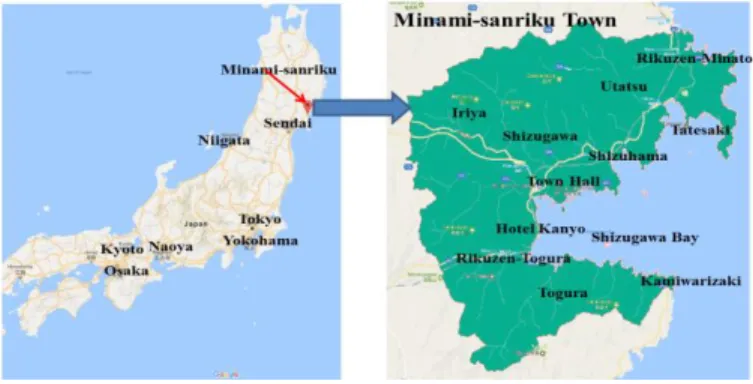
the shrinking of its rural communities and concern of dying village (Genkaishuraku). The situation is aggravated by the frequent natural disasters which tend to affect rural coastal areas disproportionately. The 2011 Great East Japan Earthquake is a case in point that had devastating consequences in multiple rural regions from Japan’s Northeast coast including Minamisanriku, the rural fishery town in which we conducted our research (see Figure 1).
Figure 1: Minamisanriku
The Japanese government has invested heavily in rebuilding infrastructure after the disaster, including the construction of new public facilities and seawalls, while promoting the concept of ‘kizuna’ (bond or connection in Japanese) as a metaphor of social solidarity for disaster recovery. NGOs were also active in coordinating volunteering activities and promoting post-disaster tourism and educational trips to revitalize the areas affected. In
addition, local communities self-organised and launched their own tourism initiatives such as Blue Tourism (Lin et al, 2018) to enhance community resilience. Despite the efforts of using tourism as strategy to enhance resilience and sustainable development, some critics also share the concern of disaster support shifting to “volun-tours” via tourism consumptions and disaster commodification (McMorran, 2017 ) while others question the ambivalence of post-disaster tourism, exploits or educates (Kingstom, 2016). In this paper, we focus on a community-led tourism initiative, i.e., the Minamisanriku Learning Centre (MLC, 南三陸ラ ーニ ン グセ ン ター ) to explore and reconceptualise the relationship between community resilience and sustainable tourism within the context of post-disaster tourism. Our research questions are:
1) What forms of community-led post-disaster tourism can develop community resilience and sustainability and support effective disaster management recovery?
2) What are the distinctive attributes and mechanisms by which post-disaster education tourism can ensure the development of both community resilience and sustainable tourism in post-disaster settings?
We proceed by defining community resilience in the context of tourism and post-disaster reconstruction in rural areas and discuss the relationship between community resilience and sustainable tourism development. Then we highlight the distinct character of post-disaster education tourism, which integrates aspects of post-disaster tourism and education for sustainable development (ESD) prior to the research context and methods in section 4. The subsequent three sections analyse the programmes promoted by the MLC to build economic, social and environmental capital. While the initial programmes could be regarded as a knee-jerk reaction to the devastation brought about by the tsunami which demonstrated the community’s ability to learn and adapt to new challenges, over time, these programmes have evolved to embrace an ethos of sustainability. We find that communities cannot build resilience unless they give due consideration to the short and long-term needs of locals, tourists/learners and the environment. Conversely, sustainability cannot be built and maintained unless communities are quick to adapt to new challenges and become adept at networking with relevant stakeholders. Finally, we highlight the attributes and mechanisms under which the post-disaster education tourism can enhance community resilience and sustainability and propose future research.
2. COMMUNITY RESILIENCE AND SUSTAINABILITY IN POST-DISASTER TOURISM STUDIES
In the disaster tourism literature, resilience is seen as a critical indicator for the community’s capacity to recover and develop in a sustainable manner (Magis, 2010), with a substantial emphasis being placed on the resilience needed to cope with immediate challenges (Biggs, Hall, & Stoeckl, 2012; Orchiston, 2013; Cui, Han and Wang, 2018). Most contemporary definitions of resilience have their roots in ecological studies, in particular, in Holling’s 1973 study (Berkes and Ross, 2013) in which resilience refers to how ecosystems respond to disturbance (Folke, 2006). While ecological resilience focuses “more on the ability of systems to return to function after a disturbance”, social resilience is “about seeing disturbance as an opportunity for change and development” (Wilson, 2012, p. 19). Adger (2000, p.347) defines social resilience “as the ability of groups or communities to cope with external stresses and as a result of social, political and environmental change” in order to build adaptive capacity (Cochrane, 2010; Nelson, Adger, & Brown, 2007; Wilson, 2012).
Community resilience as a subset of the wider notion of social resilience, shares many of its characteristics, although there are variations depending on the contexts in which the term is used (Biggs, Hall, & Stoeckl, 2012; Magis, 2010). Cox and Perry (2011, p.395-396) define the term in the context of disaster settings as “the capability of a community facing a threat, to survive and bounce back or, perhaps more accurately, bounce forward into a normalcy newly defined by the disaster losses and changes …. Adaptive capacities should include the capacity to develop and maintain social capital as it is expressed through a sense of belonging, a sense of community, place attachment and participation in civil society.”
Wilson (2014) argues that developing and maintaining social capital is important but not sufficient for community resilience: other forms of capital must come into play. Therefore, community resilience is determined by how “well the ‘critical triangle’ of economic, environmental and social capital is developed in a given community and how these capitals interact” (Wilson, 2014, p.6). Accordingly, community resilience is strongest when there is overlap between these three forms of capital.
Researchers have sought to examine what makes certain communities more resilient than others (e.g. Matarrita-Cascante, Trejos, Qin, Joo and Debner, 2017; Magis, 2010). Magis (2010, p.402), for example, suggests that “members of resilient communities intentionally develop personal and collective capacity that they engage to respond to and influence change, to sustain and renew the community and to develop new trajectories for the communities’ future.” Her study highlights the criticality of human agency and social capital in developing community resilience. Research by Meijer (2020) also supports the view that communities with strongly developed social capital tend to be more resilient and more able to develop alternative strategies in crisis situations while Imperiale and Vanclay (2016, p.204) finds that the capacity of the local community to self-organise is a key factor in addressing the
negative social and economic impacts of environmental disasters. Within the context of Japan, Kato (2018) finds that place-based traditional knowledge and social capital can enhance community resilience and can also serve as a foundation for sustainability in tourism development in areas affected by natural disasters.
Sustainability in tourism remains, however, an elusive and contentious term (Higgins-Desbiolles, 2010): sustainable tourism, sustainable development in tourism, alternative tourism and ecotourism are sometimes used interchangeably to capture the idea of sustainability. In more general terms, sustainability has been defined as “development that meets the needs of the present without compromising the ability of future generations to meet their own needs” (World Commission on Environment and Development, 1987) and is seen to comprise economic, environmental, and social elements, sometimes referred to as profits, planet, and people. The harmonisation of economic, environmental and social imperatives is thus an important concern in sustainable tourism discourses, a perspective that resonates with Wilson’s community resilience framework introduced earlier. Bulter (1999, p.35) defines sustainable tourism as that “which is developed and maintained in the area (community, environment) in such a manner and at such a scale that it remains viable over an indefinite period and does not degrade or alter the environment (human and physical) in which it exists to such a degree that it prohibits the successful development and wellbeing of other activities and processes”.
The commonalities and differences between sustainable tourism and community resilience are summarized competently by Lew, Ng, Ni & Wu (2016, p.18) who argue that while “there are distinct differences between these concepts, with sustainability’s conservation goals being in opposition to the adaptation goals of resilience”… “Both concepts share similar goals and some common approaches”. Nevertheless, the relationship between these two concepts remains controversial (McCool, 2015; Lew, 2014; Espiner et al, 2017) with questions being raised as to what comes first, resilience or sustainability. For some, resilience is seen as a mechanism or lubricant for achieving sustainable tourism (Espiner et al, 2017; Magies, 2010; Kato, 2018; Holladay and Powell, 2013) while for others, sustainable tourism is a “path to resilience” (McCool, 2015, p.214) or “a strategy to build or maintain system resilience” (McCool, 2015 p.233). Espiner et al (2017) question the distinction between adaptation and conservation and between the “survival attributes” of resilience and the idealized “steady state” of sustainability (p1386), seeing “resilience as a dynamic long-term state, where there are obvious parallels with the sustainability concept” (p.1386).
Scholars have identified a number of useful indicators of community sustainability and resilience within the context of tourism (Lew, Ng, Ni & Wu, 2016; Magis, 2010; Becken & Simmons, 2008). For example, sustainability indicators assess the extent to which community resources are conserved, the maintenance of traditional resource use,
the preservation of cultural traditions, and the provision of social welfare and equity. Resilience indicators consider the capacity of the community to change, the creation of new environmental knowledge, the improvement of living conditions and employment and the extent of social collaboration (Lew et al, 2016).
However, there are insufficient empirical studies that illustrate the attributes and mechanisms that can lead toward community resilience and sustainability in post-disaster settings. Our paper fills this gap by illustrating empirically that post-disaster education tourism is a strategy that can achieve both adaptability and conservation goals. Post-disaster tourism as an important reconstruction strategy has been highlighted by many studies, yet its definition remains ambiguous.
3. POST-DISASTER EDUCATION TOURISM
Volunteer tourism, dark tourism, reconstruction tourism, disaster education tourism, pray tourism and blue tourism are different strands of post-disaster tourism. This plethora reflects the multitude of motivations for visiting disaster areas such as personal learning, moral obligation, general education or sheer curiosity (Kang et al, 2012; Yan et al, 2016) and the existence of a variety of strategies of disaster reconstruction via tourism offers.
Post-disaster education tourism draws on debates from both disaster tourism and education for sustainable development (ESD) and has been widely embraced in Japan (Takano, 2017; Noguchi, 2017). The need to build both a resilient and sustainable future is recognised as a global concern as indicated in the ‘2015-2030 Sendai Framework for Disaster Risk Reduction’, the ‘UN Decade of Education for Sustainable Development’ (DESD 2005-2014), and the 2030 Sustainable Development Goals (SDGs). Japan’s contribution to ESD can be traced back to 2002 when the UN had adopted ‘DESD 2005-2014’ acting upon Japan’s proposal. ESD in Japan is characterised by a mix of formal/ top-down and informal/bottom-up initiatives (Singer, Gannon, Noguchi & Mochizuki, 2017). Singer et al. (2017) discuss the multifaceted efforts made by Japan to promote both formal and non-formal ESD and integrate them in a more holistic fashion. For example, formal ESD education is delivered via school-based approaches whereas non-formal ESD include NGO initiatives and community-based approaches which focus on community revitalisation, conservation, disaster risk reduction and post-disaster recovery (e.g. Takano 2017; Noguchi, 2017).
Noguchi (2017) highlights the importance of community-led education for sustainability, arguing for a shift away from formal ESD towards a more informal approach which acknowledges community rights to natural resources and builds on place-based traditions and local ways of knowing. Noguchi’s study also finds that learning occurs both in relationships between humans (for example, within indigenous Ainu tribes and between these tribes and outsider tribes), but also in relationships between communities and nature. Similarly, Takano (2017) explores
the role of NGOs in promoting place-based ESD concluding that rural communities are important learning places which encourage city visitors to rethink connections among humans and between humans and nature. The author finds that residents’ willingness to embrace change, take proactive action and collaborate with outsiders is important to long-term success as external interventions to revitalize rural communities tend to be short lived.
Despite existing challenges, Ji and Fukamachi (2017) present a successful example of how community-based efforts supported by civil society and other stakeholders enhanced the sustainable development of a dying village (Genkaishuraku) through the case of Kamiseya in Kyoto. A number of measures were taken to establish a system that preserved local resources, culture and satoyama (socio-ecological balance of human and nature landscape). However, authors point out several challenges such as the gap between local residents’ and civil society groups’ understanding of local values and the difficulties of civil society groups to secure funding to maintain activities in rural areas. Government’s approach to communication with local residents was also found to be ineffective in its adoption of a “one fits all approach”. The difficulty of balancing of short-term and long-term post-disaster development and the ability of NPOs to tackle complex issues in isolation from other stakeholders are also highlighted (Singer et al, 2017). The literature suggests that much community-based learning is often initiated by external parties such as NGOs or is policy-driven.
Post-disaster educational tourism, integrating place-based learning with community-driven ESD, has the potential for fostering both resilient communities and raising awareness of sustainability (Takano, 2017; Noguchi, 2017). While advocates argue that the benefits of this form of education tourism are significant for the affected communities in terms of both economic and social capital development, critics are quick to question whether specific initiatives such as the Tohoku’s disaster tourism, exploits or educates (Kingston, 2016). Coats and Ferguson (2013, p.32) argue that disaster tourism without careful management leads to rural inhabitants “being the subject of unwelcome tourists gazing”. Our study lends support to Takano’s and Noguchi’s views by shedding light on the attributes and mechanisms by which a community-led post-disaster tourism initiative enhanced community resilience and sustainability in a rural Japanese community affected by the 2011 Tsunami.
A resilient and sustainable system is often conceptualised as an ideal state of harmony between human society and natural environment, arising at the intersection between social, economic and environmental capital (Wilson, 2012). Our study explores the rationale for setting up the Minamisanriku Learning Centre and the ways in which its activities led to the development of economic, social and environmental capital and fostered resilient practices of adaptation and an ethos of sustainability.
4. RESEARCH CONTEXT AND METHODS
Our research focuses on one of worst-hit rural fishery towns in Japan, Minamisanriku. The Tsunami 2011 washed away the entire town centre and destroyed the main industries including fishery, farming and seafood processing. Many lives and buildings were also lost (Goulding et al, 2018). The complex logistical challenges of supporting the needs of the displaced residents and of coordinating the outpouring support provided by NGOs and volunteers, became apparent in the immediate aftermaths of the disaster. As the coastal areas of Shizugawa and Utatsu were greatly damaged by the tsunami, Iriya, located in the mountainous area of Minamisanriku, served as an important place to receive volunteers and coordinate their activities. The idea of establishing the Minamisanriku Learning Centre (MLC) was partly triggered by the urgent need to accommodate student-volunteers activities and partly by the community looking for alternative ways to re-build their livelihoods and space for sharing traumatized experience and for Machizukuri (community-building). The locals were keen to share their survival stories and pass down existing disaster knowledge to younger generations and to outsiders. With initial funding support from Taisho University, the Learning Centre along with accommodation was built in 2012.
Our research was conducted between 2013-2018. It included three research trips to Minamisanriku in 2014, 2016 and 2018 totalling four months of fieldwork. This long-term interrupted involvement in the field is sanctioned by Neyland (2007) as a viable research strategy for capturing enduring changes in participants’ stories and lived experiences and in identifying longitudinal changes in processes of post-disaster reconstruction. We used a participatory form of narrative inquiry to collect individual stories, analyse them and retell them to a wider audience as faithfully as possible (Ollerenshaw and Creswell, 2002). We actively involved the participants in our inquiry at all the stages of the research by constantly negotiating our relationships with them and the degree of our own participation in local activities. In addition to building trust, this collaborative approach ensured that the gap between the narrative told and the one reported was minimal.
The data collection involved multiple methods including 25 semi-structured interviews, four months of participant observation, document examination and photography. The benefits of multi methods to the study of rural spaces and community resilience in rural villages are widely documented (Madsen and Adriansen, 2004). In this vein, semi-structured interviews were carried out with 13 locals including volunteers from the Learning Centre, storytellers, shop owners and community leaders involved in the programmes offered by the MLC and with 12 external stakeholders including students, academic staff, tour organizers and corporate employees. The interviews varied in length between one hour and two and a half hours and were conducted in the Learning Centre and other community venues including farms and the local beach. The locals were asked about their lives before and after the
tsunami, their hopes for the future, the activities of the Learning Centre and their relationship with outsiders and the natural environment. The tourists/learners were asked about their motivations to visit Minamisanriku, their relationships with the locals and the place as well as about their personal learning objectives and achievements. Though we structured the questions around issues of adaptability and conservation in line with our research questions, we were careful not to use these specific terms in order to allow people to narrate personal and collective stories that were significant to themselves and to their communities.
We used thematic analysis (King and Brooks, 2018) to analyse the interviews. We read the transcripts independently, pinpointing recurrent themes. We then compared our initial interpretations and agreed on the three main categories which we labelled: economic, social and environmental capital. These categories support and explain in detail the topics of community resilience and sustainable tourism which guide our research questions. Our initial findings were presented to some of the study’s participants shortly after the project finished to ascertain whether they chimed with their lived experience. At the end of the process our categories were ‘thickened’ and given conceptual rigour by referring to the existing literature and to the field notes taken during the participatory workshops. The participant observation notes which resulted in over 1000 pages of field notes captured detailed information about the town, its traditions, lost industries, the nature of the encounters between the local community and visitors, helping us to map out the wider context of the individual experiences.
We have also examined media coverage of the tsunami and its aftermath including blogs, social media, local news reports and video clips as well as material uploaded on the websites of the town, of relevant universities and of the Learning Centre. More than five hundred pictures were taken to document the interactions between locals and visitors, the sea, mountains, forests and the infrastructure of this rural town at different points in time. The media coverage and pictures added context to our systematic analysis but they were not subjected to an inductive analysis in the same way that the interviews and the participant observation data was. The process of data and method triangulation along with our reflexive and open attitude towards the emergence of new themes increased the cogency of our evidence-based arguments and subsequently the validity of the study (Polkinghorne, 2007). In the following section we discuss the first theme derived from our analysis.
5. ECONOMIC CAPITAL: COMMUNITY-INITIATED TOURISM AND RESOURCES OPTIMISATION The “survival attributes” of resilience (Espiner et al, 2017 p.1386) and adaptability can be observed in the community’s initial response to the existing challenge of
coordinating the outpour of post-disaster students volunteer support, urgent need of economic recovery and mental support following the disaster, and the need to enhance disaster awareness as a disaster-prone community. According to the Disaster Awareness survey, more than 60% of people expect that another major disaster is likely to occur, but less than 40% are making sufficient preparation (Cabinet Office, 2016). Both resilience and sustainability elements can be seen from initial adaption for survival and resource optimization.
Adaptability for survival: Community-initiated tourism From its inceptions, MLC is not profit-driven as it was initially established to host students from Taisho University who were taking part in community-led ‘learning by experiencing’ tours and in volunteering work. It was quickly adapted to encourage wider participation including corporates networking, 27 other Japanese universities and numerous NGOs. The impact of MLC is obvious as it provides employment for underprivileged locals and a space for community-building (Machizukuri) and networking. “Community workshops and meetings as well as training for local storytellers and local tourist guides are held here regularly” (Interview, employee). It soon became an important infrastructure which supported the immediate needs to enhance disaster awareness, heal and move forward, thus strengthening resilience and widen community capacity for later educational disaster tourism initiatives.
Such adaptability is critical for resilience building in disaster setting characterised by non-linear unpredictable change but could legitimize extractvism under the guise of tourism intervention for community recovery if without holistic understanding of entire system (McCool, 2015). The overcapacity risks privileging it over nature in the sustainable tripartite bottom line. It raises issues of inter-generational equity, between present and future generations in resource utilization.
Conservation by design: resource optimization:
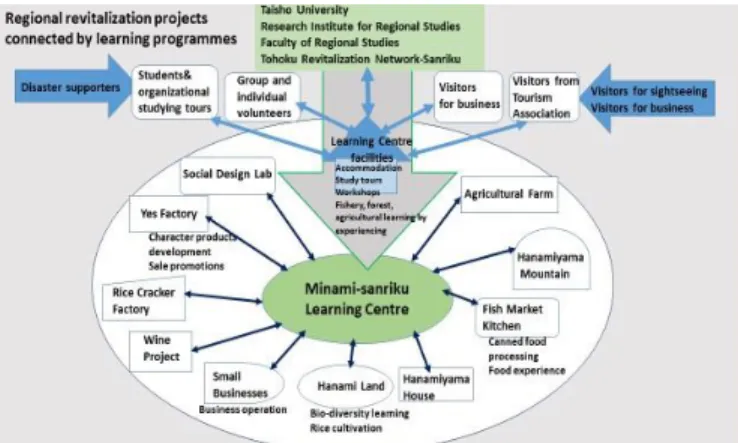
However, the Minamiasanriku learning tours were designed by intention to integrate existing challenges into core activities of Learning Centre beyond the trade-off between economic efficiency and resilience, which can be observed in their consideration of three pillars of sustainability (economic, social and environment). For example, the Learning tours were carefully designed to fit for the local ecosystem and aligned with guidelines from Town Reconstruction Plan for Tourism Development (2012) which emphasises sustainable development goals with regards to mountains, land, oceans and human well-being and the harmonisation of economic, social and environmental goals. The economic and community assets were managed through their deliberate efforts to optimize local resources across connected regional revitalization projects (see figure 2).
Figure 2: Regional revitalization projects connected by learning programmes (provided by interviewee and translated from Japanese).
The impact of optimizing local resources is explained by one of the founders of the Learning Centre as follows:
“Our projects bring around 20,000 visitors yearly. Our visitors range from students and employees, university staff, and general tourists. Our learning programmes have expanded from disaster learning to agricultural experiences at Onokuri Farm, fish processing and food design at the Fish Market Kitchen, bio-diversity learning at Hanamiyama Land, the Wine project at Non-Koubo (Agricultural Farm), character product design and development at Yes Craft Factory, forestry sustainability learning and wooden products design and so on. Our learning programmes connect local businesses with visitors and this collaborative ethos contributes to community recovery.” (Interview, a founder).
As the MLC was initiated and operated by locals, this gives them sense of ownership to manage post-disaster educational tourism such as what to teach and what to sustain and reconceive the post-disaster tourism model. Arguably, post-disaster tourism could be a welcome lifeline and good for educational purpose, rather than leading the residents “being the subject of unwelcome tourists gazing” (Coat and Ferguson, 2013, p32). As figure 2 suggests, the strategic design serves the need of immediate economic development, it also enhances resource conservation, local traditions and strengthen social capital thus facilitating community-building (Machizukuri) through knowledge-sharing and co-learning across sectors and partners. Internally, by connecting various projects, the Learning Centre brings local economic sectors such as fishery, agriculture, forestry, small businesses, and Kataribe (disaster storytellers) to work collaboratively to reconstruct their town. As the effort is driven by the community, along with the supports of other stakeholders, it is more likely to ensure community sustainable development (Ji and Fukamachi, 2017) and enhance the self-organized capacity of the local community in addressing future disasters (Imperiale and Vanclay, 2016). Externally, it enhances the
awareness of disaster risk reduction for a wider population by developing partnerships with educational institutions, civil society organisations, businesses and individual learners/tourists, creates an alternative lifeline for the neglected backwater (Kingston, 2016).
Thus, synergies between economic and social capital are created by harnessing and preserving place-based resources, local knowledge and traditions and engaging with diverse stakeholders within and beyond the community boundary. Therefore, both resilience and sustainability are being developed. Resilience building brings synergies to resource conservation and local culture traditions while sustainable tourism development benefits from the existing infrastructure for learning, wider community participation and flexible education programs that cater for the changing needs of the community and of the outsiders (Lew et al, 2016). This indicates a dynamic interrelationship between resilience planning and sustainable tourism (Espiner et al, 2017).
6. SOCIAL CAPITAL: COMMUNITY-UNIVERSITY PARTNERSHIP
Social capital has been highlighted as an important attribute of resilience building in crisis contexts (e.g. Aldrich, 2012, Magies 2010), but it becomes very challenging to retain when situation is no longer caught media attention. MLC serves as a powerful medium to retain social capital via Community-University partnership, namely Tohoku Revitalization - Private Universities Network Sanriku「東北再生-私大ネット 36」. In this section, we highlight the mechanisms by which the Learning Centre has developed both social and human capital to enhance resilience through 1) Setting out the purpose through co-designing: Ethics and responsibility are the core of educational tourism 2) Promoting sustainable relation via co-learning and knowledge co-production 3) Nurturing community leadership: succession planning.
Setting out the purpose through co-designing:
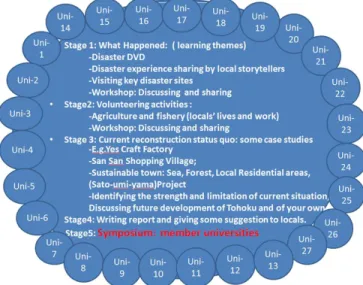
Social dimension of resilience and sustainability is shown through co-designing the educational model that puts the ethics and responsibility as the core of education tourism. Taisho University has demonstrated University social responsibility and set institutional norm for students. For example, immediately after disasters, Taisho University led 147 students and staff to participate disaster volunteer activities and 446 students for fund raising. Further support were provided by setting up Tohoku Revitalization-Private Universities Network Sanriku 「 東 北 再 生 - 私 大 ネ ッ ト 36」 (Figure 3) in which 27 private universities joined the network with the aim of facilitating education, disaster recovery and regional development for a period of ten years: 2012-2022 (Taisho University website, 2012).
Figure 3: Tohoku Revitalization - Private Universities Network Sanriku「東北再生-私大ネット 36」
A staff commented on the mission of universities to develop responsible future generations:
“As the students are the future of the country, we have the responsibility to nurture our younger generation to become responsible persons. We hope our students will experience and learn important lessons from the disaster, which I think, will be good for their self-development and moral compass” (interview).
Students engage on the educational post-disaster tourism and are encouraged to be proactive rather than reactive to the disaster challenges facing. As a tour co-ordinator commented:
“Students from the Tohoku Revitalization Network participated in the study tours voluntarily as a way of supporting disaster-affected areas. The value of seeing how collaboration works in practice, as an alternative to competition, as embedded in the community-led learning programmes, is passed down to students through such university educational trips. Students also learn problem-solving skills by actually participating in the disaster field with locals” (Trip coordinator).
With the mission and institution guidelines in place, they are less likely to be a “nuisance” (meiwaku) intruder but important forces to enhance resilience. Resilience and sustainability are juxtaposed in the process of co-designing and co-creating new knowledge as the learning tours are democratically designed and organized in a way that encourages learners/visitors to participate in problem-solving, reciprocal learning and reconceive of what to conserve and what to adapt. This ensures that students meet learning objectives while contributing updated knowledge to the process of rural reconstruction; For locals, their concerns of what to sustain (e.g. resource conservation and traditional
ecological knowledge) were included in the education tourism design while encouraging students innovation, thus echoing the dynamic relation between resilience and sustainability (Lew et al, 2016; Espiner et al, 2017).
Promoting sustainable relation: via co-learning and knowledge co-production
The resilience is further strengthened through expansion of participation, long-term network and a reciprocal exchange of knowledge. In 2014, the MLC accommodated 5,571 visitors, and received 1,484 people on its learning programmes. It continued to expand by accommodating 9,289 visitors and 2,457 people between 2016 and 2017, a steady trend continued in 2019 which saw 8500 visitors and 3000 people registered on learning programs (Minamisanriku Learning Centre website, 2019). As the coordinator commented:
“We have liaised with the MLC and discussed what we wanted the students to learn and what support we could offer. We definitely do not want relations of exchanging services, like a business transaction, one paid the money, and the other offered the service. We value the community’s spirit of cooperation and mutual help in the crisis situation. We want to support the community and we also want students to learn communal values and the ecosystem of sato-umi-yama(1)”.
The interaction between locals and visitors facilitates a two-way learning process: on the one hand, community members are able to both acknowledge the value of their own traditional knowledge while visitors’ suggestions provide useful new knowledge for future sustainable development. The updated knowledge about communal values and the ecosystem of sato-umi-yama could potentially enhance community capacity of “bouncing forward”, rather than “bouncing back” to original state (Cox and Perry, 2011, p.395-396). Their collective efforts to intentionally engage and respond to crisis could influence change and enhance community resilience (Magis, 2010). As commented by a local tour guide:
“I learned a lot of new concepts and terminology from students and other visitors, such as CSR, social capital, human capital and sustainability. In fact we use different terms with similar meaning. …” (Interview, Local tour guide)
“The Learning Centre played an important role in publicizing the town, and the learning programmes attracted a lot of university students who brought many new ideas to the town; it also provided more chances for local people to communicate with visitors and with each other. It was not just the visitors who learnt, also community members found out new things about their own town” (Interview, Tourism Association employee)
The relation was enhanced via the reciprocal exchange of knowledge, expansion of participation and long-term network. What to sustain and what to adapt was negotiated in the process of co-learning and knowledge co-production. The sustainability and resilience indicators were developed (Lew et al, 2016) and were mutually reinforcing as we can see that the activities of learning centre helped preserve place-based traditional ecological knowledge and practices (Kato, 2018) while at the same time co-created new environmental knowledge with the visitors and empowered locals with capacity for change. More importantly, this alleviated the issues of depopulation and shrinking community by enhancing regular population flow through university-community partnership though it cannot fundamentally address all the issues.
Nurturing community leadership: succession planning To further strengthen community-university relationships, the Research Institute for Regional Studies (RIRS) was established in 2016 by Taisho University, Tokyo. The Institute’s collaboration with MLC includes research activities, regional coordination and public relations activities aimed at developing human capital and nurturing the students as potential future community leaders.
The RIRS started to recruit students in 2016 with the objective of developing leadership skills for disaster reconstruction and revitalizing the town (Minamisanriku Now News, 2016). Students from the RIRS have two six-week internships per year, one in an urban city and one in Minamisanriku, across the four-year degree programme. The perspectives learned from urban cities are put to work towards regional revitalization in Minamisanriku, while local community perspectives are applied to address urban issues. Knowledge regarding culture, customs, the environment and industry is being integrated into the design for regional revitalization (Minamisanriku Now News, 2016). The internship programme in Minamisanriku town involves nine different local organizations from the public, private and non-profit sector.
The learning and post-disaster activities immerse the students in the community by teaching them traditional resource uses and cross-sector coordination skills. By applying theory to practice, students and locals co-learn and co-design services to meet reciprocal needs. By building strong relationships with the locals, students get the opportunity to improve their problem-solving and leadership skills. As Nakagawa and Shaw (2004) suggested, community leader has been prominent in utilizing social capital and effective in forging collective actions in disaster recovery. Potentially, these students could become future community leaders, bridging the links between communities’ need and government services (Nakagawa and Shaw, 2004). What students learn and experience appears to also have a profound effect on their life.
“It was really inspiring to experience how the town was rebuilt from the debris to become a town with a vision of
sustainable community. I really want to come here again. I want to see the change. I have been part of the current efforts of community reconstruction and am inspired by the architectural plan of the future Minamisanriku town.” (Interview, Student)
The people-place connection and sense of community are strengthened through engagement, which further enhance the potentials for leadership succession planning. The need to develop future community leaders is deeply felt in rural communities affected by depopulation. As explained by one of founders of the Learning Centre:
“Depopulation and aging society have been serious issues for quite a long time, in particular in the rural areas; the primary industry is on the decline as many young people went to the city for education and many of them do not like to come back to work in fishery or agriculture. We need people to come back and we also need more people to visit our town. One of the aims of the Learning Centre is to nurture young community leaders and we hope our educational programmes will bring more young people to the town. Our future is in the hand of young people. Machizukuri is not a new concept but we lack future community leaders who could make Machizukuri work more effectively”.
The aspiration to nurture the next generation of leaders is also expressed by one of community elders, who gave a speech in a workshop held in the MLC:
“Our next thing will be to train the next generation who can take on the job for reconstruction, because I am 55 years old. We believe it would still take another five or ten years to rebuild this town. Now it is us who came up with all these ideas for reconstruction but in the long-term people in their 20s and 30s need to take over this job. In doing so, I think it is very important to convey the story and the facts of the tsunami to the younger generation so that they can prepare for the future disaster in case anything happened. I fortunately survived the earthquake, but if we had done a better job of information management and crisis management, we could have saved more lives. …”. (Interview, Chef, Learning Centre kitchen)
Apparently, current community leaders have clearly articulated their concerns for leader succession. They are keen to ensure the place-based traditional knowledge (Kato, 2018) such as disasters experience are conserved, passed on while remaining open to the innovative idea from students to adapt and prepare for the ever-changing future challenges. Thus, the ethos of resilience building and sustainable development co-exist in a dynamic relationship that shapes the long-term success of this learning programme.
In short, under community-university partnership, social capital and human capital are developed and
maintained via co-creating purposes, co-learning ethos and future leader succession planning. This enhances the community’s capacity to respond to future crises and facilitates the inclusion of multiple voices in disaster planning, rural decision-making and community vitality. In the next section we explore the synergies of social and economic capital with environmental capital.
7. ENVIRONMENTAL CAPITAL: SOCIO-ENVIRONMENTAL SUSTAINABILITY LEARNING AND LOCAL SUSTAINABLE
PRACTICES
Socio-environmental sustainability education: CSR engagement and human-nature attachment,
Minamisanriku, stands in a vulnerable position in a tsunami-prone area and also boasts its great natural beauty, which has great potential for designing and implementing sustainable educational programmes. A notable change has been shown in learning programmes shifting from disaster education towards socio-environmental sustainability between 2016-2018.
One of the key features that enabled the community-initiated tourism to thrive was the ability of the community to adapt quickly and sensitively to the dynamics of disaster reconstruction in ways that met both local and visitors’ needs. The MLC has adapted its programmes to fit for ever-changing needs by offering courses on sustainable living and organising such as food design, community design, and social and environmental learning for wider participants, which enhance the community capacity of CSR engagement and place attachment. This form of tourism, integrating place-based learning with community-driven ESD has the potential for fostering both resilient communities and raising awareness of sustainability (Takano, 2017; Noguchi, 2017). For example, tours are organized for corporates to visit Minamisanriku as part of training or CSR engagement to support community. The activities included a combination of disaster, social and environmental learning shown in the words of a local farmer and tour guide:
“The environment has changed a lot since the disasters. The sign of disasters have become less obvious. The ruins and rubbles have been removed by March 2014. The volunteer activities therefore shifted from debris removal to the support of agricultural or fishery farm work. Some organizations simply came here to support us (the farmers or fishermen)….What they wanted was to volunteer with us to let their employees understand the real situation and experience the hardship of our lives in order to build up solidarity… Others come for disaster education…” (Interview, Farmer)
Such engaged field trips help build not only environmental capital, but extend further the ties and social responsibility to the town among local communities, corporations, universities and visitors. Thus, post-disaster tourism can be educational for companies to engage CSR and for sustainable business if properly organized. Visitors
have the chance to experience local people’s lives, visit post-disaster ruins and current enterprises, sustainable farming, resource utilization, hear life stories of the tsunami experiences, and ask questions.
“This field tour with the farmer reminded me of the happy memory with my grandmother. I used to visit my grandparents and work in the field at weekend when I was fed up with city life and cityscape… I really appreciated the opportunity to learn about the disaster situation, see the progress of reconstruction and listen to local people’s first-hand experience..” (Interview, Student)
The emotional connection between visitors and locals is also echoed by a local resident:
“Without volunteers’ help, we wouldn’t be able to get so much farm work done especially as we lack young people doing agriculture work. You can see that the large onion field would take days to weed, but students completed the weeding on the onion farmland in a couple of hours. I want to share our traditional coping strategy for disaster with the students and tell them how we live our lives here. I am happy that the students are interested in this. By being able to answer the questions raised by students, I feel my life is more meaningful… ” (Interview, farmer and fire fighter: see figure 4)
Figure 4: Employees from Toyota and students volunteering in the Agriculture Farm
The reflective field engagement creates connection between locals and outsiders, between human and nature. Their authenticity of support reduces the potential ethical issues caused by insensitive tourists and controversy around the exploitative or educational (Kingston, 2016). It also prevents from negative post-disaster tourism with prevailing holiday atmosphere by sitting in the hotel lobby to watch disaster video and do casual observation. Instead, such type of post-disaster tourism with explicit educational purpose and CSR engagement with students and other participants provide important communication channels to facilitate local sustainable practice.
Promote local sustainable practice: town circular vision, accreditation, sustainability education, branding
The Minamisanriku’s sustainable practices are evidenced by the implementation of a biomass town plan in 2015 via a public-private partnership after being selected as ‘Biomass Industrial City’ in 2014. A comprehensive local resource circulation system was designed to increase self-energy circulation and reduce the need for nuclear self-energy (in light of the Fukushima nuclear disaster, 2011). Under this system, the forest (forest management sector), the sea (fishery sector), the rural area (agriculture sector) and the town (community) are interconnected to create a circular economy (Amita Corporation, 2015). All waste is converted into energy or liquid fertilizer so that Minamisanriku can become a waste-free town (See figure 5).
Figure5: adapted by the authors from the Minamisanriku Sustainable Circulation Vision
In addition, the town was awarded two highly competitive certifications of environmental sustainability in 2015 and 2016: FSC and ASC for responsible forests and aquaculture. To enhance public awareness of the sustainable vision, MLC has showcased local sustainable practices by organizing learning tours, holding workshops and providing training for local tourist guides. Students and visitors visit the Biomass plants, local forests and fishery farms to learn about the local resource circulation system and other local sustainable ways of living (Minamisanriku Learning Centre Website, 2016). It is unsurprising that the comments from the students are positive:
“The longer time I stayed here the more respect I have for the local people. I was not so surprised ….of the biomass plant, wooden pallet plant and waste-free model. After all, Japan is a high-tech country. I was more surprised to
learn about how the local community works co-operatively to create such an environment that makes social innovation possible when people lives are still in such a mess after the disaster”
“The forest trip regarding the forest management award was really impressive. I liked the way the local guide gave the lecture while walking around the forest. … This field experience made a lot of terminologies and the process of sustainability much easier to understand”… (Interview, student)
The benefits for the learners and community are reciprocal. For students, theories of sustainability are linked to powerful real-life cases, which is effective in sustainability education while raising public awareness of disaster risk reduction. Positive feedback from tourists and students have word-of-mouth effects to attract others to visit the town. For the community, this contributes to branding Minamisanriku as a sustainable town through expanding the connection with educational institutions, receiving more support from visitors/tourists, publicizing the town’s model of sustainable practices and showcasing the reconstruction progress more widely. Conversely, the support and knowledge of the visitors serve to inspire and empower this rural community to meet its own sustainable development goals.
8. DISCUSSION AND CONCLUSIONS
Our empirical study throws light on the dynamic inter-relationship between community resilience and sustainability (Espiner et al, 2017). Through its community-led tourism offers, the Minamisanriku Learning Centre (MLC) supports social collaboration, improves living conditions, employment and builds community capacity for changes while at the same time conserves community resources and preserves cultural traditions and traditional resources uses. As suggested by Lew et al’s (2016), these represent tourism indicators of community resilience and sustainability.
In addition to empirically demonstrating the interrelationship between resilience and sustainability, the paper maps out a number of community attributes and mechanisms by which the MLC contributes to both resilience building and sustainable development by developing economic, social and environmental capital (see figure 6).
The ethos of the MLC is underpinned by the founders’ beliefs in the power of networking and the promotion of co-learning strategies to meet the short and long-term needs of the community and cater for the requirements of the learners/visitors.
Economically, in face of post-disaster plight of damaged infrastructure, declined livelihood and concerns for resources and traditions, the establishment of MLC and community-initiated post-disaster tourism enabled locals to adapt quickly to the dynamic of reconstruction and enhance dispersed community benefits. These include providing alternative livelihood, disaster risk reduction, space for healing and capacity for Machizukuri while demonstrating the awareness of nature-based lifeline constraints by optimising the resource via cross-sector collaboration to support sustainable practices for agriculture, fishery and forestry development. By promoting an ethos of co-learning, the Centre forges win-win economic relationships across different sectors within community and also with outside partners (universities, government, civil society and private corporations), contributing significantly to the revitalisation of this rural town and to building a proactive form of community resilience.
Socially, to revitalize the shrinking community attributing to a number of inter-related issues, the MLC has developed both social and human capital via community-university partnership to enhance resilience by setting out the purpose via co-designing model to reflect the core value of ethics and responsibility, promoting sustainable relation
via co-learning and knowledge co-production and nurturing community leadership. Underpinned by local knowledge and traditional practices, the programmes account for and get adapted to the educational needs of the learners and their feedback, thus ensuring longer-term sustainability. The emotional connection between locals and outsiders developed through co-learning processes is central to developing social capital and future community leaders whose main task is to balance the development of economic, social and environment capital in a sustainable manner.
Environmentally, given the town with attributes of disaster-prone and resource-dependency, the MLC endeavours to harmonize human society with natural environment by developing existing local resources in a sustainable way via synergising various revitalization projects in line with sustainability ethos while raising public awareness of disaster risk reduction. The move from disaster education to socio-environmental sustainability learning provided a chance to showcase local sustainable practices and contributed to the rebranding of the town as a sustainable town. By incorporating new training programmes such as food design, community design, social and environmental learning, the Learning Centre attracts a wider variety of visitors/learners, creating an environment for co-learning in which insiders’ and outsiders’ knowledge is equally valued and the natural environment is treated with respect.
While the separation of economic, social and environmental capital has been made for heuristic purposes, Figure 6: Community attributes and mechanisms that contribute to building community resilience and sustainable
it is clear that the MLC enhanced the development of all three forms of capital. The success of this rural community facing depopulation, aging and threats from future natural disasters in developing its economic, social and environmental capital provides a number of theoretical contributions to the literature on post-disaster tourism and to existing debates regarding the relationship community resilience and sustainability in tourism.
Building on the existing strong bonding social capital, the locals have reached out to outsiders (universities, businesses, tourists) via a carefully co-designed tourism offer which not only benefits community recovery but enhances public awareness of disaster risk, advocates the importance of collaboration (rather than competition) and develops individual and social responsibility. Conversely, the support and feedback from the outsiders inspires and empowers the locals to socially innovate and constantly adapt to changing local needs, environmental pressures and visitors’ expectations.
Our study highlights the community attributes and the mechanisms necessary to build a dynamic relationship between community resilience and sustainable tourism development. The community attributes are important but insufficient for developing post-disaster tourism initiatives that subscribes to a social, economic and environmental agenda. It is the mechanisms we describe above that ensure the active balancing of economic, social and environmental capital and the adaptability and sustainability of the learning offers. Thus, our paper contributes insightful ideas to post-disaster tourism debates, by highlighting the potential offered by community-led post-disaster education tourism in building both community resilience and sustainable tourism. In practical terms, although this bottom-up initiative is only small scale, it has wider social implication that we all can make a difference for socially good. The rural communities from across the world may find inspiration in the ways in which MLC eases the challenges of depopulation, shrinking community and the threat of natural disasters, while universities may consider the benefits community-led learning programmes could bring to their students as active citizens and future responsible leaders. We urge policy makers to create frameworks that encourage communities to take a proactive approach to the development of economic, social and environmental capital as it is well accepted that overreliance on external stakeholders (be they the state, civil society or private sector) leads to reconstruction programmes that tend to be short lived, unsustainable and ineffective (Singer et el, 2017). In shrinking rural communities that already experience depopulation and aging, the need to develop resilient and sustainable practices for disaster management and rural development planning is even more pressing. We suggest that this can only be achieved if communities learn to both adapt to change and preserve their heritage for future generations with wider stakeholder collaboration. The rural communities from Minamisanriku through their proactive approach to post-disaster education tourism are an inspiring
example. Yet, more empirical research on the relationship between post-disaster education tourism, community resilience and sustainability in rural areas is needed in order to unpack the processes by which community-led post-disaster tourism and education for sustainability can provide synergies in developing economic, social and environmental capital.
NOTES
*Corresponding author [email protected]
(1). The sato-umi-yama is the idea that the forest, the rural area, the sea and the people should all be interconnected highlights the sustainable ethos that underpins these learning programmes.
REFERENCES
Adger, W. N. (2000). Social and ecological resilience: are they related? Progress in human geography, 24(3), 347-364.
Aldrich, D. P. (2012). Building resilience: Social capital in post-disaster recovery. University of Chicago Press.
Amita Corporation website, (2015). Local Resource Circulation System, https://www.aise.jp/case/circulation/minamisanriku_bio.html (Accessed 8 September 2016)
Becken, S., & Simmons, D. (2008). Using the concept of yield to assess the sustainability of different tourist types. Ecological Economics, 67(3), 420-429.
Berkes, F., & Ross, H., (2013). Community resilience: toward an integrated approach. Society & Natural Resources, 26(1), 5-20.
Biggs, D., Hall, C. M., & Stoeckl, N. (2012). The resilience of formal and informal tourism enterprises to disasters: reef tourism in Phuket, Thailand. Journal of Sustainable Tourism, 20(5), 645-665.
Butler , R . W. (1999). Tourism: An evolutionary perspective. In: J.G. Nelson, R. Butler and G. Wall (eds.) Tourism and Sustainable
Development: A Civic Approach, 2nd edn. Waterloo, Canada:
University of Waterloo, 33 – 62.
Cabinet Office, Government of Japan, (2016). White Paper on Disaster
Management 2016 Summary. On-line available at:
http://www.bousai.go.jp/kyoiku/panf/pdf/WPDM2016_Summary.pd f (Accessed on 20/05/2017)
Coats, A., & Ferguson, S. (2013). Rubbernecking or rejuvenation: Post earthquake perceptions and the implications for business practice in a dark tourism context. Journal of Research for Consumers, 23(1), 32-65.
Cochrane, J. (2010). The sphere of tourism resilience. Tourism Recreation Research, 35(2), 173-185.
Cox, R. S., & Perry, K. M. E. (2011). Like a fish out of water: Reconsidering disaster recovery and the role of place and social capital in community disaster resilience. American Journal of Community Psychology, 48(3-4), 395-411.
Cui, K., Han, Z., & Wang, D. (2018). Resilience of an earthquake-stricken rural community in southwest China: Correlation with disaster risk reduction efforts. International journal of environmental research and public health, 15(3), 407.
Espiner, S., Orchiston, C., & Higham, J. (2017). Resilience and sustainability: A complementary relationship? Towards a practical conceptual model for the sustainability–resilience nexus in tourism. Journal of Sustainable Tourism, 25(10), 1385-1400.
Folke, C., 2006. Resilience: The emergence of a perspective for social– ecological systems analyses. Global Environmental Change, 16(3),
pp.253-267.
Goulding, C., Kelemen, M., & Kiyomiya, T. (2018). Community-based response to the Japanese tsunami: A bottom-up approach. European Journal of Operational Research, 268(3), 887-903.
Higgins-Desbiolles, F. (2010). The elusiveness of sustainability in tourism: The culture-ideology of consumerism and its implications. Tourism and Hospitality Research, 10(2), 116-129.
Holladay, P. J., & Powell, R. B. (2013). Resident perceptions of social– ecological resilience and the sustainability of community-based
tourism development in the Commonwealth of Dominica. Journal of Sustainable Tourism, 21(8), 1188-1211.
Imperiale, A.J. and Vanclay, F., 2016. Experiencing local community resilience in action: Learning from post-disaster communities.
Journal of Rural Studies, 47, pp.204-219.
Ji, B. and Fukamachi, K., 2017. Can civil society revitalise dying rural villages? The case of Kamiseya in Kyoto prefecture. In: J.Singer, T.Gannon, F. Noguchi and Y. Mochizuki (Eds.), 2017. Educating
for Sustainability in Japan: Fostering Resilient Communities after the Triple Disaster, (pp.156-169.). London: Routledge.
Kang, E. J., Scott, N., Lee, T. J., & Ballantyne, R. (2012). Benefits of visiting a ‘dark tourism’site: The case of the Jeju April 3rd Peace Park, Korea. Tourism Management, 33(2), 257-265.
Kato, K. (2018). Debating sustainability in tourism development: Resilience, traditional knowledge and community: A post-disaster perspective. Tourism Planning & Development, 15(1), 55-67.
King, N., and Brooks. J. (2018). Thematic Analysis in Organizational Research. In C .Cassell., A.L. Cunliffe., & G. Grandy (Eds.) The
SAGE Handbook of Qualitative Business and Management Research Methods: Methods and Challenges(pp. 219-236). London: SAGE.
Kingston, J. (2016). Does Tohoku's disaster tourism exploit or educate?
The Japan Times.
https://www.japantimes.co.jp/opinion/2016/02/27/commentary/toho kus-disaster-tourism-exploit-educate/#.XgpKo0f7TIU (Accessed on 12/02/2017)
Lew, A. A. (2014). Scale, change and resilience in community tourism planning. Tourism Geographies, 16(1), 14-22.
Lew, A. A., Ng, P. T., Ni, C. C., & Wu, T. C. (2016). Community sustainability and resilience: Similarities, differences and indicators. Tourism Geographies, 18(1), 18-27.
Lin, Y., Kelemen, M., & Tresidder, R. (2018). Post-disaster tourism: building resilience through community-led approaches in the aftermath of the 2011 disasters in Japan. Journal of Sustainable Tourism, 26(10), 1766-1783.
Madsen, L.M. and Adriansen, H.K. (2004). Understanding the use of rural space: the need for multi-methods. Journal of Rural Studies, 20(4),
pp.485-497.
Magis, K. (2010). Community resilience: An indicator of social sustainability. Society and Natural Resources, 23(5), pp.401-416. Matarrita-Cascante, D., Trejos, B., Qin, H., Joo, D., & Debner, S. (2017).
Conceptualizing community resilience: Revisiting conceptual distinctions. Community Development, 48(1), 105-123.
McCool, S. (2015). Sustainable tourism: Guiding fiction, social trap or path to resilience. Challenges in tourism research, 224-234.
McMorran, C. (2017). From volunteers to voluntours: shifting priorities in post-disaster Japan. Japan Forum, 29 (4), 558-582.
Meijer, M., (2020). When it goes wrong… learning from challenged (and revived) community initiatives. Journal of rural studies, 74, 1-9. Minamisanriki Town Reconstruction Plan, (2012). Online available at
https://www.town.minamisanriku.miyagi.jp/index.cfm/6,303,c,html/ 303/fukkoukeikaku120326.pdf. (Accessed 12/02/2018)
Minamisanriku Learning Centre website, (2019). Learning programmes. Online available at: http://ms-lc.org/programs/ (Accessed on 12/04/2019)
Minamisanriku Now News, (2016). Students from Taisho University, a
newly established Faculty of Regional Development were sent to Minamisanriku for internship. Online available at:
http://m-now.net/2016/10/soseigakubu.html (Accessed on 12/02/2018) Nakagawa, Y., & Shaw, R. (2004). Social capital: A missing link to
disaster recovery. International Journal of Mass Emergencies and
Disasters, 22(1), 5-34.
Nelson, D. R., Adger, W. N., & Brown, K. (2007). Adaptation to environmental change: contributions of a resilience framework. Annual review of Environment and Resources, 32.
Neyland, D. (2007). Organizational ethnography. London: Sage.
Noguchi, F. (2017). A radical approach from the periphery: informal ESD through rights recovery for indigenous Ainu. In: J.Singer, T.Gannon, F. Noguchi and Y. Mochizuki (Eds.), 2017. Educating for
Sustainability in Japan: Fostering Resilient Communities after the Triple Disaster, (p.201-215). London: Routledge.
Ollerenshaw, J. A., & Creswell, J. W. (2002). Narrative research: A comparison of two restorying data analysis approaches. Qualitative inquiry, 8(3), 329-347.
Orchiston, C. (2013). Tourism business preparedness, resilience and disaster planning in a region of high seismic risk: The case of the Southern Alps, New Zealand. Current Issues in Tourism, 16(5), 477-494.
Polkinghorne, D.E. (2007). Validity issues in narrative
research. Qualitative Inquiry, 13(4),471-486.
Singer, J., Gannon, T., Noguchi, F., & Mochizuki, Y. (Eds.). (2017). Educating for Sustainability in Japan: Fostering resilient communities after the triple disaster. London: Routledge.
Taisho University Website, (2012). Tohoku Revitalization University-Network-Sanriku 東北再生「私大ネット 36」, Online available at: https://www.tais.ac.jp/contribution_society/opc/blog/20131202/2540 5/ (Accessed on 12/02/2014)
Takano, T. (2017). Exploring the values of rural communities through place-based education in Niigata prefecture. In: J.Singer, T.Gannon, F. Noguchi and Y. Mochizuki 2017(Eds.). Educating for
Sustainability in Japan: Fostering Resilient Communities after the Triple Disaster, (pp.249-263). London: Routledge.
Wilson, G. (2012). Community resilience and environmental transitions. Routledge.
Wilson, G. (2014). Community resilience: path dependency, lock-in effects and transitional ruptures. Journal of Environmental Planning and
Management, 57(1), 1-26.
World Commission on Environment and Development. (1987). Our
Common Future. http://www .un-documents.net/wced-ocf.htm. Yan, B. J., Zhang, J., Zhang, H. L., Lu, S. J., & Guo, Y. R. (2016).
Investigating the motivation–experience relationship in a dark tourism space: A case study of the Beichuan earthquake relics, China. Tourism Management, 53, 108-121.