博
士 学 位 論 文
Studies on Photocatalytic Chemoselective Reduction
of Oxygen Containing Compounds
under Hydrogen-free Condition
近畿大学大学院
総合理工学研究科 物質系工学専攻
中 西 康 介
博
士 学 位 論 文
Studies on Photocatalytic Chemoselective Reduction
of Oxygen Containing Compounds
under Hydrogen-free Condition
平 成 30 年 1 月 9 日
近畿大学大学院
総合理工学研究科 物質系工学専攻
中 西 康 介
1
Contents
General introduction ... 5
1. Reduction of organic compounds ... 5
2. Photocatalytic organic synthesis ... 5
3. Co-catalyst effect on photocatalytic reaction ... 7
4. Biomass and its transformation ... 7
5. Element Strategy ... 9
6. Outline of this work ... 10
References ... 14
Chapter 1 ... 17
1.1. Introduction ... 17
1.2. Experimental ... 19
1.3. Results and discussion ... 21
1.3.1. Photocatalytic deoxygenation of diphenyl sulfoxide ... 21
1.3.2. The effect of the kind and amount of hole scavenger on yield and selectivity of DPSI produced in photocatalytic deoxygenation of DPSO ... 24
1.3.3. Action spectrum of photocatalytic deoxygenation of DPSO to DPSI ... 26
1.3.4. The expected reaction process of photocatalytic deoxygenation of DPSO to DPSI over TiO2 ... 28
1.3.5. Applicability of photocatalytic deoxygenation of sulfoxide ... 30
1.3.6. Effects of physical properties of TiO2 ... 32
1.4. Conclusions ... 35
References ... 36
Chapter 2 ... 39
2
2.2. Experimental ... 42
2.2.1. Photocatalytic hydrogenation of FAL ... 42
2.2.2. Adsorption of FAL and FOL on TiO2 ... 42
2.3. Results and discussion ... 43
2.3.1. Photocatalytic hydrogenation of FAL ... 43
2.3.2. Applicability of alcohol in chemoselective hydrogenation of FAL to FOL 47 2.3.3. Action spectrum of photocatalytic selective hydrogenation of FAL to FOL over TiO2 ... 50
2.3.4. Effects of various reaction conditions on reduction of FAL in ethanolic suspensions of TiO2 ... 52
2.3.5. The expected reaction process of photocatalytic reduction of FAL in a 2-petanol suspension of TiO2 ... 54
2.4. Conclusions ... 56
References ... 57
Chapter 3 ... 58
3.1. Introduction ... 58
3.2. Experimental ... 61
3.2.1. Preparation of metal-loaded TiO2 ... 61
3.2.2. Characterization ... 61
3.2.3. Photocatalytic reaction ... 61
3.2.4. Adsorption of furan on TiO2 or Metal-loaded TiO2 ... 62
3.2.5. Catalytic Hydrogenation of furan on TiO2 or Metal-loaded TiO2 ... 62
3.3. Results and discussion ... 64
3.3.1. Effects of different metal co-catalysts ... 64
3.3.2. Effects of the Pd loadings on the yield of THF formed ... 69
3
3.3.4. Effects of reaction conditions on photocatalytic hydrogenation of furan . 73
3.3.5. Photocatalytic hydrogenation of furan ... 76
3.3.6. Action spectrum and reaction process ... 80
3.3.7. The expected reaction process of photocatalytic hydrogenation of furan to THF over Pd-TiO2 ... 82 3.4. Conclusions ... 84 References ... 85 Chapter 4 ... 88 4.1. Introduction ... 88 4.2. Experimental ... 90
4.2.1. Preparation of metal-loaded TiO2 ... 90
4.2.2. Photocatalytic reaction ... 90
4.2.3. Adsorption experiment ... 91
4.2.4. Catalytic reaction under an H2 condition ... 91
4.3. Results and discussion ... 92
4.3.1. Effects of different metal co-catalysts ... 92
4.3.2. Effect of the amount of Rh loading on CCA yield ... 96
4.3.3. Photoinduced ring hydrogenation of BA in an aqueous suspension of Rh-TiO2 ... 98
4.3.4. Action spectrum ... 100
4.3.5. Effects of reaction conditions on ring hydrogenation of BA ... 102
4.3.6. Adsorption experiments ... 107
4.3.7. Dark reactions under H2 ... 109
4.3.8. Effect of pH ... 110
4.3.9. Expected reaction process ... 112
4
References ... 115
Chapter 5 ... 117
5.1. Introduction ... 117
5.2. Experimental ... 119
5.2.1. Preparation of TiO2 having two elements as a co-catalyst ... 119
5.2.2. Characterization ... 120
5.2.3. Photocatalytic reaction ... 120
5.3. Results and Discussion ... 122
5.3.1. Effects of the combination of two elements as a co-catalyst on ring hydrogenation ... 122
5.3.2. TEM observation ... 125
5.3.3. XPS analysis ... 128
5.3.4. XANES analysis ... 131
5.3.5. Ring hydrogenation over different types of photocatalyst with the same compositions ... 133
5.3.6. Effect of H2 treatment of Pd-free Ru/TiO2 on photocatalytic ring hydrogenation ... 135
5.3.7. Functions of Ru and Pd in photocatalytic ring hydrogenation ... 137
5.4. Conclusions ... 139
General conclusions ... 142
Publication list ... 145
Other publication list ... 147
5
General introduction
1. Reduction of organic compounds
Reduction of organic compounds has several types of reaction such as electron accepting reaction, deoxygenation reaction and hydrogenation reaction. Deoxygenation is the reaction to remove oxygen atom from oxygen containing compounds such as alcohols, epoxides and sulfoxides. Hydrogenation is the reaction to insert hydrogen atom into unsaturated bonds such as alkynyl groups, alkenyl groups, carboxyl groups and nitrile groups. Stoichiometric reducing agents such as metal hydrides are conventionally used for these reductions1, 2. Since the reduction with metal hydrides simultaneously gives harmful waste containing metal residue and an organic solvent, another environmentally friendly method not forming harmful waste is desired. Several metal catalysts were developed for environmentally-friendly reaction3, 4; however, stoichiometry agents are required as the reducing agent even in this case. Recently, reduction of organic compounds using H2 as "greener" reducing agent was reported5, 6. The reduction method using H
2 as reducing agent has the advantage that by-product is only water in the case of removal of oxygen from substrates. Most of reactions are carried out under compressed condition at elevated temperature. Therefore, when H2 is used as the reducing agent, special attention should be paid because of possibility of explosion. Transportation and storage of H2 in the compressed state consume much energy. Under these circumstances, another catalytic method working under mild conditions and consuming less energy is keenly desired for more environmentally friendly reduction of organic compounds.
2. Photocatalytic organic synthesis
Organic synthesis using photocatalysts has been extensively studied as a "greener" synthesis approach of organic compounds. Titanium(IV) oxide (TiO2) is
6
known as leading example of photocatalyst. When semiconductor photocatalysts such as TiO2 are irradiated by light having an energy larger than the band gap, electron in the valence band are excited to a conduction band, resulting in formations of excited electrons (e–) in the conduction band and positive holes (h+) in the valence band. They cause oxidation and reduction respectively. Totally, both e– and h+ are consumed, simultaneously producing reduced and oxidized products. Since this redox reaction is driven only by light at room temperature, photocatalytic system does not require assists of heating and pressurization. Since photocatalyst irradiated by light has oxidizing and reducing powers, harmful oxidizing and reducing agents are generally unnecessary. For example, it is possible to use oxygen molecule (O2) as an oxidizing agent for reactions requiring oxidizing agents such as potassium permanganate and chromium oxide. In this case, direct redox reaction between an organic compound and oxygen does not occur, in which the former is oxidized by h+ and the latter is reduced by e-. Similarly, alcohols are used as a reducing agent for reactions requiring reducing agents such as LiAlH4 and NaBH4, in which alcohols are oxidized by h+ and compounds are reduced by e-. In addition, since TiO
2 is harmless to human, TiO2 is regarded as a typical "green" catalyst material. Advantage in the separation process is also pointed out, i.e., TiO2 is easily separated from mixtures after the reaction with filtration or centrifugation.
Many examples for application of TiO2 photocatalyst for oxidation reactions have been reported. The examples include decomposition of environmental pollutants7, oxidation of hydrocarbons8 and amines9, direct oxidation of benzene to phenol10, selective oxidation of alcohols to carboxyl group11, and selective oxidation of sulfide to sulfoxide12. On the other hand, the number of reports on photocatalytic reduction is much less than that of reports on photocatalytic oxidation and most of the reports are focused on reduction of nitrobenzene13-17. Reductions of other
7
compounds are limited; reduction of aldehydes and ketones to alcohols18, 19, dehalogenation of aromatic halide20, deoxygenation of epoxides21, 22 and hydrogenation of unsaturated bonds23-25. Examples of photocatalytic reaction inducing both oxidation and reduction in the same molecule are further limited to synthesis of synthesis of L-pipecolinic acid from L-lysine26.
3. Co-catalyst effect on photocatalytic reaction
Some reduction reactions introduced in the previous section require the presence of co-catalyst on the surface of photocatalyst. In the cases of dehalogenation of an aromatic halide20, hydrogenation of an unsaturated bonds23-25 and deoxygenation of epoxides22, no reactions occurred without the use of co-catalyst, i.e., the use of co-catalysts is indispensable to drive these reactions. Positions of the valence and conduction bands of semiconductors such as TiO2 and tungsten(VI) oxide determine the oxidizing and reducing powers of the photocatalysts. No reduction occurs if the position of the conduction band is positive to the reduction potential of the target reaction. For example, the reason why no hydrogenation of the C=C double bond occurs over bare-TiO2 is that the potential for hydrogenation of the C=C bond is more negative to the position of the conduction band of TiO2. The C=C double bond of hydrocarbons is hydrogenated over Pd-loaded TiO2 photocatalyst24, 25. This result indicates that the Pd metal loaded on TiO2 works as the catalyst in the photocatalytic reduction. In other words, the possibility of the photocatalytic reduction can be expanded by introducing co-catalyst to photocatalyst. However, there is still a little example reporting that photocatalytic reduction is greatly improved by introduction of co-catalyst to photocatalyst.
8
Biomass refers to grass, trees, agricultural crops, algae, animal excreta, waste materials, it is renewable and biological origin.27 Plant-based biomass absorbs carbon dioxide in the air and water from the ground during its growth, synthesizing oxygen and sugar by photosynthesis. Carbon dioxide is known as one of greenhouse gases. When fossil resources such as petroleum are used as a fuel for thermal power generation, carbon dioxide is released into the atmosphere as exhaust gas. Recently, utilization of biomass as fuel sources and platforms of chemicals attracts much attention of chemists and conversion of biomass to biofuels has been extensively studied. Carbon dioxide released after utilization of biofuels such as combustion is absorbed again by plant-biomass during the growth. This cycle consisting of fixation of carbon dioxide by photosynthesis and release of carbon dioxide by utilization does not affect the concentration of carbon dioxide on the earth. This idea is called as "carbon neutral". At present, fats and oils are converted to biodiesel fuels that are added to diesel fuels. Biomass-derived ethanol is blended with gasoline and is solely used as fuel in some country. In addition of conversion of biomass to alternative fuels, many researchers investigate conversion of biomass to raw materials for many kinds of compounds that are now derived from petroleum. It is possible to convert biomass resources to chemicals such as alkanes, alkenes, aromatic hydrocarbons, alcohols, ethers, aldehydes, ketones, carboxylic acids, esters, nitriles, amines and amino acids28, 29. However, these conversions were achieved by means of conventional catalytic or enzymatic process. Biomass conversion requires a severe condition under high temperature and high pressure of hydrogen gas, often inducing catalyst deactivation and low selectivity of target compounds. Therefore, a new method (process, catalyst) is desired to satisfy a long catalyst life and high selectivity in biomass conversion. One of the promising methods for biomass conversions is a photocatalytic process. As mentioned in the previous section, since photocatalytic reaction occurs at room
9
temperature under an atmospheric pressure, the catalyst deactivation due to the deposition of oligomers is suppressed. As the successful case of biomass utilization, hydrogen can be produced from an aqueous suspension of photocatalyst containing biomass and biomass is simultaneously mineralized, indicating that this method has two aspects, i.e., utilization and treatment of biomass. However, there are few kinds of conversion of biomass to other compounds and a new photocatalytic reaction system utilizing biomass is highly desired.
5. Element Strategy
Element strategy is to develop materials with high function without using rare elements and harmful elements. Element strategy is achieved by studying the role and character of elements to clarify the reaction mechanisms of the functions and properties of substances and materials. There are several types of element strategy, 1) "decreased-quantity strategy" that decreases the use of rare elements and harmful elements, 2) "alternative strategy" which uses easily available and harmless elements as alternatives to rare elements and harmful elements presently used, 3) "circulation strategy" aiming at recycling of rare elements, 4) "regulatory strategy" aiming at technological innovation by imposing regulations, and 5) "new function strategy" that develops functions which have not been known until now. Examples are developments of platinum (Pt)- and rhodium (Rh)-free three-way catalyst using palladium (Pd)30, cutting usage of Rh by alloying of copper31, development of copper oxide catalyst for rare-metal free three-way catalyst32 and development of dysprosium-free neodymium magnetite for car motor33.
Recently, two elements are often used especially in catalyst materials because catalyst materials consisting of two elements exhibit larger reaction rate and higher selectivity than those of catalyst materials having single element. For example,
10
ruthenium-palladium alloy nanoparticles showed higher activity than those consisting of a single element of ruthenium, palladium or rhodium34. It is proposed that characteristics of the alloy catalyst is different from those of the single metal catalysts. Effect of alloying co-catalyst on performance of photocatalyst is also reported. When silver (Ag)-loaded zirconium oxide photocatalyst was used for reduction of nitrobenzene, aniline and azobenzene were formed35. Alloying Cu with Ag resulted in the production of azoxy compounds whereas copper-loaded photocatalyst showed lower conversion and lesser selectivity. These results indicate the alloying effect. In other case, it was reported that Pt-Ru loaded TiO2 showed higher activity than Pt-TiO2, Ru-TiO2 and Pt-TiO2/Ru (Pt and Ru were isolated) in photocatalytic oxidation of carbon monoxide36. However, there are still few reports and additional examples of the alloying effect are expected in co-catalysts loaded on photocatalyst.
At a viewpoint of five topics described above, the author was interested in photocatalytic reductions without the use of H2 gas at room temperature under an atmospheric pressure, environmentally friendly new reaction systems and new catalyst systems.
6. Outline of this work
In this thesis, various photocatalytic reductions of oxygen containing compounds under H2-free condition are described in five chapters.
In chapter 1, photocatalytic deoxygenation of sulfoxides to corresponding sulfides was examined in acetonitrile suspensions of bare TiO2 particles at room temperature under metal-free and H2-free conditions. Diphenylsulfide (DPSI) was obtained with a high yield (98%) in photocatalytic deoxygenation of diphenylsulfoxide (DPSO) in the presence of oxalic acid (OA) as hole scavenger under deaerated conditions. In this case, other reduced products such as H2 were not formed,
11
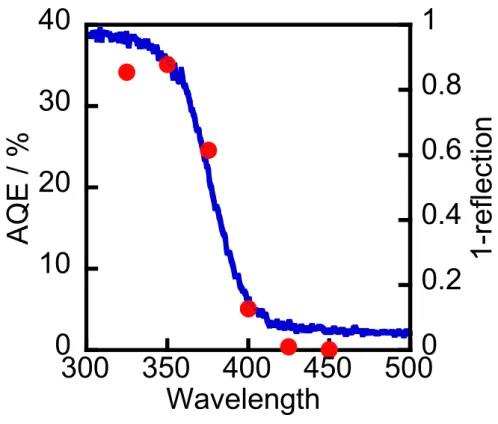
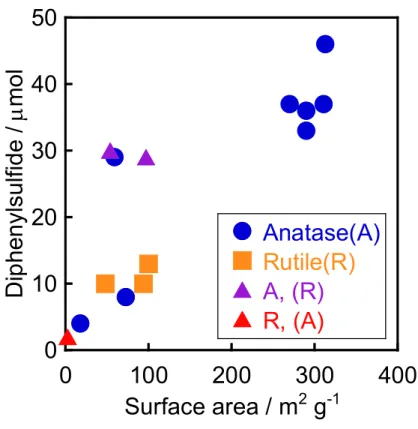
indicating that photogenarated electrons were selectively used for deoxygenation of DPSO. Re-oxidation and degradation of DPSI did not occur after consumption of DPSO. This photocatalytic deoxygenation of DPSO proceeded with high apparent quantum efficiency (AQE) of 35% at 350 nm. The AQE was in agreement with the absorption spectrum of TiO2. Therefore, it can be concluded that deoxygenation of DPSO in an acetonitrile suspension was induced by photoabsorption of TiO2. Various TiO2 samples were examined for photocatalytic deoxygenation of DPSO. A correlation was obtained for most of the TiO2 samples between specific surface area and DPSI yield. The applicability of photocatalytic deoxygenation of sulfoxides to sulfides was investigated. Phenyl vinyl sulfoxide was chemoselectively reduced to phenyl ethyl sulfide without hydrogenation of C=C double bond.
In chapter 2, photocatalytic selective hydrogenation of furfural (FAL) to furfuryl alcohol (FOL) was examined in alcohol suspensions of TiO2 under metal-free and H2-free conditions. FAL is one of biomass-derived compounds, and transformation of biomass-derived compounds is one of important topics in catalytic chemistry. FAL was successfully converted to FOL in a 2-pentanol suspension of TiO2 photocatalyst under metal-free and H2-free conditions. FOL and 2-pentanone were formed almost stoichiometrically. During the photocatalytic reaction, hydrogenation and degradation of furan structure, and re-oxidation of the hydroxymethyl group did not occur. The applicability of alcohol as hole scavenger in chemoselective hydrogenation of FAL was investigated. Ethanol and glycerol were available in hydrogenation of FAL, indicating that biomass-derived FAL can be up-graded to FOL by using biomass-derived alcohols such as ethanol and glycerol. In other words, double up-grading of FAL and alcohol was possible by photocatalytic reaction.
12
a representative O-heterocyclic compound and a biomass-derived compound, in alcohol suspensions of metal-loaded TiO2 under H2-free condition. Among the metal-loaded TiO2 examined for photocatalytic hydrogenation of furan, Pd-loaded TiO2 showed a distinctive photocatalytic activity for the hydrogenation of furan and suppressed H2 evolution. In the case of other metal co-catalysts, this excellent property was not obtained. The author examined furan adsorption on TiO2 and metal-loaded TiO2, and found that Pd showed the largest amount of adsorption of furan. Experiments under various reaction conditions revealed that biomass-related alcohols can be used for this photocatalytic system. Action spectrum was in agreement with absorption spectrum of TiO2 and AQE reached 37% at 360 nm. These results show that photocatalytic hydrogenation is not limited to hydrocarbons and can be applied to O-heterocyclic compounds.
In chapter 4, the author examined photoinduced ring hydrogenation of benzoic acid (BA) in an aqueous suspension of metal-loaded TiO2 in the presence of oxalic acid under H2-free condition. Effect of different metal co-catalysts on the yield of cyclohexanecarboxylic acid (CCA) as ring hydrogenation product was discussed. Rh-loaded TiO2 showed much higher CCA yield than other co-catalyst loaded TiO2. Correlation between hydrogen overvoltage of metal electrodes and yield of H2 in the photocatalytic reaction in the presence and absence of BA was observed. H2 evolution over Rh greatly decreased when BA was present in the reaction systems. The value of electron selectivity for the CCA formation increased with the increase in the amount of oxalic acid, while the efficiency of oxalic acid utilization decreased. From the results, there is an appropriate amount of oxalic acid for this reaction. Effects of hole scavenger and solvent were also examined and no photoinduced ring hydrogenation of BA occurred when alcohols and acetonitrile were used for as the solvent. Adsorption experiments under various conditions were carried out. The
13
difference in the adsorption properties is one of the important reasons for the high efficiency of the Rh-loaded TiO2 photocatalyst in the ring hydrogenation of BA.
In chapter 5, the author loaded two kinds of metals other than Rh on TiO2 and used these photocatalysts for ring hydrogenation of BA in aqueous suspensions under H2-free conditions. In the chapter 4, the author describes that Rh-loaded TiO2 hydrogenated BA to CCA. However, Rh is a rare and expensive element. Therefore, a photocatalyst having cheaper element(s) free from Rh is required. Among several combinations of two elements, the author found that Ru-Pd-TiO2 hydrogenated BA to CCA as well as Rh-TiO2. No ring hydrogenation occurred over Pd-TiO2, Ru-TiO2 and physical mixture of two photocatalysts. Spectroscopic analysis suggests that Ru and RuO2 in the particles loaded on TiO2 are mainly distributed on the outer surface of the particles, and most of the metallic Pd is distributed inside the particles and stabilizes some of the Ru in a metallic state. Results of photocatalytic reactions and characterization of Ru-Pd-TiO2 suggest that the stabilized metallic Ru acts as active sites for photocatalytic ring hydrogenation of BA.
14
References
1. A. J. Birch, J. Chem. Soc., 1944, 430-436.
2. J. Drabowicz, M. Mikolajczyk, Synthesis, 1976, 527-528
3. Y. Mikami, A. Noujima, T. Mitsudome, T. Mizugaki, K. Jitsukawa, K. Kaneda, Chem. Eur. J., 2011, 17, 1768-1772.
4. T. Mitsudome, A. Noujima, Y. Mikami, T. Mizugaki, K. Jitsukawa, K. Kaneda, Angew. Chem. Int. Ed., 2010, 49, 5545-5548
5. F. Corvaisier, Y. Schuurman, A. Fecant, C. Thomazeau, P. Raybaud, H. Toulhoat, D. Farrusseng, J. Catal., 2013, 307, 352-361.
6. T. Mitsudome, K. Kaneda, Green Chem., 2013, 15, 2636-2654
7. R. Ameta, S. Benjamin, A. Ameta, S. C. Ameta, Mater. Sci. Forum, 2013, 734, 247-272.
8. I. Izumi, W. W. Dunn, K. O. Wilbourn, F. F. Fan, Allen. J. Bard, J. Phys. Chem., 1980, 84, 3207-3210.
9. D. Sun, L. Ye, Z. Li, Appl. Catal. B: Environ., 2015, 164, 428-432. 10. O. Tomita, R. Abe, B. Ohtani, Chem. Lett., 2011, 40, 1405-1407.
11. S. Yurdakal, G. Palmisano, V. Loddo, O. Alagoz, V. Augugliaro, L. Palmisano, Green Chem., 2009, 11, 510-516.
12. X. Lang, W. R. Leow, J. Zhao, X. Chen, Chem. Sci., 2015, 6, 1075-1082
13. H. Kominami, S. Iwasaki, T. Maeda, K. Imamura, K. Hashimoto, Y. Kera, B. Ohtani, Chem. Lett., 2009, 38, 410-411.
14. K. Imamura, S. Iwasaki, T. Maeda, K. Hashimoto, B. Ohtani, H. Kominami, Phys. Chem. Chem. Phys., 2011, 13, 5114-5119.
15. K. Imamura, K. Hashimoto, H. Kominami, Chem. Commun., 2012, 48, 4356-4358. 16. K. Imamura, T. Yoshikawa, K. Hashimoto, H. Kominami, Appl. Catal. B; Environ.,
15
17. H. Tada, T. Ishida, A. Takao, S. Ito, Langmuir, 2004, 20, 7898-7900.
18. M. Fukui, A. Tanaka, K. Hashimoto, H. Kominami, Chem. Lett., 2016, 45, 985-987. 19. S. Kohtani, Y. Kamoi, E. Yoshioka, H. Miyabe, Catal. Sci. Technol., 2014, 4,
1084-1091
20. K. Fuku, K. Hashimoto, H. Kominami, Chem. Commun., 2010, 46, 5118-5120. 21. Y. Shiraishi, H. Hirakawa, Y. Togawa, T. Hirai, ACS Catal., 2014, 4, 1642-1649. 22. H. Kominami, S. Yamamoto, K. Imamura, A. Tanaka, K. Hashimoto, Chem.
Commun., 2014, 50, 4558-4560.
23. K. Imamura, T. Yoshikawa, K. Nakanishi, K. Hashimoto, H. Kominami, Chem. Commun., 2013, 49, 10911-10913.
24. K. Imamura, Y. Okubo, T. Ito, A. Tanaka, K. Hashimoto, H. Kominami, RSC Adv., 2014, 4, 19883-19886.
25. H. Kominami, M. Higa, T. Nojima, T. Ito, K, Nakanishi, K. Hashimoto, K. Imamura, ChemCatChem, 2016, 8, 2019-2022.
26. B. Pal, S. Ikeda, H. Kominami, Y. Kera, B. Ohtani, J. Catal., 2003, 217, 152-159. 27. P. Basu, Biomass Gasification and Pyrolysis: Practical Design and Theory,
Academic Press, United States, 2010, 27-28
28. A. Corma, S. Iborra, A. Velty, Chem. Rev., 2007, 107, 2411-2502. 29. A. J. J. Straathof, Chem. Rev., 2014, 114, 1871-1908.
30. T. Sekiba, S. Kimura, H. Yamamoto, A. Okada, Catal. Today, 1994, 22, 113-126. 31. N. Palina, O. Sakata, L. S. R. Kumara, C. Song, K. Sato, K. Nagaoka, T. Komatsu,
H. Kobayashi, K. Kusada, H. Kitagawa, Sci. Rep., 2017, 7, 41264-41272.
32. T. Fujita, H. Abe, T. Tanabe, Y. Ito, T. Tokunaga, S. Arai, Y. Yamamoto, A. Hirata, M. Chem, Adv. Funct. Mater., 2016, 26, 1609-1616.
16
34. K. Kusada, H. Kobayashi, R. Ikeda, Y. Kubota, M. Takata, S. Toh, T. Yamamoto, S. Matsumura, N. Sumi, K. Sato, K. Nagaoka, H. Kitagawa, J. Am. Chem. Soc., 2014, 136, 1864-1871.
35. Z. Liu, Y. Huang, Q. Xiao, H. Zhu, Green Chem., 2016, 18, 817-825. 36. T. Zhang, S. Wang, F. Chen, J. Phys. Chem. C, 2016, 120, 9732-9739.
17
Chapter 1
Photocatalytic deoxygenation of sulfoxides to sulfides over
titanium(IV) oxide at room temperature without use of metal
co-catalysts
1.1. Introduction
Deoxygenation of sulfoxides is an important reaction in both organic synthesis and biochemistry1-3. However, conventional deoxygenation requires stoichiometric reagents such as phosphines, halogens, and metal hydrides4-8 and yields a large amount of undesirable waste, although many efforts have been devoted to improve reaction conditions and to minimize the use of toxic reagents by using catalytic systems9-11. Recently, excellent catalysts for deoxygenation of sulfoxides, i.e., gold (Au) and ruthenium (Ru) supported on hydroxyapatite (HAP), were reported12, 13. However, even the Au/HAP and Ru/HAP catalysts required temperatures higher than 383 K and dimethylphenylsilane as a reducing agent yielding by-product residues such as siloxanes. Therefore, a more environmentally friendly catalytic reaction system for deoxygenation of sulfoxides working at lower temperatures with “greener” reducing agents giving no residue is keenly desired.
When titanium(IV) oxide (TiO2) is irradiated by UV light, charge separation occurs and thus-formed electrons in the conduction band and positive holes in the valence band cause reduction and oxidation, respectively. Photocatalytic reaction proceeds at room temperature and under atmospheric pressure, and the TiO2 photocatalyst is easily separated from the reaction mixture after the reaction and can be used repeatedly without a re-activation or re-generation process. In addition, TiO2
18
has been used for a long time as an indispensable inorganic material such as a pigment and UV absorber because it is inexpensive and not toxic for humans and the environment. Since photocatalytic reaction satisfies almost all of the 12 proposed requirements for green chemistry14, organic synthesis of various compounds using photocatalysts has recently been studied by many researchers15 and the number of reports on photocatalytic reduction of organic compounds by using photogenerated electrons has been increasing16, 17. However, most of the reports deal with reduction (hydrogenation) of nitrobenzenes to aminobenzenes18-32. In this study, the author examined a new photocatalytic reduction system, i.e., deoxygenation of sulfoxides (reduction of sulfoxides to sulfides) in a suspension of metal-free TiO2 in the presence of hole scavengers such as oxalic acid and formic acid. In this reaction, these organic acids also work as stoichiometric reagents for deoxygenation. However, oxalic acid and formic acid are recently used as green hole scavengers for photocatalytic reduction and hydrogenation because these oxalic acids are converted to carbon dioxide, which is easily separated from the solvent under acidic conditions33, 34. Here the author report that corresponding sulfides were successfully produced at room temperature without the use of toxic or undesirable reagents. .
19
1.2. Experimental
All of the reagents were commercial materials of reagent grade and used without further purification. Ishihara ST-01 was mainly used as the TiO2 photocatalyst in this study. In a typical run, TiO2 (50 mg) was suspended in 5 cm3 of acetonitrile containing diphenyl sulfoxide (DPSO) and oxalic acid in a test tube, sealed with a rubber septum under argon, and then photoirradiated at > 300 nm by a 400-W high-pressure mercury arc (Eiko-sha, Osaka) with magnetic stirring in a water bath continuously kept at 298 K. The amounts of DPSO unreacted and diphenyl sulfide (DPSI) formed were determined with an FID-type gas chromatograph (GC-2014, Shimadzu, Kyoto) equipped with a DB-1 column. The example of the gas chromatogram output is shown in Figure 1. The amount of hydrogen gas (H2) as the reduction product of protons (H+) was determined with a TCD-type gas chromatograph (GC-8A, Shimadzu, Kyoto) equipped with an MS-5A column. To obtain an action spectrum, the full arc from a xenon (Xe) lamp (Optiplex, Ushio, Tokyo) was monochromated with light width of ±10 nm using SM-100 (Bunkoukeiki, Tokyo). The light was used for photocatalytic reaction instead of the mercury arc. Spectra and intensity of the monochromated light from the Xe lamp were determined using a spectroradiometer (USR-45D, Ushio, Tokyo).
20
Figure 1 The gas chromatogram output at 30-min irradiation in Figure 2. 2.027 min: acetonitrile (solvent), 2.876 min: chlorobenzene (internal standard), 14.47 min: diphenylsulfide (product), 17.8 min: diphenylsulfoxide (substrate).
21
1.3. Results and discussion
1.3.1. Photocatalytic deoxygenation of diphenyl sulfoxide
Figure 2 shows time courses of DPSO remaining and DPSI formed in an acetonitrile suspension of TiO2 in the presence of oxalic acid under deaerated conditions. Just after photoirradiation, DPSO monotonously decreased, while DPSI was formed as the deoxygenation (reduction) product of DPSO. After 120 min, DPSO was almost completely consumed and DPSI was obtained in a high yield (98%). The results shown in Figure 2 were expressed as first-order kinetic and the rate constant was determined to be 2.15 × 10⁻² min-1. Other reduced products such as H
2 were not formed, indicating that photogenerated electrons (in other words, oxalic acid) were selectively used for reduction of DPSO. No H2 formation in the present reaction system is attributed to the use of bare (metal-free) TiO2. This H2-free system is attractive because there is no need to remove H2 from the reaction system. To evaluate stoichiometry and selectivity of the reaction and side-reactions occurring under the present conditions, a new indicator, i.e., material balance (MB), was calculated by Equation (1):
…(1),
where n(DPSO) and n(DPSI) are the amounts of DPSO and DPSI during the photocatalytic reaction, respectively, and n0(DPSO) is the amount of DPSO before the photocatalytic reaction. As shown in Figure 2, the values of MB were almost unity during the reaction, indicating that no other intermediates were produced under the present conditions. The author noted that 1) the amount of DPSI was unchanged, 2) the color of TiO2 became blue (Ti3+ species formed), and 3) no H2 was evolved, under excessive photoirradiation after complete consumption of DPSO. These results indicate that DPSI was not consumed by successive reactions such as re-oxidation and
, ) ( 0 ) ( ) ( DPSO n DPSI n DPSO n MB
22
degradation under the present conditions and that oxalic acid remaining was not consumed any more due to rapid recombination between photogenerated electrons and positive holes over Ti3+ species. From these results, the reaction, i.e., deoxygenation of DPSO to DPSI, would be shown in Scheme 1, although the author did not determine the amount of CO2.
Scheme 1 Photocatalytic deoxygenation of DPSO to DPSI in the presence of oxalic acid as a hole scavenger.
23
0
200
400
600
0.0
0.5
1.0
1.5
2.0
0
50
100
150
D
P
S
O
&
D
P
S
I /
m
ol
Time / min
M
B
/
-DPSO
DPSI
MB
Figure 2 Time courses of DPSO remaining, DPSI formed and material balance of DPSO and DPSI in an acetonitrile suspension of TiO2 in the presence of oxalic acid (1 mmol) under irradiation of UV light.
24
1.3.2. The effect of the kind and amount of hole scavenger on yield and selectivity of DPSI produced in photocatalytic deoxygenation of DPSO
Figure 3 shows the effect of the kind and amount of hole scavenger on yield and selectivity of DPSI produced in photocatalytic deoxygenation of DPSO in acetonitrile suspensions of TiO2 for 15 min. Use of a typical alcoholic hole scavenger, 2-propanol, resulted in a low yield due to the small reaction rate. On the other hand, large yields were obtained with sufficient selectivities when organic acids (formic acid and oxalic acid) were used. These organic acids, especially oxalic acid, have been shown to be efficient hole scavengers for chemoselective reduction of 3-nitrostyrene to 3-aminostyrene over a TiO2 photocatalyst9. When the amount of oxalic acid was decreased, both the yield and selectivity of DPSI decreased. Decrease in the selectivity suggests that DPSI was converted to some oxidized species other than DPSO because re-oxidation of DPSI to DPSO only decreases the yield of DPSI (the selectivity being preserved). These results indicate that twice the amount of a hole scavenger is necessary to avoid consumption of DPSI due to oxidation by positive holes.
25
0
20
40
60
80
100
Y
ie
ld
&
S
el
e
ct
iv
ity
/
%
2
-p
ro
p
a
n
ol
(
1
00
)
fo
rm
ic
a
ci
d
(1
00
)
o
xa
lic
a
ci
d
(1
0
0)
yi
el
d
se
le
ct
iv
ity
o
xa
lic
a
ci
d
(
80
)
o
xa
lic
a
ci
d
(
6
0
)
Figure 3 Effects of the kind and amount of hole scavengers on yield and selectivity of DPSI produced in photocatalytic deoxygenation of DPSO (50 µmol) in acetonitrile suspensions of TiO2 for 15 min. The values in parentheses are the amounts of hole scavengers in µmol.
26
1.3.3. Action spectrum of photocatalytic deoxygenation of DPSO to DPSI
An action spectrum is a strong tool for determining whether a reaction observed occurs via a photoinduced process or a thermocatalytic process. To obtain an action spectrum in this reaction system, deoxygenation of DPSO in acetonitrile suspensions of TiO2 (ST-01, Ishihara) was carried out at 298 K under irradiation of monochromated light from a Xe lamp with light width of ±10 nm. Apparent quantum efficiency (AQE) at each centered wavelength of light was calculated from the ratio of twice the amount of DPSI formed and the amount of photons irradiated using the following Equation (2):
…(2).
As shown in Figure 4, AQE was in agreement with the absorption spectrum of TiO2. Therefore, it can be concluded that deoxygenation of DPSO in an acetonitrile suspension was induced by photoabsorption of TiO2. As also shown in Figure 4, AQE reached 35% at 350 nm, indicating that photocatalytic deoxygenation of DPSO proceeded with high efficiency of photon utilization as well as chemical aspects such as selectivity and MB. 100. × photones incident of amount formed DPSI of amount the × 2 = AQE
27
0
10
20
30
40
300 350 400 450 500
0
0.2
0.4
0.6
0.8
1
A
Q
E
/
%
1-re
fle
ct
io
n
Wavelength
Figure 4 Absorption spectrum (right axis) and action spectrum of TiO2 in the deoxygenation of DPSO (left axis). DPSO: 50 µmol, oxalic acid: 100 µmol.
28
1.3.4. The expected reaction process of photocatalytic deoxygenation of DPSO to DPSI over TiO2
The expected reaction process of photocatalytic deoxygenation of DPSO to DPSI over TiO2 is shown in Figure 5: 1) By irradiation of UV light, photogenerated electrons (e-) and positive holes (h+) are formed in the conduction and valence bands of TiO2, and oxalic acid (or oxalate) is oxidized by h+, and 2) DPSO is reduced by e-, resulting in the formation of DPSI. However, H2 formation by reduction of H+ does not occur under a metal-free condition because H2 evolution generally requires loading of co-catalysts such as platinum and Pd.
29
Figure 5 Expected reaction process of photocatalytic deoxygenation of DPSO to DPSI over metal-free TiO2 in the presence of oxalic acid (OA).
30
1.3.5. Applicability of photocatalytic deoxygenation of sulfoxide
The applicability of photocatalytic deoxygenation of sulfoxide to sulfide was investigated, and the results are summarized in Table 1. Results of entries 1-3 indicate that the TiO2 photocatalyst can be used repeatedly for deoxygenation of DPSO to DPSI without deactivation. The reusability of TiO2 is attributable to its stability. Since the TiO2 photocatalyst is used without modification with a metal co-catalyst, the present reaction system is free from changes in states such as size, dispersion and oxidation states of the co-catalyst during the photocatalytic reaction. Almost quantitative deoxygenation of DPSO occurred under a ten-times concentrated condition (entry 4) as shown in Figure 2. Methyl phenyl sulfoxide was more easily deoxygenated to methyl phenyl sulfide (entry 5). The author found that phenyl vinyl sulfoxide was chemoselectively reduced to phenyl vinyl sulfide without hydrogenation of a C=C double bond (entry 6). Kominami et al. have reported that 3-nitrostyrene was chemoselectively reduced to 3-aminostyrene without reduction of a C=C double bond to 3-ethylaniline in a suspension of a TiO2 photocatalyst in the presence of oxalic acid as hole scavengers at room temperature32. The high reduction potential of vinyl group accounts for the chemoselective reduction of 3-nitrostyrene and phenyl vinyl sulfoxide. The use of TiO2 without a metal co-catalyst strongly contributed to the chemoselectivity. If TiO2 modified with a metal co-catalyst is used, hydrogenation of a C=C double bond35 would occur as well as deoxygenation. Photocatalytic deoxygenation was also applicable for sulfoxide of an acyclic compound (entry 7), though a longer reaction time was required.
31
Table 1 Photocatalytic deoxygenation of sulfoxides to corresponding sulfides over TiO2 at 298 K.[a]
Entry Sulfoxides Sulfides t / min Yield / %[b] Sel. /%[b] 1 20 93 95 2[c] 20 98 98 3[d] 20 >99 >99 4[e] 120 98 98 5 15 99 99 6 15 82 82 7 30 91 91
[a] Reaction conditions: TiO2 (50 mg), substrate (50 µmol), acetonitrile (5 cm3), oxalic acid (100 µmol), room temperature, under Ar. [b] Determined by GC using an internal standard. [c] Second use. [d] Third use. [e] Diphenyl sulfoxide (500 µmol), oxalic acid (1 mmol).
32 1.3.6. Effects of physical properties of TiO2
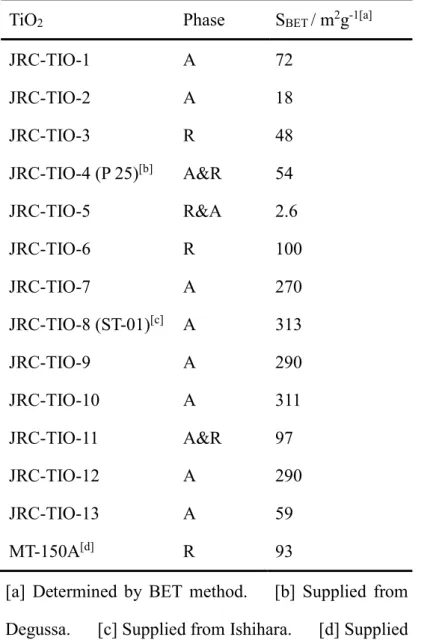
To evaluate the effects of physical properties of TiO2, representative commercial TiO2 samples, which were registered at the Catalysis Society of Japan as Japan Reference Catalysts (JRC-TIO series), were used for photocatalytic deoxygenation of DPSO under the same conditions. Phase of TiO2 and specific surface area of the TiO2 samples are summarized in Table 2. Figure 6 shows the effect of specific surface area of TiO2 samples on yields of DPSI produced. A clear correlation was observed for most of the TiO2 samples between specific surface area and DPSI yield, though there were some exceptions. These results also mean that TiO2 structure (anatase or rutile) had little effect on the photocatalytic deoxygenation of DPSO; however, bi-phase of anatase and rutile in the TiO2 sample may be effective. The author are now investigating adsorption properties of these TiO2 samples toward DPSO, DPSI and oxalic acid.
33
Table 2 Crystalline phase and specific surface area of TiO2 samples
TiO2 Phase SBET / m2g-1[a] JRC-TIO-1 A 72 JRC-TIO-2 A 18 JRC-TIO-3 R 48 JRC-TIO-4 (P 25)[b] A&R 54 JRC-TIO-5 R&A 2.6 JRC-TIO-6 R 100 JRC-TIO-7 A 270 JRC-TIO-8 (ST-01)[c] A 313 JRC-TIO-9 A 290 JRC-TIO-10 A 311 JRC-TIO-11 A&R 97 JRC-TIO-12 A 290 JRC-TIO-13 A 59 MT-150A[d] R 93
[a] Determined by BET method. [b] Supplied from Degussa. [c] Supplied from Ishihara. [d] Supplied from Tayca.
34
Figure 6 Effect of specific surface area of TiO2 samples on yields of DPSI produced in photocatalytic deoxygenation of DPSO (50 µmol) for 10 min in acetonitrile solutions containing oxalic acid (100 µmol). Minor form in bi-phase samples is shown in parenthesis.
0
10
20
30
40
50
0
100
200
300
400
Anatase(A)
Rutile(R)
A, (R)
R, (A)
D
ip
he
n
yl
su
lfi
d
e
/
m
o
l
Surface area / m
2g
-135
1.4. Conclusions
Photocatalytic deoxygenation of sulfoxides to corresponding sulfides was examined in acetonitrile suspensions of bare TiO2 particles at room temperature without the use of a metal co-catalyst and toxic reagents. Organic acids, especially oxalic acid, worked efficiently as hole scavengers. The use of an excess of organic acids was effective for achieving high yields of sulfide and for avoiding fruitless degradation of sulfides. The present photocatalytic method can be applied for deoxygenation of various sulfoxides to corresponding sulfides. Chemoselective reduction of phenyl vinyl sulfoxide to phenyl vinyl sulfide was also achieved because the metal-free TiO2 photocatalyst had no ability for hydrogenation of the C=C double bond.
36
References
1. G. Solladie, Synthesis, 1981, 3, 185-196.
2. M. C. Carreno, Chem. Rev., 1995, 95, 1717-1760. 3. J. R. Debaun, J. J. Menn, Science, 1976, 191, 187-188.
4. K. Bahrami, M. M. Khodaei, M. S. Arabi, J. Org. Chem., 2010, 75, 6208-6213. 5. G. S. Bhatia, P. P. Graczyk, Tetrahedron Lett., 2004, 45, 5193-5195.
6. K. Bahrami, M. M. Khodaei, A. Karimi, Synthesis, 2008, 16, 2543-2546. 7. J. Drabowjcz, M. Mikolajczyk, Synthesis, 1976, 527-528.
8. J. Zhang, X. Gao, C. Zhang, C. Zhang, J. Luan, D. Zhao, Synth. Commun., 2010, 40, 1794-1801.
9. K. Ogura, M. Yamashita, G. Tsuchihashi, Synthesis, 1975, 385-387. 10. P. Geneste, M. Bonnet, C. Frouin, D. Levache, J. Catal., 1980, 61, 277-278.
11. N. Garcia, P. G-Garcia, M. R. Pedrosa, F. J. Arnaiz, R. Sanz, Green Chem., 2013, 15, 999-1005.
12. Y. Mikami, A. Noujima, T. Mitsudome, T. Mizugaki, K. Jitsukawa, K. Kaneda, Chem. Eur. J., 2011, 17, 1768-1772.
13. Y. Takahashi, T. Mitsudome, T. Mizugaki, K. Jitsukawa, K. Kaneda, Chem. Lett., 2014, 43, 420-422.
14. P. T. Anastas, J. C. Warner, Green Chemistry: Theory and Practice, Oxford University Press, 1998.
15. M. A. Fox, M. T. Dulay, Chem. Rev., 1993, 93, 341-357.
16. G. Palmisano, V. Augugliaro, M. Pagliarob, L. Palmisano, Chem. Commun., 2007, 3425-3437.
17. G. Palmisano, E. Garcia-Lopez, G. Marci, V. Loddo, S. Yurdakal, V. Augugliaro, L. Palmisano, Chem. Commun., 2010, 46, 7074-7089.
37
19. V. Brezova, A. Blazˇkova, I. Sˇurina, B. Havlinova, J. Photochem. Photobio. A, 1997, 107, 233-237.
20. J. L. Ferry, W. H. Glaze, Langmuir, 1998, 14, 3551-3555.
21. J. L. Ferry, W. H. Glaze, J. Phys. Chem. B, 1998, 102, 2239-2244.
22. V. Makarova, T. Rajh, M. C. Thurnauer, A. Martin, P. A. Kemme, D. Cropek, Environ. Sci. Tech., 2000, 34, 4797-4803.
23. V. Brezova, P. Tarabek, D. Dvoranova, A. Staˇsko, S. Biskupiˇc, J. Photochem. Photobio. A: Chem., 2003, 155, 179-198.
24. H. Tada, T. Ishida, A. Takao, S. Ito, Langmuir, 2004, 20, 7898-7900.
25. H. Tada, T. Ishida, A. Takao, S. Ito, S. Mukhopadhyay, T. Akita, K. Tanaka, H. Kobayashi, ChemPhysChem, 2005, 6, 1537-1543.
26. T. Zhang, L. You, Y. Zhang, Dyes and Pigments, 2006, 68, 95-100.
27. S. O. Flores, O. R.-Bernij, M. A. Valenzuela, I. Cordova, R. Gomez, R. Gutierrez, Top. Catal., 2007, 44, 507-511.
28. S. Chen, H. Zhang, X. Yu, W. Liu, Chinese Journal of Chemistry, 2010, 28, 21-26. 29. H. Kominami, S. Iwasaki, T. Maeda, K. Imamura, K. Hashimoto, Y. Kera, B.
Ohtani, Chem. Lett., 2009, 15, 410-411.
30. K. Imamura, S. Iwasaki, T. Maeda, K. Hashimoto, B. Ohtani, H. Kominami, Phys. Chem. Chem. Phys., 2011, 13, 5114-5119.
31. K. Imamura, T. Yoshikawa, K. Hashimoto, H. Kominami, Appl. Catal. B, Environ., 2013,134–135, 193-197.
32. K. Imamura, K. Hashimoto, H. Kominami, Chem. Commun., 2012, 48, 4356-4358. 33. H. Kominami, A. Furusho, S.-y. Murakami, H. Inoue, Y. Kera and B. Ohtani, Catal.
Lett., 2001, 76, 31-34.
34. H. Kominami, T. Nakaseko, Y. Shimada, A. Furusho, H. Inoue, S.-y. Murakami, Y. Kera and B. Ohtani, Chem. Commun., 2005, 2933-2935.
38
35. K. Imamura, Y. Okubo, T. Ito, A. Tanaka, K. Hashimoto, H. Kominami, RSC Adv. 2014, 4, 19883-19886.
39
Chapter 2
Photocatalytic selective hydrogenation of furfural to furfuryl
alcohol over titanium(IV) oxide under metal-free and
hydrogen-free conditions at room temperature
2.1. Introduction
Furfural (FAL) is produced from non-edible plant-derived biomass resources such as corncobs and bagasse and is one of the most important platform chemicals with which the conversion of biomass to chemicals starts.1-2 Reduction, oxidation and condensation have been reported as methods for conversion of FAL to useful chemicals, and reduction is most important because there are two C-C double bonds and an aldehyde group in FAL. There are various reduced products of FAL such as furfuryl alcohol (FOL), tetrahydrofurfural and tetrahydrofurfuryl alcohol as hydrogenation products, 2-methylfuran and 2-methyltetrahydrofuran as side-chain hydrogenolysis products, and 1,2-pentanediol, 1-5-pentanediol and 1-pentanol as ring-opening hydrogenolysis products.3-4 Among these compounds, FOL is a useful compound and is used as raw material for solvents, various chemicals and pharmaceuticals.2 Conversion of FAL to FOL is a chemoselective reaction, i.e., the aldehyde group should be reduced without hydrogenation of the furan ring. There are several reports on chemoselective reduction of FAL to FOL.5-6 However, reported hydrogenation of FAL was achieved over metal catalysts at an elevated temperature in the presence of hydrogen (H2) as a reducing agent. Therefore, a more environmentally friendly system for FOL synthesis from FAL is highly desired.
40
irradiated by light having an energy larger than the band gap, electrons in the valence band are excited to a conduction band, resulting in the formation of excited electrons (e–) in the conduction band and positive holes (h+) in the valence band. Over the surface of the photocatalyst, e– are accepted by an adsorbed reactant to be reduced, while h+ are captured by another reactant to be oxidized. Totally, both e– and h+ are consumed, simultaneously producing reduced and oxidized products. Since this redox reaction is driven only by light at room temperature, photocatalytic reaction has attracted the interest of chemists, and the application of photocatalytic reaction to a green organic reaction system has recently been studied.7-9 However, most of studies have focused on either a reduced or oxidized product, with other products not being considered, and in the case of a reduction system, the reaction is almost limited to simple hydrogenation (reduction) of nitrobenzene. In the course of studies on application of photocatalysis to a green organic conversion, Kominami et al. reported new possibilities of photocatalytic reactions over TiO2 under metal-free and hydrogen-free conditions at room temperature. For example, almost complete chemoselectivity was achieved in hydrogenation of a nitro group to an amino group of nitrobenzenes having reducible functional groups.10 Almost complete chemoselectivity was also achieved in hydrogen transfer from aliphatic alcohols to benzaldehydes, i.e., Meerwein-Ponndorf-Verley-type reaction.11 In two hydrogenation (reduction) reactions, reducible functional groups attached to a benzene ring were preserved even though nitro and carbonyl groups are completely reduced to amino and hydroxymethyl (-CH2OH) groups, respectively. Through these studies, Kominami et al. also found another important characteristic of photocatalytic reduction (hydrogenation) over metal-free TiO2 i.e., an aromatic ring is also preserved. The author thus became interested in determining whether a heterocycle is hydrogenated or not over a metal-free TiO2 photocatalyst. The author think that FAL is a suitable model
41
compound to evaluate chemoselectivity in biomass resources because FAL consists of a furan structure and carbonyl group. In this study, the author examined photocatalytic hydrogenation of FAL in alcohol suspensions of TiO2 under metal-free and hydrogen-free conditions to evaluate the possibility of up-grading of FAL. Here we briefly report 1) chemoselectivity in hydrogenation to a furan structure and carbonyl group, 2) expandability of alcohols, and 3) reaction mechanism.
42
2.2. Experimental
2.2.1. Photocatalytic hydrogenation of FAL
TiO2 (ST-01, Ishihara, anatase, 313 m2g-1, 50 mg) was suspended in 5 cm3 of an alcohol containing FAL (ca. 50 µmol) in a test tube, which was sealed with a rubber septum and then photoirradiated under Ar at 298 K with a high-pressure mercury lamp. The amounts of FAL and FOL were determined with an FID-type gas chromatograph (GC-2025, Shimadzu) equipped with a DB-1 column. Chlorobenzene was used as an internal standard sample. Chlorobenzene (7 mm3) was added to the reaction solution (3 cm3). After the mixture had been stirred for 7 min, FAL and FOL were analyzed. The amounts of FAL and FOL were determined from the ratios of the peak areas to the peak area of chlorobenzene. The amount of H2 as the reduction product of protons (H+) and the amount of CO
2 were determined with a TCD-type gas chromatograph (GC-8A, Shimadzu) equipped with an MS-5A column and Porapak QS column. A multi-wavelength irradiation monochromator (MM-3, Bunkoukeiki Co., Ltd) was used to obtain apparent quantum efficiency (AQE), and light intensity was determined by using a spectroradiometer (USR-45D, Ushio Inc.).
2.2.2. Adsorption of FAL and FOL on TiO2
TiO2 (ST-01, 200 mg) was suspended in 5 cm3 of ethanol containing FAL and/or FOL (each 100 µmol) in a test tube. The test tube was sealed with a rubber septum under argon and the mixture was stirred in a water bath at 293 K for 30 hours in the dark. The amounts of FAL and FOL were determined with an FID-type gas chromatograph (GC-2025, Shimadzu) equipped with a DB-1 column. Chlorobenzene was used as an internal standard sample. Chlorobenzene (7 mm3) was added to the reaction solution (3 cm3). After the mixture had been stirred for 7 min, FAL and FOL were analyzed. The amounts of FAL and FOL were determined from the ratios of the peak areas to the peak area of chlorobenzene.
43
2.3. Results and discussion
2.3.1. Photocatalytic hydrogenation of FAL
Figure 1 shows time courses of photocatalytic reduction of FAL in a 2-pentanol suspension of TiO2. The amount of FAL decreased with photoirradiation and FOL was formed, indicating that the carbonyl group of FAL was chemoselectively hydrogenated to a -CH2OH group. After 30-min irradiation of UV light, FAL was almost completely consumed and the yield of FOL reached >99%. The amount of FOL did not decrease after consumption of FAL. Almost quantitative formation of FOL and no change in the amount of FOL also mean that the following reactions did not occur: 1) hydrogenation of the furan structure, 2) degradation of the furan structure, and 3) re-oxidation of the -CH2OH group of FOL. From the results of previous study and the present results, it can be concluded that benzene and furan rings are not hydrogenated over a metal-free TiO2 photocatalyst. The reason why reactions 2) and 3) did not occur is that the use of 2-pentanol as a solvent minimized the possibility of reactions 2) and 3). Adsorption of FAL and/or FOL on TiO2 in ethanol was examined and results were shown in Figure 2. Competitive adsorption of FAL and FOL revealed that FAL was preferentially adsorbed on TiO2, which accounts for the high selectivity and yield of FOL in this reaction system. The author noted that there was no other reduced product during the whole reaction. As a reduced product, H2 can be formed by reduction of protons (H+), but it was not formed. Material balance (MB) was calculated by Equation (1). The value of MB can be used to evaluate the selectivity of FOL and the presence of intermediates in the reaction.
(1) Where n(FAL) and n(FOL) are the amounts of FAL and FOL during the photocatalytic
reaction, respectively, and n0(FAL) is the amount of FAL before the photocatalytic
,
)
(
)
(
)
(
0FAL
n
FOL
n
FAL
n
MB
44
reaction. The value of MB was slightly smaller than unity in the initial stage of the reaction, suggesting that FAL was adsorbed on TiO2 and/or that an intermediate(s) was formed. After 20-min photoirradiation, the value became almost unity, indicating that the intermediate(s) was converted to FOL and/or FOL was not adsorbed on TiO2. The author also analyzed the oxidation product in this reaction. 2-Pentanone was formed as the oxidized product of 2-pentanol. The amount of 2-pentanone increased with irradiation time and was saturated at around 50 μmol. As the fully oxidized product, CO2 was not formed as is expected from no change in the amounts of FOL and 2-pentanone with prolonged photoirradiation. The balance between oxidation and reduction (redox balance, RB) was evaluated by Equation (2).
(2) During the reaction, the value of redox balance was almost unity. These results clarified the characteristics of this reaction system: 1) stoichiometric reaction of FAL and 2-pentanol to FOL and 2-pentanone occurs, 2) the stoichiometric reaction ceases when FAL is consumed, and 3) no other reactions occur.
45
Figure 1 Time courses of (a) FAL, FOL, H2, CO2, and material balance and (b) 2-pentanone and redox balance in a 2-pentanol suspension of a TiO2 photocatalyst under irradiation of UV light at 298 K.
46
Figure 2 Amount of FAL and/or FOL adsorbed onto TiO2 in ethanol containing a) FAL, b) FOL and c) FAL and FOL for 30 h in the dark.
0
0.3
0.6
0.9
1.2
FAL
a)FOL
b)FAL + FOL
c)47
2.3.2. Applicability of alcohol in chemoselective hydrogenation of FAL to FOL
Table 1 shows the applicability of alcohol as a hole scavenger in the photocatalytic reduction of FAL to FOL. FOL was obtained in high yields in all cases. The reaction rate was dependent on the reactivity of alcohol with holes because similar tendency was observed in photocatalytic hydrogen formation along with alcohol oxidation.12 The author noted that ethanol and glycerin were available in the hydrogenation of FAL, indicating that biomass-derived FAL can be up-gradated to FOL by using biomass-derived compounds. Figure 3 shows the results of re-use tests of photocatalytic reduction of FAL to FOL in ethanolic suspensions of TiO2. The photocatalyst was reusable at least twice without notable loss of activity.
48
Table 1 Applicability of alcohol in chemoselective hydrogenation of FAL to FOL over a TiO2 photocatalyst under metal-free and hydrogen-free conditions at 298 K.
Alcohols Time / min Conv.a / % Sel.b / % 10 >99 >99 15 >99 >99 20 >99 98 20 >99 92 30 >99 99 120 >99 92
aConversion of FAL; Conv. = decrement of FAL / initial amount of FAL ×100. bSelectivity of FOL from FAL; Sel. = amount of FOL / decrement of FAL ×100. cGlycerol (500 µmol) was dissolved in water.
49
Figure 3 Cycle test of TiO2 in photocatalytic reduction of FAL to FOL in ethanolic suspensions for 15-min photoirradiation from a high-pressure mercury lamp.
0
50
100
0
0.5
1
1
2
3
C
on
v.
a
nd
S
e
l.
/
%
M
at
e
ri
al
b
al
a
n
ce
/
-Cycle
50
2.3.3. Action spectrum of photocatalytic selective hydrogenation of FAL to FOL over TiO2
An action spectrum is a strong tool for determining whether a photoinduced process is the rate-determining step in the reaction observed. To obtain an action spectrum in this reaction system, hydrogenation of FAL in ethanolic suspensions of TiO2 was carried out at 298 K under irradiation of monochromated light from a Xe lamp. Apparent quantum efficiency (AQE) at each centered wavelength of light was calculated from the ratio of twice the amount of FOL formed and the amount of photons irradiated using Equation (3):
(3). As shown in Figure 4, AQE was in agreement with the absorption spectrum of TiO2. Therefore, it can be concluded that reduction of FAL in ethanolic suspensions was induced by photoabsorption of TiO2. As also shown in Figure 4, AQE reached 17% at 330 nm, indicating that photocatalytic reduction of FAL to FOL occurred with high efficiency of photon utilization.
100
×
photons
incident
of
amount
formed
FOL
of
amount
×
2
=
AQE
51
Figure 4 Absorption spectrum (right axis) and action spectrum of TiO2 in hydrogenation of FAL to FOL in an ethanolic suspension of TiO2 (left axis).
0
5
10
15
0
0.2
0.4
0.6
0.8
1
300
350
400
450
A
Q
E
/
%
1-R
e
fle
ct
a
nc
e
/
%
Wavelength / nm
TiO
252
2.3.4. Effects of various reaction conditions on reduction of FAL in ethanolic suspensions of TiO2
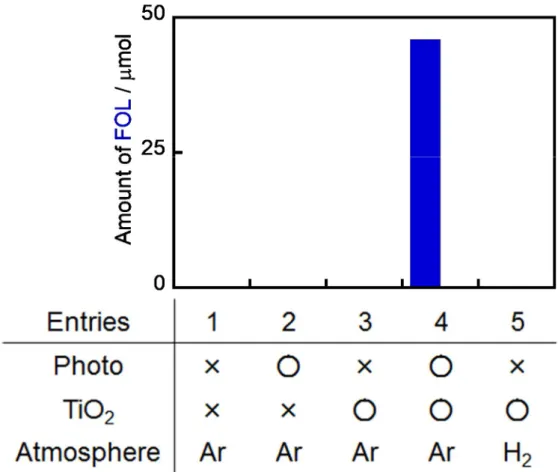
The effects of various reaction conditions on reduction of FAL in ethanolic suspensions of TiO2 are shown in Figure 5. Entries 1, 2 and 3 show the results of three blank reactions: 1) in the absence of TiO2 in the dark (non- catalytic thermal reaction between FAL and ethanol, entry 1), 2) in the absence of TiO2 with irradiation of light (photochemical reaction, entry 2), and 3) in the presence of TiO2 in the dark (thermocatalytic reaction between FAL and ethanol over TiO2, entry 3). The results indicate that the TiO2 photocatalyst and photoirradiation are indispensable for the reduction of FAL. The dark reaction under 1 atm of H2 (thermocatalytic reaction between FAL and H2 over TiO2) was examined in an ethanolic suspension at 298 K (entry 5); however, no reaction occurred, suggesting that H2 was not activated over metal-free TiO2 at 298 K. The result of entry 5 clarifies that the photocatalytic method is effective for chemoselective conversion of FAL to FOL under H2-free and metal-free conditions at around room temperature.
53
Figure 5 Effects of various reaction conditions on reduction of FAL in ethanolic suspensions of TiO2.
54
2.3.5. The expected reaction process of photocatalytic reduction of FAL in a 2-petanol suspension of TiO2
The expected reaction process of photocatalytic reduction of FAL in a 2-petanol suspension of TiO2 under H2-free and metal-free condition is shown in Figure 6: 1) By irradiation of UV light, e– and h+ are formed in the conduction and valence bands of TiO2, and 2-petanol is oxidized to 2-pentanone by h+ and 2) the carbonyl group of FAL is reduced to -CH2OH groups by e-, resulting in the formation of FOL. The furan ring is not hydrogenated, probably because the activation energy of this process over metal-free TiO2 is large. No hydrogenation of FAL even in the presence of H2 (entry 5 in Figure 5) indicates that dissociative adsorption of H2 is difficult over metal-free TiO2.
55
Figure 6 An expected reaction process of chemoselective hydrogenation of FAL to FOL and oxidation of 2-pentanol to 2-pentanone over a TiO2 photocatalyst under metal-free and hydrogen-free conditions.
56
2.4. Conclusions
In conclusion, FAL was chemoselectively and quantitatively converted to FOL in a 2-pentanol suspension of a TiO2 photocatalyst under metal-free and hydrogen-free conditions. Oxidation of 2-pentanol to 2-pentanone simultaneously occurred with a high stoichiometry, and various alcohols such as glycerol and ethanol were used for this reaction, indicating that double up-grading of FAL and alcohol was possible.
57
References
1. Corma, S. Iborra, A. Velty, Chem. Rev., 2007, 107, 2411.
2. Ullman’s Ecvyvlopedia of industrial Chemistry, ed. by H. E. Hoydonckx, W. M. V. Rhijn, W.V. Rhijin, D. E. D. Vos, P. A. Jacobs, Wiley-VCH, 2007.
DOI: doi.org/10.1002/14356007.a12-119.pub2.
3. Y. Nakagawa, M. Tamura, K. Tomishige, J. Jpn. Petrol. Inst., 2017, 60, 1. 4. Takagaki, S. Nishimura, K. Ebitani, Catal. Surv. Asia, 2012, 16, 164. 5. X. Chen, L. Zhang, B. Zhang, X. Guo, X. Mu, Sci. Rep., 2016, 6, 28558. 6. S. Sitthisa, D. E. Resasco, Catal. Lett., 2011, 141, 784.
7. Palmisano, E. Garcia-Lopez, G. Marci, V. Loddo, S. Yurdakal, V. Augugliaro, L. Palmisano, Chem. Commun., 2010, 46, 7074.
8. Palmisano, V. Augugliaro, M. Pagliaro, L. Palmisano, Chem. Commun., 2007, 3425.
9. M. A. Fox, M. T. Dulay, Chem. Rev., 1993, 93, 341.
10. Imamura, T. Yoshikawa, K. Hashimoto, H. Kominami, Appl. Catal. B Environ., 2013, 134-135, 193.
11. M. Fukui, H. Kouda, A. Tanaka, K. Hashimoto, H. Kominami, Chem. Select, 2017, 2, 2293.
12. Z. H. N. Al-Azri, W. Chen, A. Chan, V. Jovic, T. Ina, H. Idriss, G. I. N. Waterhouse, J. Catal., 2015, 329, 355.
58
Chapter 3
Photocatalytic hydrogenation of furan to tetrahydrofuran in
alcoholic suspensions of metal-loaded titanium(IV) oxide
without addition of hydrogen gas
3.1. Introduction
Tetrahydrofurans (THFs) are important compounds as intermediates of chemical products, and they are produced by dehydration of diols and hydrogenation of corresponding furans.1, 2 Hydrogenation of furans to THFs is more attractive because furans can be produced from biomass. Hydrogenation of the furans is achieved by catalytic hydrogenation using a metal catalyst such as nickel or palladium (Pd) supported on a suitable support.2 However, these catalyst systems require the addition of an excess amount of dihydrogen (H2) gas as a hydrogen source in a closed reactor. Therefore, a more environmentally friendly catalytic reaction system for hydrogenation of furans utilizing a “greener” hydrogen source is desired.
Since titanium(IV) oxide (TiO2) is inexpensive and not toxic for humans and the environment, TiO2 has been used for a long time as an indispensable inorganic material such as a pigment and UV absorber. Another important application of TiO2 is the use as a photocatalyst. When TiO2 is irradiated by UV light, charge separation occurs and thus-formed electrons in the conduction band and positive holes in the valence band cause reduction and oxidation, respectively. The photocatalytic reaction satisfies almost all of the 12 proposed requirements for green chemistry3 because of its characteristics shown below. First, TiO2 functions as a catalyst. The TiO2-photocatalyzed reaction occurs at room temperature. Solar energy can be used