Analysis of positioning of life and environmental
science education in Japanese secondary school
by international comparison
(日本の中等学校における生物および環境科学教育の
位置づけについての国際比較による分析)
山梨大学大学院
医学工学総合教育部
博士課程学位論文
March 2015
Kseniya Fomichova
Analysis of positioning
of life and environmental science education
in Japanese secondary school
by international comparison
(日本の中等学校における生物および環境科学
教育の位置づけについての国際比較による分析)
March 2015
Kseniya Fomichova
1
ABSTRACT
This research is an assessment of the degree of prioritization of life science (biology) and environmental science in the system of secondary school education of Japan in comparison to a number of countries.
The purpose of this research is to improve methodologies and practices in life and environmental sciences (LES) education in Japan and possibly internationally through a comparative study of school curricula (intended and implemented) and an identification of factors of its stakeholders’ attitudes and behaviour.
The study was conducted in two perspectives: 1) a comparative analysis of curricula in life and environmental sciences intended for teaching in lower and upper secondary schools (7-12 school years) of various countries; 2) attitudes toward s life and environmental sciences and present practices in this regard evaluated by stakeholders of school education (st udents, parents and teachers).
In particular, the study explored the following: a) qualitative and quantitative characteristics of the secondary school curricu la in life and environmental sciences in comparison to other science areas; b) an evaluation of their implementation by the stakeholders; c) an interrelationship between educational policies, practices and a societal ‘image’ of science areas through stakeholders’ assessment; d) differences in students’ attitudes towards areas of science and environmental problems in terms of their gender and/or a nationality; e) aspects of possible improvements in the present system of school science education; f) general, gender and socio-cultural regularities in the perception of science.
According to the analytical approach described earlier, the study targets to place the results obtained in Japan into the multinational comparative context of policies, practices, trends and a societal behaviour in education. Till presently, there was no research investigating a level of prioritization of life and environmental science s in Japan or other country from a broad perspective of their position in both education system and societal perception. This study is conducting such a research and is also targeting to identify regularities of the societal perception of science that have not been sufficiently presented in the scientific literature.
The objective 1 of the research was to identify the ‘position’, i.e. the level of prioritization of life and environmental sciences in school education through a comparison of qualitative and quantitative characteristics of life and environmental sciences curricula with those in physics, chemistry, Earth science in secondary schools of Japan and other countries. Methods for the objective 1 were: 1) a comparative analysis of National Standards and a course of recent reforms in school life and environmental sciences in Japan with those of other countries; 2) an assessment of practices in school science education given by the teachers (a questionnaire).
The objective 2 of the research was to identify factors of the societal perception and behaviour of the stakeholders of school education in regard to science. Methods for the objective 2 were: 1) a comparative analysis of the societal attitudes of the stakeholders of school education (students, parents and teachers) toward s areas of science and related issues in Japan and abroad with a focus on students’ gender and
2
nationality (a questionnaire); 2) testing of different types of students’ motivation in science.
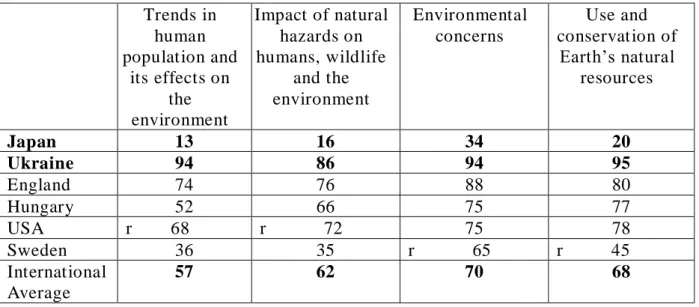
According to objective 1, National Standards in life and environmental science s of lower and upper secondary schools of Japan were compared to those of 5 countries. England, Hungary, Sweden, Ukraine, the USA were selected for comparison as two blocks representing education systems where science is divided into areas at earlier (Hungary, Sweden, Ukraine) or later (England, the USA) stages. The instructional time, number of intended, studied topics, and characteristics of the teaching process in life and environmental sciences of school systems were extracted, compared and analysed. It was concluded, that up to grade 9, Japan is the country where less science topics were included into the curricula and with the lowest average percentage of students who were taught science topics in biology and environmental sciences among all analysed countries; it was lower than the TIMSS international average. In regard to physics and chemistry, no such tendency was found, and therefore it was established that life and environmental science could be less emphasized in the teaching practice of Japanese secondary education.
For a more detailed comparison, the science education system of Ukraine representing the ‘maximum’ science curricula was selected. I n this country the last reforms in science education (of 2001 and 2010) were ‘a reverse’ to the Japanese one: while in Japan ‘minimum curricula’ were revised with an increase of instructional time and number of topics, in Ukraine the goal was to decrease those figures.
Topics compulsory for learning by all students (without those of optional courses designated for upper secondary schools) were particularly studied and arranged as a database. As of 2011, totally in grades 7-12 Japanese students were prescribed to learn 34-39 topics (Ukrainian students - 68) from 74, and instructional time was 2-4.5 times bigger in Ukraine. Also, in general, life and environmental science topics in Nat ional Standards of Ukraine prescribed more periods of the instructional time and included a more particular scientific terminology than those of Japan.
As a result of an international analysis of curricula, it was concluded that in Japan life and environmental sciences might have been less emphasized in comparison to physics and chemistry. However, this issue had to be studied after a reform of school science education in Japan that was completed by 2012. For this, a questionnaire enquiring about teachers’ opinions in regard to the present teaching practices and an impact of the reform was conducted.
Between October and December 2012, 68 sheets of responses from 27 public lower secondary schools located in Tokyo Metropolis and Yamanashi Prefecture were collected.
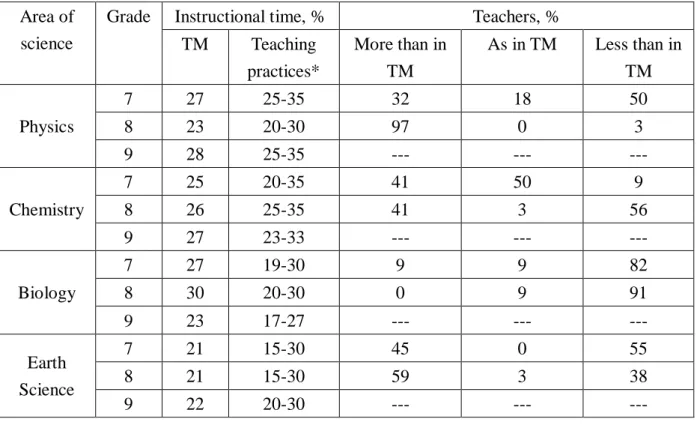
The survey identified biology as an area of science with less instructional time and contents than physics and chemistry in teaching practice in all grades of lower secondary school. In particular, in grades 7 and 8, 82% and 91% of respondents estimated that instructional time for biology was less than recommended in the teachers’ manuals. A similar trend was observed when inquiring about the content for each area of science. While biology was identified as an area of science receiving less instructional time and having less content, the respondents reported a substantially
3
higher deficiency of instructional time and in general suggested increase of it for physics and chemistry rather than for biology or Earth science. It means that biology’s instructional time might be reduced by teachers in order to increase it for physics and chemistry those reportedly experienced ‘more substantial changes’ with the last reform in contrast to biology. Accordingly, biology content might be reduced (partly taught superficially or not taught). Therefore, it was concluded that biology might be relatively less prioritized than physics and chemistry in teaching practice of Japanes e lower secondary school. The same trend may be present in regard to a higher secondary school education, while an analysis is complicated because of the division of science into disciplines at this stage and a significant difference between schools.
While teachers in Japan estimated that areas of science had different degree s of impact of the last reform, and that biology had a lesser one, it was unclear, whether this was a general (international) tendency, or not. Therefore, the reforms conducted in Ukraine in 2001 and 2010 were studied.
In Ukraine, an instructional time for science was reduced in contrast to Japan. However, before and after the reforms figures for biology and environmental science in Ukraine were equal or exceeded those for physics and chemistry, and a reallocation by individual teachers or schools was impossible in terms of time and content . Therefore, there was no difference in emphasis between areas of science identified in the case of Ukraine in contrast to Japan.
The survey of teachers’ opinions in Japan covered two main areas: an assessment of teaching practices and a perception of areas of science. The latter represent ed the objective 2 of this research and incorporated two other surveys, i.e. of students’ and parents’ opinions.
All three groups of respondents were asked to answer a number of questions about their personal and societal perception of the school science education by area.
The questionnaire for parents collected 100 samples (78 of females and 22 of males) only in Japan in June 2013.
The survey of teachers’ and parents’ opinions showed a similar assessment. In particular, boys are considered to prefer (to like and be interested in) chemistry or physics over other areas of science, while girls are considered to prefer biology. Top performing students are supposed to favour physics and chemistry to a much higher degree than biology and Earth science.
The reasons of these trends in answers are unclear, but there might be a societal image of life and environmental sciences as areas that are rather inappropriate for boys and high performers in school science. Therefore, there might be a relative societal prioritization of physics and chemistry over life and environmental science s in Japan.
Questions designated for students included the ones listed above, and also enquiring about the following in regard to areas of science: a) understandin g; b) an interest in learning and as a future career; c) a perceived level of complexity; d) a perceived usefulness of knowledge; e) a motivation: economic (associated benefits), societal (popularity, societal perception); f) an assessment of country’s policy in school education. Also, students were asked to express their attitudes toward a range of domestic and global environmental issues. A sufficient number of samples (at least 10 0
4
of each gender, age 16) were received from 6 countries: China, Guinea, Japan, Malaysia, Ukraine, and Vietnam.
Three types of regularities of students’ attitudes toward science were identified: general ones, those defined by gender of participants, and socio-cultural.
Among general regularities it was found that an interest in learning is more correlated with a perceived usefulness than with other factors ( a perceived complexity, economic benefits, an emphasis and a popularity).
Biology appears to be positioned in the middle on boys’ scale of preferences. For girls biology is not always the most favourite area, but this gender has a higher interest toward it than the opposite one in every country. The same tendency concerns physics in the case of boys. For girls physics is often the least preferable area.
Biology and environmental science are perceived as independent categories by both genders. Girls appear to have a higher interest to environmental science, while for boys it is often the least preferable area. A similar assessment is often given of Earth science.
Genders evaluate the usefulness of physics, biology and environmental science accordingly with an interest toward them. Boys evaluate physics as a more useful area than girls, while girls evaluate the usefulness of both biology and environmental science higher.
Girls often consider science to be ‘more complex’ in general. Mostly, Earth and environmental sciences are evaluated as rather simple areas, while biology is in the middle of the scale.
When evaluating peers, both genders suggest that environmental and Earth science are the least preferable for boys. Girls suggest that boys have a rank of preferences among areas as follows: 1) physics; 2) chemistry; 3) biology. It appears to be incorrect. Boys, however, suggest that other boys have various interests.
Both genders have a clear difference in the assessment of top and low performers’ attitudes toward science. While for top performers environmental science and Earth science are considered to be the least favourite, chemistry and biology are evaluated as the most favourite. For low performers the least preferable are considered to be physics and chemistry, and the preferable is either one or two among biology, Earth science and environmental science.
A comparison of attitudes towards environmental issues showed a higher level of concern about the world than about own country with exceptions of environmental problems specific for certain countries. For example, students of Japan expressed a higher concern about atomic plants in regard to own country than to the world. In general, in some countries girls expressed a higher level of concern, in others the results were mixed (with an exception of Japan).
Several socio-cultural regularities in students’ answers were identified . In particular, in regard to Japan the following patterns were observed: a) a lower interest of students to learning in areas of science, especially of girls ; b) a lower interest of girls to careers in areas of science; c) a perception of areas of science as less ‘useful’, ‘emphasized’ and ‘popular’; d) a lower evaluation of peers, especially of girls and low performers; e) a lower level of concern about environmental issues expressed by girls
5 than by boys.
It was concluded that there is a relative prioritization of physics and chemistry over life and environmental sciences in Japan in teaching practices of lower secondary schools. Also, there may be certain ‘unfavourable’ trends in the societal perception of biology and environmental sciences, in particular, among adults. Physics and chemistry may be evaluated as ‘superior’ areas co mparing to them. Interestingly, this assessment is different to that given by students. The reasons of this difference are unclear. However, it may be related to social roles of genders and other societal beliefs adopted with age. In students’ perception environmental science is overall less prioritized than biology. Some of these trends are intercultural, possibly global, while others are specific for Japan.
6
ACKNOWLEDGEMENT
I wish to express my deepest gratitude to my teacher and supervisor Prof. Misonou Taku for his help, support and care on all stages of the research that resulted in this thesis.
My appreciation goes to Prof. Takahashi Tomoko, Prof. Kazama Futaba, Assoc. Prof. Kim Kiseong and Assoc. Prof. Gerard Allen of the University of Yamanashi for their advices and kind help.
I also would like to thank to teachers Mrs. Hattori Machiko, Mr. Karpyn Yaroslav, Ms. Siryk Anastasiya, Mrs. Ljudmila Rostovtseva and their colleagues who shared an interest in this research and without whom it would not have been conducted. I also thank Mr. Tamura Kazutoshi, Mr. Akasaka Mitsuhiro, Mr. Takahata Yuuji and Mr. Sekizuka Shyouji for their kind support and tremendous help.
I thank Mr. Gomi Naoya who continuously supported this study in every possible way. I also thank my friends Ms. Tsepelenko Natalya, Ms. Avdeeva Ekaterina, Ms. Slattery Colleen, Mr. Strelets Ivan, Dr. Khujanazarov Temur and his wife Oxana, Dr. Amarathunga Deeptha, Dr. Li Yan, Dr. Manandhar Sujata, Dr. Pandey Vishnu, Ms. Denisova Ekaterina, Mr. Panchenko Alexei and his wife Oxana, Ms. Raspopina Anastasiya, Mr. Joe Priit for their kind сare, assistance and advices concerning my study.
Finally I wish to express my deepest appreciation to my friends, schools, teachers and students from Costa Rica, China, Estonia, Germany, Guinea, Indonesia, Iran, Japan, Korea, Malaysia, Nepal, the Philippines, Thailand, Russia, South Africa, Ukraine, Sri Lanka, the USA, and Vietnam for their interest, kindness, help in this research. I never thought there were so many kind people in the world till I got a chance to know all of you.
7 TABLE OF CONTENTS Abstract……….…... p. 1 Acknowledgement………... p. 6 Table of contents………. p. 7 List of figures………... p. 11 List of tables………. p. 12 List of abbreviations………... p. 15 CHAPTER 1 Introduction 1.1. Background………... p. 16
1.2. Objectives and methods………... p. 21
1.3. Dissertation outline………... p. 22
CHAPTER 2
Comparison of life and environmental sciences curricula of secondary schools in Japan and Ukraine
2.1. Introduction……….. p. 25
2.2. Methodology……… p. 26
2.3. Overview and comparison of science education systems
in Japanese and Ukrainian secondary school………... p. 27
2.4. Overview of international data of the secondary school life and
environmental science curricula………... p. 29
2.5. Comparison of life and environmental science curricula of Japan and
Ukraine (grades 7 - 12)………... p. 33
2.6. Conclusions……….. p. 42
CHAPTER 3
Recent reforms in science education in secondary schools of Japan and Ukraine
3.1. Introduction……….. p. 44
3.2. Methodology……… p. 45
3.3. Reform in Japan: justification, implementation, aftermath and
attitude of society……….... p. 46
3.4. Reforms in Ukraine………. p. 52
3.4.1. 2001 reform: justification, implementation, aftermath and
attitude of society……… p. 52
3.4.2. 2010 reform: justification, implementation, aftermath and
attitude of society……… p. 63
3.4.3. Driving force of the reforms……… p. 67
8
CHAPTER 4
Teachers’ assessment of school life and environmental science education in Japan
4.1. Introduction……….. p. 70
4.2. Methodology……… p. 71
4.3. Characteristics of respondents……… p. 73
4.4. Teachers’ perception of biology and other areas of science………… p. 75
4.4.1. Teachers’ confidence in knowledge of biology and other areas
of science……….. p. 75
4.4.2. Teachers’ enjoyment from teaching biology and other areas of
science……….. p. 76
4.4.3. Teachers’ assessment of students’ preferences in science
depending on performance……….. p. 76
4.4.4. Teachers’ assessment of students’ preferences in science
depending on gender……… p. 77
4.4.5. Teachers’ assessment of science fields’ complexity for
students………. p. 78
4.4.6. Teachers’ assessment of importance of science areas for
students’ academic career………... p. 79
4.5. Instructional time for biology and other areas of science……… p. 80
4.5.1. Comparison of instructional time for biology and other areas
of science in teachers’ manuals and practice………. p. 80
4.5.2. Areas of science with the deficiency of instructional time…… p. 82 4.5.3. Areas of science requiring more instructional time than
prescribed………. p. 83
4.5.4. Areas of science where instructional time increase or
reduction is appropriate……….. p. 83
4.6. Curricula content for biology and other areas of science in the
National Curriculum Standards and in practice………. p. 84
4.6.1. Amount of content for biology in comparison to other areas
of science……….. p. 84
4.6.2. Areas of science requiring a new or more detailed content…... p. 85 4.6.3. Areas of science requiring an increase in the number of
experiments……….. p. 86
4.6.4. Assessment of the impact of 2008-2012 reform on science
teaching in Japan………. p. 86
4.7. Analysis of survey’s results concerning instructional time and
curricula……… p. 88
9
CHAPTER 5
Parents’ assessment of school life and environmental science education in Japan
5.1. Introduction……… p. 91
5.2. Methodology……….. p. 91
5.3. Characteristics of respondents……….. p. 92
5.4. Parents’ self-assessment of knowledge in science……….. p. 94
5.5. Parents’ attitudes toward areas of science while being at school….. p. 95
5.6. Parents’ assessment of priorities in school science education……... p. 95
5.7. Parents’ assessment of children’s preferences in science
depending on gender………... p. 97
5.8. Parents’ assessment of children’s preferences in science depending
on performance……….. p. 98
5.9. Importance of science fields for students’ academic career
(parents’ assessment)……… p. 98
5.10. Discussion……… p. 99
5.11. Conclusions……….. p. 102
CHAPTER 6
Students’ assessment of school life and environmental science education (cross-cultural)
6.1. Introduction……… p. 103
6.2. Methodology……….. p. 105
6.3. Students’ attitudes toward learning in areas of science………. p. 108
6.4. Students’ attitudes to science careers……….. p. 109
6.5. Attitudes to science: examining types of motivation………. p. 111
6.6. Perceived level of complexity of science areas……….. p. 111
6.7. Perceived level of usefulness of science areas……… p. 113
6.8. Economic motivation……… p. 114
6.8.1. Perceived economic benefits in science areas……….. p. 114 6.8.2. Perceived resource support in science areas………. p. 116
6.9. Perceived prioritization of science areas………. p. 117
6.10. Perceived popularity of science areas……….. p. 118
6.11. Assessment of peers’ attitudes toward areas of science depending
on gender……… p. 120
6.12. Assessment of peers’ attitudes toward areas of science depending
on performance……….. p. 122
6.13. Students’ attitudes toward environmental problems……….. p. 123
6.14. Discussion……….. p. 124
10
CHAPTER 7
Comparison of attitudes of the stakeholders of school education in Japan towards areas of science
7.1. Introduction……… p. 131
7.2. Assessment of adolescents’ preferences in science depending on
gender………... p. 131
7.3. Assessment of adolescents’ preferences in science depending on
performance………... p. 132 7.4. Conclusions……… p. 133 CHAPTER 8 Conclusions………... p. 135 References………. p. 139 Appendices……… p. 152 Appendix A P.153 Appendix B p.157 Appendix C p.159
11
LIST OF FIGURES
1. Framework of the research……….p. 22 2. Ukrainian education system before and after 2001 and 2010 reforms…………p. 54 3. Areas of science that boys and girls ‘like’ (teachers’ and parents’ assessment).p. 131 4. Areas of science that top and low performers ‘like’ (teachers’ and parents’
12
LIST OF TABLES
2.1. Science education systems of Japanese and Ukrainian secondary school p. 27
2.2. Intended and taught TIMSS topics (grade 8)……….. p. 31
2.3. Summary of TIMSS life and environmental sciences topics
in the intended curriculum (grade 8)……….. p. 32
2.4. Summary of students whose teachers feel ‘very well’ prepared to teach
the TIMSS science topics (grade 8)……… p. 32
2.5. General analysis of the teaching approach in life and environmental
sciences………. p. 33
2.6. Life and environmental sciences themes as a part of the course
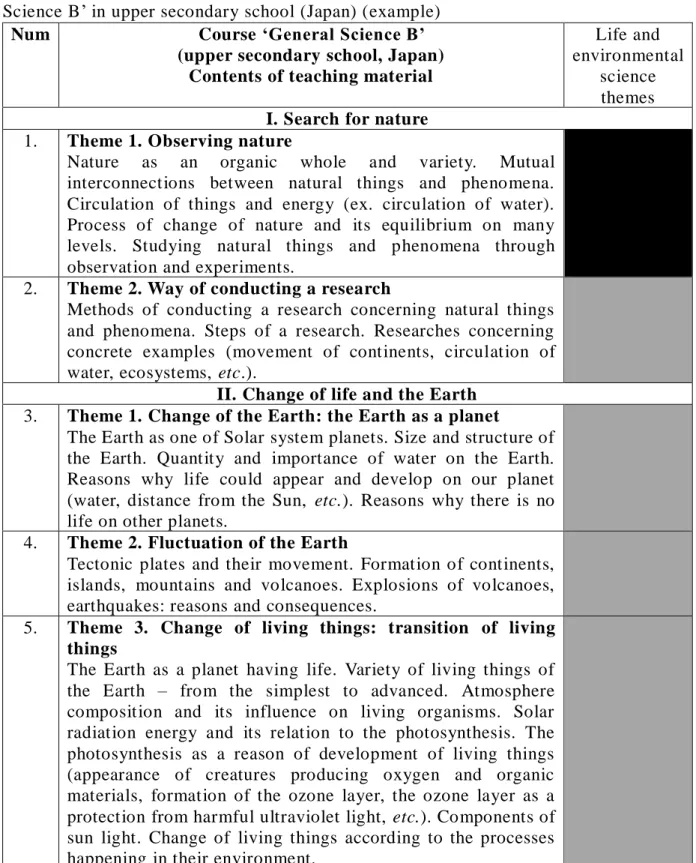
‘General Science B’ in upper secondary school (Japan) (example)……. p. 34
2.7. Summary of life and environmental science s curricula of Japanese and
Ukrainian secondary school prescribed for studying by all students….. p. 36
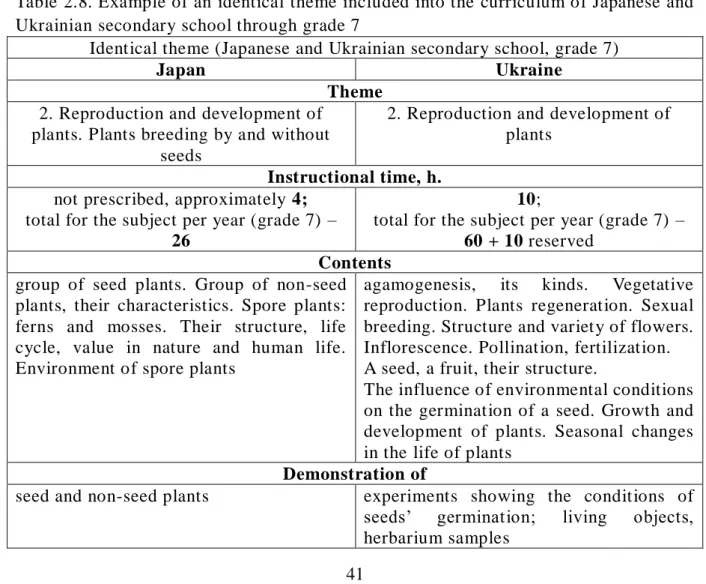
2.8. Example of an identical theme included into the curriculum of Japanese
and Ukrainian secondary school through grade 7………. p. 41
3.1. Education in Ukraine before and after 2001 and 2010 reforms………… p. 55
3.2. Summary of citizens’ attitudes towards the 2001 reform………. p. 58
3.3. Trend of political preferences of Ukrainian citizens concerning the
country’s international policy in 1997-2008………. p. 62
3.4. Regional distribution of attitudes towards the union of Ukraine with
Russia and Belarus or the EU in 2009……… p. 63
3.5. Instructional time in science in Ukrainian school before and after
2001 and 2010 reforms……… p. 64
4.1. Teaching experience of respondents……….. p. 74
4.2. Science subjects chosen by respondents in upper secondary schools
(multiple selection)……….. p. 74
4.3. University’s majors of respondents (multiple selection)……….. p. 74
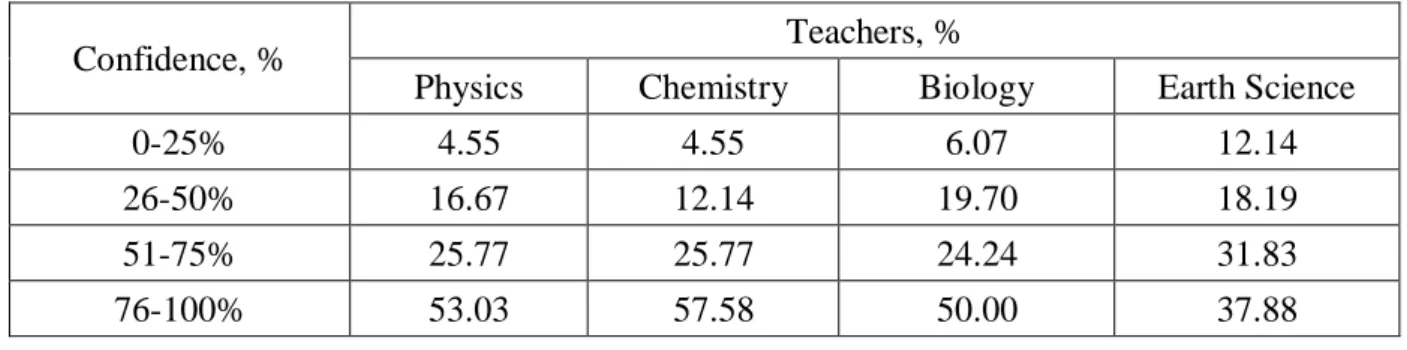
4.4. Teachers’ confidence in knowledge in areas of science………... p. 75
4.5. Teachers’ enjoyment from teaching areas of science……… p. 76
4.6. Teachers’ assessment of students’ preferences in science depending
on performance………. p. 77
4.7. Teachers’ assessment of students’ preferences toward science
depending on gender……… p. 77
4.8. Teachers’ assessment of students’ interest toward science depending
on gender……….. p. 78
4.9. Teachers’ assessment of complexity of science areas for students…….. p. 79
4.10. Teachers’ assessment of importance of science areas for
students’ academic career……… p. 79
4.11. Teachers’ assessment of importance of science areas for
students’ career in medicine and school science teaching……… p. 80
4.12. Instructional time for areas of science in teachers’ manuals (TM)
and in practice……….. p. 81
13
(the least) to 4 (the most) in practice………. p. 82 4.14. Deficiency of instructional time in science by grade (multiple choice).. p. 82
4.15. Areas of science consuming more instructional time than designated
in teachers’ manuals (multiple selection)……….. p. 83
4.16. Areas of science for which in grades 7-9 instructional time increase or
reduction might be appropriate (teachers’ assessment, multiple
selection)………... p. 84
4.17. Content for areas of science from 1 (the least) to 4 (the most)
(teachers’ assessment)………. p. 85
4.18. Areas of science requiring an increase in the number
of experiments (teachers’ assessment, multiple selection)………... p. 85
4.19. Areas of science requiring an increase in the number of
experiments (teachers’ assessment, multiple selection)……… p. 86
4.20. Impact of the education reform of 2008-2012 on areas
of science (teachers’ assessment, multiple selection)……… p. 86
5.1. Science subjects chosen by respondents in upper secondary
schools (multiple selection)………. p. 93
5.2. Science subjects which respondents willed to choose
in upper secondary schools (multiple selection)……… p. 93
5.3. Parents’ self-assessment of lack of knowledge in science……… p. 94
5.4. Attitudes toward areas of science while being at school……….. p. 95
5.5. Priority areas of science when respondents attended school
(multiple selection)……….. p. 95
5.6. Priority areas of science in the present school (multiple selection)……. p. 96
5.7. Areas of science that respondents wish to be prioritized in
children’s education………. p. 97
5.8. Parents’ assessment of children’s preferences in science depending
on gender (multiple selection)……… p. 97
5.9. Parents’ assessment of children’s preferences in science depending
on performance (multiple selection)……….. p. 98
5.10. Parents’ assessment of importance of science areas for
children’s academic career……….. p. 98
5.11. Parents’ assessment of importance of science areas for
students’ career in medicine and school science teaching……… p. 99
6.1. Students’ attitudes to learning in areas of science………. p. 108
6.2. Students’ attitudes to careers involving areas of science……….. p. 109
6.3. Correlation between students’ attitude in learning and careers p. 111
6.4. Students’ assessment of complexity of science areas……… p. 112
6.5. Correlation between attitudes toward learning in areas of science and
their complexity……… p. 113
6.6. Students’ assessment of usefulness of science areas………. p. 113
6.7. Correlation between attitudes toward learning in areas of science and
their usefulness………. p. 114
14
6.9. Correlation between attitudes toward careers and assessment of salaries
in science……….. p. 115
6.10. Students’ assessment of resource support in areas of science………….. p. 116
6.11. Correlation between attitudes toward careers and assessment of
resource support in science………. p. 117
6.12. Students’ assessment of priorities in country’s education……… p. 117
6.13. Correlation between attitudes toward learning and assessment of
priorities in country’s education………. p. 118
6.14. Students’ assessment of popularity of science areas………. p. 119
6.15. Correlation between attitudes toward careers and assessment of
popularity of science areas……….. p. 119
6.16. Correlation between attitudes toward careers and assessment of
popularity of science areas………... p. 120
6.17. Students’ assessment of peers’ attitudes toward areas of science
depending on gender……… p. 121
6.18. Students’ assessment of peers’ attitudes toward areas of science
depending on performance……….. p. 122
15
LIST OF ABBREVIATIONS
AgrS - Agricultural science
Bi - Biology
Ch - Chemistry
CN - China
DNA - deoxyribonucleic acid
DESD - Decade of Education for Sustainable Development
EHEA - European Higher Education Area
EN - England
EnvS - environmental science
ES - Earth science EU - European Union GN - Guinea HG - Hungary IA - international average JP - Japan
MedS - Medical science
MEXT - the Ministry of Education, Culture, Sports, Science and Technology of
Japan
MY - Malaysia
OECD - Organization for Economic Co-operation and Development
PISA - Program for International Student Assessment
Ph - Physics
RU - Russia
SS - secondary school
SW - Sweden
TIMSS - Trends in International Mathematics and Science Study
TM - teachers’ manuals
UA - Ukraine
UN - the United Nations
16 CHAPTER 1
INTRODUCTION
1.1. Background
In 2000, Prof. Masakata Ogawa, a researcher in sociocultural studies, and in particular, science education of Japan, gave the following introduction to his manuscript about a then-ongoing reform of school science: ‘Most foreign science educators seem to believe that the Japanese are ‘science literate’ and ‘technology literate’ because Japan is one of the most technologically advanced societies in the world. However, the attentive public and media, as well as scientists and science educators in Japan, are dubious of such a view. Rather, they are worried that it may be a myth’ (Ogawa 2001).
The reform described in Prof. Ogawa’s manuscript became the last one in the chain of changes in the school education pursuing the ‘yutori kyouiku’ policy that may be translated as ‘a relaxed education’ or ‘an education free of stress’. This policy targeted to reduce an education stress on Japanese youth and to form a school system that ‘helped children develop their individuality’ and proposed them ‘diverse choices’ (MEXT 1998). In regard to science, since 1970s till 2008, the course of reforms slowly, but steadily brought the national curricula to their minimum by reductions of instructional time and content in fundamental science topics. This trend became a controversial issue evaluated negatively by a number of researchers (e.g. Katayama 2001; Matsuda 1998). Finally, the revision of 1998, according to Ogawa (2001), ‘neither reflected the public campaigns of young people’s negative attitudes toward science and technology not contributed to another national policy, ‘science and technology as Japan’s survival strategy’ and brought the most drastic reduction of science component among all (Nakamichi 2010 a, b).
While even before the reform of 1998 studies in science education of Japan have pointed out issues within adolescents’ and adults’ attitudes towards science and technology, these issues and students’ decreasing performance in PISA and TIMSS tests finally were named as a reason for the next reform in school science education in Japan only a decade later.
As a matter of fact, a decline in performance of students in these international projects was named as a reason for the reform much more often than actual numerous ‘domestic’ problems of the Japanese system of education (Matsuda 1998).
Undoubtedly, such major projects in international evaluation as TIMSS (Trends in Mathematics and Science Studies) and PISA (Programme for International Student Assessment) are valuable and useful tools in research in education, including that of Japan. However, their methodological prospects and
17
limitations have to be considered in order to understa nd, literally, what and how they aim to evaluate, and what it means, if a country has a low, lower than some, or a declining performance of its students in either of the tests.
Firstly, PISA is created by the OECD (The Organization for Economic Co-operation and Development). This places methodological settings of the project into a context of economic development and its goals. The same concerns the TIMSS. According to Fensham (2013), an advisor for TIMSS, it was joined by the majority of present participants when the ‘ideology of the market and of global competition was taking hold in education’ in 1990s. As a result, the number of participating countries almost doubled in just several years.
Secondly, both TIMSS and PISA have certain limitations define d by their assessment intentions. TIMSS covers the ‘core science knowledge’ that is identified by extracting appropriate (by the consideration of the projects’ specialists) topics and leaving those specific for countries -participants. Accordingly, it ‘normalizes’ the science curricula creating a global ‘science-for-all’ perspective and not highlighting the emphases or intentions of its participants in school education. The goal of the PISA project was to collect information in participating countries about how ‘well prepared’ their 15-year-old adolescents were for the ‘twenty-first century life’ in several perspectives including science’ (Fensham 2013). As there were no commonly accepted methods for testing such paradigms, the assessment had obvious limitations and was met with skepticism.
Thirdly, projects of students’ assessment mostly use instruments that duplicate experiments and use a test form of questions. In regard to experiments, it is needless to point out that participating countries and even par ticular schools may have other approaches to teaching some topics selected by these projects than experiments, or teach them by experiments that differ from those described in the tests. Moreover, some participants (schools or even countries) may have no economic means to conduct experiments, and this places their students in a rather
complex situation when they are undergoing this assessment. Concerning tests,
not all participants are accustomed with this form of evaluation. Moreover, many researchers are skeptical about its methodological characteristics, practical application and outcomes. Aikenhead (2005) identifies this form of evaluation (multiple choice tests) as recalling superficial and codified knowledge, not tooled, nor personal, nor technological knowledge in science.
These two basic characteristics concerning the form of assessment used by the projects were selected to explain the difference in the performance of countries at the most basic level. Obviously, there are hundreds of features of TI MSS and PISA methodological approaches explaining certain trends in students’ performance. Therefore, a careful consideration is needed when their results are evaluated and applied in discussion, policy-making or research.
If more fundamental differences between Japan and other countries are considered, it leads to the broad perspectives of biological and socio -cultural characteristics of people. One of such differences is the students’ perception of science as of a foreign culture. According to Aikenhead (1997), Aikenhead and
18
Jegere (1999), this perception is shared by adolescents from both developing and developed countries and is explainable by the differences between their cultural origins and the culture of Western science. Therefore, while international projects of students’ assessment apply instruments derived from the Western science standards, these standards have different degrees of relevance to the ones in countries-participants and more fundamentally to the values of their societies.
Moreover, there is the most fundamental issue, namely, an assessment of effectiveness of education. What is it and how to ensure its accountability or relevance? According to Aikenhead (2005), a common belief that schools in which students have a high academic performance in examinations are ‘good schools’, and others are poor and need improvements, is misguided.
A high performance in science examinations does not mean that students are able to deal independently with science tasks, understand its relevance to everyday life, apply science knowledge and so on. However, as Aikenhead (2005) explains, politicians, the media and the public in many countries increasingly demand that education systems and individual schools provide evidence of their effectiveness, productivity and value in terms of economic investment in the form of high marks in examinations. As a result, a high performance of student in such tests as of TIMSS is seen as a desirable target and becomes a major instrument in political debates about country’s intentions in school science. Therefore, when the following reform of science education in Japan was introduced in 2008 -2012, a declining performance of this country’s students in TIMSS and PISA was identified as a major reason for it. Actually, Japan remained among top performing countries by the results of both tests (Martin et al. 2008 a, b, 2012; PISA 2009). However, this fact was mentioned much less often than the statement that its performance, literally, became lower than of ‘main competitors’, i.e. other Asian countries. Using this tool, the reform has redirected the school science education in Japan toward an increase in instructional time and content, for the first time in decades.
The issues within formal and social education in Japan, especially attitudes and literacy in science of Japanese youth and adults were rather not highlighted as a driving force for the reform of education introduced in 2008 -2012. It is not surprising, considering the fact that attitudes of the public do not have a profound impact on policies in education despite political rhetoric. However, an effectiveness of any policy depends on how it is accepted by the society and therefore fundamentally on values existing in it. Scientific, economic and other types of development are achieved with a condition that the society is ‘motivated’,
i.e. values existing in the personal and societal perception of citizens are relevant
to those designated by the country. Therefore, in order to understand how to promote science in a particular society, it is necessary to study v iews, attitudes and values that the society holds in regard to it. On the other hand, it is crucial to analyze what values or priorities are applied in science and education by country’s structures.
19
According to researchers, adolescents and adults in Jap an have a rather negative perception of science and a rather low literacy in it (Kobayashi 1993; Miller 1996; Matsuda 1998; Ogawa 2001; Sjoberg and Schreiner 2006, 2007, 2010). When investigating the reasons of this phenomenon, Ogawa (2001) explains that educational roles of family and schools have been failing in the Japanese society, and that its members see science and technology as ‘an enterprise from another world’. Therefore, an irrelevance of science to the everyday life and thinking in the perceptio n of Japanese youth may be even deeper than an attitude to it as to a ‘foreign culture’. While being consumers of the products provided by science and technology, citizens, especially youth disengage themselves from the process of their development.
Other researchers name more particular reasons for the negative attitudes of the Japanese citizens towards science. As Matsuda (1998, 2012 personal communication) indicates, biology, being the closest science for human beings, is studied superficially in the system of school education in Japan, starting from an early age. As a result, science is perceived as a concept irrelevant to the everyday life, and an interest towards it is decreasing.
Therefore, a promotion of biology and education in this area may foster a positive perception of the whole science. Following the logic that an interest in ‘close to ourselves’ things is relevant to the positive perception of the whole science, an interest in environmental studies may also contribute to an overall one. Biology, being an area of fundamental science, has received a special attention in recent years dew to new frontiers in research in this field. It was even stated that the 21st century would be the ‘era of biology’ (Johnson 2008; National Research Council 2009). Environmental studies and education have been among agendas of major international organizations since 1970s.
The purpose of the environmental education was expressed in the 1975 Belgrade Charter and adopted by the International Workshop. ‘The goal of environmental education is to develop a world population that is aware of, and concerned about, the environment and its associated problems, and which has the knowledge, skills, attitudes, motivations, and a commitment to work individually and collectively towards solutions of current problems and the prevention of new ones’ (Hungerford and Peyton 1994).
Environmental education is supposed to start at a preschool level, continue during school and later years as a part of formal and social education (lifelong learning). In 1975, the International Workshop gave a number of recommendations for the improvement of environmental education (school and for adults). Since then scientists, educators and general public have been discussing if environmental topics should form a separate subject in the school curricula, or they are to be integrated into existing science subjects. Presently, a common practice is the latter one (including Japan). Mostly, environmental studies were incorporated into school courses of biology (life science) and lesser of Earth science (geography), and therefore there is a strong bond between biology and environmental science in the school education.
20
Environmental science appears to be so challenging that countries worldwide for over forty years have been considering how to ‘environmentalize’ their education and the society overall. Or, at least documents of policymakers of a global scale create an impression that the challenge was addressed, and a substantial progress has been made in this direction. While undoubtedly some progress has been achieved, mostly a so-called ‘soft policy’ was used in regard to environmental challenges and especially in the environmental education.
The reality is that the ‘hard policy’ is used in economic issues, and if environmental education was addressed, it happened mostly because of ‘local’ efforts. Basically, at a global scale a formal education is destined to create a ‘product’ for achieving an economic well-being of a country. May be, environmental education is not considered to be ‘the matter of life and death’ to achieve this goal, and therefore it has not been enforced by methods of the ‘hard policy’ (Sen 2011). Other purposes in education (beyond economic progress) are chased by various ‘dreamers’ (Ogunniyi and Ogawa 2008) involved in education,
i.e. stakeholders of education.
Obviously, biology and environmental studies ensure a fundamental understanding of living systems and therefore contribute to all areas of science and development. However, both areas have numerous issues to be studied and possibly improved. Narrowing those issues to the scope of research in education of Japan, fundamentally it is necessary to know, if biology and environmental science are emphasized/prioritized in the system of education and in the perception of the society in Japan.
Both science education and societal perception of sc ience in Japan have been widely studied. A comprehensive literature review for research in both areas will be presented in the following chapters, while here a short summary is given. In regard to the situation with biology and environmental sciences in the system of education there are numerous publications (e.g. Riley et al. 1998; Katayama and Kanaizuka 2001; Ishikida 2005; Nakamichi 2008, 2010a,b; Miller et al. 2009; Arani and Fukaya 2010; Hatogai 2010; Katayama 2010; Metzger et al. 2010) that focus on various aspects, but do not analyse the level of prioritization of biology and environmental science comparing to other areas. The same concerns the societal perception, however, with more research reports describing general and gender regularities, socio-cultural characteristics of Japan, its similarities and differences from other nations (e.g. Weinberg 1995; Reid and Skryabina 2002; Baron-Cohen 2003; Hines 2004; Sjoberg and Schreiner 2010). Some theories were proposed to explain the perception’s reasons, and numerous findings were made (Meyers-Levi and Loken 2014). However, the question of positioning of life and environmental sciences among other areas of science (physics, chemistry, Earth science) in the perception of the society has rather not been highlighted.
Therefore, till presently, a ‘position’ (a level of prioritization/emphasis) of life and environmental sciences in Japan and other countries from a broad perspective of analysis of both education system and societal perception has not been sufficiently studied. The present study addresses this issue and therefore is
21 considered to be an original research.
The study conducts an analysis in two domains: 1) a comparative analysis of curricula in life and environmental science intended for teaching in lower and upper secondary school (7-12 school years) of various countries; 2) attitudes toward life and environmental sciences and present practices in this regard evaluated by stakeholders of school education (students, parents and teachers).
In particular, the study enquires about the following: a) qualitative and quantitative characteristics of the secondary school curriculums in life and environmental science in comparison to other science areas; b) evaluation of their implementation by the stakeholders; c) interrelationship between educational policies, practices and societal ‘image’ of science areas through stakeholders’ assessment; d) differences in students’ attitudes toward areas of science and environmental problems in terms of gender and/or nationality, e) aspects of possible improvements in the present system of school science education, f) general, gender and socio-cultural regularities in the perception of science.
According to the analytical approach described earlier, the study targets to place the data obtained in Japan into the multinational compa rative context of policies, practices, trends and societal behaviour in education. The results of Japan should be compared to those received in other countries, because such comparison would identify issues that are specific for Japan. The purpose of this research is to improve methodologies and practices in life and environmental science education in Japan and possibly internationally through studying an issue that has not been sufficiently addressed earlier.
1.2. Objectives and methods
The objective 1 of the research is to identify the ‘position’, i.e. the level of prioritization of life and environmental sciences through a comparison of qualitative and quantitative characteristics of life and environmental sciences curricula with those in physics, chemistry, Earth science in secondary schools of Japan and other countries.
Methods for objective 1 are as follows:
1) a comparative analysis of National Standards and course of recent reforms in school life and environmental science in Japan w ith those of other countries;
2) an assessment of practices in school science education given by the teachers (a questionnaire).
The objective 2 of the research is to identify factors of societal perception and behaviour of the stakeholders of school education in regard to natural science.
Methods for objective 2 are as follows:
1) a comparative analysis of societal perception and behaviour of the stakeholders of school education (students, parents and teachers) toward areas of science and related issues in Japan and abroad with focus on students’ gender and nationality (a questionnaire);
2) an analysis of different types of students’ motivation in science. Figure 1 presents the framework of the research.
22 Fig. 1. Framework of the research
A more detailed explanation of research methodology for the components of each objective is presented in corresponding chapters.
1.3. Dissertation outline
This dissertation consists of 8 chapters. The brief outline of each chapter is presented below:
Chapter 1: Introduction
This chapter explains the foundation of the entire research beginning with the general introduction into recent reforms and issues within science education in Japan. It further details the motivation of this research, and explains in general its objectives and methods. At the end it presents the outline of each chapter of the dissertation.
Chapter 2: Comparison of life and environmental science s curricula of secondary schools in Japan and Ukraine
This chapter analyses characteristics of science education in Japanese and Ukrainian schools in comparison to a number of countries. It performs a comparative study of curricula in life and environmental sciences of Japanese and Ukrainian secondary schools (grade 7-12) by creating a database of corresponding topics. Also, it analyses similar topics by their particularity and scientific terminology.
23
Chapter 3: Recent reforms in science education in secondary schools of Japan and Ukraine
This chapter studies and evaluates the reforms of school educatio n in Japan (2008-2012) and Ukraine (2001, 2010). It studies about reforms’ background and impact on school science in terms of its structural, quantitative and qualitative characteristics. A focus is made on life and environmental sciences. Finally, the attitudes of the society towards the reforms and their driving forces are evaluated.
Chapter 4: Teachers’ assessment of school life and environmental science s education in Japan
This part of the research is focused on teachers’ perception of science areas and present practices in lower secondary schools’ science in Japan. It starts with a study of teachers’ attitudes towards areas of science. In particular, such issues as teachers’ confidence, enjoyment from teaching, perceived importance of science areas and assessment of students’ preferences in science are analyzed. Then, a comparison of the instructional time allotted to biology and other areas officially (in teachers’ manuals and guidebooks) and in practice is conducted. Also, a curricular content of biology and other areas of science in the National Curriculum Standards and in practice are studied. Finally, an assessment of the impact of 2008-2012 reform on biology in comparison to physics, chemistry, and Earth science is presented.
Chapter 5: Parents’ assessment of school life and environmental sciences education in Japan
This part of the research is focused on parents of children who attend lower and upper secondary schools in Japan. At first it investigates differences between areas of science in parents’ experiences in education. Then, parents’ assessment of past and present priorities in school science education is presented, i.e. what areas of science, in respondents’ opinions, were emphasized in the past and are emphasized now. Also, what areas of science are evaluated by parents as ‘important’ in general and depending on children’s careers in future. The chapter ends with a study of parents’ perception of science areas in regards to children’s gender and academic performance.
Chapter 6: Students’ assessment of school life and environmental science education (cross-cultural)
This chapter conducts an international comparison of attitudes of male and female students (age 16) towards areas of school science in regard to understanding, interest in learning and as a future career. It covers 6 countries and targets to identify the position of life and environmental sciences in the perception of students from Japan and of their peers internationally. Also, it identifies general, gender and socio-cultural factors of students’ attitudes toward science and tests
24
students’ motivation in it by academic, societal and economic criteria. Finally, this part of the study investigates a level of students’ concern about environmental issues of domestic and global sca les.
Chapter 7: Comparison of attitudes of the stakeholders of school education in Japan towards areas of science
This part of the study performs a comparison of opinions expressed by the stakeholders of school education (students, parents and teachers) a nd presented in chapters 4-6. The purpose of this part of the research is to outdraw the societal concepts in relation to areas of science that may be common in Japan.
Chapter 8: Conclusions
25 CHAPTER 2
COMPARISON OF LIFE AND ENVIRONMENTAL SCIENCES CURRICULA OF SECONDARY SCHOOLS IN JAPAN AND UKRAINE
2.1. Introduction
Science and environmental education became the key themes of the Decade of Education for Sustainable Development (DESD) introduced by the United Nations in 2002 (The United Nations 2009; UNESCO 2010). While the Decade was proclaimed in 2002, the concept and principles of the environmental education and the question of including its topics into various subjects or forming a separate one in a secondar y school, has been discussed during several previous decades (Hungerford and Peyton 1994; Abell and Lederman 2007). Presently a common practise in many countries of the world is to teach them as a part or connected with ‘Biology’ (‘Life Science’) rather than to form a separate subject ‘Environmental Science’. Also, because of the rapid development of the body of knowledge in biology in recent years and high expectation related to its progress, the 21st century is considered to be ‘The Century of Biology’ . It means that biology acquires a special importance as an area of the fundamental science
incorporating knowledge in environmental topics, including environ mental
conservation for which governments and institutions set up high goals (Tan 2010; Teng
2010).
In the age of globalization, international comparative studies in science education are being a valuable source of information for governments, educators and scientists even despite rising critics (Aikenhead 2002 a,b, 2004, 2006, 2008; Aikehhead and Ogawa 2007; Atweh et al. 2007).
Presently, there are two major projects in this area, e.g. TIMSS (Trends in International Mathematics and Science Study) and PISA (Program for International Student Assessment). The influence of these projects is so considerable that the Ministry of Education of Japan named the performance of Japanese students in TIMSS tasks as one of the reasons for the reform o f education that started in 2008 (Nakamichi 2008; 2010a,b). Both TIMSS and PISA are focused mainly on students’ performance in science (PISA 2007, 2010). Only TIMSS provides information (rather limited) concerning the content of school life and environmental science. In this project environmental topics have been studied as a part of Earth science curricula (Martin et
al. 2008 a, b)
Neither PISA, nor TIMSS has conducted a detailed study of the content of life and environmental science curricula in the countries that participate in these projects. In the case of Japan, there are only a few comparative studies of its and foreign school science curricula. There are no studies providing a detailed analysis of biology and environmental sciences in comparison to any other country through all years of secondary school. There are also no studies of the position ( level of prioritization) of
26
these areas of science comparing to others in the education system of Japan .
Recent Japanese secondary school curriculum in science was considered to be the ‘minimum’ one and was the object for the reformation in 2008-2012. Japanese educators, researchers, science and biology teachers claim that: a) the content of present school biology textbooks is outdated; b) existing content is not taught appropriately as teachers often have insufficient knowledge of the subject and graduate in other scientific fields; c) some fundamental topics are not taught while prescribed for teaching in other countries; d) the education system has a number of failures and does not provide students with systematic knowledge of the subject while allows them to finish learning it in lower secondary school (Katayama and Kanaizuka 2001; Ishikida 2005; Center for Promotion of Science Education of Japan 2008; Hatogai 2010; Nakamichi 2008, 2010a,b; Arani and Fukaya 2010).
In the same time, there are only a few comparative studies of Japanese and fo reign school science curricula, and there are no studies providing a particular analysis of any subject or the course of science through all years of schooling (Riley et al. 1998; Miller et al. 2009; Katayama 2010; Metzger et al. 2010).
To summarize, there is an obvious necessity of comparative studies of Japanese and foreign life and environmental sciences curricula. Through such studies, the place of life and environmental sciences in the system of school education may be identified. The results are valuable for a further development of science education in Japan and other countries. The most appropriate system for a comparison with the Japanese one, should be historically formed independently and therefore be different in a number of perspectives. In this research the Ukrainian system having the roots of science education in Russian Empire and Soviet Union and recently being criticized as ‘overloaded with scientific facts and concepts’ is used (Ministry of Education of Ukraine 2001b).
It had been under the reformation according to Bologna Declaration in 2001 – June 2010 and follows the path of science themes and instructional time reduction similar to Japanese approach in 1977-2008 (Ministry of Education of Ukraine 2003, 2009a,b, 2010a,b,c).
As for Ukrainian school, there is no any comparative research of its and foreign science curricula that would provide a full and particular information about their contents. Apparently, such kind of study covering Ukrainian or Soviet and Japanese school life science curriculum has never been conducted.
Therefore, this research is the firstly conducted comparison of Japanese and Ukrainian life and environmental science school curricula. The purpose of the study is to perform a basic comparative analysis of this area of study in two fundamentally different school systems. It is focused on the necessary minimum of topics prescribed for studying by all students, i.e. on the national standards provided by the Ministry o f Education of Japan and Ukraine and does not cover the subjects of advanced courses.
2.2. Methodology
Objectives of this part of the study are as follows.
27 Japanese and Ukrainian school.
Methods for objective 1: to study and compare main characteristics of science teaching and learning in Japanese and Ukrainian school such as types, levels, years, streams, subjects, textbooks requirements, instructional time, etc.
Objective 2: to identify the state of life and environmental science curricula of Japanese and Ukrainian secondary school in the international context.
Methods for objective 2: a) to study and compare statistical data on life and environmental science curricular teaching and learning using international projects; b) to use data of a number of developed countries in order to create a background for comparison with Japan and Ukraine.
Objective 3: to create a unified data base of necessary for studying life and environmental science curriculum topics of Japanese and Ukrainian secondary school identifying the ‘minimum for all’; investigate the quantity for studying in each country; analyse similar topics in order to define the level of their complexity and particularity.
Methods for objective 3: to translate, study and analyse life and environmental science curricula prescribed for studying by the Ministry of Education in lower and upper secondary school Japan: ‘Course of study’; Ukraine: ‘Course of Study for Grades 5-9 of 12 Years Secondary School’ and ‘Course of Study for Grades 10-11 of 11 Years Secondary School’ (in Ukrainian).
2.3. Overview and comparison of science education systems in Japanese and Ukrainian secondary school
Science education systems in Japanese and Ukrainian secondary school s are somewhat similar as governments of both countries centralize them and standardize curricula.
However, there are several significant differences. The most substantial one is the teaching approach that forms a solid course of science (Japan, lower secondary school) and separate science subjects (Ukraine, starting from the 1st year of lower secondary school).
Similar and different characteristics of education systems are presented in Table 2.1 (MEXT 2008, 2009; Ministry of Education of Ukraine 2009a,b, 2010a,b).
Table 2.1. Science education systems of Japanese and Ukrainian secondary school
Similar characteristics 1. Levels: elementary – lower – upper
2. Age of entering: primary school – 6 years old
3. Streams: lower secondary school (SS) – no; upper SS: general and specialized 4. Textbooks: all science textbooks are approved by the Ministry
5. School types: public and private
6. Current requirements to be a secondary school science teacher :
degree from a teacher education program, passion a certification exam, completion of a probationary teaching period, completion of a mentoring or induction program
28
Characteristic Japan Ukraine
7. Yearly system 6-3-3 years 3(4)-5-2 years had been changed into 12 years (2001 –
June 2010) 8. Free of charge and required years Free of charge – 9; required – 9
Free of charge – all; required - 9
9. School types General and ‘Super Science
High Schools’ starting from the 10th year
General and specialized schools starting from the 4th,
7th year
Cram schools Free courses provided after
lessons by school teachers (lower and upper SS); courses
for charge provided by universities (upper SS)
10. Subjects for choice
Yes (starting from the 10th year)
No (all subjects are compulsory)
11. Subjects of lower SS
Course “General Science” ‘Physics’, ‘Biology’,
‘Chemistry’, ‘Geography’
12. Subjects of upper SS
‘Science A or B’ + 1 compulsory (from 4: ‘Physics’,
‘Chemistry’, ‘Biology’, ‘Earth Science’, I) + 1 not compulsory
(from 4, II) + ‘Basic Science’
Subjects of lower SS + ‘Ecology’
13. Current school reforms
Curricular reform (2002) – more emphasize on science
education
1) According to the global standards (from 11 to 12 years, 2001 – 2010); 2) Returning to 11 years – June 2010 14. Curriculum for students with different levels of ability
One curriculum for all students with no grouping
Different curricula for different groups of students according to the ability level
15. Current requirements to be a secondary school science teacher No requirement to have a degree in a certain subject
A degree in the subject the teacher is teaching; ex. – biology teacher is not eligible
to teach ‘Chemistry’
16. Teaching approach
b) observing natural phenomena and describing what is seen
A lot of emphasis Some emphasis
c) providing explanations about what is being studied
A lot of emphasis Some emphasis
d) designing and planning experiments or investigations