Advanced Synthesis of Dihydrofurans.
Effect of Formic Acid on the Mn(III)-Based Oxidation Risa Matsumoto and Hiroshi Nishino*
Department of Chemistry, Graduate School of Science and Technology, Kumamoto University Kurokami 2-39-1, Chûou-Ku, Kumamoto 860-8555, Japan
[email protected] Graphical Abstract
Abstract: The Mn(III)-based oxidation of a tertiary alkylamine, such as nitrilotris(ethane-2,1-diyl) tris(3-oxobutanoate) (1) with 1,1-diphenylethene (2a), effectively proceeded in an acetic acid–
formic acid mixed solvent to give nitrilotris(ethane-2,1-diyl) tris(2-methyl-5,5-diphenyl-4,5-dihydrofuran-3-carboxylate) (3). Other typical Mn(III)-based reactions of various β -diketo esters 4a–e, 2,4-pentanedione (6a), malonic acid (6b), and diethyl malonate (6c) with 1,1-diarylthenes 2a-d were also investigated in a similar acetic acid–formic acid mixed solvent and it was recognized that the reaction rate was accelerated and the product yield increased.
Keywords: Oxidation; 4,5-dihydrofurans; manganese(III) acetate; alkylamine; formic acid
Introduction
Heiba and Dessau developed the efficient synthesis of dihydrofurans using manganese(III) acetate in 1974 (eq. 1).
1Since then, many researchers
2and we
3also reported similar reactions, and the Mn(III)-based oxidative radical cyclization using β -dicarbonyl compounds has been rapidly developing.
4Dihydrofuran derivatives constitute the basic skeleton of many naturally occurring compounds and, therefore, are important from the viewpoint of building blocks in the total synthesis. On the other hand, the Mn(III)-mediated formation of the dihydrofuran ring is essential for the synthesis of functional macrocycles.
5Based on this background, we embarked on synthesizing nitrogen-anchor tripodand-type tris(dihydrofuran)s. During the reaction, we found that formic acid as an additive played an important role in the production of the dihydrofurans. We now describe the characteristic reaction involving formic acid.
Me O
O O
N
3
Mn(OAc)3
AcOH-HCO2H 70°C, argon
Ph
Ph O
O O Me
Ph Ph
N
3
Results and Discussion
Nitrilotris(ethane-2,1-diyl) tris(3-oxobutanoate) (1)
6was prepared by the condensation of 2,2’,2”-nitrilotris(ethanol) with diketene and examined the Mn(III)-based oxidation with 1,1-diphenylethene (2a) under various conditions. The reaction of 1 (0.3 mmol) with 2a (1.0 mmol) in the presence of manganese(III) acetate (1.8 mmol) was carried out in acetic acid at 100 °C under an argon atmosphere to produce the desired tris(4,5-dihydrofuran-3-carboxylate) 3 in a low yield (Table 1, Entry 1).
5The reaction was then optimized (Entries 2–8), and the best yield of 3 was achieved for the reaction at 70 °C using the molar ratio of 1:2a:Mn(OAc)
3= 1:3.3:10 (Entry 7).
However, the result was not acceptable from the viewpoint of the synthesis of 3. Probably, an undesirable reaction, such as the oxidative dealkylation of 1, occurred under the conditions at the same time.
7In order to prevent any undesirable reaction, we next investigated the corresponding ammonium salt which might be inactive for the undesirable oxidative dealkylation. The reaction was carried out by adding various acids, such as 2M HCl, p-toluenesulfonic acid (p-TsOH), 10-camphorsulfonic acid (CSA), methanesulfonic acid (MsOH), trifluoroacetic acid (TFA), and formic acid in addition to water (Entries 9-15). Surprisingly, the reaction rate dramatically changed and, especially, the addition of TFA and formic acid was remarkable (Entries 14-18). As a result, the use of a 4:1 v/v mixture of acetic acid and formic acid led to a shorter reaction time and the production of 3 in 49% maximum yield (Entry 17).
Scheme 1.
Me Me
O O
Me O Ac Ph
+ Mn(OAc)3
AcOH CH3 (1)
Ph CH3
Me O N
O O
O Me
O O
O Me
O O
Mn(OAc)3 AcOH, additive
under argon Ph Ph
O N
O
O O O O
O O
O
PhPh Me Me
Ph Ph
Me Ph Ph
1 3
2a
Table 1. Mn(III)-Based Reaction of Nitrilotris(ethane-2,1-diyl) Tris(3-oxobutanoate) (1) with 1,1-Diphenylethene (2a) in the Absence or Presence of Various acidsa
Entry 1:2a:Mn(OAc)3b Temp/°C AcOH/mL Additive Additive/mL Time/min 3/Yield/%c
1 1:3.3:6 100 50 8 20
2 1:3.3:8 100 50 10 20
3 1:3.3:10 100 50 10 19
4 1:3.3:10 100 100 10 16
5 1:3.3:10 100 25 8 20
6 1:3.3:10 reflux 50 5 19
7 1:3.3:10 70 50 45 34
8 1:3.3:10 rt 50 1 day 6
9 1:3.3:10 70 49 H2O 1 13 -d
10 1:3.3:10 70 49 2M HCl 1 5 -d
11 1:3.3:10 70 50 p-TsOH 1 eq.e 4 16
12 1:3.3:10 70 50 CSA 1 eq.e 5 26
13 1:3.3:10 70 49 MsOH 1 8 13
14 1:3.3:10 70 49 TFA 1 30 46
15 1:3.3:10 70 49 HCO2H 1 12 41
16 1:3.3:10 70 45 HCO2H 5 11 47
17 1:3.3:10 70 40 HCO2H 10 7 49
18 1:3.3:10 70 35 HCO2H 15 5 44
a The reaction of 1 (0.3 mmol) was carried out in acetic acid under an argon atmosphere.
b Molar ratio.
c Isolated yield based on 1.
d The ethene 2a was recovered and tris(dihydrofuran) 3 was not detected.
e One equivalent of p-toluenesulfonic acid (p-TsOH) and 10-camphorsulfonic acid (CSA) was added for 1.
We were interested in the phenomena that the addition of formic acid accelerated the reaction
and, then scrutinized the typical Mn(III)-based oxidative dihydrofuranation under similar
conditions.
1-3When the typical reaction of methyl 3-oxobutanoate (4a) with 2a using a
stoichiometric amount of manganese(III) acetate was conducted in acetic acid at 100 °C under an
argon atmosphere, formic acid was added (Table 2, Entries 1-5). As a result, as the amount of
formic acid increased, the reaction time decreased. Although the reaction time was the shortest
using formic acid alone as the solvent (Entry 6), the yield of the product, dihydrofuranecarboxylate
5aa, decreased, and the best yield was achieved using a 2:3 v/v mixture of acetic acid and formic
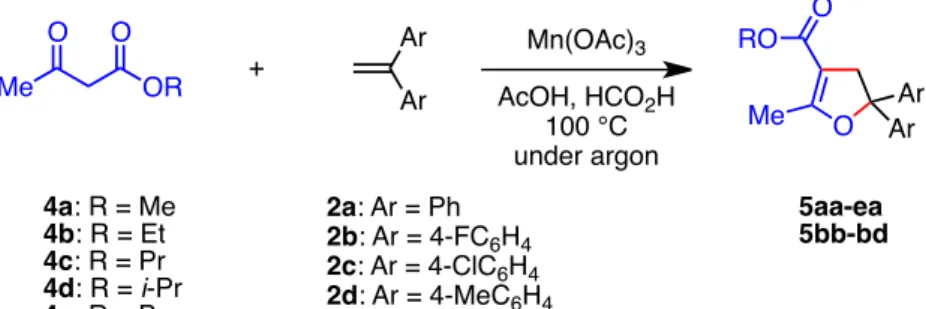
acid (Entry 4). The reaction using other combination of β -keto esters 4b-e and 1,1-diarylthenes
2b-d was also examined and a similar tendency was observed except for the yield of 5bd (R = Et,
Ar = 4-MeC
6H
4) (Entry 20). In addition, the presence of manganese(II) acetate inhibited the
production of the dihydrofuran 5ba (Entries 13 and 14).
Scheme 2.
Table 2. Mn(III)-Based Dihydrofuranation Using Various β-Diketo Esters 4a–ea
Entry 4/R 2/Ar AcOH/mL HCO2H/mL Time/sec 5/Yield/%b
1 4a: Me 2a: Ph 5 0 60 5aa (69)
2 4a: Me 2a: Ph 4 1 30 5aa (71)
3 4a: Me 2a: Ph 3 2 30 5aa (74)
4 4a: Me 2a: Ph 2 3 20 5aa (75)
5 4a: Me 2a: Ph 1 4 10 5aa (65)
6 4a: Me 2a: Ph 0 5 5 5aa (39)
7 4b: Et 2a: Ph 5 0 180 5ba (77)
8 4b: Et 2a: Ph 4 1 60 5ba (73)
9 4b: Et 2a: Ph 3 2 60 5ba (71)
10 4b: Et 2a: Ph 2 3 60 5ba (82)
11 4b: Et 2a: Ph 1 4 20 5ba (65)
12 4b: Et 2a: Ph 0 5 10 5ba (46)
13c 4b: Et 2a: Ph 2 3 60 5ba (8)
14d 4b: Et 2a: Ph 2 3 60 5ba (0)
15 4b: Et 2b: 4-FC6H4 5 0 90 5bb (55)
16 4b: Et 2b: 4-FC6H4 2 3 20 5bb (69)
17 4b: Et 2c: 4-ClC6H4 5 0 120 5bc (52)
18 4b: Et 2c: 4-ClC6H4 2 3 20 5bc (73)
19 4b: Et 2d: 4-MeC6H4 5 0 90 5bd (76)
20 4b: Et 2d: 4-MeC6H4 2 3 15 5bd (66)
21 4c: Pr 2a: Ph 5 0 180 5ca (67)
22 4c: Pr 2a: Ph 4 1 60 5ca (67)
23 4c: Pr 2a: Ph 3 2 60 5ca (82)
24 4c: Pr 2a: Ph 2 3 30 5ca (71)
25 4c: Pr 2a: Ph 1 4 10 5ca (61)
26 4c: Pr 2a: Ph 0 5 10 5ca (49)
27 4d: i-Pr 2a: Ph 5 0 120 5da (64)
Me OR
O
O Ar
Ar Me O Ar
Ar O RO
+ Mn(OAc)3
AcOH, HCO2H 100 °C under argon
5aa-ea 5bb-bd 4a: R = Me
4b: R = Et 4c: R = Pr 4d: R = i-Pr 4e: R = Bu
2a: Ar = Ph 2b: Ar = 4-FC6H4 2c: Ar = 4-ClC6H4 2d: Ar = 4-MeC6H4
28 4d: i-Pr 2a: Ph 4 1 30 5da (59)
29 4d: i-Pr 2a: Ph 3 2 20 5da (84)
30 4d: i-Pr 2a: Ph 2 3 20 5da (83)
31 4d: i-Pr 2a: Ph 1 4 10 5da (68)
32 4d: i-Pr 2a: Ph 0 5 10 5da (42)
33 4e: Bu 2a: Ph 5 0 120 5ea (62)
34 4e: Bu 2a: Ph 4 1 60 5ea (83)
35 4e: Bu 2a: Ph 3 2 60 5ea (74)
36 4e: Bu 2a: Ph 2 3 30 5ea (71)
37 4e: Bu 2a: Ph 1 4 20 5ea (69)
38 4e: Bu 2a: Ph 0 5 10 5ea (55)
a The reaction of butanoate 4 (0.1 mmol) using the molar ratio of 4:2:Mn(OAc)3 = 1:1:2 was carried out at 100 °C under an argon atmosphere.
b Isolated yield based on 4.
c The reaction was carried out using Mn(OAc)3 (0.1 mmol) in the presence of Mn(OAc)2 (0.1 mmol) (4b:2a:Mn(OAc)3:Mn(OAc)2 = 1:1:1:1).
d The reaction was carried out using Mn(OAc)2 (0.2 mmol) instead of Mn(OAc)3 (4b:2a:Mn(OAc)2 = 1:1:2).
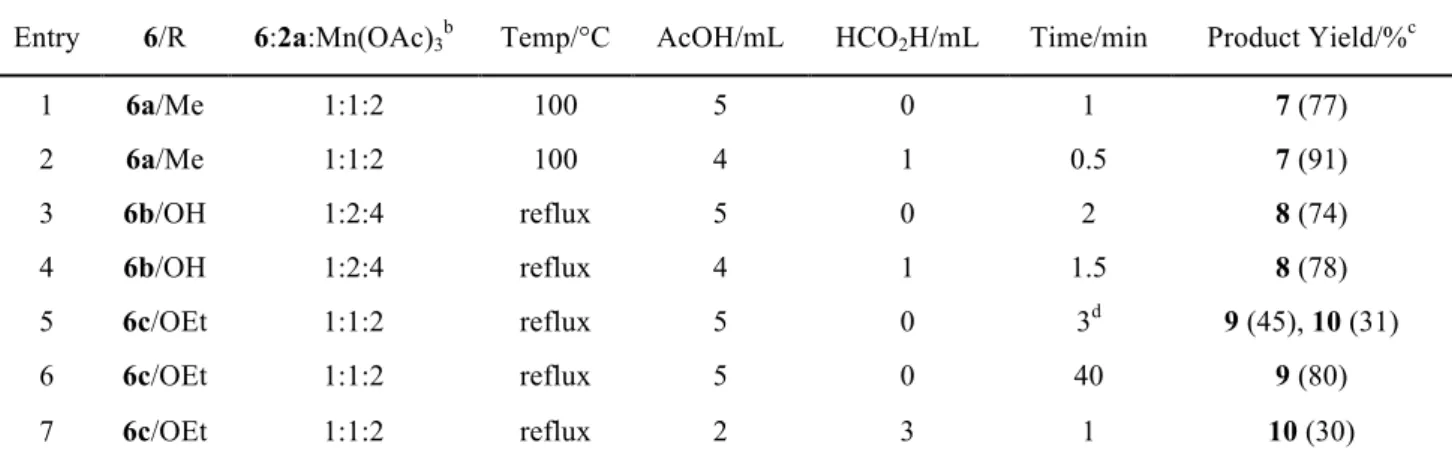
With acceptable results in hand, we examined other typical Mn(III)-based reactions using 2,4-pentanedione (6a), malonic acid (6b), and diethyl malonate (6c) to produce 3-acetyl-2-methyl-4,5-dihydrofuran 7 (eq. 2 in Scheme 3),
2spirodi- γ -lactone 8 (eq. 3),
8and 2-oxo-2,5-dihydrofuran-3-carboxylate 9 (eq. 4),
9respectively.
Scheme 3.
R R
O O
Me O Ph Ph O Me Mn(OAc)3
AcOH, HCO2H 100 °C under argon
(2)
7
6a : R = Me 6b : R = OH 6c : R = OEt
Mn(OAc)3 AcOH, HCO2H
reflux under argon
O O
O O Ph Ph
Ph
Ph (3)
8
Mn(OAc)3
AcOH, HCO2H reflux under argon
O O Ph Ph O
EtO EtO OEt
O O
Ph Ph
(4)
9 10
R = Me
R = OH
R = OEt Ph
Ph +
2a
Table 3. Mn(III)-Based Reaction of Other β-Dicarbonyl Compounds 6a–c with 1,1-Diphenylethene (2a)a
Entry 6/R 6:2a:Mn(OAc)3b Temp/°C AcOH/mL HCO2H/mL Time/min Product Yield/%c
1 6a/Me 1:1:2 100 5 0 1 7 (77)
2 6a/Me 1:1:2 100 4 1 0.5 7 (91)
3 6b/OH 1:2:4 reflux 5 0 2 8 (74)
4 6b/OH 1:2:4 reflux 4 1 1.5 8 (78)
5 6c/OEt 1:1:2 reflux 5 0 3d 9 (45), 10 (31)
6 6c/OEt 1:1:2 reflux 5 0 40 9 (80)
7 6c/OEt 1:1:2 reflux 2 3 1 10 (30)
a The reaction of 6 (0.1 mmol) was carried out in acetic acid under an argon atmosphere.
b Molar ratio.
c Isolated yield based on 6.
d The reaction was quenched before the complete consumption of Mn(III).
In all cases, the presence of formic acid led to an extremely shorter reaction time (Table 3). For the reaction of the malonate 6c with the alkene 2a in the presence of formic acid (eq. 4 in Scheme 3), however, the oxidative addition product 9 was not obtained, but 2-ethenylmalonate 10 was isolated (Table 3, Entry 7).
The mechanism for the formation of dihydrofurans, such as 5, is generally accepted that the
acetato ligand-bridged oxo-centered trinuclear manganese(III) complex undergoes the
ligand-exchange reaction with the 3-oxobutanoates to generate the manganese(III)-enolate complex,
of which the production is the rate-determining step,
4gfollowed by a single-electron transfer (SET)
oxidation from the alkenes through the oxobutanoato ligand, giving the carbon adduct radicals. The
radicals are further oxidized by Mn(III) according to the normal electron-transfer-type mechanism
and subsequently cyclized to produce the dihydrofurans 5. When formic acid was added to the
reaction mixture, the ligand exchange from the bridged acetate on the manganese(III) complex into
formate should readily occur as being more acidic (pK
a= 3.75) than acetic acid (pK
a= 4.76) and the
3-oxobutanoates (pK
a= 11 for 4b) (A in Scheme 4).
10Kochi reported that the
manganese(III)-strong acid complexes in the oxidative decarboxylation produced both ion-pair and
cationic manganese(III) species such as B which increased the reactivity,
11so that the formation of
the manganese(III)-oxobutanoate complex C should be accelerated. This was observed as
considerably shorter reaction times in our experiment. Again the
formato-manganese(III)-oxobutanoate complex C led another cationic manganese(III) species D
that underwent SET oxidation to form adduct radicals E. The radicals E were converted into
dihydrofurans 5 during a similar SET oxidation using a typical transition-metal oxidant. Formic
acid itself is a reductant (CO
2(g) + 2H
++ 2e
-= HCO
2H (aq), E° (25 °C) = -0.199 V),
10so that the
oxidant Mn(OAc)
3itself is reduced by the formic acid. In fact, Mn(OAc)
3was completely
consumed within 2.2 minutes using acetic acid–formic acid (2:3, v/v) at 100 °C in the absence of the 1,3-dicarbonyl compound and alkene. However, it seems that the oxidative radical reaction as shown in Scheme 4 predominantly proceeded in the mixed solvent system, because all the reaction times became extremely shorter in the presence of the 1,3-dicarbonyl compound and alkene (Tables 1-3).
Scheme 4.
Conclusion
It was found that the use of an acetic acid–formic acid mixed solvent effectively accelerated the Mn(III)-based oxidation of the tertiary alkylamine 1 with 1,1-diphenylethene (2a) and nitrilotris(ethane-2,1-diyl) tris(2-methyl-5,5-diphenyl-4,5-dihydrofuran-3-carboxylate) (3) was produced in a synthetically acceptable yield. Acceleration of the reaction and increase in the product yield using a similar acetic acid–formic acid mixed solvent were also observed in other typical Mn(III)-based oxidations of various β -diketo esters 4a–e, 2,4-pentanedione (6a), malonic acid (6b), and diethyl malonate (6c) with 1,1-diarylthenes 2a-d. We believe that the presence of both ion-pair and cationic manganese(III) species generated in the acid-mixed solvent accelerated the oxidation reaction.
Experimental
Measurements. Melting points were taken using a Yanagimoto micromelting point apparatus and are uncorrected. The NMR spectra were recorded using a JNM ECX 500 or AL300 FT-NMR
Me O Ar Ar O RO
RO Me
O O
MnIII MnIIIO MnIII
O O H
RO Me
O O
MnIII MnIIIO MnIII
O O
H MnIII MnIIIO MnIII
O
O Me
2
RO O
Me O
Ar Ar
RO Me O O
SET Ligand
exchange
Heterolysis
Ligand exchange
Heterolysis
SET
Ar Ar
-H+
O O
Me
MnIII MnIIIOMnIII
O O H
O O
Me
HCO2H
AcOH MnIII
MnIIIO MnIII O
H
O O
Me
O
AcOH
Cyclization
RO Me
O O
MnII MnIIIO MnIII
O O
H
Ar
Ar 5
Addition
accelerated
accelerated still accelerated
OAc-OAc AcO -OAc
-Mn(II) O
O RO
Me
Ar Ar
A B
C
D
E
F
spectrometer at 500 or 300 MHz for
1H and at 125 or 75 MHz for
13C, with tetramethylsilane as the internal standard. The chemical shifts are reported as δ values (ppm) and the coupling constants in Hz. The following abbreviations are used for the multiplicities; s, singlet; d, doublet; t, triplet; q, quartet; m, multiplet; brs, broad singlet for the
1H NMR spectrum. The IR spectra were measured in CHCl
3or KBr using a Shimadzu 8400 FT IR spectrometer and expressed in cm
−1. The EI MS spectra were obtained by a Shimadzu QP-5050A gas chromatograph-mass spectrometer at the ionizing voltage of 70 eV. The high-resolution mass spectra and the elemental analyses were performed at the Instrumental Analysis Center, Kumamoto University, Kumamoto, Japan.
Materials. Manganese(II) acetate tetrahydrate, Mn(OAc)
2•4H
2O, was purchased from Wako Pure Chemical Ind., Ltd. Manganese(III) acetate dihydrate, Mn(OAc)
3•2H
2O, was prepared according to our modified method.
12Nitrilotris(ethane-2,1-diyl) tris(3-oxobutanoate) (1) was prepared by the imidazole-catalyzed reaction of 2,2',2''-nitrilotriethanol with diketene in dry tetrahydrofuran at room temperature. The diarylethenes 2a-d were prepared by the Grignard reaction of the corresponding arylmagnesium bromides with acetophenones followed by acid-catalyzed dehydration. Imidazole, 2,2',2''-nitrilotriethanol, diketene, propyl 3-oxobutanoate (4c), and butyl 3-oxobutanoate (4e) were purchased from Tokyo Kasei Co., Ltd., and methyl 3-oxobutanoate (4a), ethyl 3-oxobutanoate (4b), isopropyl 3-oxobutanoate (4d), 2,4-pentanedione (6a), malonic acid (6b), and diethyl malonate (6c) were from Wako Pure Chemical Ind., Ltd., and used as received. Flash column chromatography was performed on silica gel 60N (40-50 µ m), which was purchased from Kanto Chemical Co., Inc., and preparative thin layer chromatography (TLC) on Wakogel B-10 (45 µ m) from Wako Pure Chemical Ind., Ltd. The solvents were commercially available first grade and used as received.
Reaction of Nitrilotris(ethane-2,1-diyl) Tris(3-oxobutanoate) (1) with 1,1-Diphenylethene (2a) in the Presence of Mn(OAc)
3.
A mixture of tris(3-oxobutanoate) 1 (120.8 mg; 0.3 mmol), diphenylethene 2a (179.5 mg; 1 mmol), and Mn(OAc)
3•2H
2O (801.9 mg; 3 mmol) in glacial acetic acid (40 mL) and formic acid (10 mL) was degassed under reduced pressure for 30 min using an ultrasonicator for exchange with an argon atmosphere. The mixture was then heated at 70 °C until the brown color of Mn(III) disappeared (normally for 7 minutes). The solvent was removed in vacuo and water (25 mL) was added to the reaction mixture. The aqueous solution was then extracted three times with chloroform (25 mL).
The combined extracts were washed with a saturated aqueous solution of sodium hydrogencarbonate, dried over anhydrous sodium sulfate, and then concentrated to dryness. The residue was separated on silica gel TLC developed with AcOEt–hexane (2:8 v/v), giving the product 3 (138.7 mg; 49%) (Table 1, entry 17). The physical data are listed below.
Nitrilotris(ethane-2,1-diyl) Tris(2-methyl-5,5-diphenyl-4,5-dihydrofuran-3-carboxylate) (3):
Light yellow oil; R
f= 0.2 (EtOAc–hexane, 2:8); IR (CHCl
3) ν 1690 (C=O);
1H NMR (CDCl
3) δ 7.37-7.21 (10H × 3, m, arom H), 4.13 (2H × 3, t, J = 6.0 Hz, -OCH
2- × 3), 3.56 (2H × 3, d, J = 1.5 Hz, CH
2× 3), 2.85 (2H × 3, t, J = 6.0 Hz, -CH
2N- × 3), 2.30 (3H × 3, s, -CH
3× 3);
13C NMR (CDCl
3) δ 166.8 (C=O × 3), 165.5 (=CO- × 3), 145.0 (6C) (arom C), 128.3 (12C), 127.4 (6C), 125.6 (12C) (arom CH), 101.4 (>C= × 3), 91.6 (>C< × 3), 61.9 (-OCH
2- × 3), 53.5 (-NCH
2- × 3), 43.9 (-CH
2- × 3), 14.1 (CH
3× 3); FAB HRMS (acetone/NBA) calcd for C
60H
58NO
9936.4112 (M+H).
Found 936.4141.
Mn(III)-Based Reaction of 1,3-Dicarbonyl Compounds 4a-e and 6a–c with 1,1-Diarylethenes 2a-d.
To a 30 mL round-bottomed flask, the 1,3-dicarbonyl compound (0.1 mmol), 1,1-diarylethene (0.1 mmol), and a mixture of acetic acid and formic acid mentioned in Tables 2 and 3 were added. After replacing air with argon in the flask, Mn(OAc)
3•2H
2O (53.6 mg; 0.2 mmol) was added and then the mixture was heated at 100 °C until the brown color of Mn(III) disappeared (the reaction times are listed in Tables 2 and 3). After the Mn(III) oxidant was completely consumed, the solvent was removed in vacuo and 2M HCl (20 mL) was added to the residue. The aqueous solution was then extracted three times with chloroform (25 mL). The combined extracts were washed with a saturated aqueous solution of sodium hydrogencarbonate followed by water, dried over anhydrous sodium sulfate, and then concentrated to dryness. The obtained residue was separated by silica gel column chromatography eluting with AcOEt–hexane (2:8 v/v), giving dihydrofurans 5, 7, spirodi- γ -lactone 8, butenolide 9, and ethenylmalonate 10, as shown in Schemes 2 and 3 and Tables 2 and 3. The physical data of the products are listed below.
Methyl 2-Methyl-5,5-diphenyl-4,5-dihydrofuran-3-carboxylate (5aa): Light yellow oil; R
f= 0.5 (EtOAc–hexane, 1:9); IR (CHCl
3) ν 1693 (C=O);
1H NMR (CDCl
3) δ 7.39-7.24 (10H, m, arom H), 3.69 (3H, s, O-CH
3), 3.60 (2H, br. q, J = 1.8 Hz, CH
2), 2.35 (3H, t, J = 1.8 Hz, CH
3);
13C NMR (CDCl
3) δ 166.6 (C=O), 166.2 (=CO-), 145.1 (2C) (arom C), 128.3 (4C), 127.5 (2C), 125.6 (4C) (arom CH), 101.5 (>C=), 91.6 (>C<), 50.9 (-OCH
3), 44.0 (-CH
2-), 14.2 (CH
3); FAB HRMS (acetone/NBA) calcd for C
19H
19O
3295.1334 (M+H). Found: 295.1331.
Ethyl 2-Methyl-5,5-diphenyl-4,5-dihydrofuran-3-carboxylate (5ba)
13: Light yellow oil; R
f= 0.4
(EtOAc–hexane, 2:8); IR (CHCl
3) ν 1690 (C=O);
1H NMR (CDCl
3) δ 7.39-7.22 (10H, m, arom H),
4.15 (2H, q, J = 7.2 Hz, CH
2-CH
3), 3.60 (2H, s, CH
2), 2.35 (3H, s, CH
3), 1.26 (3H, t, J = 7.2 Hz,
CH
2-CH
3);
13C NMR (CDCl
3) δ 166.2 (C=O), 165.8 (=CO-), 145.1 (2C) (arom C), 128.3 (4C),
127.4 (2C), 125.6 (4C) (arom CH), 101.7 (>C=), 91.4 (>C<), 59.5 (-OCH
2), 44.1 (-CH
2-), 14.4
(CH
3), 14.2 (CH
3); FAB HRMS (acetone/NBA) calcd for C
20H
21O
3309.1491 (M+H). Found:
309.1510.
Ethyl 5,5-Bis(4-fluorophenyl)-2-methyl-4,5-dihydrofuran-3-carboxylate (5bb)
13: Colorless liquid; R
f= 0.5 (EtOAc–hexane, 1:9); IR (CHCl
3) ν 1697 (C=O);
1H NMR (CDCl
3) δ 7.34-7.30 (4H, m, arom H), 7.04-6.99 (4H, m, arom H), 4.16 (2H, q, J = 7.2 Hz, CH
2-CH
3), 3.55 (2H, q, J = 1.5 Hz, CH
2), 2.34 (3H, t, J = 1.5 Hz, CH
3), 1.27 (3H, t, J = 7.2 Hz, CH
2-CH
3);
13C NMR (CDCl
3) δ 166.0 (C=O), 165.6 (=CO-), 162.1 (2C) (arom C-F, J = 245.6 Hz) 140.8 (2C, J = 2.4 Hz, arom C-1’), 127.5 (4C, J = 7.1 Hz, arom C-2’), 115.2 (4C, J = 21.4 Hz, arom C-3’), 101.8 (>C=), 90.6 (>C<), 59.7 (-OCH
2), 44.3 (-CH
2-), 14.4 (CH
3), 14.2 (CH
3).
Ethyl 5,5-Bis(4-chlorophenyl)-2-methyl-4,5-dihydrofuran-3-carboxylate (5bc)
14: Colorless amorphous; R
f= 0.5 (EtOAc–hexane, 1:9); IR (CHCl
3) ν 1701 (C=O);
1H NMR (CDCl
3) δ 7.32-7.26 (8H, m, arom H), 4.16 (2H, q, J = 7.2 Hz, CH
2-CH
3), 3.53 (2H, br. q, J = 1.8 Hz, CH
2), 2.33 (3H, t, J = 1.8 Hz, CH
3), 1.27 (3H, t, J = 7.2 Hz, CH
2-CH
3);
13C NMR (CDCl
3) δ 165.9 (C=O), 165.5 (=CO-), 143.2 (2C) (arom C), 133.7 (2C) (arom C), 128.6 (4C), 127.0 (4C) (arom CH), 101.8 (>C=), 90.5 (>C<), 59.7 (-OCH
2-), 44.0 (-CH
2-), 14.4 (CH
3), 14.2 (CH
3); FAB HRMS (acetone/NBA) calcd for C
20H
19Cl
2O
3377.0711 (M+H); found: 377.0692.
Ethyl 5,5-Bis(4-methylphenyl)-2-methyl-4,5-dihydrofuran-3-carboxylate (5bd)
13: Light yellow oil; R
f= 0.5 (EtOAc–hexane, 1:9); IR (CHCl
3) ν 1690 (C=O);
1H NMR (CDCl
3) δ 7.26-7.25 (4H, m, arom H), 7.13-7.12 (4H, m, arom H), 4.15 (2H, q, J = 7.2 Hz, CH
2-CH
3), 3.60 (2H, q, J = 1.5 Hz, CH
2), 2.33 (3H, t, J = 1.5 Hz, CH
3), 2.32 (6H, s, CH
3× 2), 1.26 (3H, t, J = 7.2 Hz, CH
2-CH
3);
13C NMR (CDCl
3) δ 166.3 (C=O), 165.9 (=CO-), 142.4 (2C) (arom C), 137.1(2C) (arom CCH
3), 128.9 (4C), 125.6 (4C) (arom CH), 101.7 (>C=), 91.4 (>C<), 59.5 (-OCH
2), 44.1 (-CH
2-), 21.0, 14.4, 14.2 (CH
3).
Propyl 2-Methyl-5,5-diphenyl-4,5-dihydrofuran-3-carboxylate (5ca): Light yellow oil; R
f= 0.5 (EtOAc–hexane, 1:9); IR (CHCl
3) ν 1686 (C=O);
1H NMR (CDCl
3) δ 7.40-7.24 (10H, m, arom H), 4.06 (2H, t, J = 7.0 Hz, -OCH
2-), 3.60 (2H, q, J = 1.8 Hz, CH
2), 2.35 (3H, t, J = 1.8 Hz, CH
3), 1.65 (2H, sex, J = 7.0 Hz, -CH
2CH
3), 0.95 (3H, t, J = 7.0 Hz, CH
2-CH
3);
13C NMR (CDCl
3) δ 166.2 (C=O), 165.9 (=CO-), 145.2 (2C) (arom C), 128.3 (4C), 127.5 (2C), 125.6 (4C) (arom CH), 101.8 (>C=), 91.5 (>C<), 65.2 (-OCH
2), 44.1 (-CH
2-), 22.2 (-CH
2CH
3), 14.2 (CH
3), 10.6 (-CH
2CH
3);
FAB HRMS (acetone/NBA) calcd for C
21H
23O
3323.1647 (M+H); found 323.1679.
i-Propyl 2-Methyl-5,5-diphenyl-4,5-dihydrofuran-3-carboxylate (5da)
3e: Light yellow oil; R
f=
0.5 (EtOAc–hexane, 1:9); IR (CHCl
3) ν 1684 (C=O);
1H NMR (CDCl
3) δ 7.40-7.24 (10H, m, arom
H), 5.04 (1H, sep, J = 6.2 Hz, >CH-), 3.59 (2H, q, J = 1.5 Hz, CH
2), 2.34 (3H, t, J = 1.5 Hz, CH
3),
1.24 (6H, d, J = 6.2 Hz, -CH(CH
3)
2);
13C NMR (CDCl
3) δ 165.9 (C=O), 165.4 (=CO-), 145.3 (2C)
(arom C), 128.3 (4C), 127.4 (2C), 125.7 (4C) (arom CH), 102.0 (>C=), 91.3 (>C<), 66.7 (-OCH<), 44.2 (-CH
2-), 22.1 (-CH(CH
3)
2), 14.2 (CH
3); FAB HRMS (acetone/NBA) calcd for C
21H
23O
3323.1647 (M+H); found 323.1665.
Butyl 2-Methyl-5,5-diphenyl-4,5-dihydrofuran-3-carboxylate (5ea): Light yellow oil; R
f= 0.4 (EtOAc–hexane, 1:9); IR (CHCl
3) ν 1686 (C=O);
1H NMR (CDCl
3) δ 7.40-7.24 (10H, m, arom H), 4.10 (2H, t, J = 7.0 Hz, -OCH
2-), 3.60 (2H, q, J = 1.8 Hz, CH
2), 2.35 (3H, t, J = 1.8 Hz, CH
3), 1.62 (2H, quin, J = 7.5 Hz, CH
2CH
2CH
2CH
3), 1.38 (2H, sex, J = 7.5 Hz, CH
2CH
2CH
2CH
3), 0.93 (3H, t, J = 7.5 Hz, CH
2CH
3);
13C NMR (CDCl
3) δ 166.2 (C=O), 165.9 (=CO-), 145.2 (2C) (arom C), 128.3 (4C), 127.5 (2C), 125.6 (4C) (arom CH), 101.8 (>C=), 91.5 (>C<), 63.5 (-OCH
2-), 44.1 (-CH
2-), 30.8 (-CH
2CH
2CH
2CH
3), 19.3 (-CH
2CH
2CH
2CH
3), 14.2 (CH
3), 13.8 (-CH
2CH
2CH
2CH
3); FAB HRMS (acetone/NBA) calcd for C
22H
25O
3337.1804 (M+H); found 337.1828.
3-Acetyl-2-methyl-5,5-diphenyl-4,5-dihydrofuran (7)
3a: Light yellow oil; R
f= 0.3 (EtOAc–
hexane, 1:9); IR (CHCl
3) ν 1667 (C=O);
1H NMR (CDCl
3) δ 7.39-7.25 (10H, m, arom H), 3.66 (2H, q, J = 2.0 Hz, CH
2), 2.38 (3H, t, J = 2.0 Hz, CH
3), 2.22 (3H, s, -COCH
3);
13C NMR (CDCl
3) δ 194.1 (C=O), 165.9 (=CO-), 144.9 (2C) (arom C), 128.3 (4C), 127.6 (2C), 125.6 (4C) (arom CH), 112.2 (>C=), 91.5 (>C<), 44.8 (-CH
2-), 29.4 (-COCH
3), 15.2 (CH
3).
3,3,8,8-Tetraphenyl-2,7-dioxaspiro[4.4]nonane-1,6-dione (8)
15: Colorless microcrystals (from CHCl
3/hexane); mp 287-290 °C (lit, mp 284.5-285.0 °C); R
f= 0.8 (CHCl
3); IR (CHCl
3) ν 1798, 1667 (C=O);
1H NMR (CDCl
3) δ 7.43-7.35 (6H, m, arom H), 7.31-7.23 (14H, m, arom H), 3.01 (2H, d, J = 13.5 Hz, -CH
2-), 2.61 (2H, d, J = 13.5 Hz, -CH
2-);
13C NMR (CDCl
3) δ 173.5 (C=O × 2), 142.1 (2C), 142.0 (2C) (arom C), 128.9 (4C), 128.6 (4C), 128.5 (2C), 128.3 (2C), 125.5 (4C), 125.4 (4C) (arom CH), 88.60 (Ph
2CO- × 2), 53.9 (>C<), 45.6 (-CH
2- × 2).
Ethyl 2-oxo-5,5-diphenyl-2,5-dihydrofuran-3-carboxylate (9)
8e,9: Colorless microcrystals (from EtOH); mp 105-108 °C (lit, mp 107.9-109.4 °C); R
f= 0.2 (EtOAc–hexane, 1:9); IR (CHCl
3) ν 1780 (C=O), 1719 (C=O), 1267 (C-O-C);
1H NMR (CDCl
3) δ 8.60 (1H, s, >CH-), 7.41-7.26 (10H, m, arom H), 4.36 (2H, q, J = 7.0 Hz, CH
2), 1.37 (3H, t, J = 7.0 Hz, -CH
2CH
3);
13C NMR (CDCl
3) δ 166.5 (C=O), 164.5 (=C-), 160.1 (C=O), 138.1 (2C) (arom C), 129.0 (4C), 128.9 (2C), 126.6 (4C) (arom CH), 123.7 (>C=), 89.2 (>CPh
2), 61.89 (-CH
2CH
3), 14.1 (-CH
2CH
3).
Diethyl 2-(2,2-diphenylethenyl)malonate (10)
9,16: Colorless liquid; R
f= 0.3 (EtOAc–hexane, 1:9);
IR (CHCl
3) ν 1734 (C=O);
1H NMR (CDCl
3) δ 7.41-7.34 (3H, m, arom H), 7.29 (5H, s, arom H), 7.23-7.201 (2H, m, arom H), 6.33 (1H, d, J = 11.0 Hz, -CH=Ph
2), 4.21 (4H, q, J = 7.0 Hz, -CH
2CH
3× 2), 4.19 (1H, d, J = 11.0 Hz, >CH-CO
2Et), 1.27 (6H, t, J = 7.0 Hz, -CHCH
3× 2);
13C NMR
(CDCl
3) δ 168.3 (C=O × 2), 141.3 (2C) (arom C), 138.5 (-CH=CPh
2), 129.8 (2C), 128.4 (2C),
128.1 (2C), 127.8 (2C), 127.6 (2C) (arom CH), 119.7 (-CH=CPh
2), 61.5 (-CH
2CH
3× 2), 53.0 (>CH-), 14.0 (-CH
2CH
3× 2).
Acknowledgements
This research was supported by a Grant-in-Aid for Scientific Research (C), No. 25410049, from the Japan Society for the Promotion of Science.
References and Notes
1. Heiba, E. I.; Dessau, R. M. J. Org. Chem. 1974, 39, 3456-3457.
2. a) Corey, E. J.; Ghosh, A. Chem. Lett. 1987, 223-226. b) Yang, F. Z.; Trost, M. K.; Fristad, W.
E. Tetrahedron Lett. 1987, 28, 1493-1496. c) Mellor, J. M.; Mohammed, S. Tetrahedron Lett.
1991, 32, 7107-7110. d) Mellor, J. M.; Mohammed, S. Tetrahedron 1993, 49, 7557-7566. e) Mellor, J. M.; Mohammed, S. Tetrahedron 1993, 49, 7567-7578. f) Melikyan, G. G.;
Vostrowsky, O.; Bauer, W.; Bestmann, H. J.; Khan, M.; Nicholas, K. M. J. Org. Chem. 1994, 59, 222-229. g) Lamarque, L; Meou, A.; Brun, P. Tetrahedron Lett. 1994, 35, 2903-2906. h) Bar, G.; Parsons, A. W.; Thomas, C. B. Tetrhedron 2001, 57, 4719–4728. i) Li, C.; Zhang, D.;
Zhang, X.; Wu, S.; Gao, X. Org. Biomol. Chem. 2004, 2, 3464-3469. j) Wang, G.-W.; Li, F.-B.
Org. Biomol. Chem. 2005, 3, 794-797. k) Huang, J.-W.; Shi, M. J. Org. Chem. 2005, 70, 3859–3863. l) Yilmaz, M.; Pekel, A. T. J. Fluorine Chem. 2005, 126, 401–406. m) Yilmaz, M.; Uzunalioglu, N.; Pekel, A. T. Tetrahedron 2005, 61, 8860–8867. n) Burgaz, E. V.; Yilmaz, M.; Pekel, A. T.; Öktemer, A. Tetrahedron 2007, 63, 7229–7239. o) Yilmaz, M.; Yakut, M.;
Pekel, A. T. Synth. Commun. 2008, 38, 914–927. p) Yilmaz, M.; Uzunalioglu, N.; Yakut, M.;
Pekel, A. T. Turk. J. Chem. 2008, 32, 411–422. q) Loğoğlu, E.; Yilmaz, M.; Katircioğlu, H.;
Yakut, M.; Mercan, S. Med. Chem. Res. 2010, 19, 490–497. r) Yilmaz, M.; Pekel, A. T. J.
Fluorine Chem. 2011, 132, 628–635. s) Yilmaz, M. Tetrahedron 2011, 67, 8255–8263. t) Yılmaz, M.; Yılmaz, E. V. B.; Pekel, A. T. Helv. Chim. Acta 2011, 94, 2027-2038. u) Biçer, E.; Yılmaz, M.; Karataş, M.; Pekel, A. T. Helv. Chim. Acta 2012, 95, 795-804. v) Deliomeroglu, M. K.; Dengiz, C.; Caliskan, R.; Balci, M. Tetrahedron 2012, 68, 5838–5844.
w) Biçer, E.; Yılmaz, M.; Burgaz, E. V.; Pekel, A. T. Helv. Chim. Acta 2013, 96, 135-141. x) Yılmaz, M.; Biçer, E.; Ustalar, A.; Pekel, A. T. Arkivoc 2014, v, 225-236.
3. a) Nishino, H. Bull. Chem. Soc. Jpn. 1985, 58, 1922-1927. b) Nishino, H.; Yoshida, T.;
Kurosawa, K. Bull. Chem. Soc. Jpn. 1991, 64, 1097-1107. c) Qian, C.-Y.; Nishino, H.;
Kurosawa, K. J. Heterocycl. Chem. 1993, 30, 209-216. d) Nguyen, V.-H.; Nishino, H.;
Kurosawa, K. Tetrahedron Lett. 1996, 37, 4949-4952. e) Nishino, H.; Nguyen, V.-H.;
Yoshinaga, S.; Kurosawa, K. J. Org. Chem. 1996, 61, 8264-8271. f) Nguyen, V.-H.; Nishino, H.; Kurosawa, K. Synthesis 1997, 899-908. g) Kajikawa, S.; Nishino, H.; Kurosawa, K.
Heterocycles 2001, 54, 171-183. h) Kumabe, R.; Nishino, H. Heterocycl. Commun. 2004, 10, 135-138. i) Chowdhury, F. A.; Nishino, H. J. Heterocycl. Chem. 2005, 42, 1337-1344. j) Fujino, R.; Nishino, H. Synthesis 2005, 731-740. k) Asahi, K.; Nishino, H. Tetrahedron 2005, 61, 11107-11124. l) Asahi, K.; Nishino, H. Tetrahedron Lett. 2006, 47, 7259-7262. m) Asahi, K.; Nishino, H. Tetrahedron 2008, 64, 1620-1634. n) Maemura, Y.; Tanoue, Y.; Nishino, H.
Heterocycles 2012, 85, 2491-2503. o) Nishino, H.; Kumabe, R.; Hamada, R.; Yakut, M.
Tetrahedron 2014, 70, 1437-1450.
4. a) de Klein, W. J. “Reactions with Manganese(III) Acetate” in “Organic Syntheses by Oxidation with Metal Compounbds,” Mijis, W. J.; de Jonge, C. R. H. I., Eds.; Plenum Press:
New York, 1986; pp 261–314. b) Iqbal, J.; Bhatia, B.; Nayyar, N. K. Chem. Rev. 1994, 94,
519–564. c) Snider, B. B. Chem. Rev. 1996, 96, 339-363. d) Melikyan, G. G. Org. React. 1997,
49, 427-675. e) Nishino, H. “Manganese(III)-Based Peroxidation of Alkenes to Heterocycles”
in “Bioactive Heterocycles I,” Eguchi, S., Ed.; Springer: Berlin, 2006, pp 39–76. f) Demir, A.
S.; Emrullahoglu, M. Curr. Org. Synth. 2007, 4, 321-351. g) Snider, B. B. Tetrahedron 2009, 65, 10738-10744. h) Pan, X.-Q.; Zou, J.-P.; Zhang, W. Mol. Divers. 2009, 13, 421-437. i) Burton, J. W. “Manganese(III) Acetate, CAN, and Fe(III) Salts in Oxidative Radical Chemistry”
in “Encyclopedia of Radicals in Chemistry, Biology and Materials,” Chatgilialoglu, C.; Studer A., Eds.; Wiley: New York, 2012, pp 901–941. j) Mondal, M.; Bora, U. RSC Adv. 2013, 3, 18716-18754.
5. a) Ouyang, J.; Nishino, H.; Kurosawa, K. J. Heterocycl. Chem. 1995, 32, 1783-1792. b) Yoshinaga, T.; Nishino, H.; Kurosawa, K. Tetrahedron Lett. 1998, 39, 9197-9200. c) Chowdhury, F. A.; Nishino, H.; Kurosawa, K. Heterocycl. Commun. 1999, 5, 111-112. d) Ito, Y.; Nishino, H. Heterocycl. Commun. 2009, 15, 467-471. e) Ito, Y.; Yoshinaga, T.; Nishino, H.
Tetrahedron 2010, 66, 2683-2694. f) Ito, Y.; Tomiyasu, Y.; Kawanabe, T.; Uemura, K.;
Ushimizu, Y.; Nishino, H. Org. Biomol. Chem. 2011, 9, 1491-1507. g) Ito, Y.; Jogo, S.; Fukuda, N.; Okumura, R.; Nishino, H. Synthesis 2011, 1365-1374.
6. Wilhelm, D.; Gelabert, A. Eur. Pat. Appl. 1994, EP 577449 (A1)–1994-01-05.
7. a) Rindone, B.; Scolastico, C. Tetrahedron Lett. 1974, 3379-3382. b) Nishino, H.; Kurosawa, K.
Bull. Chem. Soc. Jpn. 1983, 56, 1682-16887.
8. a) Ito, N.; Nishino, H. Kurosawa, K. Bull. Chem. Soc. Jpn. 1983, 56, 3527-3528. b) Nishino, H.
Bull. Chem. Soc. Jpn. 1985, 58, 217-222. c) Fristad, W. E.; Hershberger, S. S. J. Org. Chem.
1985, 50, 1026-1031. d) Fristad, W. E.; Peterson, J. R.; Ernst, A. B. J. Org. Chem. 1985, 50, 3143-3148. e) Fujimoto, N.; Nishino, H.; Kurosawa, K. Bull. Chem. Soc. Jpn. 1986, 59, 3161-3168. f) Nishino, H.; Hashimoto, H.; Korp, J. D.; Kurosawa, K. Bull. Chem. Soc. Jpn.
1995, 68, 1999-2009. g) Nishino, H.; Ishida, K.; Hashimoto, H.; Kurosawa, K. Synthesis 1996, 888-896.
9. Sato, H.; Nishino, H.; Kuroswa, K. Bull. Chem. Soc. Jpn. 1987, 60, 1753-1760.
10. Handbook of Chemistry and Physics, Lide, D. R. ed.; CRC Press: Boca Raton, 1994.
11. Anderson, J. M.; Kochi, J. K. J. Am. Chem. Soc. 1970, 92, 2450-2460.
12. Kikue, N.; Takahashi, T.; Nishino, H. Heterocycles 2015, 90(1), 540-562.
13. Yamada, T.; Iwahara, Y.; Nishino, H.; Kurosawa, K. J. Chem. Soc., Perkin Tran. 1, 1993, 609-616.
14. Tategami, S.; Yamada, T.; Nishino, H.; Korp, J. D.; Kurosawa, K. Tetrahedron Lett. 1990, 31, 6371-6374.
15. Ito, N.; Nishino, H.; Kurosawa, K. Bull. Chem. Soc. Jpn. 1983, 56, 3527-3528.
16. Inés, B.; Palomas, D.; Holle, S.; Steinberg, S.; Nicasio, J. A.; Alcarazo, M. Angew. Chem. Int.
Ed. 2012, 51, 12367-12369.
Supplementary Information
Measurements, materials, IR, 1H and 13C NMR spectra, DEPT and HRMS data including copies of 1H and 13C NMR spectra for 5ba, 5bb, 5bc, 5bd, 5da, and 7-10.
EXPERIMENTAL Measurements
Melting points were taken using a Yanagimoto micromelting point apparatus and are uncorrected. The NMR spectra were recorded using a JNM ECX 500 or AL300 FT-NMR spectrometer at 500 or 300 MHz for 1H and at 125 or 75 MHz for 13C, with tetramethylsilane as the internal standard. The chemical shifts are reported as δ values (ppm) and the coupling constants in Hz. The following abbreviations are used for the multiplicities; s, singlet; d, doublet; t, triplet;
q, quartet; m, multiplet; brs, broad singlet for the 1H NMR spectrum. The IR spectra were measured in CHCl3 or KBr using a Shimadzu 8400 FT IR spectrometer and expressed in cm−1. The EI MS spectra were obtained by a Shimadzu QP-5050A gas chromatograph-mass spectrometer at the ionizing voltage of 70 eV. The high-resolution mass spectra and the elemental analyses were performed at the Instrumental Analysis Center, Kumamoto University, Kumamoto, Japan.
Materials.
Manganese(II) acetate tetrahydrate, Mn(OAc)2•4H2O, was purchased from Wako Pure Chemical Ind., Ltd.
Manganese(III) acetate dihydrate, Mn(OAc)3•2H2O, was prepared according to our modified method.[12]
Nitrilotris(ethane-2,1-diyl) tris(3-oxobutanoate) (1) was prepared by the imidazole-catalyzed reaction of 2,2',2''-nitrilotriethanol with diketene in dry tetrahydrofuran at room temperature. The diarylethenes 2a-d were prepared by the Grignard reaction of the corresponding arylmagnesium bromides with acetophenones followed by acid-catalyzed dehydration. Imidazole, 2,2',2''-nitrilotriethanol, diketene, propyl 3-oxobutanoate (4c), and butyl 3-oxobutanoate (4e) were purchased from Tokyo Kasei Co., Ltd., and methyl 3-oxobutanoate (4a), ethyl 3-oxobutanoate (4b), isopropyl 3-oxobutanoate (4d), 2,4-pentanedione (6a), malonic acid (6b), and diethyl malonate (6c) were from Wako Pure Chemical Ind., Ltd., and used as received. Flash column chromatography was performed on silica gel 60N (40-50 µm), which was purchased from Kanto Chemical Co., Inc., and preparative thin layer chromatography (TLC) on Wakogel B-10 (45 µm) from Wako Pure Chemical Ind., Ltd. The solvents were commercially available first grade and used as received.
The physical data of the known products 5ba, 5bb, 5bc, 5bd, 5da, and 7-10 and references are listed below.
Ethyl 2-Methyl-5,5-diphenyl-4,5-dihydrofuran-3-carboxylate (5ba)[13]
Light yellow oil; Rf = 0.4 (EtOAc–hexane, 2:8); IR (CHCl3) ν 1690 (C=O); 1H NMR (CDCl3) δ 7.39-7.22 (10H, m, arom H), 4.15 (2H, q, J = 7.2 Hz, CH2-CH3), 3.60 (2H, s, CH2), 2.35 (3H, s, CH3), 1.26 (3H, t, J = 7.2 Hz, CH-
2-CH3); 13C NMR (CDCl3) δ 166.2 (C=O), 165.8 (=CO-), 145.1 (2C) (arom C), 128.3 (4C), 127.4 (2C), 125.6 (4C) (arom CH), 101.7 (>C=), 91.4 (>C<), 59.5 (-OCH2), 44.1 (-CH2-), 14.4 (CH3), 14.2 (CH3); FAB HRMS (acetone/NBA) calcd for C20H21O3 309.1491 (M+H). Found: 309.1510.
Ethyl 5,5-Bis(4-fluorophenyl)-2-methyl-4,5-dihydrofuran-3-carboxylate (5bb)[13]
Colorless liquid; Rf = 0.5 (EtOAc–hexane, 1:9); IR (CHCl3) ν 1697 (C=O); 1H NMR (CDCl3) δ 7.34-7.30 (4H, m, arom H), 7.04-6.99 (4H, m, arom H), 4.16 (2H, q, J = 7.2 Hz, CH2-CH3), 3.55 (2H, q, J = 1.5 Hz, CH2), 2.34 (3H, t, J = 1.5 Hz, CH3), 1.27 (3H, t, J = 7.2 Hz, CH2-CH3); 13C NMR (CDCl3) δ 166.0 (C=O), 165.6 (=CO-), 162.1 (2C) (arom C-F, J = 245.6 Hz) 140.8 (2C, J = 2.4 Hz, arom C-1’), 127.5 (4C, J = 7.1 Hz, arom C-2’), 115.2 (4C, J = 21.4 Hz,
arom C-3’), 101.8 (>C=), 90.6 (>C<), 59.7 (-OCH2), 44.3 (-CH2-), 14.4 (CH3), 14.2 (CH3).
Ethyl 5,5-Bis(4-chlorophenyl)-2-methyl-4,5-dihydrofuran-3-carboxylate (5bc)[14]
Colorless amorphous; Rf = 0.5 (EtOAc–hexane, 1:9); IR (CHCl3) ν 1701 (C=O); 1H NMR (CDCl3) δ 7.32-7.26 (8H, m, arom H), 4.16 (2H, q, J = 7.2 Hz, CH2-CH3), 3.53 (2H, br. q, J = 1.8 Hz, CH2), 2.33 (3H, t, J = 1.8 Hz, CH3), 1.27 (3H, t, J = 7.2 Hz, CH2-CH3); 13C NMR (CDCl3) δ 165.9 (C=O), 165.5 (=CO-), 143.2 (2C) (arom C), 133.7 (2C) (arom C), 128.6 (4C), 127.0 (4C) (arom CH), 101.8 (>C=), 90.5 (>C<), 59.7 (-OCH2-), 44.0 (-CH2-), 14.4 (CH3), 14.2 (CH3); FAB HRMS (acetone/NBA) calcd for C20H19Cl2O3 377.0711 (M+H); found: 377.0692.
Ethyl 5,5-Bis(4-methylphenyl)-2-methyl-4,5-dihydrofuran-3-carboxylate (5bd)[13]
Light yellow oil; Rf = 0.5 (EtOAc–hexane, 1:9); IR (CHCl3) ν 1690 (C=O); 1H NMR (CDCl3) δ 7.26-7.25 (4H, m, arom H), 7.13-7.12 (4H, m, arom H), 4.15 (2H, q, J = 7.2 Hz, CH2-CH3), 3.60 (2H, q, J = 1.5 Hz, CH2), 2.33 (3H, t, J = 1.5 Hz, CH3), 2.32 (6H, s, CH3 × 2), 1.26 (3H, t, J = 7.2 Hz, CH2-CH3); 13C NMR (CDCl3) δ 166.3 (C=O), 165.9 (=CO-), 142.4 (2C) (arom C), 137.1(2C) (arom CCH3), 128.9 (4C), 125.6 (4C) (arom CH), 101.7 (>C=), 91.4 (>C<), 59.5 (-OCH2), 44.1 (-CH2-), 21.0, 14.4, 14.2 (CH3).
i-Propyl 2-Methyl-5,5-diphenyl-4,5-dihydrofuran-3-carboxylate (5da)[3e]
Light yellow oil; Rf = 0.5 (EtOAc–hexane, 1:9); IR (CHCl3) ν 1684 (C=O); 1H NMR (CDCl3) δ 7.40-7.24 (10H, m, arom H), 5.04 (1H, sep, J = 6.2 Hz, >CH-), 3.59 (2H, q, J = 1.5 Hz, CH2), 2.34 (3H, t, J = 1.5 Hz, CH3), 1.24 (6H, d, J = 6.2 Hz, -CH(CH3)2); 13C NMR (CDCl3) δ 165.9 (C=O), 165.4 (=CO-), 145.3 (2C) (arom C), 128.3 (4C), 127.4 (2C), 125.7 (4C) (arom CH), 102.0 (>C=), 91.3 (>C<), 66.7 (-OCH<), 44.2 (-CH2-), 22.1 (-CH(CH3)2), 14.2 (CH3); FAB HRMS (acetone/NBA) calcd for C21H23O3 323.1647 (M+H); found 323.1665.
3-Acetyl-2-methyl-5,5-diphenyl-4,5-dihydrofuran (7)[3a]
Light yellow oil; Rf = 0.3 (EtOAc–hexane, 1:9); IR (CHCl3) ν 1667 (C=O); 1H NMR (CDCl3) δ 7.39-7.25 (10H, m, arom H), 3.66 (2H, q, J = 2.0 Hz, CH2), 2.38 (3H, t, J = 2.0 Hz, CH3), 2.22 (3H, s, -COCH3); 13C NMR (CDCl3) δ 194.1 (C=O), 165.9 (=CO-), 144.9 (2C) (arom C), 128.3 (4C), 127.6 (2C), 125.6 (4C) (arom CH), 112.2 (>C=), 91.5 (>C<), 44.8 (-CH2-), 29.4 (-COCH3), 15.2 (CH3).
3,3,8,8-Tetraphenyl-2,7-dioxaspiro[4.4]nonane-1,6-dione (8)[15]
Colorless microcrystals (from CHCl3/hexane); mp 287-290 °C (lit, mp 284.5-285.0 °C); Rf = 0.8 (CHCl3); IR (CHCl3) ν 1798, 1667 (C=O); 1H NMR (CDCl3) δ 7.43-7.35 (6H, m, arom H), 7.31-7.23 (14H, m, arom H), 3.01 (2H, d, J = 13.5 Hz, -CH2-), 2.61 (2H, d, J = 13.5 Hz, -CH2-); 13C NMR (CDCl3) δ 173.5 (C=O × 2), 142.1 (2C), 142.0 (2C) (arom C), 128.9 (4C), 128.6 (4C), 128.5 (2C), 128.3 (2C), 125.5 (4C), 125.4 (4C) (arom CH), 88.60 (Ph2CO- × 2), 53.9 (>C<), 45.6 (-CH2- × 2).
Ethyl 2-oxo-5,5-diphenyl-2,5-dihydrofuran-3-carboxylate (9)[8e,9]
Colorless microcrystals (from EtOH); mp 105-108 °C (lit, mp 107.9-109.4 °C); Rf = 0.2 (EtOAc–hexane, 1:9); IR (CHCl3) ν 1780 (C=O), 1719 (C=O), 1267 (C-O-C); 1H NMR (CDCl3) δ 8.60 (1H, s, >CH-), 7.41-7.26 (10H, m, arom H), 4.36 (2H, q, J = 7.0 Hz, CH2), 1.37 (3H, t, J = 7.0 Hz, -CH2CH3); 13C NMR (CDCl3) δ 166.5 (C=O), 164.5 (=C-), 160.1 (C=O), 138.1 (2C) (arom C), 129.0 (4C), 128.9 (2C), 126.6 (4C) (arom CH), 123.7 (>C=), 89.2 (>CPh2), 61.89 (-CH2CH3), 14.1 (-CH2CH3).
Diethyl 2-(2,2-diphenylethenyl)malonate (10)[9,16]
Colorless liquid; Rf = 0.3 (EtOAc–hexane, 1:9); IR (CHCl3) ν 1734 (C=O); 1H NMR (CDCl3) δ 7.41-7.34 (3H,
m, arom H), 7.29 (5H, s, arom H), 7.23-7.201 (2H, m, arom H), 6.33 (1H, d, J = 11.0 Hz, -CH=Ph2), 4.21 (4H, q, J = 7.0 Hz, -CH2CH3× 2), 4.19 (1H, d, J = 11.0 Hz, >CH-CO2Et), 1.27 (6H, t, J = 7.0 Hz, -CHCH3× 2); 13C NMR (CDCl3) δ 168.3 (C=O × 2), 141.3 (2C) (arom C), 138.5 (-CH=CPh2), 129.8 (2C), 128.4 (2C), 128.1 (2C), 127.8 (2C), 127.6 (2C) (arom CH), 119.7 (-CH=CPh2), 61.5 (-CH2CH3× 2), 53.0 (>CH-), 14.0 (-CH2CH3× 2).
REFERENCES
13. Yamada, T.; Iwahara, Y.; Nishino, H.; Kurosawa, K. J. Chem. Soc., Perkin Tran. 1, 1993, 609-616.
14. Tategami, S.; Yamada, T.; Nishino, H.; Korp, J. D.; Kurosawa, K. Tetrahedron Lett. 1990, 31, 6371-6374.
15. Ito, N.; Nishino, H.; Kurosawa, K. Bull. Chem. Soc. Jpn. 1983, 56, 3527-3528.
16. Inés, B.; Palomas, D.; Holle, S.; Steinberg, S.; Nicasio, J. A.; Alcarazo, M. Angew. Chem. Int. Ed. 2012, 51, 12367-12369.