• 検索結果がありません。

Chung−hsun Yu

N/A
N/A
Protected

Academic year: 2021

シェア "Chung−hsun Yu"

Copied!
21
0
0

読み込み中.... (全文を見る)

全文

(1)

Recent Trends in the World Ethnic Chinese Economy:

     A Special Look at the Worldwide Overseas        Ethnic Chinese Economy*

Chung−hsun Yu

   Since the fbunding of New China, the People s Republic of China,

in 1949 the Overseas Ethnic Chinese㏄onomy has experienced three stages of evolution. It is now in the third stage. However, the Ethnic Chinese economy is now changing very rapidly. As a result, it faces yet another tuming Point.

*In this paper Ethnic Chinese refers to all Chinese, namely the Chinese in mainland China, Hong Kong, Macau, Taiwan, and Overseas Ethnic Chinese.

nverseas Ethnic Chinese refers to overseas Chinese and their descendants. These

nverseas Chinese are mainly those who are of the first generation, have Chinese

nationality, are able to speak Chinese(including dialects)and reside overseas. They

are called Huaqiao (華僑)in Chinese. Overseas Chinese descendants are

mainly those who are of the second, third or subsequent generation, have local

nationality(sometimes dual nationality of China and the nations where they reside

or stateless)and mainly speak the 1㏄al language(some are bilingUal). They are

called Huaren (華人)in Chinese.

(2)

l Localization or Indigenization since the Founding of        New China in 1949

(1)The Emergence of Overseas Chinese Descendants:from Overseas   Chinese(華僑)to Their Descendants(華人)

   Since the fbunding of New China, diplomatic relations between China and the nations where Overseas Chinese reside were cut off and new e血gration from China to these nations had stopped. This was due to the following reasons:

   Firstly, after China was socialized, Chinese people no longer emigrated out of China. In addition, the govemments of the nations where Overseas Chinese reside, particularly in Southeast Asia, feared China s export of revolution with the aid of the Overseas Chinese as the fifth column and prohibited new immigration from China to those natlons.

   As a result, the population of first generation Chinese had decreased.

Hence, the Overseas Chinese communities which were made up of those working away from the homeland and dreaming to return home in glory as soon as possible changed into Overseas Chinese descendant communities with deeper roots and ideas of settling down in their host natlons.

   Consequently, the te㎜ Overseas Chinese (華僑)is gradually

going out of use and b㏄oming obsolete. Instead, the term Overseas

Chinese Descendants (華人)is often used. Sometimes, I will use the

(3)

te㎜ Overseas Ethnic Chinese to include both Overseas Chinese and their descendants.

(2)Diversification of the Overseas Ethnic Chinese Activities

   When the Overseas Chinese, those who intended to return to China,

were in the majority, most their lives were devoted to㏄onomic activities. In order to earn money as quickly as possible, they tended to engage in commerce or the distribution of goods.

   Nowadays, the descendants of the first generation Overseas Chinese have interests not only in㏄onomics but also in other areas, including politics, culture, social problems, etc・

(3)Development from Commerce or the Distribution of Goods Industry    to the Manufacturing lndustry

   Even in the area of economics, Overseas Chinese Descendants like to engage not only in commerce or the distribution of goods but also in the manufacturing industry which requires a long term investment. In Southeast Asia, most of the industrialists are Overseas Chillese Descelldants.

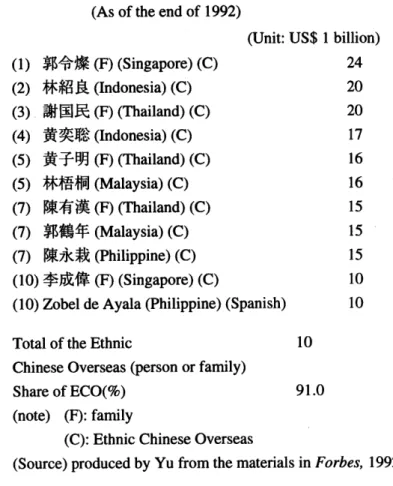
   IndusUialization in Southeast Asia is being implicated mainly by the

Overseas Ethnic Chinese. As a result, most of the biggest business

groups or billionaires are also Overseas Ethnic Chinese. Table l is an

example of this fact.

(4)

Table 1: Biggest Billionaires in Southeast Asia          (As of the end of 1992)

      (Unit:US$1billion)

(1)郭令燦(F)(Singapore)(C)       24

(2)林紹良(Indonesia)(C)         20

(3)謝国民(F)(Thailand)(C)       20

(4)黄突聡(lndonesia)(C)         17

(5)黄子明(F)(Thailand)(C)       16

(5)林梧桐(Malaysia)(C)         16

(7)陳有漢(F)(Thailand)(C)       15

(7)郭鶴年(Malaysia)(C)         15

(7)陳永栽(Philippine)(C)         15

(10)李成偉(F)(Singapore)(C)       10

(10)Zobel de Ayala(Philippine)(Spanish)      10

Total of the Ethllic       10 Chinese Overseas(person or family)

Share of ECO(%)       91.0

(note) (F):family

      (C):Ethnic Chinese Overseas

(Source)produced by Yu from the materials in Forbes,1992.

(5)

Il lnternationalization or Globalization      from the End of the 1970s

(1)Five Main Outward Movements

   As mentioned befbre, after the fbunding of New China in l949,

diplomatic relations between China and the nations where Overseas Chinese resided were cut off and new emigration from China had stopped. Naturally, even after that time, there were some kinds of Ethnic Chinese emigration, such as from Hong Kong to Great Britain, from Taiwan to the US, from lndonesia to Holland and so on. Yet, these were not so remarkable at that time.

   However, since the end of the 1970s and especially since the beginning of the 1980s, the situation has changed completely.

Intemational emigration of the Ethnic Chinese become increasingly dynamic. This is based on the intemationalization or the globalization of the means of transportation and communication throughout the world in general. Their intemational emigration was mainly due to the fbllowing five outflows of the Ethnic Chinese:

[1] The outflow of Overseas Ethnic Chinese refugees from lndochina,

particularly from Vietnam.

[2]The outflow of people and money from Hong Kong, which will be

retumed to mainland China in 1997.

(6)

[3]The outflow of money and people from Taiwan which has developed her㏄onomy very fast and could accumulate a very large amount of foreign currency reserves.

[4]The outflow of Overseas Ethnic Chinese and their money in Southeast Asia and the world to other countries and regions.

【5】The outflow of people and money from mainland China which started the economic reforms and open−door policy in 1979.

(2)Formation of the World Ethnic Chinese Economy

   Mainland China changed her㏄onomic policies at the end of the l970s. Including her policy towards Taiwan, mainland China has changed the policy from one of confrontation to one of dialogue. From around the end of the 1970s, mainland China has been signaling Taiwan of her desire to be hiendly. However, Taiwan has also changed her policies. Taiwan has brought about various kinds of democfatizations,

beginning with the abolition of Martial Law in 1987.

   As a result, the previously hostile political relationships improved

between not only mainland China and Taiwan but also within the

Overseas Ethnic Chinese communities. The political and㏄onomic

barriers were removed and the Ethnic Chinese economies of mainland

China, Hong Kong, Macau, Taiwan, and the Overseas Ethnic Chinese

began to unite. The Ethnic Chinese economy as a whole is made up of

(7)

the combining together of the various Ethnic Chinese economies from all ove曲e world, P{迂dcularly鉛m血e Asia−Paci行c region.

(3)Expansion of the Ethnic Chinese Economy in the Asia−Pacific    region and the Whole World

   In Southeast Asian economic development, foreign investment from Japan and the US plays a great role. However, from l 987011, Etllnic Chinese investment from Taiwan, Hong Kong(Macau), mainland China and the Overseas Ethnic Chinese has held or begun to hold first place in foreigrl investment ill Southeast Asia. Ethnic Chinese investment in conn㏄tion with the Overseas Ethnic Chinese in each nation has surpassed or been surpassing the Japanese and American investment in each nation of Southeast Asia.

   The case of the PhilipPines is a good example. In 1987, the share of American investment was 21.6%. However, the Ethnic Chinese share including Taiwan, Hong Kong, and mainland China was 27.0%. In 1988,

the American share was 33.8%and the Ethnic Chinese share was the

same,33.8%. However, if we include the Overseas Ethllic Chinese

investment ffom other nations, the Ethnic Chinese share is higher.111

fact, the American investment is said to include the Ethnic Chinese

capital from the US. In 1989, the American share had declined and the

Japanese share had increased. Yet the subtot田of the Ethnic Chinese

was 39%, much higher than that of Japan. We can see the same situation

in other Southeast Asian countries. Hence, we can say that the Ethnic

(8)

Chinese investment has akeady ranked fhst or is becoming first in for(∋ign investment to Southeast Asia.

   However, since around 19910r 92 Ethnic Chinese investment began to change its direction. Mos婁 of the investments are now going to mainland China and in some cases to Central and South America.

Accordingly, Ethnic Chinese㏄onomic power is expanding throughout the Asia−Pacific region and the world.

   It is not so easy for us to see exactly the Ethnic Chinese㏄onomic expansion fセom statistical data. In the past, most of the Ethnic Chinese foreign investment were very clear, since the owner of the capital was a Chinese mtional. Nowadays, however, the owller is not a Chinese national, but a foreign national, fbr exanlple, a Thai national in the case of an Overseas Chinese descendant in Thailand.

   Most㏄onomic statistics are based on nationality, not on race or ethnicity. Hence, normal eConomic statistics are not helpfUl fbr us. One indication is to what extent Chinatowns are expanding in the world. lf a Chinatowll is beillg enlarged newly constmcted is some city in some country, we can say that Ethnic Chinese economic power is expanding

in this country, in this city.

   New York s Chinatown is expanding to the north where little Italy was located and to the east where Jewish community was located. Little Italy and Jewish community are being overta]ken by Chinatown. In Budapest, Hungary, Saint Petersburg, Russia and several other locations,

new Chinatowns are also being constructed and growing.

   From these facts, we can say that the Ethnic Chinese economy is

(9)

expanding not only ill the Asia−Pacific region but also in the whole world. As a result, Ethnic Chinese billionaires account for 7.7%of the total world billionaires with more than ten billion US dollars assets in

1992.

lll Main Shadow Actors in the Age of Asia−Pacific

(1)World Economy in the Twenty First CentUry and the Asia−Pacific    Economy as a Growth Center

   The enlarged EC, North America and the Asia−Pacific region will be three poles in the 21st century world㏄onomy. However, which region of the three will be the center of the world economy?Some say that the enlarged EC will be the world㏄onomic center. Yet, in my understanding, the Asia−pacific region will be the center. Economic dynamism in the Asia−Pacific region is very strong and the growth rate of GNP or GDP is highest in this region.

(2)Main Actors in the Age

   In the Asia−Pacific region, Japan, the MEs(Newly Industrialized Economies, namely South Korea, Taiwan, Hong Kong, and Singapore),

the ASEAN,(namely Malaysia, Thailand, Indonesia, the Philippines

and Bmnei excluding Singapore)nations, mainland China are the main

(10)

actors in its remarkable economic development. Since these nations or areas are 10cated in the west pacific ocean, somO ca11 this the age of the West Pacific Ocean .

   Yet, this is not true. Without the US, the west Pacific region could not have developed well. The US is also one of the most impo伽t actors ill this age. The US has been importing a lot of goods ffom the west Pacific ocean nations. This is one reasoll why the US still has great

㏄onomlc power。

   The11, can we call this age The Age of the Pacific ?Naturally, we can. Yet, this term can not show the fact that Asia is more impo伽t compared to the US. Therefbre, the tem1 the Age of Asia−Pacific is more suitable.

(3)Main Shadow Actors in the Age

   As mentioned above, Japan, the N[Es, ASEAN and mainland China are the main actors in the Age of Asia−Pacific. We may add the US to the maill actors. However, there exist main shadow actors, as well. They are the Ethnic Chinese. We can say this for the following five reasons;

a.Economic Development of the Ethnic Chinese NIEs

   The㏄onomic development of the Asian N【Es(South Korea,

Taiwan, Hong Kong and Singapore)is very remarkable. However, three

of the four nations or areas, that is Taiwan, Hong Kong, and Singapore,

(11)

are Ethnic Chinese nations or areas. We can call them Ethnic Chinese NIEs.

b.Economic Development of the Ethnic Chinese Overseas

   The economic development of the Ethnic Chinese Overseas,

especially that in Southeast Asia, is also quite remarkable. It is mainly

the Ethnic Chinese Overseas who are supporting the amazing

development of each national economy in S outheast Asia.

c.Economic Development in Mainland China

   Since the beginning of the economic reform and the open−door policy i111979, China s・econo血ic development has also been extremely impressive. Especially, after recovering from the negative impact of the Tiananmen Square(June 4th)incident in 1989.

d.Ethnic Chinese lnvestment in Southeast Asia

e.Expansion of Ethnic Chinese Economic Power throughout Asia−

Pacific and the World.

   From the above−mentioned facts, we can say that the Ethnic Chinese,

including those in mainland China, Taiwan, Hong Kong, and Macau,

and the Overseas Chinese and their descendants, have become the main

(12)

shadow actors in the Age of Asia−Pacific.

(4)The Century for Ethnic Chinese

   There are many arguments related to the fUture prosp㏄ts of the Ethnic Chinese and I can show many estimates of their economic success in the fUture. Here, I will show only two examples of the estimates and from those estimates we can pr()ject what the century for Ethnic Chinese might be in the future.

a.Foreign Currency Reserves of the Three Chinese Tenitories

   Taiwan s fbreign currency reserves were around 86.3 billion US dollars as of the end of June 1992. Mainland China s foreign currency reserves were around 43.4 billion dollars as of the end of March 1992.

Hong Kong s fbreign currency reserves were around 29 billion dollars as of the end of 1991.The total is around l 58 billion dollars.

   The foreign currency reserves of the US were around 76.3 billion dollars as of May 1992. Japan s foreign currency reserves were around 70.5billion dollars as of June 1992. The total is around 146.8 billion dollars.

   From these figures we can see that the total of Taiwan, mainland

China and Hong Kong combined together was more than that of the US

and Japan combined together by over ten billion dollars. This means that

as far as the fbreign currency reserves are concemed, three Chinese

(13)

territories have a greater economic power than that of the US and Japan,

two㏄onomic super powers in the world economy, combined together.

Although the foreign currency reserves of the three Chinese territories has decreased, we can say that the foreign currency reserves of the three Chinese territories compare well with those of the US and Japan combined together. Recently, Taiwan s fbreign currency reserves surpassed 100 billion dollars. This is the first time in the economic history of the world in which foreign currency reserves in one country or area exceeded l OO billion dollars. As a result, the fbreign currency reserves of the three Chinese territo1ies might have surpassed those of the US and Japan again.

b.National lncome of the Ethnic Chinese as a Whole in the World

   According to China splan, in the year of 2050(sometimes it is said that the year will be around 2030), China aims to be ranked in the middle in terms of the global economy. At that time, China sper capita income might be$4,000 and the total population might be around l,500 million. Then, the total yearly income of China might be around$6,000 billion. If we add the income of the Ethnic Chinese outside mainland China, the total could be more than$7,000 billion. This is just under three times that of Japan today. The US national income is now around

$5,000billion. Hence, the total income of the Ethnic Chinese would be

more than that of the US and approximately the same amount as those

of the US and Japan combined together. Naturally, the US and Japan

(14)

would also increase their income. Yet, Ethnic Chinese economic power in the middle of the twenty first century might be equal to that of the US and Japan combined together today.

c.The Ethnic Chinese Century in Terms of Per−capita Allotments and   Severe Economic Conflict

   There are many problems which China needs to resolve in the fUture.

The population problem, the environmental destmction problem, the natural resource problem, international relations, the future of politics,

particularly that of s㏄ialism in China,㏄onomic conflicts, etc. need particular attention. If these conditions do not change, the Ethnic Chinese century might come in the twenty second or the twenty third century.

   However, even if the day when the Ethnic Chinese can surpass the US and Japan might arrive, the㏄onomic conflicts between the Ethnic Chinese and other countries or nations would be much more severe than those which today exist between the US and other countries or nations.

This is b㏄ause the current economic conflicts between the US and

others are not based on the situation that there exit many Overseas

Americans whose economic power in each country is very strong. The

Ethnic Chinese should solve these conflicts. Otherwise, the Ethnic

Chinese century can not come.

(15)

lV lnvestment in China Since the Latter Part of the 1980s,

       Especially since the Beginning of the 1990s

   Since the latter part of the 1980s, Ethnic Chinese investment fゴom outside mainland China to maillland Chilla has been increasing very rapidly. In the past, Ethnic Chinese illvestment from Taiwan, Hong Kong and Ethnic Chillese Overseas was dir㏄ted to the developed countries and Southeast Asia.

   However, since the latter part of the 1980s, Ethnic Chinese capital,

particularly from Hong Kong, began to be invested in mainland China.

In addition, since around 1987, Taiwanese capital also began to be invested in mainland China very rapidly, though it was directed to mainland China through a third country or area indirectly.

   Since the beginning of the 1990s, particularly since 1992 when Mr.

Deng Xiao−ping gave a command to go forward quickly, Overseas Ethnic Chinese capital also began to be invested in mainland China very rapidly. In this case, Mr. Li Ka−shing srole was very important. Before that, although he had been donating a very large amount of money to mainland China, his homeland, and fbunded Swatou University there,

he did not do business in mainland China.

   Since 1992, he started his business in mainland China. As a result,

many Ethnic Chinese capitalists outside mainland China, particularly

those in foreign countries(Overseas Ethnic Chinese capitalists)started

doing business with mainland China also. The above mentioned

(16)

investment from Hong Kong, Taiwan s investment and Overseas Ethnic Chinese investment to mainland China can be called thr㏄inflows.

Inflows are the inward movement to mainland China. As mentioned before, since the fbundillg of New China, localization of the Overseas Chinese had started. Since the latter part of the 1970s and particularly since the beginning of the 1980 s, intemationalism or globalization of the Overseas Ethnic Chinese started and as a result, new Overseas Chinese began to emerge. This is the outward movement or outflow of the Ethnic Chinese. We can cal1 it the outward movement or outflow from mainland China. This was a movement away from mainland China.

   However, this time the movement is dir㏄ted towards China. It is the inward movement or inflow dir㏄ted toward mainland China.

Connection of the Ethnic Chinese outside mainland China with mainland China are being revitalized. This is a movement of tuming back to China. We can call it a retum to China. it is the beginning of a new stage, the third stage.

V  The Latest Turning Point?

(1)The Beginning of a Business Recession or A(ljustment for the Next    Rapid but Stable Development?

   Now the world Ethnic Chinese economy faces three very important

issues,(a)is this a new beginning of a business recession or an

(17)

a(lj ustment awaiting the next rapid but stable development?,(b)will the Southem China Economic Zone become the fUture economic growth center?,(c)will the US or Japa11,0r both, be the main Ethnic Chinese

㏄onomic pa血【er?. In this sense, we can say that the world Ethnic Chinese economy is now at a turning point.

(2)From the Southern China Economic Zone to the Changj iang    Basin Economic Zone ?

   At the present time, the Southem China Economic Zone is a rising area in mainland China. However, it can llot be the fUture center of China s㏄onomy. China is a large country. Therefbre, there will be several centers just like in the US, not like in a small country such as Japan.

   In this sense, the Southem China Economic Zone can be one of the important economic centers in the future of mainland China. Yet, it can not be the most important one because it lacks energy resources,

heavy industry. In the history of China, all capital cities were located ill the northem areas.

   Then, in the fbreseeable fUture, which area will be the most

important economic center in mainland China?Probably the Changj iang

basin area which starts form the Shanghai−Pudong area connecting the

inland areas via the Su−nan area(southem Jiang−su Province), will be

the center. The Pudong development pr()ject will be implemented as a

national proj ect supported by the two former mayors of Shanghai, Mr.

(18)

Jiang Ze一曲, Secretary Generai of山e Chinese Communist Parity,

President of止e People s Republic of China and Chairman of the Central Military Conm廿ssion, and Mr. Zhu Rung−j i, Deputy Prime Minister. This pr()ject can not be unsuccessfu1.

   The Su。nan area is very famous for its remarkable development of

?奄≠獅№嘯??氏@Qiye (Rural enterprises). such remarkable development of rural enterPrises is expanding throughout the province and into other provinces, such as Zhej iang and Anhui. The Changj iang basin development pr()ject includes the Sanxia development project in the Changliang basin area. The latter is a very big prqj㏄t. In order to implement this pr()j ect, more than one million people must be displaced from their homeland. Destruction of the ecosystem, environmental pollution, etc. are other very serious problems facing this pr()j ect.

Nevertheless, if the Chan幻iang basin development pr()ject can be implemented successfUlly, it will help develop the Chinese economy

well.

   Then, how about the fbreign relations of the Chan釦iang basin development proj ect?In the case of the Southem China Economic Zone , its relationship with the Ethnic Chinese economy outside mainland China is most important. In case of the Dongbei(Northeast)

area including Dalian. Its relationship with Japan is most important. In

case of the Shandong area, its relationship with South Korea is most

lmportant・

(19)

(3)Mainland China s Main Foreign Economic Partner:

   the US of Japan or Both?

   The Ethnic Chinese㏄onomy needs a advanced science and the most highly advanced t㏄hnology. The Ethnic Chinese economy outside mainland China can not provide these. Only the most developed countries such as the US, Japall and the Europeall developed countries can provide them. Yet, Europe is very far from China, while Japan i s the nearest. In the case of the US, it will take a long time for Sino−US relations to return to normalcy, if the American govemment sticks to the human rights issue. Then, fbr the time being, Japan is the most suitable country to provide China the advanced science and the most highly developed technology.

   However, if Sino−US relations are normalized in the near future,

Sino−US scientific and technological cooperation could be strollgest. In

this case, Japan s㏄onomic power might be lost. It is especially

important to note that there are many Ethnic Chinese scientists and

technical experts in the US. All Ethnic Chinese Nobel Prize winners live

in the US. Their role in scientific and technological cooperation between

China and the US is very important. This cooperatioll is already under

way. Ideally, it would be best fbr China if the US and Japan both

b㏄ame the partners of the future China. However, is this very easy or

even possible?

(20)

VI Conclusion

   The Ethnic Chinese economy is now facing three very important issues. Can mainland China solve her cument㏄onomic problems,

especially inflation, overheating of the national economy, land and stock speculation, agricultural problems or famlers problems or mral problems, abuses of the love of money and corruption, and so on?Can mainland China s economy expand economic dynamism from southern China to other areas, particularly in the near負1ture to the Changtiang basin area?Can the Ethnic Chinese㏄onomy, particularly mainland China s economy, have very close relations with the most advanced countries, particularly in the fields of science and technology?

   Except fbr political issues, the f皿ture prosp㏄ts of the Ethnic Chinese economy depend on the results of the above mentioned issues.

Of the Ethnic Chinese economy as a whole, mainland China s future

economy is most impor伽t. Whether mainland China can solve the

various problems and can develop her economy well or not is the most

important factor. If mainland China can succeed in its economic

development, the Ethnic Chinese outside mainland China can develop

their economy well through their investment in mainland China, fbreign

trade with mainland China, the mutual migration of people to and from

mainland China, and so on. In this sense, we can say that the Ethnic

Chinese economy is now at a very important turning point・

(21)

(This paper was submitted to the International Conference on the

Overseas Ethnic Chinese Economy in the World held in Swatou, China

on November 28−30,1993)

Table 1: Biggest Billionaires in Southeast Asia          (As of the end of 1992)                           (Unit:US$1billion) (1)郭令燦(F)(Singapore)(C)       24 (2)林紹良(Indonesia)(C)         20 (3)謝国民(F)(Thailand)(C)       20 (4)黄突聡(lndonesia)(C)         17 (

参照

関連したドキュメント

对象设施

This paper aims to clarify the features of the descriptions of Japan in Chinese geography textbooks. Japan and China share a long-term relationship. The descriptions of Japan in

Regional Difference and Historical Change in Chinese Funeral Rites: The Inheritance and Transformation of Tradition Chinese funeral rites originate from those described in

This paper aims to study the history of Chinese educational migration and state policies which influence overseas Chinese students, to explore the mobility tendency of

In the present paper, the methods of independent component analysis ICA and principal component analysis PCA are integrated into BP neural network for forecasting financial time

Even if it is true that wh-words take wider scope over any other Q-expressions, as shown in 4, a universal quantifier mei-ge ren 'every NP' in subject position can have wider scope

Introduction to Japanese Literature ② Introduction to Japanese Culture ② Changing Images of Women② Contemporary Korean Studies B ② The Chinese in Modern Japan ②