Introduction
An annual forum of science and technology policy sponsored by the American Association for the Advancement of Science (AAAS) was held in Washington D.C. on May 13 and 14, 2010.[1] The forum is held every year for the purpose of providing science and technology researchers with an occasion to understand and discuss such topics as policy issues facing the science community and university research institutes and budget request priorities for next fiscal year. Therefore, the forum is very helpful to understand priority issues in the U.S. science and technology policy. The forum this year, which was the 35th of its kind, was attended by more than 400 representatives from the government, Congress, universities, academic societies, think tanks and science and technology policymakers of other countries. John Holdren, President Obama’s science advisor, made a keynote speech at the forum, as he did last year.
The themes of each session are as follows. In sharp contrast to last year’s forum, which was filled with expectations for the newly inaugurated government of President Barack Obama, the participants in this year’s forum appeared to have discussed policy issues scrupulously to examine the effects of a series of measures implemented by the government and the role to be played by science and technology amid severe fiscal and economic conditions.
[Plenary session]
・Budgetary requests for fiscal 2011[NOTE 1] and policy background
・Strengthening the U.S. climate to create innovation:
Role of public policy
・National security and the role of science and technology
6
1
Report on the AAAS Annual Forum (2010) on Science and Technology Policy
Yuko naganO 3rd Policy-Oriented Research Group
[Parallel session]
・Societal impacts of science and technology
・New approach to international involvement in science and technology: Trans-Atlantic outlook
・Beyond emissions trading: Different climate change problems
In this report, I would like to outline mainly the results of discussions at the sessions concerning policy trends in FY2011 R&D budget requests, innovation- related policies, and societal impacts of science and technology.
Keynote Speech
First, presidential advisor John Holdren introduced President Obama’s views that science and technology is not merely closely related with domestic and global policy issues but is the key to the issues, that it is not only necessary to aim at practical application of science and technology but also at strengthening cross-sectional science and technology infrastructure, and that, in order to solve problems, it is necessary to establish partnerships across sectors and countries, not to mention among relevant government agencies.
Then, Holdren briefly explained the important issues that have been actively addressed by the Obama administration. Among them, Holdren first cited the fact that President Obama assigned many renowned scientists to important government posts and mentioned science and technology more frequently than his predecessors in his speeches and that the President has consistently focused attention to science and technology in budget appropriations
[NOTE 1]
The U.S. federal government’s fiscal year starts in October and ends in September. For instance, the fiscal year 2011 is from October 2010 to September 2011.
2
since he began to take economic stimulus measures.
With regard to the American Innovation Strategy (announced in September 2009), Holdren said that the strategy consists of three pillars: investment in fundamental researchers as building blocks and in STEM (science, technology, engineering and mathematics) education, efforts to promote competitive markets to create innovations, and catalyst action to break through national priority issues. He stressed that the purpose of STEM education is to raise the performance of American children in science and mathematics tests to the top in the world from the current middle level and to increase the number of college graduates to one of the largest in the world by 2020. To that end, the U.S. government has aggressively implemented various measures, including the signing of the Recovery and Reinvestment Act of 2009,[NOTE 2] and sponsored “National Lab Day”,[2] a first nationwide initiative, on May 12, 2010.
In addition to these moves, Holdren introduced the government’s efforts to lay down guidelines for the utilization of stem cells and rules concerning the fairness of science. He also introduced the government’s recent efforts to simplify reporting procedures on the progress of federal government research grant projects.
Lastly, Holdren stated that the government has been tackling climate change issues from the perspective of alleviation, adjustment and damage. He said that the costs of action are likely to be far smaller than the cost of inaction. The government has been addressing the challenge of energy and climate change based on the recognition that it is “not energy and climate policy versus the economy” and that it is “energy and climate policy for the economy,” he said.
Holdren said that the measures implemented so far include inaugurations of ARPA-E[3] and Energy Innovation Hubs,[4] establishment of carbon dioxide emission standards as the first fuel economy policy, strengthening of partnerships with China, India and other emerging countries, establishment of a task force to coordinate government agencies’ response to the expansion and adoption of the U.S. Global Change Research Program,[5] and preparations of
government responses to congressional deliberations on comprehensive energy- and climate-related bills.
Federal R&D Budget for Fiscal 2011
[Distressed condition of state-run research universities]
Linda Katehi (chancellor of the University of California, Davis) reported the plight of state-run universities in California caused by severe fiscal conditions of the state government in contrast to active efforts by the federal government. She said that the situation in other states is more or less the same.
She also said that the California state budget was slashed by half in the last 20 years and is expected to be further slashed by about 25% in the next 12 months. As a result, her university had to cut teachers’
salaries and research expenditures. As well, she said that, 10 years ago, about 10% of the state budget had been allotted to research universities and about 6%
to prisons but that the proportion has been reversed.
This has forced state-run universities to raise tuitions, making it difficult to provide middle class students with high scores with an opportunity to go to college.
[Fiscal deterioration of the United States as a whole]
Douglas W. Elmendorf (Director of the Congressional Budget Office) reported that the United States is faced with fiscal deficits and an increase in government debts. In 2007, the United States ranked 15th in the world in the government debt to GDP ratio (Japan topped the list). But the country is projected to rise to a higher rank by 2020. In order to address this problem, Elmendorf stressed the need for the United States to drastically change its revenue and expenditure policies.
[Characteristics of federal R&D budget by agency and by nature]
Patrick J. Clemens (head of the AAAS research &
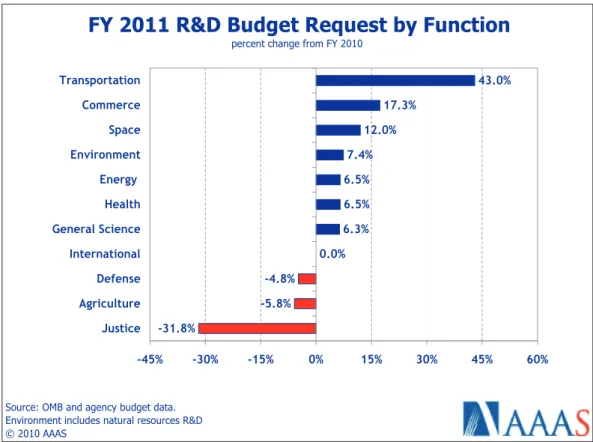
development and policy program division) explained the outline of a total of $148.1 billion R&D budget requests (down 0.3% from fiscal 2010 budget) by agency and by nature (See Figure 1). Budget requests from many agencies increased drastically, including those from the National Ocean and Atmosphere Administration (NOAA), the National Institute for Standards and Technology (NIST), and the National Aeronautics and Space Administration. However, [NOTE 2]
The Act is designed to implement large-scale economic stimulus measures, including tax cuts and various fiscal disbursements. It was enacted on February 17, 2009.
3
requests from some departments were slashed, including those from the Department of Homeland Security (DHS), the U.S. Department of Agriculture (USDA), the Department of Defense (DOD), and the Department of Transportation (DOT). Budget requests for basic research increased by 4.3%, those for development decreased 2.9%, and those for nonmilitary research as a whole increased 5.9%.
[Expanded and focused research grants by the Agriculture Department]
Roger Beachy (director of the National Institute on Food and Agriculture), while citing a sharp increase (30%) of FY2011 budget requests for subsidy programs under the Agriculture and Food Research Initiative (AFRI)[6] as a symbolic event, introduced the department’s recent efforts to address social challenges, such as climate change, bioenergy, food safety, child obesity, and global food security.
Strengthening the U.S. Climate for Innovation
Moderator F.M. Ross Armbrecht (chairman of the AAAS Committee on Science, Engineering and Public Policy) stressed the importance of innovation and said that if the United States wants to remain a leading country in the world, it is important for the country to make long-term efforts for innovation instead of short-term efforts taking only three months ahead into view, as has often been seen in its recent fiscal policies. To that end, he called for discussions on what the United States should do now.
FY 2011 R&D Budget Request by Function
percent change from FY 2010
-31.8%
-5.8%
-4.8%
0.0%
6.3%
6.5%
6.5%
7.4%
12.0%
17.3%
43.0%
-45% -30% -15% 0% 15% 30% 45% 60%
Justice Agriculture Defense International General Science Health Energy Environment Space Commerce Transportation
Source: OMB and agency budget data.
Environment includes natural resources R&D
© 2010 AAAS
Figure 1 : Changes in FY2011 R&D Budget Requests by Government Agencies (from FY2010) Source: Patrick J Clemens Note: Lighter colored bars indicate percent change with projected FY2011 earmarks.[NOTE 3]
* NOAA: National Ocean and Atmosphere Administration; NIST: National Institute for Standards and Technology; NASA: National Aeronautics and Space Administration; NSF: National Science Foundation; DOE: Department of Energy; NIH: National Institute of Health; USGS:
United States Geological Survey; EPA: Environmental Protection Agency; VA: Department of Veterans Affairs; DOT: Department of Transportation; DOD: Department of Defense; USDA: U.S.
Department of Agriculture; DHS: Department of Homeland Security
[NOTE 3]
Earmark refers to a portion of budget added for specific purposes during congressional budgetary debate. It is not included in the President’s budget message.
4
Source: Andrew Taylor
[U.S. losing its position as “innovation leader”]
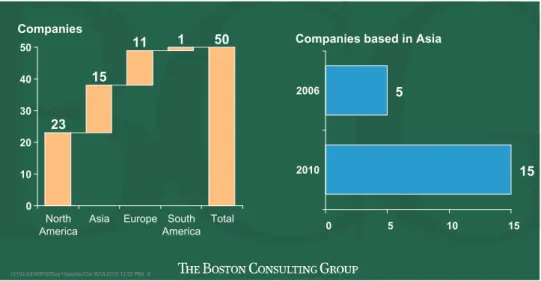
Andrew Taylor (of the Boston Consulting Group) described the situation of the United States based on the results of a survey conducted on major companies around the world. He said that the United States is now ranked 8th (Singapore ranked 1st and Japan 9th) in innovation and performance. Of the top 50 innovative companies, 23 are based in North America, 14 in Asia, 11 in Europe and one in South America. Asian companies increased from 5 in 2006 (See Figure 2). Taylor said that the United States is losing its distinction as an “innovation leader” and called on the
government to make investment in R&D, education and training.
[California’s own efforts to foster innovation]
Susan Hackwood, (executive director of the California Council on Science and Technology) stressed the importance of “a game changer”
in innovation in order to change conventional approaches. She said that California has spearheaded innovation but that it has so far focused on such areas as communication, healthcare, international system and education system.
12192-09/WIP/09Sep11ataylor/Chi (5/18/2010 12:32 PM) 9
Results of 2010 BCG/Bloomberg BusinessWeek Most Innovative Company Survey
>50% of 2010 Most Innovative Companies are international
Companies
Total South America Europe Asia North America
50 11 1
15
23
0 10 20 30 40
50 Companies based in Asia
2010 2006
15 5
0 5 10 15
Figure 2 : Locations of 50 Most Innovative Companies (2010)
Source: Steven Robinson Figure 3 : Website of National Lab Day (top page)
[Education initiative for innovation]
Steven Robinson (special assistant on the White House’s Domestic Policy Council) described education-related projects such as “Race to the Top Fund”[7] and “Educate to Innovate”[8] campaigns under the Recovery and Reinvestment Act, which have been promoted under the initiative of President Obama in cooperation with the Department of Education. He also said that “National Lab Day,” which is the latest project, is more than just a one-day event but that it is an ongoing initiative to build local community- wide networks of collaborations by actively soliciting cooperation not only from education officials and students but also from science communities and volunteers via its dedicated website (See Figure 3).
Its overriding principle is “removing obstacles for students, eliminating disparities, setting goals strictly, taking a flexible approach, and promoting innovation and rewarding success.”
Other Topics
5-1 Societal impacts of science and technology Amid aggressive investment in science and technology by the Obama administration, it is natural that calls for the assessment of societal impacts of science and technology have increased. While efforts have been made in response to such calls, some AAAS forum attendants argued that the matter should be examined from wider perspectives.
[Structure of the Government Accountability Office (GAO) enhanced]
Timothy Persons (chief scientist at the Government Accountability Office and the science division chief at the GAO’s scientific technology and engineering center) described that the GAO (which was formerly called the Governmental Accounting Office) was restructured and renamed the Government Accountability Office in 2004 and that a scientific technology and engineering center was established within the GAO in 2008 to conduct technology assessment necessary for providing independent
advice[NOTE 4] to Congress on an ongoing basis.
The center has conducted trend surveys and made projections of the future direction in specific areas.
Persons said the center responds to requests from Congress, keeping promptness and accuracy in mind.
[Attempt of impact evaluation of federal government’s research promotion]
Stefano Bertuzzi (Office of Science Policy Analysis at the National Institutes of Health) explained the outline of STAR METRICS (Science and Technology in America’s Reinvestment Measuring the EffecT of Research on Innovation, Competitiveness and Science),[9] a project which is promoted mainly by the NSF and NIH as an attempt to evaluate the scientific, economic and societal impacts of R&D projects supported by the federal government. Evaluating such impacts has come to be increasingly called for when making budget appropriations or requests under the American Recovery and Reinvestment Act. As the first stage of the project, a database necessary for the analysis of the employment situations of researchers engaged in government-funded research at six universities is being developed without imposing a heavy burden on the researchers.
In addition to these presentations, some speakers proposed to review science research priorities based on ethical standards and discipline.
5-2 National Security and the Role of Science and Technology
With regard to national security issues, which the United States has been addressing since the September 11 terrorist attacks, there are still problems challenging the country. At the AAAS forum, proposals were made and discussed to solve such problems.
[Mutual understanding of U.S. national security and higher education/science]
C.D. Mote (President of University of Maryland) spoke on the current state of the relationship between national security and universities. In the past, they were in confrontation with each other in terms of their mission and culture of higher education. However, after the 9/11 attacks, it has become necessary to understand each other and strike a balance between national security and academic freedom. In 2005, the FBI created the National Security Higher Education Advisory Board (NSHEAB), which now consists [NOTE 4]
The Government Accountability Office (GAO) is independent of the executive departments under law and is of equal rank with the Congressional Budget Office (CBO) and the Congressional Research Service (CRS).
5
of 23 university presidents. The advisory board has promoted understanding between national security issues and higher education and discussed how they can cooperate with each other by taking up such topics as bioterrorism, cybersecurity, export control, nuclear terrorism, and visa problems. Other themes of the advisory board include internships at the FBI and scholarships from the standpoint of recruiting students as FBI officials. During a question-and-answer session, it was pointed out that researchers still have difficulty entering the United States due to the limited number of researchers allowed to enter the country, while students are allowed to enter the country on a preferential basis.
In addition to these topics, the participants also discussed a proposal from the Royal Society regarding the importance of international cooperation in nuclear nonproliferation and a report on measures and problems involved in “offensive” operations against cyber attacks.
Conclusion
Finally, I would like to give my impressions of the AAAS forum.
Since its inauguration in January 2009, the Obama administration has consistently paid utmost consideration to investment in science and technology,
including the passage of the American Recovery and Reinvestment Act. At the same time, however, the administration and scientific circles are being urged to respond to an increased demand for the accountability for the effects of the investment. The government is also faced with a big challenge of dealing with a sharp increase in fiscal deficits, which is expected to lead to the accumulation of national debts.
It was against this background that the latest AAAS forum focused discussions on how to achieve accountability for the effects of investments made so far and for the role played by science and technology in policy and social issues and how to steer science and technology by forging solid footing. This is in contrast to last year’s AAAS forum, where discussions were held in an atmosphere of expectations for Obama administration’s science and technology policy.
In the United States, enhancing the quality of primary and secondary education remains a big challenge and it is positioned as a basic component in the context of creating innovation. The forum participants shared the view that it is essential for the United States to enhance the quality of education in order to secure workers with scientific knowledge and skill. Discussions at the forum revealed that the government has been making efforts, with active participation of the science community.
[1] AAAS annual forum on science and technology policy
http://www.whitehouse.gov/the-press-office/president-obama-launches-educate-innovate-campaign- excellence-science-technology-en
[2] “National Lab Day”: http://www.nationallaboday.org/
[3] Department of Energy; Advanced Research Projects Agency-Energy (ARP-E): http://arpa-e.energy.gov/
[4] Department of Energy; Energy Innovation Hubs programs:http://www.energy.gov/hubs/
[5] United States Global Change Research Program: http://www.globalchange.gov/
[6] Department of Agriculture; Agriculture and Food Research Initiative (AFRI):
http://www.nif.usda.gov/funding/afri/afri.html
[7] Department of Education; “Race to the Top Fund” projects:
http://www2/ed/gov/programs/racetothetop/index.html [8] White House; “Educate to innovate Campaign”:
http://www.whitehouse.gov/the-press-office/president-obama-launches-educate-innovate-campaign- excellence-science-technology-en
[9] Working group of STAR METRICS projects: http://sites.nationalacademies.org/PGA/fdp/PGA_057189 References
6
Yuko NAGANO
3rd Policy-Oriented Research Group Senior Research Fellow
National Institute of Science and Technology Policy http://www.nistep.go.jp/index-j.html
Has been with NISTEP since 2008 after working as a science and technology policy administrator for the Science and Technology Agency and the Ministry of Education, Culture, Sports, Science and Technology. The main research themes of the 3rd Research Study Group are industry- academic collaboration, university ventures, and regional innovation. Its main interest at present is policy planning and implementation based on evidence and how to provide scientific advice.
(Original Japanese version: published in June 2010) Profile