O R I G I N A L A R T I C L E — A L I M E N T A R Y T R A C T
Booster influenza vaccination does not improve immune response in adult inflammatory bowel disease patients treated
with immunosuppressives: a randomized controlled trial
Hiroko Matsumoto•Satoko Ohfuji•Kenji Watanabe•Hirokazu Yamagami• Wakaba Fukushima•Kazuhiro Maeda•Noriko Kamata •Mitsue Sogawa• Masatsugu Shiba•Tetsuya Tanigawa•Kazunari Tominaga•Toshio Watanabe• Yasuhiro Fujiwara•Yoshio Hirota• Tetsuo Arakawa
Received: 13 November 2014 / Accepted: 19 January 2015 / Published online: 12 February 2015
�Springer Japan 2015
Abstract
Background This research was conducted is to assess the effect of booster doses of the trivalent influenza vaccine in adult inflammatory bowel disease (IBD) patients treated with anti-tumor necrosis factor (TNF)-a agents and/or immunomodulators.
Methods Adult IBD patients and healthy individuals were subcutaneously administered the trivalent influenza vac- cine. They were randomized into two groups: the single vaccination group and the two vaccination booster group.
Blood samples were collected, and the antibody titers against each influenza strain were determined by hemag- glutination inhibition at 3 different time points (pre-vac- cination, 3 weeks post-vaccination, and after the flu season) in the single vaccination group and at 4 time points (pre-vaccination, 3 weeks post-first vaccination, 3 weeks post-second vaccination, and after the flu season) in the booster vaccination group.
Results Seventy-eight IBD patients and 11 healthy con- trols were randomized into the single vaccination group and the booster vaccination group. Twenty-nine patients received immunomodulators; 21 received anti-TNF-a agents; and 28 received a combination of both. No sig- nificant differences were observed in the evaluated immune response parameters between 3 weeks post-vaccination in the single vaccination group and 3 weeks post-second vaccination in the booster vaccination group (geometric mean titers: H1N1, p =0.09; H3N2: p =0.99; B:
p =0.94). A higher pre-vaccination titer was significantly associated with sufficient seroprotection rate after vacci- nation for the H1N1 strain (odds ratio 11.93, p=0.03).
Conclusions The second booster of trivalent influenza vaccination did not improve the immune response in adult IBD patients who were treated with immunomodulators and/or anti-TNF-a agents.
Keywords Inflammatory bowel disease�
Immunomodulator�Anti-tumor necrosis factor-aagent� Booster vaccination�Influenza vaccine
Abbreviations
ADA Adalimumab
AZA Azathioprines
CD Crohn’s disease
GMT The geometric mean titer HAI Hemagglutination inhibition HBI Harvey–Bradshaw index HBV Hepatitis B virus
IBD Inflammatory bowel disease
IFX Infliximab
OR Odds ratio
TNF-a Anti-tumor necrosis factor-a UC Ulcerative colitis
H. Matsumoto�K. Watanabe (&)�H. Yamagami� N. Kamata�M. Sogawa�M. Shiba�T. Tanigawa� K. Tominaga�T. Watanabe�Y. Fujiwara�T. Arakawa Department of Gastroenterology, Osaka City University Graduate School of Medicine, 1-4-3 Asahi-machi, Abeno-ku, Osaka 545-8585, Japan
e-mail: [email protected] S. Ohfuji�W. Fukushima�Y. Hirota
Department of Public Health, Osaka City University Graduate School of Medicine, Osaka, Japan
K. Maeda
Research Foundation for Microbial Disease of Osaka University, Osaka, Japan
Y. Hirota
Clinical Epidemiology Research Center, Medical Co. LTA, Fukuoka, Japan
123
DOI 10.1007/s00535-015-1042-7
UMIN-CTR University Hospital Medical Information Network Clinical Trial Registry
6MP 6-Mercaptopurine
Introduction
Patients with inflammatory bowel diseases (IBDs) such as ulcerative colitis (UC), Crohn’s disease (CD), and intesti- nal Behc¸et’s disease have chronic intestinal inflammation from various causes of environmental factors, dysregulated immune systems, and genetic susceptibility [1]. Immuno- suppressive therapy, immunomodulators, or anti-tumor necrosis factor (TNF)-a agents are currently used in IBD patients to improve clinical outcomes with remission induction and maintenance; however, these treatments can increase adverse events, including infections [2–4]. In particular, elderly IBD patients may be at increased risk for opportunistic infections [5, 6].
Influenza is an annual respiratory infection that can cause serious complications. In the United States, influenza causes about 226,000 hospitalizations and about 36,000 related deaths every year [7, 8]. Patients who are com- promised, elderly, or treated with immunosuppressive agents are at a higher risk of having complications if they are infected with the influenza virus [9]. Therefore, it is recommended for IBD patients who are treated with immunosuppressive agents to get the annual influenza vaccination [9].
We previously reported that immune responses to the trivalent influenza vaccination were inhibited for some strains in adult IBD patients who were treated with inf- liximab (IFX) and/or immunomodulators [10]. This has also been reported in pediatric IBD patients [11].
Children generally receive two trivalent influenza vac- cinations in one season because of their immunogenicity [12–14]. A second booster influenza vaccination is effec- tive in children for improving immune responses after insufficient immune responses following the first vaccina- tion [15]. However, it has not been clarified whether a first and a second booster influenza vaccination might be less effective for adult IBD patients treated with IFX and/or IM in comparison with healthy controls.
Pediatric IBD patients treated with IFX are highly sus- ceptible to hepatitis B virus (HBV) reactivation; thus, cli- nicians need to screen for HBV immunity when they are diagnosed with IBD. The HBV vaccine, the same inactive vaccine, showed an anamnestic immune response after the second booster vaccination [16]. In patients with rheuma- toid arthritis who are receiving treatment with immuno- suppressive drugs, optimization with a booster dose of the
trivalent influenza vaccine is also considered [17, 18]. We conducted the first prospective randomized controlled study to evaluate the efficacy of booster doses of the tri- valent influenza vaccination in adult IBD patients who were treated with anti-TNF-a agents and/or immunomodulators.
Methods
Subjects
We conducted a prospective, open label, randomized, controlled, parallel-group comparison study from Novem- ber 2012 to July 2013 in the Department of Gastroenter- ology at the Osaka City University Hospital. The study protocol was approved by the Ethics Review Board of the Osaka City University Graduate School of Medicine, and it was registered at the University Hospital Medical Infor- mation Network Clinical Trial Registry in advance (UMIN000009259).
Study subjects consisted of IBD patients receiving immunosuppressive therapy, immunomodulators and/or anti-TNF-a agents, and healthy volunteers were the con- trols (C20 years). The exclusion criteria were as follows:
(1) subjects who had already received the 2012 trivalent inactivated influenza vaccine; (2) subjects with a history of influenza infection within the last 6 months; and (3) sub- jects with a history of anaphylactic reaction to a previous influenza vaccine or vaccine components, or an acute febrile illness or signs of severe acute illness at the time of vaccination. All subjects provided written informed con- sent after the study design and possible risks were explained. We estimated that the appropriate sample size for the primary objective was 108 IBD patients and 20 controls. This was based on the assumption of a 2.5 odds ratio (OR) for an appropriate immune response in the booster two vaccination group compared to the single vaccination group, according to the data of our preliminary study, and a power of 80 % and an alpha of 0.05. The IBD patients were randomized into a single or booster vacci- nation group with a 1:1 ratio, allocation for age (\49 andC49 years), and the type of immunosuppressive ther- apy (i.e., immunomodulator monotherapy, anti-TNF-a agent monotherapy, or a combination of both). The con- trols were randomized into the single vaccination group or booster vaccination group.
Data collection
At the time of recruitment, we collected the following clinical information from the IBD patients’ medical records: age, sex, diagnosed disease (UC, CD, or intestinal
Behc¸et’s disease), duration of disease, current therapy [azathioprines (AZA), 6-mercaptopurine (6MP), IFX, and adalimumab (ADA)] that has been continued for[3 - months, disease activity [UC: partial Mayo score; CD:
Harvey–Bradshaw index (HBI)]. A partial Mayo score ofB2 for UC and HBI ofB4 for CD are defined as remission stage.
Before vaccination, the subjects were asked to complete a self-administered questionnaire, which collected the fol- lowing information: age at vaccination, body height and weight, underlying illnesses, past medical history, and allergic history (including allergy to eggs).
Vaccination with the trivalent vaccine
Each subject received a single dose or two doses as a booster of the 2012–2013 seasonal trivalent inactivated influenza vaccine (Lot HA119E; Biken, Osaka, Japan) subcutaneously. In Japan, subcutaneous administration is the routine for influenza vaccinations. The vaccine strains were A/California/7/2009 (H1N1) pdm09, A/Victoria/361/
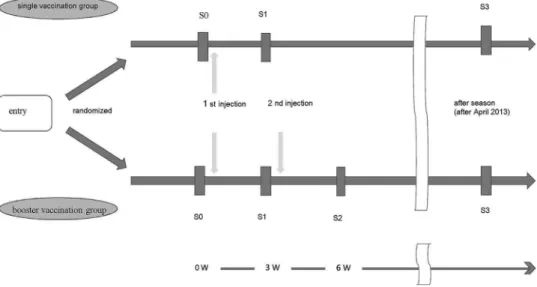
2011 (H3N2), and B/Wisconsin/01/2010 (B). A standard 0.5 mL dose of the vaccine contained 15lg of the hem- agglutinin antigen of each strain. For the booster vaccina- tion group, the subjects received a second vaccination after 3 weeks from the first vaccination.
Measurement of hemagglutination inhibition antibody titers
Figure 1 presents an outline of the present study design.
Serum samples were collected at 4 time points in the booster vaccination group: before vaccination (S0), 3 weeks after the first dose (S1), 3 weeks after the second dose (S2), and after the influenza season (after April 2013;
S3). For the single vaccination group, the serum samples
were collected at the following 3 time points: before vac- cination (S0), 3 weeks after the first dose (S1), and after the influenza season (after April 2013; S3). All serum speci- mens were stored at -80�C until they were tested for hemagglutination inhibition (HAI) antibody titers against all strains simultaneously. The HAI antibodies were mea- sured using the standard microtiter HAI method with the same antigens as in the vaccine [19]. All samples were measured at the laboratory of the Research Foundation for Microbial Disease of Osaka University between July 2013 and September 2013.
Statistical analyses
The following outcomes were calculated to assess the immunogenicity of the influenza vaccine: the geometric mean titer (GMT), mean fold-rise, seroresponse rate (C4- fold rise), and seroprotection rate (HI titerC1:40). For data processing, titers\1:10 were regarded as 1:5, and reci- procal antibody titers were analyzed after logarithmic transformation. The results were presented in the original scale by calculating the antilogarithm. A stratified analysis was also performed to investigate the effect of potential confounders: sex, age at vaccination, disease duration, immunosuppressive treatment, defined disease, disease activity (remission or active), and pre-vaccination titer (\1:10, 1:10–1:20, andC1:40). The significance of the fold-rise within a category was assessed using the Wilco- xon signed-rank test, and inter-category comparisons were made by using either the Wilcoxon rank-sum or Kruskal–
Wallis tests. The Chi square test or Mantel-extension method for the trend test was also used when appropriate.
Furthermore, to consider the independent effect of the booster dose on the immune response, multivariate analy- ses were conducted using logistic regression models with potential confounders. We chose to adjust the variables, Fig. 1 An outline of the present
study design
which revealed the differences in the stratified analysis, or we reported the effect on the immune response from pre- vious studies, as potential confounders. All analyses were performed using SAS, version 9.1.3 (SAS Institute, Cary, NC, USA).
Results
Study participants
Seventy-eight IBD patients and 11 controls were enrolled.
The baseline characteristics were well matched for sex, age at vaccination, disease, and disease duration between the two groups after randomization (Table 1). The immuno- suppressive therapy, immunomodulator monotherapy, anti- TNF-aagent monotherapy, and combination therapy were also randomized well between the two groups (p=0.82).
Thirty-eight patients had CD, 33 had UC, and 7 had Be- hc¸et’s disease. There were no statistically significant dif- ferences in disease activity between the two groups (HBI:
p=0.66; partial Mayo score:p =0.19).
Forty-six participants received a single dose of the influenza vaccination and 43 participants received two doses between November 5, 2012 and December 28, 2012.
All 89 subjects had follow up until July 2013.
Changes in the parameters of immunogenicity
The immune responses to the trivalent influenza vaccination for the 3 strains during each phase are shown in Table 2.
Among 78 IBD patients, there were no significant differ- ences in GMTs after vaccination between S1 in the single vaccination group and S2 in the booster vaccination group (H1N1: p=0.09; H3N2: p=0.99; B: p =0.94). There were also no significant differences in GMTs after the flu season for each strain between the groups (H1N1:p =0.54;
H3N2:p =0.93; B: p=0.90). Although the seroprotec- tion rate for the H1N1 strain after two vaccinations (S2) was lower in the booster vaccination group than that (S1) in the single vaccination group (p=0.04), the seroprotection rates for the other strains were similarly observed in both groups. The seroprotection rates after the flu season were equally distributed for each strain between the groups (H1N1:p=0.35; H3N2:p=0.80; B:p =0.31).
In the study subjects, the pre-vaccination titer for the B strain was very high compared to that of the H1N1 or H3N2 strains. Therefore, the seroprotection rates of the B strain for all participants after vaccination (S1 or S2) were 100 %.
In the single vaccination group, the seroprotection rate after vaccination (S1) was[70 % for every strain (H1N1:
85 %, H3N2: 82 %, B: 100 %). This means that the
trivalent 2012/2013 seasonal influenza vaccine used in this study provided sufficient immune responses from a single vaccination, even though the IBD patients were treated with immunosuppressive agents [14].
Among the control subjects, there were no significant differences between the single vaccination and booster vaccination groups with regard to the GMT, fold-rise, and seroprotection rate at each point. In the control group, a relatively low pre-vaccination titer (B1:20) was noted for H1N1 in 5 participants, for H3N2 in 9 participants, and for B in 0 participants. However, only one participant was unexpectedly randomized into the booster vaccination group; the GMT of this patient after the second vaccination did not improve.
Stratified immunogenicity analysis
To focus on the influences of the type of immunosup- pressive treatment or pre-vaccination titer for the immune responses of the 3 strains at each phase, we performed a stratified analysis of the single vaccination and booster vaccination groups (Table 3). However, there were no associations between the types of immunosuppressive treatment (AZA or 6MP, IFX or ADA, AZA/6MP, and IFX/ADA) or the immune responses between the groups after vaccination (S1 in the single vaccination group vs. S2 in the booster vaccination group). Figure 2a shows the changing process of GMTs for the 3 strains according to the types of immunosuppressive treatment at each phase in only the booster vaccination group. The second booster vaccination did not influence GMTs in relation to the type of immunosuppressive treatment in adult IBD patients.
Conversely, subjects with a higher pre-vaccination titer showed higher GMTs and seroprotection rates for H1N1 and H3N2 strains after vaccination (S1 or S2; Table 3), as described in our previous study [10]. Figure 2b shows the changing process of GMT for the 3 strains according to the pre-vaccination titer in the booster group. All participants had a higher pre-vaccination titer (C1:40) for the B strain.
The second booster vaccination did not improve the GMT of the lower pre-vaccination titer group (\1:40) in adult IBD patients who were treated with immunosuppressive agents. Additionally, Fig. 2c shows the changing process of GMT for the 3 strains according to the immune response at S1 after the first vaccination in the booster vaccination group. The second booster vaccination also did not improve the GMT of the lower immune response group (\1:40) in adult IBD patients who were treated with anti- TNF-a agents and/or immunomodulators.
After adjusting for immunosuppressive therapy and the pre-vaccination titer, the booster vaccination group had a lower OR for seroprotection compared to the single vac- cination group. Particularly, the decrease in OR of the
booster group was marginally significant for the H1N1 strain (OR 0.34,p =0.05; Table 4). Combination therapy with AZA/6MP and IFX/ADA did not result in a lower OR compared to monotherapy with AZA, 6MP, IFX, or ADA.
A higher pre-vaccination titer (C1:40) was significantly associated with a sufficient seroprotection rate after vac- cination for the H1N1 strain (OR 11.93,p=0.03).
Adverse events
There were no severe side effects such as fatalities or anaphylactic shock after vaccination. In the medical records, 4 patients in the single vaccination group and 4 patients in the booster vaccination group complained of pain with swelling at the site of the subcutaneous injection.
The second booster vaccination did not result in additional adverse events.
Discussion
The influenza virus infection is an annual issue, and many people receive influenza vaccinations annually. The global H1N1 pandemic and its mortality in 2009 still remains in our memory, and the elderly and children are at high risk for the severe influenza infection [20]. Patients adminis- tered immunosuppressive agents are also at a high risk.
Recent developments in immunomodulators or anti-TNF-a agents provide better prognoses for IBD patients, and several new immunomodulatory drugs, including biologics
for individual target molecules, are under development in clinical trials [21]. Several guidelines recommend the annual influenza vaccination for IBD patients, especially those treated with immunosuppressive drugs, steroids, immunomodulators, or anti-TNF-a agents [26]. Educa- tional intervention is effective for increasing the rate of vaccination [27], and the influenza vaccination is not associated with IBD flares [28].
However, some investigations reported an insufficient immune response to the influenza H1N1 vaccination in IBD patients treated with immunosuppressive drugs [29, 30]. For the first time, we also report an inhibited immune response to some strains of the trivalent influenza vacci- nation in adult IBD patients treated with IFX and/or im- munomodulators [10]. Further investigations are needed to establish the appropriate influenza vaccination program for IBD patients taking immunosuppressive agents.
Lu et al. [11] reported that the trivalent influenza vac- cination produces a high prevalence of seroprotection in pediatric IBD patients, particularly against A strains. IBD patients\8 years old received two booster vaccinations in that study. The proportion of seroprotected pediatric IBD patients and GMTs at post-vaccination was similar between the non-immunosuppressed therapy groups and the immunosuppressed therapy groups for all three strains.
Regarding the other inactivated vaccine, the HBV vaccine, 76 % pediatric IBD patients who had an insufficient immune response after the first vaccination had an anam- nestic response after the second booster vaccination [16].
Therefore, we conducted the present prospective Table 1 Baseline
characteristics of the study subjects
Data are expressed as no. (%) of patients, unless otherwise indicated
CDCrohn’s disease,UC ulcerative colitis,IFX infliximab,ADAadalimumab, AZAazathioprine,6MP 6-mercaptopurine,HBIHarvey–
Bradshaw index
Characteristics Study subjects
n(%)
Single group Booster group p
All (N=89) 46 43
Gender
Male 51 (57 %) 25 (54 %) 26 (60 %) 0.56
Female 38 (43 %) 21 (46 %) 17 (40 %)
Age at vaccination (years±SD) 43.9 45.3 (26–73) 42.4 (21–72) 0.29 Immunosuppressive therapy
Healthy control 11 (12 %) 7 (15 %) 4 (1 %)
AZA or 6MP 29 (33 %) 14 (30 %) 15 (35 %) 0.82
IFX or ADA 21 (24 %) 10 (22 %) 11 (26 %)
IFX/ADA and AZA/6MP 28 (31 %) 15 (33 %) 13 (30 %)
Disease duration (years±SD) 9.37 8.8 (1–30) 10.0 (1–27) 0.76
Disease
Crohn’s disease 38 (43 %) 20 (22 %) 18 (20 %) 0.77
Ulcerative colitis 33 (37 %) 15 (17 %) 18 (20 %)
Intestinal Behc¸et disease 7 (7 %) 4 (4 %) 3 (3 %)
Disease activity
HBI (CD) 4.03 3.61 (1–7) 4.47 (1–12) 0.66
Partial Mayo score (UC) 3.12 2.44 (0–8) 3.72 (0–10) 0.19
randomized controlled study to evaluate the second booster of the trivalent influenza vaccination in adult IBD patients treated with immunosuppressive agents.
Our findings indicate that the booster of the trivalent influenza vaccination does not improve the immune responses to the 3 strains in adult IBD patients who are treated with immunomodulators and/or anti-TNF-aagents.
Of note, the second booster of the influenza vaccination did not result in an additional immune response in patients who had an insufficient immune response in the present study (Fig. 2c). Only the single vaccination responded enough to meet the international licensing criteria of the European Agency for the Evaluation of Medical Products. In this study, the seroprotection rate after the first vaccination was high (H1N1: 85 %, H3N2: 82 %, B: 100 %) compared to
our previous study (H1N1: 81 %, H3N2: 61 %, B: 86 %) [10]. This good reaction may be the reason for the low increase in antibody titers after the second vaccination.
Moreover, when comparing the pre-vaccination titers of each strain between the present study and our previous study, a lower pre-vaccination titer (B1:10) was observed for H1N1 in 37 and 60 % of participants, for H3N2 in 8 and 60 % of participants, and for B in 0 and 30 % of participants in the present and previous studies, respec- tively. As a higher pre-vaccination titer will yield a better immunoresponse after a single vaccination, good results were obtained in the present study after single injection [31]. Comparison with healthy controls also helped to understand the immunological status in IBD patients that was not suppressed in this series. Furthermore, a history of Table 2 Changes in the parameters of immunogenicity for the 3 strains of the trivalent influenza vaccine during the study period
IBD Geometric mean titera Fold risea Seroprotection rate (C1:40),n(%)b
Before vaccination (S0)
After vaccination#
After season (S3)
S1/S0 for single S2/S0 for booster
Before vaccination (S0)
After vaccination#
After season (S3) H1N1
Single group 14 86 32 6.35*** 8 (21) 33 (85) 27 (55)
Booster group 13 53 27 4.22*** 8 (21) 25 (64) 20 (46)
p 0.98 0.09 0.54 0.41 1.00 0.04 0.35
H3N2
Single group 16 81 57 4.95*** 9 (23) 32 (82) 28 (72)
Booster group 20 77 50 3.86*** 10 (26) 30 (77) 29 (74)
p 0.29 0.99 0.93 0.37 0.79 0.57 0.80
B
Single group 68 169 116 2.48*** 32 (82) 39 (100) 38 (97)
Booster group 96 169 120 1.77*** 39 (100) 39 (100) 39 (100)
p 0.10 0.94 0.90 0.08 0.006 NA 0.31
Healthy control H1N1
Single group 24 65 32 2.69* 4 (57) 6 (86) 5 (71)
Booster group 26 57 48 2.00* 3 (75) 4 (100) 3 (75)
p 0.77 0.92 0.68 0.77 0.55 0.43 0.90
H3N2
Single group 16 40 24 2.44** 1 (14) 5 (71) 2 (29)
Booster group 28 57 28 2.00* 2 (50) 4 (100) 2 (50)
p 0.16 0.36 0.60 0.77 0.20 0.24 0.48
B
Single group 98 160 108 1.64* 7 (100) 7 (100) 7 (100)
Booster group 95 160 80 1.68* 4 (100) 4 (100) 3 (75)
p 1.00 1.00 1.00 1.00 NA NA 0.17
NAnot applicable
# GMT after 1 vaccination (S1) for once group and GMT after 2 vaccinations (S2) for booster group
*p\0.1, **p\0.05, ***p\0.0001
a Wilcoxon signed-rank test for intracategory comparisons, and either the Wilcoxon rank-sum test or the Kruskal–Wallis test for intercategory comparisons
b Seroprotection rate (post-vaccination titerC1:40).v2 test between 2 categories
Table 3 Stratified immunogenicity analyses of the 3 strains of the trivalent influenza vaccine according to the type of immunosuppressive treatment or pre-vaccination titer during the study period
Influenza A (H1N1)
Geometric mean titera Seroprotection rate (C1:40),n(%)b Before
vaccination (S0)
After vaccination#
After season (S3)
Before vaccination (S0)
After vaccination#
After season (S3) Single group
Treatment
Healthy control 24 66 36 4 (57) 6 (86) 5 (71)
AZA or 6MP 14 76 46 2 (14) 10 (71) 10 (71)
IFX or ADA 9 98 20 2 (20) 10 (100) 3 (30)
AZA/6MP and IFX/ADA 17 88 32 4 (27) 13 (87) 8 (53)
p 0.21 0.81 0.30 0.19 0.29 0.19
Pre-vaccination titer
\1:10 5 108 18 0 14 (86) 5 (31)
1:10–1:20 14 54 32 0 13 (72) 10 (56)
C1:40 71 120 71 12 (100) 12 (100) 11 (92)
p \0.0001 0.03 0.003 \0.0001 0.11 0.006
Booster group Treatment
Healthy control 28 57 48 3 (75) 4 (100) 3 (75)
AZA or 6MP 11 61 24 2 (13) 10 (67) 6 (40)
IFX or ADA 13 45 24 2 (18) 8 (73) 5 (45)
AZA/6MP and IFX/ADA 14 52 34 4 (31) 7 (54) 7 (54)
p 0.51 0.98 0.62 0.08 0.37 0.68
Pre-vaccination titer
\1:10 5 34 16 0 8 (47) 5 (29)
1:10–1:20 15 61 35 0 11 (73) 7 (47)
C1:40 55 91 55 11 (100) 10 (91) 9 (82)
p \0.0001 0.10 0.008 \0.0001 0.04 0.02
Influenza A (H3N2)
Geometric mean titera Seroprotection rate (C1:40),n(%)b Before
vaccination (S0)
After vaccination#
After season (S3)
Before vaccination (S0)
After vaccination#
After season (S3) Single group
Treatment
Healthy control 16 40 24 1 (14) 5 (71) 2 (26)
AZA or 6MP 19 93 84 4 (29) 11 (76) 12 (86)
IFX or ADA 20 92 49 2 (20) 9 (90) 8 (80)
AZA/6MP and IFX/ADA 13 66 44 3 (20) 12 (80) 8 (53)
p 0.33 0.52 0.08 0.88 0.81 0.03
Pre-vaccination titer
\1:10 5 23 23 0 2 (40) 1 (20)
1:10–1:20 14 75 45 0 25 (81) 19 (61)
C1:40 49 121 106 10 (100) 10 (100) 10 (100)
p \0.0001 0.02 0.02 \0.0001 0.02 0.006
Booster group Treatment
Healthy control 28 57 28 2 (50) 4 (100) 2 (50)
Table 3continued
Influenza A (H3N2)
Geometric mean titera Seroprotection rate (C1:40),n(%)b Before
vaccination (S0)
After vaccination#
After season (S3)
Before vaccination (S0)
After vaccination#
After season (S3)
AZA or 6MP 21 101 55 5 (33) 12 (80) 11 (73)
IFX or ADA 26 71 58 3 (27) 9 (82) 10 (91)
AZA/6MP and IFX/ADA 15 61 40 2 (15) 9 (69) 8 (62)
p 0.18 0.51 0.31 0.53 0.60 0.30
Pre-vaccination titer
\1:10 5 20 28 0 1 (50) 1 (50)
1:10–1:20 15 63 37 0 21 (72) 18 (62)
C1:40 57 143 95 12 (100) 12 (100) 12 (100)
p \0.0001 0.01 0.004 \0.0001 0.08 0.04
Influenza B
Geometric mean titera Seroprotection rate (C1:40),n(%)b Before
vaccination (S0)
After vaccination#
After season (S3)
Before vaccination (S0)
After vaccination#
After season (S3) Single group
Treatment
Healthy control 98 160 108 7 (100) 7 (100) 7 (100)
AZA or 6MP 57 152 125 10 (71) 14 (100) 14 (100)
IFX or ADA 86 139 98 10 (100) 10 (100) 10 (100)
AZA/6MP and IFX/ADA 70 211 121 12 (80) 15 (100) 14 (93)
p 0.47 0.37 0.69 0.15 NA 0.55
Pre-vaccination titer
\1:10
1:10–1:20 18 98 88 0 7 (100) 9 (100)
C1:40 92 184 120 39 (100) 39 (100) 3 (97)
p \0.0001 0.02 0.17 \0.0001 NA 0.67
Booster group Treatment
Healthy control 95 160 80 4 (100) 4 (100) 3 (75)
AZA or 6MP 96 175 121 15 (100) 15 (100) 15 (100)
IFX or ADA 117 132 132 11 (100) 11 (100) 11 (100)
AZA/6MP and IFX/ADA 80 198 110 13 (100) 13 (100) 13 (100)
p 0.78 0.64 0.98 NA NA 0.02
Pre-vaccination titer
\1:10 1:10–1:20
C1:40 96 168 116 43 (100) 43 (100) 42 (98)
NAnot applicable,IFXinfliximab,ADAadalimumab,AZAazathioprine,6MP6-mercaptopurine
# GMT after 1 vaccination (S1) for one group and GMT after second vaccination (S2) for booster group
a Wilcoxon signed-rank test for intracategory comparisons, and either the Wilcoxon rank-sum test or the Kruskal–Wallis test for intercategory comparisons
b Seroprotection rate (post-vaccination titerC1:40). The Mantel-extension method for trend test among 3 categories
influenza infection or vaccination influences the immu- noresponse for each strain. In Japan, vaccination for influenza has been performed for the same H1N1 strain annually after 2011. However, a difference was noted for strain B between 2010 and 2011 (Victoria lineage), and 2012 (Yamagata lineage) based on the estimation of the influenza epidemic.
A randomized study in children showed that the second booster of the influenza vaccination was effective for improving the seroprotection rate [32]. In contrast, the booster vaccination did not provide an anamnestic immune response in the elderly [32–34]. We reported that the second booster vaccination was not as effective in adults with severe motor and intellectual disabilities [35]. Thus, we expected that the most important factor of the immune response for the second booster vaccination was age. Humoral immune responses develop with increasing age, supporting the notion of broadening of immune responses and affinity maturation of the antibodies that are produced [33, 34].
There were limitations to the present study. The number of participants was small. When participant recruitment was initiated (November 2012), the influenza vaccination period had already begun in Japan. Hence, many IBD
patients in our hospital may have been administered the vaccination in other hospitals or clinics. Therefore, we could not meet our target for the number of patients recruited. However, if the number of participants were increased, the results would not be so different from our current results according to the statistical analysis. The immune response to influenza strain B is usually less se- roprotected compared to strain A [11]. Yet, the pre-vacci- nation titer of strain B was extremely high in our study.
Pre-existing antibody titers provide a substantial effect on immune response [35]. Our study also showed that higher pre-vaccination titers to the H1N1 strain were associated with a sufficient immune response for the influenza vac- cination (Fig. 2a; Table 4).
Immune response is different from the incidence rate of influenza. The approaches based on CD4?or CD8?T cells specific to the conserved viral core protein epitopes cor- related with the cross-reactive cellular immune responses, not the strain-matched B cell, which may make the development of a novel influenza vaccine possible [35, 36].
In conclusion, this is the first prospective randomized controlled study to investigate the efficacy of a second booster vaccination on the immune response in adult IBD
GMT for influenza A(H1N1) strain
10
GMT for influenza A(H3N2) strain
20 40 80 160
S0 S1 S2 S3
S0 S1 S2 S3
20 40 80
10
GMT for influenza B strain
10 20 40 80 160 320
S1 S2
S0 S3
Influenza A(H1N1)
1:40 160
80 40 20
S0 S1 S2 S3
Influenza A(H3N2)
Influenza A(H1N1)
Influenza A(H3N2)
1:40 320
160 80 40 20 10
S0 S1 S2 S3
10
Influenza B Influenza B
S3 S2
S1 160
80 40 20 10
1:40 - -
S3 S2
S1 80 40 20 10
1:40 - -
S1 S3
160 80 40 10 20
1:40 - - S3 S2
S1 160
80 40 20 10
S2
A B C
Fig. 2 aThe change in the geometric mean titers for the 3 strains according to the immunosuppressive treatment in the booster vaccination group involving IBD patients and controls. b The changing process of geometric mean titers for the 3 strains according
to the pre-vaccination titer in the booster vaccination group. cThe changing process of geometric mean titer for the 3 strains according to the immune response at 3 weeks after the first dose (S1) after the first vaccination in the booster vaccination group
patients taking immunosuppressive agents. The second booster of the trivalent influenza vaccination did not improve the immune response of adult IBD patients treated with immunomodulators and/or anti-TNF-a agents. The booster influenza vaccination does not appear to be nec- essary in adult IBD patients and healthy adults. With regard to the trends of immunosuppressive therapy for IBD patients, further investigations are essential for establishing an appropriate influenza vaccination strategy in high-risk IBD patients.
Acknowledgments This study was supported by a research grant from the Research on Emerging and Re-emerging Infectious Diseases and research grants from the Health and Labor Sciences Research Grants and Health and Labor Sciences Research Grants for research on intractable diseases from the Ministry of Health, Labor and Wel- fare in Japan.
Conflict of interest Kenji Watanabe lectured for AbbVie Japan, Mitsubishi Tanabe Pharma Corporation, Eisai, and has received unrestricted research grants from AbbVie Japan, Mitsubishi Tanabe Pharma Corporation, and Eisai.
References
1. Abraham C, Cho JH. Functional consequences of NOD2 (CARD15) mutations. Inflamm Bowel Dis. 2006;12:641–50.
2. Aberra FN, Lichtenstein GR. Methods to avoid infections in patients with inflammatory bowel disease. Inflamm Bowel Dis.
2005;11:685–95.
3. Lichtenstein GR, Feagan BG, Cohen RD, et al. Serious infections and mortality in association with therapies for Crohn’s disease:
TREAT registry. Clin Gastroenterol Hepatol. 2006;4:621–30.
4. Viget N, Vernier-Massouille G, Salmon-Ceron D, et al. Oppor- tunistic infections in patients with inflammatory bowel disease:
prevention and diagnosis. Gut. 2008;57:549–58.
5. Naganuma M, Kunisaki R, Yoshimura N, et al. A prospective analysis of the incidence of and risk factors for opportunistic infections in patients with inflammatory bowel disease. J Gastro- enterol. 2013;48:595–600.
6. Ueno F, Matsui T, Matsumoto T, et al. Evidence-based clinical practice guidelines for Crohn’s disease, integrated with formal consensus of experts in Japan. J Gastroenterol. 2013;48:31–72.
7. Thompson WW, Shay DK, Weintraub E, et al. Mortality asso- ciated with influenza and respiratory syncytial virus in the United States. JAMA. 2003;289:179–86.
8. Thompson WW, Shay DK, Weintraub E, et al. Influenza-asso- ciated hospitalizations in the United States. JAMA.
2004;292:1333–40.
9. Cohn AC, MacNeil JR, Clark TA, et al. Prevention and control of meningococcal disease: recommendations of the Advisory Committee on Immunization Practices (ACIP). MMWR Recomm Rep. 2013;62:1–28.
10. Hagihara Y, Ohfuji S, Watanabe K, et al. Infliximab and/or im- munomodulators inhibit immune responses to trivalent influenza vaccination in adults with inflammatory bowel disease. J Crohns Colitis. 2014;8:223–33.
11. Lu Y, Jacobson DL, Ashworth LA, et al. Immune response to influenza vaccine in children with inflammatory bowel disease.
Am J Gastroenterol. 2009;104:444–53.
12. Kathleen M, Neuzil LAJ, Nelson J, Klimov A, et al. Immuno- genicity and reactogenicity of 1 versus 2 doses of trivalent inactivated influenza vaccine in vaccine-native 5-8-year-old children. J Infect Dis. 2006;194:1032–9.
13. Englund JA, Walter EB, Fairchok MP, et al. A comparison of 2 influenza vaccine schedules in 6- to 23-month-old children.
Pediatrics. 2005;115:1039–47.
14. Opinion of the EMEA on the potential risk associated with medicinal products in relation to bovine spongiform encepha- lopathy (BSE) (16 April 1996) and report from the Committee for Proprietary Medicinal Products (CPMP) on the ‘Note for Guid- ance on minimizing the risk of transmitting animal spongiform encephalopathies via medicinal products’ (15 April 1997).
Adverse Drug React Toxicol Rev 1997;16:113–21.
15. Zhu FC, Wang H, Fang HH, et al. A novel influenza A (H1N1) vaccine in various age groups. N Engl J Med.
2009;361:2414–23.
16. Moses J, Alkhouri N, Shannon A, et al. Hepatitis B immunity and response to booster vaccination in children with inflammatory bowel disease treated with infliximab. Am J Gastroenterol.
2012;107:133–8.
17. Saad CG, Borba EF, Aikawa NE, et al. Immunogenicity and safety of the 2009 non-adjuvanted influenza A/H1N1 vaccine in a large cohort of autoimmune rheumatic diseases. Ann Rheum Dis.
2011;70:1068–73.
18. Esteve Comas M, Loras Alastruey C, Fernandez-Ban˜ares F. How do we manage vaccinations in patients with inflammatory bowel disease? Dig Dis. 2009;27:370–4.
19. Ohfuji S, Fukushima W, Deguchi M, et al. Immunogenicity of a monovalent 2009 influenza A (H1N1) vaccine among pregnant Table 4 Multivariate analysis
of the associated factors for a sufficient seroprotection rate after vaccination
Model included all variables in this table
IFXinfliximab,ADA
adalimumab,AZAazathioprine, 6MP6-mercaptopurine Logistic regression model:CI confidence interval,ORodds ratio
Influenza A (H1N1) p Influenza A (H3N2) p
OR (95 % CI) OR (95 % CI)
One S1 1 1
Booster S2 0.34 (0.11–1.01) 0.05 0.68 (0.22–2.17) 0.52
Immunosuppressive therapy
Healthy control 1 1
AZA or 6MP 0.58 (0.05–6.41) 0.65 1.11 (0.16–7.74) 0.92
IFX or ADA 1.64 (0.12–22.05) 0.71 1.60 (0.20–12.58) 0.66
AZA/6MP and IFX/ADA 0.49 (0.04–5.38) 0.56 1.12 (0.17–7.60) 0.91 Pre-vaccination titer
\1:10 1 1
1:10–1:20 1.34 (0.44–4.09) 0.61 4.44 (0.80–24.77) 0.09
C1:40 11.93 (1.30–109.19) 0.03 Not applicable
women: lowered antibody response by prior seasonal vaccination.
J Infect Dis. 2011;203:1301–8.
20. Matias G, Taylor R, Haguinet F, et al. Estimates of mortality attributable to influenza and RSV in the United States during 1997–2009 by influenza type or subtype, age, cause of death, and risk status. Influenza Other Respir Viruses. 2014;8:507–15.
21. Danese S. New therapies for inflammatory bowel disease: from the bench to the bedside. Gut. 2012;61:918–32.
22. Viget N, Vernier-Massouille G, Salmon-Ceron D, et al. Oppor- tunistic infections in patients with inflammatory bowel disease:
prevention and diagnosis. Gut. 2008;57:549–58.
23. Parker S, Chambers White L, Spangler C, et al. A quality improvement project significantly increased the vaccination rate for immunosuppressed patients with IBD. Inflamm Bowel Dis.
2013;19:1809–14.
24. Rahier JF, Papay P, Salleron J, et al. H1N1 vaccines in a large observational cohort of patients with inflammatory bowel disease treated with immunomodulators and biological therapy. Gut.
2011;60:456–62.
25. Andrisani G, Frasca D, Romero M, et al. Immune response to influenza A/H1N1 vaccine in inflammatory bowel disease patients treated with anti TNF-a agents: effects of combined therapy with immunosuppressants. J Crohns Colitis.
2013;7:301–7.
26. Cullen G, Bader C, Korzenik JR, Sands BE. Serological response to the 2009 H1N1 influenza vaccination in patients with inflam- matory bowel disease. Gut. 2012;61:385–91.
27. Gross PA, Weksler ME, Quinnan GV, Douglas RG, Gaerlan PF, Denning CR. Immunization of elderly people with two doses of influenza vaccine. J Clin Microbiol. 1987;25:1763–5.
28. Feery BJ, Cheyne IM, Hampson AW, et al. Antibody response to one and two doses of influenza virus subunit vaccine. Med J Aust.
1976;1(186):188–9.
29. Levine M, Beattie BL, McLean DM. Comparison of one- and two-dose regimens of influenza vaccine for elderly men. CMAJ.
1987;137:722–6.
30. Hara M, Hanaoka T, Mizushima T, et al. Diminished immuno- genicity to pandemic H1N1 2009 influenza vaccine in subjects with severe motor and intellectual disability. Vaccine.
2011;29:8323–9.
31. Hobson D, Baker FA, Curry RL. Effects of influenza vaccines in stimulating antibody in volunteers with prior immunity. Lancet.
1973;2:155–6.
32. Davenport FM, Hennessy AV, Francis T. Epidemiologic and immunologic significance of age distribution of antibody to antigenic variants of influenza virus. J Exp Med. 1953;98:641–56.
33. Epstein SL, Price GE. Cross-protective immunity to influenza A viruses. Expert Rev Vaccines. 2010;9:1325–41.
34. Kobayashi M, Ohfuji S, Fukushima W, et al. Immunogenicity and reactogenicity of a monovalent inactivated 2009 influenza A vaccine in adolescents: with special reference to pre-existing antibody. J Pediatr. 2012;160:632–7.
35. Sridhar S, Begom S, Bermingham A, et al. Cellular immune correlates of protection against symptomatic pandemic influenza.
Nat Med. 2013;19:1305–12.
36. Bonduelle O, Yahia N, Siberil S, et al. Longitudinal and inte- grative biomodeling of effector and memory immune compart- ments after inactivated influenza vaccination. J Immunol.
2013;191:623–31.