LETTER
Fast Visual Odometry Based Sparse Geometric Constraint for RGB-D Camera
Ruibin GUO†a),Student Member, Dongxiang ZHOU†, Keju PENG†,andYunhui LIU††,Nonmembers
SUMMARY Pose estimation is a basic requirement for the autonomous behavior of robots. In this article we present a robust and fast visual odom- etry method to obtain camera poses by using RGB-D images. We first propose a motion estimation method based on sparse geometric constraint and derive the analytic Jacobian of the geometric cost function to improve the convergence performance, then we use our motion estimation method to replace the tracking thread in ORB-SLAM for improving its runtime per- formance. Experimental results show that our method is twice faster than ORB-SLAM while keeping the similar accuracy.
key words: pose estimation, fast visual odometry, geometric cost function, iterative optimization, 3D reconstruction
1. Introduction
Pose estimation is crucial for robotics mapping and con- trol tasks. The visual odometry can estimate the robot’s pose with onboard cameras which provides sufficient pose information. Methods employing monocular cameras have been proposed in [1], [2]. However, the trajectory com- puted by these methods are not the true scale of the real world. To estimate the absolute true scale factor, more in- formation should be incorporated. This is achieved either by intergrating the monocular camera with Inertial Measure- ment Units[3]or by using the stereo cameras[4]. Equiped with color and depth information, the RGB-D cameras pro- vide a more convenient way for Simultaneous Localization and Mapping (SLAM) problem. The methods that simul- taneously recover camera poses and reconstruct 3D scene mapping by using RGB-D sensor can be divided into two classes: feature-based methods and dense methods. Each class of methods has its own advantages and disadvantages in practical application.
The feature-based methods use feature points to con- struct constraint and then solve the camera poses. RGB- D SLAM[5] was the first popular open-source system in which the motion estimation was computed by feature matching and ICP. Endrs et al.[6] presented a mapping system based on visual keypoints and provided an open- source implementation to stimulate scientific comparison
Manuscript received June 6, 2018.
Manuscript revised September 13, 2018.
Manuscript publicized October 9, 2018.
†The authors are with College of Electronic Science, National University of Defense Technology, Changsha, 410073, China.
††The author is with the Department of Mechanical and Au- tomation Engineering, The Chinese University of Hong Kong, Hong Kong, China.
a) E-mail: [email protected] DOI: 10.1587/transinf.2018EDL8119
and progress. Latter, the ORB-SLAM[7]that uses the same ORB features for tracking, mapping and place recognition tasks represents the state-of-the-art feature-based SLAM system. Since the feature-based methods require feature ex- traction and matching at each frame, it takes up most of the time for computing relative pose. In addition, the feature descriptors that used to matching keypoints are not robust to illumination change.
For dense methods, the pose is estimated with a dense front-end. KinectFusion[8] maintained the single scene model with a global volumetric, this system is limited to small workspaces due to its volumetric representation.
Kinectinuous[9]was able to operate in large environments by using a rolling cyclical buffer and using place recogni- tion for loop closing. ElasticFusion[10]is capable of cap- turing comprehensive dense globally consistent surfel-based maps of room scale environments. Kerl et al.[11]proposed a dense visual SLAM method for RGB-D cameras that min- imized both the photometric and the depth error over all pixels. Nevertheless, the number of points processed at each frame is large (typically hundreds of thousands), which make the local optimization computationally infeasible in real-time.
In our work, a geometric cost function and its analytic Jacobian are derived for pose estimation and we combine our motion estimation method with ORB-SLAM for im- proving its performance. The contributions of this work in- clude:
• We propose a motion estimation method based on sparse geometric constraint, which is robust to illu- mination changes and eliminates the feature-matching process to reduce the runtime of motion estimation.
• We derive the analytic Jacobian of the geometric cost function to improve the convergence performance.
• We improve the performance of ORB-SLAM by ex- cluding the keypoints near the objects’ edges and using our fast motion estimation method to estimate poses.
2. Proposed Method
In this section, we first derive a warping function and con- struct the geometric error function by using probabilistic theory; then the analytic Jacobian of the geometric cost function is derived for faster convergence; at last, we com- bine our motion estimation method with ORB-SLAM to im- prove its runtime performance and excluding the keypoints Copyright c2019 The Institute of Electronics, Information and Communication Engineers
near the objects’ edges for more accurate pose estimation.
2.1 Warping Function for Depth Map
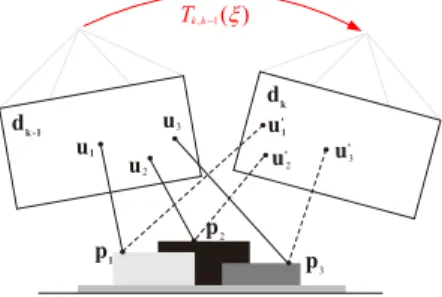
For two consecutive depth imagesdk−1 and dk shown in Fig. 1, an image pointu1 =(u1, v1)T at depthdk−1is trans- formed to the current depth planedkby the warping function W(·) and its pixel coordinateu1is predicted.
Firstly, we reconstruct the 3D pointp1=(x, y,z)T cor- responding to the pixelu1 =(u1, v1)T by using the inverse projection function:
p1=πππ−1(u1,dk−1(u1))=dk−1(u1) u1−cx
fx
,v1−cy
fy ,1 T
(1) where fx, fyare the focal lengths onxaxis andyaxis, and (cx,cy)Tis the camera centra coordinate.
Then, p1 is transformed to p1 = Rk,k−1 ·p1 +tk,k−1
indkcoordinate by using rigid-body transformation matrix Tk,k−1 =
Rk,k−1 tk,k−1
01×3 1
, whereRk,k−1 is a 3×3 rotation matrix andtk,k−1 =(tx,ty,tz)T is a 3×1 vector represents a translation from framedk−1to framedk.
Lastly,p1is projected to depth mapdk by the projec- tion functionπππ(·) :R3→R2, and the warping function is:
u1=W(Tk,k−1,u1,dk−1(u1))
=πππ(Rk,k−1·πππ−1(u1,dk−1(u1))+tk,k−1) (2) whereπππ(p)=(fxx
z +cx,fyy
z +cy)T andp=(x, y,z)T. 2.2 Constructing Geometric Cost Function
For a pixeluiat depth imagedk−1, the residual error as the geometric difference betweendk−1anddkis:
r(ui)=dk(W(Tk,k−1,ui,dk−1(ui)))
− Rk,k−1·πππ−1(ui,dk−1(ui))+tk,k−13 (3) where·represents the Z-component of a 3D point.
The distribution of the residual error can be described by a conditional probabilisticp(ri|ξ), whereξ=(ω,t)Tis the corresponding twist coordinates ofTk,k−1,ω is the angular velocity andtis the linear velocity. The twist coordinateξ
Fig. 1 Estimation for the relative pose through minimizing the geometric difference between image pixels corresponding to the same 3D points.
is mapped toSE(3) by exponential map[12]:
Tk,k−1(ξ)=exp( ˆξ) (4)
where ˆξ =
[ω]× tT
0 0
, and [ω]× is the skew symmetric matrix ofωT.
Fornpixelsuiwithi=1,2, . . . ,n, the likelihood of the whole residual becomes p(r|ξ) =
i
p(ri|ξ). Using Bayes’
rules, the posterior likelihood of a camera motionξis:
p(ξ|r)= p(r|ξ)p(ξ)
p(r) (5)
The prior p(ξ) models the potential knowledge of the states before we do the measurements. If we know noth- ing, p(ξ) is a uniform distribution with constant value. By maximizing the posterior probability,ξcan be estimated:
ξMAP=arg max
ξ p(ξ|r)=arg max
ξ
i
p(ri|ξ)p(ξ)
=arg min
ξ −
i
logp(ri|ξ)−logp(ξ)
=arg min
ξ −
i
logp(ri|ξ) (6)
The minimum is obtained by setting the derivative of the logarithmic likelihood function to zero:
−
i
∂logp(ri|ξ)
∂ξ =−
i
∂logp(ri|ξ)
∂ri
∂ri
∂ξ =0 (7)
By defining w(ri) = ∂logp(ri|ξ)/∂ri · 1/ri, we obtain
i
∂ri/∂ξ·w(ri)·ri = 0, and the optimization problem in (6) is equivalent to the weighted least squares problem:
ξMAP=arg min
ξ −1
2
i
w(ri)·r2i (8)
As the depth noisendof all pixels is independent and follows Gaussian distribution[13], i.e.nd ∈ N(0, σ2d), and p(ri) ∝ exp(−r2i/σ2d), thenw(ri) is a constant value, and we get the geometric cost function:
ξMAP=arg min
ξ
ui
r(ξ,ui)2 (9)
2.3 Analytic Jacobian Solution for Iterative Optimization To minimize the geometric cost function (9), the Gauss- Newton algorithm can be used, whose main idea is to ap- proximate the error function by its first order Taylor expan- sion that determined by Jacobian matrix around the initial guess of variableTk,k−1(ξ). However, the Jacobian matrix in g2o library[14]is computed numerically by a stable small constant, the convergence of iterative optimization is slow.
Therefore, it is important to derive the analytic Jacobian ma- trix for faster convergence:
∂r(ξ,ui)
∂ξ =
gy −gx 0 0 0 1
+
⎛⎜⎜⎜⎜⎜
⎜⎜⎜⎜⎝
∂dk(ui)
∂ui · fx
∂dk(ui)
∂vi · fy
⎞⎟⎟⎟⎟⎟
⎟⎟⎟⎟⎠
T⎛
⎜⎜⎜⎜⎜
⎜⎜⎝ −ggxg2y
z 1+gg2x2
z −ggyz g1z 0 −ggx2
z
−1−gg2y2 z
gxgy
g2z gx
gz 0 g1
z −ggy2 z
⎞⎟⎟⎟⎟⎟
⎟⎟⎠
whereg=(gx, gy, gz)T =Rk,k−1·πππ−1(ui,dk−1(ui))+tk,k−1and ui=(ui, vi)T =πππ(g).
2.4 Improvement for ORB-SLAM
ORB-SLAM system uses ORB features for tracking, map- ping and place recognition. We use our motion estimation method to replace the tracking thread in ORB-SLAM for improving its performance. The flow chart of our tracking method for consecutive frames is shown in Fig. 2.
Runtime Performance:Feature extraction and match- ing are the necessary steps before solving the camera poses in ORB-SLAM. However, the point correspondences and the relative camera motion can be obtained simultaneously by minimizing the geometry cost function in our method, we need not to extract the ORB features for each frame, unless it is determined to be a keyframe.
Accuracy Performance: Since the gradients near edges are larger than those in smooth regions, which result in larger geometric error near the objects’ edges affected by depth noise. We exclude the feature points near the geo- metric boundary and use the optimized point set to estimate camera poses:
ξMAP=arg min
ξ
i∈R˜k
r(ξ,ui)2 (10)
where ˜Rk = {u|u ∈ Rk−1 ∧ u Bk−1 ∧ πππ(Rk,k−1 · πππ−1(u,dk−1(u))+tk,k−1) ∈ Ωk}, Rk−1 is the set of feature points in frameFk−1,Ωk is the image domain of depthdk, andBk−1is the set of keypoints near objects’ boundary.
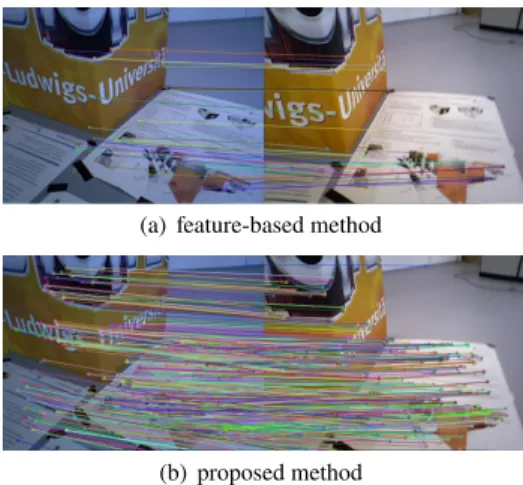
Robustness to Illumination Changes: The matching points and estimated poses in our method are computed di- rectly by using geometric values in the depth images rather than color images, so it is robust to illumination changes.
Figure 3 shows the comparison of matching point pairs ob- tained by feature matching method and our method on il- lumination change images, there are 48 and 788 point cor- respondences, respectively. The absolute translational er- ror (ATE) of relative pose for these two images obtained
Fig. 2 Overview of our tracking method.
by feature-based method and our method is 0.0333(m) and 0.0201(m), respectively. The lower the ATE value is, the higher the accuracy of the method is. Therefore, our method is more robust and with higher accuracy than the feature- based method on illumination change images.
3. Experiments and Evaluation
The TUM RGB-D dataset[15], which contains indoor se- quences from RGB-D sensors grouping with several cate- gories, is applied to evaluate SLAM/odometry methods and the ORB-SLAM system is taken as comparision. We have run both our approach and ORB-SLAM in an Intel Core i7 desktop computer with 16GB RAM, ubuntu 16.04 platform.
For each dataset, we run 5 times and the average results of the accuracy and runtime are computed.
3.1 Accuracy
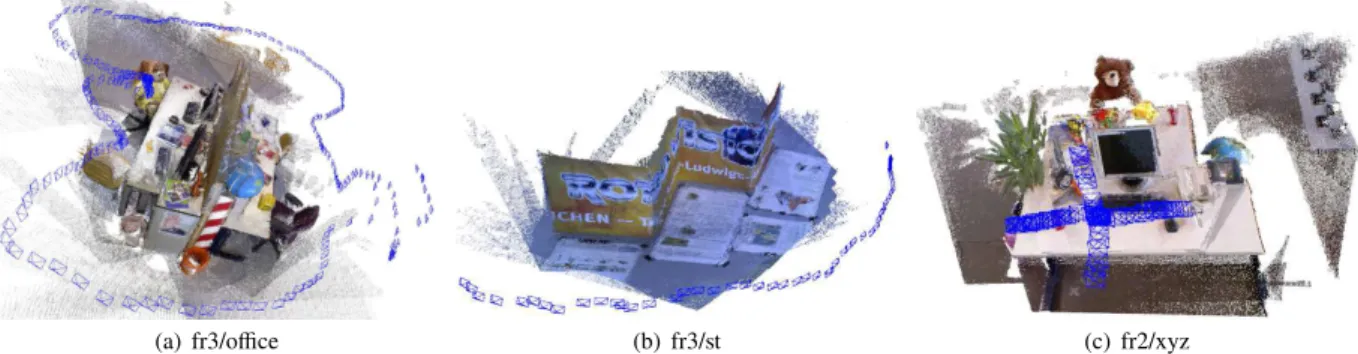
Table 1 shows the accuracy of our visual odometry method with/without excluding points near objects’ boarder and ORB-SLAM, the root mean square error (RMSE) of the absolute translational error for keyframes’ poses is used as the performance metrics. The result shows that proposed method with excluding boarder’s points performs better than no boarder suppression, and it works with almost the same precision compared with ORB-SLAM. Figure 4 shows the point clouds obtained by back-projecting the sensor depth maps from the computed keyframe poses (represented as blue box) in three sequences: fr3/office, fr3/st and fr2/xyz.
These pointcloud reconstructions show the accuracy of esti- mation poses that obtained by our method intuitively.
Fig. 3 Point pairs’ matching result on illumination change images.
Table 1 Comparison of translation RMSE (m) on TUM RGB-D dataset.
Dataset Our method No boarder suppression ORB-SLAM
fr2/xyz 0.00452 0.006814 0.00384
fr2/rpz 0.00324 0.010492 0.00528
fr3/office 0.0128 0.034242 0.0132
fr3/st 0.0115 0.027164 0.0148
Fig. 4 Dense pointcloud reconstructions from estimated keyframe poses and RGB-D information.
Table 2 Comparison of convergence performance.
Evaluation Analytic method Numerical Method
ATE (m) 0.0043 0.0047
runtime (ms) 11.70 45.08
Table 3 Runtime evaluation for pose evalution time (ms).
Dataset Our method Numerical method ORB-SLAM
fr2/xyz 20.7 69.5 31.2
fr2/rpz 19.3 64.2 27.5
fr3/office 25.8 74.2 40.4
fr3/st 18.3 67.9 29.3
3.2 Runtime Evaluation
To depict the effectiveness of our proposed analytic Jacobian, experiments have been performed on two consec- utive frames with 1008 point correspondences to estimate relative pose. We have computed the runtime of iterative process and the ATE of relative pose, as shown in Table 2.
It demonstrates that proposed analytic jacobian is 4 times faster than the numerical jacobian used in g2o.
Table 3 shows the average runtime required for frames by using our visual odometry method with analytic/
numerical jacobian and ORB-SLAM, this runtime consists of 2 processes: (1) extracts feature points and pose esti- mation for consecutive frames in front-end, (2) local map optimization and loop detection in back-end. The process- ing speed of the proposed method is more than 50 frames per second. While the corresponding processing speed for ORB-SLAM is 25 frames per second. The main reason for the significant speed-up is that we use our proposed analytic jacobian to estimate motion and our method does not need feature matching procedure. In addition, our method min- imizes the geometric cost function by using sparse reliable ORB keypoints, which are extracted when a new keyframe inserted instead of being extracted in each new frame.
4. Conclusion
In this paper, we proposed a sparse geometric-based motion estimation method without feature-matching procedure, and we derived the analytic jacobian to minimize our geometric
cost function. Our method could estimate motion directly from geometric values without intensity-consistent assump- tion, so it is robust to illumination changes. The computa- tional efficiency of ORB-SLAM is significantly improved by using our method to track sparse points in front-end, and our method keeps the similar accuracy by using opti- mized point set that excludes the boarders’ points to esti- mate poses.
References
[1] G. Klein and D. Murray, “Parallel tracking and mapping for small AR workspaces,” International Symposium on Mixed and Aug- mented Reality, pp.1–10, 2007.
[2] C. Forster, M. Pizzoli, and D. Scaramuzza, “SVO: Fast semi- direct monocular visual odometry,” IEEE International Conference on Robotics and Automation, pp.15–22, 2014.
[3] S. Leutenegger, S. Lynen, M. Bosse, R. Siegwart, and P. Furgale,
“Keyframe-based visual-inertial odometry using nonlinear opti- mization,” International Journal of Robotics Research, vol.34, no.3, pp.314–334, 2015.
[4] T. Pire, T. Fischer, J. Civera, P. De Crist´oforis, and J.J.
Berlles,“Stereo parallel tracking and mapping for robot localiza- tion,” IEEE/RSJ International Conference on Intelligent Robots and Systems, pp.1373–1378, 2014.
[5] P. Henry, M. Krainin, E. Herbst, X. Ren, and D. Fox,“RGB-D map- ping: Using depth cameras for dense 3D modeling of indoor en- vironments,” Experimental Robotics, Springer Tracts in Advanced Robotics, vol.79, pp.477–491, Springer Berlin Heidelberg, Berlin, Heidelberg, 2014.
[6] F. Endres, J. Hess, J. Sturm, D. Cremers, and W. Burgard, “3-D mapping with an RGB-D camera,” IEEE Trans. Robotics, vol.30, no.1, pp.177–187, 2014.
[7] R. Mur-Artal and J.D. Tard´os, “ORB-SLAM2: An open-source SLAM system for monocular, stereo, and RGB-D cameras,” IEEE Trans. Robotics, vol.33, no.5, pp.1255–1262, 2017.
[8] R.A. Newcombe, S. Izadi, O. Hilliges, D. Molyneaux, D. Kim, A.J. Davison, P. Kohi, J. Shotton, S. Hodges, and A. Fitzgibbon,
“KinectFusion: Real-time dense surface mapping and tracking,”
IEEE International Symposium on Mixed and Augmented Reality, pp.127–136, 2011.
[9] T. Whelan, M. Kaess, H. Johannsson, M. Fallon, J.J. Leonardet, and J. McDonald, “Real-time large-scale dense RGB-D SLAM with vol- umetric fusion,” International Journal of Robotics Research, vol.34, no.4-5, pp.598–626, 2015.
[10] T. Whelan, S. Leutenegger, R.F. Salas-Moreno, B. Glocker, and A.J. Davison, “ElasticFusion: Dense SLAM without a pose graph,”
Robotics: Science and Systems, 2015.
[11] C. Kerl, J. Sturm, and D. Cremers, “Dense visual SLAM for RGB-D cameras,” IEEE/RSJ International Conference on Intelligent Robots
and Systems, pp.2100–2106, 2013.
[12] D.E. Holmgren, “An invitation to 3-d vision: From images to geometric models,” Photogrammetric Record, vol.19, no.108, pp.415–416, 2004.
[13] C.V. Nguyen, S. Izadi, and D. Lovell, “Modeling Kinect sensor noise for improved 3D reconstruction and tracking,” International Confer- ence on 3D Imaging, Modeling, Processing, Visualization & Trans- mission, pp.524–530, 2012.
[14] R. K¨ummerle, G. Grisetti, H. Strasdat, K. Konolige, and W.
Burgard, “g2o: A general framework for graph optimization,”
IEEE International Conference on Robotics and Automation, vol.7, pp.3607–3613, 2011.
[15] J. Sturm, N. Engelhard, F. Endres, W. Burgard, and D. Cremers, “A benchmark for the evaluation of RGB-D SLAM systems,” Intelligent Robots and Systems, pp.573–580, 2012.