LETTER
Analysis of Rescue Request and Damage Report Tweets Posted during 2019 Typhoon Hagibis
Keisuke UTSU†a)andOsamu UCHIDA††b),Members
SUMMARY The 2019 Typhoon Hagibis (No. 19) caused widespread destruction in eastern Japan. During the disaster, many tweets includ- ing rescue request hashtags such as #救助(meaning #Rescue) and #救 助要請 (meaning #Rescue_request) were posted on Twitter. An offi- cial disaster information account of the Nagano Prefectural Government asked the public to provide information in the form of damage reports and rescue requests using the hashtag #台風 19号長野県被害 (#Ty- phoon_No.19_Nagano_Prefecture_damage). As a result, many tweets were posted using this hashtag. Moreover, the account contacted the posters of tweets requesting rescue and delivered the information to the Fire Depart- ment. In this study, we analyze the circumstances of the above tweets.
key words: disaster, social media, Twitter
1. Introduction
Social media plays an important role in disaster response and has been studied for this purpose by many researchers.
In particular, Twitter, one of the most popular social me- dia platforms, has been used to share damage reports and rescue requests in recent disasters [1]–[4]. In Japan, the police (110) and the fire department (119) officially accept the rescue requests only by telephone, and they do not ac- cept the requests by Twitter posts. To request a rescue on Twitter in Japan, the @TwitterLifeline account, which is op- erated by Twitter Japan, suggests the use of the hashtag #救
助
(meaning #Rescue) and recommends that users provide accurate and detailed information in the tweet, such as re- quirements, pictures, address, and location[5]. In recent major flood events such as the 2017 Northern Kyushu Heavy Rain Disaster and the 2018 Japan Flood (Western Japan Heavy Rain), the hashtags employed included #Rescue or#救助要請(meaning #Rescue_request). The existing stud- ies analyzed the tweets with the hashtags posted during the flood events[6]–[9]. Sato and Imamura indicated that few of the tweets with these hashtags included detailed information on the location of the victims, the current status of damage and injuries, or the number of injured victims, all of which are needed to carry out a successful rescue. In fact, only a few rescues were made based on the tweets[7]. Nishikawa et al. indicated that many tweets with the hashtags did not
Manuscript received April 13, 2020.
Manuscript publicized May 20, 2020.
†The author is with the School of Information and Telecommu- nication Engineering, Tokai University, Tokyo, 108-8619 Japan.
††The author is with the School of Information Science and Technology, Tokai University, Hiratsuka-shi, 259-1292 Japan.
a) E-mail: [email protected] b) E-mail: [email protected]
DOI: 10.1587/transfun.2020EAL2040
include any information directly related to rescue requests, thereby making it difficult to extract those tweets that were clearly requesting rescues [8]. Song and Fujishiro carried out an investigation by interviewing the posters of tweets that clearly requested a rescue during the 2018 Japan Floods and indicated that the majority of the tweets included such infor- mation as accurate addresses or landmarks. Moreover, they extracted rescue request tweets using machine learning tech- niques[9],[10]. On the other hand, some local governments have called for the posting of disaster-related information using a hashtag that combines
災害
(meaning “disaster”) and their municipality name (e.g., #***_city_disaster)[11].Moreover, some of these local governments have conducted drills on how to submit disaster-related information. In the 2019 Typhoon Hagibis (No. 19), a record-breaking amount of heavy rain poured down over a wide area of eastern Japan.
During the disaster, tweets with the hashtags #Rescue or
#Rescue_request were posted. Furthermore, an official dis- aster information account of the Nagano Prefectural Govern- ment, the @BosaiNaganoPref account, called for damage reports and rescue requests to be posted using the hashtag
#Typhoon_No.19_Nagano_Prefecture_Damage [12]. As a result, many tweets were posted using this hashtag. Next, the account contacted some of those who had posted tweets using the reply function on Twitter and delivered the requests to the Fire Department. To improve rescue efforts based on tweets and the application systems that support disaster re- sponses, the circumstances of the tweets with the hashtags related to the rescue requests and damage reports posted in recent disasters need to be investigated. In this paper, we analyze such tweets posted during the Typhoon Hagibis.
2. Analysis of Tweets
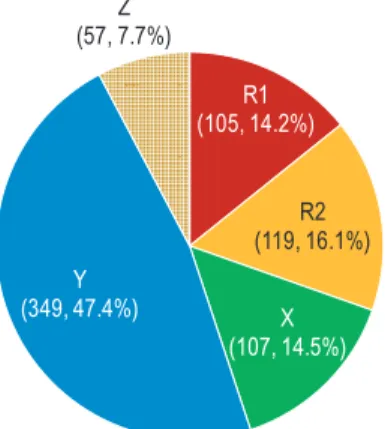
2.1 Tweets Including #Rescue and/or #Rescue_request We collected 737 tweets including #Rescue and/or #Res- cue_request from 0:00 October 10 to 23:59 October 14 us- ing Twitter Search API. Then, we manually classified the collected tweets into one of the categories (R1)–(Z) listed below. Figure 1 shows the distribution of the tweets in the categories.
• (R1) Tweets requesting the rescue of a poster, an in- dividual, or a group. Tweets in this category include a detailed address (such as the house number, street number, and name of the location) or a description of a Copyright©2020 The Institute of Electronics, Information and Communication Engineers
Table 1 Most retweeted five tweets with the hashtags #Rescue and/or #Rescue_request in the category R1 (descending order by the number of retweets).
Tweet Time/Date # of retweets†
T11 台風の影響で 一本しかない道が流されしまい、完全孤立状態です。避難所にも沢山の方がおられます。よ ろしくお願いいたします。#佐野市#自衛隊#水木町#秋山川#救助要請#台風19
English: Typhoon has washed out the only access road. We are completely isolated. There are many peo- ple at the evacuation center. Please help us. #Sano_city #Self-Defense_Forces #Mizuki_cho #Akiyama_river
#Rescue_request#Typhoon_No.19
Note:The tweet was still available as of Mar. 1, 2020. The tweet includes a video showing a river overflowing its bank and a collapsed road.
8:30, Oct. 13
4,287
T12 家の一階が浸水してしまい、孤立しています。今は家族ともに2階に避難しています。 救助お願いします。
381-0001赤沼*** #台風19号長野県被害#救助要請
English: The first floor of our house has been flooded and we are isolated. I have evacuated to the second floor with my family. Please help us. Zip code:381-0001, Address: *** Akanuma. #Ty- phoon_No.19_Nagano_Prefecture_damage#Rescue_request
Note:The tweet has already been deleted. The tweet probably included a picture of a flooded town.
8:24, Oct. 13
2,680
T13 救援お願いします 場所:栃木県佐野市葛生町水木町 川の増水により、完全に道路も決壊。完全に孤立して います。過疎地域のため、お年寄り多数で公民館に避難しています。#消防#台風19#救助要請#栃木県佐 野市水木#秋山川#至急
English:Please rescue us.Address: Mizuki-cho, Kuzuu-machi, Sano City, Tochigi Prefecture. Road access has been lost due to the river overflowing its banks. We are completely isolated. Many elderly people live in this area and they have evacuated to a public hall. #firefighting #Typhoon_No.19#Rescue_request#Mizuki_Sano- city_Tochigi-prefecture #Akiyama_river #urgent
Note:The tweet has already been deleted.
21:39, Oct. 12
2,604
T14 長野市穂保の福祉施設からです!利用者様、職員全員2階へ避難してます!一刻も早くの救助お願いしま す!#千曲川#氾濫#救助要請
English:This is a request from a welfare facility in Hoyasu, Nagano City. All users and employees have evacuated to the second floor. Please rescue them as quickly as possible. #Chikuma_river #Flood#Rescue_request Note:The tweet has already been deleted. The tweet probably included a video showing a flooded town.
7:39, Oct. 13
2,158
T15 茨城県水戸市岩根町***那珂川氾濫で家1階がほぼ浸かるほど浸水しています。屋根上にいます。 救助求
#台風19号#救助#台風情報#台風
English:Address: Iwane-cho, Mito City, Ibaraki Prefecture. First floor of my house has nearly been completely flooded due to the Naka River overflowing its banks. I am on the rooftop. Please rescue. #Typhoon_No.19
#Rescue#Typhoon_information #Typhoon
Note:The tweet has already been deleted. The tweet probably included a picture of a flooded town.
9:38, Oct. 13
1,602
Fig. 1 Distribution of tweet content types for 737 tweets with #Rescue and/or #Rescue_request.
landmark at the location where the rescue is requested.
These tweets usually use the hashtag #Rescue, as in- structed by the @TwitterLifeline account[5].
Table 1 shows the most retweeted five tweets in this cat- egory. Of the tweets in this category, we could simply specify the areas or names of the streets in which the rescue was needed in 42 tweets (40.0%), and the cor- responding street numbers or landmarks in 63 tweets (60.0%).
• (R2) Tweets requesting a rescue, but which do not meet the conditions to be included in category R1.
• (X) Tweets about posting and/or sharing rescue requests or the use of hashtags on Twitter or another social net- working service (SNS).
This category also includes tweets criticizing the post- ing of the rescue requests or damage reports. Although the tweets were not directly related to rescue requests, some of them may have encouraged others to post res- cue requests using the hashtags on Twitter.
• (Y) Tweets not classified as an (R1)–(X) tweet, but talking about the disaster.
• (Z) Tweets not classified as an (R1)–(Y) tweet.
Categories (Y) and (Z) represented over a half of all tweets posted. These tweets were not directly related to rescue requests.
2.2 Tweets Including
#Typhoon_No.19_Nagano_Prefecture_damage The @BosaiNaganoPref account called for posting the
†The number of retweets shown in Tables 1, 2 and 3 represent the number of those in the collected tweets, thus they are not same as the real number on Twitter.
Table 2 Examples of tweets calling for posts of damage reports and rescue requests by the @Bo- saiNaganoPref.
Tweet Time/Date # of Retweets†
T21 【情報提供依頼】今回の台風第19号により生じた被害について、情報提供をお願いします。投稿の際は画 像と位置情報、ハッシュタグ#台風19号長野県被害を付けてください。投稿をするにあたり、身の安全の確 保を最優先してください。投稿する前に、命を守る行動をお願いします。#台風19 #長野県
English: Please provide information on the damage caused by Typhoon No.19. Include pictures, your position information and hashtag#Typhoon_No.19_Nagano_Prefecture_damageon the post. When you post, give the highest priority to ensuring your safety. Act to protect your lives. #Typhoon_No.19 #Nagano_Prefecture
17:11, Oct. 12
308
T22 #台風19号長野県被害#千曲川陸上自衛隊の応援部隊が派遣される予定です。救助体制が強化されますので、
それまでもう少し救助を待っていてください。救助要請があれば、#台風19号長野県被害 で位置情報をツ イートしてください。
English: #Typhoon_No.19_Nagano_Prefecture_damage#Chikuma_river An additional team from the Japan Ground Self-Defense Force will be dispatched. The rescue system will be strengthened. Wait for a short time until the rescue. If you wish to be rescued, please post a tweet with your position information by using #Ty- phoon_No.19_Nagano_Prefecture_damage
7:33, Oct. 13
1,983
T23 #台風19号長野県被害#千曲川 おはようございます。皆様の情報収集へのご協力に感謝します。救助要請の ツイートには住所等個人情報が多く記載されています。救助要請いただいた方の中で、すでに救助された方 は関連するツイートを削除してください。よろしくお願いいたします。
English: #Typhoon_No.19_Nagano_Prefecture_damage#Chikuma_river Good morning. Thank you for your cooperation in providing the information. Rescue request tweets contain personal information such as your address.
If you posted a rescue request and you have already been rescued, please delete the tweets related to your request.
6:24, Oct. 14
1,978
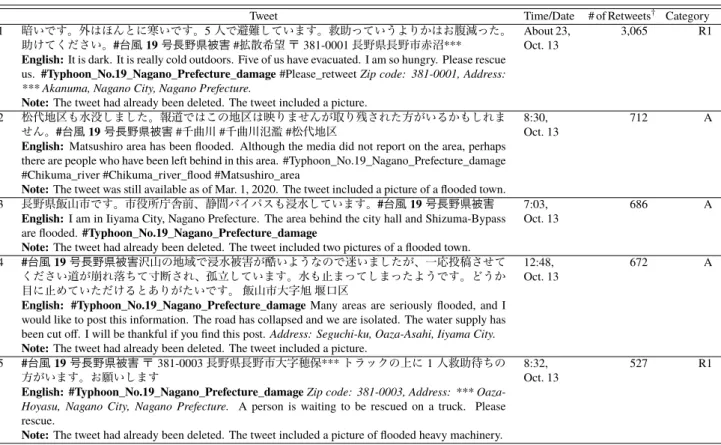
Table 3 Most retweeted tweets including #Typhoon_No.19_Nagano_Prefecture which were catego- rized in A or R1 (descending order by the number of retweets).
Tweet Time/Date # of Retweets† Category
T31 暗いです。外はほんとに寒いです。5人で避難しています。救助っていうよりかはお腹減った。
助けてください。#台風19号長野県被害#拡散希望 〒381-0001長野県長野市赤沼***
English:It is dark. It is really cold outdoors. Five of us have evacuated. I am so hungry. Please rescue us.#Typhoon_No.19_Nagano_Prefecture_damage#Please_retweetZip code: 381-0001, Address:
*** Akanuma, Nagano City, Nagano Prefecture.
Note:The tweet had already been deleted. The tweet included a picture.
About 23, Oct. 13
3,065 R1
T32 松代地区も水没しました。報道ではこの地区は映りませんが取り残された方がいるかもしれま せん。#台風19号長野県被害#千曲川#千曲川氾濫#松代地区
English:Matsushiro area has been flooded. Although the media did not report on the area, perhaps there are people who have been left behind in this area. #Typhoon_No.19_Nagano_Prefecture_damage
#Chikuma_river #Chikuma_river_flood #Matsushiro_area
Note:The tweet was still available as of Mar. 1, 2020. The tweet included a picture of a flooded town.
8:30, Oct. 13
712 A
T33 長野県飯山市です。市役所庁舎前、静間バイパスも浸水しています。#台風19号長野県被害 English:I am in Iiyama City, Nagano Prefecture. The area behind the city hall and Shizuma-Bypass are flooded.#Typhoon_No.19_Nagano_Prefecture_damage
Note:The tweet had already been deleted. The tweet included two pictures of a flooded town.
7:03, Oct. 13
686 A
T34 #台風19号長野県被害沢山の地域で浸水被害が酷いようなので迷いましたが、一応投稿させて ください道が崩れ落ちて寸断され、孤立しています。水も止まってしまったようです。どうか 目に止めていただけるとありがたいです。 飯山市大字旭 堰口区
English: #Typhoon_No.19_Nagano_Prefecture_damageMany areas are seriously flooded, and I would like to post this information. The road has collapsed and we are isolated. The water supply has been cut off. I will be thankful if you find this post.Address: Seguchi-ku, Oaza-Asahi, Iiyama City.
Note:The tweet had already been deleted. The tweet included a picture.
12:48, Oct. 13
672 A
T35 #台風19号長野県被害〒381-0003長野県長野市大字穂保***トラックの上に1人救助待ちの 方がいます。お願いします
English: #Typhoon_No.19_Nagano_Prefecture_damageZip code: 381-0003, Address: *** Oaza- Hoyasu, Nagano City, Nagano Prefecture. A person is waiting to be rescued on a truck. Please rescue.
Note:The tweet had already been deleted. The tweet included a picture of flooded heavy machinery.
8:32, Oct. 13
527 R1
rescue requests and damage reports using hashtag #Ty- phoon_No.19_Nagano_Prefecture_Damage. Table 2 shows examples of tweets calling for posts. These tweets were available as of March 1, 2020. Initially, the account called for damage reports as shown in T21 and T22. Next, the ac- count called for posting of rescue requests, also as shown in T23. We collected 1,921 tweets including the hashtag from 17:00 October 12 to 11:59 October 15 using Twitter Search
API. We focused on 1,760 tweets excluding 59 tweets posted by the @BosaiNaganoPref account and 102 tweets posted by accounts originating from news organizations. Then, we manually classified the tweets into one of the categories (A)–
(Z) listed below. Figure 2 shows the distribution of the tweets in the various categories. Table 3 shows the most retweeted five tweets which were classified into categories (A) or (R1).
Table 4 Example of a rescue request tweet and a response from @BosaiNaganoProf to the request (1).
Poster Tweet Time/Date
T41 A (Personal ac- count), @***
#台風19号長野県被害長野県長野市大字穂保573-1長野市穂保高台公園40人以上の人が避難してま す。お願いします
English: #Typhoon_No.19_Nagano_Prefecture_damage Address: 573-1 Oaza-Hoyasu, Nagano City, Nagano Prefecture.Forty or more people evacuated to Hoyasu Takadai Park. Please rescue them.
Note:The tweet was still available as of Mar. 1, 2020.
8:44, Oct. 13
T42 @BosaiNaganoPref (Reply to A)ご連絡ありがとうございます。要請を確認いたしましたので、必ず救助に向かいます。落
ち着いて身の安全を確保してお待ちください。
English:Thank you for contacting us. We have checked the request. We are sure to rescue you. Please stay calm and secure your safety while waiting for rescue.
8:55 Oct. 13
Table 5 Example of a rescue request tweet and a response from @BosaiNaganoProf to the request (2).
Poster Tweet Time/Date
T51 B (Personal ac- count), @***
私の知人ですが救助をお願いします。 長野市赤沼*** ***(人名)さん自宅の1階が水没し、2階で 救助を待っております。 食料が底をつき、停電している状況です。水道は使えます。 ご近所にも同 じ状況の方がいるようです。よろしくお願いします。#台風19号長野県被害
English: Please rescue my acquaintance. Address: ***, Akanuma, Nagano City, Name: ***He is wait- ing for a rescue on the 2nd floor of his house. The 1st floor of his house has been flooded. No food.
Power has been cut. Water is available. His neighbors are also waiting to be rescued. Please help. #Ty- phoon_No.19_Nagano_Prefecture_damage
Note:The tweet had already been deleted.
13:15, Oct. 13
T52 @BosaiNaganoPref (Reply to B)ご連絡ありがとうございます。救助要請行いました。
English:Thank you for contacting us. We have sent a rescue request.
15:48, Oct. 13
Fig. 2 Distribution of tweet content types for 1,760 tweets with #Ty- phoon_No.19_Nagano_Prefecture_Damage.
• (A) Tweets of damage report
Many tweets included images or videos regarding dam- age caused by the disaster. The examples include flooded or damaged roads along with the residents, swollen rivers, toppled power poles, and damaged rail- way tracks. There are also images of maps indicating flooded areas. Excluding tweets related to damage re- ports, we found tweets providing information on pass- able undamaged roads and civil engineering works on restoring collapsed riverbanks. These damage report tweets were in keeping with the purpose of the hashtag.
In other words, the hashtag contributed to the collection of damage reports. However, we did not find any tweets where the @BosaiNaganoPref account communicated with the posters.
• (R1) Tweets requesting a rescue (same as that in Sect. 2.1)
The tweets in this category requested a rescue while providing a detailed address or landmark indicating the victim’s location. The @BosaiNaganoPref account contacted the posters using Twitter and delivered the rescue requests to the Fire Department. Tables 4 and 5 show examples of these posts. The account asked the posters to remove the tweets if they had already been rescued as shown in T23 of Table 2. Thus, many tweets in this category had already been removed from Twitter, and we could not find them.
• (R2) Tweets requesting a rescue, but which do not meet the conditions for inclusion in category R1 (same as that in Sect. 2.1)
There were few tweets of this kind.
• (W) Tweets providing information in support of victims We found tweets requesting relief supplies, and oth- ers about evacuation centers, support information for victims, school closures, and acceptance of volunteers.
Although these tweets do not meet the purpose of the hashtag, the hashtag was used to share disaster-related information. As a result, the hashtag served as a means for sharing a diverse range of information.
• (X) Tweets about posting and/or sharing rescue request posts or the use of hashtags on Twitter or another SNS.
Although the tweets do not meet the purpose of the hashtag, they may have encouraged victims to post res- cue requests and damage reports using the hashtag.
• (Y) Tweets not classified as an (R1)–(X) tweet, but talking about the disaster
The tweets include copies of online news and images
captured from a TV screen. The posters of the tweets may not have understood the purpose of the hashtag or read the instructions posted by the @BosaiNaganoPref account and they used the hashtag in imitation of other tweets that included the hashtag.
• (Z) Tweets not classified as an (A)–(Y) tweet
These tweets include impressions of the disaster, mes- sages in support of victims, and criticisms of the gov- ernment. The posters of the tweets may not have un- derstood the purpose the hashtag or read the instruc- tions posted by the @BosaiNaganoPref account. Since the tweets in the categories (Y) and (Z) were not di- rectly related to rescue requests or damage reports, they may have possibly interfered with the collection of the tweets.
As a result, due to the call for tweets issued by the @BosaiNaganoPref, many rescue requests and dam- age reports were posted using this hashtag. In other words, the local government designated the hashtag and requested the public to provide them with information.
Consequently, many tweets were shared using the hash- tag #Tyhoon_No.19_Nagano_Prefecture_damage. A fur- ther discussion is needed regarding which hashtags are best suited to sharing the information; municipality name-based hashtags, which have conventionally been recommended (#***_city_disaster), or disaster name-based hashtags (such as #Tyhoon_No.19_Nagano_Prefecture_damage).
3. Conclusions
During the 2019 Typhoon Hagibis, many tweets were posted that included the hashtags #Rescue, #Rescue_request, and/or
#Typhoon_No.19_Nagano_Prefecture_damage. In this pa- per, we analyzed the tweets to investigate the circumstances under which these tweets were posted. The tweets with these hashtags contributed to the collection of information.
Therefore, it is important for local governments to designate the hashtags and conduct drills and educational programs on how to post information on Twitter. However, since the tweets with the hashtags contained information not directly related to rescue requests or damage reports, a method to effectively eliminate such tweets is required to facilitate an efficient disaster response. In addition, users need to provide appropriate information. To facilitate information sharing, we have proposed two web applications: Disaster Informa- tion Tweeting/Mapping System (DITS/DIMS)[13],[14]and T-@npi Safety Information Sharing System [15] We will seek to disseminate these applications in the future.
Acknowledgments
This study has been supported by Grant-in-Aid for Scien-
tific Research (KAKENHI) 17K12989, Japan Society for the Promotion of Science (JSPS).
References
[1] M. Imran, C. Castillo, F. Diaz, and S. Vieweg, “Processing social media messages in mass emergency: A survey,” ACM Computing Surveys 2015, vol.47, no.4, Article 67, June 2015. DOI:10.1145/
2771588
[2] T. Simon, A. Goldberg, and B. Adiniab, “Socializing in emergen- cies — A review of the use of social media in emergency situa- tions,” Int. J. Information Management, vol.35, no.5, pp.609–619, Oct. 2015. DOI:10.1016/j.ijinfomgt.2015.07.001
[3] L. Austin and Y. Jin, Social Media and Crisis Communication, Rout- ledge, 2017.
[4] O. Uchida and K. Utsu, “Utilization of social media at the time of disaster,” IEICE Fundamentals Review, vol.13, no.4, pp.301–311, April 2020 (in Japanese). DOI:10.1587/essfr.13.4_301
[5] @TwitterLifeline, Twitter, https://twitter.com/TwitterLifeline/status/
1016519147738419201, accessed March 1. 2020.
[6] S. Sato, “Analysis of tweets hashtagged “#Rescue” in the 2017 North Kyushu Heavy Rain disaster in Japan,” Proc. 2018 5th Int. Conf. on Information and Commun. Technologies for Disaster Management (ICT-DM), Dec. 2018. DOI:10.1109/ICT-DM.2018.8636370 [7] S. Sato and F. Imamura, “An analysis of tweet data tagged with
“#Rescue” in the 2018 West Japan Heavy Rain disaster: Comparative analysis with the case of 2017 North Kyushu Heavy Rain disaster,”
J. JSNDS, vol.37, no.4, pp.383–396, 2019 (in Japanese).
[8] S. Nishikawa, O. Uchida, and K. Utsu, “Analysis of rescue request tweets in the 2018 Japan floods,” Proc. 2019 Int. Conf. on Information Technology and Computer Commun. (ITCC 2019), pp.29–36, Sept.
2019. DOI:10.1145/3355402.3355408
[9] C. Song and H. Fujishiro, “Finding reliable rescue request in disas- ters — Analysis of “Rescue” tweet in 2018 West Japan Heavy Rain disaster —,” IEICE Technical Report, NLC2018-36, Feb. 2019 (in Japanese).
[10] C. Song and H. Fujishiro, “Toward the automatic detection of rescue- request tweets: Analyzing the features of data verified by the press,”
Proc. 6th Int. Conf. on Information and Communication Technologies for Disaster Management (ICT-DM 2019), pp.18–20, Dec. 2019.
DOI:10.1109/ICT-DM47966.2019.9032895
[11] Twitter, Inc., https://blog.twitter.com/official/ja_jp/a/ja/2015/twitter- 11.html, accessed March 1. 2020
[12] @BosaiNaganoPref, https://twitter.com/BosaiNaganoPref/status/11 82931714227617792, accessed March 1. 2020.
[13] O. Uchida, M. Kosugi, G. Endo, T. Funayama, K. Utsu, S. Tajima, M.
Tomita, Y. Kajita, and Y. Yamamoto, “A real-time information shar- ing system to support self-, mutual-, and public-help in the aftermath of a disaster utilizing Twitter,” IEICE Trans. Fundamentals, vol.E99- A, no.8, pp.1551–1554, Aug. 2016. DOI:10.3390/fi12010014 [14] M. Kosugi, K. Utsu, S. Tajima, M. Tomita, Y. Kajita, Y. Yamamoto,
and O. Uchida, “Improvement of Twitter-based disaster-related infor- mation sharing system,” Proc. 4th Int. Conf. on Information and Com- mun. Technologies for Disaster Management (ICT-DM’17), Dec.
2017. DOI:10.1109/ICT-DM.2017.8275693
[15] K. Utsu, M. Abe, S. Nishikawa, and O. Uchida, “Twitter-based safety confirmation system for disaster situations,” Future Internet, vol.12, no.1, 14, Jan. 2020. DOI:10.3390/fi12010014