Electronic Supplementary Information for
Highly nucleophilic vitamin B
12-assisted nickel-catalysed
reductive coupling of aryl halides with non-activated alkyl
tosylates
Kimihiro Komeyama,* Ryo Ohata, Shinnosuke Kiguchi and Itaru Osaka
Department of Applied Chemistry, Graduate School of Engineering, Hiroshima University 1-4-1 Kagamiyama, Higashi-Hiroshima City, Hiroshima 739-8527, Japan
E-mail: [email protected]
Table of contents
1. General Information. ... S-2 2. Materials. ... S-2 3. General procedure for the cross coupling (example: entry 1, Table 1). ... S-2 4. Control experiment for the reaction of cyclohexyl tosylate with KI. ... S-3 5. Reaction of c-HexOTs (1a) with 4-MeOC6H4I (2a) without Ni cat. (entry 2 in Table 1). ... S-4
6. Reaction of c-HexOTs (1a) with 4-MeOC6H4I (2a) without VB12 cat. (entry 3 in Table 3). ... S-5
7. Alkylation of methylcobalamin with 2-bromonaphthalene with Ni cat. (Eq. 1). ... S-5 8. Radical-clock experiment (Eq. 2) using 5-hexenyl tosylate (1q) and 4-(EtO2C)C6H4I. ... S-7
9. Reaction of 9-decenyl tosylate (1r) with 4-iodoanisole (2a) (Eq. 3). ... S-10 10. Spectral date for products (Table 2) ... S-13 11. NMR spectra of products. ... S-17 12. References. ... S-32
Electronic Supplementary Material (ESI) for ChemComm.
1. General Information.
All reactions were performed under argon. A flash column chromatography was performed with silica gel 60 (Kanto Chemical Co., Inc., 40–50 nm). TLC monitoring was carried out on silica gel aluminum sheets (Merck, type 60 F254). Gas chromatography (GC) monitoring
was performed on a Shimadzu GC-2014. Nuclear magnetic resonance (NMR) spectra were measured on Varian-400 (1H NMR: 400 MHz; 13C NMR: 101 MHz) spectrometer or Varian-500 (1H NMR: 500 MHz; 13C NMR: 126 MHz) spectrometers, calibrated from residual deuterated chloroform at 7.26 ppm or tetramethylsilane at 0.00 ppm for 1H NMR spectra and at 77.0 ppm for
13C NMR spectra. Mass spectrum (MS) was recorded on Shimadzu GCMS-QP2010SE (EI, 70
eV). Melting points were determined using melting point system Mettler Toledo MP90 and were unrecorded. High-resolution mass spectrum (HRMS) was performed by LTQ Orbitrap XL from Thermo Fisher Scientific in the Natural Science Center for Basic Research and Development (N-BARD) of Hiroshima University.
2. Materials.
N,N-Dimethylformamide (DMF) and chlorotrimethylsilane (TMSCl) were dried over activated molecular sieves 4Å, distilled and stored with activated MS 4Å under argon. NiBr2,
vitamin B12 (cyanocobalamin from Nacalai tesque Inc., [CAS: 68-19-9]), methylcobalamin
hydrate (from Tokyo Chemical Industry Co., Ltd., [CAS: 288315-09-3]), manganese powder (99.9%, from Kanto Chemical Co., Inc.) and all ligands were purchased and used as received. NiBr2(2,2’-bpy)1 and CoCl(dmgH)2(py)2 were prepared by reported method. All alkyl tosylates
were prepared from the corresponding alcohols by the reported methods.3 Unless otherwise noted, commercially available reagents were used as received without further purification.
3. General procedure for the cross coupling (example: entry 1, Table 1).
In an Schlenk tube, Mn powder (28 mg, 0.5 mmol) was placed and heated at 400 ºC for 5–10 minutes under vacuum. After cooling, the Schlenk tube was charged with NiBr2 (5.5 mg,
0.025 mmol), 2,2’-bipyridine (3.9 mg, 0.025 mmol), KI (42 mg, 0.25 mmol) and vitamin B12 (33.9
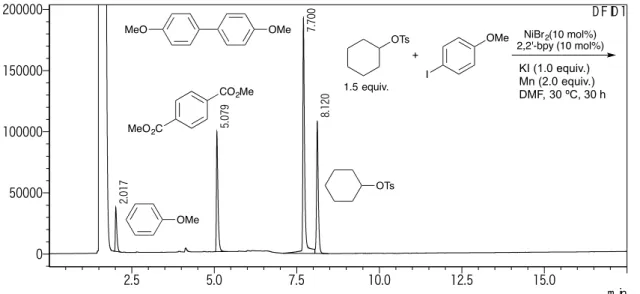
mg, 0.025 mmol). After that, DMF (1.0 mL) and TMSCl (10 µL) were successively added. The mixture was stirred for 10 minutes at ambient temperature. 4-Iodo anisole 2a (59 mg, 0.25 mmol) and cyclohexyl tosylate (95 mg, 0.38 mmol) were added at one, and the resulting mixture was stirred at 30 ºC. After 30 hours, the reaction mixture was quenched with water, diluted with ethyl acetate and added dimethyl terephthalate as an internal standard. GC yields of cross-coupling
product 3a and homo-coupling product 4 were determined from the solution (Figure S1). The aqueous phase was extracted with ethyl acetate, the combined organic phases was dried over anhydrous MgSO4. After filtration and removal of solvent, the residue was purified by a silica gel
flash chromatography to get the cross coupling product 2a (30 mg, 64% yield). The characterization of 3a was carried out based on the reported date.4
Figure S1. GC chart of the crude product in the Ni/VB12-catalysed cross-coupling of cyclohexyl
tosylate (1a) and 4-anisyl iodide (2a) at 30 ºC for 30 h (entry 1, Table 1).
4. Control experiment for the reaction of cyclohexyl tosylate with KI.
In an Schlenk tube, cyclohexyl tosylate (64 mg, 0.25 mmol), DMF (1 mL) and KI (42 mg, 0.25 mmol) were added. The mixture was stirred for 30 h at 30 ºC. After complete the reaction, the mixture was quenched with water and deluded with ethyl acetate. A gas chromatography measurement of the organic layer clearly showed no formation of cyclohexyl iodide, which must be appeared at about 2.7 minutes under the conditions.
2016/12/16 13:05:39 Page 1 / 1 D :\G C 2014\O hata\O -141.12.16..gcd
分析レポート
<クロマトグラム> <ピークレポート> サンプル名 : サンプルID : データファイル : O -141.12.16..gcd メソッドファイル : Norm al.gcm バッチファイル : バッチファイル.gcb バイアル番号 : 5 サンプルタイプ : 未知 注入量 : 1 uL分析日時 : 2016/12/16 12:25:29 分析者 : System Adm inistrator
解析日時 : 2016/12/16 12:43:03 解析者 : System Adm inistrator
m in uV 2.5 5.0 7.5 10.0 12.5 15.0 0 50000 100000 150000 200000 250000 D FID 1 2 .010 5 .072 5 .739 7 .696 8.091 D FID 1 ピーク# 1 2 3 4 5 合計 保持時間 2.010 5.072 5.739 7.696 8.091 面積 203363 324143 790303 42897 46390 1407095 高さ 66061 94543 242385 7533 13026 423548 濃度 0.000 0.000 0.000 0.000 0.000 単位 ppm マーク V 化合物名 C 16 <サンプル情報> MeO2C CO2Me OMe MeO OTs OMe OMe
S-4
Figure S1. GC chart of iodocyclohexane (up); the crude product of cyclohexyl tosylate (1a)
and KI at 30 ºC for 30 h (bottom).
5. Reaction of c-HexOTs (1a) with 4-MeOC6H4I (2a) without Ni cat. (entry 2 in Table 1).
In an Schlenk tube, Mn powder (28 mg, 0.5 mmol) was placed and heated at 400 ºC for 5 – 10 min under vacuum. After cooling, the Schlenk tube was charged with vitamin B12 (33.9
mg, 0.025 mmol) and KI (42 mg, 0.25 mmol). After that, DMF (1.0 mL) and TMSCl (10µL) were successively added, followed by stirring for 10 min at ambient temperature.4-anisyl iodide (2a, 58.5 mg, 0.25 mmol) and cyclohexyl tosylate (1a, 95.3 mg, 0.38 mmol) were added at one, and the resulting mixture was stirred at 30 ºC for 30 hours. The reaction mixture was quenched with water, diluted with ethyl acetate.
Figure S2. GC chart of the crude product (entry 2 Table 1).
2017/03/10 9:58:00 Page 1 / 1
==== Shim adzu LabSolutions データ比較 ====
デー タ1 :* D :\G C 2014\O hata\IodoC yclohexane.gcd デー タ2 :* D :\G C 2014\O hata\O -117.gcd m in uV 2.5 5.0 7.5 10.0 12.5 15.0 17.5 0 500000 1000000 1500000 デー タ1 デー タ2 m in uV 2.5 5.0 7.5 10.0 12.5 15.0 0 500000 1000000 1500000 2000000 2016/11/02 12:48:07 Page 1 / 1
分析レポート
<クロマトグラム> <ピークレポート> サンプル名 : O -109-40h サンプルID : データファイル : O -109-40h.gcd メソッドファイル : N orm al.gcm バッチファイル : A O C _12_sam ple.gcb バイアル番号 : 2 サンプルタイプ : 未知 注入量 : 1 uL 分析日時 : 2016/11/02 9:12:42 分析者 : System A dm inistrator 解析日時 : 2016/11/02 9:30:16 解析者 : System A dm inistrator m in uV 2.5 5.0 7.5 10.0 12.5 15.0 -25000 0 25000 D FID 1 1 .987 3 .896 8 .106 D FID 1 ピー ク# 1 2 3 合計 保持時間 1.987 3.896 8.106 面積 28679 223226 50563 302469 高さ 8417 67593 14275 90285 濃度 0.000 0.000 0.000 単位 マー ク 化合物名 <サンプル情報> OTs OTs KI (1.0 equiv.) DMF, 30 ºC, 30 h I OTs I OMe6. Reaction of c-HexOTs (1a) with 4-MeOC6H4I (2a) without VB12 cat. (entry 3 in Table 3). In an Schlenk tube, Mn powder (28 mg, 0.5 mmol) was placed and heated at 400 ºC for 5 – 10 min under vacuum. After cooling, the Schlenk tube was charged with vitamin B12 (33.9
mg, 0.025 mmol) and KI (42 mg, 0.25 mmol). After that, DMF (1.0 mL) and TMSCl (10µL) were successively added, followed by stirring for 10 min at ambient temperature.4-iodo anisole (58.5 mg, 0.25 mmol) and cyclohexyl tosylate (95.3 mg, 0.38 mmol) were added at one, and the resulting mixture was stirred at 30 ºC for 30 hours. The reaction mixture was quenched with water, diluted with ethyl acetate. The aqueous phase was extracted with ethyl acetate. A gas chromatography measurement of the organic layer was carried out, and the following chart was obtained.
Figure S3. GC chart of the crude product (entry 3 Table 1).
7. Alkylation of methylcobalamin with 2-bromonaphthalene with Ni cat. (Eq. 1).
In an Schlenk tube, Mn powder (28 mg, 0.5 mmol) and molecular sieves 4Å (125 mg, beads from Merck; Lot. No.: 1.05708.0250) was placed and heated at 400 ºC for 5 – 10 min under vacuum. After cooling, the Schlenk tube was charged with NiBr2(2,2’-bpy) (9.4 mg, 0.025
mmol, 10 mol%), DMF (2.5 mL) and TMSCl (10µL) were successively added, followed by stirring for 10 min at ambient temperature. 2-bromonaphthalene (52 mg, 0.25 mmol) and methylcobalamin hydrate (336 mg, ca. 0.25 mmol) were added at one, and the resulting mixture was stirred at 30 ºC for 30 hours. The reaction mixture was quenched with water and then dilute d with ethyl acetate. The aqueous phase was extracted with ethyl acetate. The combined organic phases was dried over anhydrous MgSO4. After filtration and removal of solvent, the crude
2016/11/16 10:46:17 Page 1 / 1
分析レポート
<クロマトグラム> <ピークレポート> サンプル名 : サンプルID : データファイル : O -116-yield.gcd メソッドファイル : N orm al.gcm バッチファイル : ハ ゙ッチファイル.gcb バイアル番号 : 2 サンプルタイプ : 未知 注入量 : 1 uL 分析日時 : 2016/11/15 17:59:41 分析者 : System A dm inistrator 解析日時 : 2016/11/15 18:17:15 解析者 : System A dm inistrator m in uV 2.5 5.0 7.5 10.0 12.5 15.0 0 50000 100000 150000 200000 D FID 1 2 .017 5 .079 7 .700 8 .120 D FID 1 ピー ク# 1 2 3 4 合計 保持時間 2.017 5.079 7.700 8.120 面積 113191 327932 748543 393097 1582762 高さ 35857 97733 191137 108165 432891 濃度 0.000 0.000 0.000 0.000 単位 マー ク V V 化合物名 <サンプル情報> OTs KI (1.0 equiv.) Mn (2.0 equiv.) DMF, 30 ºC, 30 h I OMe + NiBr2(10 mol%) 2,2'-bpy (10 mol%) 1.5 equiv. OTs MeO2C CO2Me OMe MeO OMeproduct was obtained. The yields of products were determined by NMR using anisole as an internal standard. In the absence of molecular sieves, 2-methylnaphthalene and naphthalene was obtained in 10% and 50% yields, respectively. It is known that super-reduced VB12s can
react with water to give hydrido-cobalamin, which might cause the hydrodebromination.5
Figure S4. GC chart of the crude product (Eq. 1).
Figure S3. NMR chart of the crude product (Eq. 1) with anisole (3.82 ppm, 3H) as an
2017/02/24 13:42:14 Page 1 / 1 D :\G C 2014\Kigucchi\1207w orkup.gcd <クロマトグラム> <ピークレポート> サンプル名 : サンプルID : データファイル : 1207w orkup.gcd メソッドファイル : N orm al.gcm バッチファイル : ハ ゙ッチファイル.gcb バイアル番号 : 8 サンプルタイプ : 未知 注入量 : 1 uL 分析日時 : 2017/02/23 17:23:17 分析者 : System A dm inistrator 解析日時 : 2017/02/23 18:12:13 解析者 : System A dm inistrator m in uV 2.5 5.0 7.5 10.0 12.5 15.0 0 50000 100000 150000 200000 1.521 D FID 1 3 .238 3 .907 5 .039 14 .436 D FID 1 ピー ク# 1 2 3 4 5 合計 保持時間 1.521 3.238 3.907 5.039 14.436 面積 244836750 327466 663984 345237 416812 246590249 高さ 67481815 100363 204587 101539 77240 67965542 濃度 0.000 0.000 0.000 0.000 0.000 単位 マー ク 化合物名 <サンプル情報> Br
internal standard. 8.18 – 8.19 ppm (2-Brnaphthalene, 1H), 7.62 and 2.52 ppm (2-Menaphthalene, 1H and 3H).
8. Radical-clock experiment (Eq. 2) using 5-hexenyl tosylate (1q) and 4-(EtO2C)C6H4I.
In an Schlenk tube, Mn powder (28 mg, 0.5 mmol) was placed and heated at 400 ºC for 5–10 minutes under vacuum. After cooling, the Schlenk tube was charged with NiBr2(2,2’-bpy) (9.4 mg, 0.025 mmol, 10 mol%), KI (42 mg, 0.25 mmol) and vitamin B12 (33.9 mg,
0.025 mmol). After that, DMF (1.0 mL) and TMSCl (10 µL) were successively added. The mixture was stirred for 10 minutes at ambient temperature. 4-Iodo ethyl benzoate (69 mg, 0.25 mmol) and 5-hexenyl tosylate (1q, 95 mg, 0.38 mmol) were added at one, and the resulting mixture was stirred at 30 ºC. After 30 hours, the reaction mixture was quenched with water, diluted with ethyl acetate. The aqueous phase was extracted with ethyl acetate, the combined organic phases was dried over anhydrous MgSO4. After filtration and removal of solvent, the residue was purified by
a silica gel flash chromatography to afford the mixture of cross-coupling products 3q’ and cyclized product 3q in 68% total yield. The ratio (3q’:3q”:3q = 80:20:trace) was estimated by 1H NMR measurement of the mixture.
min 5,774,700 10.0 17.0 TIC 1 2 3 4
#:1 Retention Time:7.105 /min.
m/z 100 90 80 70 60 50 40 30 20 10 40 50 60 70 80 90 100 110 120 130 140 150 160 170 180 190 200 210 220 230 41 53 69 77 90 107 118 136 148 164 176 187 203 232
#:2 Retention Time:7.260 /min.
m/z 100 90 80 70 60 50 40 30 20 10 40 50 60 70 80 90 100 110 120 130 140 150 160 170 180 190 200 210 220 230 41 55 69 77 91 105 117 131 148 164 176 187 203 217 232
#:3 Retention Time:7.295 /min.
m/z 100 90 80 70 60 50 40 30 20 10 40 50 60 70 80 90 100 110 120 130 140 150 160 170 180 190 200 210 220 230 41 55 69 77 91 105 117 131 148 159 176 187 203 232
#:4 Retention Time:7.605 /min.
m/z 100 90 80 70 60 50 40 30 20 10 40 50 60 70 80 90 100 110 120 130 140 150 160 170 180 190 200 210 220 230 41 55 69 77 91 107 118 136 148 164 176 187 207 232 3q' 3q" 3q CO2Et CO2Et CO2E t
9. Reaction of 9-decenyl tosylate (1r) with 4-iodoanisole (2a) (Eq. 3).
In an Schlenk tube, Mn powder (28 mg, 0.5 mmol) was placed and heated at 400 ºC for 5–10 minutes under vacuum. After cooling, the Schlenk tube was charged with NiBr2(2,2’-bpy) (9.4 mg, 0.025 mmol, 10 mol%), KI (42 mg, 0.25 mmol) and vitamin B12 (33.9 mg,
0.025 mmol). After that, DMF (1.0 mL) and TMSCl (10 µL) were successively added. The mixture was stirred for 10 minutes at ambient temperature. 4-iodoanisole (2a, 59 mg, 0.25 mmol) and 9-decenyl tosylate (1r, 116 mg, 0.38 mmol) were added at one, and the resulting mixture was stirred at 30 ºC. After 30 hours, the reaction mixture was quenched with water, diluted with ethyl acetate. The aqueous phase was extracted with ethyl acetate, the combined organic phases was dried over anhydrous MgSO4. After filtration and removal of solvent, the residue was purified by
a silica gel flash chromatography to afford the mixture of cross-coupling products 3r and 3r’ in 64% total yield. The ratio (3r:3r’= 58:42) was estimated by 1H NMR measurement of the mixture.
min 36,527,831 10.0 17.0 TIC 1 2 3 4
#:1 Retention Time:8.005 /min.
m/z 100 90 80 70 60 50 40 30 20 10 40 50 60 70 80 90 100 110 120 130 140 150 160 170 180 190 200 210 220 230 240 250 41 55 65 77 91 108 121 134 147 161 175 189 204 218 231 246
#:2 Retention Time:8.060 /min.
m/z 100 90 80 70 60 50 40 30 20 10 40 50 60 70 80 90 100 110 120 130 140 150 160 170 180 190 200 210 220 230 240 250 41 55 65 77 91 108 122 134 147 161 175 190 203 217 231 246
#:3 Retention Time:8.135 /min.
m/z 100 90 80 70 60 50 40 30 20 10 40 50 60 70 80 90 100 110 120 130 140 150 160 170 180 190 200 210 220 230 240 41 55 65 77 91 108 121 134 147 161 175 189 203 218 246
#:4 Retention Time:8.250 /min.
m/z 100 90 80 70 60 50 40 30 20 10 40 50 60 70 80 90 100 110 120 130 140 150 160 170 180 190 200 210 220 230 240 41 55 65 77 91 108 121 134 147 161 175 218 246 3r ( )5 3r' ( )5 OMe OMe
10. Spectral date for products (Table 2)
1-Dodecyl-4-methoxybenzene (3b).6 Isolated as colorless oil; 1H NMR (500
MHz, CDCl3) δ 7.11 (d, J = 8.4 Hz, 2H), 6.84 (d, J = 8.7 Hz, 2H), 3.80 (s, 3H),
2.60 – 2.52 (m, 2H), 1.59 (p, J = 7.4 Hz, 2H), 1.38 – 1.20 (m, 18H), 0.90 (t, J = 6.9 Hz, 3H); 13C NMR (126 MHz, CDCl3) δ 157.46, 134.96, 129.13, 113.52, 55.13, 34.97, 31.86,
31.71, 29.62, 29.61, 29.58, 29.55, 29.47, 29.30, 29.22, 22.63, 14.0; EI-MS m/z (relative intensity): 276 (M+, 17),121 (100).
1-Dodecyl-4-methylbenzene(3c).4 Isolated as colorless oil; 1H NMR (499 MHz,
CDCl3) δ 7.07 (s, 4H), 2.55 (t, J = 7.7 Hz, 2H), 2.31 (s, 3H), 1.70 – 1.55 (m, 2H),
1.43 – 1.15 (m, 18H), 0.88 (t, J = 7.0 Hz, 3H); 13C NMR (125 MHz, CDCl3) δ
139.93, 134.95, 128.94, 128.31, 35.49, 31.89, 31.61, 29.63, 29.57, 29.49, 29.31, 22.64, 20.92, 14.05; EI-MS m/z (relative intensity): 260 (M+, 25), 105 (100).
5-Dodecylbenzo[d][1,3]dioxole (3d). Isolated as white solid (melting point:
30–31 ºC); 1H NMR (500 MHz, CDCl3) δ 6.73 (d, J = 7.9 Hz, 1H), 6.68 (d, J =
1.7 Hz, 1H), 6.63 (dd, J = 7.9, 1.7 Hz, 1H), 5.92 (s, 2H), 2.58 – 2.46 (m, 2H), 1.57 (p, J = 7.2 Hz, 2H), 1.28 (d, J = 14.4 Hz, 18H), 0.89 (t, J= 6.9 Hz, 3H); 13C NMR (126 MHz, CDCl3) δ 147.38, 145.31, 136.80, 120.96, 108.81, 107.96, 100.62, 35.67, 31.90, 31.76, 29.66,
29.65, 29.62, 29.58, 29.50, 29.34, 29.18, 22.67, 14.10; EI-MS m/z (relative intensity): 290 (M+, 50), 135 (50); HRMS calcd for C19H30O2 [M+]: 290.4470, found: 290.4465.
Ethyl 4-dodecylbenzoate (3e).7 Isolated as colorless oil; 1H NMR (499 MHz,
CDCl3) δ 7.95 (d, J = 7.7 Hz, 2H), 7.23 (d, J = 7.8 Hz, 2H), 4.36 (q, J = 7.3 Hz,
2H), 2.65 (t, J = 7.8 Hz, 2H), 1.61 (q, J = 6.8, 6.2 Hz, 2H), 1.48 – 1.07 (m, 21H), 0.88 (t, J = 6.8 Hz, 3H); 13C NMR (125 MHz, CDCl3) δ 166.30, 147.94, 129.10, 127.90,
127.50, 60.18, 35.44, 31.35, 30.59, 29.07, 28.99, 28.89, 28.78, 28.67, 22.11, 13.77, 13.52; EI-MS m/z (relative intensity): 318 (M+, 100), 290 (13), 273 (36), 177 (31), 164 (42), 149 (18), 136 (30), 119 (23), 105 (21), 91 (89). ( )11 CO2Et ( )11 ( )11 OMe ( )11 O O
Methyl 2-dodecylbenzoate (3f).8 Isolated as colorless oil; 1H NMR (500 MHz, CDCl3) δ 7.82 (dd, J = 7.8, 1.5 Hz, 1H), 7.38 (td, J = 7.5, 1.5 Hz, 1H), 7.26 – 7.16
(m, 2H), 3.86 (s, 3H), 2.94 – 2.87 (m, 2H), 1.61 – 1.50 (m, 2H), 1.34 – 1.24 (m, 18H), 0.85 (t, J = 6.9 Hz, 3H); 13C NMR (126 MHz, CDCl3) δ 168.23, 144.69, 131.73, 130.86,
130.48, 129.45, 125.59, 51.85, 34.44, 31.90, 31.82, 29.74, 29.67, 29.65, 29.62, 29.61, 29.51, 29.34, 22.67, 14.11; EI-MS m/z (relative intensity): 304 (M+, 35), 273 (100), 163 (22), 150 (72), 145 (23), 131 (98), 118 (69), 91 (41).
2-(2-Phenylpropyl)naphthalene (3g). Isolated as colorless oil; 1H NMR (500
MHz, CDCl3) δ 6.62 – 6.53 (m, 3H), 6.41 (s, 1H), 6.28 – 6.17 (m, 2H), 6.15 –
6.05 (m, 3H), 6.00 (d, J = 7.3 Hz, 3H), 1.61 (t, J = 7.7 Hz, 2H), 1.48 (t, J = 7.8 Hz, 2H), 0.85 (p, J = 7.8 Hz, 2H); 13C NMR (126 MHz, CDCl3) δ 142.22, 139.74, 133.58, 131.94,
128.44, 128.30, 127.80, 127.57, 127.37, 127.33, 126.39, 125.83, 125.74, 125.05, 35.54, 35.42, 32.82; EI-MS m/z (relative intensity): 246 (M+, 30), 142 (100); HRMS calcd for C19H18 [M+]:
246.1409, found: 246.1401.
5-dodecyl-N-methylindole (3h). Isolated as red oil; 1H NMR (500 MHz,
CDCl3) δ 7.45 (d, J = 1.5 Hz, 1H), 7.26 (d, J = 8.4 Hz, 1H), 7.09 (dd, J = 8.4, 1.6
Hz, 1H), 7.03 (d, J = 3.0 Hz, 1H), 6.44 (dd, J = 3.0, 0.8 Hz, 1H), 3.78 (s, 3H), 2.77 – 2.70 (m, 2H), 1.74 – 1.64 (m, 2H), 1.44 – 1.27 (m, 18H), 0.92 (t, J = 6.9 Hz, 3H); 13C NMR (126 MHz, CDCl3) δ 135.16, 133.70, 128.66, 128.51, 122.47, 119.83, 108.73, 100.30, 35.98,
32.71, 32.33, 31.86, 29.63, 29.58, 29.55, 29.33, 29.30, 22.63, 14.07; EI-MS m/z (relative intensity): 299 (M+, 39), 144 (100); HRMS calcd for C21H33N [M+]: 299.2613, found: 299.2614.
3-(3-Phenylpropyl)thiophene (3i). Isolated as thin-yellow oil; 1H NMR (500 MHz,
CDCl3) δ 7.28 – 7.18 (m, 3H), 7.19 – 7.12 (m, 3H), 6.93 – 6.88 (m, 2H), 2.63 (q, J =
7.7 Hz, 4H), 1.98 – 1.88 (m, 2H); 13C NMR (126 MHz, CDCl3) δ 142.49, 142.10,
128.36, 128.22, 128.11, 125.67, 125.14, 119.95, 35.33, 31.98, 29.67; EI-MS m/z (relative intensity): 173 (98), 155 (43), 118 (32), 104 (30), 91 (100); HRMS calcd for C13H14S [M+]:
202.0816, found: 202.0810. ( )3 Ph S ( )11 Me N ( )3 Ph ( )11 MeO2C
1-(4-Anisyl)-3-phenylpropane (3j).1 Isolated as colorless oil; 1H NMR (500 MHz, CDCl3) δ 7.35 – 7.28 (m, 2H), 7.22 (d, J = 7.2 Hz, 3H), 7.14 (d, J = 8.1 Hz, 2H), 6.87 (d, J = 8.7 Hz, 2H), 3.82 (s, 3H), 2.67 (t, J = 7.7 Hz, 2H), 2.63 (t, J = 7.6 Hz, 2H), 1.96 (p, J = 7.6, 7.1 Hz, 2H); 13C NMR (126 MHz, CDCl3) δ 157.65, 142.32, 134.31, 129.26, 128.40, 128.25, 125.66, 113.66, 55.20, 35.34, 34.47, 33.18; EI-MS m/z (relative intensity): 226 (M+, 38), 134 (15), 121 (100).
1-(2-Butyloctyl)-4-methoxybenzene (3k). Isolated as colorless oil; 1H
NMR (500 MHz, CDCl3) δ 7.05 (d, J = 8.6 Hz, 2H), 6.81 (d, J = 8.5 Hz, 2H),
3.79 (s, 3H), 2.46 (d, J = 7.0 Hz, 2H), 1.64 – 1.46 (m, 1H), 1.39 – 1.10 (m, 16H), 0.87 (t, J = 7.0 Hz, 3H), 0.87 (t, J = 6.7 Hz, 3H); 13C NMR (126 MHz, CDCl3) δ 157.49,
133.87, 130.05, 113.36, 55.23, 39.74, 39.54, 33.06, 32.74, 31.91, 29.70, 28.80, 26.53, 23.06, 22.69, 14.15, 14.12; EI-MS m/z (relative intensity): 276 (M+, 10); 121 (100); HRMS calcd for C19H32O [M+]: 276.2453, found: 276.2451
1-(8-Benzyloxyoctyl)-4-methoxybenzene (3l). Isolate as colorless oil; 1H
NMR (500 MHz, CDCl3) δ 7.36 – 7.30 (m, 5H), 7.08 (d, J = 8.5 Hz, 2H), 6.82
(d, J = 8.5 Hz, 2H), 4.50 (d, J = 1.5 Hz, 2H), 3.78 (s, 3H), 3.50 – 3.42 (m, 2H), 2.56 – 2.50 (m, 2H), 1.66 – 1.52 (m, 6H), 1.40 – 1.22 (m, 6H); 13C NMR (126 MHz, cdcl3) δ
157.53, 138.67, 134.96, 129.20, 128.30, 127.58, 127.42, 113.59, 72.83, 70.47, 55.21, 35.00, 31.72, 29.74, 29.66, 29.43, 29.18, 26.16; EI-MS m/z (relative intensity): 326 (M+, 32), 235 (51), 217 (15), 161 (34), 147 (21), 122 (96), 121 (100), 91 (95); HRMS calcd for C22H30O2 [M+]:
326.2246, found: 326.2251.
2-(3-(4-methoxyphenylpropyl)isoindoline-1,3-dione (3m). Isolate
as white solid (melting point: 92–93 ºC); 1H NMR (500 MHz, CDCl3) δ
7.81 (dd, J = 5.4, 3.1 Hz, 2H), 7.69 (dd, J = 5.4, 3.1 Hz, 2H), 7.10 (d, J = 8.6 Hz, 2H), 6.78 (d, J = 8.6 Hz, 2H), 3.74 (s, 3H), 3.72 (t, J = 7.2 Hz, 2H), 2.62 (t, J = 7.7 Hz, 2H), 1.99 (p, J = 7.5 Hz, 2H); 13C NMR (126 MHz, CDCl3) δ 172.13, 161.51, 137.55, 136.78,
135.83, 132.90, 126.85, 117.47, 58.92, 41.49, 35.97, 33.75; EI-MS m/z (relative intensity): 295 (M+, 55), 161 (28), 147 (30), 121 (100); HRMS calcd for C18H17NO3 [M+]: 295.1208, found:
295.1195 ( )3 N OMe O O ( )8 BnO OMe OMe ( )5 ( )3 ( )3 Ph OMe
Ethyl 6-(4-methoxyphenyl)hexanoate (3n). Isolated as colorless oil; 1H NMR (500 MHz, CDCl3) δ 7.09 (d, J = 8.3 Hz, 2H), 6.82 (d, J = 8.3 Hz, 2H),
4.12 (q, J = 7.2 Hz, 2H), 3.78 (s, 3H), 2.55 (t, J = 7.7 Hz, 2H), 2.29 (t, J = 7.5 Hz, 2H), 1.71 – 1.60 (m, 2H), 1.64 – 1.55 (m, 2H), 1.41 – 1.28 (m, 2H), 1.25 (t, J = 7.1 Hz, 3H); 13C NMR (126 MHz, CDCl3) δ 173.61, 157.46, 134.41, 129.04, 113.48, 60.00, 55.04, 34.60,
34.11, 31.16, 28.50, 24.66, 14.07; EI-MS m/z (relative intensity): 250 (M+, 15), 121 (100); HRMS calcd for C15H22O3 [M+]: 250.1569, found: 250.1562.
Ethyl 4-(3-oxobutyl)benzoate (3o). Isolated as colorless oil; 1H NMR (500
MHz, CDCl3) δ 7.94 (d, J = 8.3 Hz, 2H), 7.24 (d, J = 8.2 Hz, 2H), 4.35 (q, J
= 7.2 Hz, 2H), 2.93 (t, J = 7.6 Hz, 2H), 2.77 (t, J = 7.5 Hz, 2H), 2.13 (s, 3H), 1.37 (t, J = 7.2 Hz, 3H); 13C NMR (126 MHz, cdcl3) δ 207.27, 166.46, 146.33, 129.73, 128.41,
128.26, 60.78, 44.55, 30.04, 29.56, 14.29; EI-MS m/z (relative intensity): 220 (M+, 92), 191 (10), 177 (51), 175 (93), 163 (26), 149 (61), 131 (31), 105 (74); 43 (100); HRMS calcd for C13H16O3
[M+]: 220.1099, found: 220.1093
5-Cyclopentyl-N-methylindole (3p). Isolated as yellow oil; 1H NMR (499
MHz, CDCl3) δ 7.48 (s, 1H), 7.24 (d, J = 8.6 Hz, 1H), 7.13 (d, J = 8.5 Hz, 1H),
7.04 – 6.91 (m, 1H), 6.48 – 6.33 (m, 1H), 3.74 (s, 3H), 3.09 (p, J = 8.7, 8.3 Hz, 1H), 2.09 (d, J = 10.1 Hz, 2H), 1.99 – 1.53 (m, 6H); 13C NMR (125 MHz, CDCl3) δ 137.31, 135.42,
128.86, 128.59, 121.38, 118.51, 108.90, 100.54, 46.05, 35.10, 32.74, 25.5; EI-MS m/z (relative intensity): 199 (M+, 100), 184 (8), 170 (76), 157 (19), 144 (35), 131 (13), 115 (9); HRMS calcd for C14H17N [M+]: 199.1361, found: 199.1358. N Me ( )5 EtO2C OMe ( )2 CO2Et O
12. References.
1 M. Chemli, A. H. Said, J.-L. Fave, C. Barthou and M. Majdoub, J. Appl. Polym. Sci., 2012,
125, 3913.
2 A. Panagiotopoulos, K. Ladomenou, D. Sun, V. Artero and A. G. Coutsolelos, Dalton Trans., 2016, 45, 6732.
3 (a) M. E. Kuehne, B. F. Lambert, J. Am. Chem. Soc., 1959, 81, 4278; (b) J. Zhou, G. C. Fu, J. Am. Chem. Soc., 2003, 125, 12527.
4 G. Cahiez, V. Habiak and C. Duplais, A. Moyeux, Angew. Chem. Int. Ed., 2007, 46, 4364. 5 (a) G. N. Schrauzer and R. J. Holland, J. Am. Chem. Soc., 1971, 93, 4060; (b) K. Takai and C. Toratsu,
J. Org. Chem., 1998, 63, 6450.
6 S. Dupuy, K-.F. Xhang, A-.S. Goutierre, O. Baudoin, Angew. Chem. Int. Ed., 2016, 47, 14793.
7 W. D. Neudorff, N. Schulte, D. Lentz and A. D. Schlüter, Org. Lett., 2001, 3, 3115. 8 X. Luo, H. Zhang, H.Duan, Q. Liu, L. Zhu, T. Zhang and A. Lei, Org. Lett.,2007, 9, 4571.