九州大学学術情報リポジトリ
Kyushu University Institutional Repository
Global metabolic rewiring of an obligate photoautotrophic cyanobacterium for carbon- efficient chemical production
菅野, 雅皓
https://doi.org/10.15017/1866370
出版情報:Kyushu University, 2017, 博士(システム生命科学), 論文博士 バージョン:
権利関係:
1
Global metabolic rewiring of an obligate photoautotrophic cyanobacterium for carbon-efficient chemical production
Masahiro Kanno
Kyushu University 2017
2
Table of Contents
Table of Contents ... 2
Chapter 1 General introduction ... 4
1.1 Introduction ... 4
1.2 Aims and contents of this study ... 11
1.3 Milestones ... 15
Chapter 2 2,3-Butanediol production in an obligate photoautotrophic cyanobacterium in dark conditions via diverse sugar consumption. ... 16
2.1 Abstract ... 16
2.2 Introduction ... 17
2.3 Results ... 21
2.4 Discussion ... 25
2.5 Materials and Methods ... 28
2.6 Figures ... 32
2.7 Tables ... 39
Chapter 3 Engineering an obligate photoautotrophic cyanobacterium to utilize glycerol for growth and chemical production ... 40
3.1 Abstract ... 40
3.2 Introduction ... 41
3.3 Results and Discussion ... 43
3.4 Materials and Methods ... 48
3.5 Figures ... 53
3.6 Tables ... 60
Chapter 4 Global metabolic rewiring for improved CO2 fixation and chemical production in cyanobacteria ... 64
4.1 Abstract ... 64
4.2 Introduction ... 65
4.3 Results ... 68
4.4 Discussion ... 79
4.5 Materials and Methods ... 82
4.6 Figures ... 90
4.7 Tables ... 105
Chapter 5 General conclusion ... 111
5.1 Conclusion ... 111
5.2 Future outlook ... 114
Acknowledgements ... 120
References ... 122
Appendix I - Metabolite abundance in Strain 3 grown with and without glucose in continuous light conditions. ... 131
3
Appendix II - Metabolite abundance in Strains 3, 11 and 15 grown with glucose in
continuous light conditions. ... 137
4
Chapter 1
General introduction
1.1 Introduction
1.1.1 Biological production as a promising alternative for petroleum-based chemical industry Since the onset of the 20th century, human society has been briskly consuming
non-renewable resources to produce fuels and chemicals that are now an integral part of our life.
Chemical manufacturing firms currently produce more than 70,000 products as part of a worldwide industry which is still growing beyond $5 trillion by 20201,2. In the past few decades, however, considering the potential environmental effects, geopolitical issues and the depletion of petroleum resource, rethinking our dependency on petroleum has become increasingly crucial. Especially the potential depletion of crude oil based on the Peak Oil theory by M. King Hubbert was on a controversy.
In fact, industrial resource has been diversified to a range of materials such as natural gas, coal, plant biomass and carbon dioxide, leading to a significant structural change in global chemical industry. Hence, efficient utilization and conversion of these resources into value-added materials are under investigation worldwide. In particular, shale gas revolution in the United States will likely make them a new global leader of manufacturing of inexpensive ethylene derivatives3,7, part of which will flow into Asian countries including Japan. It is believed that the shale gas will be able to provide sufficient amount for at least 160 years.
In contrast, Japan seems left behind this global shift. So far, dependence on imported crude oil in Japanese chemical industry has been quite strong6. However, due to the global shift described above, we also must find alternative ways to reduce the environmental and economic risks before it is too late. For instance, aromatic chemicals and C4 chemicals such as butadiene, an important precursor for synthetic rubber, cannot be yielded from natural gas. Although Japanese chemical
5
industry has gained benefits from manufacturing these chemicals from crude oil, their supply will be likely insufficient in shale gas-based economy4, which potentially impacts the Japanese
manufacturers.Some Japanese chemical companies are regarding the ethylene-based industry and related shortage of some conventional chemicals as business opportunities, thus alternative chemical processes for production of butadiene, benzene, and xylene are currently developed5 .
Since any these resources are non-renewable, eco-friendly process utilizing renewable resources such as plant biomass or carbon dioxide is desirable. Biological production of fuels and chemicals from plant biomass-derived sugars is well-established technology and expected as a promising alternative. In such microbial cell factories, one-pot synthesis of desired products can be performed from biomass-derived sugars by designing an appropriate metabolic pathway8. Biological production proceeds at atmospheric temperature and pressure. One of the beauties of biological production is that any organic substances can be produced in theory as long as an efficient
biosynthetic pathway is available. Thus, biological production has a potential to provide chemicals lacked in shale gas-based economy, such as C4 chemicals and aromatic chemicals4.
To date, a variety of products9, such as alcohols10,11, diols12,13, acids14,15,16,17
, amino acids18, proteins and pharmaceuticals19, have been commercialized due to their cost-competitiveness or difficulties of their chemical synthesis. In particular, commodity chemicals that cannot be easily synthesized from petroleum such as 1,3-propanediol12, succinic acid14,15,16, and itaconic acid20 were eagerly set as target products of bio-based production firms and their commercialization has been achieved. It is of note that most of these industrialized products are natively produced in large amounts in certain microorganisms, though recently targeted products are even expanding to non-natural metabolites in microbes11,14,16.
In spite of the success, economic competitiveness of microbial production of fuels and chemicals from plant biomass is not always so clear against petroleum-based products that
6
commercialized bio-based chemicals have been mainly limited to native biological products that cannot be easily synthesized in chemical reactions. Although many issues such as fixed cost and product separation cost need to be solved, this is mainly due to its high operation cost associated with feedstock itself and feedstock processing compared to oil-derived products21. Consequently, bio-manufacturing of commodity chemicals from sugars are challenging to be economically competitive, particularly in light of recent low oil prices21. In fact, since the sudden rise of crude oil price in 200922, there has been a significant shift in bio-based chemical production industry in the United States. Target products are rather selected from specialty chemicals and pharmaceuticals than commodity chemicals and many companies have started looking at more inexpensive one-carbon (C1) feedstocks such as carbon dioxide, syngas23 and methane18,24 for bio-based chemical production.
1.1.2 Biological recycling of CO2
CO2 is promising as an alternative and abundant carbon source, which could potentially lower the feedstock cost of biological production. The average cost of capture and compression of CO2 is reported to be $31/tonne CO2, which is approximately ¥3/kg CO2 and 10-fold cheaper than sugar feedstock cost (¥30/kg glucose)25.
Furthermore, there is a strong demand for recycling CO2 to prevent continuous expansion of global CO2 emission27. Assuming the current upward trend continues, a global warming of approximately 2 °C above the level in 1900 would occur, which could result in global climate change and environmental change such as a disruptive rise of sea level by 4-6 meters27. Although the quantitative relationship between CO2 emission, atmospheric CO2 concentration, and global
temperature are still controversy, the potential risk of adverse effects on society, economy and the environment is too large to ignore.
7
As a means to recycle CO2 into desired products, biological CO2 fixation is attractive.
Notably, CO2, the most oxidized C1 feedstock, requires high energy input (reducing power) to be fixed and converted into hydrocarbons. In nature, there are several candidate pathways for the fixation of CO2 including: Calvin-Benson (CB) cycle, the reductive tricarboxylic acid cycle, the Wood-Ljungdahl pathway, the 3-hydroxypropionate: 4-hydroxybutyrate pathway, and the dicarboxylate: 4-hydroxybutyrate cycle7. As in the case of conventional fermentative production, CO2 can be converted to desired products through metabolic engineering approaches. However, considering the future demands for a number of genetic modifications, selection of microorganisms amenable to genetic engineering is critical.
Conversion of CO2 into value-added products has been particularly studied with
photosynthetic organisms, such as eukaryotic microalgae and prokaryotic cyanobacteria, acetogenic bacteria or lithoautotrophic organisms27. While photoautotrophic organisms can fix CO2 with reducing power obtained from photosynthesis, electron shuttles such as H2, formic acid and carbon monooxide provide reducing power for CO2 fixation in acetogens and lithoautotrophic organisms7,27. Very recently, Escherichia coli was engineered to fix CO2 to synthesize sugar by expressing genes essential for the CB cycle28. However, it requires exogenous addition of pyruvate as an energy source and carbon source. Thus, synthetic autotrophs are excluded from candidates in this study.
Although lithoautotrophic organism are attractive due to its independence of light exposure and ease of scale-up, applicability to industrial process is still in doubt in terms of cost of these electron donors and explosiveness of H2. In a recent study29, reported hydrogen production costs of 0.36-1.83 $/kg and 2.48-3.17 $/kg from coal and natural gas, respectively. Since 2 moles of hydrogen is needed to fix 1 mole of CO2 in the case of the CB cycle, hydrogen cost clearly affects the overall production costs. Recently, in order to overcome those issues associated with electron donors, lithoautotrophic organisms, such as Cupriavidus necator, have been engineered to produce
8
biofuels from CO2 using H2 or formic acid that were electrochemically synthesized from sunlight or wind30,31. However, the productivities are still low and the lithoautotrophic organisms generally lack well-developed genetic tools.
Anaerobic fermentation of syngas, gas mixture of CO2, H2, and CO, by acetogenic bacteria via the Wood-Ljungdahl pathway, has also been applied to production of an array of fuels and chemicals, which is being expected as a novel type of biological process32,33. Benefits of syngas fermentation include tolerance to gas impurities and flexibility regarding gas feedstock composition.
However, as in the case of lithoautotrophic organisms, development of genetic engineering tools are required.
1.1.3 Cyanobacteria as hosts for photosynthetic chemical production
Cyanobacteria have attracted many researchers as one of the best candidates for direct conversion of CO2 into fuels and chemicals. Cyanobacteria are a diverse group of prokaryotic Gram-negative autotrophs, that collectively are responsible for a capture of atmospheric CO2 from the open ocean and for fixing biologically available nitrogen in the soil35. Cyanobacteria are recognized as the evolutionary ancestor of chloroplasts36.
Importantly, they are amenable to genetic engineering, thus preferred as model organisms for the study of photosynthesis and circadian rhythm for many years26,34,37. Many cyanobacteria naturally take up foreign DNA and recombine it into their genome without modification or
pretreatment of cells38, which allows for the expression of heterologous genes and genetic elements in cyanobacterial hosts. Therefore, genetic engineering tools and metabolic pathways demonstrated in fermentative organisms such as Escherichia coli (E. coli) has been successfully adapted to cyanobacteria, leading to its emergence as a host for chemical synthesis in a direct process41,58. Furthermore, some cyanobacterial strains can be easily cultured in laboratories and show relatively
9
fast growth with doubling times of 2~4 h39. These superiority of cyanobacteria as a host compared to eukaryotic algae has led to faster development of engineering tools for cyanobacteria and
photosynthetic production of a number of compounds40,41,42.
As a consequence of development of cyanobacteria as a model organism, large amount of basic information is now available and applicable for metabolic engineers43. Rapid accumulation of
“omics” data such as genomics, transcriptomics, proteomics, metabolomics, and carbon flux analysis and biochemical information of enzymes allows for design of metabolic engineering strategies in practice. In addition, due to its similarity with higher plants, cyanobacteria can be used as a model organism to screen for effective engineering strategies in prior to demonstration in higher plants44, which is generally time-consuming and troublesome. In cyanobacteria, multiple genetic modification can be easily introduced and recent progress of genome editing in cyanobacteria45,46 could further accelerate future studies. Hence, successful approaches such as augmentation of carbon fixation rate in cyanobacteria can be fed back to an improvement of crop yields and productivities, which is one of today’s global interests.
1.1.4 Challenges with cyanobacterial chemical production
One of the biggest challenges towards commercialization of cyanobacterial chemical production is that large light-exposing surfaces need to be provided to power photosynthesis and maximize photosynthetic carbon fixation, which requires extensive process design, optimization and large land area7. Although open-pond cultivation systems are inexpensive, they need large land areas and often suffer from water loss, contamination and controlling culture conditions27. Assuming the annual production of succinic acid at 20,000 ton47, the land area of open-pond type of
photoautotrophic production facility is estimated to be 16 times larger than that of sugar-based heterotrophic production facility, likely causing additional production costs such as construction,
10
land, labor, and maintenance costs. (In this calculation, one heterotrophic production facility equals to one Tokyo dome approximately.) Notably, success in microbial engineering can reduce land use.
For example, 10% increase of phototrophic productivity results in 10% reduction of in the footprint of cyanobacteria cultivation27.
Their strict dependence on light illumination gives us other challenges other than large land area. First, production time is restricted to only lighted hours during the day when using sunlight as an energy source. Second, high cell-density culture in bioreactor is generally desirable to maximize production titer and productivity per area, however, it is challenging due to limited light availability inside the culture. In fact, most of the reported cyanobacterial chemical production have been demonstrated with continuous lighting and dilute culture conditions (mostly less than 1 gDCW L-1). Despite the significant success with demonstration of heterologous production of many kinds of fuels and chemicals so far, productivities and titers have been too low for commercialization (most on the order of mg L-1)42. Many attempts to increase productivity through maximizing the supply of precursors of production pathway have not been effective enough for industrialization48,49. Low production titer is generally problematic for recovery of hydrophilic compounds from aquatic medium at the practical point of view.
1.1.5 Photomixotrophic production as an alternative strategy to industrialization
Photomixotrophic chemical production with a fixed carbon feedstock is a possible solution to boost production in diurnal lighting or high cell density conditions. In the previous study by McEwen et al.50, introduction of heterologous glucose transporter was found to give an obligate photoautotrophic cyanobacterium, Synechococcus elongates PCC 7942 (S. elongatus), an ability to utilize exogenous sugar, demonstrating continuous cell growth in diurnal lighting conditions in the presence of sugar. Additionally, the growth of cells engineered to utilize supplementary carbon
11
source during dark phases was comparable to that during light phases50. In the study by McEwen et al., the absence of glucose importer was proven to be a major reason for inability to import
exogenous sugar. In fact, when cyanobacteria are grown in a 24 h L/D cycle, cells perform photosynthesis and store fixed carbon as the branched glucose polymer glycogen during the day75. Glycogen subsequently is degraded at night for energy and reducing power via the OPP pathway75. Therefore genes responsible for sugar catabolism besides a sugar transporter gene exist in S.
elongates genome.
Although the similar ideas using the facultative cyanobacterium Synechocystis PCC 6803 for augmentation of heterologous chemical production have been reported86,87,88, significant improvement in the production titers and productivities was not observed in any of these studies. In these studies, whether photomixotrophic production strategies was advantageous or not was not discussed at economical point of view. As long as expensive feedstocks such as glucose and xylose are supplemented, the production yield must be paid attention to minimize feedstock cost. Therefore, the utilization of both CO2 and glucose should be appropriately balanced in engineered strains to achieve desirable production titer and yield. However, cyanobacterial carbon metabolism have never been globally rewired for such a purpose.
1.2 Aims and contents of this study
First of all, the aim of this study is to demonstrate a new strategy for improvement of cyanobacterial chemical production with excellent carbon efficiency. To do that, I chose to engineer an obligate photoautotrophic cyanobacterium, S. elongatus, to consume glucose and CO2
simultaneously and utilize both for chemical production. 23BD is selected as not only an important chemical building block but a model target to gauge performances of engineered cyanobacterial strains. There are a few reasons why 23BD is selected for this study.
12
Fermentative 23BD production has been studied for years as an alternative route for chemical production51. 23BD production pathway is well-established also in cyanobacteria52,53 and the reported rate of photoautotrophic 23BD production was the highest ever probably because the pathway is specifically modified and suitable for cyanobacteria and has a couple of
thermodynamically favorable steps52.
Next, 23BD is a promising candidate not only as valuable product but also precursor for more value-added chemicals. 23BD itself has been used in the manufacturing of plasticizers, inks, fumigants, and explosives. 23BD can be further converted to valuable chemicals by either biological or chemical reactions. Biological conversion of 23BD to methyl ethyl ketone by diol dehydratase has been reported54, which is a liquid fuel additive and useful industrial solvent. The catalytic conversion of 23BD to 1,3-butadiene has also been well established55.
Furthermore, as described in 1.1.1, demonstrating an alternative route to produce C4 chemicals that is lacked in natural gas-based industry would be beneficial and to utilize C1 feedstocks for the production of C4 chemicals could be a unique advantage of cyanobacterial chemical production.
Here, to demonstrate industrially feasible and carbon-efficient chemical production in cyanobacteria, S. elongatus is engineered in three steps (details of each of the steps are described in each chapter).
In the chapter 2, both heterologous sugar metabolism gene and 23BD production pathway genes are integrated in S. elongatus to confirm if sugar supplementation help engineered strains produce 23BD continuously in light-limited conditions such as diurnal light conditions or high cell density conditions. Second, engineered strains were cultured in continuous dark conditions to demonstrate more drastic trophic conversion. Finally, long-term production in high cell density conditions were attempted to maximize the production titer.
13
In the chapter 3, for more industrial feasibility, utilization of glycerol, an inexpensive and abundant feedstock, is explored. Since S. elongatus is not able to metabolize extracellular glycerol, respiratory and fermentative metabolism pathway genes from E. coli are expressed in S. elongatus.
However, heterologous glycerol metabolism is found out to be toxic in S. elongatus, thus alleviation of toxicity is attempted. Finally, glycerol supplementation successfully improved 23BD production in light-limited conditions.
In the chapter 4, glucose metabolism is further rewired to create a synergetic effect of combining glucose catabolism and photoautotrophic carbon fixation. In the chapter 2, significant improvement of 23BD production is demonstrated with the addition of glucose, though the
production yield is only 40% of the theoretical maximum yield from glucose alone (0.5 g23BD/gglucose), suggesting the need for construction of 23BD production host with higher carbon efficiency. In the chapter 3, glycerol utilization is explored as a less expensive and abundant carbon source for photomixotrophic production. Although heterologous glycerol metabolism pathway is successfully installed in S. elontaus, alleviation of toxicity associated with glycerol metabolism is still partial.
Thus, glucose utilization is further explored again in the chapter 4.
Central carbon metabolism is rewired to enhance glucose influx and then direct it toward carbon fixation and chemical production. Given that cyanobacterial metabolism has a great flexibility, I expected that large influx of exogenous glucose and appropriate direction of glucose catabolism would be a driving force for a global change in carbon metabolism, ultimately enhancing CO2 fixation by supplying a large amount of precursor, ribulose-1,5-bisphosphate (R15P).
Furthermore, because glucose metabolism can provide not only metabolites but reducing power, CO2
fixation should be observed even in darkness. For many years, much work has been done to improve the catalytic activity of the key carbon fixation enzyme, ribulose-1,5-bisphosphate
carboxylase/oxygenase (RuBisCO), but with very limited success. In this study, a provision of
14
supplementary carbon source is used to compensate for inefficient regeneration of R15P, a substrate for RuBisCO. This very different approach towards improvement of carbon fixation in a
light-independent manner would be of great interest for a broad range of research area.
In the chapter 5, based on the progress in this study, conclusion and future outlook towards commercialization of cyanobacterial chemical production are described.
15 1.3 Milestones
Specifically, the followings are the final milestones in this study:
1) 10 g/L; to decrease product recovery cost 2) 0.1 g/L/h; to shorten production time
3) > 100% of the theoretical maximum yield of 23BD from glucose alone; to decrease feedstock cost and overcome the theoretical limit of heterotrophic production scheme.
16
Chapter 2
2,3-Butanediol production in an obligate photoautotrophic cyanobacterium in dark conditions via diverse sugar consumption.
This chapter closely resembles published work. Citation: McEwen, J. T*., Kanno, M.* &
Atsumi, S. 2,3-Butanediol production in an obligate photoautotrophic cyanobacterium in dark conditions via diverse sugar consumption. Metab. Eng. 36. 28-36. doi: 10.1016/j.ymben.2016.03.004 (2016) *Both authors equally contributed to this work. The reuse of part of this publication is permitted under the appropriate copyright. The original article can be found in the following link.
http://pubs.acs.org/doi/abs/10.1021/acssynbio.6b00239
2.1 Abstract
Cyanobacteria are under investigation as a means to utilize light energy to directly recycle CO2 into chemical compounds currently derived from petroleum. Any large-scale photosynthetic production scheme should rely on natural sunlight for energy, thereby limiting production time to only lighted hours during the day. Here, an obligate photoautotrophic cyanobacterium was engineered for enhanced production of 2,3-butanediol (23BD) in continuous light, 12 h:12 h light-dark diurnal, and continuous dark conditions via supplementation with glucose or xylose. This study achieved 23BD production under diurnal conditions comparable to production under
continuous light conditions. The maximum 23BD titer was 3.0 g L-1 in 10 d. Also achieving
chemical production under dark conditions, this work enhances the feasibility of using cyanobacteria as industrial chemical-producing microbes.
17 2.2 Introduction
The ever increasing consumption of petroleum products has led to an increase in CO2 emissions and growing concern regarding ecological and human health56,57. The utilization of photosynthetic microbes as a means to directly convert CO2 to fuels and chemicals is gaining popularity as a renewable alternative to petroleum based chemicals. Unlike renewable production strategies derived from plants such as corn, microbial chemical production does not require arable land and so does not compete with food crops58,59,60. Cyanobacteria, ubiquitous photosynthetic microorganisms, are primary producers of biomass in many ecosystems61 and have been engineered for the production of valuable fuels and chemicals directly from CO2
62. Owing to their genetic tractability, a variety of heterologous pathways for the production of useful chemicals have been integrated into cyanobacteria63 including: alcohols64,65, acids66, alkanes67, alkenes68,69,70, diols52, isoprenoids71, and esters72.
A variety of cyanobacterial strains have been utilized as microbial cell factories, but the obligate photoautotrophic organism Synechococcus elongatus PCC 7942 (S. elongatus) has been engineered to produce various chemicals at higher titers and productivities relative to other cyanobacteria64,52,73. However, nearly all cyanobacterial production studies have exclusively used continuous lighting in laboratory conditions when measuring productivity. Natural sunlight is freely available for any photo-dependent chemical platform and would aid the commercial viability of production. However, natural lighting includes periods of darkness during which cyanobacteria naturally stop growing, fixing carbon, and producing biochemicals. This decreases the production time for many otherwise highly productive phototrophic organisms to 8–14h per day, depending on geographic location. While many heterotrophs sense light74, the growth and maintenance of photoautotrophs depends solely on light, and thus these organisms have developed several sophisticated sense/ response and metabolic regulatory mechanisms75,76 including: global
18
transcription regulation based on circadian rhythms77, light sensitive cyanobacterial chrome activation78, and quorum sensing pathways79. Of these mechanisms, circadian-rhythm based regulation has been extensively studied in S. elongatus. All cyanobacteria exhibit this fundamental three-protein clock system wherein the auto-phosphorylation state of the complex induces signaling cascades80. This system has profound effects on all facets of gene regulation81 by interacting with global regulators82, sigma factors83, and topological genome features84. These complex systems make large-scale modification of the photoautotrophic cellular environment difficult to predict and engineer. The diversity of the metabolic capabilities of photoautotrophic cyanobacteria is not completely understood, as sophisticated engineering tools for cyanobacteria are still being established58,84,85.
One possible solution for improving chemical productivity in cyanobacteria is to use a photoheterotrophic organism supplemented with a fixed carbon feedstock. This approach may contribute to additional complexity in a phototrophic production facility and reintroduce common issues with traditional fermentative production schemes, such as increased probability for microbial contamination. However, efficient photobioreactor engineering and design is nascent, and substantial increases in productivity may compensate for the additional limitations. Recently, the facultative photoheterotrophic cyanobacterium, Synechocystis sp. PCC 6803 (Synechocystis), has been
engineered for sugar-supplemented production of chemicals including isobutanol and lactic acid86,87. The addition of glucose to Synechocystis production increased isobutanol titer from 90 mg L-1 to 114 mg L-1. However, in the isobutanol production strain, glucose consumption was reduced 65–80%, disabling effective conversion to product. In lactic acid production, glucose supplementation resulted in no improvement in productivity or titer. More recently, Synechocystis has been engineered to consume xylose in addition to the native substrate, glucose, for augmentation of heterologous ethylene production88. This strain showed increased growth in heterotrophic (dark) conditions as
19
well as up to 1.6-fold increase in mixotrophic (lighted) ethylene production compared to strictly photoautotrophic growth and production. However, titers presented in that study range between 3 mg L-1 and 15 mg L-1, falling behind previous engineering efforts in S. elongatus64,52,73.
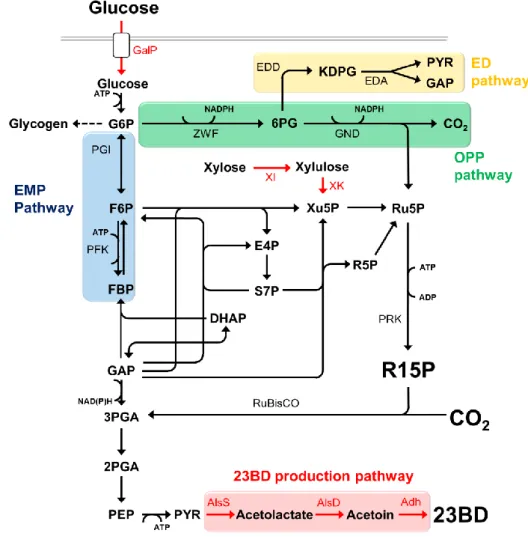
Optimizing sugar consumption by overcoming native regulation in natural
photoheterotophs may prove difficult. Such limitations may be avoided by rewiring the metabolism of an obligate photoautotroph, an organism strictly reliant on light and CO2 for growth (Fig. 2-1). It has been previously shown that one of the causes of obligate photoautotrophy in S. elongatus is the poor uptake of extracellular fixed carbon sources through native membrane transporters50. S.
elongatus can be rendered photoheterotrophic by heterologous expression of the glucose transporter gene galP or the xylose degradation genes xylEAB from Escherichia coli. However, the sugar consumption of these strains lagged behind natural photoheterotrophic microorganisms50. The two-fold goal of this study was the improvement of sugar consumption of the engineered S.
elongatus strains, and the utilization of that consumption for the production of the valuable chemical 2,3-butanediol (23BD).
20
21 2.3 Results
2.3.1 Effect of sugar supplementation under continuous light conditions
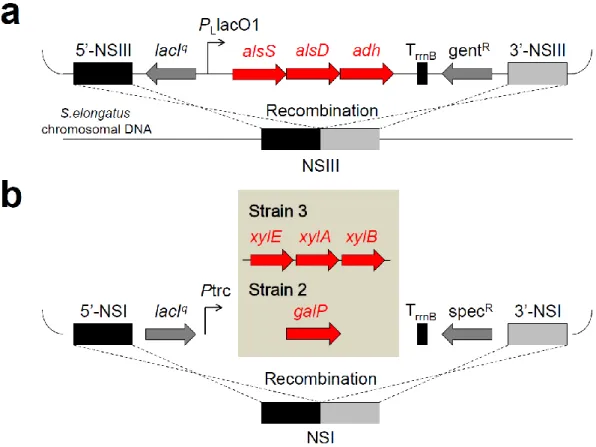
Strain 1, harboring 23BD production genes (PLlacO1:: alsS-alsD-adh), and Strain 2, harboring both 23BD production and glucose transporter genes (PLlacO1:: alsS-alsD-adh, Ptrc::
galP) were cultivated in the presence and absence of glucose in 10 mL culture tubes (Table 2-1 and Fig. 2-2). Strain 2 did not exhibit any growth or production on glucose alone (without sodium bicarbonate), thus 10 mM sodium bicarbonate was added to all subsequent experiments.
Concentrations of NaHCO3 greater than 10 mM did not yield any improvement to growth or
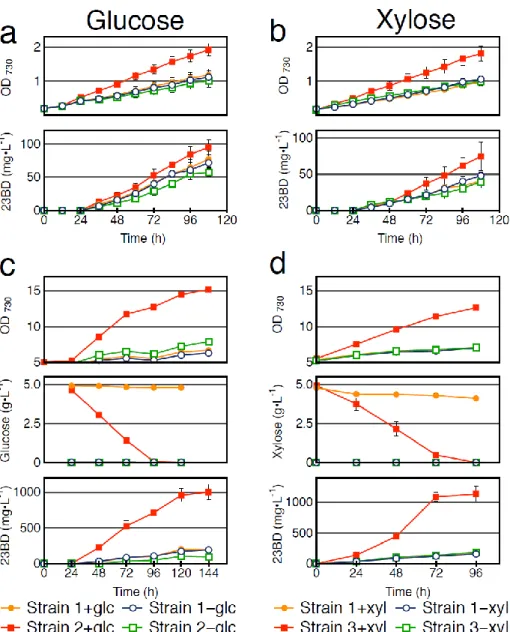
production. For Strain 2, final biomass accumulation as measured by OD730 and final 23BD titer (95 mg L-1) increased by 92% and 66% (from 57 mg L-1), respectively, upon the addition of glucose (Fig.
2-3a). In contrast, the control strain, Strain 1, showed no significant difference in 23BD titer (72 mg L-1) with the addition of glucose. Using the same conditions we evaluated the effects of xylose on Strain 1 and Strain 3, harboring the genes for 23BD production and xylose transport/degradation (PLlacO1:: alsS-alsD-adh, Ptrc:: xylE-xylA-xylB) (Table 2-1 and Fig. 2-2). A similar trend was exhibited wherein an increase in 23BD titer with xylose addition was only apparent in Strain 3, increasing from 39 mg L-1 to 75 mg L-1 compared to no significant difference for Strain 1 at 41 mg L-1 (Fig. 2-3b).
2.3.2 23BD production in high cell density conditions
In a large scale production scheme, maximizing cell density may be advantageous for more efficient chemical production. However, chemical production from very dense cultures of obligate photoautotrophic organisms at large scale may be difficult due to decreased availability of light per cell stemming from limited light penetration into the culture and mutual cell shading. Sugar supplementation in dense cultures may overcome the associated difficulties of high cell density
22
phototrophic cultures. Therefore, the starting cell density of Strains 1 and 2 was increased to OD730
~ 5 (~1.1 gDCW L-1), and tested in continuous lighting conditions for growth and 23BD production.
Upon the addition of glucose, the cell growth of Strain 2 increased 93% and 23BD titer by 1050%
to a final titer of 1003 mg L-1 (Fig. 2-3c). Glucose was completely consumed within 96h, and the maximum consumption rate of glucose for Strain 2 was 67 mg L-1 h-1 while the maximum 23BD production rate was 25 mg L-1 h-1 (Fig. 2-3c). Strain 1 showed negligible glucose consumption and no significant increase in final 23BD titer (192 mg L-1) or biomass accumulation (Fig. 2-3c).
Analogous conditions were applied to Strain 3 (Fig. 2-3d). The maximum increase of 23BD titer and biomass upon addition of xylose to Strain 3 was 813% (to 1138 mg L-1) and 179%, respectively, while Strain 1 showed no increase in titer (158 mg L-1) (Fig. 2-3d). The xylose consumption rate for Strain 3 was 67 mg L-1 h-1 and the maximum productivity was 27 mg L-1 h-1 (Fig. 2-3d).
2.3.3 Effect of sugar supplementation under diurnal light conditions
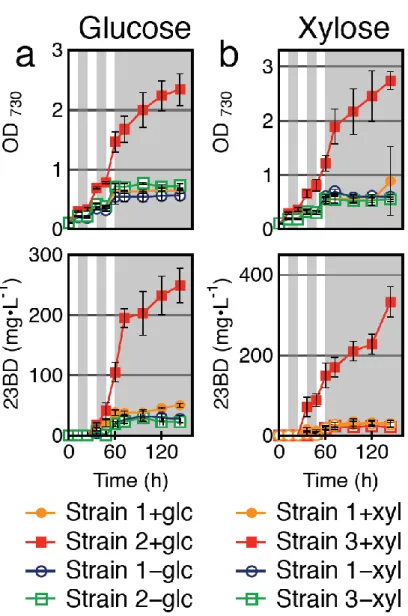
To mimic natural sunlight conditions, diurnal lighting conditions were examined. Cells were cultivated in a 12 h: 12 h light/ dark (LD) cycle in the presence or absence of sugar (Fig. 2-4).
Continuous 23BD production was observed only when glucose was added to Strain 2, while no difference could be measured with Strain 1 (Fig. 2-4a). 23BD production in Strain 3 also continued through the dark phase when xylose was added (Fig. 2-4b). Growth of Strains 2 and 3 in the
presence of glucose or xylose, respectively, tended to be slower in the dark than in the light.
However, productivity was consistent for these strains regardless of lighting conditions (Fig. 2-4).
For Strain 1, the dark phases impeded both growth and productivity (Fig. 2-4). The 23BD titer and biomass accumulation achieved by Strain 2 increased with the addition of glucose by 202% and 149%, respectively (Fig. 2-4a). In the presence of xylose, Strain 3 showed a 453% improvement in titer and 184% improvement in cell growth (Fig. 2-4b). The maximum glucose consumption rate in
23
a single 12 h period for Strain 2 was 19 mg L-1 h-1 while the average consumption rate was 8 mg L-1 h-1. The maximum xylose consumption rate in a single 12 h period for Strain 3 was 28 mg L-1 h-1 while the average consumption rate was 11 mg L-1 h-1. The 23BD productivities from Strains 2 and 3 during the dark period (2 mg L-1 h-1) were comparable to those in the light (glucose; 3 mg L-1 h-1, xylose; 2 mg L-1 h-1). Strain 1 showed no significant growth, sugar consumption, or 23BD
production in the dark.
2.3.4 Effect of sugar supplementation under dark conditions
To evaluate the capability of Strains 2 and 3 to grow and produce 23BD heterotrophically, continuous dark conditions were tested (Fig. 2-5). 23BD can theoretically be produced in continuous dark since both the carbon precursors and necessary reducing power (in the form of NADPH) may be generated by sugar catabolism. Light activated heterotrophic growth (LAHG) is a well
characterized growth mode in Synechocystis wherein the strain is maintained in continuous dark conditions except for a 15 min light pulse every 24 h64. This method of light pulsing was used to test the growth and 23BD production of Strains 2 and 3 in the presence or absence of glucose or xylose.
Cells were grown in a 12:12 LD cycle for the first 60 h, and then incubated in continuous dark for another 84 h, excepting the 15 min light pulse every 24 h. When the appropriate sugar was added to Strains 2 or 3, significant increases of both biomass accumulation and 23BD concentration were observed and continued for the duration of the 84 h dark incubation (Fig. 2-5). Strain 2 produced 155 mg L-1 of 23BD in the dark with glucose (Fig. 2-5a), and Strain 3 produced 183 mg L-1 of 23BD in the dark with xylose (Fig. 2-5b). In continuous dark, neither Strains 2 nor 3 grew or produced 23BD without added sugar, nor did Strain 1 grow or produce 23BD regardless of the addition of sugar.
24 2.3.5 13C-labeled metabolites analysis
To determine the ratio of carbon from glucose and CO2 in produced 23BD, 13C-labeled metabolite analysis was applied to high density cultures incubated in continuous lighting conditions (Fig. 2-6). The isotopic composition of 23BD was determined by gas chromatography–mass
spectrometry (GC–MS) after 120 h of production under continuous light with 13C-labeled glucose. In Strain 2, 67% of carbons in 23BD contained 13C, indicating that 67% of the carbons were from glucose and 33% were from CO2 (Fig. 2-6b). In contrast, Strain 1 metabolite analysis showed that 8% of the carbons in 23BD were from glucose and 92% were from CO2 (Fig. 2-6b).
2.3.6 Long-term 23BD production experiments
The maximum possible chemical titer and the degree of sugar utilization are of great relevance to the industrial feasibility of cyanobacterial production platforms. Thus, a long-term, fed-batch scheme with or without glucose was applied to Strain 2 in continuous light (Fig. 2-7). The experiment continued for as long as Strain 2 exhibited an increase in total 23BD titer either with or without glucose. Production of 23BD was observed from Strain 2 for 10 d. Glucose was replenished to 5 g L-1 every 3–4 d, depending on when glucose had been depleted (Fig. 2-7b). The strain
exhibited continuous growth throughout the 10 d experiment, and the maximum titer of 23BD was 3.0 g L-1, with a maximum productivity of 22 mg L-1 h-1 (Fig. 2-7a and c).
25 2.4 Discussion
In this study, we show that modification of a photoautotrophic cyanobacterium for sugar consumption leads to superior photoheterotrophic chemical productivity when compared to the naturally photoheterotrophic strain, Synechocystis. Recent metabolomic analysis of Synechocystis grown in the presence of glucose showed a decrease in Calvin Benson (CB) cycle metabolites and a reduction in carbon fixation90. This suggests that central carbon metabolism is strongly regulated by the presence of fixed carbon sources. This is supported by the decrease in glucose consumption and low reported productivities of isobutanol and lactic acid in engineered Synechocystis strains when in the presence of glucose86,87. This is most likely owing to a variety of specialized natural regulatory elements including sigma factors and specific regulatory proteins influencing carbon metabolism that are absent in obligate photoautotrophic strains91. By engineering the naturally obligate photoautotroph S. elongatus for heterotrophic production, we show that glucose consumption may continue uninhibited for at least 10 d at a fairly constant rate, and that a significant portion of the carbons in the target chemical produced (67%) are from glucose.
The high cell density production studies capitalize on the key advantages of supplementing phototrophic organisms with sugar (Fig. 2-3c and d). The continued growth of Strain 1 (without any sugar consuming modifications) at high cell density is limited by light penetration of the cell culture, while growth on sugar is only limited by diffusion into the cell interior. The facilitated import and metabolism of sugars by Strains 2 (glucose) and 3 (xylose) provide a strong advantage in growth and production at high cell densities by allowing a higher rate of carbon entry into metabolism, while simultaneously maintaining the advantage of photosynthetically producing ATP and NADPH decoupled from carbon input.
Freely available, natural lighting (sunlight) conditions are diurnal in nature and of particular interest to industrial pursuits. In this study, the 23BD production from Strains 2 and 3
26
grown with sugar increased in both light and dark periods compared to strains grown without sugar, leading to a 2–4 fold improvement in final titer (Fig. 2-4). Though the availability of reducing equivalences generated from photosynthesis decreases under diurnal conditions, the
sugar-augmented strains were able to overcome that limitation and continue both growth and production in the dark phases. In the presence of sugar (glucose), production titers in continuous light conditions (84 mg L-1) was slightly lower than that in diurnal light conditions (131 mg L-1). The similar trend is observed in the case of xylose as well. Carbon metabolism during the dark phases does not depend on carbon fixation but sugar catabolism. Therefore, relatively faster supply of metabolites from sugar might occur in darkness. Continuous production in diurnal lighting with a strict photoautotroph demonstrates the broad versatility of genetic manipulation in this strain.
However, it is unclear whether photo- dependent regulation is circumvented in the dark and carbon storage generated in light conditions is utilized for growth and production in these engineered photoheterotrophs, or if all carbon and reducing equivalences come from the consumption of sugar in dark conditions. Analysis of 13C labeled carbons in produced 23BD with uniformly labeled glucose feeding in continuous dark conditions would provide more precise understandings about the carbon allocation in diurnal lighting conditions.
Carbon metabolism of externally supplied sugar in S. elongatus is unknown and of particular interest. For the naturally photoheterotrophic strain Synechocystis, sugar metabolism has been widely investigated under different trophic conditions92,93,43. In standard light conditions, glycolysis was active in Synechocystis grown on glucose, while the oxidative pentose phosphate (OPP) pathway became a main glucose degradation pathway in dim light or dark conditions in response to the increased requirement for NADPH. In the case of S. elongatus, Diamond et al.
suggested that the circadian clock regulator, KaiC, might be responsible for inhibiting the OPP pathway activity in the light, thus switching between the CB cycle and the OPP pathway during the
27
light and dark phases of diurnal condition75. In this study, although little is known about the relative metabolic flux between the CB, OPP, and Entner-Doudoroff (ED, closely linked to OPP) pathways in S. elongatus (Fig. 2-1), more detailed understanding of carbon metabolism in the engineered photoheterotrophic S. elongatus strains would likely aid in future optimization of target chemical production.
While supplementation of each sugar led to comparable improvement of 23BD production, the overall consumption of xylose (73 µM h-1, Strain 3) was much greater than that of glucose (44 µM h-1, Strain 2) in the light (Fig. 2-3). However, no significant difference of sugar consumption between glucose and xylose was observed during the dark phases. Further analyses are required to elucidate the detailed mechanisms that cause these differences in glucose/xylose consumption depending on light availability.
The normalized 23BD titer for Strain 2 was greater than for Strain 1, but no increase in carbons utilized from CO2 was observed between the strains, indicating that the increase in titer was due to the conversion of glucose to 23BD. To understand the changes in metabolic flux between these strains, a detailed flux analysis is required. A variety of metabolomics approaches have been previously used to investigate carbon flux and carbon fixation in cyanobacteria90,94,95, but none of these have included cyanobacteria engineered for photoheterotrophic chemical production. These systems level approaches maybe well suited to examine the increased production abilities of the mutant strains engineered in this study (Fig. 2-6).
28 2.5 Materials and Methods
2.5.1 Reagents
Glucose, xylose, 23BD, and isobutanol were obtained from Sigma-Aldrich (St.Louis, MO).
13C labeled glucose was obtained from Cambridge isotope laboratories (Andover, MA).
Isopropyl-β-D-thiogalactoside (IPTG) was obtained from Fischer Scientific (HanoverPark, IL).
Phusion polymerase was purchased from New England Biolabs (Ipswich, MA). Gentamicin was purchased from Teknova (Hollister, CA); Spectinomycin was purchased from MP Biomedicals (SantaAna, CA).
2.5.2 Strain construction
Strains used in this study are listed in Table 1. Transformation of S. elongatus was carried out as previously described96. Transformants were selected on BG11 agar plates supplemented with the required antibiotics. Complete chromosomal segregation for the introduced fragments was achieved through propagation of multiple generations on a selective agar plate and verification by colony PCR. Correct recombinants were confirmed by PCR and sequencing of the purified genomic DNA in order to verify integration of targeting genes into the chromosome.
2.5.3 Culture conditions
Unless otherwise specified, all S. elongatus strains were cultured in BG11 medium at 30 °C with rotary shaking (100 rpm) and light (65 μmol photons m-2 s-1 in the PAR range) provided by four 86 cm 20 W fluorescent tubes 5 cm above the cell cultures whenever lights were on. Light intensity was measured using a PAR quantum flux meter (ModelMQ-200, Apogee Instruments). For 23BD production experiments, cells were diluted at time = 0 to an OD730 of 0.2 except for high cell density experiments (OD730 = ~5) and grown in 10 mL of production media (BG11 containing 20 mM
29
HEPES (pH7.0), 0.1 mM IPTG, 10 mM NaHCO3, 10 mg L-1 thiamine, 10 mg L-1 gentamicin, and 20 mg L-1 spectinomycin when necessary). During the production experiments, 5 g L-1 of the appropriate sugar and 10 mM NaHCO3 were added as required. Cell growth was indirectly monitored by measuring OD730 in a Microtek Synergy H1 platereader (BioTek), under the assumption that OD730 correlates with cell biomass in the culture. Samples were diluted to between OD730 0.2 and 0.9 for accurate cell density measurements.
2.5.4 23BD production in continuous or diurnal lighting conditions
Cells were grown in 10 mL of production media in 20 mL glass tubes with air exchange caps. Every 12 h, 10% of the culture (1 mL) was removed, the pH was adjusted to 7.5±0.5 with 10 N HCl, and 1 mL of production media containing 100 mM NaHCO3, was added. In the long term production experiments, when glucose was completely consumed (Day 4, 7, and 10), replacement production media containing100 mM NaHCO3 and 50 g L-1 glucose was used.
2.5.5 23BD production in continuous dark conditions
Cells were inoculated into 25 mL of production media in 250 mL baffled glass flasks with air exchange caps, and grown in diurnal lighting conditions for 60 h. Subsequently, cultures were incubated in the dark by wrapping the flasks with aluminum foil. Every 24 h the cultures were placed in lighted conditions for 15 min. Then the 10% culture removal, pH adjustment, and addition of fresh medium were performed as described above.
2.5.6 Quantification of glucose and xylose
Glucose and xylose in culture supernatant were quantified using a high performance liquid chromatograph (LC-20AB, Shimadzu, Columbia, MD) equipped with an autosampler (SIL-20AC),
30
Fast Acid Analysis Column (Biorad, Hercules, CA, USA), and a differential refractive detector (RID-10A). 5 mM H2SO4 served as the mobile phase at a flow rate of 0.6 mL min-1 at 65 °C for 15 min.
2.5.7 23BD quantification
Culture supernatant samples were analyzed by a gas chromatograph (GC) (Shimadzu) equipped with a flame ionization detector and Cyclodex-b column (30m, 0.32 mm internal diameter, 0.25 µm film thickness; Agilent Technologies). The GC oven temperature was held at 105 °C for 1 min, increased with a gradient of 20 °C/min until 225 °C and held for 3 min. The temperature of the injector and detector was 250 °C. Isobutanol was used as an internal standard.
2.5.8 GC-MS analysis of 13C labeled 23BD
Samples were analyzed by gas chromatography (GC)-mass spectrometry (MS) (Shimadzu) equipped with SHR5XLB column (30 m, 0.25 mm internal diameter, 0.25 μm film thickness;
Restek) and a quadruple mass selective detector operated at 70 eV. For each analysis, the GC oven temperature was held at 40 °C for 3 min, increased with a gradient of 45 °C min-1 until 300 °C. The temperature of the injector was set at 225 °C. The ion source (electron ionization [EI]) temperature was set at 200 °C. 23BD detection was performed using selective ion mode (m/z = 45, 46 and 47).
Although the molecular mass of 23BD is 90 g mol-1, the signal of the molecular ion (m/z = 90) of is extremely low with the MS settings, and we were unable to improve the signal. Thus, we compared the peak at m/z = 45 with the peaks at m/z = 46 and 47 to determine the 13C-labeling percentage of 23BD. These peaks correspond to fragmented ions consisting of two carbons. The peak at m/z = 45 represents ions with two 12C carbons, while those at m/z = 46 and 47 are for ions with one and two
13C labeled carbons, respectively. The relative intensity in the total of all these three peaks were
31
determined as X, X+1, and X+2. Finally, 13C-labeling percentage of 23BD was defined as “%glucose = (0.5 × X+1 + X+2) / (X + X+1 + X+2) × 100”. Assuming that all carbons of 23BD originate from either glucose or CO2, %CO2 was yielded by “%CO2 = 100 - %glucose”.
32 2.6 Figures
Fig. 2-1 Overview of central metabolic pathway engineering. An abbreviated schematic of central metabolites of the EMP pathway, the ED pathway, the OPP pathway and the CB cycle are shown. Black lines indicate native genes and red lines indicate heterologously overexpressed genes. AlsS, acetolactate synthase; AlsD, acetolactate
decarboxylase; Adh, alcohol dehydrogenase; XI, xylose isomerase; XK, xylulose kinase; DHAP, dihydroxyacetone phosphate; EDA, 2-keto-3-deoxygluconate-6-phosphate aldolase; EDD, 6PG dehydratase; E4P,
erythrose-4-phosphate; FBP, fructose-1,6-bisphosphate; F6P, fructose-6-phosphate; GAP, glyceraldehyde-3-phosphate; GalP, galactose-proton symporter; GND, 6PG dehydrogenase; G6P,
glucose-6-phosphate; KDPG, 2-keto-3-deoxy-6-phosphogluconate; PEP, phosphoenolpyruvate; PGI, phosphoglucose isomerase; PFK, phosphofructokinase; PRK, phophoribulokinase; PYR, pyruvate; RuBisCO,
ribulose-1,5-bisphosphate carboxylase/oxygenase; R5P, ribose-5-phosphate; R15P, ribulose-1,5-bisphosphate; Ru5P, ribulose-5-phosphate; S7P, sedoheptulose-7-phosphate; Xu5P, xylulose-5-phosphate; ZWF, G6P dehydrogenase;
23BD, 2,3-butanediol; 3PGA, 3-phosphoglycerate; and 6PG, 6-phosphogluconate.
33
Fig. 2-2 Schematic of genome engineering in S. elongatus. (a) Schematic representation of the 23BD pathway genes integration into NSIII52. (b) Schematic representation of the glucose transporter gene or xylose transporter and metabolism genes integration into NSI50.
34
Fig. 2-3 Sugar utilization under continuous light conditions. Filled shapes indicate the presence of sugar, empty shapes indicate the absence of sugar. Error bars indicate the standard deviation of biological triplicates. (a) Time course of cell growth and production of Strains 1 (PLlacO1:: alsS-alsD-adh) and 2 (PLlacO1:: alsS-alsD-adh, Ptrc::
galP) with or without glucose grown from a starting cell density of OD730 = 0.2. (b) Time course of cell growth and production of Strains 1 and 3 (PLlacO1:: alsS-alsD-adh, Ptrc:: xylE-xylA-xylB) with or without xylose from a starting cell density of OD730 = 0.2. (c) Time course of the cell growth, sugar concentration, and 23BD production of Strains 1 and 2 with or without glucose from a starting cell density of OD730 = 5.0. (d) Time course of the cell growth, sugar concentration, and 23BD production of Strains 1 and 3 with or without xylose from a starting cell density of OD730 = 5.0.