A Classified Lexicon of Jinghpaw Loanwords in Kachin Languages Kurabe, Keita
ILCAA, Tokyo University of Foreign Studies/University of Melbourne
The Kachin people, who inhabit northern Burma and its adjacent areas in China and India, are a linguistically diverse people that form a single socio-cultural complex of shared cultural traits. Jinghpaw, a Tibeto-Burman language, serves as a lingua franca among the linguistically diverse people, and as such, has provided a number of lexical items to non-Jinghpaw Kachin languages that form a part of the areal lexicon of the Kachin region. The aim of this paper is to provide a semantically classified lexicon of Jinghpaw loanwords in other major languages of the Kachin that have emerged due to close cultural and linguistic contact. This paper also provides a brief background and comparison of several Kachin languages, followed by descriptions of the linguistic properties of Jinghpaw loans in terms of phonology, morphosyntax, and semantics.
Keywords:language contact, loanwords, borrowing, Jinghpaw, Kachin
1. Introduction
2. Languages of the Kachin people 3. The contact situations and borrowings 4. A classified lexicon of Jinghpaw loanwords
1. Introduction
The Kachin people, who inhabit northern Burma and parts of China and India neighboring it, are a linguistically diverse people who form a socio-cultural complex of shared cultural traits, such as marriage alliance systems.1 They speak several distinct
Kurabe, Keita. 2018. “A classified lexicon of Jinghpaw loanwords in Kachin languages”. Asian and African Languages and Linguistics12. pp.99–131. [Permanent URL: http://hdl.handle.net/10108/91146]
1Abbreviations for languages and language families in this paper are as follows: An. (Anong); Bur. (Colloquial Burmese); Dl. (Dulong); Jg. (Jinghpaw); Lc. (Lacid); Lg. (Langsu); Lq. (Leqi); Ls. (Lisu); Lv. (Lhaovo);
Ng. (Ngochang); Pa. (Pali); Pl. (Pola); PTB (Proto-Tibeto-Burman); Rw. (Rawang); Sh. (Shan); Sk. (Sanskrit);
TB (Tibeto-Burman); WB (Written Burmese); Zw. (Zaiwa).
For secondary data on the languages in this paper, we, unless otherwise noted, draw on the following secondary sources: Anong (Sun and Liu 2009); Burmese (Myanmar Language Commission ed. 2009); Dulong (Trung Dictionary Committee 2016); Jinghpaw (Maran 1978); Lacid (Wannemacher 2011); Langsu (Dai 2005);
Leqi (Dai and Li 2007); Lhaovo (Sawada 2003a, 2004, 2005; supplemented by Yabu 2000 marked by Y2);
Lisu (Bradley 2006); Ngochang (Nasaw Sampu et al. 2005); Pali (Rhys Davids and Stede, eds. 1921-1925);
Proto-Tibeto-Burman (Matisoff2003); Rawang (LaPolla and Sangdong 2015; supplemented by Humphries 2014 marked by H); Shan (Sao Tern Moeng 1995); Zaiwa (Wannemacher 2017; supplemented by Yabu 1982 marked by Y1, and Lustig 2010 marked by L). The Jinghpaw data are transcribed with slight modification, based on Kurabe (2016a). The Shan data are transcribed based on the system used in SEAlang Library Shan Dictionary:
languages belonging to Tibeto-Burman (TB), many of which are mutually unintelligible with each other. Multilingualism is an ordinary and long-standing phenomenon in this world of multiple languages. This multilingualism, however, is not always reciprocal:
Jinghpaw, a Jinghpaw-Luish (Asakian) language of TB, serves as a lingua franca among this linguistically diverse people; it is also spoken as a second language by several Kachin linguistic groups. The Jinghpaw influence on other Kachin languages has been an intensive and prolonged phenomenon in the Kachin area, bacause of which a number of Jinghpaw lexical items have been introduced into other languages in the Kachin area, which form a part of the areal lexicon in the Kachin region.
Several previous studies on non-Jinghpaw Kachin languages, especially dictionaries and wordlists with etymologies, have individually identified Jinghpaw loanwords in the languages (Yabu 1982, Wannemacher and Zau Mo 2000, and Lustig 2010 for Zaiwa;
Sawada 2004 for Lhaovo; LaPolla and Sangdong 2015 for Rawang). Dai (1993: 1) provides thirteen Jinghpaw loans in three Kachin languages. There has, however, been little study that sheds light on the whole picture of Jinghpaw loans in Kachin languages.
The primary purpose of this paper, as a preliminary approximation toward studies in Kachin contact linguistics, is to provide a summary of Jinghpaw loans in other Kachin languages, classified based on semantic fields. This paper also differs from previous works in providing: (a) criteria for diagnosing the likelihood of the loan status of each item that helps to distinguish between certain and possible loans; (b) semantic classification of loans that help to determine in what semantic areas Jinghpaw influence is significant; and (c) additional loan data identified by the author. Jinghpaw loans are key in not only understanding language contact in the Kachin region but also in peeling back the layers of contact-induced lexical changes in the Kachin languages required to enable further understanding of the genetic subgrouping of the languages in the region.
The organization of this paper is as follows. Section 2 provides a brief background of Kachin languages, followed by a comparison of their linguistic properties in terms of phonology (2.1), morphosyntax (2.2), and lexicon (2.3). In Section 3, after describing the contact situation among Kachin languages (3.1) and the scale of Jinghpaw influence (3.2), we will look at Jinghpaw loans (3.3) in terms of their identification (3.3.1), adaptation and importation (3.3.2), grammatical borrowing (3.3.3), and their semantics (3.3.4). Section 4 is devoted to a list of Jinghpaw loans in several other Kachin languages, classified in terms of semantic fields.
2. Languages of the Kachin people
This section provides a brief summary of the languages spoken by the Kachin people in terms of phonology, morphosyntax, and lexicon.2 Before we move on, a brief
http://www.sealang.net/shan/dictionary.htm (accessed on May 31, 2017). Colloquial and Written Burmese are given, based on the transcription systems in Kato (2008) and Duroiselle (1916), respectively.
2Data on Lisu and Rawang are provided and checked by David Bradley and Randy J. LaPolla, respectively.
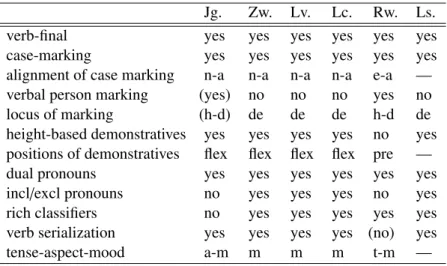
description of major Kachin languages is in order. The Kachin people, as noted in Section 1, are a linguistically diverse people, encompassing speakers of several distinct languages, including Jinghpaw (Jg.), Zaiwa (Zw.), Lhaovo (Lv.), Lacid (Lc.), Rawang (Rw.), and Lisu (Ls.). Some properties of these six well-recognized major languages of the Kachin in Burma are summarized in Table 1. It should be noted that it is not easy to tell the exact number of languages spoken by the Kachin people due to the difficulties in distinguishing between languages and dialects as well as a lack of relevant information on underdescribed languages. Rawang, for example, consists of a number of diverse
“dialects” that are not always mutually intelligible. Note also that the Lisu, whose population is great in China and who have a distinct nationality status there, are often regarded as a group distinct from the Kachin, especially outside Kachin State.
Table 1 Major languages of the Kachin people
Jg. Zw. Lv. Lc. Rw. Ls.
autonym Jinghpaw Zaiwa Lhaovo Lacid Rawang Lisu
population 940,000 110,000 103,500 31,800 63,000 942,700
ISO 639-3 kac atb mhx lsi raw lis
affiliation TB TB TB TB TB TB
within TB JL NGB NGB NGB RG NGB
within subgroups JG NB NB NB NG CNG
locations Whole SE SE SE N N
The population of each linguistic group of the Kachin may vary due to the lack of accurate census data in Burma. The estimated population given in Table 1 is based on the Ethnologue (Simons and Fennig 2017). All languages spoken by the Kachin people are affiliated with the Tibeto-Burman (TB) branch of the Sino-Tibetan language family, belonging to three distinct branches within TB: Jinghpaw-Luish/Asakian (JL), Ngwi-Burmese (NGB), and Rung (RG).3Within the branch, Jinghpaw belongs to the Jinghpaw sub-branch (JG); Zaiwa, Lhaovo, and Lacid to Northern Burmish (NB);
Rawang to Nungish (NG); and Lisu to Central Ngwi (CNG). Jinghpaw is distributed throughout the Kachin region, except in the far north area; Zaiwa, Lhaovo, and Lacid are concentrated especially in the southeastern area; Rawang and Lisu are especially found in the northern area.
Nomenclatural complexity, as applicable to the entire TB branch (Matisoff1996), also holds for the Kachin languages. Dai and Xu (1992: 2–3) provide the intra-Kachin autonyms and exonyms in China given in Table 2, where the Jinghpaw exonyms for
3See Matisoff(2013) for Jinghpaw-Luish/Asakian, and LaPolla (2003) for Rung that is established based on shared morphological innovations.
Zaiwa, Lhaovo, and Lacid were often used in the early literature on these languages.4
Table 2 Intra-Kachin autonyms and exonyms
Jg. Zw. Lv. Lc. Pl.
Jg. tSiN31phoP31 a31tsi55 m˘a31Zu31 l˘a31Si55 po31lo31 Zw. Si55tu
¯N55 tsai21va51 l˘a21la
¯N51 l˘a21tShi55 p˘a21lo21 Lv. phauk55vO51 tsa35vO31 l˜O31vO31 l˘a31tShik35 p˘a31lO31 Lc. phuk31vu51 tsai31vu51 la
¯N31vu51 l˘a31tShi51 p˘a31lO51 Pl. phauk31va31 ti31va31 l˜o31va31 l˘a31tShi35 po31la31
2.1. Phonology
All Kachin languages, as with other neighboring TB languages, have lexical tones exhibiting three to six tonal contrasts in open syllables and no or two in checked syllables. In general, vowel length is not phonemically contrastive in the Kachin languages, except Rawang with non-basic long vowels. The major Kachin languages allow final consonants except Lisu, which has only open syllables in its native phonology.5 PTB medial *-r-is retained in Jinghpaw (after bilabial and velar stops), unlike in other languages,6while PTB final liquids, which have merged with PTB *-n in Jinghpaw, are retained only in Rawang.
4The table includes the Pola, whose language is closely related to Zaiwa, Lhaovo, and Lacid, and excludes the Lisu and Rawang, whose closest relatives have distinct nationality status in China.
5Lisu has final nasal consonants, but only in some loans. The most frequent is/N/./n/also occurs in one Chinese loanp7n21‘classifierfor books’ used in Burma, also a few others used in China. Also, Lisu has two “checked”
tones, tone 3 mid with tense phonation and tone 6 low falling with final glottal stop. These contrast with tone 4 mid with normal phonation and tone 5 low falling without final glottal stop (David Bradley, p.c., 2017). In this paper, we count tone 6 as one type of tone in accordance with Bradley (2003).
6The Dulong varieties closely related to Rawang do have medial liquids (Randy J. LaPolla, p.c., 2017).
Table 3 Phonologies of the major Kachin languages
Jg. Zw. Lv. Lc. Rw. Ls.
lexical tones yes yes yes yes yes yes
tonal contrast in checked syllables yes yes yes yes no n/a
vowel length no no no no (no) no
medial liquids yes no no no no no
final consonants yes yes yes yes yes no
final liquids no no no no yes no
diphthongs in closed sylllables no no yes yes no n/a
free VC distribution yes yes no no yes n/a
rich sesquisyllables yes yes yes yes yes no
rich syllabic nasals yes no no no no no
Zaiwa, which is closely related to Lhaovo and Lacid but is most influenced by Jing-hpaw (see Section 3.2), is of interest, in that, its phonology often exhibits systematic similarities to that of Jinghpaw (Yabu 1988: 106, Kurabe 2015: 74, Müller 2016: 34). Its phonetic diphthongs, for example, do not occur in closed syllables like in Jinghpaw but unlike in Lhaovo and Lacid. Also, the VC distribution (vowel-final consonant combination) is relatively free in Zaiwa and Jinghpaw but more restricted in Lhaovo and Lacid (over 30 gaps). Note, further, that Zaiwa has a vowel system similar to that of Jinghpaw but diverse from those of other closely related NB languages, including Lhaovo, Lacid, Ngochang, and Achang. Compare:7
(1) a. Jg. i,e,a,o,u,ai,au,oi,ui b. Zw.i,e,a,o,u,ai,au,oi,ui c. Lv. i,e,a,o,u,ø,au
d. Lc. i,e,a,o,u,1,0,ei,ai,au,ou, (ui,ua) e. Ng. i,E,a,a;,O,u,W,ei,Au,u2,Wu
f. Ac. i,e,a,O,o,u,@,ei,ai,oi,ui,iu,au,@u,ua,iau,uai
Sesquisyllables, consisting of a heavy syllable preceded by a light syllable with reduced phonemic possibilities (Matisoff 1973), are somewhat common in many Kachin languages. Syllabic nasals, which are abundant in Jinghpaw, are highly marginal or absent in many other Kachin languages.8
7Data drawn from the following sources: Jg. (Kurabe 2016a); Zw. (Yabu 1982), Lv. (Sawada 2004), Lc. (Wannemacher 2011), Ng. (Nasaw Sampu et al. 2005), and Ac. (Yabu 2011).
8Syllabic nasals, although highly rare, are marginally attested in many Kachin languages: Zw.m11‘yes’,m1mo35
‘no’,m31mo31‘agreed!’ (Lustig 2010: 227); Lv.n
"
F‘yes’,n
"
L‘quotation’ (Sawada 1999: 110); Lc.n‘ok’,n.jok
‘five people’ (Wannemacher 2011: 6), Ng.N´
"
‘fish’,N´
"
‘five’,ˆN
"
‘1sg’ (Yabu 1990: 126). Southern Lisu also has some syllabic nasals in the first syllable of two-syllable words, mostly reduced from syllables with a nasal initial plus a high vowel in other dialects. The syllabic nasal tends to be homorganic to the following initial, regardless of its source, e.g.,N21khWP21‘night’, elsewheremWP21khWP21ormW21khW21(David Bradley, p.c., 2017)
2.2. Morphosyntax
Table 4 is a brief summary of some morphosyntactic properties of the major Kachin languages. All languages, as with many other TB languages, are verb-final, where the order of core arguments in transitive clauses is usually determined by pragmatic principles. They have case-marking systems (in many cases, not obligatory), the alignment patterns of which vary between the nominative-accusative (n-a) and ergative-absolutive (e-a) systems.9Person marking on verbs, which is alien to the NGB Kachin languages, is found in Jinghpaw and Rawang, both manifesting the hierarchical alignment with (Rawang) or without (Jinghpaw) an inverse marker (LaPolla 2010, Kurabe 2016a). It should be noted, however, that modern spoken Jinghpaw in Burma usually does not encode the person category on the verb anymore, which can be attributed to its status as a lingua franca among many speakers whose languages do not have verb agreement. Jinghpaw and Rawang have both head and dependent marking (h-d) at the clausal level while others have only dependent marking (d), although, as noted above, modern spoken Jinghpaw has been shifting toward a dependent-marking language, much like neighboring NGB Kachin languages.
Table 4 Morphosyntaxes of the major Kachin languages
Jg. Zw. Lv. Lc. Rw. Ls.
verb-final yes yes yes yes yes yes
case-marking yes yes yes yes yes yes
alignment of case marking n-a n-a n-a n-a e-a — verbal person marking (yes) no no no yes no
locus of marking (h-d) de de de h-d de
height-based demonstratives yes yes yes yes no yes positions of demonstratives flex flex flex flex pre —
dual pronouns yes yes yes yes yes yes
incl/excl pronouns no yes yes yes no yes
rich classifiers no yes yes yes yes yes
verb serialization yes yes yes yes (no) yes
tense-aspect-mood a-m m m m t-m —
Demonstratives in many Kachin languages are distinguished in terms of not only distance but also relative height,10which is not uncommon in the languages of the hill
9Here, we use these terms in the non-strict sense because, in many Kachin languages, the marking is based primarily on semantic and pragmatic factors.
Case marking in Lisu is pragmatic and fairly infrequent. The ergative and agentive subject can be marked withle44 but is usually not. The accusative can be marked withtæ55, which is a bit more frequent thanle44(David Bradley, p.c., 2017).
10Although Rawang does not have height-based demonstratives, Anong, which is closely related to Rawang, does
peoples of Southeast Asia. It is also worth noting that demonstratives in Jinghpaw and NB Kachin languages exhibit flexibility in their positions, with the ability to occur in both pre- and post-nominal positions (Kurabe 2015: 77, Müller 2016: 35), while they occur in pre-nominal position in Rawang.11 Personal pronouns, having dual pronouns, exhibit three-way splits in person in many Kachin languages. The inclusive/exclusive distinction, scattered throughout most of the TB branches but not reconstructible for PTB (LaPolla 2005), is found in NGB Kachin languages. Jinghpaw, unlike other neighboring Kachin languages, is not a classifier-rich language and only has a small set of optional sortal numeral classifiers, which appear to have arisen due to language contact with neighboring classifier languages. Verb serialization, as with other neighboring languages of Southeast Asia, is widely employed in many Kachin languages, except Rawang, where preceding verbs usually undergo tonal changes like nominalization. The citation form for verbs usually takes a tense-aspect-mood marker in Kachin languages (including a zero in Lacid) that is chiefly based on:
aspect (change-of-state vs. non-change-of-state) and mood (declarative, interrogative, imperative, etc.) in Jing-hpaw (‘a-m’ in Table 4); mood (realis vs. irrealis) in Zaiwa, Lhaovo, and Lacid (‘m’ in the table); and tense (past vs. non-past) and mood (declarative, etc.) in Rawang (‘t-m’ in the table).12
2.3. Inherited lexicon
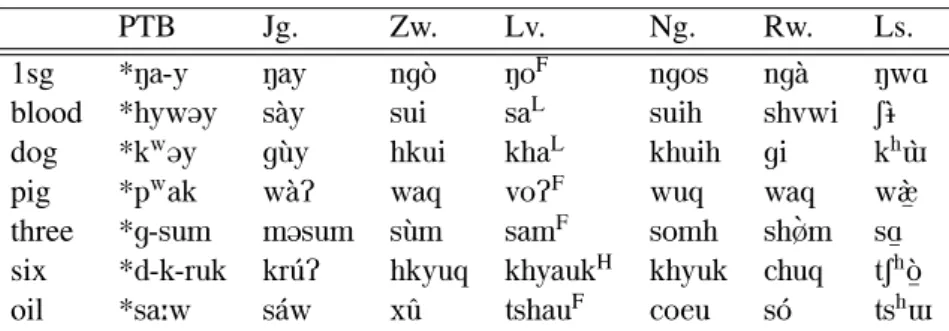
The Kachin languages, all of which belong to the TB branch, share many words inherited from their common ancestor, as illustrated in Table 5.13
Table 5 Inherited words
PTB Jg. Zw. Lv. Ng. Rw. Ls.
1sg *Na-y Nay ng`o NoF ngos ng`a NwA
blood *hyw@y s`ay sui saL suih shvwi S`ı
dog *kw@y g`uy hkui khaL khuih gi khW`
pig *pwak w`aP waq voPF wuq waq w `æ
three *g-sum m@sum s`um samF somh sh`øm sA¯ six *d-k-ruk kr´uP hkyuq khyaukH khyuk chuq tS¯ho` oil *sa:w s´aw xˆu tshauF coeu s´o tsh¯W
Lexical items, not always cognates, are sometimes structured into a similar pattern in some Kachin languages. For example, kinship terms, as pointed out by Burling
have them (Randy J. LaPolla, p.c., 2017).
11See Bradley (2017), for the complex distribution of demonstratives in Lisu.
12TAM in Lisu is pragmatic, with aspect marked more than anything else (David Bradley, p.c., 2017).
13Due to a lack of sufficient lexical data for Lacid, they are substituted for by those of Ngochang (Nasaw Sampu et al. 2005), which is considered to be the closest relative of Lacid by Lacid speakers.
(1971), are organized into a similar kinship system in Jinghpaw and Lhaovo, although individual kin terms are not always cognates between them (see Section 3.3.3). Note also that semantic fields do not always exhibit a similar structure among the Kachin languages. For example, Jinghpaw has only one motion verb that is deictically neutral, carrying the sense of both ‘go’ and ‘come’, while Zaiwa, Lhaovo, and Lacid have four deictic motion verbs distinguished in terms of distance, height, etc. (Yabu 1988, Sawada 2003b). Also, Jinghpaw and Rawang, as with many Southeast Asian languages, have multiple washing verbs consisting of distinct roots while Zaiwa and Lhaovo do not (Yabu 2009).
3. The contact situations and borrowings 3.1. The contact situations in the Kachin region
Jinghpaw, due to it being predominantly spoken, serves as a lingua franca among the linguistically diverse Kachin people. In the Kachin region, especially in the southeastern part where the Burmish Kachin population is great, it is not difficult to find Kachin villages (k˘ahtawng), village clusters (m˘are), and communities inhabited by several distinct linguistic groups (Leach 1954, Dai, Fu, and Liu 1985, Dai 1993, Bradley 1996). Multilingualism is a common and prolonged phenomenon, part of which stems from marriage preferences built into the Kachin cultural system that promote and perpetuate multilingualism among the Kachin, as Bradley (1996:
750–751) puts it:
In most mixed villages each Burmish group operates as a Kachin exogamous patrilineal clan, so if the father is from one of the Burmish-speaking groups, the mother must have a different first language from her husband. Grandparents could therefore represent up to four languages, but marriage preferences tend to lead to repeated marriages between the same clans. The clan identity is acquired from the father, but children also speak the mother’s language, especially if it forms a substantial group in the village. Thus, people of one of the Burmish backgrounds may be bilingual in their father’s and their mother’s language, and if neither of these is Jinghpaw they will early on become trilingual and use Jinghpaw as their medium of education, literacy and lingua franca within the group as a whole.
Dai (1993) provides a socio-linguistic description of language use within the Jingpo [Kachin] nationality in China, showing that the language choice is not arbitrary, being ruled by factors such as social setting, generation, age, sex, and occupation, some of which are explained as follows (ibid., p.4):
Many Jingpo families include people from different subgroups. In such families, the language used by each member is stipulated by tradition. The
children belong to their father’s subgroup, and they use the language of that subgroup. If a father and mother are from different subgroups, the father and children use one language and the mother uses another. Although husband and wife each master the other’s language, each uses his or her own. In other words, people speak in one language but are spoken to in another. The mother insists on using her own language, and the children may also use their mother’s language when speaking to her....If a family has a grandmother who speaks a third language, the younger generation uses her language when speaking to her.
3.2. Scale of Jinghpaw influence
Jinghpaw influence on other Kachin languages varies from language to language, as represented below.
(2) Scale of Jinghpaw influence
←−−−−−−−−−−−−−−−−−−
Zaiwa Lhaovo, Lacid Rawang LisuZaiwa is considered the most affected by Jinghpaw, as reflected in its phonological similarity to Jinghpaw (Section 2.1) as well as in its abundant Jinghpaw loans, including many kinship terms such as ‘father’ and ‘mother’ (Section 3.3.4). Lisu, on the other hand, is least influenced by Jinghpaw, as many of its speakers do not enter into the Kachin cultural complex, especially outside Kachin State (Section 2). This is reflected in the fact that Lisu has very few Jinghpaw loans. Lhaovo and Lacid are also considered to have been significantly influenced by Jinghpaw while Rawang is less so, although Rawang has a number of Jinghpaw loans, as demonstrated in Section 4. More evidence should be accumulated to render the validity of the scale.
3.3. Jinghpaw loanwords
Due to intensive contact, many Kachin languages, aside from inherited words (Section 2.3), also share a considerable number of lexical items that have arisen as a result of intra-Kachin language contact. Jinghpaw, as a lingua franca, is one of the major donor languages in the Kachin region, providing its lexical items in other Kachin languages, as exemplified in Table 6, that form a part of the areal lexicon of the Kachin region.14
14The Zaiwa data for ‘sugar’ and the Lhaovo data for ‘desk’ are based on Lustig (2010) and Yabu (2000), respectively.
Table 6 Jinghpaw loans in several Kachin languages
PTB Jg. Zw. Lv. Ng. Rw.
cat *s/k-roN l@Pnyaw la-nyha´u l˘a˜na
¯u
¯
L lvnyhau
prawn *s-di:k kh@tsˆu kh˘atsuF khvsoeq gvz`u
song m@kh´on mahkˆon mvk´un
box *ta s@d`ek sidek sadig svdik
sugar j`umd`uy zyum11dui11 j`umd`oy
different C`ay shaˆı ˇsayH shaih sh´ay
noisy *syay g@r`u garu k˘aruF
bless C@m´an shimˆan S˘amanH shvmanh shvm´an
It is also of importance to note that Jinghpaw has performed the function of transferring some lexical items of languages of high prestige, such as Pali, Burmese, and Shan, into other Kachin languages (Matisoff2013: 24, Kurabe 2016b, 2017). This is represented by the following chains of borrowing across several language families:
Indo-Aryan (IA), Tibeto-Burman (TB), and Tai-Kadai (Tai). The position occupied by Rawang in these chains can also be replaced by other non-Jinghpaw Kachin languages.
(3) Borrowing chains (Matisoff2013: 24)
Pali (IA)→Burmese (TB)→Shan (Tai)→Jinghpaw (TB)→Rawang (TB) For example, the words for ‘blue’, ‘wheel’, and ‘recognition’ in Pali (Pa.), given from (4a) to (c), respectively,15are likely to have entered into recipient languages through the borrowing chains.16
(4) a. Pa.n¯ıla>WBn¯ıl¯a>Sh.ni2laa2>Jg.nila>Ng.nila b. Pa.cakka>WBcak>Sh.tsaak3>Jg.j`ak>Zw.jak c. Pa.sati>WBsati>Sh.sha1ti5>Jg.s@d`ıP>Rw.svdiq
Indirect borrowing sometimes explains the presence of non-etymological elements and non-straightforward semantic correspondences. Examples:
(5) a. Sh.kaa5‘trade(v.)’>Jg.ph@ga‘trade(n.)’>Zw.hpag´a‘trade(n.)’
b. WBun3‘coconut’>Sh.maak2-Pun1‘coconut’ (lit. tree-coconut)>
Jg.m@Pˆun‘coconut’>Rw.mvw´øn‘coconut’
c. WBkhyam3s¯a‘be at ease’>Sh.khaam4shaa2‘be at ease’>Jg.khy´ams`a
‘be at ease; be cheap’>Lv.khyamHsaF‘be at ease; be cheap’
d. Sh.maj5shaw3‘slender piece of wood’>Jg.m`ays`aw‘paper’>
Zw.mausau‘paper’, Rw.m`es`o‘paper’
15They underwent semantic changes in recipient languages, i.e., ‘sapphire’, ‘machine’, and ‘caution’, respectively, the last of which denotes both ‘caution’ and ‘promise’ in Jinghpaw and ‘promise’ in Rawang.
16More relevant examples can be found in Kurabe (2016b).
3.3.1. Identification of loanwords
Identifying a loan among many shared retentions is not always easy, but the loan status of a given item would be demonstrated by the following criteria/clues (Haspelmath 2009, Campbell 2013):
(6) a. phonological patterns b. morphological complexity c. cognates in sister languages
The phonological criterion suggests that items in (7) are not words native to Zaiwa, Lhaovo, and Rawang. As pointed out by Sawada (2005), the loan phoneme /r/17 indicates the loan status of the words in (7a) in Zaiwa and Lhaovo, for which Written Burmese r corresponds to /w/ and /G/, respectively. The aberrant rhyme /un/ in Lhaovo, which has many gaps in the VC combination of its native phonology, also suggests that the word in (7b) is of foreign origin. The fact that the native phonology of Rawang does not allow consonant clusters gives us a clear indication that the Rawang item in (7c) is a Jinghpaw-derived term.
(7) a. Zw.garu, Lv.k˘aruF<Jg.g@r`u‘noisy’
b. Lv.ph˘alu
¯nL<Jg.ph@lun‘mint’
c. Rw.gr´vy<Jg.gr`ay‘very’
The morphological complexity of items in (8), which is transparent and analyzable in Jinghpaw but not in other languages, also reveals to us that they are words of Jinghpaw origin. Note that Jg. s@d`ek ‘box’ in (8c) is not always analyzable for modern native speakers due to its phonological reduction, but the history of the language clearly indicates its status as a Jinghpaw word.18
(8) a. Zw.myiqhtoi‘prophet’<Jg.my`ıP-th`oy(lit. eye-shine)
b. Lv.S˘amanH, Rw.shvm´an‘bless’<Jg.C@-m´an(lit. caus-be.true) c. Zw.sidek‘box’<Jg.s@-d`ek(ultimately froms`ut-d`ek‘lit. wealth-box’) Cognates in closely related sister languages also provide a clue in identifying loans.
A given item in non-Jinghpaw Kachin languages is likely to be of Jinghpaw origin when a cognate is unattested not only in PTB but also in their sister languages outside the Jinghpaw sphere of influence: Burmese for Northern Burmish Kachin languages,
17It also marginally occurs in a few native particles.
18This word is a loanblend whose second syllable is ultimately of Burmese origin (Kurabe 2016b: 110). This is reflected in the final-kbecause Jinghpaw has regularly lost PTB *-k, reducing it to a glottal stop in inherited words (Benedict 1972: 14). As such, Jinghpaw words with final-kare good candidates for loanwords (Matisoff1974:
157).
The same development also holds for the Mvtwang dialect of Rawang where all of the historical *-k finals became glottal stops in citation forms of native words (-krepresents 1st person marking on verbs – some other dialects still have-k), so if the Mvtwang form ends in-kwe know it is a loan (Randy J. LaPolla, p.c., 2017).
and Dulong and Anong for Rawang. Words rendering ‘cat’ in Zaiwa and Lhaovo, for example, are likely to be Jinghpaw loans, given that no cognate is attested in Burmese, as in (9a). A more convincing case comes from Zw. jum‘salt’, which is not attested in other closest NB languages, such as Lhaovo and Ngochang, as in (9b). The same, as exemplified by (9c), is also applicable to Rawang that is closely related to Dulong and Anong spoken in China. Rw.mvkray‘bridge’ is clearly a Jinghpaw loan not only because of its phonological aberrancy (see above) but also because of its absence in Dulong (Dl.) and Anong (An.). Note that Rawang also has the worddvbà‘bridge’ that is relatable to the Dulong form.
(9) a. Jg.l@Pnyaw; Zw.la-nyha´u, Lv.l˘a˜na
¯u
¯
L, Bur.c`auð b. Jg.j`um; Zw.jum, Lv.tshoL, Ng.coh, Bur.sh´a c. Jg.m@khray; Rw.mvkray, Dl.d@31brA53, An.go31ô˜a55
3.3.2. Adaptation and importation
Foreign inputs are sometimes modified in accordance with the native phonology of recipient languages. Jinghpaw consonant clusters with medial /r/, for example, are usually not allowed in the native phonotactics of other Kachin languages (Section 2.1).
Thus, they are often subject to adaptation in recipient languages, as in (10a) to (c).
(10) a. Jg.C@kram‘greet’>Zw.shi-ky´am b. Jg.gr`ay‘very’>Zw.gyai, Lv.gyai(Y2) c. Jg.bra‘be scattered’>Rw.bya
There are also many Jinghpaw words that did not undergo any phonological integration in donor languages even at the cost of restrictions to their native phonologies. The Jinghpaw phoneme /r/, restricted in the native words of Zaiwa and Lhaovo, was imported into them, filling the gaps in their native phonologies once created by sound changes (Section 2.1). For example:
(11) a. Jg.g@r`u‘noisy’>Zw.garu, Lv.k˘aruF b. Jg.rum‘waterfall’>Zw.rum35(L) c. Jg.kh`uNr´an‘marry’>Lv.khung ran’’(Y2)
Lhaovo, which has many gaps in its VC restriction, sometimes fills the gaps with Jinghpaw loans. For example, rhymes such as /ut/, /on/, and /iN/, which are not allowed in Lhaovo native phonology (Sawada 2004), are filled by Jinghpaw loans, e.g., (12) a. Jg.th`ot‘move’>Lv.thutF
b. Jg.kh´on‘sing’>Lv.khon’’(Y2) c. Jg.diN‘be straight’>Lv.ding’’(Y2)
3.3.3. Structural borrowing
In contrast to material borrowing, little is known about structural borrowing among the Kachin languages that has emerged as a result of contact-induced changes and linguistic convergence. This section provides a few remarks on points of interest.
One example comes from thema-like prefixes in Jinghpaw, Zaiwa, Lhaovo, and Lacid that derive nouns with the meaning of ‘everything’, with reduplication of the verb stems, as in (13).19This productive morphological process can be demonstrated to be of Jing-hpaw origin, based on the etymology of the ma-like prefix, that is, m´aP ‘be exhausted’ (Hanson 1896: 32). Note that verb stems involved in this process are not always cognate.
(13) a. Jg.N`a‘exist’→N`a m´@-Nˆa‘everything that exist’
b. Zw.ny`ı‘exist’→ny`ı ma-ny`ı‘everything that exist’
c. Lv.na‘exist’→na ma-na‘everything that exist’
d. Lc.nyid‘exist’→nyid mo-nyid‘everything that exist’
Shared calques, as shown in (14), also provide examples of structural borrowing. It seems highly possible that Kachin languages have far more of these kind of calques, although it is beyond my knowledge.
(14) a. ‘sugar’ (lit. salt-sweet): Jg.j`um-d`uy, Ng.coh-chau b. ‘bicycle’ (lit. foot-wheel): Jg.l@go-leN, Zw.hkyi-lhˆeng c. ‘for example’ (lit. word-measure): Jg.g`a-C@d´on, Zw.dang-k´e
Loan meaning extension can also be attested. Both Jinghpaw and Zaiwa, as pointed out by Yabu (1982), express ‘north’ and ‘south’ using the words ‘length’ and ‘width’, respectively, which is highly idiosyncratic and thus attributable to language contact.
(15) a. Jg.d`ıNduN‘length, north’,d`ıNd`aP‘width, south’
b. Zw.mau-tsˆung(lit. sky-length) ‘north’,mau-pyˆı(lit. sky-width) ‘south’
Also, semantic patterns are sometimes shared among the Kachin languages. A characteristic trait of some Kachin languages, as demonstrated by Burling (1971), is that they share a remarkably similar kinship term system, where items, not always cognate, are organized into a similar system, as Burling (1971: 27) puts it:
[T]he [kinship] terms of Jinghpaw and Maru [Lhaovo] are (with one interesting exception to be discussed later) different, but the systems into which they are organized are very similar. Indeed the systems are so much alike that each term of one language can generally be paired with a synonym from the other language and the equivalent pairs can be defined together.
19The Zaiwa data are based on Wannemacher (2010: 90). Lhaovo and Lacid forms in their orthographic forms are taken from my field notes.
3.3.4. Semantics of loans
Many Jinghpaw loans, as seen in the loan lexicon in Section 4, are cultural items from such semantic fields as religion,20clothing, and the house, which are susceptible to borrowing in general, as exemplified in (16a) to (c). Nevertheless, as provided in (16d) and (e), more borrowing-resistant items with culture-free meanings such as body parts, spatial relations, and sense perception also appear in the loanword lexicon.
This includes items in the Leipzig-Jakarta list of core/basic vocabulary (Haspelmath and Tadmor 2009, Tadmor, Haspelmath and Taylor 2010), such as ‘salt’, ‘mouth’, and
‘sweet’. It should be noted, however that, as shown in (16e), the loans with culture-free meanings often coexist with inherited words, confirming that they are less borrowable.
(16) a. Zw.dums´a‘spirit medium’, Zw.garai‘God’, Rw.noqg´u‘worship’
b. Zw.mak´a‘embroidery’, Rw.sømban‘cloth’, Rw.s`ømbuq‘pocket’
c. Zw.htingnu‘house of a chief’, Rw.sh´vr`ım‘tie-beams of a roof’
d. Zw.nu‘mother’, Zw.mahkˆu‘voice’, Zw.jum‘salt’
e. Zw.d´ıng‘straight’, Zw.ny`ang‘straight’; Rw.sh`øng`vn‘outside’, Rw.t´vng
‘outside’; Zw.dui11‘sweet’ (L), Zw.cyui11‘sweet’ (L); Rw.n`onggøp
‘mouth’, Rw.n´ıg´u‘mouth’; Zw.zit1‘urine’ (L), Zw.i1si31‘urine’ (L) Zaiwa, which is most affected by Jinghpaw (Section 3.2), is of interest in that it has adopted many Jinghpaw kinship terms, including ‘father’ and ‘mother’, which are cross-linguistically resistant to borrowing (Tadmor, Haspelmath and Taylor 2010).
This situation can be contrasted with that of Lhaovo, which shows a similar kinship organization to Jinghpaw (Section 3.3.3) but is more resistant to adopting individual kin terms. In some cases, as in (17f), Zaiwa has both loan and inherited words simultaneously.
(17) a. Jg.Pwˆa‘father’, Zw.wa, Lv.P˘aphoH(cf. Bur.apha) b. Jg.Pnˆu‘mother’, Zw.nu, Lv.P˘amyi
¯
H(cf. Bur.ami) c. Jg.Pna‘elder sister’, Zw.nh´a, Lv.P˘apayL
d. Jg.P@Cˆu‘grandchild’, Zw.ˆashu, Lv.myitL(cf. Bur.mre3) e. Jg.Pwoy‘grandmother’, Zw.who´ı, Lv.P˘aphyitH
f. Jg.ji‘grandfather’, Zw.chy´ı, Zw.hpau, Lv.P˘aphukH(cf. Bur.aphui3) Jinghpaw loans, as exemplified in (18), sometimes undergo semantic changes in recipient languages, illustrating changes such as specialization.
(18) a. Jg.l@m`u‘sky; heavens’>Zw.lamu‘heavens’
b. Jg.m@d`at‘listen; order(n.)’>Zw.madat‘promise, advice’
c. Jg.khyeN‘be red; be yellow’>Zw.kyeng55‘be yellow’ (L) d. Jg.d`em‘stamp(v.); take picture’>Zw.dem‘take picture’
20Christianity is the major religion of the Kachin people in Burma who practiced animism before Christianity.
e. Jg.s´et‘add; wear glasses’>Zw.suet5‘wear glasses’ (L) f. Jg.pa‘be flat; field’>Zw.bva55‘field’ (L), Lv.pa
¯
L‘field’
g. Jg.khr`at‘fall; issue permit’>Rw.krvt‘issue permit’
h. Jg.phyen‘enemy; army’>Rw.pin‘army’
i. Jg.s@d`ıP‘caution; promise’>Rw.svdiq‘promise’
4. A classified lexicon of Jinghpaw loanwords
This section offers a lexicon of Jinghpaw loans in several Kachin languages, particularly Zaiwa and Rawang. Due to the lack of sufficient lexical data on Lhaovo and Lacid, their items are limited in the lexicon. The following dictionaries and literature were consulted for identification of loans in each language, supplemented by the author:
Lhaovo (Sawada 2003a, 2004, 2005), Rawang (LaPolla and Sangdong 2015), Zaiwa (Yabu 1982, Wannemacher and Zau Mo 2000, Lustig 2010).
4.1. Loanword status
The loan status of each item based on the three criteria/clues in (6), provided in Section 3.3.1, is indicated by “p” (for phonological patterns), “m” (for morphological complexity), and “c” (for cognates in sister languages, as far as the available data tell).
The last is further divided into “cb” (meaning that cognates are absent in Burmese),
“cn” (cognates are absent in other Northern Burmish), “cd” (cognates are absent in Dulong), and “ca” (cognates are absent in Anong).21 Note that absent cognates do not mean that relevant data are not found in the sources, but that semantically corresponding words are not cognate with given items. It should be noted also that the cognate criterion is not always conclusive, given that not all sources are comprehensive dictionaries.
4.2. Lexicon
The loanword lexicon is classified in terms of semantic fields based on Aung Kyaw et al. (2001): nature (4.2.1); animals (4.2.2); plants (4.2.3); food and drink (4.2.4); clothing and adornments (4.2.5); dwelling (4.2.6); tools (4.2.7); community, occupation, and production (4.2.8); communication and transportation (4.2.9); culture and entertainment (4.2.10); cults, customs, and socializing (4.2.11); human body (4.2.12); life, sickness, and death (4.2.13); human relationships (4.2.14); types of people (4.2.15); activity (4.2.16); mental activity (4.2.17); sensations (4.2.18); state and quality (4.2.19); time (4.2.20); location and movement (4.2.21); copula and existential (4.2.22); quantity and number (4.2.23); interjections (4.2.24); particles and connectives (4.2.25); and adverbs (4.2.26). The first column provides English translations for
21See n. 1 in Section 1 for sources I have drawn on for the lexical comparison. I also consulted Sun and Liu (2009) for Anong and to copious Dulong lexical data provided by Randy J. LaPolla for Dulong.
corresponding Jinghpaw words based on Hanson (1906) and Maran (1978). The second offers Jinghpaw items in the orthographic forms followed by phonemic transcriptions enclosed in slashes. The third column provides corresponding forms in other Kachin languages with clues for their loan status.22 No glosses are provided for these words when all the given items denote identical meanings.
4.2.1. Nature
fog, mist m˘ahkup/m@kh`up/ Zw.mau11kup5(cn, cb) (L) fog, mist sai wan/sayw`an/ Zw.saiwan(cn, cb)
gold ja/j`a/ Rw.j`a(ca, cd)
iron hpri/phr`ı/ Rw.p`ı(ca, cd)
island zunlawng/z`unloN/∼ zinlawng/z`ınloN/
Zw.zinl´ong(cn, cb), Rw.t`ı zøn lung(cd) (H) jade lung seng/l`uNseN/23 Zw.lungsˆeng(m, cn, cb),
Rw.l`ongs´ıng(m, ca, cd) lowland hpung nam/ph`uNnam/ Rw.p`vngn¯vm(m) plain l˘ayang/l@yaN/ Zw.lay´ang(m, cn, cb) shore hkin-gau/kh`ıng`aw/ Zw.gin-ga`u(m, cn, cb) tree, kind of24 l˘ahkra/l@khr´a/ Rw.lvkr´a tvw˘a(p) (H) valley hk˘araw/kh@r´oP/ Rw.kvroq(m, ca, cd) vapor s˘alu/s@lu/ Zw.se1lu35(cn, cb) (L)
waterfall rum/rum/ Zw.rum35(p, cn, cb) (L)
zinc hpri hpraw(ng) /phr`ı phr`o(N)/
Rw.p`ıp`ung(m) (H)
4.2.2. Animals
alligator hkang se/kh´aNs´e/25 Zw.hkangsˆe(cb) Ng.khanghseh(cb) animal dusat dumyeng/d`us`at
d`u.my´eN/26
Zw.tusat tumyˆeN(cn, cb) (Y1) animal27 yam nga/yamNa/ Zw.tusat yamN´a(m, cn, cb) (Y1) butterfly28 p˘alam la /p@lˆaml´aP/ ∼ pi
lam la/pilˆaml´aP/
Zw.hpalhˆam(cb), Ng.phvlhyam(cb)
22The data on Langsu and Leqi, two Northern Burmish languages/dialects under Jinghpaw influence in China, are also provided in the footnotes, if relevant.
23A loanblend whose second syllable is of Pali origin (Kurabe 2016b: 118).
24‘Cephalostachyum virgatum’
25Also in Rw.kangsh´ealthough relevant meanings are not listed in the Anong and Dulong sources.
26A loanblend whose first element is of Shan origin (Kurabe 2017).
27‘domesticated animals, beasts of burden’
28Also in Lg.ph˘@31l˜E31and Lq.ph˘@55la
¯m33.
chameleon shingnyen/CiNny`en/ Zw.shingny`eng(cn, cb) cat29 l˘anyau/l@Pnyaw/ Zw. la-nyha´u (cb), Lv. l˘a-˜na
¯u
¯
L
(cb), Ng.lvnyhau(cb) cicada gaw yeng/goyeN/ Zw.koyeng(cn, cb)
cock’s comb jaw ban/j`oPb`an/ Zw.zyoq1-ban11(m, cn, cb) (L) cricket30 k˘adawn/k@don/ Zw.ke5dvon55∼he5dvon55(cb) (L) cuckoo kuk dun/k´ukdun/ Rw.kukdon(ca, cd) (H)
deer shat nga/C`atNa/ Rw.shvtnga(m, ca, cd)
elephant m˘agwi/m@guy/ Zw. magu´ı(cn, cb), Rw. mvgw`ı (ca, cd), Ls.magwi31
flying squirrel s˘alaw/s@l´o/ Zw.si1lo31(cn, cb) (L)
herd(v.) rem/rem/ Zw.r´em(p, cn, cb)
horse gumra(ng)/g`umr`a(N)/ Rw.g`ømr`ang(ca, cd)
hunt32 gyam/gyam/ Zw.gy´am(cn, cb)
mosquito ji grawng/j`ıPgr`oN/ Rw.z`ıg`ung(m, ca, cd) prawn33 k˘atsu/kh@tsˆu/ Lv. kh˘atsu
¯
F (cb), Ng. khvtsoeq (cb), Rw.gvz`u(cd)
rhinoceros dumbau/d`umb`aw/ Zw.dum11bau11(cb) (L), Ng.dumbaus(cb)
scorpion n-gaw gawk /´ngˆog´ok/ Zw.gogok∼n-gˆo-gok(p, cb)
shell kawp/k`op/ Zw.gvop1(cn, cb) (L)
tiger sh˘araw(ng)/C@ro(N)/ Rw.shvr`ung(ca, cd) (H) wild bison hpaw lam/ph`oPl´am/ Rw.poql´vm(m)
wild cat, species of
sha lawm/C´al`om/ Rw.sh´al`um(m, ca)
4.2.3. Plants
be flourish ring/r´ıN/ Zw.ring(p, cb)
branch l˘akung/l@k`uN/ Zw.l˘aku
¯N(m) (Y1) cinnamon m˘aza/m@dz´a/ Rw.mvz˘ash´øng(cd) (H) flower nam pan/n`ampan/ Rw.n`vmbvn(m, ca, cd)
forest nam/n`am/ Rw.n`vm(ca, cd)
fungus awng lawt/P`oNl`ot/ Zw.ong11lot1(cn, cb) mildew mung zung/muNdz`uN/ Zw.mhungz´ung(cb) thicket sh˘alawng/C@loN/ Zw.shil´ong(cn, cb) yam, variety of na htam/n`aPth`am/ Zw.naq5tam11(m, cb) (L)
29Also in Lg.l˘@31Nja
¯u35.
30Also in Lg.kh˘@55tO
¯n31.
31In Northern Lisu spoken in Burma (David Bradley, p.c., 2017).
32‘to lie in wait for, to hunt by hiding behind vegetation and catching unaware game as they pass’
33Also in Lg.kh˘@55tsu
¯
31.
4.2.4. Food and drink
bread muk tawng/m`uktoN/34 Rw.muk tung(m) (H) game meat nam shan/n`amC`an/ Rw.n`vmsh`an(m, cd) (H)
porridge hpa/ph`aP/ Rw.paq(ca, cd)
salt jum/j`um/ Zw.jum(cn, cb)
serve35 jau/jaw/ Zw.ja´u(cn, cb)
slice(v.) lep/l`ep/ Zw.lyep1lyep1 36(cn, cb) (L) sugar jum dwi/j`umd`uy/ Zw.zyum11-dui11(m, cn, cb) (L),
Rw.j`umd`oy(m, ca, cd) tobacco m˘alut/m@l´ut/37 Rw.mvløt(m)
4.2.5. Clothing and adornments
adorn sh˘areng/C@reN/ Zw.si1reng35 (p, m, cn, cb) (L), Rw.shvring(m)
cloth sumpan/sumpan/ Rw.sømban(m, ca, cd)
embroidery38 m˘aka/m@ka/ Zw.mak´a(m, cb) pocket sumbu/s`umb`uP/ Rw.s`ømbuq(m, ca, cd) wear glasses set/s´et/ Zw.suet5(cn, cb) (L) 4.2.6. Dwelling
beams39 sh˘arem/C@rem/ Rw.sh´vr`ım(ca, cd)
corner jut/j`ut/ Zw.jut(cn, cb)
corner (of a fire- place)
dap jut/d`apj`ut/40 Zw.dap1-zyut1(cn, cb) (L) fence-post hpun dung/phund`uN/ Zw.pun55dung11(m, cn, cb) (L) foundation41 m˘adung/m@duN/ Rw.mvd`øng(m, ca, cd)
homeland bu ga/b´ug´a/ Zw.bug´a(m, cn, cb) house of a chief htingnu/th`ıNnu/ Zw.htingnu(m, cn, cb) neighbor htingbu/thiNbu/ Zw.htingbu(m, cn, cb) post42 daw lum/d`oPl´um/ Rw.d`ol`øm(m, ca)
34A loanblend whose first syllable is of Burmese origin (Kurabe 2016b).
35‘to serve, to wait on, to attend others (as at a meal or a feast)’
36‘ideophone expressing the notion of cutting into small slices’
37A loanblend whose second syllable is of Shan origin (Kurabe 2017).
38‘embroidery, carving, drawing, steps or movements, as of a dance’. Also in Lq.m˘@33ka
¯
33.
39‘the tie-beams of a roof’
40The first syllabe is a common TB root (Matisoff2003: 336).
41‘the basis, foundation, root of a thing, central or main pillar’
42‘a large round post: usually, the front side post of a house’
step43 n-gam/`ng`am/ Zw.ng1gam11(p, cb) (L), Ng.gam(cb)
4.2.7. Tools
basket44 sawng/soN/ Zw.song11(cn, cb) (L)
box s˘adek /s@d`ek/ Zw. sidek (m, cb), Lvsadig (m, cb) (Y2), Rw.svdik(m, ca, cd) casting net sumgawn/s`umg`on/ Rw.shvmgun´ (m, cd)
dipper ka-mai/kamay/ Zw.gva55mai35(cn, cb) (L) fan l˘ayit/l@y`ıt/45 Rw.lvwøt(m, ca, cd)
glass, amber pat /p´at/ Ng.pvt(cb)
heddle-bar46 s˘anat/s@n´at/ Rw.sanat(m) (H) large hoe shang hkawp/CaNkh´op/ Zw.shamhkop(cn, cb) picture, figure sumla/s`umla/ Zw.suml´a(cn, cb),
Rw.s`ømla(ca, cd) pincers, tongs l˘akap/l@k´ap/ Rw.lvgap(m, ca, cd)
rope sumri/sumri/ Rw.sømri(m)
rubber k˘anoi/g@Pnoy/ Rw.gvnwe(m, ca)
seal, mark m˘asat m˘asa/m@s`at m@sa/ Zw.masat mas´a(m, cn, cb) slate lung pa/l`uNpa/ Zw.longp´a(m, cn, cb) tumbler pat gawm/p´atgom/ Ng.pat kom(m, cb) 4.2.8. Community, occupation, and production
beggar maw hpyi/mophyi/ Zw.mohpy´ı(m, cn, cb), Rw.mop`ı(m)
cost(n.) m˘anu/m@nu/ Rw.mvnø(ca, cd)
cultivate hkai/kh´ay/ Zw.hkai(cn, cb)
district ginwang/g`ınwaN/ Zw.ginw´ang(m, cn, cb), Rw.g`ønwang(m, ca) entrance to a
village
numshang/n`umC`aN/ Zw.numshang(m, cn, cb), Rw.n`vmsh`vng(m, ca, cd) foreign maigan/m`aygan/ Zw.maigan(m, cn, cb) gather47 zup/dz`up/ Zw.zup(cb), Ng.zop(cb) gathering hpawng/ph`oN/,zup
hpawng/z`upph`oN/
Zw.hpong(cb),zuphpong(m, cb), Rw.pong(ca)
43‘a step, a notch of which a series is indented into a heavy block of wood and used as a ladder’
44‘a kind of covered basket carried by the Northern Kachin’
45All of the historicalw-becamey-before front vowels in Standard Jinghpaw. The original sounds are retained in Jinghpaw varieties spoken in the northern areas where Rawang is spoken (Kurabe 2014).
46‘the heddle-bar of a Kachin loom’
47‘to gather, congregate, assemble, to form a confluence, as two or more streams’
issue permit hkrat/khr`at/ Rw.krvt(p)
join force48 jawm/j´om/ Zw.ch´om(cb), Ng.chomp(cb) judge(v.) hp˘aran/ph@r´an/ Rw.pvr˘a:n`oe(m, ca) (H) messenger k˘asa/k@sa/ Zw.kas´a(m, cn, cb) mock49(v.) roi/r´oy/ Zw.rhoˆı(p, cb),
Rw.r´oy∼vr´oy(ca) remove50 rawm/r`om/ Zw.rom11(p, cb) (L) trade hp˘aga/ph@ga/51 Zw.hpag´a(m, cb),
Lv.ph˘akaL(m, cb) village m˘are(ng)/m@re(N)/ Rw.mvr`ıng(ca, cd)
wealth sut /s`ut/ Zw.s`ut(m, cn, cb)
wealth sut gan/s`ut g`an/ Zw.s`utgan(m, cn, cb) work bungli/b`uNl`ı/ Rw.b`vnl`ı(m, ca, cd) 4.2.9. Communication and transportation
accompany lawm/l´om/ Zw.l`om(cn, cb)
airplane nbung li/`nbuNli/ Rw.n`vmbøngli ∼n`vmbungli (m, ca, cd)
answer(n.) m˘ahtai/m@th`ay/ Zw.mahtai(m, cb)
be noisy52 k˘aru/g@r`u/ Zw.garu(p, cb), Lv.k˘aruF(p, cb) be noisy k˘aru k˘achyi/g@r`u g@c`ı/ Zw.garu gachyˆı(p, m, cb) bridge mahkrai/makhray/ Rw.mvkray(p, ca, cd) for example ga sh˘adawng/g`a c@d´on/ Rw.k`ashvd´un(ca)
move53 htawt/th`ot/ Zw.htot1(cb), Lv.thutF(p, cb) listen; order(n.) m˘adàt/m@d`at/ Zw.madat54(cn, cb)
say ngu/N´u/ Zw.ngˆu(cb)
4.2.10. Culture and entertainment
attend school jawng lung/j`oNl`uN/ Rw.z`ungl`ong(m, ca, cd) book laika/l`ayka/55 Zw.laik´a(m, cn, cb),
Rw.l`ega(m, ca, cd) clarinet dumba/d`umba/ Ng.dumba khvlhank(m)
48‘to join forces, to co-operate, to plan and do in unison, to chase or drive game, as a party of hunters, together, unitedly’
49Also in Lg.ZOi31and Lq.ZO
¯:i55.
50‘to remove, clear away (e.g., as straw from a threshing floor or heaped-up weeds from a field)’
51A loanblend whose second syllable is of Shan origin (Kurabe 2017).
52Also in Lq.k˘@33Zo:33.
53Also in Lg.thOt31and Lq.thu:t55.
54‘promise, words said at death for inheritance, advice, etc.’
55A loanblend whose first syllable is of Shan origin (Kurabe 2017).
flute sumpyi /sumpyi/56 Zw.sampy´ı(m, cn, cb) inheritance s˘ali wunli/s@l´ı w`unl´ı/ Zw.sal´ı wunl´ı(m, cn, cb) literature laili laika/l`ayl`ı l`ayka/57 Zw.lail`ı laik´a(cn, cb) newspaper shi laika/C`ı l`ayka/ Rw.sh`ıl`ega(m, ca, cd) play (games) ginsup/g`ıns´up/ Zw.sup(cn, cb)
press, print dip/d`ıp/ Rw.dip(ca, cd)
sing hkawn/kh´on/ Zw.hkˆon(cb),
Lv.khon’’(cb) (Y2) song58 m˘ahkawn/m@kh´on/ Zw.mahkˆon(m, cb),
Rw.mvk´un(m, ca, cd) story, tale mau mwi/m`awm`uy/ Zw.mau31mi11(m, cb) (L),
Ng.mvnyei(m, cb), Ls.m´A mj`ø(m, cb)
take picture dem/d`em/ Zw.dem(cn, cb), Rw.d´ım(ca) tell, narrate hkai/kh`ay/ Zw.hkai(cn, cb)
write ka/ka/ Zw.k´a(cn, cb)
4.2.11. Cults, customs, and socializing
baptism hka lup/kh`aPl`up/ Zw.hkaqlup(m, cb)
bless sh˘a-a/C@P`a/ Zw.shi-a(cn, cb)
bless sh˘aman/C@m´an/ Zw.shimˆan (m, cb), Lv.S˘amanH (m, cb), Ng. shvmanh (m, cb), Rw.shvm´an(m, cd)
chief du/du/ Rw.d˘u(ca, cd) (H)
chief’s assistant hkring mang/khiNmaN/ Rw.kønmvng(m) (H) chronology59 mu shi/m´uPCi/ Rw.muqshi nvt(m) (H) compete shingjawng/C`ıNjoN/ Rw.sh`øngjong(m, cd) common people d˘arat/d@r´at/ Rw.dvrvt(ca, cd)
curse d˘agam/d@g´am/ Rw.dvg´vm(ca, cd)
dance the Manau nau/n`aw/ Zw.nau11(cb) (L)
dancing post60 sh˘adung/C@d`uN/ Zw.si1dung11(m, cn, cb) (L) fault61 m˘ara/m@r`a/ Zw.mara(p, cb), Rw.mvr`a(ca) fine(v.) sh˘awa/C@w´aP/ Rw.shvwaq(m, cd) (H) give birth sh˘angai/C@N`ay/ Zw.shi-ngai(m, cn, cb)
56A loanblend whose second syllable is of Shan origin (Kurabe 2017).
57A loanblend whose first and third syllables are of Shan origin (Kurabe 2017).
58Also in Lg.m˘@31khOn55.
59‘the history or chronology of the celestial nat’
60‘the square or plank-like dancing post, carved with dancettes, placed in the center of a dancing-floor (naura) at a great feast (m˘anau)’
61Also in Lg.m˘@31Za31and Lq.m˘@53Za53.
God K˘arai/g@r`ay/ Zw.garai(p, m, cn, cb), Rw.gvr`ay(m)
God K˘arai G˘asang/g@r`ay g@s`aN/
Zw.garai gasang(p, m, cn, cb), Rw.gvr`ay gvs`vng(m)
heavens l˘amu/l@m`u/ Zw.lamu(cn, cb)
heavens sumsing/s`umsiN/ Zw.sums´ıng(cn, cb) history l˘abau/l@b´aw/ Zw.labaˆu(cn, cb)
Manau62 M˘anau/m@n`aw/ Zw.manau(cb),
Rw.mvn`o(ca, cd)
marry hkung ran/kh`uNr´an/ Lv.khung ran” (p, cn, cb) (Y2), Rw.k`ungr´vn(ca, cd)
morals s˘ari s˘adang/s@r`ı s@d´aN/ Zw.sar`ı sadang(p, m, cn, cb) nat altar hkung-ri/khuNr`ı/ Zw.hkungri(cb)
nat-priest63 dumsa/d`umsa/ Zw.dums´a(cb), Rw.d`vmsh`a(ca) nat-priest of the
second order
hkinjawng/kh`ınjoN/ Rw.k`ønz`ong(ca) (H) prophet myi htoi/my`ıPth`oy/ Zw.myiqhtoi(m, cn, cb) punishment ˘ari/P@r´ı/ Zw.ar´ı(p, cn, cb) spirit64 j˘athung/j@th`uN/ Zw.jihtung(cb) vanish65 hpoi/ph`oy/ Zw.hpoi(cn, cb),
Rw.p`oy(ca, cd) wonder(n.) mau hpa/mawpha/ Ng.mauh phoh(m) word of God mung ga/m`uNg`a/ Rw.m`ongk`a(m) worship naw ku/n´oP k´uP/ Zw.noqkuq(m, cn, cb),
Rw.noqg´u(m, ca) 4.2.12. Human body
buttocks dang bau/d`aNbaw/ Zw.dvang31bau35-bvun31(m, cn, cb) (L)
cross the legs or arms
gungkai/g`uNk´ay/ Ng.kungh kaiq(cb)
dart(v.) htim/th`ım/ Zw.htim(cn, cb)
greet66 sh˘akram/C@kram/ Zw.shi-ky´am(cb)
62‘a great nat-feast and religious dance which legend claims to be of supernatural origin (the feast, which lasts four, six, or eight days, can be given only by those who offer to the M˘adai nat, this being the aristrocratic lineages)’
63Also in Lg.tum31sa35and Lq.tOm33sa53.
64‘a family of powerful and cruel terrestrial nat that inhabit waterfalls, caves, and deep forests (two of these, Dingra Shun Wa and Nhkut Chyang, are especially important in Kachin traditional lore)’
65‘to vanish, disappear, to lose potency, become inane, to have vanished or been lost (e.g., as luck, glory, honor, flavor)’
66Also in Lg.S˘@31kja
¯m35and Lq.S˘@31kja
¯m33.
hide gawp/g`op/ Zw.gop1(cn, cb) (L)
in a dozing myet myet /my`et my`et/ Zw.mvyet1mvyet1(cn, cb) (L) mole prat/pr`at/ Zw.i1-bvyat1(cn, cb) (L) mouth n-gup/`ng`up/ Rw.n`onggøp(ca, cd)
tickle k˘ajwi/g@juy/ Ng.gvjywih-lhoq(cb)
twist(v.) m˘anai/m@n`ay/ Zw.me1nai11(cn, cb) (L)
urine jit/j`ıt/ Zw.zit1(m, cn, cb) (L)
voice m˘ahku/m@kh´u/ Zw.mahkˆu(cn, cb) 4.2.13. Life, sickness, and death
army hpyen dap/phyend`ap/67 Rw.pindap(m)
booty l˘anep/l@n´ep/ Ng.lvnyhvp(cb)
enemy, army hpyen/phyen/ Rw.pin(p,68ca)
epidemic69 zin li/z`ınl´ı/ Zw.Pana tsinli(m, cn, cb) (Y1), Rw.z`ønl`ı(m)
fates m˘arawng/m@roN/ Rw.mvr`ung70(ca, cd) fight(v.) k˘asat/g@s´at/ Zw.k˘as´at(cn, cb) (Y1),
Rw.gvsvt(ca, cd)
gleet ri/r`ıP/ Ng.ri nos(p)
have fever bu/b´uP/ Zw.buq(cn, cb)
hiccup(v.) k˘a-e/k@P´eP/ Zw.ageq geq(cb) independence shang lawt/C`aNl`ot/ Rw.shvnglut(m, ca) itch71 m˘aru/m@r`uP/ Zw.me1ruq1(p, m) (L) malaria hka li/kh´aPl`ı/ Rw.kaql`ı(m, ca, cd) military officer hpyen du/phyendu/ Rw.pindu(m)
rebel gumlau/g`uml`au/ Ng.gomloeus kuot(m)
rest(v.) ban/b`an/ Zw.b´an(cn, cb)
rest(v.) hkring/khr`ıN/ Zw.hkying(cn, cb) soldier hpyen la/phyenla/ Rw.pinla(m, ca) take care of bau/baw/ Zw.ba´u(cn, cb)
trouble(v.) zingri/ziNri/ Zw.zing-ri(p, m, cn, cb)
war m˘ajan/m@j`an/ Zw.majan(cn, cb),
Rw.mvz`an(ca, cd)
67A loanblend whose second syllable ultimately came from Mon through Burmese and Shan (Kurabe 2016: 104).
68This word is clearly a loan from its phonetic shape because there are no native words withpin(Randy J. LaPolla, p.c., 2017).
69‘an epidemic, esp. of cattle disease’
70‘deadly curse that can last for generations’
71‘itch, an itchy rash’
4.2.14. Human relationships
aunt (paternal)72 moi/Pmoy/ Zw.mho´ı(cn, cb) brother (elder) hpu/ph`u/ Zw.pu11(cn, cb) (L) brother (1st) ma gam/m`agam/ Zw.lag´am(cb)
brother (2th) ma naw/m`ano/ Zw.lanong(cb) (L), Ng.naw(cb) brother (3th) ma la/m`al`aP/ Zw.lalaq(cb) (L)
brother (4th) ma tu/m`at´u/ Zw.latˆu(cb) brother (5th) ma tang/m`ataN/ Zw.lat´ang(cb) brother (6th) ma yaw/m`ayo/ Zw.lay´ong(cb) brother (7th) ma hka/m`akh´a/ Zw.lakhˆa(cb) brother (8th) ma yun/m`ay`un/ Zw.layun(cb)
cross-cousin hkau/khaw/ Zw.hk´au(cb), Lv.khau:(cb) (Y2) family dinghku/d`ıNkhu/ Rw.d`øngku(m, ca, cd)
father wa/Pwˆa/ Zw.wa(cn, cb)
father-in-law tsa/tsa/ Zw.tsa(cn, cb)
first born ˘alat/P@l`at/ Rw.vlat g´ø(ca) (H) friend numnang/n`umnaN/∼
m˘anang/m@naN/
Zw.numn´ang(m, cn, cb)
grandchild shu/Cˆu/ Zw.ˆashu(cn, cb)
grandfather (maternal)
ji dwi/jid`uy/ Zw.zvi5-dui11(cn, cb) (L) grandfather
(paternal)
ji/ji/ Zw.chy´ı(cn, cb)
grandmother (maternal)
˘adwi/P@dˆuy/ Zw.a¯5-dui11(cn, cb) (L) grandmother
(paternal)
woi/Pwoy/ Zw.who´ı(cn, cb)
mother nu/Pnˆu/ Zw.nu(cn, cb)
sister (elder) na/Pna/ Zw.nh´a(cn, cb)
sister (1st) ma kaw/m`ak´oP/ Zw.mukoq(cb), Ng.kaw(cb) sister (2nd) ma lu/m`al´uP/ Zw.luq1∼luq5¯ (cb) (L)
sister (3rd) ma roi/m`aroy/ Zw.muro´ı(p, cb), Ng.roi(p, cb) sister (4th) ma htu/m`ath`uP/ Zw.muhtuq(cb)
sister (5th) ma kai/m`akai/ Zw.muka´ı(cb), Ng.kai(cb) sister (6th) ma tawm/m`atom/ Zw.mut´om(cb)
sister (7th) ma pri/m`apri/ Zw.mu-py´ı(cb)
sister (8th) ma yun/m`ay`un/ Zw.muyun(cb), Ng.yun(cb) sister (9th) ma kying/m`akyiN/ Zw.gving55(cb) (L)
72‘a paternal aunt, a mother-in-law, a husband’s mother, any middle-aged woman of theda ma man’s wives’
sister-in-law73 rat/Pr´at/ Zw.rhat(p, cn, cb) sister-in-law74 ning/PniN/ Zw.nh´ıng(cn, cb)
son sh˘adang/C@daN/ Rw.shvd`vng‘child’ (m, ca, cd) uncle75 wa dim/Pw´ad`ım/ Zw.wa dim(cn, cb)
wife jan/jan/ Zw.j´an(cn, cb)
4.2.15. Types of people
blacksmith ningdup/n`ıNd`up/∼ Zw.ningdup(m, cn, cb)
Chinese miwa/m`ıw`a/ Zw.myiwa(m, cb) (L),
Rw.m`ıw`a(m, ca, cd) grown man wa ngan/w`aP ng´an/ Zw.waq1ngan31(cb) (L) hero sh˘are/C@re/ Zw.sar´e(p, cb), Rw.shvre(cd) Kachin76 wunpawng/w`unpoN/ Zw.wun11-bvong55(m, cb) (L) leader ning baw/n`ıNbo/ Zw.ningb´o(m, cb)
young girl hkawn ji/kh`onj`ı/ Rw.k˘onzi(m, ca, cd) (H)
youth ram/r´am/ Zw.r´am(p, cb)
4.2.16. Activity
beg hpyi/phy´ı/ Zw.pi55(cn, cb) (L)
catch rim/r`ım/ Rw.r`ım(ca, cd)
cause trouble gumlau/g`uml`aw/ Zw.gumlau(cb), Ng.gomloeus(cb) distinguish ginhka/g`ınkh`aP/ Rw.g`ønkaq(m)
divide gam/g`am/ Zw.g`am(cb), Ng.gvm(cb)
divide g˘aran/g@r´an/ Rw.gvr´vn(m, cd) fiddle with g˘ajam/g@j`am/ Zw.gajam(cn, cb) help77 k˘arum/g@rum/ Zw.gar´um(p, cb), Rw.gvrøm(ca, cd) mark(v.) m˘asat/m@s`at/ Zw.masat(cn, cb) place cross-wise dingchyai/d`ıNc´ay/ Rw.døngjay(m) (H) praise sh˘akawn/C@k`on/ Zw.shikon(m, cn, cd),
Rw.shvg`un(m, ca, cd)
prohibit hkum/kh´um/ Zw.kh´um(cn, cb)
73‘(1) the elder sister of a wife, (2) the wife of an elder brother, (3) the younger brother of a husband’
74‘a sister-in-law (a husband’s sisters or the wife of a brother)’
75‘a kinship term designateing the younger brothers of a father or the husbands of the younger sisters of a mother’
76‘the center, the middle: mankind, or the inhabitants of the middle universe: the confederation of Kachin tribes’
77Also in Lg.k˘@31Zum55and Lq.k˘@33Zum55.