Quick Task Effect: focus on students perceptions
Chiaki Hayashi Abstract
This article is based on an intervention study conducted at a first-year university English class. The class used a fluency training activity, Quick Task, which is a brief task requiring students to talk and write about an assigned topic, making them think, explain and comment spontaneously. The aim of this research is to determine the extent to which this task was effective in making English less stressful and more enjoyable for the students. To help achieve this purpose, a quantitative research, comparing the results of pre- and post- course questionnaires, was conducted. The results showed that students gained a higher level of confidence and acquired a positive attitude towards learning English. The teacher also gained insights into what students thought and was encouraged to further develop this project. Practitioner research was found to be valuable.
: classroom task, fluency, perception, practitioner research
Introduction
This project is the second research on developing students fluency in using English as a foreign language. It is based on a previous study which examined a specific classroom task called Quick Speech and Write activity (hereby Quick Task or QT). QT is a group activity that only takes 15-minutes of class time. With little need for preparation and administration, in a group of three, students give a 1-minute speech and listen to their peers speeches in the group. Then each of the three students join a different group of four, whereby they present the same 1-minute speech for the second time. The second speech is often better from the first in terms of vocabulary and grammar. And, finally they write what they spoke about in three minutes (Hayashi, 2018).
The previous research collected and analysed students responses and showed that QT was able to promote language fluency among students taking First-year English (hereby FYE) classes taught by the author. This
study is founded upon the aforementioned research. To help develop students fluency in language use, the worksheet and instruction were simplified to aid student understanding and make them less time consuming to implement. With these small changes, it was thought that QT can be made more adaptable and adjustable to many classroom contexts.
Each class is different in terms of the students interests, aptitudes, and background. Moreover, limitations imposed by the institutional environment needs to be taken into account when teaching. Based on a pre-sessional test result, FYE classes are divided into four to five different levels according to each major. The author is in charge of teaching different levels depending on the semester. During the first semester, she teaches the highest and the lowest, and for the second semester, she is in charge of two mid-level classes. The former research was conducted in the second semester of 2017 with mid-level students, while this current research was carried out with the highest and the lowest levels during the first semester of 2018. Therefore, the gaps between the different levels need to be taken into consideration when analysing the effects of QT.
The new questionnaire was re-designed to collect numeral data to ensure a quantitative analysis of student responses. QT was used to review classroom materials every 5 classes. Students reported an overall improvement in their English ability and feeling more confident and less anxious about speaking, reading, and writing in English by the end of the semester. By studying the student feedbacks, one can infer that the students thought that this task was beneficial, thereby demonstrating its effectiveness as an approach in teaching.
Changes
Though largely based on the results obtained in the previous study, this study differs in three ways: worksheet, questionnaire, and the people who participated in this project. These changes will be described in this section. This case study was conducted in 2018 in two First-year English classes (1A and 1B).
Worksheet
In the previous research, it was found that some of students thought that the activity worksheet was confusing and hard to understand
(Hayashi, 2018). Thus, measures were taken to present each step more clearly. The method of peer evaluation and the instruction was simplified and shortened, shortening the time needed for explanation in English. Japanese was also used to aid student understanding. Moreover, the worksheet reflected the order in which the students had to complete the task. Thus, what they had to do first appeared at the top, followed by what they had to do next. To help students continue their speeches, the previous worksheet provided them with useful English expressions that could be used during their presentations, and also included different subtopics they could include in their speeches. The new worksheet did not include these expressions and list of subtopics (see Appendix A).
Questionnaire
The focus of the previous questionnaire was to collect student feedback on how they felt about the task and the classroom. To help achieve this end, emotive terms such as, Great , Enjoyable , Fine , Hard , Too hard , and Boring were used. These words can lower psychological barriers, make students more open (Iwata & Shigemitsu, 2017), and encourage learners to express their thoughts. And the questionnaire was able to obtain detailed comments from students. Expressions Less stressful , Enjoyable and Fun describing the positive effect of the task were repeatedly used
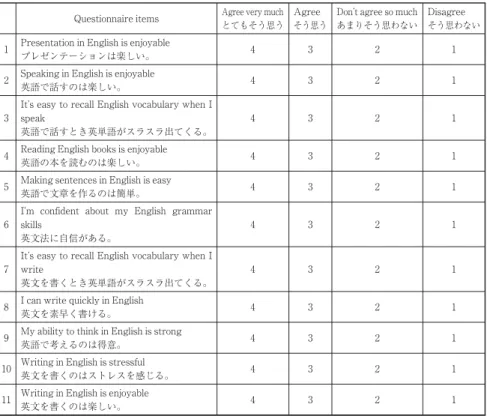
The focus of the current case study, on the other hand, was to look closely at how students perception changed. To conduct a comparative analysis, the survey needed to be implemented twice, during the first and the last class of both FYE 1A and 1B. The questionnaire tried to quantitatively assess to what extent the Quick Task was helpful towards reducing student stress and making English learning enjoyable. The questions were all followed by answers with a four-point scale in Japanese: とてもそう思う (I agree very much) for 4 , そう思う (I agree) for 3 , あま りそう思わない (I don t agree so much) for 2 and そう思わない (I disagree) for 1 . (see Appendix B) Answers with large numbers indicated the students high level of confidence and motivation, not to mention their strong aptitude for language learning.
As Table 1 shows, there are eleven questions that appear in the questionnaire. Seven of these eleven questions were borrowed from the work done by Hashimoto (2017) on quick write and four additional questions address issues related to speaking and reading. Comparing the
Table 1. QT questionnaire items and four scale points Questionnaire items Agree very much
とてもそう思う Agree そう思う
Don t agree so much あまりそう思わない
Disagree そう思わない 1 Presentation in English is enjoyable
プレゼンテーションは楽しい。 4 3 2 1
2 Speaking in English is enjoyable
英語で話すのは楽しい。 4 3 2 1
3
It s easy to recall English vocabulary when I speak
英語で話すとき英単語がスラスラ出てくる。
4 3 2 1
4 Reading English books is enjoyable
英語の本を読むのは楽しい。 4 3 2 1
5 Making sentences in English is easy
英語で文章を作るのは簡単。 4 3 2 1
6
I m confident about my English grammar skills
英文法に自信がある。
4 3 2 1
7
It s easy to recall English vocabulary when I write
英文を書くとき英単語がスラスラ出てくる。
4 3 2 1
8 I can write quickly in English
英文を素早く書ける。 4 3 2 1
9 My ability to think in English is strong
英語で考えるのは得意。 4 3 2 1
10 Writing in English is stressful
英文を書くのはストレスを感じる。 4 3 2 1
11 Writing in English is enjoyable
英文を書くのは楽しい。 4 3 2 1
average scores of pre- and post- surveys, Hashimoto claimed that quick task was effective in making writing more enjoyable for students while enabling students to think more quickly in English. He also insisted that through quick write, students gained a higher level of confidence in writing. This research attempts to verify his results and examine the effect QT has on speaking, not only writing. This study can help determine if QT is applicable in different educational contexts.
Subjects
The research subjects were students in the author s classes during the first semester of 2018, in FYE 1A and 1B. She taught 93 students in FYE 1 A and 104 students in FYE 1B. In total, 197 students attended her classes,
Table 2. Students levels of English
Majors FYE 1A Averages by dept. FYE 1B Averages by dept. Contemp. Culture 96.7 (L 51.0 R 45.7) 142.8 (L69.6 R73.2) Med.com/Lit.arts 98.3 (L 51.8 R 46.4) 136.5 (L65.4 R71.2) Child Development 96.4 (L 51.2 R 45.2) 135.9 (L67.4 R68.5) Psychology 99.5 (L 51.7 R 47.8) 137.4 (L66.9 R68.6) Note. L=Listening R=Reading
participated in QT and were asked to fill in the questionnaire. They are not English-majors. They re majoring in four different areas: Contemporary Culture, Media and Communication & Literary Arts, Early Childhood Development and Psychology. To help determine the students appropriate level of English and help stream them to one of 4-5 existing levels, all first-year students took a TOEIC bridge test in April (Hayashi, 2009). In what follows, the test results will be examined.
As can be seen in Table 2, there was a gap between FYE 1A and 1B classes. FYE 1A is the lowest proficiency group, while FYE 1B is the highest. According to the Common European Framework (CEFR), however, FYE 1A is in the A1 level and FYE 1B belongs to the A2 level. To use the CEFR terminology, both FYE 1A and 1B belong to the category of Basic Users, not Independent Users. Furthermore, A1 is categorized as Beginner level, while 1B belongs to the Elementary English level. Those differences don t seem clear. Baba (2016), however, argues that students who score 130 can be regarded as novice or slow learners.
Survey
FYE instructors usually teach 4 classes a day. Each class meets twice a week. In total, there are 22 classroom sessions (Hayashi, 2009). Each class did five QTs. After introducing QT during the first class, each task was scheduled every four sessions as a way of reviewing the materials grammar, vocabulary, textbook, etc. covered in class. In addition, the quick task was used at the beginning of every fifth class.
The questionnaire was distributed and collected during the first and the final session. Participants were asked to fill in the chart honestly. They were also asked to describe their thoughts and opinions, and to voice any requests about QT and classes in general. This study is largely based on these numeral data and comments.
Table 3. Some results from FYE 1A
Questionnaire items PRE POST Difference
Average STD Average STD
1 Presentation in English is enjoyable 2.20 0.78 2.66 0.85 0.46
2 Speaking in English is enjoyable 2.18 0.79 2.78 0.83 0.60
3 It s easy to recall English vocabulary when I speak 1.32 0.49 1.72 0.72 0.40
4 Reading English books is enjoyable 1.62 0.72 2.05 0.91 0.43
5 Making sentences in English is easy 1.29 0.50 1.71 0.84 0.42 6 I m confident about my English grammar skills 1.22 0.49 1.52 0.81 0.30 7 It s easy to recall English vocabulary when I write 1.23 0.52 1.67 0.83 0.44
8 I can write quickly in English 1.22 0.47 1.67 0.79 0.45
9 My ability to think in English is strong 1.25 0.49 1.68 0.72 0.43
10 Writing in English is stressful 2.48 0.86 2.22 0.87 -0.26
11 Writing in English is enjoyable 1.77 0.79 2.20 0.75 0.43
Table 4. Some results from FYE 1B
Questionnaire items PRE POST Difference
Average STD Average STD
1 Presentation in English is enjoyable 2.27 0.76 2.61 0.80 0.34
2 Speaking in English is enjoyable 2.61 0.80 2.92 0.78 0.31
3 It s easy to recall English vocabulary when I speak 1.63 0.56 1.93 0.61 0.30
4 Reading English books is enjoyable 2.28 0.82 2.52 0.95 0.24
5 Making sentences in English is easy 1.70 0.58 2.02 0.79 0.32 6 I m confident about my English grammar skills 1.52 0.63 1.83 0.74 0.31 7 It s easy to recall English vocabulary when I write 1.79 0.70 1.96 0.74 0.17
8 I can write quickly in English 1.65 0.63 2.04 0.76 0.39
9 My ability to think in English is strong 1.60 0.63 1.88 0.64 0.28
10 Writing in English is stressful 2.26 0.81 2.13 0.82 -0.13
11 Writing in English is enjoyable 2.35 0.8 2.64 0.82 0.29
Results
The results for each question and the students comments will be examined. Students voices are always a source of insights enabling teachers to gain an accurate and deeper understanding of their classrooms. Comparative Analysis of FYE1A and 1B
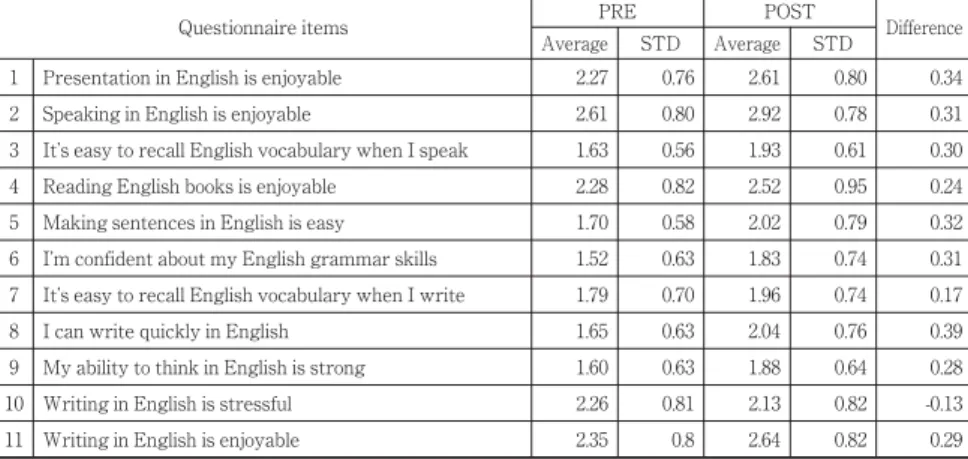
Table 3 and 4 summarize the results obtained from FYE 1A and FYE 1B. Students overall perceptions can be inferred from these tables.
According to Table 3, by comparing the average scores between the pre- and post- survey for FYE 1A, we learn that students in general acquired a more positive attitude towards learning English. Students found speaking, presenting, reading and writing more enjoyable. In addition, the study shows that students were able to recall vocabulary and write English sentences with more speed and ease. Moreover, they became more confident in grammar. And the results reveal that their ability to think in English improved. The results show that QT has multiple positive effects for the learning of English.
If we compare the results for Speaking in English is enjoyable (item No. 2), Reading English books is enjoyable (item No.4) and Writing in English is enjoyable (item No.11), item No.2 gained 0.6 points, while item No. 4 and No.11 gained 0.43 points. These results suggest that QT is most effective in the area of speaking. However, item No. 7 to No. 11 support Hashimoto s study which showed that QT was effective in making writing less stressful and more enjoyable for the students. This present study also shows that QT was instrumental in fostering interest in reading.
More importantly, this result suggests that students find reading more stressful than writing. They found speaking the most enjoyable, followed by writing, and many found reading the least enjoyable. This finding contradicts what other researchers have found: students find writing to be the most stressful and demanding in foreign language learning (Baba, 2015; Hashimoto, 2017; Shen, 2016; Ward, 2013). Results that are less biased and partial can be obtained if the questions on the questionnaire ask the same number of questions about reading, speaking, and writing.
The smallest gain (-0.24) was item 10, Writing in English is stressful. It can however be said that QT seems to be effective in making writing less stressful for students. The second smallest increase in points was item 6, I m confident about my English grammar skills. Students understanding of grammar is not assessed when they are engaging in QT. Thanks to that approach, however, some students commented that they were surprised when they realized they could write something in English.
Table 4 shows the results obtained from FYE 1B. The difference between the pre-course and post-course average scores for 1B is slightly smaller. This is particularly true for item 2, 7 and10: Speaking in English is enjoyable , It s easy to recall English vocabulary when I write and Writing in English is stressful . On the whole, the results show that the difference in average scores for 1A was twice as large when compared to 1B. This may
suggest that QT is more effective for slow learners in developing fluency in speaking and writing.
Participants Comments
The number of students narrative feedbacks obtained in this study was fewer than the previous study. For the pre-course questionnaire, 111 (FYE 1A n=49 & FYE 1B n=62) out of 185 participants (FYE 1A n=88 & FYE 1B n=97) filled in the final part of the questionnaire sheet which intended to collect participants thoughts about QT or class in general. For the post-course questionnaire sheet 90 (FYE 1A n=47 & FYE 1B n=43) out of 169 (FYE 1A n=80 & FYE 1B n=89) completed it. Only about half of the participants shared their thoughts and opinions. However, the comments from the post-course questionnaire were longer and more detailed than those found in the pre-course questionnaire.
Examining the words used to describe learning English in the pre-course survey, some similarities and differences emerged. Nearly 22% (n= 11) of the participants in FYE 1A and 25% (n=15) in FYE 1B were inclined to use negative words such as 苦手 (Incompetent) , 嫌い (Dislike) and 不安 (Worried) . It is interesting to note that learners enrolled in higher level classes showed more anxiety than the lower level students. Moreover, in the post-course survey, there were only 2 short negative comments in total, one from FYE 1A and the other from 1B. They described English as being
Too hard and Difficult . It can be argued that QT was able to modify the students negative preconception towards English learning.
Many participants from FYE 1A wrote that The group speech task enabled me to speak in English and that In comparison to secondary school, this university s FYE class not only enhanced my understanding of English but it also taught me the joy of learning English. More than 10 participants reported such changes in perception. In addition, 4 surprisingly asserted their ability to speak English, thereby conveying their confidence.
For the pre-course questionnaire, 6 participants from FYE 1A used the word Fun to convey their wish to enjoy learning English in conjunction with the word, 頑張る (I will do my best) . 24 wrote that they were going to do their best. In the post-course survey, only 10 stated that they would do their best when studying English in the future. However, 31 reported that they had fun studying English. It is difficult to sustain the level of motivation they initially had. However, about 66% (n=31) of the
participants experienced the joy of learning English.
Regarding the pre-course questionnaire results for FYE B1, only 2 participants used the word Fun but 22 wrote that they would do their best. Some comments suggested that they had foreign friends who they could contact in English by SNS. Participants wrote about using YouTube, watching CNN and movies, and listening to music in English. Nearly one third of the participants (n=30) also reported their use of smartphone apps to build their English vocabulary and for listening practice. Students from advanced classes seemed to be more comfortable and proactive in using a range of materials provided by advanced technology.
As for the use of the word Fun , in the post-course survey, 40% (n=35) of the participants used the word for describing their learning experience. Three participants also reported that they had no fluency practice before QT. Another three described their QT experience as valuable. A participant claimed that the instructor should employ this task in every class. Some wrote that it improved their ability to communicate, enhanced their motivation, and provided the opportunity to use more English. However, only 9 participants (13 less than the numbers obtained from the pre-course questionnaire) stated that they would do their best learning English in the future. One participant reported that QT enabled her to pose questions when communicating with her peers, and this helped her make friends in class. These comments suggest the students positive attitude towards QT.
Generally speaking, a study of the questionnaires reveals that the students gained confidence in writing and speaking, and reading to a lesser extent. Students, for the most part, enjoyed learning and experienced the positive use of English. And more importantly, the negative, stressful feelings they had towards writing, speaking, and (surprisingly) reading decreased.
Discussion
Ryan (2018) maintains that practitioner research can be highly motivating for teachers, and it can in principle engender teachers who are more engaged in, and content with, their work. Among the many questionnaire surveys the instructor received, one stands out for complementing the quality of instruction she experienced in class. She wrote the following in Japanese:
先生は一人ひとりの目を見て話してくれるので、聞く気持ちもすごく 高まったし、楽しく英語を学べました。(I enjoyed learning English and was really motivated attending classes, because you looked at every one of us while teaching.)
At the final classroom session, the student expressed her gratitude to the author, pointing out how motivated she was to learn, thanks to the instructional approach she adopted. This was a valuable comment made by a student, highlighting an essential element in English education, namely the importance of teacher-student communication for promoting learning among teachers and students. This is especially true of educational contexts in Japan, where fluency learning should focus more on the learner as a concrete human being, not disembodied automatons.
This survey also suggests that fluency training has multiple positive effects on language learning. No matter how much grammar and vocabulary students acquire, their knowledge will be useless if they lack the ability to use it for communicative purposes (Widdowson, 2018).
This survey also revealed that students commonly used their smartphone apps for translation, making it unnecessary to memorize the meaning of words. Many educational institutions are promoting the use of various technologies for classroom use and for testing. Currently, machines are being used to interview people to help determine their communicative ability. Facing this current situation, teachers and policy makers who are involved in language education need to find a more basic, realistic and sustainable path in EFL teaching, noticing what communication is for. We need communicative competence to connect with people.
Limitations and Implications
Like any case study, findings obtained from this research cannot be generalized, even within the specific context in which the project was conducted. This case study was carried out in a very specific context: A three month intensive English course for first-year university students at a women s university. During the first semester of 2018, the author taught twenty-two classes, each lasting for one hour.
Some broad implications, however, can be drawn from the collected data. Firstly, there is a need for more empirical research into how to teach fluency effectively. In FYE 1B, some participants viewed QT as an
exercise in fluency development and they for the most part found it useful. Fostering student engagement is paramount for better fluency training. Further studies need to examine the effects across proficiency levels and the impact QT has on students majoring in different subjects.
To collate more specific data, questionnaires that address factors other than their level and major must be administered. By knowing the students names/ numbers, the researcher can, among other things, identify who wrote the comments, keep track of their change in perception, ascertain how much they spoke and wrote when engaging in QT, and identify their test results. The general effectiveness of QT can be established in light of a more detailed understanding of the students.
There is an additional problem that emerges from comparative studies. In reality, there are students who stop attending class during the middle of the semester, while others leave or drop out of school. This makes it difficult to establish the effectiveness QT has on students, and the varying effects it has on different classes because the data from these absentee students cannot be obtained.
The final requirement concerns the items that appear on the questionnaires. This case study implied that QT had multiple effects on the four skills of language learning. However, the number of questions addressing each of these skills is different. For the assessment to be more fair and accurate, the number of questions allocated to each skill must be more balanced. By overcoming these problems and limitations, a more reliable and valid QT project becomes possible and will be the subject of future research.
Conclusion
This article described a case study based on a task to develop language fluency called Quick Task. The results indicated some promising effects. The study showed that QT helped change the students perception on learning English and increased their speed to think in English. Ryan (2018) says, Virtually no one does more than add a tiny incremental contribution to our field, but each drop raises our collective knowledge . Teachers should have a forward-looking approach to teaching. They should seek tasks that are promising, and continue expanding the possibilities and horizons of teaching through action research and trial and error. Data collection and student feedback are useful means for improving classroom
practice, encouraging teachers to move forward and face the reality of teaching in the class.
References Baba, C. (2015).
. Paper presented at The 13th Asia TEFL conference, Nanjing International Youth Culture Center, Nanjing, China.
Baba, C. (2016). Nihon
gakujutsu shinkou kai, kagaku kenkyu hi kiban kenkyuu (C) No.26370640, 2014-2016.
Council for Cultural Co-operation, Education Committee, Modern Languages Division, Strasbourg. (2001).
. Cambridge: Cambridge University Press. Hashimoto, S. (2017).
Paper presented at JACET 56th International Convention, Aoyama Gakuin University, Tokyo.
Hayashi, C. (2009). University students perspective on English learning. , 19, 69-79.
Hayashi, C. (2018). Quick Speech and Write as an effective pedagogical strategy for developing fluency.
, 6, 71-92.
Iwata,Y. & Shigemitsu, Y. (2017).
. Paper presented at JACET 56th International Convention, Aoyama university, Tokyo.
Ryan, J.(2018). 7 principles of practitioner research. , 27, 3, 4-5. Shen, D.(n.d.). . Ablconnect Harvard Web Publishing. Retrieved on August
10, 2016 from http://ablconnect.harvard.edu/quick-write.
Ward, T. (2013). Six ways to use Quick Writes to promote learning. On Course Workshops. http : / / oncourseworkshop. com / life-long-learning / six-ways-use-quick-writes-promote-learning/.
Widdowson, H. (2017). . On course workshops. At JACET
Q
Quick Task Questionnaire 2018
Dear FYE students,
Thank you very much for participating in my FYE class. I’ve been thinking of how I can better develop your linguistic skills. Here I am going to ask about your feelings toward English. Please feel free to write anything. I am very happy if you would share me your precious idea s and experiences especially on language learning and teaching. I will use your data only in my research paper for the journal of my university: The Centre for the Study of English Language Teaching JOURNAL. Thank you very much, in advance, for your kind cooperation!
1. Please let me know your background. Please circle one of the following items.ᑓᨷۑࢆࡅ࡚ࡃࡔࡉ࠸ࠋ Modern Culture / Media Communication & Literal Art / Child Development / Psychology
2. Have you ever done any presentations or speeches in English in your junior or senior high school? ୰Ꮫᰯࡢⱥㄒࡢᤵᴗ࡛ࠊⱥㄒ࡛ࣉࣞࢮࣥࢸ࣮ࢩࣙࣥࡸࢫࣆ࣮ࢳࢆ⾜࠸ࡲࡋࡓ㸽 Yes / No How about outside the class? ᤵᴗ௨እ࡛ࡣ⾜࠸ࡲࡋࡓ㸽 Yes / No
㧗ᰯࡢⱥㄒࡢᤵᴗ࡛ࠊⱥㄒ࡛ࡢࣉࣞࢮࣥࢸ࣮ࢩࣙࣥࡸࢫࣆ࣮ࢳࢆ⾜࠸ࡲࡋࡓ㸽 Yes/ No
ᤵᴗ௨እ࡛ࡣ⾜࠸ࡲࡋࡓ㸽 Yes / No
How about in Japanese?. ᪥ᮏㄒ࡛ࡣ⾜࠸ࡲࡋࡓ㸽 Yes/ No
If your answer is Yes. Tell me more. ࢇ࡞άື࡛ࡋࡓ㸽
௨ୗᑐࡍࡿពぢࠐࢆࡅ࡚ࡃࡔࡉ࠸ࠋ Questionnaire items
࡚ࡶࡑ࠺ᛮ࠺ ࡑ࠺ᛮ࠺ ࠶ࡲࡾࡑ࠺ᛮࢃ࡞࠸ ࡑ࠺ᛮࢃ࡞࠸
1 Presentation in English is enjoyable. ࣉࣞࢮࣥࢸ࣮ࢩࣙࣥࡣᴦࡋ࠸ࠋ
4 3 2 1
2 Speaking in English is enjoyable. ⱥㄒ࡛ヰࡍࡢࡣᴦࡋ࠸ࠋ
4 3 2 1
3 It’s easy to recall English vocabulary when I speak.ⱥㄒ࡛ヰࡍࡁⱥ༢ㄒࡀࢫࣛࢫࣛฟ࡚ࡃࡿࠋ
㸲 㸱 㸰 㸯
㸲 Reading English books is enjoyable. ⱥㄒࡢᮏࢆㄞࡴࡢࡣᴦࡋ࠸ࠋ
4 3 2 1
㸳 Making sentences in English is easy. ⱥㄒ࡛ᩥ❶ࢆసࡿࡢࡣ⡆༢ࠋ
㸲 㸱 㸰 㸯
㸴 I’m confident about my English grammar skills. ⱥᩥἲ⮬ಙࡀ࠶ࡿࠋ
㸲 㸱 㸰 㸯
㸵 It’s easy to recall English vocabulary when I write.ⱥᩥࢆ᭩ࡃࡁⱥ༢ㄒࡀࢫࣛࢫࣛฟ࡚ࡃࡿࠋ
㸲 㸱 㸰 㸯
㸶 I can write quickly in English. ⱥᩥࢆ⣲᪩ࡃ᭩ࡅࡿࠋ
㸲 㸱 㸰 㸯
9 My ability to think in English is strong. ⱥㄒ࡛⪃࠼ࡿࡢࡣᚓពࠋ
㸲 㸱 㸰 㸯
1 㸮
Write in English is stressful. ⱥᩥࢆ᭩ࡃࡢࡣࢫࢺࣞࢫࢆឤࡌࡿࠋ
㸲 㸱 㸰 㸯
11 Write in English is enjoyable. ⱥᩥࢆ᭩ࡃࡢࡣᴦࡋ࠸ࠋ
㸲 㸱 㸰 㸯
1. Please let me know your thoughts concerning the textbook we are using.ⱥㄒࢸ࢟ࢫࢺࡢ༳㇟ࢆ㑅ࢇ࡛ࡃࡔࡉ ࠸ࠋ
Great / enjoyable /fine / hard / too hard / boring / other ______________
⣲ᬕࡽࡋ࠸ ᴦࡋ࠸ 㞴ࡋ࠸ 㞴ࡋࡍࡂࡿ ㏥ᒅ ࡑࡢ㹝㹝㹝㹝㹝㹝㹝㹝㹝
Why do you feel so? Tell me more.࠺ࡋ࡚ࡑ࠺ឤࡌࡲࡍ㸽ලయⓗ࡞⌮⏤ࢆᩍ࠼࡚ࡃࡔࡉ࠸ࠋ
2. What kind of English do you want to acquire? ࢇ࡞ⱥㄒࢆ㌟╔ࡅࡓ࠸࡛ࡍ㸽 British English/American English/International English/My English/ ____________________
Please explain more. Why do you think so? ࠺ࡋ࡚ࡑ࠺ᛮ࠺ࡢ࡛ࡍ㸽
3. What do you usually do to better you English ability? Please write as much as possible about what you do to learn and use English in your daily life.
ⱥㄒຊࢆ㌟╔ࡅࡿⅭ᪥ࠎఱྲྀࡾ⤌ࢇ࡛࠸ࡿࡇࡀ࠶ࡾࡲࡍ㸽 Yes / No
If your answer is Yes, tell me more. Yesࡢேࡣࠊࡶࡗヲࡋࡃᩍ࠼࡚ࡃࡔࡉ࠸ࠋ 6㸬Have you ever use your mobile phone (smart phone) and / or computer for learning English?
ⱥㄒᏛ⩦ࡢⅭࢫ࣐࣍ࡸࣃࢯࢥࣥࢆࡗࡓࡇࡀ࠶ࡾࡲࡍ㸽 Yes / No
If you’re Yes, tell me more. Yesࡢேࡣࠊࡶࡗヲࡋࡃᩍ࠼࡚ࡃࡔࡉ࠸ࠋ
7㸬Please write any comment or request to better this FYE classroom.ఱពぢࡸせᮃࠊ࣓ࢵࢭ࣮ࢪࢆ㸟