Tech Bull Fac Agr Kagawa Univ , Vol 41, No 1, 89-95, 1989
PURIFICATION AND SOME PROPERTIES
OF A NOVEL
,8
-MANNOSIDASE PRODUCED
BY A BACTERIUM ISOLATED FROM SOIL
Kaoru
TAKEGAWA,
Fuminobu OSAKA, Takayuki JIKIBARA
and
Shojiro IWAHARA
A gram positive bacterium isolated from soil was found to produce
8
-mannosidase that act on 0-,4 - D-mannopyranosyl-(1-2)-D-mannose in a cell-free extract The enzyme was partially purified from the cell-free extract to remove other glycosidase activities The opimum pH and temperature for the activity to ,4 -mannosidase was pH 6 5, and 40'C , respectively The enzyme was completely inhibited by Cu2+ and Hg2+, and strongly inhibited by the addition of mannose T h e enzyme almost completely hydrolyzed 0 - 8 - D-mannopyranoslyl-(1-2)-D-mannose to mannose, but did not act on p-nitrophenyl-8
-D-mannoside or 0 - ,4 -Introduction
8-Mannosidase (EC 3 2 125) has been purified from various sources such a s snail(",hen ovid~ct'~),mush- room'34', pinapple'5',Aspergtllus n~ger'~", and also from the liver of Turbo co~nutus'~' Because of its strict substrate specificity ,4 - mannosidase is used a s an indispensable tool for studies on glycoprotein structure
8
- Mannosidic linkage is known to occur in plant mannans"' and plant gums"0' In general, the mannose of mannose-containing polysaccharides in plants has the configuration of
8
-1,4-linkage Man ,4 1-4GlcNAc8
1-4GlcNAc-Asn is also a common sequence in the core region of asparagine-linked oligosaccharides of various glycoproteinsRecently, we obtained a disaccharides from the polysaccharides of Fusartum s p M7-1 by digestion with a bacterium enzyme preparation and identified it a s 0 - ,4 -D-mannopyranosyl-(1-2)-D-mannose (abbreviated
90 Tech Bull Fac Agr Kagawa Univ, Vol 41, No 1, 1989
as Man
P
1-2Man)"" This is the first report to our knowledge on the isolation of Man ,Q 1 + 2 Man andthere have been no reports of the substrate specificity of
P
-Mannosidases for ManP 1 + 2 Man This paper describes the uniqueP
-mannosidase from a gram positive bacterium isolated from soilMaterials and Methods
Mtcroorgantsms and culttvatzon The bacterium strain FO 1-2A was used throughout this investigation The bacterium was isolated from a soil sample in Osaka city by an enrichment culture method using Man j3 1 + 2 Man a s the sole carbon source The maintenance medium contained 0 5% peptone, 0 5%
yeast extract, 0 5% NaCl and 2% agar (pH 7 0) The bacterium was transferred from a slant culture to 5 ml of the medium in a test tube, and the seed culture was incubated at 28"C, for 22 hr, with shaking Each culture was then transferred to a 500 ml shakeflask containing 150 ml of the medium and cultivation was carried out at 28°C on a reciprocal shaker
Preparatton of the cell-free eztract Bacterial cells were washed two times with 10 mM potassium phosphate buffer (pH 7 O), resuspended in the same buffer and then disrupted with an ultrasonic oscillator (Nihon Seiki Co 15KHz, 15min) T h e supernatant obtained by centrifugation was dialyzed against 10 mM potassium phosphate buffter (pH 7 0) and used a s the crude enzyme preparation
Parttal purtftcatzon of
P
-mannostdase from F O 1-2A Stazn Unless otherwise specified, all operations concerning enzyme purification were carried out at about 5°CStep 1 Ammontum sulfate fracttonatton T o the dialyzed crude extract, solid ammonium sulfate was added to 30% saturatuon After stirring for 30 min, the mixture was centrifuged To the supernatant, solid ammonium sulfate was added to 50% saturation The mixture was stirred for 30 min and then centrifuged The resulting precipitate was dissolved in a minimal volume of 10 mM postssium phosphate buffer containing 1 mM 2-mercaptoethanol, pH 7 0, and dialyzed against the same buffer for 12 hr
Step 2, 1st DEAE-Toyopearl 650M column chromatography The dialyzed solution was applied to a DEAE-Toyopearl 650M column (3 0x40cm)previously equilibrated with 10 mM potassium phosphate buffer containing 1 mM 2-mercaptoethanol, pH 7 0 After the column was washed with the same buffer, it was eluted with a linear gradient of 0 to 0 5 M NaCl in the same buffer The active fractions were pooled and then precipitated by ammonium sulfate
Step 3 2nd DEAE-Toyopearl 650M column chromatography T h e concentrated enzyme was applied to a second DEAE-Toyopearl column (1 5x30~111) previously equilibrated with 10 mM phosphate buffer containing 2-mercaptoethanol After the column was washed with the same buffer, it was eluted a linear gradient of 0 to 0 3 M NaCl in the above buffer T h e most active fractions were pooled
Preparatton of M a n B 1+2Man M a n P l-tPMan was isolated from a polysaccharide of Furartum s p M7-1 by the previously described method"" 0 - ,4 -D-Mannopyranosyl-(l+2)-D-mannitol (Man
B
l+2Man-01) was prepared by the NaBHa reduction of ManP
1+2ManMatertals Yeast mannan and gum guar were obtained from Sigma Chemicals Co p-Nitrophenyl derivatives of sugars were also purchased from Seikagaku Kogyo Co All other chemicals used were of the
Kaoru TAKEGAWA et al : Purification of P-mannosidase 91
highest grade commercially available
Enzyme assay The reaction mixture was composed of 600 nmol of M a n P 1+2Man, 30 p mol of
potassium phosphate buffer (pH 7 0) and the enzyme solution in a total volume of 100 p I After incubation for an appropriate time, fifty microliters of the reaction mixture were analyzed by HPLC and the levels of Man /3 1+2Man and mannose were determined One unit is defined as the amount of enzyme that degrades 1 ,u mol of Man
/3
I +2Man per min at 37 "C under the assay conditions p-Nitrophenyl-glycoside hydrolyzing activity was assayed with the appropriate p-nitrophenyl glycosides Levels of p-nitrophenol released were determined from abosorbance at 400 nm (molar extinction coefficient, 17,700) One unit of enzyme activity was defined as the amount which released 1 p mol of p-nitrophenol per minAnalyttcal methods HPLC for saccharide analysis was carried out with a Hitachi model L6000
chromatograph equipped with a Shodex RI SE-31 For the separation of mannobiose and mannose, a column of Shim-Pack ION S-802 (eluted with deionized water at a flow rate of 1 ml per min at 6O'C)was employed Protein was determined by the method of Lowry et a1 with crystalline egg albumin as the standard(12' The protein content, by column charomatography, was determined by measuring the absorbance at 280 nm
Results
Culture condtttons for the productton of /3-mannostdare from FO I-2A stratn A soil microorganism which
was capable of growing on
Maria
1+2Man was isolated by enrichment culture techniques T h e /3 -mannosidase-producing bacterium F O 1-2A was gram-positive and did not form spores Analysis of culture filtrates and harvested cells, which had been disrupted by sonication, showed that all /3 -mannosidase activity was intracellularT h e effect of various carbon sources on the p~oduction of P-mannosidase is shown in Table 1 All the carbon sources repressed the formation of P-mannosidase
Stabtltzatton o f
P
-mannostdase T h e /3 -mannosidase from F O 1-2A was very unstable and in a 50 mMpotassium phosphate buffer (pH 7 0 ) at 5C for 24 hr, the enzyme lost more than 90% of its original activity Therefore, we examined ways to stabilized the enzyme activity with the addition of various chemicals to the solution The addition of 1 mM 2-mercaptoethanol temporarily stabilized the enzyme, but 3 days later, the enzyme activity had decreased to below 30% of that at the start (Fig 1) Moreover, when
Table 1 Partial Purfication of P-1,2-Mannosidase from FO 1-2A
Total 'I otal Specific Yield PNP* Protein activity activity B -Man Step (mg) (munits) (munits/mg) (%) (munits) Cell-Free Extract 13.590 232
Ammonium sulfate 2,560 155 (30 - 50% Satn )
1st DEAE-Toyopearl 360 110 2nd DEAE-'Toyopearl 33 46
Tech Bull Fac Agr Kagawa Univ , Vol 41, No 1, 1989
Storage period (hr)
Fig 1 Effect of 2-Mercaptoethanol and Nz Substitution on
P
-Mannosidase Stability2 -Mercaptoethanol was added to FO 1 -2A cell-free extracts, then the air in the test tubes was substituted with
Nz
gasSamples were preserved at 5°C and the remaining activities were assayed at intervals @, none;
0,
addition of 2-mercaptoethanol;0,
addition of 2-mercaptoethanol andNz
substitutedsubstitution with Nt gas was employed, the crude enzyme solution was stable for 3 days in 50 mM potassium phosphate buffer, pH 7 0 ,containing 1 mM 2-mercaptoethanol (Fig 1)
Properttes o f P-Mannoszdase The overall purification and yield of 8-Mannosidase are summarized in Table
2 Throughout the procedure, an 80-fold purification was attained with a recovery of about 20% from the cell-free extract The partially purified P-mannosidase was practically free from all o t h e ~ glycosidase tested (p-nitrophenyl- a -or -
P
-D-glucopyranoside, - a -or-P
-D-galactopyranoside, - a -or-8
-L-fucopyranoside, - a -or-8
-D-mannopyranoside, - -D-xylopyranoside, -
8
-D-glucuronoside, and - 2-actamide- 2-deoxy -8
-D-glucopyranoside as substrates)Effects o f pH and temperature on enzyme acttvtty and stabzltty The optimum pH of the enzyme was
Table 2 Effects of Various Carbon Sources on Enzyme Production
Additon to Medium Conc (%) Emzyme activity(%)
None 100 Glucose 0 . 5 34 Yeast mannan 0 . 1 30 Gum guar 0.. 1 22 Mannose 0 . 3 12 Konjak mannan 0.. 1 12
FO 1-2A was grown on medium containing 0 5% peptone, 0 5% Yeast extract, 0 5% NaC1, and a carbon source at the concentration indicated After culturing for 1 day, the cells were harvested and
B
Kaoru TAKEGAWA et a1 : Purification of
P
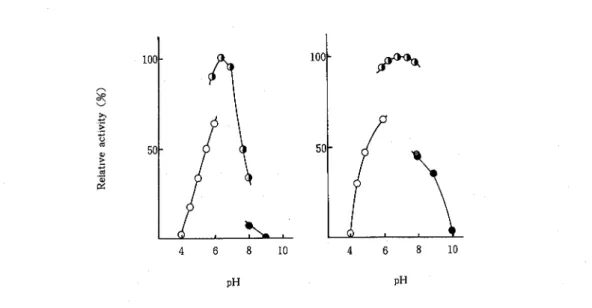
-mannosidaseFig 2 Effects of pH on the Activity and Stability of t h e 1 -Mannosidase from FO 1-2A
( a ) Effect of pH on the activity The enzyme was assayed in 100 mM buffers of various pHs under standard conditions
( b ) T h e enzyme was pretreated in 50 mM buffers of various pHs at 5T. for 24 hr,
then the remaining activity was assayed at pH 7 0 Buffers used:
0,
sodium acetate-acetic acid;0,
potassium phosphate;
a,
glycine-NaOHTable 3 Effects of Various Chemicals on Enzyme Activity
Compound Conc (%) Emzyme
(mM> Activity(%) None 100 MgSO4 1 74 MnS04 1 88 ZnS04 1 66
c0so4
1 82 HgClz 1 0 c u s o z 1 0 EDTA 1 47 Glucose 10 100 Galactose 10 82 N-acetylglucosamine 10 100 N-acetylgalactosamine 10 110 Chitobiose 10 100 Mannose 10 24 Yeast mannan 15 mg/ml 100The enzyme was preincubated at 37Cfor 10 min in 30 mM potassium phosphate buffer (pH 7 0 ) with various compounds and the residual activity was assayed under standard conditions
94 Tech Bull Fac Agr Kagawa Univ , Vol 41, No 1, 1989
found to be 6 0 to 7 0 T h e enzyme was stable in the pH range of 6 0-8 0 when kept at 5°C for 24 hr (Fig 2) The enzyme showed the highest activity at 40°C under the standard assay conditions Its thermal stability was examined by heating it at various temperatures for 10 min, at pH 7 0 The enzyme was found to be stable up to 40C
Effects o f vartous compounds on the enzyme acttvtty The effects of various metal ions and sugars on the
enzyme activity were examined by incubating the enzyme with the compounds at 37" and then directly assaying the activity (Table 3) T h e enzyme was completely inactivated by treatments with HgZ+ and Cu2+ And the enzyme activity was greatly inhibited by the addition of mannose Other sugars such as glucose, galactose, N-acetylglucosamine, N-acetylgalactosamine, and yeast mannan did not inhibit the enzyme activity when used in concentrations of 10 mM
Substrate spectftctty T h e rate of hydrolysis with respect to the
Maria
1-+2Man concentration wasexamined T h e apparent Michaelis-Menten constant of the enzyme, calculated from a Lineweaver-Burk plot, was 12 8 mM for Man
P
l-+2ManThe activities of the enzyme were investigated with Man ,8 1-2Man and Man
P
1-+2Man-ol About 4 ,U mol of Man /3 I-tZMan and M a n b 1-+2Man-ol was incubated at 37°C with 8 munits of the enzyme in 10 mM potassium phosphate buffer, pH 7 0, containing 1 mM 2-mercaptoethanol (total volume, 5 0 0 , ~ 1) ManP
l-+2Man was hydrolyzed almost completely by the enzyme within the 12 hr incubation In contrast, ManB
-+2Man-ol was not hydrolyzedDiscussion
Gorin and his co-workers ~eported a methanol-assimilating yeast, Ptchta pastorts, and were able to elaborate on a mannan containing both a-1,2 and 8-1,2 linkages in the branching moieties'l3' They also had a similar main-chain as demonstrated by proton magnetic resonance spectra studies
""
We obtained the M a n b 1-2Man from acidic polysaccharides of Fusartum sp M7-l"')Moreover, all the
Fusartum strains that we examned produced similar acidic polysaccharides containing M a n b 1-+2Man
"4'Therefore, P-1,2-linked mannose-containing polysaccharides may be widely distributed among yeasts and molds
We examined the action of commercial ,B -mannosidase preparations (Achattna fultca and Turbo
cornutus )on Man ,8 l-t2Man Although they could act on Man
P
1-+2Man, the hydrolysis rates were very slow (manuscript in preparation)P
-Mannosidases from Achattna fultca, Turbo cornutus and Aspergtllusntger appeared to be specific for the mannosyl P-1,4 linkages For example, the hydrolysis rate of three
P
-mannosyl-N-acetylglucosamine by Aspertgtllus nzger
B
-mannosidase is in the following order, Dl-4)) ,81-+6)P1-+3To search for a better source of /3 -1,2 specific mannosidase, we used an enrichmment culture technique in which culture were grown on M a n P 1-2Man as a sole carbon source All the soil microorganisms which were capable of growing on ManB 1-2Man, showed that the ,8 -mannosidase activities were within the cells (data not shown)
Kaoru TAKEGAWA et a1 : Purification of ,8 -mannosidase 95
Because of its unstability, we could not purify the enzyme of F O 1-2A to homogeneity But the partially purified /3 -mannosidase was free all other glycosidases tested We compared the enzynatic properties of the P-mannosidase with those of the other 8-mannosidases The
P
-mannosidases from other sources showed strong activities on p-nitrophenyl- ,Q -D-mannopyanoside, while theP
-mannosidase from F O 1-2A did not T h e ,B -mannosidase from other sources had the highest activities at acidic pH values However, the optimum pH for the FO 1-2A enzyme was around 7 0 T h eP
-mannosidase from F O 1-2A was considerably inhibited by the addition of mannose, not by the addition of other monosaccharides Bouquelet reported that theP
-mannosidase activity of Aspergtllus nzger was decreased to half of the original by the addition of 20 mM mannose to the reaction mixture'"T h e 8-mannosidase from F O 1-2A did not hydrolyze M a n P 142Man-ol In addition, this enzyme could not produce mannose from Fusartum sp M7-1 polysaccharide containing M a n P 1+2Man (data not shown) Therefore, this enzyme has strict aglycon specificities and seems to be hightly specific for M a n P 1-2Man Further studies on the substrate specificity of the new /3 -1,2 specific mannosidase from F O 1-2A are currently being investigated
References SUGAHARA, K , T OKUMURA and I YAMAS- ~ ~ N ~ , B t o c h t m Btophys Ac ta,268,488(1972) SUKENO, T , A L TARENTINO, T H PLUMMER and F MALEY, Methods Enzymol,28, 7 7 7 (1972)
WAN,C C , J E MULDREY, S -C LI and Y
-T LI, J Btol Chem ,251,4384(1976) S O N E , ~ and a MISAKI, J Btochem,83,1135 (1978)
LI, Y -T and Y -C LEE, J Btol Chem , 247,3677 (1972)
BOUQUELET, S , C SPIK and
J
MONTREUIL, Btochtm Btophys Ac ta, 522,521(1978) ELBEIN, A D , S ADYA and Y C L E E J Btol Chem , 252,2026(1977)MURAMAISU,T and F EGAMI, J Btochem , 62,700(1967)
WHISTLER, R L and E L RICHARDS. The
Carbohydrates Chemistry and Biochemistry, 2nd e d , vol IIA and IIB, p447, Academic Press (1970)
(10) ASPINALL, G 0 , R BEGBIE and J E MAC-
KAY, J Chem Soc , 1962,214
(11) IWAHARA, S and T TANAKA, Agrtc Btol Chem , 52, 9 (1988)
(12) LOWRY ,O H , N
J
ROSEBROUGH, A L FARR and R J RANDALL, J Bzol Chem , 193,265(1951)(13) GORIN, P A J , J F T SPENCER and S S BHAI TACHRJEE, Can J Chem ,47, 1 4 9 9 (1969)
(14) IWAHARA, S , T JIKIHARA, M NAKOSHI and
K TAKEGAWA , Ntppon Nogetkagaku
Katsht, 62,604, (1988)